
Quick Answer
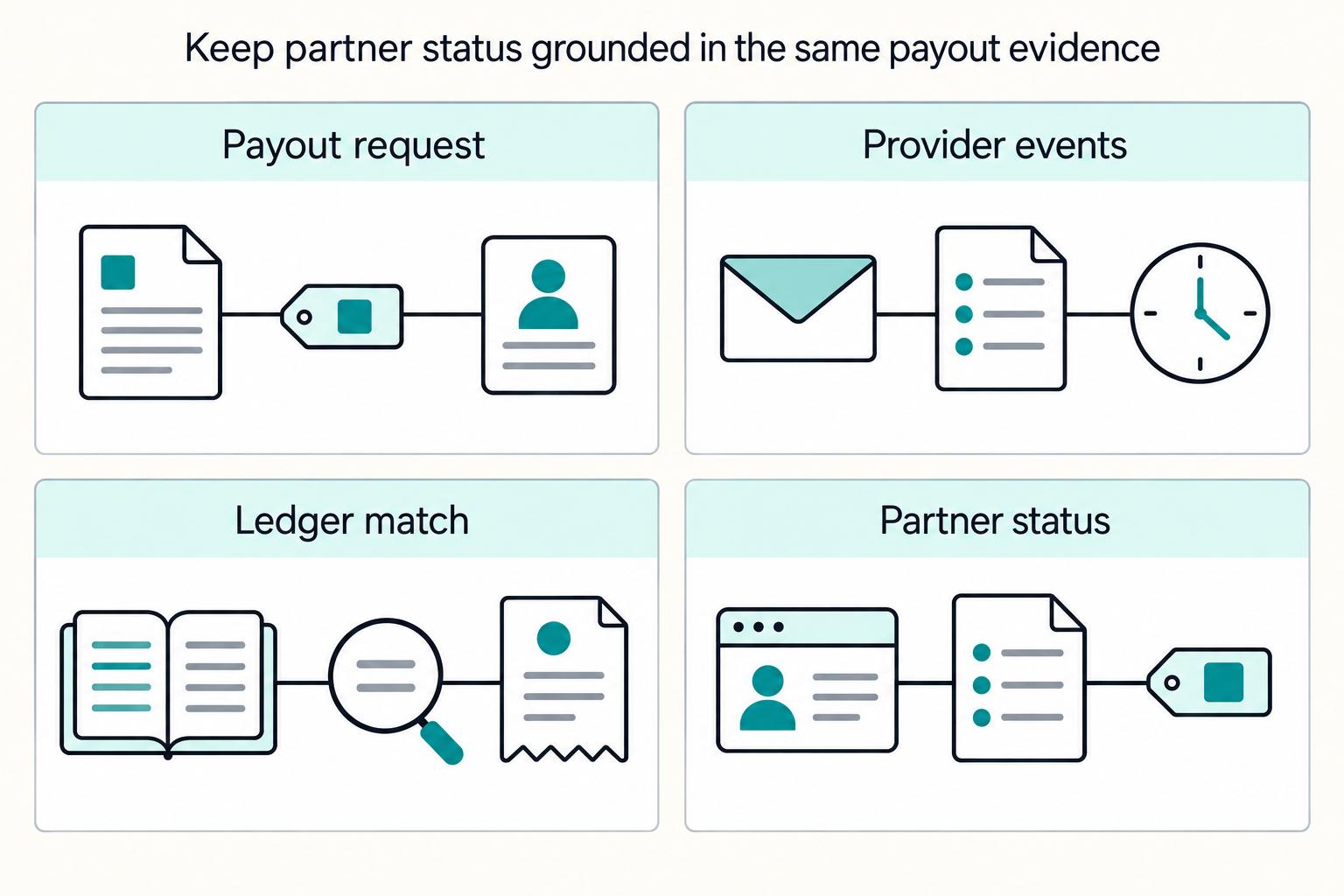
Make partner onboarding requirements, payout states and exception actions clear, then measure changes in the same cohort. Before the live pilot, implement durable payout identity, safe provider-scoped retries, authenticated event storage, recoverable processing and cash reconciliation. A pending state needs reliable operational evidence, while a completed payment needs the proof appropriate to its product and account ownership.
Why payment experience decides partner ecosystem growth#
Payment experience is a growth lever, not just an operations layer. It shapes partner trust, retention, expansion, and margin. This guide is for founders, revenue leaders, product teams, and finance operators who need execution choices tied to measurable results, not generic payout advice.
Start by getting the scope right. A partner network is a network of businesses that go to market with you for shared audiences, and payment experience is broader than transaction processing. In practice, it covers the full money journey partners go through, from onboarding and verification to payout visibility, exception handling, and issue resolution. If you operate a marketplace model, Marketplace Economy 101 for Platform Business Models is a useful companion framing.
Before approving a payment change, state the expected effect: fewer setup stalls, clearer payout status or less support rework. Measure that effect in the affected partner cohort rather than assuming that faster payment causes growth.
Define success across cost per active partner, onboarding completion, payout outcomes and partner feedback. NPS measures reported willingness to recommend; it is a supporting signal, not proof that a payment change caused retention or revenue growth.
Keep risk in the same decision sequence as growth. In payment systems, operational risk is loss risk from failed processes, people, systems, or external events. A faster experience change can still be the wrong choice if it raises failures or rework. Use this order: define partner friction, state the expected retention or expansion effect, tie it to your unit-economics definition, check NPS implications, and test the operational-risk tradeoff before rollout.
Define the payment experience you are actually managing#
Define payment experience before you rank friction or buy tooling, or you will optimize the wrong layer. If your team treats it as only "money sent," you will miss the journey points that shape partner outcomes day to day.
-
Set the boundary beyond transaction execution. Payment execution is only part of the job. Include Partner Onboarding, Compliance Reviews, payout visibility, and issue resolution in your operating definition, because partner payment experience goes beyond paying on time. If your journey map ends at "payout initiated," extend it to onboarding completion requirements, review holds, status updates, and dispute or action paths before network deadlines.
-
Name the network model you are serving. A Creator Economy flow is different from AdTech, an online marketplace, or a Sharing Economy platform. Creators need clear monetization paths, ad tech sits in the publisher-advertiser chain, marketplaces manage third-party seller flows and risk, and sharing-economy usage is common even though the term does not have one settled definition. If you span models, document which model drives onboarding, compliance, and payout rules first, because requirements vary by business model, transaction type, and country.
-
Use one definition across Product, Finance Ops, and Engineering. These teams will optimize different targets unless the definition is explicit. Decide whether onboarding data is collected up front or incrementally, define compliance-review trigger points, and publish the partner-visible payout status states. Then have each team map the same start and end points. If one starts at signup and another at first payout, your definition is still fragmented, and that fragmentation leads to delays, manual handoffs, and reporting gaps.
Gather the operating baseline before you change anything#
Before you redesign anything, lock a current-state baseline that Revenue, Finance, and Product all trust. Otherwise, you will optimize against anecdotes and internal noise.
Step 1 Create one baseline artifact with four measures#
Create one baseline artifact with four measures in one place: NPS, onboarding drop-off, payout failure rate, and reconciliation lag. Keep it strict: metric name, exact definition, source system, refresh date, and owner. For the onboarding side of that baseline, Contractor Onboarding Best Practices to Reduce Drop-Off gives a practical measurement lens.
For Net Promoter Score, use the standard 0 to 10 response scale, with 9 or 10 as promoters and 0 to 6 as detractors. For onboarding drop-off, define each funnel step explicitly so you can see where conversion actually declines. The goal is a baseline you can track regularly, not a one-time snapshot.
Step 2 Collect root-cause evidence before decisions start#
Collect root-cause evidence before decisions start. At minimum, pull:
- API execution logs showing request and response activity, plus errors or execution traces
- Webhook delivery status with per-event outcomes such as Delivered, Pending, and Failed, plus prior HTTP status codes where available
- Reconciliation reports that match fees to payment statuses and capture lifecycle changes and modifications
Then run a practical check. Take one recent failed payout and trace it from the API call, through webhook delivery attempts, into reconciliation. If that trace is slow or incomplete, your baseline is not ready. If that evidence chain is still fuzzy, Account Reconciliation for Payment Platforms shows the handoff finance will need.
Do not treat raw failed webhook counts as final failure. Stripe retries undelivered events for up to 3 days, and Stripe's Events API history goes back up to 30 days.
Step 3 Assign decision owners before tradeoffs show up#
Assign decision owners before tradeoffs show up. If Revenue owns growth targets, Finance owns controls, and Product owns roadmap sequencing, document that split instead of leaving it implied.
This matters when metrics conflict. If onboarding drop-off is high while reconciliation lag is rising, decide in advance who chooses what moves first and who signs off on the risk.
Map the end-to-end partner money journey#
Map the real path from signup to first confirmed payout. Each state needs timestamped operational evidence. For a nonfinancial or pending state, record that no posting is required yet or settlement evidence is not yet available; do not invent a bank match for onboarding or an unknown instruction.
Step 1 Trace the real path from signup to first payout#
Start with one real partner and rebuild the journey from production records, not internal process docs. In a Connect-style flow, that usually means: create the connected account, complete onboarding requirements, capture or receive funds, route funds to the connected account, let funds accumulate in that balance, then initiate payout.
Use a simple map, but make ownership, timestamps, partner-visible status, and proof explicit.
| Stage | What actually happens | Partner-visible state | Verification checkpoint |
|---|---|---|---|
| Partner Onboarding | Account is created and onboarding requirements are completed | "Setup in progress" or equivalent | Account creation record and onboarding completion state |
| Funding | Customer payment or platform funding event is created | "Payment received" only when internally confirmed | Provider payment-status event and internal transaction ID |
| Payment Routing | Platform charges, then transfers funds to the connected account if you use separate charges and transfers | Often invisible unless exposed | Transfer record linked to the original payment |
| Settlement and payout | Funds accumulate in the connected account balance and payout is initiated, then paid or failed | "Payout pending," "Paid," or "Action needed" | Payout lifecycle webhook events and the reconciliation report |
The output should be one row per stage with owner, source of truth, and incident-ready evidence.
Step 2 Mark the handoffs that break trust#
Trust usually breaks at handoffs, not at a single API call. Mark four patterns first: unclear status, duplicate requests, manual data re-entry, and delayed exception handling.
A partner who sees only “pending” may request another payment. Distinguish waiting for review, ready to submit, submitted with outcome unknown, confirmed processing and completed. Keep the same durable payout instruction while investigating an unknown result; a provider’s limited idempotency-key retention is not a licence to create a replacement payment.
Step 3 Attach diagnosable checkpoints with Webhook and Reconciliation evidence#
At each handoff, define the status evidence and any financial effect. Onboarding may need an account requirement record and no posting; submitted-unknown needs the durable instruction and investigation; confirmed movement needs provider/accounting evidence. Identify whose bank is being matched: a platform debit, seller-account movement and beneficiary credit are different observations.
For payouts, map provider events into documented states for that account and product. A failed event can identify an action, while a paid status is provider evidence rather than independent proof of beneficiary bank credit. Connect the payment, transfer, fees and bank movement through references; do not require all objects to share one ID.
Show partners only states supported by current evidence, with the next action and update time. Pending status can be accurate before financial settlement is available. Completed status needs the evidence specified for that product and must not be inferred from a delivery acknowledgment.
Rank payment friction by economic impact, not by loudest complaint#
Once you can trace each handoff, prioritize friction by economic impact, operating cost, and risk exposure. Ticket volume can help, but it should stay a secondary signal.
Step 1 Build a weighted table from real loss points#
Start with one row per friction point in the partner money journey, and score each one the same way every time: revenue impact, cost-to-serve, risk exposure, and implementation effort. That keeps prioritization tied to benefits, total cost of ownership, and risk instead of headline upside alone.
| Friction point | Revenue impact | Cost-to-serve | Risk exposure | Implementation effort | What to verify first |
|---|---|---|---|---|---|
| Repeated onboarding data requests before first payout | High | Medium | Medium | Medium | Funnel drop-off by step, duplicate submissions, and time to completion |
| Missing payout failure reason or next step in the partner UI | Medium | High | Medium | Low | Tickets per failed payout, retry volume, and failure-reason coverage |
| Bank-account or payout-rail mismatch for a corridor | High in affected markets | High | High | High | Failure rate by country or currency, rail eligibility, and manual interventions |
| Manual review queue blocking payout release | Medium | High | High | Medium | Queue age, hold duration, release rate, and escalation outcomes |
Use evidence, not memory: onboarding logs, payout event history, reconciliation records, and support reasons.
Step 2 Apply a dual-hit rule for priority#
Use this as a working rule, not a universal law: if one friction point hurts activation and payout success in the same journey segment, move it ahead of cosmetic UX fixes unless effort or risk is clearly disproportionate.
Validate that by cohort. Link partner IDs across onboarding completion, first funding, first payout attempt, and payout outcome. If the same cohort has higher drop-off and higher payout failure in one segment, treat it as one compounding defect, not two separate team problems.
Step 3 Separate quick wins from structural fixes with Unit Economics and NPS#
Split the backlog into quick operational improvements and structural changes. Compare cost per active partner and contribution margin by cohort, with NPS as supporting feedback. A generic LTV-to-CAC ratio does not decide whether a payout defect deserves repair.
Quick wins are usually status and exception-handling improvements that reduce support load quickly. Structural fixes, like rail selection or cross-border payout logic changes, take longer but can reshape partner trust and repeat usage. Read NPS movement alongside payout success, time to first payout, and support demand before you expand a fix.
Step 4 Add rail and corridor caveats before approving spend#
Do not model impact as universal. Coverage varies by market and program, especially for Account-to-Account Payments and cross-border payouts.
US instant rails support fast domestic settlement at participating institutions, but bank reach, account eligibility and your provider’s sending capability must all match the corridor. SEPA Instant is a euro credit-transfer rail. Neither domestic rail label establishes the time or cost of an onward cross-border payout; obtain an end-to-end quote and test the actual beneficiary route.
Decide what to build and what to buy for the payments layer#
Make the ownership call with a practical default: if compliance updates and payout exceptions are already slowing execution, buy the core rails and keep only strategic differentiators in-house. Use the infrastructure view in Global Payment Processing Platforms: Complete Infrastructure Guide to pressure-test the build-vs-buy assumptions.
Step 1 Score the real ownership cost#
Run a Build-vs-Buy Analysis on four axes: control, time-to-market, compliance burden, and ongoing maintenance risk. Teams often overweight feature control and undercount post-launch operational load.
In practice, the hard part is the ongoing work: compliance reviews, partner-data maintenance, exception handling, and coverage changes across rails and geographies. If exception queues are already backlogged, assume a fully in-house core will add pressure before it reduces it. That is usually a sign you should compare against Guide to Bulk Payment Processing Platforms rather than a feature wishlist.
Use one gating check before approving build: assign a clear owner for ongoing rule and operations changes, not just initial delivery. If ownership is unclear, treat that as a staffing gap, not a technical plan.
PCI is a useful pressure test. PCI DSS v4.x introduced 64 new requirements, with 51 future-dated requirements effective 31 March 2025. The planning signal is simple: compliance moves continuously, so your estimate should too.
Step 2 Compare options at the interface, not the pitch deck#
Compare vendor and in-house options on the operating surfaces your teams use every day.
| Criterion | Buy signal | Build signal | What to verify before deciding |
|---|---|---|---|
| API quality | Clear docs, consistent object model, retry guidance, and idempotency support | You need custom request semantics or a custom domain model | Confirm duplicate-prevention behavior. Stripe documents idempotency keys up to 255 characters and notes keys may be pruned after at least 24 hours. |
| Webhook reliability | Event delivery is observable and replayable | You need custom event design across internal services | Confirm outage behavior. Stripe documents automatic retries for up to 3 days and event retrieval for the last 30 days in the cited guide. |
| Payment routing flexibility | Multi-provider or multi-rail routing is configurable | Routing logic is a core differentiator by corridor, cost, or success rate | Confirm routing by market, use case, and failure condition. |
| Reconciliation depth | References, statuses, and exports support finance review | You need ledger-level control or custom matching logic | Review sample outputs for a failed payout, retry, and reversal before deciding. |
Step 3 Stress-test the choice against common ecosystem models#
Before you decide, check the choice against the actual network bottleneck.
A managed payout service may reduce operational sprawl; a bank or data-connectivity provider may cover a different part of the journey. Compare actual supported activities, account ownership, exception handling and contractual responsibilities. A merchant-of-record product for sales does not automatically take over contractor-engagement obligations.
The interagency third-party risk guidance applies to banks; a platform can use its planning, diligence, contracting, monitoring and exit structure as an operating reference without claiming every bank obligation applies directly to it. Assign responsibilities with the regulated provider instead of treating outsourcing as a transfer of all accountability.
Step 4 Define your exit before you commit#
Set exit and migration constraints before signature, not during incident response.
Cover three areas: data portability, operational continuity, and rollback. Confirm the exact exports and event history needed for reconciliation and exception workflows, and define how dual-run and revert would work during migration.
If you cannot name migration constraints up front, treat lock-in as an explicit tradeoff rather than an accidental one.
Redesign onboarding and compliance gates without killing conversion#
The right balance is simple to state and hard to execute: keep signup light, but make payout eligibility explicit. Use staged Partner Onboarding with risk-based depth. Collect what is needed for the next milestone, then require the rest before payout or higher-risk activity.
Step 1 Stage the data request by milestone#
Collect information against the next permitted capability, using the provider’s requirements and applicable rules. Progressive onboarding can delay optional fields, but it cannot postpone verification required before charging, funding or enabling payouts. Explain each outstanding item and the activity it prevents.
- Collect basic contact details at signup.
- Identify the next requested capability and its mandatory identity, entity, tax or other requirements.
- Resolve the checks required before enabling that capability, including charging, funding or payouts where applicable.
- Refresh records when provider or regulatory requirements change.
Track requirements.currently_due and requirements.current_deadline on the relevant capability or account. They show what is outstanding and when required information must be submitted and verified. Surface both internally and to partners to reduce avoidable support escalations and surprise disables.
Step 2 Apply progressive verification by risk#
Risk-based reviews can vary in depth within the applicable regime and provider program. They cannot waive mandatory identity, ownership or sanctions requirements. Record the applicable requirement, the reviewer and the resolved outcome before enabling the affected capability.
When risk signals rise in a specific route, program, or segment, tighten checks there first instead of slowing all partner cohorts. For escalations, keep an evidence trail: failed field, requested document, submission timestamp, and next decision point. If deeper verification is needed, additional documentation can include a valid government-issued ID scan.
Step 3 Publish status states and response windows#
Make status explicit so delays feel managed, not arbitrary. Expose partner-facing states tied to real verification and payout progress, and include payout lifecycle states such as processing, posted, failed, returned, and canceled. On the partner-facing side, What Is Supplier Portal Contractor Self-Service Payment Status? is a good design reference.
Define internal response targets for review and exception queues. Give the partner the next action and an update time, distinguishing an estimate from a guaranteed arrival date. Return timing depends on the route and failure reason; avoid a universal two-to-three-day promise.
Step 4 Monitor requirement changes and close the loop quickly#
This model only works if you monitor it continuously. Use webhooks for verification and payout status changes, especially account.updated, and route updates to both operator queues and partner notifications.
Verify that new requirements move from currently_due to resolved and that partner-facing status updates with them. If required information becomes past due without action, capability can be disabled, which turns early conversion gains into downstream trust loss.
Implement the execution layer for reliability at scale#
Execution reliability starts with one rule: treat the API call as the start of a payout attempt, not final settlement. From day one, retries, Webhook handling, and Payment Routing all need to be traceable.
Step 1 Standardize idempotency keys before adding retries#
Before dispatch, persist a durable payout instruction, amount, currency, beneficiary version and provider key. After a timeout, keep its outcome unknown and query the provider or correlate events. Replay the same payload only within the provider’s safe retry rules; when key retention expires, investigate the original before any new submission.
Provider constraints differ, so define one internal standard around them. Stripe returns the same result for repeated requests with the same key, including 500 responses. Stripe keys can be up to 255 characters and may be pruned after 24 hours. Adyen supports safe retry after no response when the same idempotency header is reused, with a maximum key length of 64 characters. If you want one format across Stripe and Adyen, keep it at 64 characters or less.
Release check: force a timeout in test, resend the exact same request with the exact same key, and verify one logical payout attempt.
Step 2 Persist authenticated events before acknowledging them#
Webhooks are authenticated inputs to a payout state model. Deduplicate using the provider’s event identity, apply allowed transitions and object versions or sequence data where supplied, and retrieve authoritative object status when events conflict. A late message must not turn a confirmed completed payment back into pending.
Verify the webhook signature and durably commit the message before acknowledging delivery. Process it asynchronously. Commit each local status/accounting effect with its processed marker in one database transaction, and persist downstream intents in that transaction. Dispatch external actions after commit; correlate their responses and reconcile unknown outcomes because a local transaction cannot make a remote provider write atomic. Receipt is not the same as completed processing.
Verification check: after a simulated endpoint outage, confirm you can recover events, update the original payout record, and show which messages arrived, failed, and were reprocessed.
Step 3 Design routing fallback with full path visibility#
Fallback routing only helps if the whole decision path stays auditable. Keep one parent payout record and attach each routing decision, processor response, and failure reason so Finance can reconcile and Support can explain outcomes.
A checkout payment-routing feature does not establish outbound payout failover. For payouts, switch providers or rails only after confirming the original was never sent, definitively failed without movement, or returned and reconciled. Keep the original instruction, attempt references, approved replacement and cash allocation linked. Unknown or merely slow processing remains an investigation state.
Step 4 Define acceptance checks for continuity, not just happy paths#
Do not release this layer on single-path success. Release only when failure and recovery paths are clear end to end.
Before rollout, confirm:
- A timed-out payout request can be retried with the same idempotency key without creating a second logical attempt.
- Webhook redelivery updates the original payout record, not a parallel status trail.
- Failed webhook events expose a usable reason and timestamp for operators.
- Routing fallback preserves a complete audit trail from initial request to final outcome.
If any check fails, fix it before launch. The core risk is not only duplicate payouts or delayed updates, but erosion of partner trust in platform status.
Make reconciliation and auditability visible to operators and partners#
Build reconciliation alongside retry and event handling, before the first live payout pilot. Finance needs a tested match between obligations, provider movements, fees and bank evidence from the start. Faster status screens do not compensate for an unexplained cash balance.
Step 1 Build a daily exception view and assign one owner#
Run reconciliation daily, not at month end. Adyen's platform reporting explicitly supports daily payout reconciliation and daily report generation, so teams can work from current data.
Your exception view should quickly show what paid out, what is unmatched, and who owns the next action. A practical structure is separate queues for unmatched payouts, amount mismatches, and missing status updates. Without a named daily owner, exceptions become backlog instead of control.
Verification point: each day, sample one completed payout and confirm you can trace it to the transactions it settles.
Step 2 Stitch provider references, ledger entries, and status into one chain#
Keep the durable instruction, provider attempts, event IDs, local processing state, accounting references where an effect exists, and product-appropriate report or bank evidence when available. Explicitly record pending evidence or no-posting states. Operators should be able to explain an open item without pretending it has already settled.
Use reporting matched to the payout product. Stripe’s payout reconciliation report is designed for automatic payouts; manual or instant payout integrations need the applicable balance and transaction data instead. Persist those references and match external bank evidence separately. A report marked reconciled is not proof of every beneficiary receipt.
A common failure mode is split truth: payout status in the product database, transaction detail in provider reports, and bank matches in separate finance files. That creates parallel records, and Support usually sees the weakest one.
Step 3 Mirror internal truth in the partner-facing timeline#
Partner-facing status should reflect the same underlying event chain operators use. Partners do not need every internal event, but they do need clear, accurate checkpoints tied to real state changes.
Partners should see the amount, currency, last confirmed state, expected timing and next action. They should not need to open several tickets to discover that a document is missing or an operator is investigating a transfer.
Verification point: when internal state changes from a webhook event, confirm the partner view updates the original payout record instead of creating a conflicting second history.
Step 4 Add explicit asynchronous controls for BaaS and A2A flows#
In Banking-as-a-Service (BaaS) and Account-to-Account Payments flows, asynchronous state changes are normal, so you need explicit event controls. A2A payments move funds directly between bank accounts, and state can change after the initial API response. If your event model is still coarse, review Real-Time Ledger vs Batch Settlement Architecture for Platform Volume before widening the lane.
Subscribe to relevant events, store them durably, and process them idempotently. Event-driven payment guidance treats persistent storage and idempotent processing as core integrity controls, and webhook APIs are a common way platform ecosystems expose those events.
Keep the original instruction, provider key and references, received-event record, processing status and partner timeline. Add ledger effects, product-appropriate report rows and bank evidence when they exist; record why they are not yet available otherwise. A missing settlement record can be the reason for an investigation, not a reason to hide the pending state.
Avoid the failure patterns that break partner trust#
Partner trust usually breaks from repeated operational surprises, not a single failed payout. The pattern to avoid is straightforward: payout promises that outpace compliance readiness, API releases without reliable webhook handling, and incident recovery that resumes expansion before reconciliation is closed.
Step 1 Monitor Compliance Reviews before you promise faster payouts#
Do not promise payout speed your verification path cannot support. If you manage connected accounts, monitor requirement status updates continuously and handle changes quickly, rather than treating verification as a one-time onboarding task.
Use a daily check of accounts with requirements.currently_due. When that field is not empty, outstanding requirements can restrict capabilities, and payouts or charges may not be enabled if required verification or capabilities are missing. The red flag is a product state that says "ready for payout" while compliance requirements are still unresolved.
Step 2 Ship every API change with Webhook monitoring attached#
An API integration is not production-ready until its Webhook Endpoint is monitored. Event delivery runs over HTTP requests, and temporary processing failures can trigger repeated retries, including automatic redelivery for up to three days.
After each release, trigger a real or test event and confirm it is received, stored durably, and applied to the original payout record. A common break pattern is an initial API call succeeding while the follow-up event remains undelivered or stuck in retries, leaving partners with no visible status movement.
Step 3 Contain incidents and close Reconciliation before expanding#
When incidents happen, contain first. Pause noncritical changes, identify whether the break is in verification, event delivery, or settlement matching, and publish status updates on a defined cadence. A practical benchmark is every 30 minutes, or another cadence appropriate to severity, which also helps reduce repeat support load. For routing-response design, Gateway Routing for Platforms is the right adjacent playbook.
Before resuming affected payouts, account for each impacted instruction: unsent, unknown, processing, completed, failed or returned. Match provider cash movements, fees and bank entries, with named exceptions for missing evidence. Use the correct reporting window and time zone; avoid declaring closure from a single paid webhook or an arbitrary calendar-day sample.
Conclusion and your next 90 days#
Use the quarter to ship controlled, measurable improvements, not a broad rewrite. Start only after you can show where partners stall, how state changes are recorded, and who owns each decision.
Step 1 Capture the baseline in Week 1-2#
Create one current-state artifact that combines baseline metrics, the full partner journey, and the ownership model. Name each stage from signup to first successful payout, mark manual-review points, and assign one decision owner each from Product, Finance, and Revenue.
Your readiness check is simple: from this document alone, a teammate should be able to answer where partners drop out, which event confirms each state transition, and who can approve control changes.
Step 2 Approve the top three fixes in Week 3-4#
Approve an economic prioritization table with only three friction fixes for this cycle. Score issues on commercial impact, cost to serve, risk exposure, and implementation effort, and prioritize fixes that improve both activation and first successful payout in the same journey segment.
Set a strict approval bar. Each selected fix needs a defined cohort, expected operational change, and clear success and failure evidence for post-launch review.
Step 3 Ship execution changes with hard verification gates in Week 5-8#
Before the first live pilot, verify required onboarding gates, durable instruction and retry behavior, authenticated durable event receipt, cash reconciliation, exception ownership and partner messaging. Start with one eligible cohort and expand only after its cash and status records agree.
In the integration’s test environment, exercise timeout, duplicate event, stale status and crashes before and after the processing commit. Verify that local state, postings and processed marker commit together, pending downstream intents resume, and unknown remote effects are reconciled before retrying.
Step 4 Review reconciliation and incident operations in Week 9–10#
Reconciliation and incident controls must already operate before the live pilot. In weeks nine and ten, review exception age, ownership and resolution quality using the reporting path for the actual payout product. Improve the dashboard without delaying the underlying control.
Run this daily, with dashboards that show payout reference, settlement batch, exception age, current owner, and escalation path.
Step 5 Review outcomes and decide the next tranche in Week 11-12#
Do not decide the next investment tranche until you have a post-launch read on Unit Economics, partner retention signals, and NPS trend by segment. Track NPS regularly using the zero-to-ten recommend scale, including promoter, 9 or 10, and detractor, 0 to 6, movement across cohorts or geographies.
Review contribution margin and cost to serve by partner cohort, alongside retention and payout outcomes. Confirm country, product and program coverage before expanding, and keep the legal/accounting ownership model explicit.
Frequently Asked Questions
What parts of payment experience matter most beyond payout speed?
Beyond speed, the biggest levers are onboarding friction, compliance clarity, and clear payment status. In practice, partners are more likely to churn on uncertainty and repeated process friction than on a known wait time. Prioritize the step where partners stall between submitting details and becoming payout-ready.
How does better payment experience improve partner retention and ecosystem growth?
Clear setup requirements and payout status can reduce avoidable partner frustration. Test retention and support outcomes in the affected cohort, using unchanged comparison cohorts where practical; a vendor survey is not a universal forecast for your platform.
How should we prioritize payment UX fixes when engineering capacity is limited?
Prioritize a friction point with observed onboarding loss, repeated failed payout attempts or high support cost in the same cohort. Compare the expected improvement with implementation effort and control risk. Checkout abandonment statistics do not directly quantify partner payout losses.
When should a platform automate partner onboarding and payout operations?
Automate when manual reviews, batch files, or spreadsheet checks begin delaying onboarding or payment-state updates. The urgency rises as you move toward instant payments, where traditional batch-based processing is no longer practical. If daily operations require constant human queue monitoring to keep status current, automation is overdue.
What tradeoffs should we expect between faster payouts and stronger risk controls?
Faster payout models increase control pressure because instant payments settle quickly and are irrevocable. As payout speed increases, fraud, liquidity, compliance, and third-party risk controls need to strengthen in parallel. Expand access in controlled cohorts instead of relaxing checks across the board.
Which metrics best show that payment friction is hurting monetization?
Track onboarding completion, time to the first confirmed payout, open overdue payouts, failures by reason and support contacts per payout. Pair these with cohort retention and partner feedback. NPS movement alone does not show monetization causality.
How do we decide between building payment capabilities and buying infrastructure?
Compare the control you need with the engineering and operational work you can sustain. Determine which entity performs regulated activities and which obligations you retain under law and contract. Bank CDD rules do not automatically apply to every platform. For card-data flows, establish actual PCI scope and the appropriate validation method with your acquirer.
Researched and edited by the Gruv editorial team. Gruv builds cross-border billing, payouts, and finance-operations software for global businesses.
Sources
Includes 3 external sources outside the trusted-domain allowlist.
- docs.stripe.com/webhookstrusted
- docs.stripe.com/api/idempotent_requeststrusted
- fdic.gov/news/financial-institution-letters/2023/fil2...trusted
- blog.pcisecuritystandards.org/now-is-the-time-for-organizations-to-adopt-t...external
- docs.adyen.com/development-resources/webhooks/handle-webhoo...external
- docs.adyen.com/development-resources/api-idempotencyexternal
Educational content only. Not legal, tax, or financial advice.
Related Posts

The Freelance Payment Penalty: A Modeled Audit of Platform Fees, FX Spreads, and Payout Delays
The money rarely disappears through a single, easy-to-spot fee. The real loss is stacked. A marketplace takes its commission, a processor adds a charge for international cards, a bank or payment company converts the currency at a spread, a platform holds the funds before release, and a wire sheds a little to intermediaries on the way in. Each layer looks defensible on its own, but the worker feels the combined result as a smaller deposit and a later payday.

How to Respond to a Subpoena for Business Records
Move fast, but do not produce records on instinct. If you need to **respond to a subpoena for business records**, your immediate job is to control deadlines, preserve records, and make any later production defensible.

A US Expat's Guide to Investing in UCITS ETFs to Avoid PFIC Issues
The real problem is a two-system conflict. U.S. tax treatment can punish the wrong fund choice, while local product-access constraints can block the funds you want to buy in the first place. For **us expat ucits etfs**, the practical question is not "Which product is best?" It is "What can I access, report, and keep doing every year without guessing?" Use this four-part filter before any trade: