
Quick Answer
Start by picking the simplest model your team can operate end to end, then expand only after controls hold in pilot. Use the four-path comparison (full-stack, modular MoR plus VBA, multi-rail, hybrid) to assign ownership for verification, FX, and disbursements by corridor. Keep production gated until finance and engineering can trace one movement from API request to provider reference, ledger entry, and reconciliation export. Block release when tax status is incomplete, including W-8/W-9 and VAT validation records.
How to Choose Global Payment Infrastructure for Your Platform#
Global payment processing for platforms is an infrastructure decision, not just a checkout decision. Once you collect in one market, convert currency, and pay out in another, you are managing cost, speed, access, transparency, compliance, and settlement at the same time. The Financial Stability Board frames international payments around four persistent frictions: high costs, low speed, limited access, and insufficient transparency.
This guide treats that reality as an architecture choice. A workable setup has to process payments across borders, convert currencies, support local payment methods where relevant, and handle security and local regulatory compliance. In many platform operations, compliance, FX, and settlement are handled programmatically rather than through manual ops, so your architecture directly shapes finance and engineering load.
If you own product, finance, or engineering for a marketplace, contractor platform, creator product, or embedded-payments flow, this guide uses four practical paths:
- Full-stack payment systems: one primary vendor covers more of collection, FX, compliance, and payouts. Key differentiator: often less integration surface early, but more dependence on one provider's country, program, and payout coverage.
- Modular components: you combine specialist components across the stack. Key differentiator: more control by function, with more internal coordination across ledgers, events, and exceptions.
- Multi-rail payments: you route transactions and payouts across providers or rails by corridor. Key differentiator: more routing flexibility, with higher monitoring, reconciliation, and failure-handling complexity.
- Hybrid in-house core with regional partners: you own the core ledger, risk, and approvals while using regional partners for market execution. Key differentiator: more strategic control, with higher governance and staffing burden.
Treat cross-border scope as technical and regulatory from day one. BIS describes three connected themes: payment interoperability and extension, legal and supervisory frameworks, and cross-border data exchange and message standards. The G20 roadmap is organized into 19 building blocks, which is a useful check against any "single API solves it" framing.
A practical early task is to define corridor design and ownership before vendor demos. For each corridor, document the collection method, source currency, FX owner, settlement currency, payout method, AML decision owner, and which provider references flow into your ledger and reconciliation exports. If you cannot trace that path from request to ledger posting before pilot, explainability risk is higher when a transaction fails or is held.
Compliance and coverage should be treated as market-dependent, not assumed. FATF Recommendations provide a common AML/CFT framework, but implementation and supervision are jurisdiction-specific. Capabilities differ across platforms, and payout availability can vary by industry and country of operation, so confirm your exact collection and payout corridors in writing.
Use the rest of this guide as a decision sequence, not a promise of universal coverage. The goal is better judgment under real constraints. Choose the right level of complexity for your team, keep reconciliation explainable, and avoid discovering at go-live that your market, payout route, or compliance model does not fit your business. For the full breakdown, read Continuous KYC Monitoring for Payment Platforms Beyond One-Time Checks.
Who this list is for and how to choose#
This list is for products that move money between multiple parties, not just through a single merchant checkout. It can fit contractor platforms, creator products, marketplaces, and embedded-payments flows where you collect, verify, and pay out across borders.
The dividing line is operational control. If you need to onboard recipients, run KYC checks, review customer due diligence details, including beneficial owners where applicable, and run payouts in batches, you are in platform territory. If you do not, avoid adding cross-border complexity too early.
Score each option on five criteria#
Use these five criteria to narrow the field before you compare pricing or product polish.
| Criterion | What to confirm | Why it matters |
|---|---|---|
| Cross-border coverage | Supported countries, currencies, and payout routes for your use case | Cost, speed, access, and transparency should be judged on exact corridors |
| Compliance depth | Who collects data, who verifies it, and what evidence is required before payouts proceed | Labels do not mean the same thing everywhere |
| Payout operations | Support for payout batches and a sample payout reconciliation batch or equivalent export | Confirms your team can run day-to-day exception handling |
| Reconciliation burden | How many report families finance must combine to close the month | This is ongoing operating cost, not a minor setup detail |
| Implementation and ownership load | Whether the path gets you live in weeks instead of quarters or requires more UI and data-collection work | Determines go-live speed and internal ownership load |
- Cross-border coverage
Score the exact collection and payout corridors you need, not a broad marketing footprint. Get written confirmation of supported countries, currencies, and payout routes for your use case. Judge cost, speed, access, and transparency on those corridors, since those remain the core pain points.
- Compliance depth (KYC and due diligence in practice)
Check what the provider verifies before processing payments and before paying out funds. Do not assume labels mean the same thing everywhere. Focus on who collects data, who verifies it, and what evidence is required before payouts proceed.
- Payout operations
Confirm support for payout batches and day-to-day exception handling your team can run. A useful checkpoint is a sample payout reconciliation batch, or equivalent export, that ties transactions to each payout settlement batch.
- Reconciliation burden
Ask how many report families finance must combine to close the month. If teams must stitch together multiple account and balance-platform reports, treat that as ongoing operating cost, not a minor setup detail.
- Implementation and ownership load
Full-stack platform products may get you live in "weeks instead of quarters." Modular paths can give more control, but API-only onboarding also means owning more UI and data-collection work.
If your priority is a faster go-live, start with a full-stack setup. If you need more control over onboarding and payout flows, start modular and accept more implementation ownership. Red flag: if a provider cannot show how payout status maps to verification and reconciliation exports, do not move past pilot.
If you want a deeper dive, read Payments Infrastructure for Creator Platforms: A Complete Build vs. Buy Guide.
Quick comparison table for architecture choices#
Use this table to eliminate options quickly. Prioritize compliance ownership and reconciliation clarity before headline pricing. If you cannot name who collects verification data, who verifies it, who can hold funds, and how a failed payout appears in exports, do not move past pilot.
| Option | Best for | Time to launch | KYC/KYB/AML ownership | FX control | Payout batches support | Reconciliation complexity | Vendor concentration risk |
|---|---|---|---|---|---|---|---|
| Full-stack payment systems | Teams that want one primary vendor and lower integration overhead | Can be shorter in some cases, but verify by corridor and scope | More vendor-assisted, but not fully outsourced by default; contract terms still decide responsibilities | Limited by provider capabilities and program terms | Provider-dependent; timing and behavior vary by provider and program | Lower than multi-provider setups because reporting is more unified | Highest, because one provider can become a critical single point of failure |
| Modular stack with MoR + VBAs | Platforms that want controlled expansion by function | Usually slower than a single-vendor setup; depends on integration scope | Split ownership. A MoR is the legal seller and can take payment and tax liabilities, while other checks can remain with you or payout partners | Medium to high, depending on how components are combined | Depends on the payout provider; not inherent to VBAs alone | Medium to high because finance must tie together MoR, account, and payout records | Medium, because risk is spread but multiple vendors become operational dependencies |
| Multi-rail payments orchestrator | Larger platforms that need routing, retries, and provider failover | Can be slower; access and integration detail are often not public | Split across destination processors and your orchestration layer; liability can remain with each processor | Medium to high if you manage routing and conversion choices | Variable. Strong for payment routing, but payout support is not universal | High, since teams reconcile across multiple providers and formats | Lower processor concentration, but added dependence on the orchestration layer |
| Hybrid in-house core plus regional providers | Mature teams that need strong control over ledger, risk, and regional payout choices | Scope- and market-dependent; often a longer path | Mostly yours, with regional partners handling specific regulated functions by market and contract | Can be high if treasury and routing logic are built in-house | Can be strong when built or contracted region by region | High at first, though internal references can be designed to improve clarity over time | Lower single-vendor concentration, but partner dependencies remain |
| Decision rule | If compliance ownership is unclear, stop after pilot regardless of pricing | N/A | Must be explicit before production | N/A | Must be traceable from onboarding status to payout outcome | Must be explainable in export artifacts | Treat unclear ownership as material risk, not contract detail |
How to read the table#
The tradeoff is straightforward: the more control you want over routing, FX, and payout logic, the more operational ownership your team takes on. Full-stack setups can reduce integration burden and reconciliation overhead, but they also concentrate risk in one provider relationship.
The modular path can balance control and delegation. A Merchant of Record is the legal seller and can take payment and tax-related liabilities, while virtual bank account identifiers can help collect and identify incoming funds. The tradeoff is more boundaries and more records to reconcile across systems.
Multi-rail orchestration improves resilience by routing across providers and retrying failed transactions with configured rules. It does not automatically centralize liability or fee terms, which can remain tied to each destination processor.
Operator checks before you choose#
Ask each shortlisted vendor to walk you through one failed payout end to end: verification status, provider reference, payout or return code, and the exact export where finance sees it. If traceability is missing at the artifact level, treat that as operating risk.
For payout batches, require specifics: file format, maximum item count, retry behavior, return handling, and replay safety for failed items. A public benchmark exists: Wise states up to 1,000 payments in one CSV/XLSX batch.
Check first-payout timing in real pilot conditions. Stripe notes initial payouts can take 7 to 14 days after the first successful payment in some cases, which is a practical reminder that payout timing is not uniform.
What public docs often understate#
Public docs are often thin on three decision drivers: pricing model detail, regional depth, and integration effort. Public pricing is not always directly comparable because non-core products may be priced separately, regional requirements differ by country, and orchestration access or integration details can require direct vendor engagement.
Treat this table as a shortlisting tool. The right architecture is the one your team can operate, explain, and reconcile when payouts fail. With that frame in place, the sections below show where each option fits and where it usually breaks.
For a step-by-step walkthrough, see Global Treasury Management for Platforms Across 50+ Countries.
Option 1 full-stack payment systems with one primary vendor#
Choose this when time to launch and operational simplicity matter more than rail-level customization. A setup with one primary vendor can reduce integration and reconciliation overhead by keeping acceptance, risk, and payouts in one system instead of stitching together multiple providers.
- Best for: Teams that need to launch quickly with lower integration overhead.
- Pros: Faster path to production, often fewer vendor contracts, more unified operations.
- Cons: Less flexibility on custom routing and higher concentration risk.
- Concrete fit: An early-stage creator platform that needs international payment capabilities before it has deep internal payments operations.
- Decision rule: Pick this option when speed and operating simplicity matter more than deep control of rails and routing.
Adyen frames this model as one platform to accept, process, and settle payments, with key payment methods added through a single integration. PayPal makes a similar point: fragmented global stacks increase complexity and cost, while a unified stack centers acceptance, risk, and payouts.
Speed is often a major reason teams choose this path. Stripe Connect positions platforms to go live in weeks instead of quarters. Stripe's me&u case reports deployment in under three months, with a stated goal of shipping in weeks, not months. That does not guarantee the same result for every platform, but it is consistent with the core benefit of a smaller integration surface.
The tradeoff is flexibility and concentration. If you already need multi-provider failover, corridor-specific routing, or deeper rail-level control, this model can become restrictive sooner. Concentration risk is also real: the Bank of England has warned that concentration of critical services in one third-party provider can create resilience risk. Before signing, test the boundaries in your real corridors and entity setup:
- Scope check: Confirm what "single integration" includes across acceptance, risk, and payouts, including contract and export scope.
- Failure traceability check: Walk one failed payout end to end and verify status, reference IDs, failure codes, and finance exports.
- Coverage check: Validate corridor-level availability, since headline method breadth does not mean uniform coverage across countries, entities, and recipient types.
We covered this in detail in SOC 2 for Payment Platforms: What Your Enterprise Clients Will Ask For.
Option 2 modular stack with Merchant of Record and Virtual Bank Accounts#
Choose this when you need controlled expansion by function, not one vendor doing everything. Use a Merchant of Record (MoR) where legal sale ownership and transaction responsibility are the hard part. Then add Virtual Bank Accounts (VBAs) where bank-transfer intake and attribution need a separate lane.
The upside is optionality and clearer domain boundaries. The cost is higher orchestration: more interfaces, more ledger touchpoints, and tighter coordination across engineering, finance, and operations.
Why teams choose this model#
This model can fit when collection and money-movement capabilities are maturing at different speeds. One phased path is to start with MoR for customer collection, then add VBAs as inbound transfer volume grows, then roll out payout batches corridor by corridor.
That phased path is often the appeal. Decomposing payment processing into distinct capabilities can improve modularity and flexibility, but component replacement is still a real implementation project.
What MoR actually buys you#
MoR is the entity with legal responsibility for the transaction, and that entity depends on configuration. In platform setups, the MoR can be the platform or connected accounts.
Scope matters because MoR responsibilities can include sales tax handling, PCI compliance, refunds, and chargebacks. Card-network MoR rules are enforced, and violations can carry significant fines.
Before launch, get a written, flow-by-flow answer to this question: which entity is the MoR, and who owns refunds, chargebacks, tax handling, and customer-facing obligations for each transaction type?
What VBAs actually are#
VBAs are sub-ledger accounts linked to a physical demand deposit account, not independent cash-holding accounts. Their operational value is in the unique identifiers that help attribute inbound transfers to a customer or legal entity.
That can make intake design cleaner, but footprint is provider-specific. For example, one provider describes virtual account management as live across 12 locations and available in 30+ currencies, so corridor and currency coverage still needs validation.
Do not treat a VBA identifier as full end-to-end traceability. It helps identify where funds came in, but you still need designed links across requests, provider references, internal ledger postings, and downstream payout records.
How the phased rollout usually looks#
| Module | What it handles first | Why it helps | What to watch |
|---|---|---|---|
| Merchant of Record (MoR) | Customer collection and transaction responsibility | Defines legal transaction responsibility, including tax, PCI, refunds, and chargebacks based on setup | Misstating which entity is MoR per flow |
| Virtual Bank Accounts (VBAs) | Bank-transfer intake and payer/entity attribution | Uses unique identifiers to improve inbound tracking | Treating VBAs as independent stored-value accounts |
| Payout batches | Corridor-specific outbound disbursement | Expands payout operations in stages | Corridor coverage, return handling, and exception ownership |
The checkpoint before production scale#
Do not scale this model until every module emits traceable events from request to ledger posting. For MoR, prove transaction ownership and the event that triggered the ledger entry. For VBAs, tie the unique identifier to the inbound transfer and internal balance movement. For payout batches, ensure deterministic references for creation, status changes, returns, and final ledger impact.
Use provider identifiers across reports, APIs, and webhooks, and run reconciliation daily. If operations cannot trace one failed transaction end to end without engineering help, the stack is not ready for production scale.
This option is worth the added coordination only when you need component-level control and can absorb the operating cost. If your next step is more routing flexibility rather than cleaner boundaries, the next model is the more relevant comparison.
Option 3 multi-rail payments orchestration across providers#
Choose this only when routing quality is a product requirement and you can operate rail-level monitoring end to end. It fits platforms with mixed geographies and localized payment methods. If you cannot trace failures, retries, and final outcomes across rails, do not run multi-rail payments in production.
Where this model actually helps#
Multi-rail payments means choosing different rails per transaction instead of forcing every payment through one path. That matters when behavior differs by market: customer payment preferences vary by country, and local payment methods processed through local connections can be more likely to get issuer approval.
The upside is resilience and route choice across providers. You can shift traffic when a path degrades or when a local method is needed. The cost is operational: you now own routing logic, provider-specific exceptions, and multiple reconciliation outputs at once.
A practical use case is a platform serving sellers or contractors across several regions. Cards can be strong in one market, while local bank methods matter more in another.
What has to be true before production#
Failover is the core mechanism, but only if it is driven by real signals. Payment failover can reroute traffic when a path breaks, and the required inputs are real-time success rates, error codes, response times, and connectivity. Without those signals per provider and per rail, failover logic is unreliable.
Topology is a tradeoff. Active-active reduces switchover time because multiple paths stay live. Active-passive is simpler to run because backup remains secondary until needed.
Before launch, run a traceability check on one failed payment. Prove operations can follow the request, routing decision, retry history, provider reference, and final outcome without engineering stitching logs manually.
What to compare across providers#
| Criterion | What to compare | Why it matters operationally |
|---|---|---|
| Route failover behavior | Active-active vs active-passive, trigger conditions, retry behavior | Switchover speed and duplicate-risk handling depend on actual failover design |
| FX handling ownership | Where conversion happens and whose rate applies when source and destination currencies differ | FX is a funds-flow event; unclear ownership creates reconciliation and explanation problems |
| Dispute handling model | Who responds, required evidence, and deadlines | Card disputes are bank-initiated, and missed deadlines can auto-lose the case (often 7 to 21 days) |
| Reconciliation effort per provider | Report granularity, batch structure, merchant-account splits, provider references | Transaction-level reconciliation exists, but provider exports are not unified by default |
FX ownership is often left too vague. Processing in 135+ currencies does not answer where conversion occurs in your flow or how converted amounts land in your internal ledger.
Disputes are the other common trap. In one setup you may need to respond before a hard deadline; in another, merchants can accept or defend chargebacks with supporting documents. Dispute ownership is provider-specific, so deadlines, evidence packs, and queue ownership must be provider-specific from day one.
Use multi-rail only when routing flexibility is required by the product, not just as a concentration hedge. If you cannot monitor rail-level behavior and reconcile provider outputs cleanly, stay with a simpler architecture until your controls catch up.
Related: Guide to Bulk Payment Processing: How Platforms Send Thousands of Payouts in a Single Run.
Option 4 hybrid in-house core with regional partners#
Choose hybrid only when strict control is a requirement and you can staff payments operations, compliance, and finance reconciliation as first-class functions. It gives you deep control and customization, but it can also be a heavy path to operate.
- Best for: mature teams with strong engineering capacity and strict control requirements for international payment infrastructure.
- Tradeoff: more strategic control, with higher governance and staffing burden.
- Concrete use case: an enterprise platform that owns its internal ledger, risk controls, approvals, and audit trail, while using regional partners for country-specific payout or collection rails.
- Decision rule: if you cannot fund ongoing ops, compliance, and reconciliation ownership, do not choose hybrid.
Where this option fits#
In this model, you own the core decisioning and data model, then connect external partners for market execution. Compared with some full-stack systems, you may keep more control over ledger and risk logic. Compared with multi-rail orchestration, the goal is less route optimization and more ownership of the core, while accepting partner dependence for local rails.
Why regional partners are still necessary#
Regional execution conditions vary. Cross-border payment improvement conditions differ by jurisdiction and region, and the fast-payments market is broad, with at least 75 FPS in operation. So even with a centralized core, you still need partner ecosystems for country-specific rails.
Do not treat broad provider footprint messaging as universal coverage. Country support and payout behavior differ by market. PayPal Payouts, for example, has 4 country-level payout feature levels, and providers publish supported countries and regions rather than one global standard. In practice, your corridor matrix should define the partner, rail, currency support, settlement behavior, and onboarding or payout constraints per market.
What you must own internally#
The main challenge here is governance, not just integration. AML/CFT expectations vary across jurisdictions, and FATF's risk-based approach means controls must be adapted by market. Your core should clearly own:
- Ledger truth and partner mapping: internal transaction IDs, partner references, beneficiary IDs, and final ledger posting keys.
- Risk and approval controls: onboarding state, screening outcomes, transaction limits, and hold or release decisions.
- Reconciliation and exception handling: partner settlements, returns, fees, and timing differences mapped back to your ledger without manual stitching.
A practical readiness check is tracing one payout end to end: beneficiary approval, payout creation, partner acknowledgment, settlement or return, and ledger impact.
The real caveats#
Coverage and tax or compliance obligations vary by market and by program. This is a design constraint, not boilerplate. Cross-border VAT coordination gaps can create double-taxation or unintended non-taxation risk, so hybrid programs need market-by-market tax and compliance review.
A frequent risk is assuming an internal core removes regional complexity. It does not. It shifts that burden onto your team. If partner file formats, beneficiary rules, or country availability change, your core must absorb those changes cleanly.
Minimum compliance and tax gates before first cross-border payout#
Do not let the first payout go live until verification, AML controls, and tax records are complete enough for provider review and your own audit trail.
| Gate | Requirement | Operational note |
|---|---|---|
| KYC and business verification | Treat individual KYC and legal-entity business verification as binary controls for production payouts | If an account is not verified, it should not be payout-enabled |
| Beneficial ownership and AML escalation | Identify and verify beneficial owners for legal-entity onboarding and assign named owners for approve, hold, and escalate decisions | Controls cannot stop at company name and registration details |
| W-9 and W-8 BEN status | Collect Form W-9 where required and Form W-8 BEN for foreign persons when requested by the withholding agent or payer | Account records should show tax form type, status, and collection date, with payout blocking when required tax status information is missing |
| VAT checks and user-side rules | Use VIES for EU cross-border trade and store the validation result with a timestamp | FEIE is capped at $132,900 per person for tax year 2026, and FBAR applies when aggregate foreign account value exceeds $10,000 during the year |
| Gated enablement flow | onboarding checks -> internal risk review -> transaction-limit setup -> payout enablement -> exception queue ownership | Before the first batch, test both the happy path and the failure path |
One major platform provider states user verification is required before processing payments or paying out funds. That same provider also warns that incomplete onboarding data causes delays and extra documentation requests. Documentation gaps are a concrete launch risk, alongside technical issues.
1. KYC and business verification are launch gates#
Treat individual KYC and legal-entity business verification as binary controls for production payouts. If an account is not verified, it should not be payout-enabled.
Before you enable batches, run one end-to-end test account and confirm your team can view submitted onboarding data, see verification status, and match that status to the payout account.
2. Beneficial ownership and AML escalation need clear ownership#
For legal-entity onboarding, U.S. AML program requirements include procedures to identify and verify beneficial owners. So controls cannot stop at company name and registration details. Before payout enablement, assign named owners for approve, hold, and escalate decisions when beneficial ownership data is incomplete or inconsistent.
3. W-9 and W-8 BEN status should be resolved before payout#
If U.S. information returns may apply, collect Form W-9 so you have the correct TIN where required. For foreign persons, collect Form W-8 BEN when requested by the withholding agent or payer.
If you act as a payment settlement entity, Form 1099-K filing obligations can apply for reportable payment transactions. Operationally, your account record should show tax form type, status, and collection date, with payout blocking when required tax status information is missing.
4. VAT checks are corridor-specific; FEIE/FBAR are user-side rules#
For EU cross-border trade, use VIES to verify whether a business is registered to trade cross-border within the EU, and store the validation result with a timestamp.
Keep boundaries clear: FEIE and FBAR are U.S. taxpayer and account-holder rules. For tax year 2026, FEIE is capped at $132,900 per person, and FBAR applies when aggregate foreign account value exceeds $10,000 during the year. These may inform user guidance, but they are not substitutes for payout-side tax controls.
5. Use a gated enablement flow and assign the exception queue#
A practical operating order is: onboarding checks -> internal risk review -> transaction-limit setup -> payout enablement -> exception queue ownership. This is an operating recommendation, not a universal regulatory sequence.
Before the first batch, test both paths:
- Happy path: onboarding submission to approval, limits, and payout release.
- Failure path: missing tax form or incomplete verification triggers a payout block with a visible reason code and assigned owner.
Blocked or held payouts can occur from incomplete verification, AML evidence gaps, or missing tax records. The real control point is whether that queue has daily ownership and clear resolution steps.
This pairs well with our guide on Webhook Payment Automation for Platforms: Production-Safe Vendor Criteria.
Engineering checkpoints that prevent duplicate money movement#
Once KYC and tax gates are in place, the main engineering risk is duplicate or untraceable movement. Four controls are non-negotiable: idempotent writes, duplicate-safe webhooks, explicit state transitions, and strict FX and reconciliation checks.
- Idempotency on payout creation and batch submission
For providers that support idempotent requests, any money-moving POST should use one idempotency key per intended movement, not per retry. Persist the key with your internal transfer ID before the request is sent, so retries after connection failures replay safely instead of creating a second object.
If retry logic generates a new key on timeout, you create a duplication path. Also plan for retention limits: providers like Stripe note keys can be removed after they are at least 24 hours old, so your audit trail cannot rely on provider-side key history alone.
- Duplicate-safe webhook consumption
Treat webhook delivery as duplicate-prone. Providers can send the same event more than once, so log processed event IDs and no-op duplicates before any side effects.
This is a common failure mode: outbound calls are idempotent, but inbound event handlers are not. For payouts and virtual account flows, repeat events should not repost ledger entries, while later failed outcomes should route to exceptions instead of being ignored.
- Explicit state transitions for VBAs and payouts
Use a controlled internal state machine and map provider-specific statuses into it. Do not let each service invent its own status language.
Define exactly what each transition means operationally, for example when funds are reserved, when a movement is credited or failed, when funds are returned, and when manual intervention is required. This preserves the link between virtual account activity, payout records, and ledger postings so reconciliation stays explainable.
- FX quote expiry and traceable reconciliation keys
Enforce quote validity at execution time and treat expired quotes as stale. Wise exposes rateExpirationTime and transfer-creation quote windows, for example 30 minutes, and Airwallex requires conversion before valid_to_at with supported validity periods from 1 minute to 24 hours.
Verification checkpoint: every transaction must carry both provider and internal identifiers, not a single key. Keep a reconciliation tuple such as internal transfer ID, provider object or reference ID, provider event ID when relevant, and batch or ledger posting ID. If any part is missing, hold for review.
Finance and ops controls that keep month-end clean#
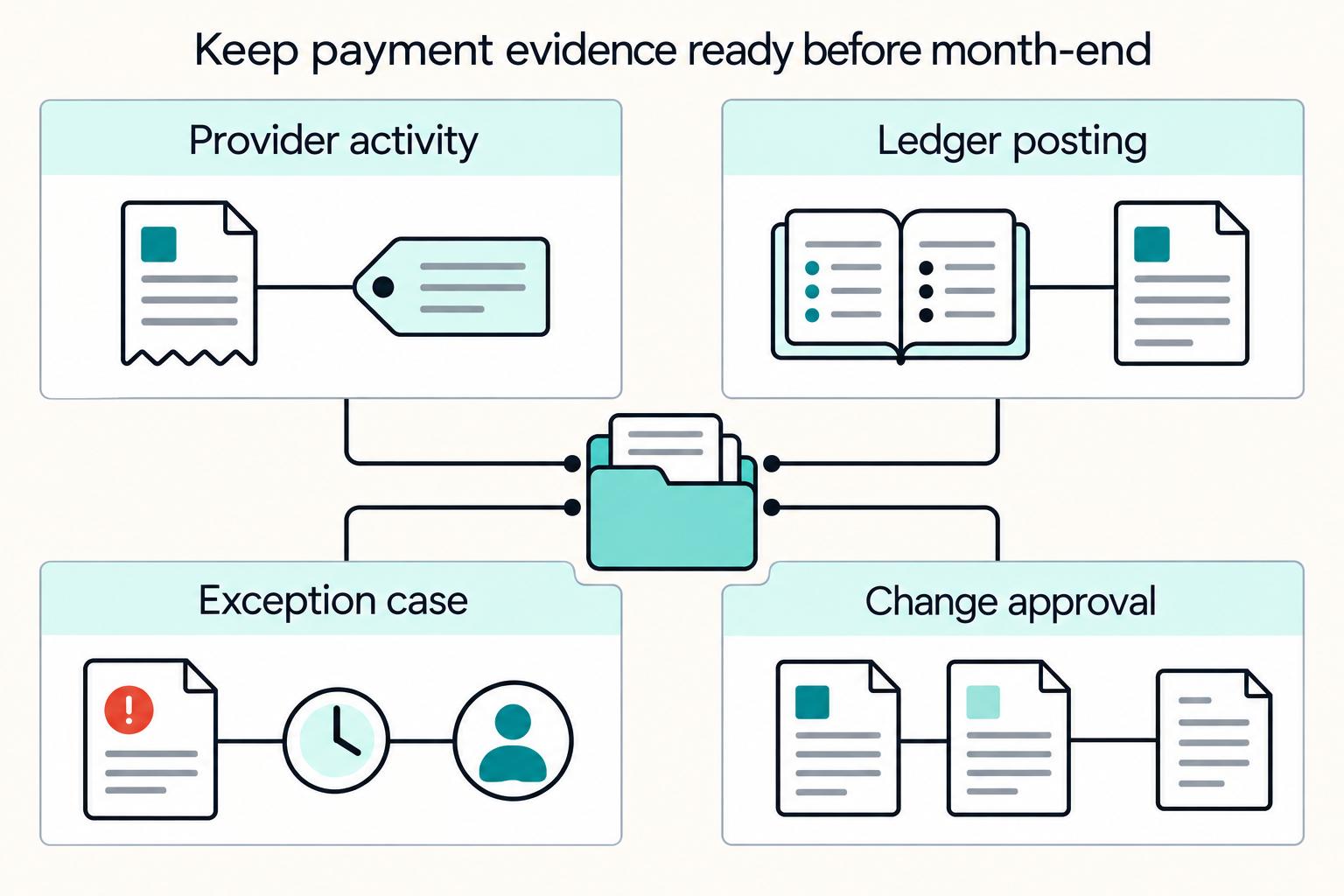
Once money movement is traceable, keep month-end clean by making that traceability operational every day: reconcile daily, route exceptions to named owners, and require approval for material changes.
- Daily reconciliation pack
Build one pack each business day, not a month-end rescue exercise. In UK client money scope, FCA CASS requires internal client money reconciliation each business day and expects records that are accurate enough to serve as an audit trail and sufficient to show and explain transactions.
A practical internal pack can include transaction-level exports, provider references, related ledger postings, exception aging, and unresolved return items. The practical test is simple: for any payout, deposit, or return, you can trace from provider activity to ledger entries and back again, with current exception status visible.
Treat unresolved returns as time-sensitive work. In ACH/Nacha context, improper reversal return windows differ by case type, including 60-day (consumer R11 claim context) and 2-day (non-consumer R17) timelines.
- Exception queues with named owners
Avoid a single generic ops inbox. Route transactions into exception queues by issue type, then assign a named owner and escalation path for each queue.
Keep each case structured with class, required fields, opened date, current owner, and due date. Federal Reserve ERS materials describe defined case types, required fields, reporting time frames, and daily recap reporting that includes items pending institution action. Design your queues with the same time-aware discipline.
Preserve evidence and status history early. Some operational reports are only available for three business days, and some responses are due within ten business days, so queue design should not depend on portal history staying available.
- Approval gates for material changes
High-risk payment changes should require explicit approval, not single-operator execution. Put approval gates in front of payout batch edits and other settlement or routing configuration changes that can alter who receives funds, when funds move, or how balances are booked.
Make responsibility explicit and tie signoff to risk ownership. Interagency eCFR guidance emphasizes assigning specific implementation responsibility and approving material changes as risks evolve. The red flag is treating a settlement-impacting change as routine configuration rather than a money-movement risk decision.
Implementation sequence for the first 90 days#
Use the first 90 days to prove money movement is explainable, not just technically possible. Treat this sequence as an operating template, then confirm jurisdiction-specific legal and tax requirements before expanding. If compliance scope or corridor ownership is still unclear by day 30, pause expansion until it is clear.
| Period | Main work | Key checkpoint |
|---|---|---|
| Days 1 to 30 | Choose your architecture, assign ownership for KYC, KYB, and AML decisions by corridor and entity type, and lock a minimum viable corridor set | If compliance scope or corridor ownership is still unclear by day 30, pause expansion until it is clear |
| Days 31 to 60 | Complete collection, FX, and payout integration, then run a controlled sandbox pilot before live volume | Drill failure paths, validate sender_batch_id handling for PayPal payouts, and enforce quote freshness for Stripe FX quote flows |
| Days 61 to 90 | Harden reconciliation and finalize tax-document handling | Finance should be able to reconcile each payout to its settled transaction batch using provider references and transaction-level settlement exports |
| Go or no go | Launch only when engineering and finance can jointly trace any payment from API request to ledger entry to reconciliation export | If either team cannot do that on demand, stay in pilot |
1. Days 1 to 30#
Choose your architecture, assign ownership for KYC, KYB, and AML decisions by corridor and entity type, and lock a minimum viable corridor set for cross-border payouts. Keep scope tight enough that compliance, tax, finance, and product teams can all name the same launch countries and payout types.
Treat AML due diligence as a full process, not a checkbox. FinCEN describes CDD as four core elements, and legal-entity flows require procedures to identify and verify beneficial owners. Ship a written evidence pack with required fields, document types, escalation owner, and the exact point where payout enablement is blocked.
2. Days 31 to 60#
Complete collection, FX, and payout integration, then run a controlled sandbox pilot before live volume. Stripe recommends testing in a safe environment before go-live, and PayPal states sandbox processes behave like production for flow testing.
Drill failure paths, not just happy paths. Retry payout creation with idempotency keys and confirm duplicate-safe behavior. If you use PayPal payouts, validate sender_batch_id handling because reuse within 30 days is rejected. If you use Stripe FX quote flows, enforce quote freshness because attaching an expired quote can return a 400 error.
3. Days 61 to 90#
Harden reconciliation and finalize tax-document handling. W-9 collection is for capturing the correct TIN for information-return reporting; foreign individuals may need W-8BEN, and foreign entities may need W-8BEN-E.
For EU VAT checks, use VIES as a validation signal, but treat it as binary valid or invalid output rather than a complete compliance record. Finance should be able to reconcile each payout to its settled transaction batch using provider references and transaction-level settlement exports.
4. Go or no go#
Launch only when engineering and finance can jointly trace any payment from API request to ledger entry to reconciliation export, with unresolved exceptions and tax-document gaps visible by owner. If either team cannot do that on demand, stay in pilot.
Before go-live, map each milestone in your 90-day plan to concrete API events, payout statuses, and reconciliation outputs in the Gruv docs.
Conclusion#
In most cases, the right choice is the payment architecture your team can run reliably under stress, not the one with the longest feature list. If you are deciding between full-stack, multi-rail, modular, or hybrid setups, start with the option you can explain, reconcile, and recover when something fails.
- Choose operability before feature breadth
A wider feature set does not help if your team cannot prevent, respond to, recover from, and learn from disruption. In payments, reliability is closely tied to user trust. Practical test: when a payout fails, can you quickly identify what happened, who owns the next action, and whether funds moved? If teams cannot match payment records across systems without manual digging, fix traceability before adding rails.
- Earn complexity in phases, with explicit checkpoints
Use a risk-based path that matches your current size, complexity, and risk profile. Early on, a simpler setup can be stronger because it reduces failure points and operational handoffs. Before moving from one primary provider to a modular or multi-provider model, verify payments can be traced end to end in your records and accounts. Then test failure cases that expose weak ownership, escalation, and recovery paths.
- Treat traceability and governance as the durable advantage
The strongest platforms are often not the ones with the most moving parts. They are the ones with accurate records, clear escalation channels, and recurring reconciliation discipline. In practice, that means clear control gates, recurring reconciliation, and records that hold up as an audit trail.
Where FCA CASS applies, internal client money reconciliation is expected each business day, and certain records are retained for five years. In the FCA operational-resilience context, firms in scope had until 31 March 2025 to ensure important business services could operate within impact tolerances. These are jurisdiction-specific examples, not universal rules, but they point to the same operating standard: clear ownership and reliable controls.
If your stack cannot support reliable reconciliation, clear ownership, and visible recovery paths, do not add complexity yet. A durable edge in global payment processing is operational control you can prove. For related reading, see Device Fingerprinting Fraud Detection Platforms for Payment Risk Teams.
If you are finalizing architecture tradeoffs, align on corridor coverage, compliance ownership, and reconciliation expectations in one working session with Gruv's team.
Frequently Asked Questions
What infrastructure does a global payment platform need end to end for cross-border transactions?
You typically need a stack that covers collection, compliance checks, FX handling, payout execution, ledgering, and reconciliation, with provider references finance can trace from request to settlement export. That scope matters because cross-border payments are still defined by cost, speed, access, and transparency gaps, and correspondent-bank handoffs can add fees, delays, and weaker visibility. If any layer is manual or hard to trace, explainability risk rises quickly.
How should a marketplace choose between multi-rail payments and full-stack payment systems?
A single full-stack setup is often simpler until you have a clear routing need such as global coverage or reliability. A multi-rail model can solve those needs, but adding and managing providers is complex and resource-intensive. Even where orchestration routes payments across processors, Stripe’s current documentation notes disputes and settlement-related activity are outside orchestration, so finance and support still need separate operating controls.
What are the minimum KYC, KYB, and AML controls before enabling payout batches?
There is no single checklist that applies unchanged across every jurisdiction, but a FATF-aligned baseline is clear. Identify and verify customers with reliable independent sources, verify beneficial owners for legal entities, and run ongoing due diligence and transaction scrutiny after onboarding. For some peer-to-peer cross-border payments, FATF’s 18 June 2025 Recommendation 16 update introduced standardized payment-message information requirements above USD/EUR 1,000.
How do FX handling choices change reconciliation risk for finance teams?
FX timing is a major reconciliation risk. Under IAS 21, when exchange rates change between transaction date and settlement date, an exchange difference results. Finance closes are cleaner when your records keep conversion timing and settlement references aligned so differences are explainable.
What usually breaks first at scale: compliance gates, payout operations, or reconciliation?
There is no universal order. Failures usually show up first where ownership and controls are weakest: compliance reviews, payout operations, or reconciliation traceability. If engineering says a payout was sent but finance cannot match it to settled lines without manual digging, that often points to a control-design gap rather than raw volume alone.
When does Merchant of Record (MoR) simplify operations, and when does it add constraints?
Merchant of Record is the entity legally authorized and responsible for processing customer payments for a transaction. It can simplify operating boundaries around payment collection, but it does not automatically remove every legal or compliance obligation for the platform in every market. The tradeoff is control, so confirm settlement, data, and market-level constraints before committing.
Try a related tool
Researched and edited by the Gruv editorial team. Gruv builds cross-border billing, payouts, and finance-operations software for global businesses.
Sources
- bis.org/cpmi/cross_border.htmtrusted
- ecfr.gov/current/title-31/subtitle-B/chapter-X/part-1...trusted
- ecfr.gov/current/title-12/chapter-III/subchapter-B/pa...trusted
- europa.eu/youreurope/business/taxation/vat/check-vat-n...trusted
- federalregister.gov/documents/2016/05/11/2016-10567/customer-due...trusted
- federalreserve.gov/frrs/regulations/appendix-cpss-iosco-princip...trusted
- ffiec.gov/sites/default/files/media/press-releases/201...trusted
- irs.gov/forms-pubs/about-form-w-9trusted
Educational content only. Not legal, tax, or financial advice.
Related Posts

The Freelance Payment Penalty: A Modeled Audit of Platform Fees, FX Spreads, and Payout Delays
The money rarely disappears through a single, easy-to-spot fee. The real loss is stacked. A marketplace takes its commission, a processor adds a charge for international cards, a bank or payment company converts the currency at a spread, a platform holds the funds before release, and a wire sheds a little to intermediaries on the way in. Each layer looks defensible on its own, but the worker feels the combined result as a smaller deposit and a later payday.

How to Respond to a Subpoena for Business Records
Move fast, but do not produce records on instinct. If you need to **respond to a subpoena for business records**, your immediate job is to control deadlines, preserve records, and make any later production defensible.

A US Expat's Guide to Investing in UCITS ETFs to Avoid PFIC Issues
The real problem is a two-system conflict. U.S. tax treatment can punish the wrong fund choice, while local product-access constraints can block the funds you want to buy in the first place. For **us expat ucits etfs**, the practical question is not "Which product is best?" It is "What can I access, report, and keep doing every year without guessing?" Use this four-part filter before any trade: