
Quick Answer
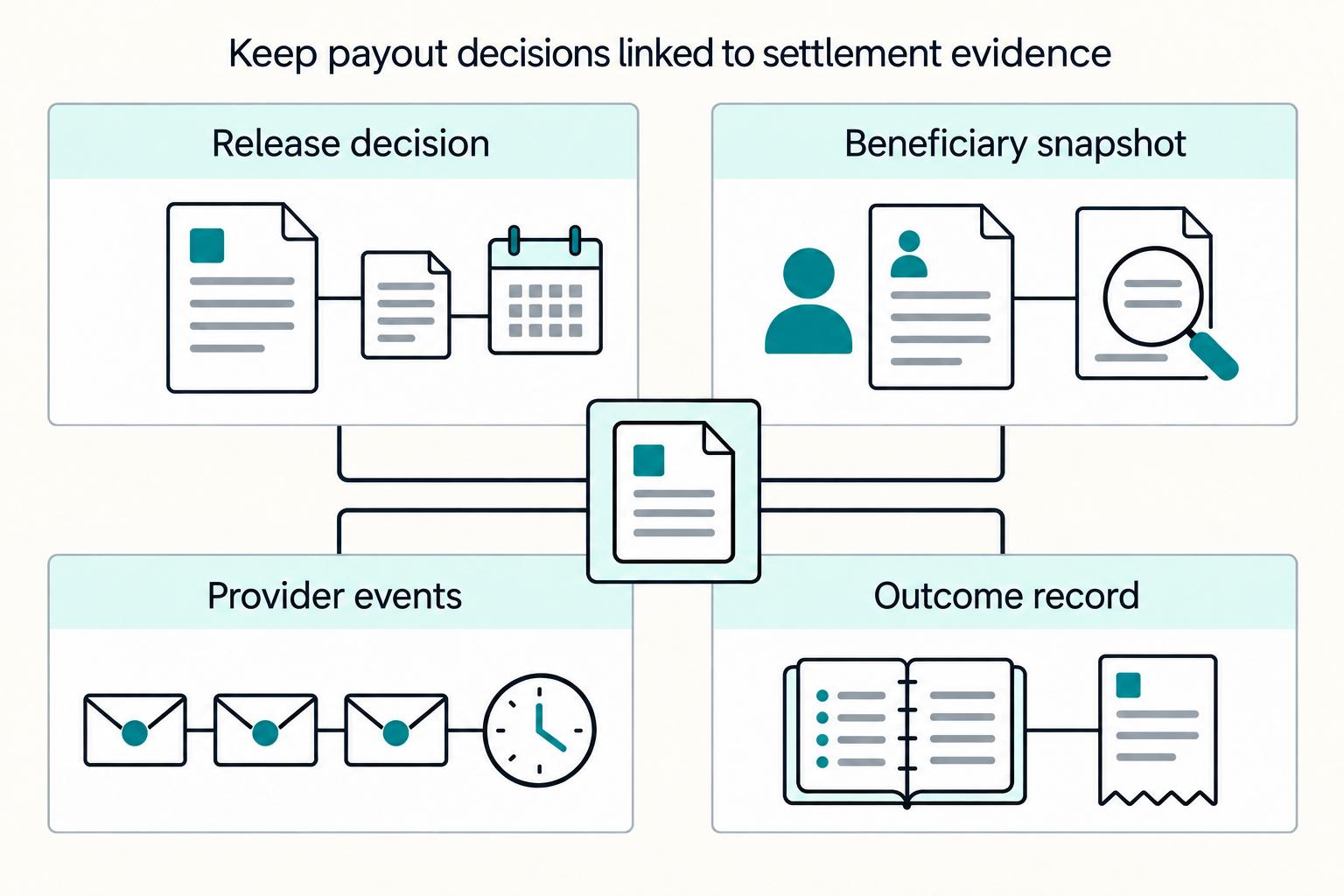
European platforms should combine VAT and SEPA by making payout release depend on one control chain: a recorded VAT decision, beneficiary checks such as Verification of Payee, and the final SEPA execution record. The strongest setup keeps those decisions in the payout record, maps VoP outcomes to release, hold, or escalate actions, and stores evidence from instruction to settlement.
How VAT and SEPA connect in platform operations#
The hard part is not VAT on one side and SEPA on the other. It is keeping tax treatment, beneficiary checks, and euro payout execution aligned when your platform pays across multiple European markets at speed.
This article treats VAT and SEPA as one operating problem, not two separate compliance topics. For marketplace operators, the tax question is rarely just "is VAT due?" EU VAT rules span taxable transactions, taxable persons, chargeable events, rates, and exemptions. EU law also recognizes cross-border platform activity as an area where enforcement and compliance can be difficult. If tax decisions sit with one team and payout release with another, that complexity shows up fast.
On the payment side, SEPA simplifies execution, but scope still differs across rules and schemes. The ECB describes SEPA as harmonized standards for domestic and cross-border euro payments, and as of 22 May 2025 the broader SEPA region covered 41 European countries. Scheme scope still matters. The European Payments Council says SEPA Instant Credit Transfer coverage progressively spans over 36 countries, which is not the same as uniform instant capability across all SEPA countries.
Regulatory pressure also increased in 2024. CESOP-linked VAT transparency rules took effect on 1 January 2024, and from 1 April 2024 PSPs in scope must transmit information on payees receiving more than 25 cross-border payments per quarter. Separately, the Instant Payments Regulation was adopted on 13 March 2024 and covers euro credit transfers within the European Union. If the business pushes faster euro payouts, the control evidence has to keep up.
One control point sits at the center of that problem: verify the beneficiary before money moves. Under the Instant Payments Regulation, Verification of Payee informs the payer about discrepancies between the payment account identifier and the intended payee name, and it must be offered free of charge to the payer. For euro area Member States, the ECB timeline shows 9 October 2025 for VoP. In practice, the useful check is not only "is the IBAN valid?" but also "do the payee identity details match the account we are about to use?"
In practice, breakdowns are often operational. Payout execution can be ready while tax classification is still unresolved, or an account identifier can pass format checks while payee-name alignment is still unclear. As one payments chief compliance officer put it, "with that efficiency comes the responsibility to identify and mitigate risks creatively."
That is the backdrop for the control options that follow. The key decision is not which tool to buy first. It is which control design keeps VAT treatment, Verification of Payee, and SEPA payout execution in one defensible chain for cross-border payouts in the European Union and eurozone. For related context, see When Marketplace Platforms Still Face Sales Tax Nexus Obligations.
Choose the control design before you choose tools#
Choose the control design first. Your payout process should produce one defensible release decision across VAT treatment, beneficiary checks, and SEPA execution before you optimize for speed.
| Control area | Baseline | Stronger design |
|---|---|---|
| VAT decision clarity | Show the VAT treatment and who approved it before money moves | Keep the VAT decision in the payout record, not in a separate file |
| SEPA execution reliability | Build pre-initiation checks and fallback actions; VoP applies to both standard and instant transfers | Map each VoP state to a defined action such as release, hold, or escalate |
| Audit evidence quality | Keep the VAT decision, beneficiary-validation result, rail used, PSP reference, and settlement outcome | Let compliance and finance reconstruct the payout without requesting PSP logs by hand |
| Exception handling burden | Plan for discrepancy and rejection paths under speed; instant transfers can make funds available within 10 seconds | Set clear ownership and deadlines for exception states, especially close-match and rejection paths |
| Ownership across teams | Define who owns tax classification, rail execution, and time-sensitive exceptions | Keep one accountable release point per payout |
If SCT Inst volume is rising while VAT decisions still live in email or spreadsheets, treat that gap as an early operational fix.
- VAT decision clarity
Before money moves, you should be able to show the VAT treatment and who approved it. Core VAT compliance includes registration with relevant tax authorities, plus charging and accounting for VAT to tax authorities. What separates stronger designs: the VAT decision lives in the payout record, not in a separate file that has to be reconciled later. We recommend making that payout record the document your finance and tax teams review first.
- SEPA execution reliability
Rail choice matters only when pre-initiation checks and fallback actions are built in. Under the Instant Payments Regulation, PSPs that offer standard euro credit transfers must also offer instant credit transfers, and VoP applies to both standard and instant transfers. VoP returns match, close match, no match, or other before initiation. What separates stronger designs: each VoP state triggers a defined action such as release, hold, or escalate, instead of being treated as informational.
- Audit evidence quality
Your controls should produce one exportable record for both tax review and payout investigation. At minimum, keep the VAT decision, beneficiary-validation result, rail used, PSP reference, and settlement outcome. DAC7 reporting responsibility sits with platform operators, and the first exchange for calendar year 2023 took place at the end of February 2024. What separates stronger designs: compliance and finance can reconstruct the payout without requesting PSP logs by hand.
DAC7 sits beside this work rather than inside it. It asks a platform to report seller identity and quarterly consideration to a tax administration rather than to charge anything at checkout, and it draws on the same seller record the indirect tax questions do. DAC7 and DPI reporting for platforms covers what that data set contains and when it is due, which is worth keeping separate in a control design even where the underlying record is shared.
- Exception handling burden
Weak designs usually fail in exception logic, especially under speed. VoP exists because discrepancies can occur between the payment account identifier and the intended payee name, and instant transfers can make funds available within 10 seconds. SEPA compliance monitoring also tracks rejected-transaction share. What separates stronger designs: clear ownership and deadlines for exception states, especially for close-match and rejection paths. We see the break most often when your ops team can spot a mismatch but no one owns the response window.
- Ownership across teams
Cross-border payouts break when tax, payments, and legal ownership is unclear. Define who owns tax classification, who owns rail execution, and who can approve time-sensitive exceptions. What separates stronger designs: one accountable release point per payout, even when specialist review is distributed. We recommend naming that release owner explicitly so your team is not improvising at cutoff.
This design usually fits teams running recurring euro payouts through a PSP, especially where VAT treatment may vary by market and payout exceptions already create drag. It is also useful when you operate across both the EU and wider SEPA coverage, since SEPA spans 41 European countries while some EU legal obligations do not apply outside the EU or EEA.
At very low volume, full automation may not be the right first move. If your team can still review each payout end to end with named approval and a complete evidence trail, manual handling can remain workable. The real red flag is manual processing without durable records of VAT basis, payee-check outcome, and release rationale.
Before you add payout speed, run one simple check: can finance retrieve a single payout and show the VAT basis, VoP result, PSP event history, and final settlement status in one place? If not, fix that control chain first. We treat that retrieval test as a release gate because your team should be able to answer it in minutes, not hours. By 9 October 2025 in euro-area Member States, sending instant payments and VoP obligations make integrated operations more important, not less. Related: SEPA Payments for Platforms: How to Send Euro Disbursements Across Europe.
Compare the best VAT and SEPA control options at a glance#
If you need a default path, use a pre-payout VAT decision gate and a unified evidence pack now. Pilot SCT Inst routing only after VoP handling, beneficiary checks, and exception ownership are tied to the payout record. We would rather see your team prove the record chain on standard SCT before it turns on instant routing at scale.
Rail choice matters, but speed does not fix weak tax records or weak beneficiary controls, and VoP alone is not complete DAC7 or VAT audit evidence.
| Control option | Best for | Required systems | Rail stance | VoP dependence | IBAN/BIC timing | Evidence depth for DAC7 and VAT audits | Key pros | Key cons | Primary failure mode | Recommendation |
|---|---|---|---|---|---|---|---|---|---|---|
| 1. Pre-payout VAT decision gate | Mixed VAT treatment across markets or seller types | Tax decision store linked to payout record, approval trail, PSP connection | SCT default; SCT Inst only after tax release | Low to medium | Policy-defined (onboarding and/or initiation) | High for VAT, medium for DAC7 unless seller and jurisdiction fields are attached | One release decision, clearer audit trail | Can slow urgent disbursements when tax data is incomplete | Payout is held late because VAT basis was not resolved upstream | Adopt now |
| 2. Risk-tiered rail routing for SCT vs SCT Inst | Teams balancing speed against error cost | Policy matrix, payout orchestration, override logging, PSP rail support | Explicit SCT vs SCT Inst split | Medium to high; VoP matters more when funds can be available in less than 10 seconds | Initiation (optional onboarding pre-check) | Medium; strong rail evidence, weaker when tax basis sits outside payout record | Aligns urgency with control strength | Needs disciplined overrides and staffed exceptions | Wrong tier sends a disputed payout on instant rail | Pilot first |
| 3. Beneficiary verification-first design | Operators with returns, mismatches, or account-detail errors | Beneficiary master data, IBAN validation, BIC hygiene, PSP payee-check support | Works for both SCT and SCT Inst | High; VoP applies to both and returns match, close match, no match, or other before initiation | Policy-defined (onboarding and/or initiation) | Medium for VAT, medium for DAC7 | Strong first-line control against misdirected payouts | More onboarding friction and more close-match reviews | Valid IBAN but unresolved payee-name mismatch blocks release near cutoff | Adopt now |
| 4. Dual-queue exception handling | Tax and payments teams already escalating through chat or email | Case queue, SLA ownership, approval logging, PSP event intake | Both rails, tighter deadlines for SCT Inst exceptions | Medium; VoP states route to queue paths | Initiation with onboarding reference | High if queue outcomes are stored with payout and tax records | Clear ownership and better reconstruction | Queue and governance overhead | Exceptions land in the wrong queue and miss payout windows | Pilot first |
| 5. Jurisdiction rules matrix with DAC7 alignment | Multi-market EU operations with changing reporting obligations | Rules repository, owner, review cadence, linkage to seller and market data | Rail-agnostic; define evidence by rail | Low; VoP is supportive, not core | Policy-defined (onboarding, then refresh on beneficiary-data change) | High for DAC7 where in scope, high for VAT when logic is maintained | Reduces local policy drift | Stales quickly without clear ownership | Rule drift causes reporting error even when payout execution is correct | Adopt now |
| 6. Unified evidence pack from instruction to settlement | Audit readiness, reconciliation, partner due diligence | Store that joins tax decision, beneficiary checks, rail used, PSP reference, settlement status | Both SCT and SCT Inst, rail recorded per payout | Medium; store VoP when available, but do not treat it as complete evidence | Policy-defined, with timestamps and actor or system identity | Very high for VAT support and DAC7 support where operator reporting applies | One exportable record across tax, payment, settlement | Requires explicit storage, retention, and access control | Evidence stays fragmented, so teams cannot reconstruct one payout end to end | Adopt now |
For euro-area teams, 9 October 2025 is the key operational date for sending instant payments and VoP, with receiving instant payments earlier on 9 January 2025. Treat beneficiary checks as release controls, not informational metadata.
Keep the reporting split clear. DAC7 entered into force on 1 January 2023 and places reporting obligations on platform operators where applicable. Separate EU VAT anti-fraud rules introduced PSP reporting obligations from 1 January 2024, including a stated trigger of more than 25 cross-border payments to the same payee. Your internal controls should reconcile to PSP references and settlement outcomes, not replace PSP obligations.
Before committing to any option, test one payout record for five fields in one view: VAT basis, IBAN or BIC check history, VoP result if used, rail selected, and final settlement status. If you cannot produce that, defer instant-first routing and fix the record chain first. We recommend running this test with a real payout your finance lead can trace without asking engineering for help. If you run this check with your finance lead, we expect your tax and ops owners to review the same record before you release funds.
For a step-by-step walkthrough, see SEPA Direct Debit for European Subscriptions With Clear Approval and Rollout Checks.
Option 1 pre payout VAT decision gate#
Use a pre payout VAT decision gate when VAT treatment must be settled before any SEPA release decision. It is a practical approach for platforms operating across multiple EU markets with mixed VAT outcomes.
VAT treatment depends on transaction facts that should be resolved before money moves. The place of taxation determines which EU country's rules apply. Some marketplace flows can treat the platform as a deemed supplier. Marketplace record-keeping obligations can still apply even when the platform is not the deemed supplier. If payout creation starts before those points are resolved, the payout record can become a tax-evidence problem later.
When this option earns its overhead#
This model is most useful when you have broad jurisdiction spread, mixed seller profiles, or several transaction patterns with different VAT outcomes. Keep one principle clear: SEPA is the payment rail, not the tax decision. We use this model when your market mix changes faster than your tax playbooks.
SEPA Credit Transfer is harmonized for domestic and cross-border euro transfers, and SCT Inst can make funds available within 10 seconds. That speed helps only after the VAT basis is resolved.
What to decide before payout creation#
The gate does not need to answer every tax question. It needs to confirm that the release-critical VAT points are resolved and recorded. At minimum, store these items on the payout record:
- VAT basis used for release, including rule or policy version
- place-of-taxation outcome, or why it was not required for that flow
- whether deemed-supplier treatment was applied for that transaction type, when relevant
- seller or beneficiary identity, with timestamps and approver or system actor
- selected rail (
SCTorSCT Inst) after tax clearance
A simple test is to pick one payout and see whether you can reconstruct why release was approved. If you cannot see the VAT basis, country logic, and release approval trail, the gate is not functioning as a control. If your reviewer cannot reconstruct it quickly, we would not treat the gate as production-ready.
How to route after tax clearance#
The sequence should be straightforward: tax cleared, beneficiary checks completed, payout created, then route through SCT or SCT Inst based on urgency and internal policy.
Under the Instant Payments Regulation, adopted 13 March 2024, PSPs that offer regular credit transfers must also offer instant credit transfers, and Verification of Payee applies to both standard and instant credit transfers. The euro-area dates shown by the ECB are 9 January 2025 for receiving instant payments and 9 October 2025 for sending instant payments and VoP. Treat VoP as a PSP beneficiary-verification control, not a substitute for VAT classification.
Exception handling at cutoff#
If tax status is unknown at cutoff, one internal policy option is to release only internally defined low-risk payouts and hold the rest for escalation. Treat this as an internal policy choice, not a legal safe harbor. We recommend documenting who on your team can hold, release, or escalate at cutoff. If you hold a payout, we recommend logging why your team paused it and when you expect your next review.
Common failure mode#
The tradeoff here is delay when tax inputs are incomplete. The recurring breakdown is cutoff-time bypass: payout is released first, VAT is resolved later, and records can diverge across finance, tax, and PSP reporting. If your cutoff playbook allows that bypass, you are accepting a record-repair project later.
Require an evidence pack for every released or held exception: unresolved tax issue, approver, beneficiary-check status, rail used, and final settlement or hold outcome. If that record is not exportable end to end, the pre payout gate is not operating as intended.
You might also find this useful: What Is an IBAN Number? How Platforms Use IBANs to Send Error-Free European Payouts.
Option 2 risk tiered rail routing for SCT and SCT Inst#
Use risk-tiered routing to decide payout speed after release eligibility is already clear. Default to SEPA Credit Transfer (SCT) for routine flows, and use SEPA Instant Credit Transfer (SCT Inst) only for urgent, low-risk cases where the controls are already reliable.
Under the Instant Payments Regulation, adopted 13 March 2024, PSPs that offer regular euro credit transfers must also offer instant credit transfers, and Verification of Payee (VoP) applies to both standard and instant credit transfers. So this is not "checked instant versus unchecked standard." The control burden exists on both rails. The operational difference is that SCT Inst runs within ten seconds and on a 24 hours a day, 365 days a year clock.
A practical policy matrix#
| Payout pattern | Default rail | Route logic |
|---|---|---|
| Standard supplier or seller payout | SCT | Use when payment is not time-critical and you want additional time for review and exception handling before final processing. |
| Urgent low-risk refund or corrective payout | SCT Inst | Use only when urgency is real, beneficiary data is already validated, and the case is straightforward. |
| Elevated-risk or exception-tagged payout | Hold off instant routing (typically SCT after review) | Keep off instant until review is complete. Once an instant order is released, intervention time is very limited. |
At minimum, keep these fields on the payout record: risk class, payout type, release eligibility status, VoP result, beneficiary status, permitted rail, and override approver. If you cannot explain why a payout qualified for SCT Inst instead of SCT, the routing policy is not audit-ready.
Where this option earns its keep#
This model can help when instant usage is increasing but error cost is still uneven across payout types. A practical pattern is routine supplier payouts on SCT and urgent low-risk refunds on SCT Inst.
Before you lean on speed, check corridor reality. SEPA covers 41 European countries, while SCT Inst is described as progressively spanning 36 European countries. Rail choice should therefore depend on urgency, risk, and whether your PSP-beneficiary corridor supports the intended instant flow.
The checks that matter most#
The controls that make this work are simple but unforgiving. VoP handling needs to be live for both rails, and discrepancies should trigger controlled outcomes. Override rules should stay narrow, logged, and tied to named approvers with reason codes. Exception handling also has to match the rail clock, including outside business hours.
The main failure mode is policy drift. Ad hoc exceptions gradually reclassify most urgent requests as low risk. Keep SCT Inst narrow until beneficiary validation, VoP handling, and after-hours exception operations are consistently reliable.
Option 3 beneficiary verification first design#
Use this design when payout errors are mainly caused by beneficiary data quality, not tax classification. If returns, delays, or misdirected transfers trace back to account details, make beneficiary verification a release condition and decide rail speed only after the payee record is reliable.
| Area | What this design emphasizes |
|---|---|
| Best fit | Frequent returns or misdirected transfers tied to account-detail errors |
| Main strengths | First-line control through IBAN checks, BIC hygiene where your PSP uses it, and payee-name plus IBAN verification via VoP |
| Main cost | Potentially more onboarding friction and exception handling |
| Practical placement | Run the control before first payout initiation and before treating a beneficiary as payout-ready in your PSP flow |
| Main failure mode | IBAN is valid but name outcome is unresolved (close match or not possible) |
What this option does better#
This design gives you a stronger first-line control before money moves. In VoP, the payer-side PSP requests a check from the payee-side PSP, and the core comparison is the payee name against the IBAN provided by the payer. The payer gets a result before payment initiation, and this applies to both SCT and SCT Inst.
IBAN format checks alone are not enough. A structurally valid IBAN can still lead to the wrong account or to delays if the underlying details are wrong. A stronger sequence is to validate IBAN format, keep BIC or IBAN-to-PSP mapping current where your PSP depends on it, and then run VoP to test whether the name and account identifier align.
Where to place the control in your PSP flow#
Use this as an internal control design before first payout initiation, not as a blanket legal claim about onboarding timing. The supported legal timing in scope is before payment initiation.
A workable sequence is to capture the beneficiary name as it will be sent to the PSP, plus the IBAN and any BIC your provider requires. Confirm IBAN quality at source where possible, since the servicing bank is the authoritative source for the correct IBAN. Then run VoP before first payout initiation and store the exact outcome: match, close match, no match, or other/not possible.
For implementation context, ECB timelines list VoP dates of 9 October 2025 for euro area Member States and 9 July 2027 for non-euro area Member States. The EPC VoP rulebook entered into force on 5 October 2025.
The tradeoff you are accepting#
You are often trading some speed and conversion for cleaner payout data. Some beneficiaries will need corrections or manual handling before payout release.
Plan for unresolved outcomes explicitly. If the IBAN appears valid but VoP returns close match or not possible, consider pausing auto-release and routing the case to corrected beneficiary data or documented operator review.
Keep the evidence tight on both the beneficiary and payout records: submitted name, submitted IBAN, any BIC or account-holding PSP reference used, VoP result, timestamp, PSP response reference, and exception approver where relevant. Treat VoP as a payment-detail control, not identity proof. It does not replace VAT, KYC, or DAC7 evidence duties.
Option 4 dual queue exception handling for tax and payout conflicts#
Use this design when tax and payments have different owners. Keep VAT exceptions and SEPA execution exceptions in separate queues with separate decision rights. The point is control clarity, not process complexity.
This option is most useful after basic beneficiary controls are already in place, for example IBAN checks, VoP outcomes, and PSP-side validation. At that stage, the blocker is often ownership: who can clear a tax hold, and who can resolve a rail or settlement failure.
Queue 1 tax classification conflicts#
Route seller tax-status disputes, missing invoice data, and classification mismatches to a tax or compliance-owned queue, not payments ops. This fits the underlying obligations. DAC7 has applied since 1 January 2023, and platform operators are expected to collect and verify seller information. For most B2B transactions, invoicing is compulsory because the VAT invoice underpins VAT liability.
Capture at intake: seller ID, market, service type, invoice status, claimed VAT treatment, blocking reason, and release approver. If reporting posture is affected, attach the DAC7-relevant seller record and the exact disputed field.
Checkpoint for this model: no payout leaves this queue until the tax record states whether treatment is accepted, rejected, or escalated. If a payout is time-sensitive and VAT status is disputed, use a documented internal escalation path and store the approval with the payout record.
Queue 2 payout execution issues#
Route rail and settlement exceptions to a payments-ops-owned queue. Handle PSP rejects, TARGET Instant Payment Settlement (TIPS) issues, bank-rail timeouts, and mismatches between requested and actual execution here.
This queue runs on payment clocks. TIPS has operated since November 2018 on 24/7/365 availability, and SCT Inst is designed for funds to be made available in less than ten seconds. That timing profile is different from tax classification work, even when both block the same payout.
Capture at intake: rail type, PSP reference, beneficiary identifier, timestamp, settlement status, reject code or provider message, and whether the instruction was SCT Inst or a standard transfer. If the issue is beneficiary verification, link the stored VoP result instead of reopening the tax case. An operator should be able to see whether failure happened before initiation, at PSP acceptance, or during settlement.
What makes this design worth the overhead#
The tradeoff is higher queue-management and SLA overhead. You need explicit timers, handoff rules, and an escalation owner for cases that touch both queues.
The benefit is a cleaner audit trail: one chain for tax reasoning and one for payment execution. A practical rule is this: tax or compliance decides release permission, payments ops decides execution method. Keep those decisions separate, even under pressure to move euro transfers quickly.
This split can improve traceability for cross-border patterns. From 1 April 2024, PSPs must transmit information on payees receiving more than 25 cross-border payments per quarter under CESOP-related rules. You may not control PSP reporting directly, but you do control whether your exception history explains why a payee was held, corrected, or released.
Option 5 jurisdiction rules matrix with DAC7 alignment#
Use this option when your main risk is inconsistent classification across EU markets, not just slow exception handling. A maintained jurisdiction matrix gives tax, compliance, finance, and payout teams one decision record for how each seller flow is treated before money moves.
The benefit is consistency across VAT treatment, DAC7 reporting scope, and payout-release evidence. The risk is drift. Without clear ownership and update cadence, the matrix stops matching your product and market reality.
What this option is best for#
This design fits platforms with multiple seller cohorts, several service lines, and real market variation. If onboarding differs for goods sellers, personal-services providers, and transport-rental operators, you already have rule sprawl. The matrix makes that sprawl explicit and reviewable.
DAC7 is a useful anchor because reporting obligations sit with platform operators and cover both cross-border and non-cross-border activities. Teams can focus on cross-border flows and under-classify domestic ones.
Start with a simple key: seller type, activity type, market, platform role, reporting flag, payout-release evidence, and source authority. Keep platform role explicit. VAT accountability depends on role and facts. Where a platform intermediates in its own name on behalf of an underlying seller, it is presumed to be the supplier for VAT purposes.
The matrix fields that matter#
Build around repeatable decisions, not country names alone. Minimum useful fields are seller type and claimed tax status at onboarding, activity type, the market where the obligation applies, whether the platform acts in its own name or only facilitates, DAC7 reporting applicability, VAT owner or escalation owner, payout evidence required before release, and the legal or policy source with effective date and last review date. Use DAC7 activity categories directly so operators are not mapping ad hoc labels during review.
| DAC7 activity type | Why it needs its own row | Payout-control implication |
|---|---|---|
| Rental of immovable property | Different seller facts and reporting attributes than services or goods | Require property-related seller evidence and jurisdiction tag before release |
| Personal services | Role confusion between platform and provider can occur | Check platform-role field and invoice status before payout approval |
| Sale of goods | Can include both domestic and cross-border fulfillment patterns | Keep market and VAT treatment attached to each seller flow |
| Rental of any mode of transport | Separate activity logic from property rental and services | Do not reuse service rules without explicit review |
The operator detail that prevents drift#
The key control here is change control, not an annual policy check. Each matrix change should include source authority, effective date, and named approver. If an operator cannot tell why a row changed and when it became active, that row should not control payout release.
Keep timeline fields grounded in real milestones. DAC7 is Council Directive (EU) 2021/514 of 22 March 2021. It entered into force on 1 January 2023, and the first exchange for calendar year 2023 took place at the end of February 2024. Those dates help align matrix version history with periods you may need to explain later.
A practical trigger is any new seller journey or new activity type. Drift can start from stale classification tables, not only from legal interpretation.
Where teams get this wrong#
One mistake is treating DAC7 as reporting-only and leaving payout controls outside the matrix. DAC7 does not set SEPA rail routing or Verification of Payee controls, but your matrix should still define what evidence must exist before release for reportable or tax-sensitive flows.
Another mistake is assuming DAC7 is cross-border only. It is not, and domestic flows still need classification.
A third risk is skipping non-Union operator handling. If an operator outside the EU performs commercial activity in the Union, Non-Union Platform Operators must register and report in one single EU country. Include reporting-entity and registration-jurisdiction fields instead of assuming the local operating company always reports.
Recommendation#
Choose this option when cross-market interpretation is your core failure mode. Assign one owner for matrix quality, require source-backed updates, and block payout-rule overrides until the relevant row is corrected.
A maintained matrix will not remove judgment, but it will stop the same classification question from being answered differently by tax, ops, and finance.
If you want a deeper dive, read DAC7 for Non-EU Platforms: Does Your Marketplace Owe Tax Data to European Authorities?.
Option 6 unified evidence pack from instruction to settlement#
Choose this option when auditability is the main risk. Aim for one record set that shows the key checks ran before money moved under EPC scheme rules. Once classification is done, the control question becomes how to evidence the full chain from release decision to payment outcome for the same payout.
This works best when legal, finance, compliance, and payments ops are all reviewing the same transactions. Finance needs reconciliation, compliance needs proof of control execution, and reviewers usually ask for both tied to one payout trail.
Why this option works#
The core benefit is end-to-end traceability. SEPA instruments run on common technical standards and business rules, so you can structure evidence consistently instead of rebuilding it team by team.
It also fits VAT-control scrutiny. Directive (EU) 2020/284 states that PSPs hold information identifying the payee and payment details such as date, amount, and Member State of origin, and links that information to VAT-control tasks. That does not mean every non-PSP platform must mirror PSP legal duties field for field, but it supports designing your evidence pack around those same traceable facts.
What to prepare#
Keep one exportable record per payout, or per payout line item. Include:
- release decision, with decision date and rule version
- instruction-time beneficiary data, including IBAN and payee name
- IBAN check result and any available Verification of Payee (VoP) result
- rail used, for example SCT or SCT Inst
- PSP event timestamps, and transaction references if returned by the PSP
- final internal payout status, for example settled, rejected, returned, or cancelled
VoP outcomes are especially useful as control evidence because EPC documentation defines concrete response types such as match, no match, close match, and check not possible. If release proceeds after a no match or check-not-possible result, keep a clear override record with named approval.
For SCT Inst, timestamp quality matters operationally. EPC documentation requires an unambiguous transaction timestamp including milliseconds, and the scheme targets funds availability in less than ten seconds. Coarse timestamps make delay analysis hard to defend.
Where this option goes wrong#
The failure mode is usually governance, not design. A unified pack works only if you define source-of-truth ownership, change rights, and retention rules for each field.
Do not blur mutable internal notes with immutable PSP events during retries or beneficiary updates. Also be careful on retention. Regulation (EU) 2020/283 sets a three-calendar-year recordkeeping period for PSPs, but that period should not be assumed to apply identically to every non-PSP platform record without legal review.
Recommendation#
Use this option when audits, bank reviews, or partner due diligence are likely. Set one acceptance rule: a payout is not fully evidenced unless finance can reconcile totals and compliance can verify control execution, including IBAN checks and any available VoP outcomes, without manual reconstruction.
Build the minimum evidence set auditors and regulators will ask for#
For each euro payout, keep four linked records under one case ID as an internal minimum evidence set. This lets tax, payments, and audit teams trace the same payout without rebuilding evidence from raw logs.
| Record | Key fields | Why it matters |
|---|---|---|
| VAT decision record | Tax outcome, decision date, rule version, EU market context, and any override approver | Keeps jurisdiction context attached, including whether the activity may fall into a DAC7 reporting population |
| Beneficiary validation log | Beneficiary name, instruction-time IBAN, IBAN-check result, and any VoP result | Covers pre-payment outcomes such as match, close match, no match, or other |
| Payout instruction record | Instruction timestamp, amount, currency, payee reference, selected rail, and PSP used | Preserves whether the payout was standard credit transfer or SCT Inst |
| Settlement outcome record | PSP event history, final status, payee, date, amount, and Member State of origin where available | Supports later CESOP-related review, including the 1 April 2024 transmission point and the more than 25 cross-border payments per quarter threshold in PSP reporting context |
- VAT decision record
Store the tax outcome, decision date, rule version, European Union market context, and who approved any override. VAT controls require accounts detailed enough for VAT to be applied and checked, so keep jurisdiction context attached, including whether the activity may fall into a DAC7 reporting population. DAC7 can cover both cross-border and domestic platform activity, and annual reporting is due by 31 January of the following year.
- Beneficiary validation log
Keep the beneficiary name, instruction-time IBAN, IBAN-check result, and any Verification of Payee result. VoP applies to both standard and instant credit transfers, and returns a pre-payment outcome: match, close match, no match, or other. If you release on a no-match or other outcome, retain the escalation disposition and named approver.
- Payout instruction record
Save instruction timestamp, amount, currency, payee reference, selected rail, and the Payment Service Provider (PSP) used. Always record rail context as standard credit transfer or SEPA Instant Credit Transfer (SCT Inst). Instant transfers target funds availability within 10 seconds, which affects timing and exception review. Do not lose the original rail choice during retries.
- Settlement outcome record
Capture PSP event history, final status, and VAT-control payment facts: payee, date, amount, and Member State of origin where available. This supports later CESOP-related review, including the 1 April 2024 transmission point and the more than 25 cross-border payments per quarter payee threshold in PSP reporting context.
Define retention and access rules separately from record structure. PSP cross-border payment records are referenced with a three calendar year retention period, while CESOP keeps transmitted data for up to five years. Do not assume one period applies to all platform records. Apply GDPR data minimisation, limit unnecessary PII exposure in finance and risk views, and set review or erasure dates in advance.
If your VAT gate depends on clean tax IDs, run edge-case records through the VAT number validator before high-volume payout windows.
Set escalation triggers before incidents force bad decisions#
Set escalation paths before release pressure starts. If tax certainty, payee certainty, or evidence completeness breaks, treat the case as non-routine and route it to the named owner.
| Escalation trigger | When to escalate | Required response |
|---|---|---|
| VAT and payout urgency conflict | VAT treatment is still disputed but the business wants same-day release | Confirm the case file includes a VAT decision record, jurisdiction, and any override with a named approver and date |
| Verification of Payee fails near cutoff | VoP returns close match, no match, or other before initiation on standard or instant credit transfers | Keep a clear rationale if a pre-payment warning was accepted |
| Repeated exceptions in one jurisdiction | The same exception pattern repeats in one Member State | Review jurisdiction, seller type, service type, VoP outcome pattern, and tax-decision outcomes together |
| Controls work but proof does not | The payment rail works but control evidence is incomplete | Do not treat the case as control-complete if sanctions checks or other required records are missing |
- VAT and payout urgency conflict
Escalate to compliance when VAT treatment is still disputed but the business wants same-day release. The EU sources here do not define a single mandatory escalation rule for this exact conflict, but DAC7 does place reporting obligations on platform operators and expects seller information to be collected and verified. Before release, confirm the case file includes a VAT decision record, jurisdiction, and any override with a named approver and date.
- Verification of Payee fails near cutoff
Treat close match, no match, or other VoP outcomes as escalation signals. VoP results arrive before initiation for both standard and instant credit transfers, and SCT Inst leaves little decision time because funds are expected to be available in less than ten seconds. If you proceed anyway, keep a clear rationale for why a pre-payment warning was accepted.
- One jurisdiction starts producing the same exceptions
Escalate from case handling to policy review when the same exception pattern repeats in one Member State. Repetition can come from policy drift, seller-data quality, or counterparty behavior, so review jurisdiction, seller type, service type, VoP outcome pattern, and tax-decision outcomes together. Persistent manual fixes are a signal to correct the rules matrix.
- Instant Payments Regulation controls work, but proof does not
Escalate when the payment rail works but control evidence is incomplete. The IPR covers euro credit transfers in the EU, and ECB milestones for euro-area Member States include 9 January 2025 for receiving instant payments and 9 October 2025 for sending instant payments and Verification of Payee. If sanctions checks or other required records are missing, do not treat the case as control-complete.
Set final authority explicitly: compliance for tax ambiguity, payments ops for rail or PSP failure, legal for cross-border liability edge cases. That split is an internal design choice, but EBA governance expectations still require clear lines of responsibility and management-body accountability.
Conclusion#
The strongest design is one control flow, not separate tax and payout processes. Tie the VAT decision, the SEPA rail choice, and the PSP outcome into one traceable record.
- Bind tax classification to payout release
VAT is not only a filing issue after payment. Article 242 of the EU VAT Directive requires accounts detailed enough for VAT to be applied and checked, so a practical control is to make release depend on a recorded VAT classification and jurisdiction, with approver evidence where needed. Practical test: for any payout sample, can you pull the VAT decision, transaction context, and payout instruction from one record path? If not, the control is incomplete even when settlement succeeds.
- Pick one operating model and define ownership clearly
SEPA harmonizes euro payment standards, but your internal controls still determine risk. Under the Instant Payments Regulation, euro credit transfers within the EU include a verification-of-payee service that applies to both standard and instant credit transfers, and that service must be free to the payer. Because SCT Inst can make funds available within ten seconds, use it where classification, payee checks, and release authority are already clear. Route ambiguous cases through a slower path until resolved. The key is explicit ownership for tax ambiguity, rail execution issues, and overrides.
- Treat evidence as part of execution, not post-payment admin
DAC7 places reporting obligations on platform operators across both cross-border and non-cross-border activity. It does not by itself require a single end-to-end evidence file, but one exportable record set is usually the cleanest control design. Include VAT decision data, jurisdiction, DAC7-relevant seller data captured for reporting, payee-validation result, rail used, PSP reference, settlement outcome, and any escalation or override. If finance and compliance cannot both work from that same record set, traceability can break under audit or incident pressure.
If your team cannot explain one payout from tax classification to PSP outcome in a single trace, fix that before scaling volume.
To translate this control design into an operational workflow with policy gates, status tracking, and audit trails, review Gruv Payouts and confirm fit for your markets.
Frequently Asked Questions
Do platforms need to collect VAT on every payout?
No. VAT applies to taxable transactions such as supplies of goods or services for consideration, not to every payout event. Start with the underlying transaction and document the VAT classification before release, especially where platform, deemed-supplier, or record-keeping duties may apply.
Which SEPA controls are mandatory and which are internal best practice?
That depends on who is legally in scope. Under the Instant Payments Regulation, PSPs that offer regular credit transfers must also offer instant credit transfers, and VoP applies to both standard and instant transfers and must be free to the payer. Internal controls are your own design choices, such as hold-and-review rules for discrepancies and retaining PSP event evidence for audits. Keep geography separate too, because SEPA covers 41 countries while some EU-law obligations do not apply outside the EU or EEA.
How should we choose between SEPA Credit Transfer and SEPA Instant Credit Transfer?
Choose based on risk and decision certainty, not speed alone. Use SCT Inst when tax treatment and payee checks are already clear, since instant transfers are designed to make funds available within ten seconds. Use standard SCT when a case still needs review or escalation so execution timing does not outrun your control evidence.
What changed operationally under the Instant Payments Regulation?
For euro-area Member States, key milestones are 9 January 2025 for receiving instant payments and 9 October 2025 for sending instant payments and Verification of Payee. Following adoption on 13 March 2024, instant transfers are no longer only an optional product alongside standard credit transfers for in-scope PSPs. PSPs offering instant transfers must also run sanctions checks at least daily, so operational readiness includes evidence as well as connectivity.
Who should own VAT decisions versus payout execution decisions?
This framework does not set one mandatory internal owner split, so you need to define it explicitly. A practical model is compliance for VAT classification, payments operations for rail execution issues, and legal for cross-border liability edge cases. The critical control is the handoff record, especially if payout urgency overrides a tax hold.
What evidence should we retain for VAT, DAC7, and payout audits?
Keep one exportable record set per payout. Include the VAT decision, jurisdiction, payee-validation result, payout instruction, rail used as SCT or SCT Inst, PSP reference, settlement outcome, and any escalation or override. For DAC7, retain the seller information you collected and verified, plus the activity category used for reporting. Do not assume a single universal DAC7 retention period from this framework.
Try a related tool
Researched and edited by the Gruv editorial team. Gruv builds cross-border billing, payouts, and finance-operations software for global businesses.
Sources
- ecb.europa.eu/paym/retail/instant_payments/html/instant_pa...trusted
- ecb.europa.eu/paym/retail/sepa/html/index.en.htmltrusted
- eur-lex.europa.eu/eli/dir/2020/284/oj/engtrusted
- eur-lex.europa.eu/eli/dir/2021/514/oj/engtrusted
- europa.eu/youreurope/business/taxation/vat/charging-de...trusted
- taxation-customs.ec.europa.eu/taxation/tax-transparency-cooperation/admini...trusted
- taxation-customs.ec.europa.eu/taxation/vat/fight-against-vat-fraud/tacklin...trusted
- vat-one-stop-shop.ec.europa.eu/index_entrusted
Educational content only. Not legal, tax, or financial advice.
Related Posts

The Freelance Payment Penalty: A Modeled Audit of Platform Fees, FX Spreads, and Payout Delays
The money rarely disappears through a single, easy-to-spot fee. The real loss is stacked. A marketplace takes its commission, a processor adds a charge for international cards, a bank or payment company converts the currency at a spread, a platform holds the funds before release, and a wire sheds a little to intermediaries on the way in. Each layer looks defensible on its own, but the worker feels the combined result as a smaller deposit and a later payday.

How to Respond to a Subpoena for Business Records
Move fast, but do not produce records on instinct. If you need to **respond to a subpoena for business records**, your immediate job is to control deadlines, preserve records, and make any later production defensible.

A US Expat's Guide to Investing in UCITS ETFs to Avoid PFIC Issues
The real problem is a two-system conflict. U.S. tax treatment can punish the wrong fund choice, while local product-access constraints can block the funds you want to buy in the first place. For **us expat ucits etfs**, the practical question is not "Which product is best?" It is "What can I access, report, and keep doing every year without guessing?" Use this four-part filter before any trade: