
Quick Answer
Separate the decision first: for australia tax residency nomad cases, run residency analysis on one lane and GST administration on another. The article warns that day count alone is not enough because your abode and intention records must support the position you file. It also stresses that registration status, invoice details, ABN or ARN usage, and lodgment cadence should all match one operating model, with a hard checkpoint to register within 21 days when required.
Start With Tax Residency, Then Check GST and ABN#
The goal is a defensible, low-drama position the Australian Taxation Office (ATO) can follow from your records, not a clever workaround. For a digital nomad, that usually means keeping two tracks straight: residency and GST/ABN admin. Consistency is what holds up over time: use real facts, take steps in a clear order, and keep documents that still match months later.
- Classify your likely residency and GST/ABN position from current facts, not your preferred result.
- Execute transition steps in an order that matches that position.
- Maintain an evidence file from day one with dated contracts, invoices, registrations, and filings.
Residency calls, registration decisions, and business admin sit side by side, so their signals need to align. In Australia, GST is 10% on most goods and services sold. Not every enterprise must register for GST, but penalties may apply if registration is required and missed, and once registration is required, you must register within 21 days under ATO registering for GST. Before registering for GST, you need an ABN.
ABN status is also a practical check. Individuals carrying on an enterprise are entitled to an ABN, while someone engaged as an employee is not entitled to an ABN for that employee activity. If contracts, invoicing setup, and ABN position do not match, fix that first and keep a dated monthly record of what changed and when. Meanwhile, keep invoice controls consistent in the free invoice generator so wording and identifiers stay aligned.
Start with a plain baseline note before you change anything. Capture your current registration position, your invoicing method, and the evidence you already have in hand. This gives you a stable before snapshot. It also makes later reviews much easier because you can show exactly when a change happened, not guess from memory.
A practical way to keep momentum is to treat each filing period as a small decision cycle. Ask the same three questions each time: what changed, what does that change trigger, and what document proves it. Doing this early helps prevent records from lagging behind activity, which can create avoidable disputes.
Start With the Terms That Change Your Tax Bill#
Separate income-tax residency analysis from GST registration labels before you do anything else. That removes early confusion and helps you choose the GST path that matches how your business actually runs.
Keep income-tax residency analysis on a separate track. For GST, focus on the ATO labels that directly change what you can claim and how you lodge.
| Term | What it means in practice | Friction point to check now |
|---|---|---|
| Simplified GST registration | A pathway for non-resident businesses to register, lodge, and pay through online services. | You elect to be a limited registration entity, are not entitled to an ABN, cannot claim GST credits for purchases, and lodge and pay quarterly. |
| Standard GST registration | A pathway for non-resident businesses that want ABN-linked capabilities. | You need an ABN, identity proofing, and BAS lodgment monthly or quarterly. If you are outside Australia, you cannot lodge electronically and may need an Australian registered tax agent. |
| Limited registration entity | Status under simplified registration. | No ABN entitlement and no GST credit claims. |
Check one threshold early: simplified registration references sales of low value imported goods to consumers at A$1,000 or less. If GST credits are important to your model, simplified registration may be the wrong fit.
If GST registration is required and you do not register, penalties may apply. Keep contracts, invoice profile, ABN position, and lodgment cadence aligned so your records tell one story.
You can treat this as a two-lane decision. Lane one is residency analysis. Lane two is GST compliance mechanics. The lanes interact, but they are not the same question. Avoid treating a GST label as proof of residency status, or using residency language to skip GST obligations that already apply.
When comparing simplified and standard registration, make the choice against your actual commercial activity, not the path that sounds easier on paper. If you need tax invoices and GST credit access, that points you in one direction. If your activity fits simplified conditions and you accept its limits, that points in another. The key is that your invoices, registration type, and filings must all match the same choice.
Keep a short decision note each time you review this. One paragraph is enough: what path you are on, why it still fits, and what evidence supports that call. Notes like this save time later when an adviser asks why a prior period was handled that way. If you want a deeper dive, read Digital Nomad Taxes in 2026 With a Defensible Filing Plan.
How the ATO Actually Decides Residency#
Assess residency on its own track. The ATO uses multiple residency tests, so no single headline rule should drive your filing position. For the day-count branch, use the ATO 183-day test page. Use this map before you file:
- Test-by-test assessment: work through each residency test separately as part of your full filing position.
- Domicile test: the hinge point is whether your permanent place of abode is outside Australia.
- 183-day test: if you are in Australia for more than half the income year, continuously or intermittently, you will be a resident unless both exception conditions are met.
For the 183-day test, the exception applies only when both are true: your usual place of abode is outside Australia, and you do not intend to take up residence in Australia.
Keep wording precise. Usual place of abode in the 183-day test is not the same term as permanent place of abode in the domicile test.
A useful method is to keep one page per test with two columns: evidence that supports your position and evidence that cuts against it. You are not trying to win a debate on paper. You are trying to see where your file is thin before you lodge. If one test has weak support, call that out directly and decide whether to file conservatively or get advice first.
The practical mistake to avoid is collapsing these tests into one shortcut. A person can feel sure based on travel pattern alone, then discover the file does not support the terms used in the return. Separate test pages force cleaner thinking and reduce drift between what you believe and what you can document. If you want a quick next step, try the tax residency day counter.
Why the 183 Day Rule Fails as a Nomad Shortcut#
Day count is a signal, not a final answer. The 183-day test is one branch of residency analysis, not an override.
The rule is narrower than many people assume. If you are in Australia for more than half the income year, continuously or intermittently, you will generally be a resident under this test unless both conditions are met: your usual place of abode is outside Australia, and you do not intend to take up residence in Australia.
Shortcut planning can fail when people track days but do not keep evidence for abode and intention. That can create false confidence and weak files.
Use day count as one input:
- Track days against the income year, not just calendar months.
- Keep dated evidence of your usual place of abode outside Australia.
- Record intention when facts change.
- Treat
under 183 daysas weak evidence when the broader file is mixed.
Also keep language clean: usual place of abode and permanent place of abode are not interchangeable terms. In practice, this is where records can split without anyone noticing. Your calendar may look tidy, but invoices, addresses, contract details, and other admin records can still send mixed signals. If those materials do not line up with your stated position, day count alone will not carry the weight.
Use a simple cross-check at the end of each period. Compare your day log with your abode evidence and your intention notes. If one set is missing or contradictory, flag the period as unresolved and avoid confident language in filings until you close the gap. This keeps you from locking in a position that your own records cannot support.
A second check is wording discipline in your notes and adviser conversations. If you mean usual place of abode, write that exact term. If you mean permanent place of abode, write that instead. Small wording errors often become bigger problems when they are repeated across emails, internal notes, and returns.
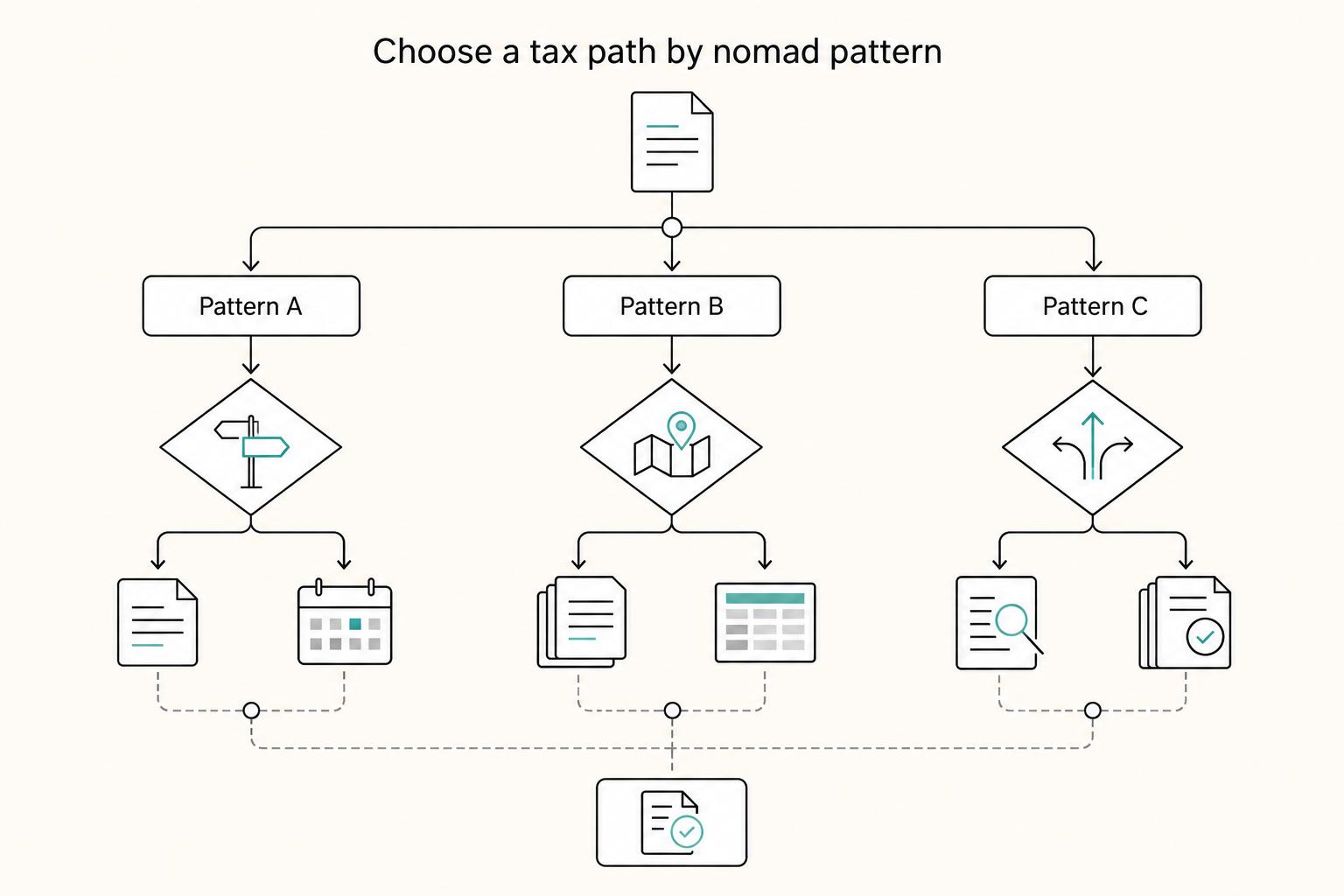
Choose Your Path Based on Your Nomad Pattern#
Choose the GST path that fits how you actually operate, then keep your records consistent with that choice.
| Pattern | Typical profile | GST path to test first | Practical tradeoff |
|---|---|---|---|
| Pattern A | Stable non-resident operating model with straightforward sales activity | Simplified GST registration | Uses an ARN, but no ABN entitlement and no GST credit claims. |
| Pattern B | Mobile operation that needs tax invoices and GST credit access | Standard GST registration | ABN required first, no electronic lodgment from outside Australia, and you may need an Australian registered tax agent. |
| Pattern C | Mixed or changing operating model across contracts and locations | Compare both paths against current invoicing and purchase needs before choosing | Potential inconsistency if registration, invoicing, and claims do not match real activity. |
Use this early filter: simplified registration references low value imported goods at A$1,000 or less. If your model depends on GST credits, simplified registration will not fit, and standard registration is usually the first route to test.
If registration is required, register within 21 days. Then run one check each cycle:
- Confirm whether registration is required now.
- Match invoice details to your current identifier, ABN or ARN.
- If using simplified registration, do not claim GST credits.
- If using standard registration from outside Australia, plan lodgment support, including an Australian registered tax agent where needed.
The table is a starting point, not a label you set once and never revisit. Pattern shifts can happen when client mix, purchase profile, or contracting style changes. When that happens, re-run the path check immediately instead of waiting for year-end. Delayed changes can make records harder to reconcile.
A practical trigger list helps here. Re-check your path when invoicing format changes, when credit claims become important, or when your ABN status changes. Re-check again if lodgment support from outside Australia becomes an issue. These can indicate that your current setup may no longer fit the way you are operating.
If the answer is still unclear after a re-check, choose the path that reduces immediate compliance risk and document why. You can refine later, but late registration, misaligned invoices, and incorrect credit treatment are harder to unwind once filings have started.
Execute the Transition in the Right Order#
Sequence is your main control point after choosing a GST path. When registration, invoicing, and lodgment move in the same order, your file stays coherent and easier to defend.
| Phase | Main action | Key point |
|---|---|---|
| Planning phase | Map your current setup and the order of admin changes. | If standard GST registration is the likely path, confirm ABN entitlement early because an ABN is required before GST registration. |
| Setup phase | Complete access and setup before filing activity starts. | If simplified registration is relevant, create AUSid; if standard registration applies, complete identity proofing and lock in BAS handling. |
| Initial operating phase | Keep contracts, invoice identifiers, registration type, and lodgment behavior in sync each cycle. | If GST registration becomes required, register within 21 days. |
| Verification checkpoint | Review the current record after each step. | Check whether registration status, invoice identifier, lodgment calendar, and payment history point to one operating model. |
- Planning phase: map your current setup and the order of admin changes. If standard GST registration is the likely path, confirm ABN entitlement early because an ABN is required before GST registration. If you are an individual carrying on an enterprise, that can support ABN entitlement. Employee-only activity does not.
- Setup phase: complete access and setup before filing activity starts. If simplified registration is relevant, create AUSid so you can use online services for non-residents. If standard registration applies, complete identity proofing and lock in BAS handling, because BAS lodgment and GST payment run monthly or quarterly.
- Initial operating phase: keep contracts, invoice identifiers, registration type, and lodgment behavior in sync each cycle. If GST registration becomes required, register within 21 days.
- Verification checkpoint: after each step, review the current record. Do registration status, invoice identifier, lodgment calendar, and payment history point to one operating model?
If these records diverge, pause and fix sequence gaps before issuing more invoices or lodging new statements. A common failure mode is doing commercial activity first and admin prerequisites later. In my experience, a one-page sequence checklist prevents most avoidable rework.
Turn the sequence into a dated checklist with owners, even if you are a solo consultant. Owner can be you, your adviser, or your agent, but each step needs one accountable person and one due date. This avoids a common handoff problem where everyone assumes someone else completed an item.
During setup, save proof of completion as you go. For example, when identity proofing is done, save that confirmation immediately in the same folder as registration records. When BAS handling is set, save the schedule and any supporting communications. This keeps evidence close to action and reduces cleanup work later.
In the initial operating phase, run a short regular review even if no filing is due that week. Check that new invoices use the right identifier. Confirm your internal treatment matches your registration path. Verify your calendar still reflects your monthly or quarterly obligations correctly. Small regular checks are lighter than a large reconstruction before lodgment.
If sequence breaks, do not keep pushing activity forward while promising to fix records later. Freeze the next filing step, resolve the mismatch, and then restart. The pause may feel inconvenient, but it is usually faster than repairing multiple periods with conflicting treatment.
Build an Evidence File You Can Defend#
A defensible file tells one consistent story over time: where you were, what your living pattern looked like, and whether your actions matched your stated intention about living in Australia. Keep one dated folder and record decisions in time order so each period can be reviewed on its own.
| Record | What to keep | Key detail |
|---|---|---|
| Timeline log | Arrivals, departures, and any period in Australia for more than half the income year | Treat those periods as key review points. |
| Usual and permanent abode record | Dated records showing your habitual living pattern | Where relevant, support that your usual place of abode was outside Australia and your permanent place of abode was outside Australia. |
| Intention record | Dated notes and actions | Show whether you intended to take up residence in Australia. |
| Status decision log | Why you treated yourself as resident or non-resident for tax purposes at each checkpoint | Note what change would trigger reassessment. |
- Timeline log: Record arrivals, departures, and any period in Australia for more than half the income year. Because the 183-day test is one of the residency tests, treat those periods as key review points.
- Usual and permanent abode record: Keep dated records showing your habitual living pattern and, where relevant, support that your usual place of abode was outside Australia and your permanent place of abode was outside Australia.
- Intention record: Keep dated notes and actions showing whether you intended to take up residence in Australia.
- Status decision log: At each checkpoint, record why you treated yourself as resident or non-resident for tax purposes, and what change would trigger reassessment.
If the file shows mixed signals, pause and reconcile the record before the next filing step. Consistency across periods is what gives your position weight.
The file should be usable by someone who has never seen your business before. That means clear file names, clear dates, and short context notes that explain why a document matters. You do not need long essays. A few lines linking document to decision are enough.
A practical structure is to keep each period in its own subfolder with the same document order every time. Repetition makes review faster and reduces accidental omissions. If you later need adviser input, you can share one period quickly instead of sending an unstructured archive.
When facts change, update the file the same day if possible. Delayed updates create memory errors, and memory errors become inconsistencies. The goal is not volume of documents. The goal is a file where each key call can be traced to a dated record without guesswork.
Spot Failure Modes Before They Become Tax Disputes#
Tax disputes often start with inconsistent records long before anyone argues technical labels. Stress-test your file before each filing step: GST status, ABN position, invoicing, and lodgment trail should all point in the same direction.
| Failure mode | What it looks like | Article note |
|---|---|---|
| Unresolved GST trigger | Registration is required, but you do not register within 21 days. | Penalties may apply. |
| Single-check tunnel vision | You rely on one compliance label while your registration, invoicing, or lodgment records point elsewhere. | Stress-test the file before each filing step. |
| Wrong registration assumptions | Simplified and standard registration are treated as interchangeable. | Simplified does not provide ABN entitlement or GST credit claims, while standard requires ABN registration, identity proofing, and BAS lodgment. |
| Non-resident lodgment gap | Under standard registration, you cannot lodge electronically from outside Australia. | You may need an Australian registered tax agent. |
- Failure mode 1, unresolved GST trigger: registration is required, but you do not register within 21 days. Penalties may apply.
- Failure mode 2, single-check tunnel vision: you rely on one compliance label while your registration, invoicing, or lodgment records point elsewhere.
- Failure mode 3, wrong registration assumptions: simplified and standard registration are not interchangeable. Simplified does not provide ABN entitlement or GST credit claims, while standard requires ABN registration, identity proofing, and BAS lodgment.
- Failure mode 4, non-resident lodgment gap: under standard registration, you cannot lodge electronically from outside Australia and may need an Australian registered tax agent.
Run this checkpoint before lodging:
- Confirm when GST registration became required and whether it was completed within 21 days.
- Confirm your registration path still matches current activity and ABN or GST credit needs.
- Confirm invoice details and records are consistent with the path you are using.
- Confirm lodgments are on schedule: quarterly for simplified registration, and as required under standard registration.
- Confirm employee activities are not being treated as ABN-eligible enterprise activity.
If checks conflict, reconcile records first. If conflict remains, get professional advice before you take a filing position. You can treat this as a pre-lodgment gate: if any critical check fails, filing stops until the issue is resolved and documented. Critical checks are registration timing, invoice record accuracy, and correct treatment of GST credits for your chosen path.
When a failure mode appears, write a short incident note. Record what happened, which periods are affected, what correction was made, and how you will prevent repeat errors. This is not bureaucracy for its own sake. It helps prevent the same problem from repeating in a later period.
Do not treat repeated minor mismatches as harmless. Small discrepancies compound over time and make later review harder. Correct them while the period is still fresh, even if the immediate dollar impact seems small.
Handle Unknowns and Rule Changes Without Guessing#
Treat possible changes to Australian GST obligations as unconfirmed until they are verified in current ATO materials. File based on rules that are clearly in force, not commentary. For current setup rules, cross-check ATO pages on registering for GST and GST pathways for non-residents.
Use a simple note split: Confirmed rule and Open question. Confirmed examples from current GST guidance include:
- If GST registration is required, register within 21 days.
- Simplified and standard GST registration are different paths. Simplified does not provide an ABN and does not allow GST credit claims.
- Standard registration includes BAS lodgment and GST payment monthly or quarterly.
- Under standard registration, if you are outside Australia, you cannot lodge electronically and may need an Australian registered tax agent.
Label unknown points directly. If a statement comes from summaries rather than current ATO guidance, mark it as pending verification and do not treat it as settled.
Apply the same discipline to cross-border assumptions. Verify each jurisdiction before aligning your Australian GST position.
Use this confirmation sequence before filing:
- Confirm local registration basis, effective date, and filing duties with a local adviser in your new country.
- Confirm cross-border interaction with an Australian adviser.
- File one aligned Australian GST position with dated notes and the exact ATO materials you relied on.
If either adviser cannot confirm a key point, treat the position as uncertain and file conservatively until verified. Keep unknowns visible between filing cycles. A short unresolved list prevents pending items from disappearing into email threads. Review that list before each major decision and close items only when you have direct confirmation.
Run an Ongoing Compliance Cadence After You Leave#
Post-departure compliance is a recurring cycle, not a one-time setup. Keep GST administration on a set schedule, and keep your day log updated in the tax residency day counter.
Start with the fixed obligations covered here: if GST registration becomes required, act within 21 days, and penalties may apply if you fail to register when required. Then follow the path that matches your registration type.
- Simplified GST registration: elect limited registration entity status, lodge GST returns, and pay GST quarterly.
- Standard GST registration: lodge BAS and pay GST monthly or quarterly.
If you are outside Australia and on standard registration, plan lodgment logistics early. You cannot lodge electronically from outside Australia and may need an Australian registered tax agent under ATO standard GST registration guidance.
Use a recurring checkpoint:
- Confirm whether GST registration was triggered and completed within 21 days.
- Confirm whether you are on simplified registration or standard registration, and apply the right lodgment and payment cycle.
- Confirm lodgment method and agent support if you are outside Australia.
- Update documentation in the same cycle when facts change so obligations and records stay aligned.
- If you are applying for an ABN, register GST and PAYG withholding together where needed.
Set the cadence on your calendar now, not when a deadline is close. Include a preparation date before each lodgment date so there is time to reconcile records and correct errors. Last-minute reviews are where small gaps are missed.
Keep one short checklist for each cycle and reuse it. Repetition improves quality because you are checking the same points in the same order. When the list changes, log why it changed so future reviews stay consistent.
Keep Money Records Audit Ready From Day One#
Audit-ready money records make GST compliance easier to verify, so set up one consistent record set from your first invoice.
For each transaction, keep enough detail for a third party to rebuild the trail. Record invoice number, issue date, payment timestamp, gross amount, GST treatment, payout reference, and destination account. Keep raw exports and working files so history remains visible.
Map records to ATO obligations as soon as they are triggered. Not every business must register for GST, but if registration becomes required, you need to register within 21 days and penalties may apply if you miss it. Keep a dated note of when the trigger was identified, who confirmed it, and what was filed.
Your registration path changes what records are most important to retain:
- Simplified GST registration: for eligible non-resident businesses, lodge and pay quarterly; no ABN entitlement and no GST credit claims for purchases.
- Standard GST registration: lodge BAS and pay monthly or quarterly; if outside Australia, electronic lodgment is not available and you may need an Australian registered tax agent.
Keep exportable logs that separate domestic and foreign flows, and tag Australia-related transactions separately from broader business income for adviser review. This supports analysis, but records alone do not determine residency status.
Use a monthly checkpoint:
- Reconcile invoice totals to payouts and flag unresolved differences.
- Export raw ledger files and store a dated copy before manual adjustments.
- Confirm your active GST path and that BAS or GST returns were lodged on time.
- If standard GST applies while you are outside Australia, save agent correspondence and lodgment proof.
- Keep classification assumptions in a short register for adviser review.
- If you use Gruv modules where enabled, keep compliance artifacts and transaction history in the same review folder.
If a number cannot be traced quickly, treat it as a red flag and resolve it before the next filing cycle. A useful pattern is to keep two views of the same data: raw exports and a reviewed ledger copy with your classifications. Raw exports preserve original detail. Reviewed copies make adviser discussions faster because assumptions are visible. Keep both with dates so changes over time are clear.
Also keep invoice checks simple and repeatable. Confirm invoice details match your active registration path for that period. When details drift, correction work grows quickly, especially across multiple clients.
When reconciliation uncovers a mismatch, resolve it immediately and leave a short note describing the correction. Notes should include period, affected amount, and reason for the change. This avoids repeating the same investigation later when memory has faded.
Conclusion#
Consistency is what makes this workable: your facts, filings, and documents should point to the same story, and GST guidance should not be used to force a residency outcome.
If your situation is mobile or mixed, use conservative assumptions until your evidence is clear. Keep residency analysis separate from GST administration, because registration choices are compliance pathways, not residency proof.
Anchor action to the hard GST checkpoints. If registration is required, register within 21 days; the turnover trigger is $75,000; and penalties may apply if you fail to register when required.
For non-residents, choose the GST path based on tradeoffs you can defend:
- Simplified registration lets you register, lodge, and pay online. It starts with AUSid and issues a 12-digit ARN, but you cannot issue tax invoices or claim GST credits.
- Standard registration fits businesses entitled to or holding an ABN. BAS obligations are monthly or quarterly, and you may need an Australian registered tax agent because electronic lodgment is not available from outside Australia.
Keep a clean evidence file with dated decision notes, revenue tracking, registration records (ABN or ARN), and BAS lodgment or payment confirmations where relevant. If narrative and documents conflict, pause and escalate before lodging.
Take one practical next step today: run the checkpoint lists in this article against your current period and mark each item pass, fail, or unknown. Fix fail items first, verify unknowns with current guidance or advisers, and then lock your filing position. That sequence reduces surprises and keeps your position defensible over time. If you need a broader framework, revisit the digital nomad tax guide, validate day counts in the tax residency day counter, and confirm what is supported for your specific country or program by talking to Gruv.
Frequently Asked Questions
Is being outside Australia enough to become Non-resident for tax purposes?
Not on its own. GST registration and business tax administration are separate questions from residency status tests. Check current residency-specific guidance before you treat your status as settled.
What is the practical difference between Resident for tax purposes and Non-resident for tax purposes?
GST compliance mechanics for non-resident businesses, including registration pathways and ongoing lodgment obligations, are a separate question from residency status. Keep residency analysis separate from GST administration so you do not rely on the wrong rules.
What are the four Tax residency tests the ATO uses?
Use current residency materials for the test names, definitions, and how they are applied.
Does the 183-Day Test decide everything for a Digital nomad?
Nothing here applies the 183-day test to your facts. These sources cover GST pathways such as simplified and standard registration. Use them for GST compliance, not for residency outcomes.
What evidence best supports a Permanent place of abode outside Australia?
Use residency-specific guidance or professional advice for what evidence is expected to support a permanent place of abode claim.
Can the ATO challenge my position years after I leave?
If GST registration is required, you must register within 21 days. Under standard GST registration, BAS lodgment and GST payment are required monthly or quarterly. For ATO challenge windows on residency positions, verify with residency-specific guidance.
Are stricter Australian tax residency changes already in force or still uncertain?
Related GST materials show different page update dates, including 23 May 2025 and 11 September 2025. Verify what residency law changes are currently in force in residency-specific guidance before filing.
Try a related tool
Researched and edited by the Gruv editorial team. Gruv builds cross-border billing, payouts, and finance-operations software for global businesses.
Sources
Educational content only. Not legal, tax, or financial advice.
Related Posts

Digital Nomad Taxes in 2026 With a Defensible Filing Plan
With digital nomad taxes, the first move is not optimization. It is figuring out where you may be taxable, where filings may be required, and what proof supports that position.

How to Write a Freelance Proposal That Wins Clients
Most guidance on how to write a freelance proposal focuses on persuasion. That is only half the job. Your proposal also needs to hold up once the client says yes. Vague language creates misunderstandings and arguments about whether the work was actually done.
The Best Tools for Creating Professional Presentations
Use a 2025-2026 validation sweep each quarter: confirm one monthly software baseline ($15/month), one collaboration baseline ($30/month), and one premium workflow baseline ($60/month) before changing client-facing tool commitments.