
Quick Answer
Model working capital needs for a fast-growing payment platform by starting with the funding decision, then tracing route-level cash timing from collection to operational availability to payout. Build a monthly cohort base case using real transaction data, DSO, effective DPO, settlement delays, and payout design. Then stress-test growth and delay scenarios so you can see when volume creates a funding gap before margins do.
Start With the Cash Timing That Actually Drives the Model#
Fast growth in payments can become a liquidity problem before it looks like a margin problem. Collections, settlement, and payouts can drift out of sync. You can post healthy revenue and still carry a real funding gap between when cash goes out and when it comes in.
Start by reframing growth as a liquidity problem#
Start by aligning on terms. Working capital is current assets minus current liabilities, and working capital requirement is the cash needed to run day-to-day operations.
That framing matters because teams can track growth, take rate, and gross profit while the real pressure sits in timing. In a growing company, weak working-capital dynamics can leave the business cash-strapped even with a strong income statement. High growth can also reduce free cash flow when working-capital demands rise.
Your first checkpoint is simple. Map the actual lag between customer collection, operational fund availability, and merchant or partner payout. If you can only see booked revenue by month, you do not yet have the operating view you need.
Connect monetization choices to the funding gap#
Monetization choices are cash-timing choices. Changes to payout speed, fund access, disbursement structure, or cost recovery can increase funding needs even when headline unit economics look better.
Payment-system design sits at the center of this. Fast payments are near-real-time transfers that can make recipient funds available immediately, and they are now available in over 100 jurisdictions. Do not assume every market gives you the same timing buffer between inflows and outflows.
Avoid the opposite simplification. Slower payments do not automatically improve working capital. In some designs, paying faster creates better economics. Virtual cards can add 60+ days of float, and early-payment discounts can imply approximately 36% APY. The real question is whether your timing design creates value or just hides risk.
Force one shared decision across founder, product, and finance#
The point is not a cleaner spreadsheet. It is one shared decision: which growth moves you can fund safely now, and which require a different operating design first.
If you cannot state that decision in one sentence, pause and simplify. A useful test is: "Can we support this quarter's planned volume and payout design without creating a funding gap that must be financed?"
From there, model real money movement, not an idealized flow. For a deeper timing breakdown, read payment timing and cash position.
Related reading: How to Set Up a Multi-Entity Payment Structure for Global Platform Operations.
Define the exact decision your model must support#
Decide the question first. Are you prioritizing faster growth this quarter, or protecting working capital while you grow? If the team cannot align on that tradeoff, pause there. A precise model still fails the real test if you cannot pay bills, suppliers, and employees on time.
State the decision as a one-sentence yes-or-no prompt tied to a time window. For example: can planned growth be funded without creating a working-capital gap? Keep the definition explicit: working capital is current assets minus current liabilities, with attention to assets that convert to cash within a year.
Then lock scope to flows you can measure now. Include the main collection and payout paths you can trace with real reporting. Exclude routes you cannot reliably track from collection to cash availability to payout.
Use the small control stack the leadership team already trusts. Track working capital and cash flow with one or two existing operating metrics; when working-capital demands are high, faster growth can still reduce free cash flow. Do not invent a new scorecard just for this model. Capture the decision, included and excluded flows, and metric stack in a one-page note. If that note cannot get agreement, the model is not ready.
Gather the minimum input pack before you model#
Build the smallest evidence pack that explains cash timing in your real operation, not in a clean spreadsheet. If an input cannot be tied to internal records, current policies, and a named owner, treat it as uncertainty.
Pull transaction-level cash data#
Use raw collections and disbursements at the event level, not monthly rollups. For each route, capture when money was collected, when it became operationally available, when payout was initiated, and when payout completed. Where you have multiple collection or payout paths, flag each path so you can test whether reconciliation behavior or time to usable funds differs.
Keep push and pull flows separate, and keep payout routes separate. Transaction flow, message flow, and settlement structure differ by route, so a single blended average will hide timing risk.
As a quick trust check, sample recent transactions across core routes and confirm every timestamp maps back to source reporting without guesswork.
Record timing assumptions that actually drive working capital#
Capture the timing inputs you will model: customer payment timing, effective vendor payment behavior, and known settlement delays visible in operations. Use effective behavior, not contract language. If customers are paying more slowly, or your team is paying bills early, model those behaviors directly.
For vendor terms, record agreed terms, usual payment date, and exceptions by major cost line. Supplier payment delays can create downstream stress, so longer terms on paper are not the same as terms that hold up in practice.
Your verification pack should include collection-lag evidence, vendor-term schedules, and recent settlement-delay exceptions. Mark any verbal estimate as uncertain.
Align live operational gating points#
If your operation includes KYC, KYB, or AML checks, create one shared view across product, risk, and finance of the current gates, trigger events, and release events.
Model gated reality, not the happy path in product docs. If funds are paused for verification or monitoring review, include that timing in your assumptions. A practical check is to review recent delayed-funds cases and confirm the model can explain each one using current gates.
Log real demand for platform-based lending from your own book#
If you see requests for platform-based working capital support in sales notes, support tickets, account reviews, and renewal conversations, log them as scenario inputs. Tag requests by segment and stated need.
Use this to test concentration risk, not to prove a market narrative. If demand signals are directional or incomplete, keep them in scenarios rather than the base case.
Create a lightweight intake sheet tied to the same one-page decision note, with one owner, one current answer, and one evidence source per input.
If you want a deeper dive, read Working Capital Management for Payment Platforms: How to Optimize Cash Between Collection and Disbursement.
Map cash timing across your actual money lifecycle#
Once the input pack is grounded, trace the money route step by step. If you cannot show when cash is collected, operationally available, and actually spendable, your baseline can understate timing risk.
Build a route-level lifecycle map#
Create separate maps for routes that behave differently in practice, including cross-border payout routes, so timing differences stay visible instead of getting averaged away.
| Step | Checkpoint |
|---|---|
| 1 | Customer payment event |
| 2 | Provider or partner confirmation |
| 3 | Internal ledger recognition |
| 4 | Funds operationally available |
| 5 | Payout initiation |
| 6 | Payout completion |
| 7 | Reconciliation complete |
If timing definitions are unclear on a route, mark them as unresolved and assign an owner. If a step changes receipt identification, balance visibility, or reconciliation handling, mark that transition explicitly.
Mark three cash states at each step#
At every step, record three separate cash states:
| Cash state | What to mark | Evidence to use |
|---|---|---|
| Collected | When payment is treated as collected in your operating structure | Processor records, contracts, flow design |
| Operationally available | When operations or treasury can act on funds | Ledger events, provider credit confirmation, balance reports |
| Spendable | When funds can be used or released after applicable controls | Hold-release events, payout eligibility status |
Do not collapse these into one timestamp. Use the event that proves the state change, and note where that proof lives.
Separate synchronous and asynchronous events#
Label each step as synchronous or asynchronous so the model reflects real operations, not product-surface timing. If status can change later, treat it as asynchronous and model the transitions, for example initiated, pending, released, and completed, rather than a single success timestamp.
Fast payment systems are being developed globally, but "fast" should not be treated as proof that every downstream state is immediate, final, or spendable for your operation. This matters most when payout timing certainty matters to sellers, creators, or gig workers.
Add one failure mode per step and map the cash impact#
For each step, log one realistic failure mode, its trigger, owner, and cash consequence. Useful examples include provider or partner delays, reconciliation exceptions, or cross-border payout friction.
Then apply the modeling rule:
- If a failure is recurring and evidenced, include the delay in baseline timing.
- If it is plausible but weakly evidenced, place it in downside scenarios.
- If ownership or evidence is missing, treat that handoff as unresolved risk.
This is how step-level exceptions turn into cash-flow pressure without pretending to know more than you do. We covered this in detail in How to Build a Deterministic Ledger for a Payment Platform.
Build a base-case model in monthly layers#
Build the base case in monthly cohorts so you can see when growth appears to fund itself and when it may create a cash gap. A single blended annual view can hide timing pressure that shows up in real operations.
Keep this model narrow by design. It should answer one cash question under your current operating setup. One model cannot do every job, so give clear ownership to treasury and the CFO and keep assumptions auditable.
Start with a monthly cohort spine#
Start with a monthly cohort spine that runs from commercial activity to spendable cash. For each month, track at least four blocks by product line or route: transaction volume, fee or revenue generation, cash in, and cash out. Then calculate monthly net working-capital change and cumulative impact.
Keep products separate when timing differs in reality. Blending a core payment flow, a faster payout product, and a lending product into one line can hide which line starts consuming cash first.
Use reconciliation as the first trust check. Validate one closed month against ledger entries, processor settlement reports, payout files, and bank movement before relying on forecast outputs.
Make timing assumptions explicit as monthly drivers#
Make timing assumptions explicit as monthly drivers, not side notes. At minimum, include expected Days Sales Outstanding, effective Days Payment Outstanding, and when customer acquisition cost actually leaves cash.
| Monthly driver | What to include | Modeling note |
|---|---|---|
| Days Sales Outstanding | Expected Days Sales Outstanding | Use operating reality for each assumption |
| Days Payment Outstanding | Effective Days Payment Outstanding | If contracts say one thing but payment behavior shows another, model the effective pattern you can prove |
| Customer acquisition cost timing | When customer acquisition cost actually leaves cash | When CAC is paid now and related cash inflow arrives later, the cohort can create a real funding need |
Treat acquisition timing carefully. If an assumption cannot be evidenced, mark it unresolved instead of smoothing it into an average.
Model real-time payments and virtual cards in separate liquidity lines#
Model real-time payments and virtual cards in separate liquidity lines rather than assuming faster rails always help. Keep any liquidity impact as an assumption to test unless your operating design or partner documentation proves the direction.
Make settlement structure explicit in the assumptions. Deferred net settlement and real-time settlement are distinct models, so separate inbound availability effects from outbound timing pressure and toggle them independently.
If direction is not proven from operating design or partner documentation, keep the base-case impact neutral and test alternatives in scenarios instead. Do not treat instant as proof that legally collected, operationally available, and spendable cash all move at once.
If loan originations are in scope, treat them as a separate module#
If loan originations are in scope, treat them as a separate module, not blended revenue, so credit-driven cash exposure stays visible. Show origination cash outflows separately from fee income and repayment inflows, and document funding ownership clearly.
Keep the lending module linked to the base case but structurally separate from core payments economics. That separation can surface financing pressure earlier, before reactive cash handling forces emergency financing decisions.
Use a compact base-case comparison by product line:
| Product line | Timing assumptions to populate | Cash gap month | Primary sensitivity driver |
|---|---|---|---|
| Core payment processing | DSO for fee collection, effective DPO to partners and vendors, settlement lag | Model output | Collections timing versus partner and vendor payments |
| Payouts using real-time payments or virtual cards | Inbound availability timing, payout release timing, settlement model used | Model output | Payout design relative to rail speed |
| Loan originations (if in scope) | Funding-out timing, fee recognition timing, repayment timing | Model output | Principal deployment pace versus cash return |
When this is done well, the base case becomes an operating affordability view, not just a revenue forecast with a cash tab attached.
For a step-by-step walkthrough, see Days Payable Outstanding (DPO) for Marketplaces: How to Optimize Working Capital Without Hurting Sellers.
Stress-test the model with growth and delay scenarios#
Stress testing is where you find out whether growth is actually financeable. A single forecast can create false confidence, and fast growth can still produce cash strain when working-capital timing breaks.
Start from the monthly baseline#
Start from your monthly baseline and keep its structure intact. The baseline is your normal-state view, so scenario work should change assumptions, not rebuild the model.
Pressure-test only what you can see in real cash timing. If inflows and outflows are not visible by month, scenario outputs may look precise while staying unreliable.
Run a minimum set of growth and delay scenarios#
Run at least three scenarios, then add a delay-focused downside case if timing risk is material. Use a base case, an upside case, and a downside case as your minimum.
Keep shocks severe but realistic so you can evaluate resilience under revenue drops, funding delays, or cost spikes.
| Scenario | Trigger condition to model | Expected working-capital impact | Pre-agreed management action |
|---|---|---|---|
| Base case (planned growth) | Volume and pricing follow baseline assumptions | Reference point for cash-gap timing and recovery | Run to plan and monitor monthly variance |
| Upside case (faster-than-planned growth) | Volume rises faster than baseline assumptions | Working-capital needs can rise before cash conversion catches up | Prioritize timing fixes before increasing growth spend |
| Downside case (revenue/cost pressure) | Revenue drops and/or costs rise versus baseline | Cash strain can appear earlier and persist longer | Reforecast liquidity and sequence spending more conservatively |
| Delay-focused downside | Funding timing slips relative to baseline | Cash availability lags operating needs | Separate timing effects from demand effects and adjust plan cadence |
Set decision rules before you review outputs#
Set decision rules before you review outputs. If the cash gap appears before expected margin gains, treat it as a timing problem first. That usually means slowing new acquisition spend until cash-conversion timing is corrected.
Treat downside shocks as operating scenarios#
Treat downside shocks as operating scenarios, not a side note. When revenue drops, funding is delayed, or costs spike, the gap between incoming cash and outgoing cash can widen quickly.
Use that case to test whether your plan still holds if funds stay unavailable longer than expected, even when top-line growth stays on track.
If your delay scenario exposes cash gaps between receipt and disbursement, review Virtual Accounts before you change growth spend.
Choose monetization levers by cash impact, not only margin story#
Choose monetization levers by cash timing first, then by the margin story, especially when growth may be pressuring liquidity. Use this screen before you add or expand any lever:
| Decision test | What to do now |
|---|---|
| Is the upside mostly forecasted? | Treat it as forward-looking and plan for variance instead of funding to the best case. |
| Is performance shown with a non-GAAP metric? | Keep it supplemental, and anchor decisions to GAAP and your own cash reporting so comparisons stay honest. |
| Does a recurring revenue model still require front-loaded spend or faster payouts? | Do not assume stronger margin optics will improve cash timing; validate with your own operating data first. |
| Does the lever improve near-term fee capture but delay collections versus obligations? | Treat it as a potential cash-timing risk and require internal scenario testing before sequencing it. |
| Can you improve collection timing with less complexity? | Prioritize that path only when internal cash reporting confirms the impact. |
Keep one explicit do-not-do-now list for attractive ideas that could worsen working-capital timing under current constraints.
Decide when to use lending versus treasury levers#
Do not default to platform-based working capital lending. First test whether treasury mechanics can shrink the cash gap without adding loan exposure.
Start with one-page comparisons of non-credit levers versus lending. If your funding gap is already covered by a line of credit, test timing fixes before adding a new lending module.
| Lever | What to test in the model | Practical upside | Red flag |
|---|---|---|---|
| Vendor payment terms | Whether you can increase DPO without damaging supplier behavior | Direct timing improvement | Supplier friction or offsetting pricing changes |
| Virtual cards or payables tools | Whether payment float increases average AP balance | Can add 60+ days of float, depending on terms | Low supplier acceptance can offset float assumptions |
| Payment-rail optimization, including real-time payments where appropriate | Whether inflows move earlier than outflows | May reduce settlement lag in some operating designs | Outflows speed up more than collections |
Keep the model mechanical. Treasury levers should narrow the funding gap through DIO/DSO reductions or DPO increases before you assume new lending volume is the answer.
Start with a simple rule. If funding demand is high but credit visibility appears thin or unstable by your own criteria, improve timing first through term design and rail choices before expanding lending exposure. For real-time payments, verify the before-and-after effect on cash-gap days in your operating design. Faster rails do not automatically improve working capital.
Also account for adoption risk. Timing gains can stall when users adopt only if others adopt, and low expected uptake can reinforce itself. If benefits depend on merchant, supplier, or counterparty behavior change, validate acceptance and route coverage in a limited segment before scaling assumptions.
Use a second rule here. If your internal risk controls and cohort performance data are strong enough for your own thresholds, limited lending expansion may be considered. Keep lending as a separate module with explicit exposure and funding assumptions.
Treat outside market narratives as directional only. They can help frame questions, but your operating truth is your own data. The outside lending evidence includes mortgage-market findings, so use it as a tradeoff warning, not direct proof for payment-platform working-capital decisions.
Add policy gates and governance before scaling changes#
Before you scale any timing or lending change, lock the governance first. Features that improve payment speed can also change cash availability, control exposure, and compliance load, so product, finance, and risk need to approve the same decision before rollout.
Set a cross-functional launch gate#
Set one approval checkpoint for any change that affects working capital, including payout speed, settlement timing, or new funding features. Product should own customer and operational impact, finance should sign off on the cash-impact assumption, and risk or compliance should sign off on control impact before release.
This is especially important for fast-payments changes. Implementation and launch choices can affect adoption outcomes. If adoption shifts, your liquidity assumptions can shift with it. Keep one verification rule: no launch ticket closes until the modeled cash-impact assumption and named approving owner are attached.
Require explicit AML and control sign-off#
Treat faster payouts as a policy change, not just a UX win. Regulators are raising AML expectations for payment companies, so require written sign-off stating whether AML review points or related verification steps change, whether funds become available before controls complete, and how exceptions are handled.
The core red flag is payout speed increasing while controls remain designed for the old timing. If a change enables earlier funding access or spendability, require a clear yes-or-no decision on updates to hold logic, monitoring, or escalation before launch. A generic "compliance reviewed" note is too weak.
Make every assumption change auditable#
Log every material model change in a decision log. Record:
| Log item | What to record |
|---|---|
| Assumption changed | the assumption changed |
| Reason | why it changed |
| Owner | the owner |
| Approvers | approvers across product, finance, and risk |
| Effective date | the effective date |
| Rollback trigger | the rollback trigger if production results diverge |
Auditability is a control, not overhead. It helps prevent a common failure mode: teams overweight consumer-support narratives and underweight user vulnerability or concentration risk as platformisation expands. If a major assumption is not traceable to a named owner and approval, do not scale it.
Common modeling mistakes and how to recover quickly#
The most common breakdown is unrealistic logic, not spreadsheet math. A model can look clean and still fail if adoption, growth shape, or cash behavior is too optimistic.
Re-cut growth around cash timing#
Strong bookings or reported revenue do not automatically solve liquidity. Rebuild from bottom-up drivers and cash timing: when cash is collected, when costs land, and when funds are actually usable.
Use one hard checkpoint: the model reconciles across all 3 statements: P&L, balance sheet, and cash flow. If revenue improves while cash tightens, treat that as a signal, not an error.
Separate lending from core payments economics#
If lending is part of the business, model it as a separate module, run distinct downside cases, and then reconnect it to consolidated cash flow so you can see what is driving the result.
A quick validation is that you should be able to turn the lending module off and still read base payments performance clearly.
Add control friction and failed states#
Avoid scenarios that assume operating controls always run smoothly. Include delays, exception queues, and failed states in scenario inputs so cash availability reflects operating reality.
For payment-specific controls such as KYC, KYB, and AML, treat exact timing as unknown until you validate it with your own data.
If volume scales smoothly in the model while controls stay invisible, the forecast is likely overstated and fragile under diligence.
Use benchmarks as prompts, then calibrate to your data#
Benchmarks are useful for questions, not default assumptions. Industry narratives can reflect trends and interests, so treat external examples as prompts to test your own model logic.
Then calibrate to your transaction history and operating patterns. If an assumption cannot be supported by your own data, keep it out of decision-critical projections.
Related: How to Scale Global Payout Infrastructure: Lessons from Growing 100 to 10000 Payments Per Month.
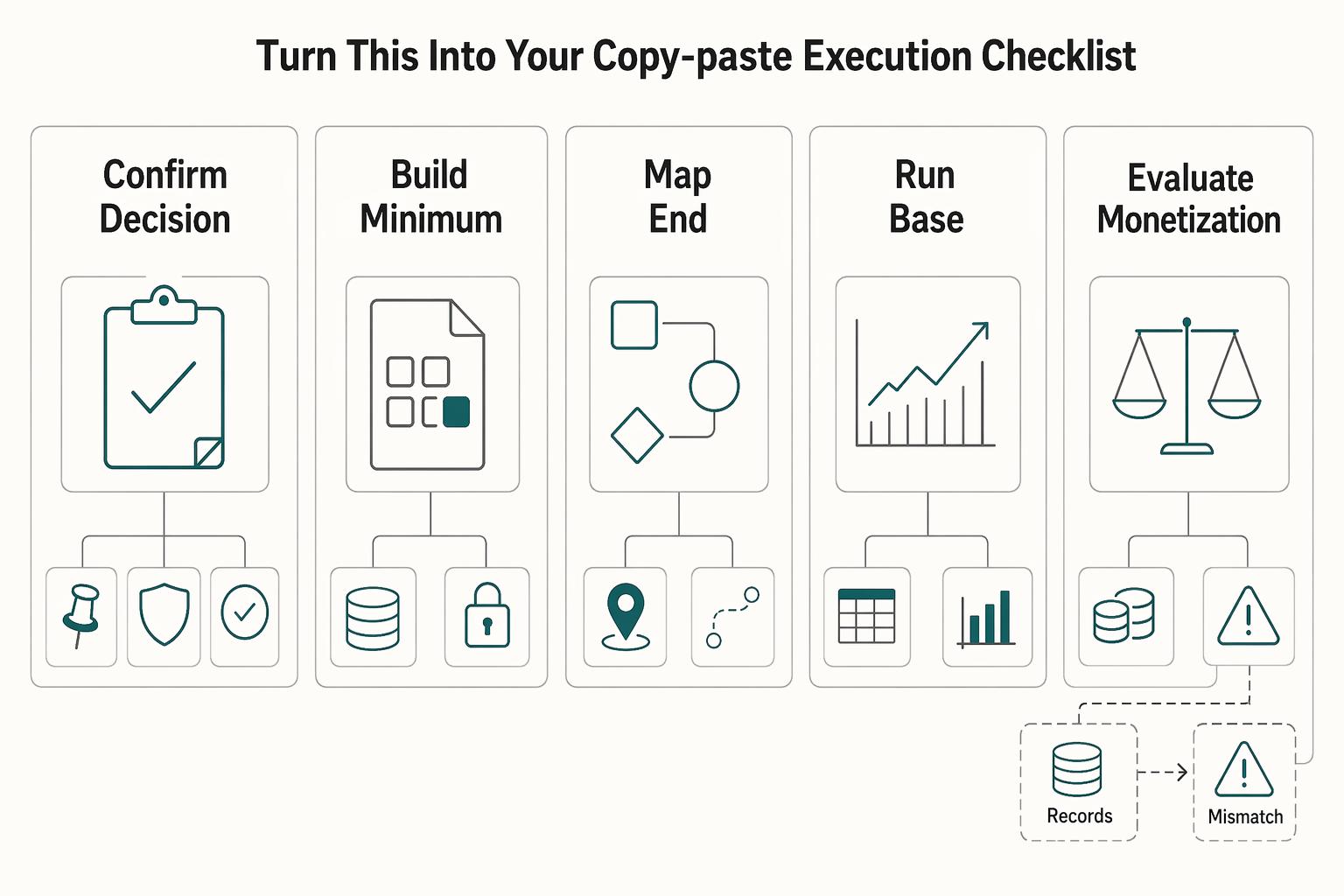
Turn this into your copy-paste execution checklist#
Use this checklist to make a clear working-capital decision before growth creates a cash squeeze.
- Confirm the decision, owner, and success metric.
Write one sentence for the decision you are making now, assign one accountable owner, and set the next review date. If product, finance, and risk describe the decision differently, resolve that scope first.
- Build the minimum input pack.
Keep one dated assumption pack for timing and cost inputs. Save the source artifact for each material assumption so changes are visible when you re-check the model.
- Map end-to-end cash timing and log failure modes.
For each major flow, record when cash is collected, when it becomes available internally, and when it is spendable. Log failure modes per flow, and treat urgent incoming-payment checks or vendor delay requests as stress signals.
- Run base and delay scenarios, and add upside if useful.
Keep scenario views in one file and define the action tied to each one. Trigger actions from observed cash-timing changes, not from expected growth alone.
- Evaluate monetization levers on cash timing and margin.
Compare options on how quickly they improve cash timing and on margin potential. Review expected impact on Cash Conversion Cycle, Days Sales Outstanding, and Days Payment Outstanding before prioritizing fee capture.
- Document governance gates before launch.
Require product, finance, and risk sign-off on the operational change, cash impact, and rollback condition. Store approvals, assumption version, and launch date in the same decision log.
- Set a recurring recalibration cadence.
If monthly fits your operating rhythm, use it to compare assumptions against actual cash movement and update only what changed. The goal is to catch drift early, before revenue growth leaves you cash-strapped.
When you move from model decisions to implementation, use the Gruv docs to map policy gates, payout states, and reconciliation into your operating flow.
Frequently Asked Questions
How should a fast-growing payment platform estimate Working Capital needs without overfitting the model?
Use a small, auditable assumption set tied to dated artifacts, current policies, and named owners. Start with observable buckets and only include flows you can trace from collection to cash availability to payout. If an input cannot be tied to current documentation or source reporting, treat it as uncertainty rather than precision.
Why doesn’t strong top-line growth guarantee healthy cash position in a Recurring revenue model?
Strong top-line growth does not guarantee a healthy cash position because collections, settlement, and payouts can drift out of sync. A company can post healthy revenue and still carry a real funding gap between cash out and cash in. Re-check the model against actual cash movement, not revenue alone.
Which levers usually move cash position faster: Vendor payment terms, Real-time payments, or lending expansion?
There is no universal ranking for vendor terms, real-time payments, and lending expansion. Model each lever separately against your own flow data and test the timing impact before deciding. Treasury mechanics should be tested before assuming new lending volume is the answer, and faster rails do not automatically improve working capital.
When does Platform-based working capital lending become a strategic advantage instead of a risk amplifier?
Platform-based working capital lending becomes strategic only when cross-functional alignment and explicit ownership are clear. Test timing fixes and treasury levers first, then consider limited lending expansion only if your internal risk controls and cohort performance data are strong enough for your own thresholds. Keep lending as a separate module with explicit exposure and funding assumptions.
How do Days Sales Outstanding and Days Payment Outstanding change the practical funding plan?
Use DSO and DPO as monthly timing drivers based on operating reality, not just contract language or external benchmarks. Adjust the funding buffer from your measured cash-in versus cash-out gap, then confirm the effect in actual cash movement before reducing funding dependence. Effective payment behavior matters more than paper terms.
What assumptions are most dangerous when benchmarking against PayPal, Shopify, or Block?
The biggest risk is assuming one public pricing view applies universally and stays stable over time. Fee treatment can vary by market or region, domestic versus international classification, and grouped markets, and exceptions can apply. FX or issuer-bank costs may still apply even when a fee is waived.
What is still unknowable at planning time, and how should teams handle that uncertainty in decisions?
Future fee and policy changes are not fully knowable at planning time. Handle that uncertainty with bounded scenarios, frequent assumption refreshes using dated checkpoints and Policy Updates, and a shared assumptions pack so teams stay aligned.
Researched and edited by the Gruv editorial team. Gruv builds cross-border billing, payouts, and finance-operations software for global businesses.
Sources
- bis.org/publ/qtrpdf/r_qt2403c.htmtrusted
- bis.org/publ/bppdf/bispap152.pdftrusted
- fastpayments.worldbank.org/sites/default/files/2021-11/Fast%20Payment%2...trusted
- fastpayments.worldbank.org/sites/default/files/2023-05/Settlement%20Not...trusted
- fdic.gov/analysis/cfr/bank-research-conference/annual...trusted
- federalregister.gov/documents/2025/11/18/2025-20211/enhanced-tra...trusted
- kellogg.northwestern.edu/faculty/mezzanotti/documents/technology_adop...trusted
- pmc.ncbi.nlm.nih.gov/articles/PMC10281586trusted
Educational content only. Not legal, tax, or financial advice.
Related Posts

The Freelance Payment Penalty: A Modeled Audit of Platform Fees, FX Spreads, and Payout Delays
The money rarely disappears through a single, easy-to-spot fee. The real loss is stacked. A marketplace takes its commission, a processor adds a charge for international cards, a bank or payment company converts the currency at a spread, a platform holds the funds before release, and a wire sheds a little to intermediaries on the way in. Each layer looks defensible on its own, but the worker feels the combined result as a smaller deposit and a later payday.

How to Respond to a Subpoena for Business Records
Move fast, but do not produce records on instinct. If you need to **respond to a subpoena for business records**, your immediate job is to control deadlines, preserve records, and make any later production defensible.
A US Expat's Guide to Investing in UCITS ETFs to Avoid PFIC Issues
The real problem is a two-system conflict. U.S. tax treatment can punish the wrong fund choice, while local product-access constraints can block the funds you want to buy in the first place. For **us expat ucits etfs**, the practical question is not "Which product is best?" It is "What can I access, report, and keep doing every year without guessing?" Use this four-part filter before any trade: