
Quick Answer
Set up a multi-entity payment structure by assigning a named legal entity and owner to every collection, payout, refund, hold, and return flow before choosing processors or rails. Build a minimum evidence pack, lock a narrow 90-day scope, validate collection and payout rails by market, set entity-level FX and compliance rules, and launch one corridor first with traceable reconciliation, idempotent retries, and webhook controls.
What the Structure Needs to Handle#
Start with accountability, not a vendor demo. In a multi-entity payment structure for global platform operations, one of the first decisions is where risk, money movement, and decision rights sit. That choice shapes processor account design, exception approvals, and reconciliation effort.
This matters because cross-border payment services are supervised differently across jurisdictions, and treatment is not fully consistent across bank and non-bank providers. Cross-border payment data is also subject to rules on how it is collected, stored, managed, and transferred. If you choose rails before ownership is clear, you can end up collecting in one entity, paying out from another, and leaving ownership of the customer, balance, AML decision, and exception queue unclear.
Start with a minimum evidence pack#
Build the minimum evidence pack before you choose a structure. Include:
- A list of each entity in scope, with legal name, country, and LEI if available. An LEI is a unique 20-character alphanumeric identifier linked to verified reference and ownership data.
- A simple money-flow map for each product surface, such as contractor payouts, creator payouts, marketplace settlement, or B2B collections.
- Current and planned processors, bank accounts, wallets, and treasury owners by entity.
- A short note on where payment data is created, stored, reviewed, and transferred across borders.
The goal is simple: finance, ops, and engineering should align on one entity list and one set of payment flows.
Name the accountable entity for every flow#
For each flow, define the accountable entity before you compare tools. For every collection, payout, refund, hold, and return path, name:
- The contracting entity
- The entity that receives funds
- The entity that releases funds
- The team or person approving exceptions
If those four items are not named, the architecture is still abstract.
Apply the FATF risk-based approach at the entity level. Identify, assess, and understand ML/TF risk exposure, then place proportional controls where ownership actually sits. One common mistake is treating compliance as a processor setting instead of an entity responsibility.
Set a 90-day scope you can actually prove#
Set a 90-day scope that is narrow enough to ship and broad enough to prove control. Treat 90 days as a decision and first-implementation horizon, not as a promise that every entity and market will be live. In practice, this may mean one production corridor, one or two entities, one primary collection rail, one payout rail, and a reconciliation method finance can run reliably.
Make the tradeoff explicit. Speed can mean fewer entities and less local autonomy. More control can mean more operational overhead, intercompany handling, and approval logic. If scope includes too many corridors or processor migrations at once, you may not see the real constraint clearly.
Use this guide as a working sequence#
Use the rest of this guide as a working sequence, not as a claim that regulators require a fixed order. Moving through entity design, processor selection, FX policy, compliance gates, and reconciliation checkpoints is a practical way to surface risk early and assign clear owners.
By the end, you should have a structure choice, a named owner for each entity and flow, a processor shortlist by market, and documented control points that finance, ops, and engineering can execute together. If any planned flow still lacks an accountable entity or a traceable approval path, stop and resolve that first.
If payout volume is growing quickly, see How to Scale Global Payout Infrastructure: Lessons from Growing 100 to 10000 Payments Per Month.
Do you need a multi-entity structure now#
If your real problem is entity ownership and reporting control, a multi-entity model is usually the better fit. If the real problem is only payout execution speed, keep your current design and fix payout workflows and AP automation first.
Compare your current state with the target state#
Compare your current state with the target state in plain language before you change tools.
| Dimension | Single legal entity with centralized flows | Multi-entity structure with localized operations and consolidated reporting |
|---|---|---|
| Accountability | One entity contracts, receives, and pays across most flows | Each entity owns defined flows in its market or product area |
| Compliance load | Simpler at first, but cross-jurisdiction exceptions often accumulate in one queue | More local setup, but responsibility sits closer to the regulated activity |
| Reporting and control | Faster group-level view, but weaker entity-level control when exceptions sit outside core flows | Entity-level records with group-level consolidated financial statements when a parent controls subsidiaries |
The tradeoff is usually straightforward: centralization can buy speed early. Localization can improve control boundaries and entity-level reporting, but it adds operating overhead.
Use hard triggers instead of intuition#
Consider moving when these issues recur, especially in combination:
| Trigger | What recurs |
|---|---|
| Cross-jurisdiction compliance friction | A centralized approval queue struggles to absorb it, especially where AML/CFT implementation differs by country |
| Repeated intercompany workarounds | One entity keeps collecting or paying for another, and finance must repeatedly defend transfer-pricing logic under the arm's length principle |
| Processor coverage or onboarding gaps | By country or entity type, including payout capability differences across markets |
Fix the cheaper bottleneck first#
If your bottleneck is invoice matching, approval routing, payment origination, reconciliation, or reporting, prioritize AP automation first. If the bottleneck is unclear entity ownership of balances or weak month-end reporting control, consider moving to multi-entity operations.
The usual mistake is misreading processor friction as a structure problem, or restructuring too early and creating intercompany overhead finance cannot support.
Get a decision matrix before you build#
Before you build, produce a one-page decision matrix with explicit alignment from finance, product, and engineering. Include each flow, accountable entity, current workaround, stay-centralized versus localize trigger, processor or compliance blocker, and named owner.
If any flow still has unclear ownership or temporary intercompany handling, pause and resolve that first.
Related: Platform Operator Legal Entity Structure: C-Corp vs LLC for US Payment Businesses.
Define your entity map and money boundaries#
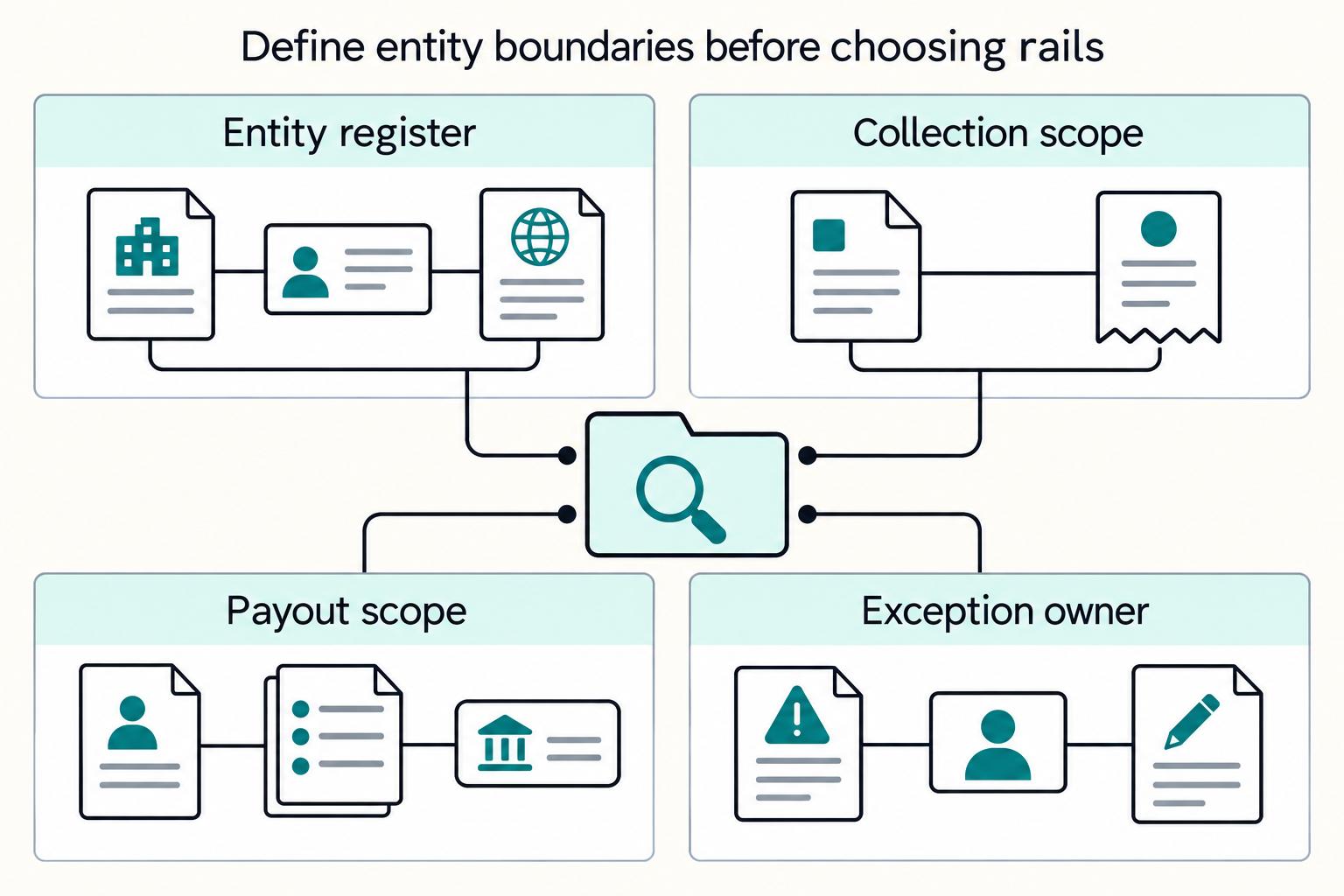
Set entity and money boundaries before you configure any payment rails. Create a working matrix for each entity that states what it can collect, what it can pay, and where intercompany flows are expected, tolerated, or blocked.
Build an entity register first#
Start with an entity register, not an org chart. For each entity, record its operating purpose, markets, product surfaces, and the identity data providers may verify: legal name, address, and tax information.
If you cannot state what money an entity may receive or disburse, treat that as a control gap. Remove catch-all language like "can process global payments if needed," because it can become a fallback route for misrouted funds.
Choose your treasury stance up front#
Choose your treasury stance explicitly: centralized treasury with local execution, or localized treasury with entity autonomy. Neither is universally better. Centralization can improve control and efficiency. Decentralization can fit local regulatory and business conditions better.
A group treasury can coordinate execution, but paying on behalf of another entity requires a permitted legal and provider arrangement. Document agency, funding, bank ownership and intercompany due-to/due-from entries. Assess arm’s-length pricing for relevant related-party services; a shared corporate hierarchy alone does not authorize cross-entity money movement.
Either model still needs to support consolidated reporting. Your map has to work for day-to-day operations and for parent-subsidiary reporting as one economic unit.
Tie boundaries to product surfaces#
Tie boundaries directly to product surfaces so the model is executable.
| Product surface | Boundary question to answer now | Failure mode if you skip it |
|---|---|---|
| Contractor payouts | Which entity contracts with the worker, and which entity funds payout | One entity collects, another pays, and finance backfills intercompany logic later |
| Creator payouts | Which entity owns balances, fees, and payout release decisions | User relationship and payout controls sit in different entities |
| Marketplace settlement | Which entity collects, and how funds split to recipients | Provider-specific missing-split behavior can place funds and fees in an unintended balance account; verify the selected integration |
| B2B payments collection | Which entity issues invoices, and which entity receives cash | Invoicing and cash receipt land in different entities, breaking reconciliation |
Use provider capabilities to implement your boundary design, not to blur it.
Verify corridors and exception handling before build#
For each flow, name the owner, the allowed source and destination corridor, and the escalation path when money lands in the wrong entity.
Verify the selected provider’s behavior for missing or invalid split instructions, including where balances and fees land and who must correct the booking. A liable balance account or reserve is a provider-specific account mechanism, not a universal multi-entity rule. Confirm supported corridors separately.
Sample your highest-volume flows and confirm the collecting entity, paying entity, intercompany rule, provider account, and escalation owner for each. If any high-volume flow lacks a named owner or a wrong-entity correction path, stop before configuring rails.
For accounts payable planning, see How to Build a Global Accounts Payable Strategy for a Multi-Country Platform.
Pick your collection and payout rails by market#
Choose rails market by market, and separate collection from payouts from the start. A provider that improves checkout in one market may not support the payout capabilities you need in that same market.
Build a market rail matrix around entities#
Build a market rail matrix around entities and integration surfaces, not vendor preference. For each target market, capture collecting entity, paying entity, product surface, integration type, and provider onboarding country.
| Provider | Collection check | Payout check | Integration note |
|---|---|---|---|
| Stripe | Confirm onboarding support for the entity country or region | Validate payout fit separately; do not assume it matches collection coverage | Confirm the actual direct API or commerce-platform integration and its account restrictions |
| Adyen | Filter by country or region, processing currency, settlement currency, and supported integration | Validate payout and transfer design separately from checkout method fit | Availability depends on Drop-in, Components, or API-only |
| PayPal | Check checkout fit by market | Validate sender/receiver eligibility and feature availability for the exact country pair | Evaluate checkout and payout suitability independently |
| Airwallex | Check supported regions and currencies for account setup | Confirm Connected Account capabilities, payouts and FX for the program; do not substitute open-banking Linked Accounts | Confirm market coverage before finalizing rail design |
| Circle | Treat separately from core checkout decisions | Validate supported countries for Circle Mint wire transfer flows | Confirm country support directly before design |
The output should be market-specific. You should know who collects, who pays out, on which surface, and with which rails.
Separate inbound and outbound decisions#
Do not force one provider to handle both inbound and outbound flows in every market. If collection strength conflicts with payout-country capability, treat payout capability as the launch gate for contractor and creator programs.
Check platform constraints before shortlisting providers#
Shopify, WooCommerce, Adobe Commerce, and direct API implementations are different execution paths.
| Path | Constraint or note |
|---|---|
| Shopify | Country and business-category support for Shopify Payments affects third-party gateway choices |
| WooCommerce | The official Stripe plugin has its own supported methods and account configuration; check the installed version and market |
| Adobe Commerce | Validate store/website scope and supported account configuration in the current integration |
| Direct API | A different execution path from Shopify, WooCommerce, and Adobe Commerce implementations |
Run one launch-readiness check per market#
Before you build, run one launch-readiness check per market: onboarding eligibility, integration compatibility, collection availability, and payout-country capability. A market is not launch-ready until both inbound and outbound flows are validated for the actual entity and surface you will use.
For the accounting side, see How to Handle Currency Gain and Loss Reporting for a Multi-Currency Platform.
Set your FX policy before volume makes it expensive#
Set your FX policy as soon as collection and payout flows are defined so conversion costs stay visible as volume grows. For each entity, decide which currencies it may hold in multi-currency accounts, when it must convert, and who can approve exceptions.
Define hold-versus-convert rules per entity#
Use an entity-level policy table, not one global rule. For each entity, capture its operating currency, common incoming currencies, payout or supplier currencies, and whether balances are held or converted on receipt.
Base the rule on operating use. If an entity collects in EUR and regularly pays out in EUR, holding can reduce repeated conversions. If it collects in a currency it rarely uses, convert under a documented rule instead of leaving balances unmanaged.
If you plan to offset balances across currencies, define the mechanism clearly. A multi-currency notional pool can support drawdowns in needed currencies without physical conversion, but notional pooling is jurisdiction-dependent and only available where regulation permits it. Do not assume pooling is available in every entity or market.
Assign exceptions to named approvers. A lightweight model is fine, but accountability should be explicit: one finance owner and a backup.
Set quote discipline before anyone converts#
Use executable time-bounded quotes where supported. Record the provider’s actual expiry and permitted usage; lock windows differ by product, market and payment versus transfer. A rate preview is not a guarantee of final payout amounts.
When an unused quote expires, refresh it and reapprove material changes before execution. If execution was already requested but the result is uncertain, resolve the original conversion before using a new quote.
Log conversion intent at execution time. Keep simple, auditable reason codes, such as payout funding, supplier payment, balance cleanup, treasury rebalance, or exposure reduction, and store quote ID, timestamp, validity window, executing entity, and approver.
Keep forwards and options behind formal governance#
Keep forward contracts and currency options behind formal governance. Use them only when finance can maintain that governance from the start. A forward currency contract sets a predetermined exchange rate for a future date, while a currency option gives the right, but not the obligation, to exchange at a set price.
Document exposure, approval limits and risk-management objective before using hedges. Formal hedge-accounting designation is needed when electing that accounting treatment; purchasing a forward or option does not automatically create a qualifying hedge relationship.
Keep trade confirmation, approved exposure memo and entity owner. Add formal designation and effectiveness documentation when electing hedge accounting.
Verify FX attribution before you scale#
The test is simple: finance should be able to explain FX gain or loss by entity from the recorded trail. Under IAS 21, exchange-rate selection and reporting treatment are core, and exchange differences on monetary-item settlement or translation are generally recognized in profit or loss when they arise.
Run one traced example per entity from source balance through quote, execution record, provider confirmation, ledger posting, and final P&L attribution. If the trail breaks, tighten policy and controls before scaling. IFRS 7 disclosure expectations on risk exposure and risk management make this audit trail operationally important.
Configure compliance gates and approval controls#
Once FX approvals are logged, apply the same discipline to compliance decisions. Each onboarding decision, payout hold, release, rejection, and investigation outcome should trace back to the right entity.
Map controls by legal entity and flow#
Build controls per entity, not as one shared model, because onboarding, payout data requirements, and escalation ownership can differ by entity and flow.
For each entity, map onboarding, payout release, and investigation handling.
For onboarding, define required identity evidence and accepted sources. Customer identity verification should rely on reliable, independent documents, data, or information.
On payout release, define who decides when payment information is incomplete or inconsistent, including when to execute, reject, or suspend. Also define who checks message completeness, who can place a hold, and who can release it. If a provider preserves payment message data unchanged, capture that in your design. If fields are dropped or rewritten, treat it as a payment-transparency risk.
Put gates on each transaction#
Put gates on each transaction, not only in post-transaction review, especially for fast or near-instant payouts.
Keep a clear decision trail per payout, such as submitted, held, released, rejected, or escalated, with the acting entity, corridor, data-completeness result, hold reason, and final decision. For sensitive overrides or releases, require dual approval with separate initiator and approver roles. Approval cannot override a mandatory sanctions block or other legal prohibition; such a release must follow the applicable legal authority and compliance procedure.
Use a simple readiness test: pick one payout per entity and reconstruct the full sequence from system records alone. If you cannot clearly show who held it, what was missing, who approved release, and the provider outcome event, the gate is not ready.
In fast payments, suspicious activity often needs near-real-time detection, because once funds move there may be limited time to intervene.
Do not anchor release logic to one global amount trigger. FATF’s June 2025 Recommendation 16 revision concerns payment transparency and has an end 2030 implementation horizon. Determine current message fields and restrictions from applicable national law and the regulated roles in the actual flow.
Require evidence packs for sensitive actions#
Require a compact evidence pack for every manual hold, release, override, and investigation closure so decisions are reviewable later. Include:
- provider reference
- internal ticket (if your process uses one)
- decision reason
- approver identity
- timestamp
- acting entity
- provider case or review ID if available
Keep the evidence attached to the transaction record, not split across tools. In US banking contexts, examiners may review suspicious activity decisions, including documentation of decisions not to file a SAR, so this record discipline matters in practice.
Related reading: How to Hedge FX Risk on a Global Payout Platform.
Build reconciliation and reporting that can survive audits#
Once approvals and holds are traceable, make reconciliation traceable the same way. As a control target, each flow should be explainable from payment request to provider reference to ledger posting for the relevant entity before you expand it broadly.
Make the ledger your reporting anchor#
Use posted ledger events as your reporting anchor where possible, then derive wallet or balance views from those events. In Stripe, balance transactions are a strong accounting starting point versus ad hoc snapshots because they provide a ledger-style record of money flowing in and out.
This keeps reporting consistent. Drift usually starts when finance and ops use different cutoffs or different event sets.
Use a simple checkpoint on one payout:
- originating request or instruction
- acting entity
- provider reference
- resulting ledger postings
- final state, including return or exception status
If that chain is hard to reconstruct, treat it as a reporting control gap before scaling further.
Define one reconciliation pack per legal entity#
Build one repeatable reconciliation pack per entity, with the same structure each period. At minimum, include:
- ledger entries
- provider references
- payout states
- return states
- exception logs
For Stripe automatic payouts, use the payout reconciliation report and payout-linked balance transactions to match the bank deposit to underlying activity. Manual and instant payouts do not support that same automatic-payout allocation; reconcile their balance history and your internal allocation records separately.
For Adyen, reconciliation guidance recommends working at merchant account level. Use transaction-level settlement details for settled and paid-out payments, batch-level aggregate settlement details for credits, debits, and counts, and preserve unique identifiers used to track across reports.
Align finance outputs to multi-entity accounting#
Entity outputs should feed consolidation directly. In Business Central, consolidation is described as transferring general ledger entries from two or more companies into a consolidated company, and that is a practical operating model to mirror.
Spreadsheets can still help, but they should not be where entity truth is created. Standardize each output before volume grows: account mapping, currency treatment, provider reference fields, and intercompany tags.
If intercompany flows exist, keep counterparties and identifiers intact. Missing intercompany structure can slow close and investigations.
Build consolidated views with drill-down intact#
Use a two-layer reporting design: group summary first, entity drill-down second. IFRS 10 frames consolidation as a single economic entity view, but audit and investigation work still requires tracing to the entity that processed the flow.
Design consolidated views so group totals can be drilled down by entity, provider account, payout batch, and transaction. A detailed consolidation audit trail and child-entity visibility in hierarchy views is a useful pattern here.
In US reporting contexts, Regulation S-X (17 CFR Part 210) sets form and content requirements for financial statements. Keep summary numbers tied to traceable underlying records, and if a new flow cannot do that yet, keep it controlled until the evidence chain is reliable.
For ledger design details, see How to Build a Deterministic Ledger for a Payment Platform.
Implement integration controls your engineers can trust#
Control duplicate execution first. Assume timeouts, duplicate webhook deliveries, and late callbacks will happen, then design payout and transfer handling so retries do not move money twice or hide the real state.
Enforce idempotency on every money-moving write#
Require idempotency on payout and transfer create calls where the provider supports it. Stripe supports idempotent requests with keys up to 255 characters, and Adyen supports idempotency on POST requests with keys up to 64 characters.
After a timeout or lost response, check authoritative status where available or use the provider’s supported identical-request retry. Reuse the original key and parameters within its retention and account/region scope. If the original outcome is unknown, do not issue a replacement under a new key or another provider.
Store the key, parameters, instruction ID, processor and acting entity. If the key is missing or aged beyond support, reconcile the original attempt before retrying. A provider key is not a permanent duplicate guard or a shared key across providers.
Treat webhooks as asynchronous truth inputs#
Treat webhooks as the asynchronous input that confirms provider outcomes, not as optional notifications. Stripe notes that endpoints can receive the same event more than once, and undelivered events can be resent for up to three days.
Persist, deduplicate and reconcile each event against current payout state. Keep provider event ID, receipt time and entity/instruction routing fields, with payload protection and access/retention controls for sensitive data.
Do not assume exactly-once delivery or perfect ordering. If an older callback arrives after a newer state, reconcile instead of blindly overwriting.
Use one internal status surface with named owners#
Use one internal status surface for operations, then map provider-native states into it per processor. This keeps queues readable without pretending all providers use the same status model.
| Internal status | Internal meaning | Primary owner | Evidence to retain |
|---|---|---|---|
| submitted | Request accepted internally and sent to provider | Engineering or payments service owner | instruction ID, idempotency key, provider request reference |
| pending | Awaiting provider completion or callback | Ops | current provider status, last webhook time, retry history |
| failed | Provider indicates payout did not complete | Ops, with engineering support if ambiguous | failure code or message, request payload, callback record |
| held | Provider review or compliance hold | Ops or compliance | hold reason, ticket, approver or reviewer identity |
| returned | Funds sent back after non-completion or non-claim | Ops and finance | return event, original payout reference, ledger reversal link |
| resolved | Final investigated state with accounting closed out | Finance or ops lead | resolution note, final ledger posting, entity tag |
Preserve provider-native states after mapping. For PayPal, distinguish failed, held, unclaimed and returned outcomes; apply the product’s documented expiry and recovery rules rather than treating an unclaimed payout as an immediately available replacement.
Run failure injection before launch#
Run failure injection before you scale any corridor. Where available, use provider test values to trigger both positive and negative payout outcomes, including batch behavior.
| Test | Expected result |
|---|---|
| Replay the same webhook event twice | State changes once |
| Delay a callback | Stale data does not overwrite newer state |
| Simulate a payout-creation timeout | Original result is resolved or retried under the supported identical-request contract; no duplicate movement |
| Trigger mixed payout batch outcomes | Successful, failed, and held items separate cleanly in your internal model |
If these tests create duplicate ledger movement, unclear ownership, or records that cannot be tied back to entity reporting, pause rollout and fix the integration first.
Execute the 90-day rollout in ordered phases#
Roll this out in waves, not all at once. Once retry, webhook, and reconciliation controls are in place, the next risk is scope creep across entities and markets without enough evidence to judge what actually worked.
Lock scope and governance before you cut a ticket#
Lock scope and ownership first: signed entity map, live risk register, and owner matrix accepted by finance, ops, and engineering. If those are still moving, you are not production-ready.
In the entity map, define each entity, what it can collect, what it can pay, and where intercompany flows are allowed or prohibited. In the owner matrix, answer for every material activity what happens, who performs or approves it, and when it happens. This is the governance base for controlled batches, so later waves can learn from earlier ones.
Define phase-one scope explicitly: first production corridor, payment processor stack, funding account, payout method, and Multi-Currency Accounts policy. If any of these stay open, teams will fill gaps with assumptions, and assumptions can create cross-entity posting errors.
Confirm verification prerequisites for the actual capabilities before go-live. Providers can restrict processing and payouts separately; record active capabilities and outstanding requirements for each entity rather than assuming every onboarding state has the same effect.
Stop if ownership is unclear. If finance cannot explain exception ownership, or ops cannot show authority to release, hold, or reverse by entity, phase one is not complete.
Launch one production corridor end to end#
Start with one corridor end to end: one entity, one market path, one payout use case, and one reconciliation pack. That gives you operating evidence without multiplying failure points.
Run it as a partial, time-limited production deployment with a formal proceed or stop decision. Scope the canary by cohort, payout volume, or country pair so you can evaluate live behavior clearly.
Use final production components in this corridor: chosen payment processor stack, active Multi-Currency Accounts policy, and the reconciliation pack finance will use in close. Do not defer FX or reporting detail, or close can become reconstruction work.
Run a full pre-cutover test at least one week before planned cutover. Validate activity timing, owner handoffs, webhook flow, provider references, and rollback mechanics, not just whether money moved.
If you separate payment activity by account, keep it aligned to the entity model. Stripe notes account separation helps reporting and payout reconciliation. Mixing activity in one account may look simpler early, but it can make investigations and consolidated reporting harder later.
Expand only after the first corridor clears real gates#
Expand only after the first live corridor passes compliance, observability, and month-end close gates.
Compliance means required verification, approvals, and evidence are complete for that entity and flow. Observability means you can evaluate canary outcomes and make a proceed or stop decision from live data. Month-end close means finance can trace instruction, provider reference, ledger posting, and bank impact without manual stitching.
Use a strict rule: if an exception cannot be traced from request through provider state to ledger resolution, delay the next wave. This matters even more when compliance expectations differ by entity or market.
If you are a SEC registrant, keep this bar explicit: management cannot conclude ICFR is effective if material weaknesses exist. More broadly, unresolved control gaps are not a scaling detail.
Keep one cutover table as the decision record#
Use one cutover table as the decision record for go or no-go, rollback triggers, and required evidence. A cutover runbook should make activities, owners, timing, and rollback explicit.
| Phase | Decision owner | Go/no-go gate | Rollback condition | Required evidence |
|---|---|---|---|---|
| 1 Lock scope | Finance lead + engineering lead + ops lead | Signed entity map, risk register, owner matrix approved | Unverified entity, missing approval owner, unresolved intercompany flow rule | Signed artifacts, verification status, issue log with named owners |
| 2 First production corridor | Payments owner | Pre-cutover test completed at least one week before launch, canary cohort defined, reconciliation pack ready | Duplicate movement, unreconciled provider references, unclear FX handling under Multi-Currency Accounts policy | Test results, canary plan, sample reconciliations, rollback steps |
| 3 Expansion wave | Finance and ops sponsor | Prior corridor passed compliance, observability review, and month-end close | Open control gaps, unresolved returns or holds, finance cannot produce entity and consolidated views | Close pack, exception log, canary evaluation, approval record |
If the table cannot answer what happens, who does it, when it happens, and what evidence proves readiness, pause expansion. Keep waves small until the evidence is clean, then scale.
If you are turning this rollout into implementation tickets, use the Gruv docs to map webhook events, payout states, and idempotent retry handling before each go/no-go gate.
Common mistakes that create expensive rework#
Expensive rework often starts when entity boundaries exist in policy but not in production systems. If a boundary matters for finance or compliance, it needs to be enforceable in account setup, API behavior, approvals, and reporting.
Tie entity design to technical enforcement#
Engineering should prove that account, funding source and payout permissions implement the approved entity boundary. Verify entity-country requirements and any authorized cross-border arrangement with the provider; a single integration does not grant every subsidiary access to every account.
Use a simple checkpoint. For each entity, identify the account, funding source, payout path, and webhook destination carrying its activity. If you cannot point to those production objects, the boundary is still conceptual.
Delay rail expansion until close works cleanly#
When IFRS 10 applies, consolidated financial statements present the group as one economic entity and eliminate intragroup effects. Preserve counterparties and entity records so finance can identify and eliminate relevant balances, transactions and unrealized effects while retaining the underlying audit trail.
Use a hard gate: if finance cannot trace request, provider reference, ledger posting, and bank impact for one entity, do not add another rail or market.
Keep exceptions out of the normal path#
Keep policy exceptions visible, limited, and explicitly approved instead of folding them into default handling. FATF describes a risk-based approach as the cornerstone of its recommendations, so higher-risk cases should follow distinct approval and evidence paths with approver identity, decision reason, and provider reference.
Watch for async drift. A payout can look resolved, then change state when a late webhook arrives. Stripe can automatically resend undelivered webhook events for up to three days, so exception queues need ongoing reconciliation, not one-time review.
Verify vendor coverage corridor by corridor#
Verify country, currency, entity type and product together. Collection, payout, issuing and FX coverage can differ even within one provider. Retain a dated program-specific coverage matrix rather than using headline country counts as launch evidence.
Validate each target corridor with a written matrix: who can collect, who can receive payouts, what failure states are returned, and who owns manual intervention when domestic rails or local regulation change outcomes.
Conclusion and copy-paste launch checklist#
Do not scale on policy intent alone. Scale only after entity boundaries, money movement, FX treatment, compliance gates, reconciliation, and retry behavior all work together under test.
- Confirm the entity decision. Approve an entity map with explicit intercompany flow rules and clearly named legal-entity pairs that are allowed to transact.
- Finalize the boundary map. For each entity, define what it can collect, what it can pay out, and where funds must not land, with corridor ownership and escalation paths.
- Pick rails by market. Use provider-published country and payment-method scope, and evaluate collection rails separately from payout rails when coverage differs.
- Lock the FX policy. Start from each entity's functional currency, and document hold-versus-convert rules so exchange-difference outcomes are attributable in profit or loss.
- Configure compliance gates. Map controls to onboarding and transaction states, including release, hold, and investigation paths, and require durable approval evidence for sensitive actions.
- Validate reconciliation before launch. Test with live-like data and at least one real payment, using provider reconciliation artifacts and lifecycle states while preserving consolidated and entity-level views.
- Test idempotent retries and recovery. Verify duplicate protection, retry safety, and delayed-event handling, including fresh and aged idempotency-key scenarios.
- Scale in phases. Launch one corridor end to end first, then expand entities or markets only after exception handling is stable.
- Entity map approved with intercompany flow rules
- Payment processor and rail matrix approved per market
- Functional-currency and conversion policy documented
- Compliance gates mapped to onboarding and transaction states
- Reconciliation pack and consolidated reporting tested on live-like data
- API and webhook idempotency and failure-recovery tests passed
- Phase rollout gates signed by designated internal owners
Before adding new entities or corridors, confirm market/program coverage and control design with the Gruv team.
Frequently Asked Questions
What is a Multi-Entity Payment Structure in Global Platform Operations?
A multi-entity payment structure assigns payment contracts, accounts, permissions and accounting to the legal entities responsible for each flow. A provider may support separate accounts under one integration, but confirm which customers, subscriptions, balances and reporting records belong to each account.
When should a platform stay on one Legal Entity instead of adding more entities?
There is no universal rule for when a platform should move from one legal entity to multiple entities. Stripe describes common triggers for adding entities as international operations, financial isolation, and acquisitions. If those drivers are not active, staying on one entity may avoid added operational overhead.
How do you reduce FX leakage across entities using Multi-Currency Accounts?
Set hold-versus-convert rules per entity and currency against actual operating needs. Holding a currency you routinely pay out can avoid repeated conversions. Notional pooling is a separate bank treasury arrangement requiring legal, credit, tax and jurisdictional review; it is not a feature implied by ordinary multi-currency accounts.
What should finance own vs what engineering should own in payment operations?
There is no fixed split that applies to every platform. One workable boundary is finance owning policy decisions while engineering implements those policies in account configuration, API behavior, idempotency, and webhook processing. This matters because account-type configuration can shift liability and verification responsibilities.
Which controls are non-negotiable before launching a new entity or corridor?
Require entity-specific account and funding mappings, actual onboarding eligibility, safe retries, reliable event handling and a reconciliation pack. Record release restrictions and approvers under the applicable program. Verify each provider’s idempotency contract rather than assuming all REST calls accept the same header or retention window.
What usually breaks first when payout volume scales across markets?
Duplicate or late webhooks and uncertain create responses are common scale risks. Preserve event IDs, current authoritative status and financial effects, and test that retries and older events cannot duplicate or erase a payment outcome.
How should we compare Stripe, Adyen, PayPal, and alternatives without bias?
Compare providers by exact corridor, entity and product, with collection and payouts assessed separately. Request account-boundary documentation, supported split or transfer behavior, current API limits and failure-state examples. Choose against your liability, reconciliation and coverage requirements rather than headline disbursement capacity.
Try a related tool
Researched and edited by the Gruv editorial team. Gruv builds cross-border billing, payouts, and finance-operations software for global businesses.
Sources
- bis.org/cpmi/cross_border.htmtrusted
- bis.org/cpmi/publ/d213.pdftrusted
- bsaaml.ffiec.gov/docs/manual/06_AssessingComplianceWithBSAReg...trusted
- csrc.nist.gov/glossary/term/audit_trailtrusted
- developer.paypal.com/docs/payouts/standard/reference/country-featuretrusted
- docs.stripe.com/api/idempotent_requeststrusted
- docs.stripe.com/webhooks/process-undelivered-eventstrusted
- ecfr.gov/current/title-17/chapter-II/part-229/subpart...trusted
Educational content only. Not legal, tax, or financial advice.
Related Posts

The Freelance Payment Penalty: A Modeled Audit of Platform Fees, FX Spreads, and Payout Delays
The money rarely disappears through a single, easy-to-spot fee. The real loss is stacked. A marketplace takes its commission, a processor adds a charge for international cards, a bank or payment company converts the currency at a spread, a platform holds the funds before release, and a wire sheds a little to intermediaries on the way in. Each layer looks defensible on its own, but the worker feels the combined result as a smaller deposit and a later payday.

How to Respond to a Subpoena for Business Records
Move fast, but do not produce records on instinct. If you need to **respond to a subpoena for business records**, your immediate job is to control deadlines, preserve records, and make any later production defensible.

A US Expat's Guide to Investing in UCITS ETFs to Avoid PFIC Issues
The real problem is a two-system conflict. U.S. tax treatment can punish the wrong fund choice, while local product-access constraints can block the funds you want to buy in the first place. For **us expat ucits etfs**, the practical question is not "Which product is best?" It is "What can I access, report, and keep doing every year without guessing?" Use this four-part filter before any trade: