
Quick Answer
Choose based on repayment source and control model, then test with one cohort. Use factoring when invoice verification is strong and buyer payment behavior is predictable; it is tied to the invoice asset and often uses a debt purchase agreement. Use invoice financing when you need more flexibility across segments but can still govern approvals and collections. Use cash advance when repayment from future sales is the cleaner fit. Before launch, confirm underwriting ownership, collections contact, and exception paths.
Embedded working capital is a product decision, not just a financing feature#
Treat this as a product design choice first and a funding feature second. The model you pick changes who controls the invoice asset, who collects repayment, what your support team has to explain, and how the economics hold up once disputes and exceptions show up. That is the real lens for embedded working capital.
Three options matter most, and they are not interchangeable just because they all promise faster access to cash. Public material helps on the core mechanics, but it is still thin on consistent pricing, approval timelines, and default treatment for embedded variants. The practical move is to compare what is known, then pressure-test the unknowns before you ship.
- Embedded invoice factoring
This is often a strong fit when your platform already has solid invoice data and reliable buyer payment behavior. It is an in-product financing flow tied to unpaid invoices, and factoring is commonly described as advancing 70% to 90% of invoice value. Key differentiator: factoring is usually tied to the invoice asset itself, and the collections process matters. That gives you a tighter working-capital story, but disputes, invoice verification, and buyer payment reliability can become operating issues fast.
- Invoice financing
This sits close to factoring, but the structure and control model differ. Both turn unpaid invoices into working capital, yet the structure, control, and collections process differ significantly. Key differentiator: you often get more design flexibility, which can help a multi-segment platform, but that flexibility also creates more policy choices. If you cannot say who owns approval logic, repayment handling, and edge-case decisions, you are not ready to launch cleanly.
- Cash advance
A merchant cash advance puts capital upfront and repayment comes from a percentage of future card-based sales, which makes the user story simple. It can also be more accessible: one referenced survey summary cited 58% of MCA applicants receiving at least partial funding versus 30% for small-business loan applicants. Key differentiator: speed and simplicity can improve uptake, but the tradeoff is economics. MCAs are widely described as one of the most expensive forms of business financing, so strong activation does not automatically mean a healthy model.
Before you choose, verify one evidence pack: invoice quality, payment-cycle predictability, and the actual repayment source visible in your product data. A basic checkpoint is whether you can reliably confirm invoice status, buyer identity, and transaction history before an offer is shown. If those signals are weak, the failure mode is not just credit loss. It can include manual exception handling, confusing support tickets, and thinner economics after launch.
You might also find this useful: What Is Invoice Factoring? How Platforms Can Offer Early Payment to Contractors in Cash Flow Crunch.
How to choose the right model for your platform#
Once you accept that this is a product choice, the next filter is operational readiness. If your team cannot say who owns underwriting, exception handling, and policy changes, do not launch yet.
| Decision point | Grounded signal | Why it matters |
|---|---|---|
| Cash-flow urgency | B2B payment terms of 60 to 120+ days can create a meaningful cash gap. | If most users are paid quickly or have low drawdown need, the offer may add support burden without enough usage. |
| Payment-cycle predictability | A stable 75-day cycle is easier to finance than a mix of 15-day, 45-day, and disputed 120-day invoices. | Invoice-backed options are easier to operate when timing is consistent and delay patterns are understandable. |
| Risk and customer interaction ownership | Model choice changes ownership of receivables, credit risk, customer interaction, and overall cost structure. | Spell out who owns approvals, collections contact, dispute decisions, and write-off calls. |
| Underwriting depth and governance | Underwriting credit risk is a complex capability that few software vendors possess; supervisory guidance emphasizes written standards for prudent lending. | Set written approval rules, exception paths, and review ownership before go-live. |
This is for platform teams building monetization inside embedded finance, where financing is integrated directly into the user experience of a digital platform. It is not for teams that just want a generic "get paid faster" button while leaving credit decisions, support friction, and risk cleanup undefined.
- Start with cash-flow urgency
Look for a real timing problem, not a vague interest in faster access to funds. In B2B flows, payment terms of 60 to 120+ days can create a meaningful cash gap, which is exactly where invoice-linked products become relevant. Key differentiator: urgency tells you whether financing belongs in the product at all. If most users are paid quickly or have low drawdown need, the offer may add support burden without enough usage to justify it.
- Check how predictable the payment cycle really is
Pull cohort-level data by segment, buyer type, and invoice pattern before you choose a model. If payment timing is consistent and delay patterns are understandable, invoice-backed options are easier to operate. If timing swings hard month to month, complexity usually rises with it. Key differentiator: predictability matters more than average term length. A stable 75-day cycle is easier to finance than a messy mix of 15-day, 45-day, and disputed 120-day invoices that all look similar at the point of offer.
- Decide how much invoice risk and customer interaction you want to own
The distinction here is simple: model choice changes ownership of receivables, credit risk, customer interaction, and overall cost structure. That is the heart of the decision, not just headline funding speed. Key differentiator: if you are comfortable tying the product tightly to invoice quality and buyer behavior, invoice-linked structures can fit. If you want less dependence on who owns the asset or who talks to the buyer when payment stalls, be more cautious. A practical checkpoint is a short policy note that spells out who owns approvals, collections contact, dispute decisions, and write-off calls.
- Be honest about underwriting depth and governance
Take this point seriously: underwriting credit risk is a complex capability that few software vendors possess. If that is not a real strength inside your team, partnering for underwriting can be the more practical launch path than pretending product or sales can absorb it. Key differentiator: governance is not admin work. It is launch readiness. As a control benchmark, supervisory guidance emphasizes written standards for prudent lending. You should not treat that as universal legal coverage for every platform, but the principle is still hard to ignore: written approval rules, exception paths, and review ownership before go-live. Without that, teams end up handling approval and exception decisions ad hoc after launch.
For a step-by-step walkthrough, see Working Capital Management for Freelancers Who Invoice Clients.
Compare the three models before you pick a winner#
Once you know how much underwriting and collections work your team can actually own, the comparison gets simpler. If your platform runs on predictable B2B invoices, start with factoring versus invoice financing. If repayment is better tied to future sales than to a named invoice, cash advance usually deserves the first look.
| Decision point | Factoring | Invoice financing | Cash advance |
|---|---|---|---|
| Funding trigger | Funding is triggered by an unpaid invoice that is sold to a factor. | Funding is triggered by borrowing against an invoice while the business retains ownership. | Funding is triggered by expected future sales, not invoice settlement. |
| Repayment source | The buyer pays against the invoice, and the asset has already been sold. | The business remains responsible for collecting the invoice and repaying the financier. | Repayment comes from a percentage of future sales. In some embedded setups, this is auto-deducted as a repayment rate from platform sales. |
| Operational burden | Can require clean invoice verification, buyer payment tracking, and clear collections ownership. | Collections stay with the business, so reconciliation and follow-up do not leave your operation. | Repayment friction can be lower when deductions are automated, but offer governance and risk limits still matter. |
| Likely impact on unit economics | Can improve liquidity for users waiting 30, 60, or 90 days, but economics depend on fee levels and exception volume. One source cites 70% to 90% upfront and a 2% to 5% fee as an example structure. | Keeps more customer interaction in your hands, which may help the user relationship, but servicing work can rise because collections-related work stays with you. | Often the simplest user story, but economics depend on sales volatility and pricing terms rather than invoice quality alone. |
| Best for | Platforms with stable invoice patterns and strong invoice quality. | Platforms that want invoice-linked funding without selling every invoice asset. | Sellers with irregular billing or transaction-led revenue that can support percentage-based repayment. |
| Watch out for | Buyer disputes, delayed payment, and confusion over who contacts whom when settlement stalls. | Hidden internal burden if invoice terms vary by cohort and your team becomes the cleanup point for collections exceptions. | Weak alignment to formal invoice workflows and changing offer economics when sales slow down. |
| Known vs unknown from current sources | Known: invoice sale and example advance and fee mechanics. Unknown: standard approval speed, uniform eligibility, and default treatment across providers. | Known: the business retains ownership and collects the invoice. Unknown: market-wide fee norms, a common approval timeline, and consistent default handling. | Known: repayment is tied to future sales, and some implementations auto-deduct. Unknown: a standard fee model, approval timing, and default treatment. Some terms vary by risk profile. |
| Scenario under stress | Holds up best when invoice flow is predictable and buyers usually pay on time. Breaks down faster when disputes or delayed settlements increase. | More flexible than factoring when cohorts differ, but stress often shows up as extra reconciliation work because you still own collections. | Can align better with volatile transaction flow because repayment follows sales, but a sales drop can slow paydown and pressure economics. |
The practical split is straightforward: factoring and invoice financing are both invoice-led products, but they put control in different places. Factoring is closer to an invoice-operations model. Invoice financing lets you keep more ownership of the customer relationship, but that also means your team keeps more of the hard work when an invoice is late or questioned.
Cash advance is the outlier because the repayment source is future sales, not a specific invoice. That can remove a lot of front-end friction, but it also changes what you need to verify before launch. Instead of proving invoice validity and settlement behavior first, you need confidence that sales volume is real, ongoing, and measurable enough for percentage-based repayment to work without constant manual intervention.
A useful checkpoint before you choose is a simple evidence pack for one target cohort. Include invoice aging, payment timing distribution, dispute rate, and a short note that names who owns collections contact and exception decisions. If you cannot verify invoice status cleanly, do not assume an invoice-led product will stay operationally neat after go-live.
The common failure mode is not product fit on paper. It is choosing a model whose repayment logic and support burden do not match your data quality. If your invoices are verified, timing is stable, and buyer behavior is understandable, compare factoring and financing first. If invoice patterns are messy and your users are paid through ongoing platform sales, cash advance is often easier to operate. Only use it with tight eligibility rules and close economics review.
If you want a deeper dive, read The Rise of Embedded Finance: What It Means for Freelance Platforms.
Best option when invoices are predictable and receivables quality is strong#
If your platform has recurring B2B invoices, low noise in billing, and buyers that usually pay on pattern, factoring is often the strongest first choice. The fit is not just speed to cash. It is that the funding logic matches the asset: a specific unpaid invoice backed by observable payment behavior.
Mechanism In embedded invoice factoring, the invoice asset is sold to a third party at a discount rather than simply used as collateral. One source describes the legal structure as a debt purchase agreement, and collection still follows the original invoice terms, with payment collected from the buyer. In one example, the upfront advance is typically 80% to 90%, often received within 24 to 48 hours. Key differentiator: the advance is tied to a named invoice, not to projected future sales or a general credit line.
Why it works when receivables are clean This model tells a simple liquidity story to users: once a valid invoice exists, they can get cash before the buyer settles. It tends to fit best when underwriting can rely on a few stable signals, especially invoice quality, customer credit, and consistency of billing. If those inputs are strong, the product is easier to explain internally and easier to review later.
That can fit a platform serving enterprise clients on 30, 60, or 90 day terms where completed work is verified the same way every time before invoicing. If your ops team can consistently confirm that the invoice is valid, the buyer is identifiable, and billing patterns are steady, factoring is usually cleaner than forcing a cash advance model onto invoice-led activity. Key differentiator: repayment comes from buyer settlement on a real invoice, which makes the product feel natural when payment behavior is stable.
Where teams get burned The same structure that makes factoring attractive also makes it sensitive to weak invoice quality. If invoice details are inconsistent, buyer payment reliability is uneven, or disputes are common, underwriting and exception handling get much heavier. Your approval file should connect the invoice record, the buyer view, the billing history, and the agreement structure clearly enough for ops to trace why funding was approved.
The biggest red flag is assuming the factor always absorbs nonpayment. One source notes that most of the time factoring companies use a recourse agreement, which means if the customer fails to pay, the seller may have to repay the advance. That is the failure mode to plan for. It is not just slow payment, but a disputed or unpaid invoice that can come back into your support and collections queue. Key differentiator: strong when invoice quality is real and provable, risky when that quality is only assumed. We covered this in detail in A Guide to Invoice Factoring for Freelancers.
Best option when you want financing flexibility without full receivables sale#
If the factoring test from the last section only fits part of your book, invoice financing is often the better next move. You get more room than a full invoice sale, but that extra room shows up as more policy decisions in underwriting, repayment design, and exception handling.
| Use case | Grounded detail | Operational note |
|---|---|---|
| Not every funded invoice is treated as a sale | Accounts receivable financing can be structured as using invoices as collateral for a loan or selling them outright; factoring is specifically about transferring the right to collect payment on an invoice. | AR loans and factoring come with different cost, visibility, administration, and eligibility profiles. |
| Payment behavior changes by cohort | One cohort may invoice enterprise buyers on 60 or 90 day terms, while another has 30 day terms, weaker payer quality, or more billing noise. | Favor invoice financing when buyer quality, invoice cleanliness, and dispute frequency vary widely across users. |
| Approval evidence is visible before funding | Surface invoice amount, due date, named payer, payment terms, current dispute status, prior payment history on that buyer, and who owns collections if payment is delayed. | A common failure mode is approving from incomplete invoice data. |
- Choose financing when you do not want every funded invoice treated as a sale.
Accounts receivable financing can be structured in two different ways: using invoices as collateral for a loan or selling them outright. That matters because factoring is specifically about transferring the right to collect payment on an invoice, while financing can preserve a different collections setup. Key differentiator: you are buying flexibility in legal and operating design, not just faster cash. The tradeoff is that AR loans and factoring come with different cost, visibility, administration, and eligibility profiles, so you need clearer product policy up front.
- Use invoice financing when payment behavior changes by cohort.
This is often the better fit for a multi-vertical platform where one cohort invoices enterprise buyers on 60 or 90 day terms, while another has 30 day terms, weaker payer quality, or more billing noise. In that environment, one rigid model can either decline too many workable cases or create more manual cleanup later. Key differentiator: segment-level variability is the decision rule. If buyer quality, invoice cleanliness, and dispute frequency vary widely across users, favor invoice financing over forcing every case into pure factoring. The practical warning is that this approach works best with clean invoices from reliable customers and is a poor fit when disputes are frequent or collections are already weak.
- Define approval evidence inside the digital platform before funding anything.
The minimum checkpoint is not a prettier offer screen. It is whether your platform can surface the evidence you need before approval: invoice amount, due date, named payer, payment terms, current dispute status, prior payment history on that buyer, and who owns collections if payment is delayed. Because invoice financing often relies on the customer's credit profile rather than only the seller's, the payer record has to be visible and reviewable. Key differentiator: approval quality depends on evidence discipline. If your risk profile is higher, control over the collateral usually needs to get tighter, not looser, which means more monitoring and more exceptions. A common failure mode is approving from incomplete invoice data, then discovering after funding that the invoice was disputed, the buyer was hard to verify, or the collections path was never assigned.
The practical recommendation is simple: use financing flexibility when your invoices are real but not uniform. Just do not confuse flexibility with lower operational burden, because it usually means the opposite.
This pairs well with our guide on A guide to Stripe's 'Capital' for business financing.
Best option when speed and UX simplicity matter most#
When speed beats structure, cash advance can be the better product. If your users have irregular billing patterns, low tolerance for paperwork, and need liquidity fast, test this path first, but only with strict eligibility and exposure limits.
Cash advance This works best when the user story is simple: take an offer inside the product, receive funds, and repay from future sales activity rather than from one named invoice. That is why it often shows up in embedded working-capital offers. The key differentiator is that merchant cash advance is a sales-based financing model, so repayment tracks anticipated sales, revenue, or invoices instead of a formal invoice sale.
Why it is often easier to explain The UX can be cleaner than invoice-linked products because users do not need every advance tied to a specific buyer, due date, or dispute workflow. Public examples lean into that simplicity. Stripe says its offer has "no lengthy application," Shopify describes "repay as you sell," and one Square-linked review describes repayment as a percentage of daily sales, with quoted amounts up to $350,000. The key differentiator is variable repayment. One example offer shows 9% of sales going toward repayment, which is often easier to explain to a seller with uneven cash flow than fixed installments.
Where teams get hurt The same simplicity makes guardrails more important. Because repayment is sales-linked, not strictly invoice-linked, you should only extend offers where you can verify payment volume and history from observed transaction data. You also need to confirm the repayment path is actually connected to ongoing sales. The failure mode is approving users with thin or volatile platform history, then discovering the product looked simple in the UI but behaved unpredictably in collections, support, or disclosure handling. If that is your user base, start small and cap limits hard.
Where platform teams lose margin and trust#
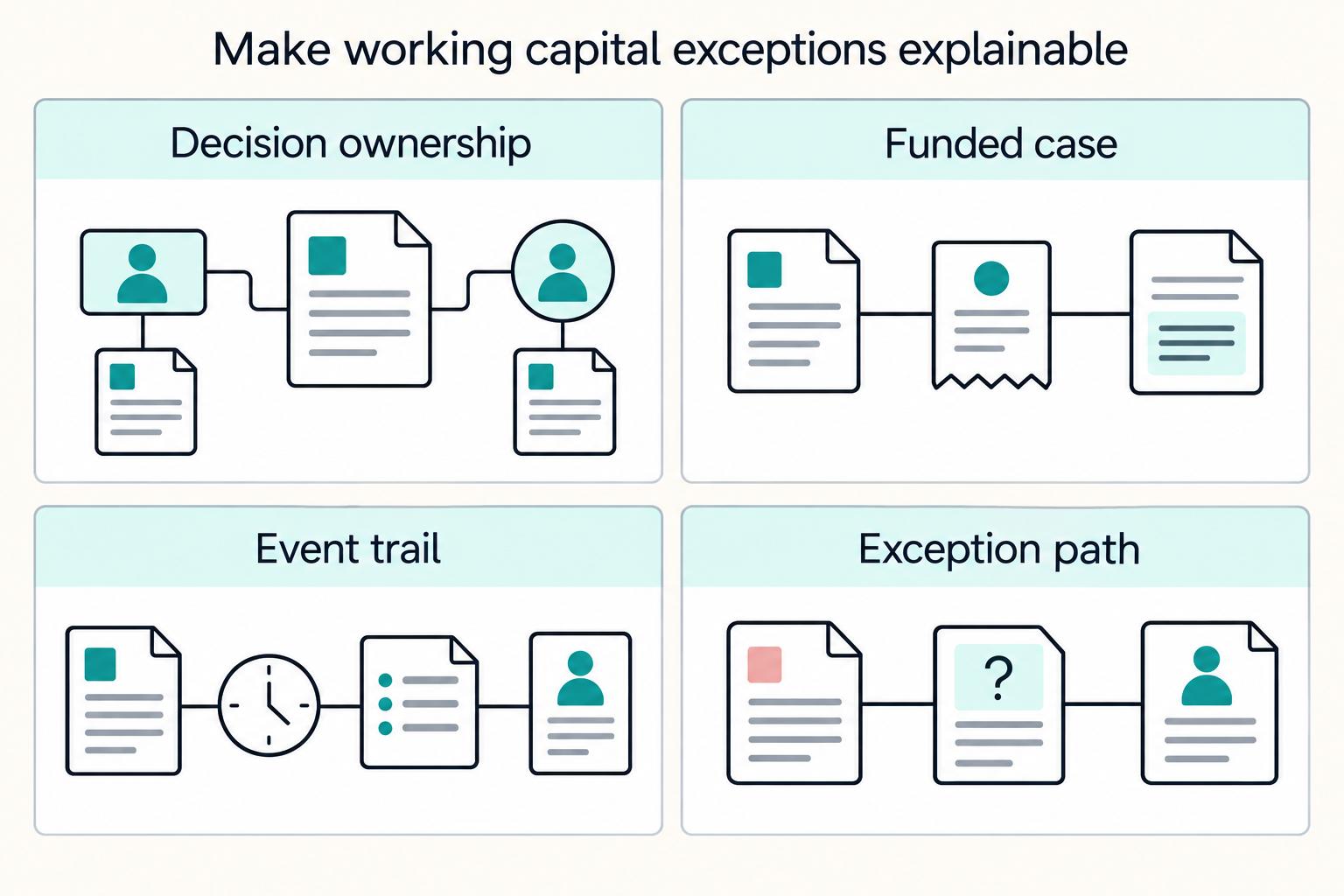
If you cannot point to one owner for underwriting, one owner for collections logic, and one owner for exception handling, do not launch yet. The biggest trust failures in embedded finance often come from weak controls, unclear decisions, and audit gaps that force your team to clean up problems by hand.
| Failure mode | Grounded sign | Control checkpoint |
|---|---|---|
| Blurred ownership | The same person or team can both approve funding and operate collections-related access. | Write down roles, responsibilities, lending authorities, underwriting processes, application and document flows, and approval processes before go-live. |
| Activation that hides service cost | Support load can show up later through invoice disputes, delayed buyer payments, partial settlements, and users asking why a funded amount or repayment status changed. | Trace a sample of funded cases from invoice approval to repayment or exception. |
| Weak auditability across invoice events | Finance teams cannot reconstruct who changed an invoice status, who approved an exception, or why a policy override happened. | Keep a timestamped record for invoice creation, approval, funding, dispute, repayment, status change, and manual override, plus the user or service account behind each action. |
| No edge-case path when the buyer does not pay on time | The buyer pays late, pays short, disputes the invoice, or the invoice changes after approval. | Use a short red-flag test: unclear policy gates, no delayed-buyer fallback, no escalation path, no named approver for exceptions. |
- Blurred ownership
Underwriting is the process used to decide whether the lending risk is acceptable. Teams get into trouble when product owns the UX, finance owns reconciliation, and nobody owns the final approval standard. A practical red flag is when the same person or team can both approve funding and operate collections-related access. Guidance on segregation of duties treats that kind of overlap as a bad control pattern because role separation is a basic fraud and loss control.
The checkpoint here is simple: before go-live, write down the policy elements supervisors expect loan-operations policies to cover. They include roles, responsibilities, lending authorities, underwriting processes, application and document flows, and approval processes. If any of those are still "to be figured out in ops," you are launching too early.
- Activation that hides service cost
A smoother offer flow can improve the user experience. The trap is assuming activation equals margin. In practice, support load can show up later through invoice disputes, delayed buyer payments, partial settlements, and users asking why a funded amount or repayment status changed.
Your verification step should be operational, not just commercial: review a sample of funded cases and trace each one from invoice approval to repayment or exception. If your team needs spreadsheets, Slack threads, or manual joins to explain what happened, the economics are worse than the launch dashboard suggests.
- Weak auditability across invoice events
Finance teams stop trusting the product when they cannot reconstruct who changed an invoice status, who approved an exception, or why a policy override happened. Internal control is not an abstract governance concept here. It is the set of policies, procedures, and processes that protects assets and limits risk. Compliance monitoring also depends on documented approval and reporting controls.
The operator detail that matters most is an event trail. Keep a timestamped record for invoice creation, approval, funding, dispute, repayment, status change, and manual override, plus the user or service account behind each action. Without that, reconciliation becomes argument-driven instead of evidence-driven.
- No edge-case path when the buyer does not pay on time
This is where trust breaks fastest. If the buyer pays late, pays short, disputes the invoice, or the invoice changes after approval, your frontline team needs a defined fallback. Weak or ineffective internal controls, including inadequate record keeping and loan review, have been linked to operational losses in banks. The same failure mode applies here.
Use a short red-flag test before launch: unclear policy gates, no delayed-buyer fallback, no escalation path, no named approver for exceptions. If even one of those is missing, pause the invoice-linked offer or keep the rollout narrow until the control gaps are fixed.
Launch checklist for embedded working capital inside your product#
Once ownership and fallback paths are defined, launch in a strict order: segment first, model second, policy third. Most avoidable mistakes happen when teams start with the offer card in the UI and only later discover that the user base, repayment logic, and exception handling do not match.
-
Define the target segment before you pick the product. Start with one segment you can describe in operational terms, not marketing terms: who invoices, who pays, how predictable the payment cycle is, and how often documents change after issue. The key differentiator here is repayment behavior. Invoice-backed financing is repaid through conversion of working assets, including collection of an accounts receivable invoice, so segment quality matters more when repayment depends on invoice collection than when you are testing a simpler cash advance path. If you cannot explain why this cohort belongs in embedded invoice factoring, invoice financing, or cash advance, you are not ready to build the offer.
-
Choose one model, then lock approval and exception policies around that model. You only have three choices in this article: embedded invoice factoring, invoice financing, or cash advance. Treat that as a product decision with control implications, not a packaging choice. The differentiator is what evidence supports approval and what happens when repayment goes off plan. For invoice-linked products, your policy should state what counts as a confirmed invoice, who can approve funding, and who can approve an exception when a buyer pays late, pays short, or disputes the invoice. A good checkpoint comes straight from supervisory thinking: ask whether your loan policies and approval procedures are adequate before rollout, not after the first loss or support backlog.
-
Build the evidence pack before go-live. Keep it to four concrete sections: sample invoice data quality, payment-cycle distribution, underwriting rule rationale, and support handling assumptions. The differentiator is that this pack should prove your assumptions with actual platform records, not just spreadsheet logic. In documented invoice flows, the supplier delivers the goods and invoice to the buyer, who uploads the invoice onto the platform, and advances can be based on confirmed invoices. So verify that your platform can actually capture those steps. Red flags are simple: missing invoice confirmations, inconsistent buyer identifiers, rules that nobody can justify, or support assumptions with no staffing owner behind them.
-
Check the product integration where users and operators will feel the pain. There are three things to verify in the digital platform: where the offer appears, how the user accepts terms, and how statuses are exposed to ops teams after funding. The differentiator is visibility after acceptance. A launch can look clean in the front end and still fail because ops cannot see whether an invoice is approved, funded, disputed, repaid, or manually overridden. Make sure terms acceptance is recorded as evidence, not just a click event, and that status changes are visible outside the product team. If your support team has to ask engineering to reconstruct a case, the design is not finished.
-
Wire finance controls and roll out to one cohort only. Before expansion, define reconciliation design, audit trail requirements, and how model performance is reviewed against unit economics. The differentiator is whether finance can trace every funded case from approval to repayment or exception with documentation, approval, and reporting controls in place. New activities are expected to align with business strategy and sound risk management, so do not judge the launch on activation alone. Start with one cohort, then review approval quality and operational load together. If the economics look acceptable but manual exceptions or reconciliation work keeps climbing, hold the rollout and fix the process before you expand.
Related: Working Capital Optimization for Platforms: How Payment Timing Affects Your Cash Position.
Conclusion: Pick the model that matches your economics and operating reality#
There is no universal winner among factoring, invoice financing, and cash advance. The right choice depends on economics plus operating fit: how you allocate capital and focus, what experience you want for users, and how much risk and servicing work your team can actually absorb.
If your data shows predictable invoices and strong receivables quality, start by comparing factoring against invoice financing. If you want invoice-linked funding but collections control needs to remain closer to the business, financing may fit better. If repayment is more naturally anchored to ongoing sales and UX simplicity matters most, cash advance may be the better path. But speed alone is not enough, especially with MCA-like products. You need to understand the product's unique features before you scale it.
Whatever you choose, stage the launch. Size the opportunity, create a focused go-to-market plan, choose the right integration path, and make repayment mechanics and risk ownership explicit before you expand. If underwriting, risk analysis, or capital-markets work are outside your core strength, partnering can be the more practical launch path than building everything from scratch.
Frequently Asked Questions
What is the difference between embedded invoice factoring and traditional factoring?
The core financing mechanic is the same: a business sells unpaid invoices to a third party for immediate cash. The difference is where it happens. In embedded factoring, the offer sits inside your platform workflow, while traditional factoring is usually arranged outside the product through a separate provider relationship.
Who gets paid upfront and who collects from the buyer in factoring?
In standard factoring, the business gets cash upfront against the invoice, and the factor can collect from the buyer directly. In an embedded version, that same flow is surfaced inside the platform instead of being handled entirely outside it.
Is invoice financing the same as invoice factoring?
No. With invoice financing, the business generally remains in control of the sales ledger, collections, and invoice processing, and clients continue to direct their payments to the business. With factoring, the factor can handle collections directly from the customer. Both can turn unpaid invoices into working capital, but the structure and collections design are different.
When does a cash advance fit better than an invoice-based product?
When repayment is better tied to future sales than to settlement of a named invoice. A merchant cash advance is repaid using future card sales or a share of sales, so it can fit businesses with ongoing transaction volume and uneven cash flow. It should not be treated as automatically cheaper or universally better.
What should a platform validate before launch?
At minimum: repayment source, collections ownership, and approval evidence. For invoice-led products, validate invoice confirmation, payer identity, payment timing, and whether dispute risk is visible in your workflow. For cash-advance-style offers, validate observed transaction volume and history. More broadly, make sure written policies cover roles, approvals, exceptions, and reporting before rollout.
Try a related tool
Researched and edited by the Gruv editorial team. Gruv builds cross-border billing, payouts, and finance-operations software for global businesses.
Sources
- consumerfinance.gov/compliance/compliance-resources/small-busine...trusted
- ecfr.gov/current/title-12/chapter-VI/subchapter-B/par...trusted
- ecfr.gov/current/title-12/chapter-III/subchapter-B/pa...trusted
- fdic.gov/resources/supervision-and-examinations/exami...trusted
- fdicoig.gov/sites/default/files/reports/2022-08/09-002.pdftrusted
- federalreserve.gov/publications/2025-march-consumer-community-c...trusted
- ftc.gov/news-events/news/press-releases/2022/01/merc...trusted
- govinfo.gov/content/pkg/GOVPUB-T12-PURL-LPS42734/pdf/GOV...trusted
Educational content only. Not legal, tax, or financial advice.
Related Posts

Choosing Embedded Finance for Freelance Platforms With an Operations-First Scorecard
Trend headlines are not a selection method. If you are evaluating embedded finance for freelancers, start with an operations-first scorecard that tests day-to-day execution before you reward product polish.
Working Capital Optimization for Platforms Through Payment Timing Control
Working capital is current assets minus current liabilities. In platform operations, timing controls are a practical lens you can verify: when collection data is posted, when funds are final, and when disbursements are released.

Invoice Factoring for Contractors: How Platforms Offer Early Payment and Manage Risk
If you run a platform for contractors, early payment is a product and risk decision before it is a goodwill feature. Ask four things up front: Who funds the advance? Who collects from the payer? Who absorbs nonpayment risk? Do the unit economics still work once disputes and exceptions show up?