
Quick Answer
Factoring can bridge an invoice-to-cash gap if the net advance arrives in time and the fees, reserve conditions, recourse exposure and collections process are acceptable. Get the written terms and compare delayed-payment outcomes before assigning the receivable.
What factoring changes in your cash flow#
Factoring can turn an eligible unpaid invoice into earlier cash, with a fee and possible repayment obligations. Before committing, compare the amount available now with what you will eventually retain, and confirm who contacts the client. A quicker advance is useful only if it covers the timing gap on terms you can afford.
Accounts receivable are amounts owed by customers. When you deliver work now and collect later, subcontractor bills, software costs and other commitments can fall due first. Map those dates before choosing finance; a particular country's payment deadline is not a universal invoice term or a funding guarantee.
What invoice factoring does#
Factoring usually involves assigning receivables to a provider that advances part of their value and handles collections. Some arrangements finance selected invoices; others cover a customer account or wider ledger. British Business Bank's overview distinguishes factoring from invoice discounting, where the business generally retains collection responsibility. Check the actual arrangement rather than treating every early-payment product as the same.
The tradeoffs are timing, cost and control:
- Timing and conditions for when you receive funds, and what can delay them
- What happens if the buyer pays late or disputes the invoice
- Client communication: who contacts your client about payment, how they phrase it, and what happens if there's a delivery dispute
Hypothetical scenario: you factor an invoice for a high-value retainer client. Funding lands fast, but the provider sends a blunt payment notice that makes your client feel like they were sent to collections. You solved cash flow this week and created client risk next month.
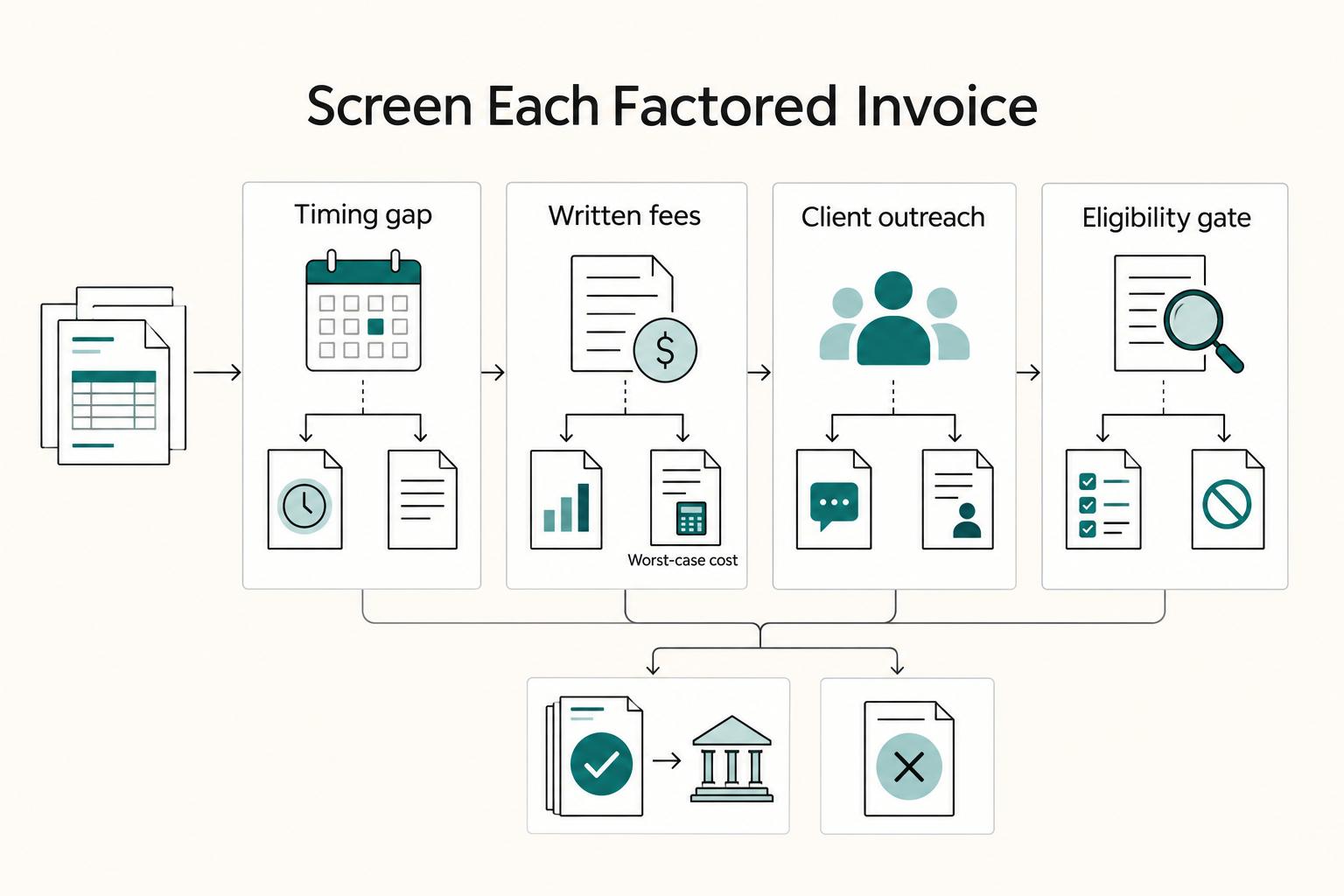
Screen each invoice before submission#
Use the scorecard to organize the decision, the due diligence checklist to inspect the agreement, and the per-invoice workflow to track funding through final settlement.
| If your problem is... | Your safer first move | When factoring fits |
|---|---|---|
| Timing mismatch (cash flow crunch) | Tighten invoicing cadence and acceptance proof | You need earlier payment and can protect client experience |
| Unclear costs | Demand a written fee formula and release rules | You can model worst-case cost before submitting invoices |
| Client relationship sensitivity | Control who manages payment outreach | Provider commits to a client-friendly workflow in writing |
Final safety default: confirm eligibility, exact workflow, and all fees in writing before you submit invoices, because terms vary by provider and program.
Define the advance, reserve and collection process#
Get the proposed agreement, fee schedule and sample settlement statement before assigning invoices. Confirm whether the facility covers selected invoices or the wider ledger, including any exclusivity obligation.
An invoice records the customer's payment obligation, but the invoice alone does not prove that a receivable is valid or eligible. Keep the underlying contract, delivery records and any required acceptance evidence.
Use a unique invoice ID, correct legal entities, service details, due date, agreed payment terms and any required PO reference. Include interest or late fees only where the agreement and applicable law permit them; a penalty clause is not universally required for a factor to review an invoice.
The five terms that decide your cash flow outcome#
In many invoice factoring agreements, you will see a shared vocabulary. Do not assume the vocabulary means the same thing across companies. Treat each term as "defined by the agreement," and get the definitions in writing.
| Term | What to confirm in writing |
|---|---|
| Accounts receivable (AR) | What counts as eligible receivables, and what makes an invoice ineligible |
| Credit check / review | What gets reviewed, what slows approval, and what your proof pack must include |
| Advance rate / timing | When money is released, what can delay it, and what conditions change the amount or timing |
| Reserves / holdbacks | Whether any amount is held back, when it is released, and what can be netted out |
| Fees and adjustments | Do not model cash flow off the headline fee alone; build scenarios that stay realistic |
Recourse vs non-recourse: translate the label into obligations#
Recourse concerns your obligations when the factor does not recover the receivable. It can materially affect risk, so read the triggering events and exclusions rather than relying on the label.
Ask who bears loss for customer insolvency, ordinary late payment, a delivery dispute, credits or refunds, fraud and a breach of your warranties. Record the deadlines, evidence requirements and remedies: repayment, repurchase, reserve offset or another contractual action.
Use a short factoring decision scorecard#
Invoice factoring can solve a cash flow gap, but speed costs, and the control tradeoffs live in the factoring agreement. Before you submit accounts receivable or sign anything that changes who gets paid and how, run a fast filter.
Get a quote for your actual entity, invoice size, client country and debtor concentration. A freelancer may not qualify for a provider's standard ledger facility. Ask about selective or spot funding if you need one invoice financed, and distinguish initial onboarding time from release time for an already approved invoice.
Score four decision areas from 0 to 2#
Score each bucket quickly, then apply the rule at the bottom.
| Bucket | 0 (No-go) | 1 (Caution) | 2 (Go) |
|---|---|---|---|
| Cash urgency | You just dislike waiting. No operational consequence. | Waiting creates stress, but you can still meet commitments. | Late payment forces missed payroll, rent, contractor payments, or tax set-asides. |
| Fee tolerance | You cannot state your max acceptable total fee as a % of the invoice. | You can state it, but it pushes you close to your gross margin. | You can state it, and it stays comfortably below your gross margin. |
| Client risk (debtor realities) | Your client disputes invoices or changes acceptance criteria frequently. | Your client pays, but communication and approvals run slow. | Your client approves work cleanly and pays predictably once invoiced. |
| Contract and control | You cannot get the factoring agreement and full fee schedule upfront. | You can get it, but you dislike who controls collections or debtor management. | You can get it, and you stay comfortable with collections workflow and client communication. |
Illustrative screening rule: 7–8 suggests further due diligence; 5–6 calls for addressing the weakest area; 0–4 suggests another approach. This is an editorial decision aid, not a validated underwriting test. A high total never overrides a disputed or ineligible invoice, unclear assignment rights, unaffordable recourse, or missing written terms.
Check the weakest area before proceeding#
- Cash urgency: Map the obligations and funding date. If the gap is manageable, compare deposits, milestones or better invoicing before paying for finance. Urgency does not make unsafe terms affordable.
- Fee tolerance: Compare total fees with the invoice's gross profit, not just revenue. Model slower collection and retained reserves. Related: Stop Freelance Profit Margin Erosion.
- Client payment: Check approval, invoice disputes, credit notes and collection history. Factoring does not fix an unresolved service dispute.
- Contract and communication: Confirm who collects, the notices and escalation tone, and whether you can accept those controls. A collections-retaining product may be invoice discounting or agency factoring rather than full-service factoring.
For example, a retainer client may be sensitive to collection notices. Ask for the notification and escalation process before assigning the invoice. Your preference to keep communication does not override the factor's rights; choose a product whose agreed workflow fits.
Map the invoice from delivery to settlement#
Deliver and invoice under the client's terms, submit an eligible receivable, complete provider review and track the actual advance. Funding depends on approval and release conditions, not simply the moment an invoice is uploaded.
Distinguish three amounts throughout: invoice face value, advance actually received, and any reserve still held by the factor. None can be substituted for the others when planning available cash.
The end-to-end money flow (map it before you act)#
| Stage | What you do | What the factor does | What can block progress |
|---|---|---|---|
| Deliver | Deliver work and capture acceptance evidence | N/A | Unclear deliverables or shifting acceptance |
| Invoice | Issue an invoice with explicit Payment Terms | N/A | Invoice missing required fields, PO refs, or consistent invoice ID |
| Submit | Submit the invoice you want to sell | Intake and review | Invoice not eligible under the provider's rules |
| Review | Provide supporting docs fast | Checks the debtor and invoice under its eligibility rules | The customer fails credit review, or docs do not match |
| Fund | Record the net advance, deductions and receipt date | Sends funds after approval | Delays if details or documentation need correction |
| Collect + settle | Reconcile customer receipts, fees, credits and reserve movement | Collects or follows the agreed arrangement, then provides settlement details | Any mismatch or missing information can trigger back-and-forth |
Request a timeline for onboarding, invoice review, release, bank receipt and reserve settlement separately. Plan around your agreed and observed dates, with a buffer; generic claims such as within hours to weeks are too broad to fund a specific commitment.
Where timelines and deals actually slip (the unglamorous gates)#
Ask when the provider's timing promise starts and which verification, banking or document dependencies can extend it. Record who follows up if the agreed release date is missed.
Run this control checklist before you submit anything, then use it every time:
- Proof pack tied to the invoice number: approval email, delivery receipt, SOW milestone sign-off
- Invoice hygiene: consistent invoice ID, correct legal entity names, matching PO or project reference
- Status tracking: submitted, approved, funded, collected, settled (do not rely on your bank balance alone)
If a client's AP team needs a PO reference that is absent, correct the invoice and attach the matching authorization before submission. Good records can reduce avoidable delay, but they do not guarantee approval.
An invoice generator can help format the billing record. It does not verify delivery, debtor eligibility or assignment rights.
Calculate fees, usable cash and reserve release#
Calculate the full fee formula and the timing of every deduction. Include time-based charges, payout fees, minimums and adjustments, then test collection delays and partial payment.
Request the complete pricing stack (and where each fee hits your cash)#
Do not accept "our rate is X" on a call. Ask for a fee schedule and a sample statement, then map every cost into a simple formula you can run per invoice.
| Pricing component | Where it can show up | The question that removes ambiguity |
|---|---|---|
| Factoring Fee (base charge) | Taken from the advance, taken from the reserve, or billed separately | "Exactly how do you calculate the base fee, and when do you charge it?" |
| Funding and payout fees (wire, ACH, expedited) | Per funding event or per payout | "What fees apply when you fund and when you pay out the reserve?" |
| Setup and admin fees (onboarding, processing, due diligence) | Upfront, monthly, or per invoice | "List every non-rate fee. When do you charge each one?" |
| Minimums and penalties (minimum fees, early termination, late-style penalties) | Monthly, contract term, or after a trigger | "What triggers extra charges, and can you cap them in writing?" |
Ask whether charges are deducted from the advance, netted from the reserve or invoiced separately. An advance rate is a percentage used to calculate the gross advance; actual day-one cash can be lower after deductions. A reserve is a provider-held balance, not automatically your own spendable bank account.
Model downside: time-to-pay + reserve friction (two cost drivers to watch)#
Illustrative quote: a $10,000 invoice, an 85% advance, a $20 transfer fee deducted at funding, and a 2% fee on the invoice face value for each started 30-day period. Assume that fee is deducted from the reserve, all days run from funding to collection, and there are no other charges. Day-one cash is $8,500 minus $20 = $8,480. If collection occurs on day 30, the fee is $200, reserve release is $1,500 minus $200 = $1,300, and total cash retained is $9,780. The $220 total cost is 2.2% of the invoice, not an annual percentage rate.
Also lock down Reserve Account release in writing. Ask:
- "What exact event releases the reserve: payment received, cleared funds, or another defined condition?"
- "How do you handle partial payments, short-pays, and deductions? Do you hold the reserve until resolution?"
Under that same illustrative formula, collection on day 60 produces a $400 fee, $1,100 reserve release and $9,580 total retained cash: a $420 cost. Day 61 starts a third period, raising the fee to $600. Check whether the real fee clock stops on customer payment, cleared receipt or another event, and whether a delayed reserve release adds charges. A short-pay or dispute needs its own scenario; it is not just another late-payment day.
Read minimum-volume charges, term and renewal dates, exit fees, personal guarantees, security interests, offsets and any requirement to submit all receivables. Check existing lender rights before assigning the same invoice or ledger. Ask how liens or other security are released after final obligations are settled. Retained profit should cover the finance cost; revisit pricing and margin if it does not.
Read recourse triggers and non-recourse exclusions#
HMRC's description of factoring products distinguishes recourse from covered loss protection and notes variants. Use it as UK background, then read your own agreement for the risks actually transferred.
Translate the labels into outcomes you can actually plan for#
With recourse, an unpaid or ineligible receivable can trigger an obligation to repay or repurchase under the agreed terms. Find the aging deadline, notice and cure process, the amount due and whether the factor can offset other reserves. Keep that potential cash outflow in the forecast.
Non-recourse transfers specified credit losses, often subject to debtor approval, limits and claim conditions. It does not necessarily cover commercial disputes, returns, credits, fraud or a breach of your warranties. Ask the provider to identify each covered event and exclusion, not merely promise that you never repay.
For each event, write down who bears the shortfall and when. A customer refusing payment because it disputes delivery can have a different outcome from an approved customer's insolvency.
| Term on the sales call | What you must confirm in writing | Your real risk as a freelancer |
|---|---|---|
| Recourse | What events trigger your obligation to reimburse the factor | You may face a delayed cash hit if the customer does not pay |
| Non-recourse | What kinds of nonpayment qualify under your agreement | You may still carry certain nonpayment outcomes the contract doesn't cover |
Hypothetical: your client claims "delivery didn't meet expectations" and pauses payment. If your agreement treats that kind of situation as non-covered nonpayment (or otherwise pushes it back on you), you can end up funding the gap while you also fix the relationship.
Clauses to evaluate (and the workflow that protects your brand)#
Confirm the payment notice, collection contacts and escalation process, along with who handles a service dispute. A freelancer can seek communication safeguards, but cannot promise the client that the factor will never contact it unless the arrangement actually says so.
| Clause or workflow | What to confirm in writing |
|---|---|
| Nonpayment definition | What exactly counts as a customer not paying, and what happens next under recourse or non-recourse? |
| Customer payment and notification language | Who the customer pays under this setup and how the change is communicated |
| Termination and lock-in | Auto-renewal, notice requirements, and any exit fees |
| Collections escalation ladder | Who contacts the customer, when, and with what language |
| Dispute workflow + visibility | Documentation expectations and status visibility so you can reconcile each invoice and fee line in your accounting |
Compare providers on written terms and invoice-level reports#
Request the documents needed to compare cost, eligibility, client communication, repayment exposure and settlement. Keep the exact entity and version of the proposed agreement with the comparison.
Your intake packet (what you request, in writing)#
Ask for the fee schedule, standard agreement and sample invoice-level statement before making a commitment. Missing key terms should remain a decision blocker, even if the sales call is reassuring.
- Commercial terms (how pricing works in practice, and how anything outside the "base" price is handled)
- Exit terms (how you leave, and what obligations carry over)
- Operational process (how they interact with your customers, and how exceptions get approved)
Save contractual terms and signed amendments, not just screenshots of marketing claims. Record the relevant clause and ask the provider to resolve contradictions in writing.
Use a provider comparison grid#
Compare the proposed product for your own invoice and client. Price alone will miss differences in reserve offsets, claim exclusions, support and exit obligations.
| Provider area | What to compare in writing |
|---|---|
| What they will and won't accept | Eligible entity, country, debtor, invoice age/value, concentration limits and assignment restrictions |
| Holds, offsets, or adjustments | How holds, offsets, or adjustments work, and what triggers them |
| Cost increases | What can increase your costs over the life of an invoice relationship |
| Reporting and reconciliation | Invoice-level advance, receipts, fees, credits, reserve movement and dates; downloadable reconciliation records |
| Support and escalation | How support and escalation work when something breaks |
Hypothetical: you assign an invoice, your client short-pays, and the provider treats it as an issue. If you already documented the workflow, support path, and any adjustment rules, you can execute calmly instead of improvising under pressure.
Red flags that trigger an immediate no-go:
- Fees, minimums or timing rules that cannot be modeled from the written terms.
- Unresolved assignment or security conflicts, unaffordable repayment obligations, unacceptable collection conduct or missing settlement reports.
Optional market scan: use communities and peer threads as lead sources, then validate every term directly with the provider in writing before you submit invoices.
Use an invoice-level workflow and reconciliation record#
Use the same record from submission through final settlement. Keep the invoice, factor's account reference, advance, charges, customer payments and reserve adjustments linked.
1. Prepare and submit the receivable#
Start before the invoice exists. The cleaner your delivery and paperwork, the easier it is to support the invoice later.
- Agreed billing terms: Define deposits, milestone invoices and acceptance requirements before the work. Record earned charges and any deposit already applied so you submit only the outstanding eligible amount.
- Build a per-invoice documentation bundle (your internal standard): SOW, change orders, any acceptance email or sign-off artifact, timesheets or deliverables list, and the invoice PDF. Use consistent invoice numbering so your accounts receivable stays easy to track.
When you submit to a factoring company, you are using your accounts receivable to qualify for funding, and they typically collect directly from your customer.
Resolve known delivery disputes and confirm any assignment or consent requirements before offering the invoice. Do not fund it with two providers or ignore an existing lender's security over the receivable.
Confirm key terms per invoice, in writing:
- The invoice's approved gross advance percentage and amount, any upfront deductions, and expected net receipt.
- Fee basis, rate, counting periods, clock start and stop, reserve deductions, taxes if applicable and any separate billed charge.
Hypothetical: you finish a milestone, get a clear "approved" email, then submit that exact invoice (with the email attached) for factoring. You skip the invoice that still sits in "internal review."
2. Track collection, exceptions and final reserve#
Define and track a simple lifecycle so you can manage your freelance finance like an operator. This is an internal template you can adapt.
| Stage (your template) | What you log | What "done" means |
|---|---|---|
| Submitted | Invoice/factor reference, outstanding eligible amount and submission date | Provider confirms receipt |
| Approved | Eligible amount, advance, fees and conditions | Written approval and release conditions recorded |
| Funded | Gross advance, deductions, net receipt and date | Actual available funds reconciled |
| Collected | Customer receipts, dates, currency and allocations; credits or shortfall | Provider confirms receipts, including any unresolved balance |
| Final settlement | Reserve movements, fees, offsets and payout | Statement and actual receipts reconcile; no unexplained balance is marked closed |
In the $10,000 day-30 example, reconcile $8,480 net advance plus $1,300 reserve payout plus $220 fees to the invoice value. The customer's $10,000 payment to the factor is not another $10,000 receipt in your bank. Do not count the advance and later collection as two sales. Ask your accountant whether the arrangement is recorded as a receivable transfer or financing under the applicable accounting rules, and reconcile gross figures and charges accordingly.
-
For disputed, delayed or partial payment, retain the proof bundle, record the open amount and use the agreement's notice, claim or recourse process.
-
If the client pays you directly after assignment, notify the factor promptly and follow the agreed remittance process; keep the invoice from being collected twice.
-
For unexplained fees, reserve offsets or delayed payouts, request invoice-level calculations and keep the balance open until resolved.
-
Invoice issued with clear Payment Terms and consistent numbering
-
Documentation bundle complete (SOW, changes, acceptance artifact, deliverables record, invoice PDF)
-
Per-invoice Advance Rate confirmed in writing
-
How fees are calculated and when they apply confirmed in writing
-
Statement reviewed and reconciled before you close the month
-
Assignment/consent and existing security checked; client notice, recourse exposure and reserve settlement recorded.
Check cross-border rights and accounting records#
Before cross-border funding, confirm the provider's contracting entity, eligible seller and debtor countries, permitted currency, assignment requirements and collection route. Approval of a country does not settle every legal or tax question.
Jurisdiction and coverage: verify the legal perimeter, not the marketing#
Factoring generally runs through a contract (often called a Factoring Agreement) and ties funding to an invoice or receivable. Rules and enforceability vary across jurisdictions, so do not treat any provider's "we support international" claim as a green light until you see:
- Governing law, dispute forum and mandatory local requirements; the contract's law clause does not eliminate all other applicable law
- The provider's definition of Debtor eligibility (your client's jurisdiction can matter as much as yours)
- Whether the provider funds commercial invoices only, and what they accept as a "real" receivable
Submit a valid receivable supported by an actual payment obligation. A proforma or estimate is not evidence by itself of an earned, enforceable debt. Confirm how the provider handles deposits, future milestones and partially paid invoices.
Tax and reporting: get clean documents, or you will create cleanup work later#
Keep the gross invoice, funding statement, fee documents, credit notes, customer receipts and final reserve statement together. Earlier cash does not by itself determine tax timing or expense treatment.
- Ask how the provider documents the Factoring Fee (provider statement, fee invoice, or both). Then align that output with your accountant's expense categorization so you do not guess at tax time.
- If you invoice Australian clients or operate in Australia, coordinate GST treatment for your invoicing flow (and any related fees) with your advisor. Use one reference doc and stick to it: A Guide to GST for Australian Freelancers.
A dashboard showing a net payout may omit fees or outstanding reserve movements. Ask for an export or statement that supports the reconciliation before choosing the provider.
| Question to ask | Why it matters |
|---|---|
| "Is this product available for my jurisdiction and my client's jurisdiction?" | Confirms coverage before you build a process around it |
| "Which entity is the counterparty to the transaction (and, where applicable, the buyer/assignee of the receivable)?" | Clarifies who holds the relevant rights/responsibilities and how to document the transaction |
| "What documents will I receive for fees and reserve settlements?" | Protects tax reporting and clean reconciliation |
Get local accounting or legal advice where assignment rights, guarantees, security, foreign currency or tax treatment remain unresolved. Check the particular invoice rather than inferring approval from a broad international coverage claim.
Make the funding decision before the cash deadline#
Keep a dated forecast of customer receipts and unavoidable commitments. Compare factoring against a workable payment-term change, available reserves or other funding on the same amount and time horizon.
If a May invoice will not be collected until July, identify which commitments fall in the gap and what net advance would arrive in time. A large invoice is not a large available balance when reserves and deductions remain held.
Maintain a basic cash-flow routine#
Include contractor payments, software renewals, tax obligations and essential operating costs in the forecast. Avoid treating an expected reserve payout as cash already available.
- Keep business transactions separately identifiable; use a separate account where required or useful for your structure.
- Budget around conservative collectible receipts and essential costs, with a realistic buffer.
- Review expected and overdue receivables by invoice, including collection responsibility.
- Compare profit with cash availability; financing changes receipt timing and adds cost, without creating a second sale.
Check the final decision against the actual invoice#
Confirm the eligible amount, net funding date, delay scenario, reserve conditions and potential recourse payment. If the advance cannot cover the gap on affordable terms, choose another plan before committing.
If waiting is manageable, improve invoice delivery, approvals and future payment terms first. If funding is necessary, retain the agreed collection and settlement records through closeout.
Frequently Asked Questions
What is invoice factoring for freelancers?
Factoring assigns an eligible unpaid receivable to a provider in exchange for earlier funding, usually with collection services. The advance, retained reserve, fees and any repayment obligations depend on the agreement. Invoice discounting generally leaves collection with the business; labels and arrangements vary.
How much do factoring companies charge (and what fees are usually hidden until you ask)?
There is no universal fee. Request the base and time-based formula, counting periods, transfer charges, setup or monthly minimums, taxes where applicable and exit fees. Check whether deductions reduce the initial advance or later reserve, and model the invoice under faster and slower collection.
How fast can freelancers get paid with invoice factoring?
Ask for separate onboarding, invoice approval, release and bank-receipt dates. A quoted funding speed may start only after approval and complete documentation. Reserve settlement occurs under its own conditions, so it is not day-one cash.
Is invoice factoring worth it for freelancers, or should I just change my payment terms?
Compare the full funding cost with the invoice's gross profit and the consequences of waiting. Negotiate deposits, milestones or shorter terms where practical. Factoring may bridge a genuine gap, but a high score or urgent bill does not justify unclear terms, an ineligible invoice or unaffordable recourse.
What should I check before signing a factoring agreement?
Check eligible invoices and assignment rights, full fees, reserve release, recourse events and exclusions, guarantees or security, collections conduct, term, renewal and exit. Obtain a sample statement and confirm how credits, short-pays and direct customer payments are handled.
What's still unknown before choosing a factoring provider?
Until confirmed in writing, treat eligibility, net advance timing, reserve release and nonpayment obligations as unresolved. Verify your own entity and client, not just the provider's headline coverage. If a material condition is unclear, resolve it before committing the invoice.
Try a related tool
Researched and edited by the Gruv editorial team. Gruv builds cross-border billing, payouts, and finance-operations software for global businesses.
Sources
Includes 3 external sources outside the trusted-domain allowlist.
Educational content only. Not legal, tax, or financial advice.
Related Posts

Stop Freelance Profit Margin Erosion Before It Hits Cashflow
Revenue can hold steady while the business underneath it gets weaker. What comes in matters, but what you keep after the work is delivered is the clearer signal of health.
A Guide to GST for Australian Freelancers
Australian freelancers generally need GST registration when current or projected GST turnover reaches $75,000. Check both rolling periods, classify overseas work, and keep invoices and eligible purchase records ready for your assigned BAS cycle. An ABN or a marketplace tax setting alone does not establish GST registration.

The Freelance Payment Penalty: A Modeled Audit of Platform Fees, FX Spreads, and Payout Delays
The money rarely disappears through a single, easy-to-spot fee. The real loss is stacked. A marketplace takes its commission, a processor adds a charge for international cards, a bank or payment company converts the currency at a spread, a platform holds the funds before release, and a wire sheds a little to intermediaries on the way in. Each layer looks defensible on its own, but the worker feels the combined result as a smaller deposit and a later payday.