
Quick Answer
Classify the vendor’s criticality, assess exposure and evidenced controls in each risk domain, then record residual risk and a concrete decision. Use the highest material domain and mandatory-control checks so an average cannot hide a serious gap. A critical service stays critical even when controls improve.
Why Platforms Need a Consistent Vendor Risk Scorecard#
Use this guide to build a practical, defensible approach to scoring and monitoring payment-adjacent vendor risk, with clear escalation points and named ownership. It is for compliance, legal, finance, and risk teams that need decisions and evidence that will hold up under scrutiny.
U.S. interagency banking guidance covers third-party relationships throughout their life cycle. A platform can adopt that approach for internal oversight, but its legal duties depend on its own entity, activity and bank-partner agreement. Outsourcing a required control does not remove the regulated entity’s accountability.
Start with operating clarity before you add scoring complexity. For each in-scope vendor, one record should let a reviewer quickly answer:
- What the vendor does
- Where it touches your payment flow
- Who owns the relationship internally
- What evidence supports the current risk view
Keep scope tied to vendors that can affect payment operations or compliance, not generic software procurement. If a service can influence onboarding outcomes, AML/CFT controls, payout execution, payment data handling, or incident response, treat it as in scope until you can justify otherwise.
Oversight should match the actual risk of the relationship. Higher-impact vendors, such as payout or AML/CFT dependencies, need deeper evidence and tighter escalation than low-impact tools. The standard here is defensibility, not uniformity. You should be able to explain why each vendor got the depth of review it received. If you cannot, the model is unlikely to hold up when a real incident hits.
What to prepare before scoring any payment vendor#
Scores are only as defensible as the setup behind them. Before you assign any risk tier, lock down ownership, evidence, documentation standards, and review cadence for your regulatory context so work does not stall between teams.
Define ownership first#
Name one relationship owner and the reviewers needed for its actual role. Include an AML lead where the service affects an applicable AML program, rather than assuming every platform or software vendor has bank AML duties.
Verification point: for each in-scope vendor, keep one current record that names the internal owner, AML reviewer, legal reviewer, and approver. Do not assume procurement or security owns every compliance exception.
Assemble the evidence pack before scoring#
Assemble the evidence pack before scoring starts. Typical inputs include the current contract and SLA, business continuity or resilience material, and any available independent audit or SOC evidence, plus other assurance records your program requires.
Treat missing evidence as a risk signal, not an admin delay. If contractual obligations on compliance, escalation, or resilience are unclear, the relationship can increase AML/CFT noncompliance exposure even if the product looks strong.
Set evidence standards and storage rules#
Set evidence standards and storage rules before reviews begin. Define what counts as acceptable proof, who can approve exceptions, and where final records live.
If you are in scope for EU financial-entity ICT oversight, maintain and update the required register of information for supervision and internal risk management. Checkpoint: a reviewer who was not in the original meeting should still be able to reconstruct the decision from the record alone.
Set review cadence before scoring#
Set review frequency from criticality, exposure and change signals, while meeting any applicable statutory, regulatory or contractual minimum. A risk-based internal schedule does not override a mandated review.
If you are building a broader vendor oversight program, Third-Party Risk Management for Payment Platforms: How to Vet and Monitor Your Payment Vendors goes deeper on due diligence and ongoing review.
Define vendor scope and criticality before you score#
Get scope right first, or later scores will look precise without being defensible. Classify each vendor by its role in your payment flow, then set criticality by customer impact and compliance or continuity risk, not brand strength or spend alone.
Map vendors by payment impact#
Map vendors by payment impact, not procurement category. Third-party scope is broader than classic outsourced IT and includes relationships such as merchant payment processing services.
A practical internal split is:
- payout processor or payment execution provider
- onboarding or KYC support provider
- transaction or sanctions screening support provider
- operational infrastructure that keeps payment activity running
This is a working taxonomy, not a regulator-mandated list. The point is to separate vendors by failure effect. A hosting vendor tied to your payout engine may be more critical than a well-known back-office tool.
Verification point: write a one-line service statement for each vendor in plain English. Examples include "screens payees against sanctions lists before release of funds" and "hosts the service used to submit payout files." If it reads like product marketing, the scope is still too loose.
Assign tiering from continuity and compliance impact#
Record criticality separately from residual risk. Criticality asks how much harm an outage or failure would cause; residual risk asks how much exposure remains with the evidenced controls. Effective controls do not make an essential payout dependency noncritical.
Apply that test directly. If a vendor failure can pause payouts, block onboarding decisions, interrupt screening, or create an AML or sanctions control gap, that relationship is likely critical. This can still be true when contract value is modest, because dependency and control impact can matter more than price.
Brand strength can mislead here. A large provider can still sit on a critical control point. A smaller specialist can be lower risk when it has no decisioning role, no sensitive data exposure, and no impact on payment flow.
Do not downgrade onboarding or screening vendors just because they "only support" one step. If your process depends on their output, accountability for those controls still stays with your institution.
Use an explicit if-then rule#
Use an explicit if-then rule before scoring. If failure can stop money movement or block KYC decisions, start by classifying the relationship as critical unless you can demonstrate a workable fallback in your required timeframe.
This keeps debates from turning into budget or familiarity arguments and aligns with the principle that third-party relationships do not all carry equal risk or criticality. Ask: "What fails for customers, compliance, or operations if this service is down today?"
Verification point: ask the business owner and compliance lead separately, "What customer or regulatory outcome fails if this vendor is unavailable for 24 hours?" If the answers differ, the tier is not ready for approval.
Document boundary conditions for each arrangement#
Document boundary conditions for each arrangement so scoring reflects actual use, not abstract capability. The same vendor can create different risk profiles across products, markets, and service modules.
Capture at least:
- exact service used, including module or process step
- legal entities, markets, and customer segments in scope
- whether the vendor makes, supports, or only informs KYC or payment decisions
- data handled, outputs produced, and fallback if unavailable
Bank CIP rules apply to covered banks. If your platform supplies onboarding data or verification services, document its role in the bank’s program and any applicable reliance conditions; do not assume using a vendor satisfies them. Assess your own entity’s obligations separately.
Related: Vendor Lock-In Risk in Payment Platforms: How to Maintain Optionality When Scaling.
Choose scoring domains and evidence requirements#
Keep the scorecard boring and defensible. Use standard domains, and require named evidence plus a named reviewer for each one. If you only score cybersecurity, or rely on undocumented judgment, the result is harder to defend when a critical payment vendor has a major disruption.
Set the core domains first#
Set core domains before reviewing vendor responses. Credible vendor risk practice is broader than security, so cover at least data protection, security, business continuity, compliance and regulatory exposure, operational reliability, and financial risk.
| Domain | Required evidence | Primary reviewer |
|---|---|---|
| Data protection | data handling description, contract terms covering customer information, retention or deletion commitments | Privacy or compliance |
| Security | due diligence response on access to your systems or confidential information, control summary, incident history if available | Security |
| Business continuity | business continuity and disaster recovery materials, recovery contacts, any test or exercise summary | Operations or resilience owner |
| Compliance and regulatory exposure | risk analysis for the outsourced activity, applicable control narrative, contract obligations | Compliance and legal |
| Operational reliability | service support model, escalation path, disruption record, oversight notes | Business owner or operations |
| Financial risk and viability | current business plan and financial due diligence package | Finance or procurement risk |
Assign a reviewer and evidence threshold to each domain#
Assign one accountable reviewer and one evidence threshold to each domain. Third-party risk can coordinate, but business, security, compliance, legal, and finance each need a defined review lane.
Use a hard rule: do not score a domain unless the artifact is retained and the reviewer is named. Keep the file set with the relationship record, including valid contracts, business plans, risk analyses, due diligence materials, and oversight activity. Before approval, confirm each domain has a dated artifact, a reviewer name, and either a rationale or an open issue.
Add payment overlays to generic scoring#
Generic vendor scoring is not enough for payment dependencies. Add payment overlays so the score reflects real operational and compliance exposure:
- Onboarding: establish the platform’s role in any covered bank CIP and whether reliance conditions are satisfied.
- AML support: identify the regulated entity’s program, escalation owner and contractual responsibilities.
- Covered bank service providers: notify an affected banking customer as soon as possible after determining that a computer-security incident materially disrupted or degraded covered services, or is reasonably likely to do so, for four or more hours. This is a legal notification trigger, not an instruction to wait four hours; use the designated bank contact. Previously communicated scheduled maintenance, testing or updates are treated separately under the rule.
Treat insufficient evidence as a real outcome#
Treat insufficient evidence as a real internal scoring outcome. It is not a formal regulatory rating label, but it fits the basic requirement that due diligence be documented and sufficient to support reliance decisions.
For a material missing artifact, record insufficient evidence rather than a reassuring numerical score. Block full approval until the required evidence is obtained. A time-limited exception can address discretionary internal requirements, but cannot waive a legal requirement or a mandatory program control.
Build the scoring model and residual risk logic#
Use an anchored qualitative model when the evidence does not justify numerical precision. The following example is an internal decision method, not a regulatory rating scale. Assess each domain separately and keep criticality as a distinct field.
Anchor the Ratings Before Reviewing Vendors#
For each domain, record inherent exposure as low, moderate or high: low means limited data or payment impact with a proven workaround; moderate means a bounded disruption or sensitive-data exposure; high means material payment, customer or compliance harm. Record control strength as strong, partial or weak: strong requires current evidence and testing for this service, partial means a material coverage or testing gap, and weak means absent or failed safeguards.
Use the same anchors for comparable services. Preserve the rationale, evidence scope and reviewer. Do not convert a vendor’s broad SOC report into a strong rating for a control the report never tested.
Separate inherent risk, control strength, and residual risk#
Determine residual risk per domain using this illustrative decision matrix. It is an ordering aid, not a probability estimate: high exposure with strong controls is moderate; high exposure with partial or weak controls remains high. Moderate exposure with strong controls is low, with partial controls moderate, and with weak controls high. Low exposure with strong or partial controls is low and with weak controls moderate. A missing essential artifact is insufficient evidence and bypasses this matrix.
- Inherent risk: baseline exposure before controls
- Control strength: effectiveness supported by retained evidence
- Residual risk: risk that remains after controls are applied
For a payout processor, suppose security has high exposure but current scoped access testing supports strong controls: residual security risk is moderate. Continuity also has high exposure, but its recovery test omitted your payout-file path, so controls are partial and residual continuity risk is high. Compliance evidence is complete with strong controls against moderate exposure, yielding low residual risk. Overall risk follows the highest material domain, high; it is not an average that hides the continuity gap.
The processor remains critical because its outage stops payouts. In this example, operations owns a recovery test and alternate-route drill, compliance confirms mandatory controls, and the executive owner withholds expansion until continuity evidence is accepted. A tested fallback may support a narrowly scoped internal exception only where required controls remain satisfied. Record the decision and due date, then reassess the affected domain when the test is complete.
Set escalation for critical high residual risk#
Escalate a critical vendor with high residual risk to the accountable executive and control owners. Sign-off records the permissible decision; it does not authorize prohibited activity or erase a mandatory control gap.
Document whether the decision covers onboarding, current use or expansion, along with service scope, conditions, compensating controls and expiry. If a mandatory control is absent, keep that activity blocked until the requirement is met.
Add a legal and compliance checkpoint before go-live#
Add a formal legal and compliance checkpoint before go-live for financial services obligations.
Before launch, retain the domain conclusions, evidence, criticality, open conditions, contract version and required sign-offs. Apply the obligations of the actual regulated entity and service arrangement.
For the compliance side of ongoing monitoring, How to Conduct an Annual AML Risk Assessment for Your Payment Platform covers how to run a focused annual review.
Map score tiers to mandatory controls and owners#
Tiering has to be operational. In regulated financial contexts, each risk tier should trigger mandatory controls, named owners, and clear actions when evidence is missing or controls weaken.
Higher-risk and critical relationships need more rigorous oversight, while lower-risk relationships can use scaled controls. The aim is one matrix that is specific enough for decisions and simple enough to use across planning, due diligence and third-party selection, contract negotiation, ongoing monitoring, and termination.
Build one tier-to-control matrix#
Use a single control matrix with non-negotiable minimums for each tier.
| Oversight category | Typical vendor profile | Mandatory controls | Primary owner and approval |
|---|---|---|---|
| Low | Low residual risk in a noncritical scoped service | Baseline due diligence, scoped contract review, simplified monitoring, documented issue path | Business or operations owner, legal review as needed |
| Elevated | Moderate or high residual risk in a material domain | Enhanced due diligence, tighter risk-based information refresh, more active monitoring, and clearer incident/remediation expectations in contracts | Named compliance owner plus legal and business approver |
| Criticality overlay | Vendor tied to a critical or important function | Apply full scoped due diligence, control validation and tested contingency/exit planning regardless of a low residual-risk score | Cross-functional owners with executive accountability |
Assign named owners, not just teams#
Functional labels are not enough. Higher-risk tiers should have named individuals for day-to-day coordination and monitoring, especially where vendor performance can affect AML/KYC controls.
Outsourcing does not transfer accountability from management. Named ownership helps reduce stale evidence, unsigned exceptions, and stalled follow-up.
Related reading: Accounts Payable Outsourcing for Platforms When and How to Hand Off Your Payables to a Third Party.
If your tier-to-control matrix is mostly defined, review Gruv docs to pressure-test how approval gates, payout states, and audit trails can map into your operating flow.
Set escalation triggers legal compliance and finance can execute#
Escalation works only when triggers, decision rights, and response windows are written and usable. For regulated financial institutions, using third parties does not transfer legal or AML accountability. Your escalation rules should live in formal third-party risk procedures, not in ad hoc email practice.
Define trigger events in writing#
Use trigger categories your teams can identify quickly:
- Failed control evidence: missing, stale, or nonresponsive evidence for required KYC/AML controls, or inability to support incident-response testing expectations
- Repeated incidents: the same issue reappears after the remediation date or after the vendor represented the control as fixed
- Material policy breaches: vendor conduct conflicts with contractual or internal control requirements tied to compliance, customer protection, or operational resilience
- Unresolved audit findings: findings remain open past due date, or are marked closed without root-cause evidence
For each trigger, define the minimum evidence package and owner validation so escalation does not stall.
Assign severity paths with named owners and windows#
Route escalations to named decision-makers, not generic aliases. Use severity-based paths with explicit authority to restrict, remediate, or exit.
| Severity | Typical trigger | Required decision-makers | Illustrative internal response target |
|---|---|---|---|
| Medium | Isolated failed evidence or first material deviation with limited impact | Business owner and compliance owner | Owner triage by next business day |
| High | Repeated incidents, overdue remediation, or unresolved finding on a key control | Compliance lead, legal, finance owner | Same-day control-owner decision on exposure restriction |
| Critical | Breach affecting critical KYC/AML, payout, or incident-reporting obligations | Senior compliance approver, legal lead, finance, executive owner | Immediate containment and legal notification assessment; any legal deadline controls |
Where notification law applies, separate its clock from your internal escalation target. Under NYDFS Part 500, a covered entity must report a qualifying cybersecurity incident within the applicable 72-hour determination-based window; a vendor event qualifies only when it meets the regulation’s defined criteria. Notice of an extortion payment is due within 24 hours of payment. Have legal identify scope and record the determination or payment timestamp rather than treating every vendor alert as the same reportable event.
Apply a hard stop for critical KYC/AML breaches#
Consider a hard-stop rule: if a critical vendor breaches a KYC or AML control obligation, pause new exposure until remediation is accepted by compliance and legal.
This is a containment control, not an automatic termination rule. It prevents new exposure from being added while facts and remediation are still being validated.
Separate internal handling from specialist counsel review#
Internal teams can handle first-pass triage, evidence collection, vendor challenge, and remediation tracking. Escalate to specialist counsel when an event may trigger regulatory notice, affect a required compliance acknowledgment, create a serious contract dispute, or raise a credible restriction or termination decision.
If a NYDFS filing may be implicated, your record should show determination timing, decision ownership, remediation timeline status, and sign-off for any required certification or acknowledgment. For routine monitoring issues without reporting implications, internal legal and compliance can proceed, but unresolved issues still require prompt corrective action, including termination where appropriate.
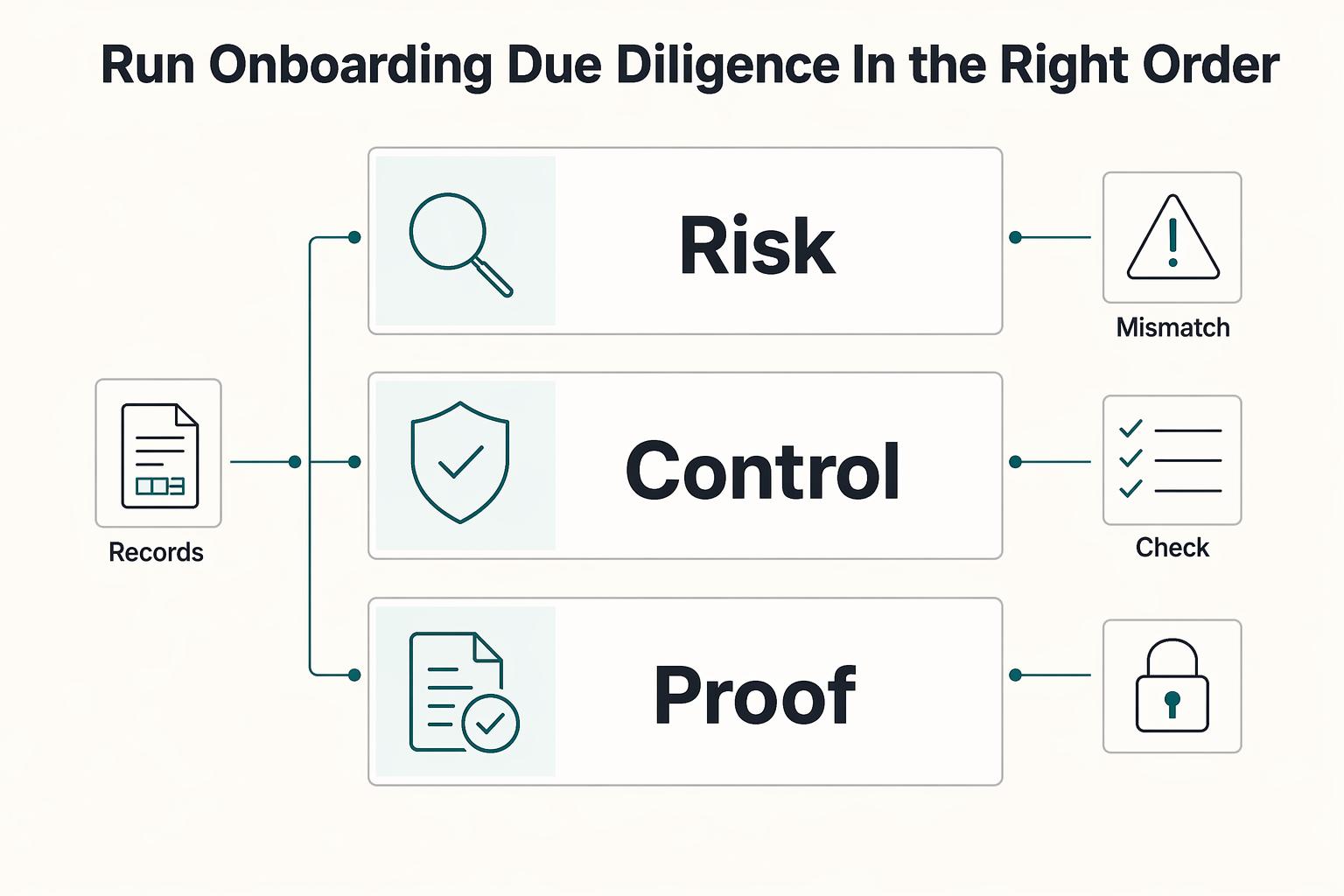
Run onboarding due diligence in the right order#
The order matters. Define scope in planning, complete due diligence before selection, align contract terms, record the decision, then move into ongoing monitoring. That sequence aligns with the third-party risk life cycle of planning, due diligence and third-party selection, contract negotiation, ongoing monitoring, and termination, and it supports defensible approvals.
Step 1: Scope the relationship first. Start with the intended use and criticality of the relationship. Because relationships do not all carry the same risk, this is where you set the depth for the rest of onboarding.
Step 2: Run evidence intake as due diligence before selection. Collect and review evidence for the scoped relationship before you finalize selection. If material evidence is missing or does not match the scoped service, treat the file as incomplete until that gap is addressed.
Step 3: If you score, do it after evidence review, and separate incomplete cases. Score the vendor based on the scoped relationship and the evidence you actually received. Keep an explicit "insufficient evidence" outcome so incomplete files are not treated as full approvals.
Step 4: Confirm contract terms match the control story before use. Contract negotiation follows due diligence in the life cycle. Claimed controls should be reflected in enforceable terms. If contract commitments and reviewed controls do not align, pause go-live decisions until that gap is resolved.
Step 5: Record a clear decision and maintain the audit trail. A formal "decision memo" label is an internal choice, not a regulatory requirement, but the record itself is important. Document the decision context (for example: scope, evidence reviewed, open conditions, approvers, and status), then keep documentation and reporting current across the relationship life cycle.
Monitor vendors monthly and quarterly without creating noise#
Monitoring should be frequent enough to catch change, but not so noisy that teams start ignoring it. Use a risk-based split cadence, keep lighter exception checks between broader revalidations, and treat deeper review intervals as internal policy choices, not universal rules.
Set a split cadence by risk tiering. Start with the onboarding tier and decide what needs fast exception detection versus periodic revalidation. Ongoing monitoring is its own life-cycle stage and should be commensurate with relationship risk and complexity, so one flat schedule is usually the wrong design.
An illustrative internal cadence is monthly exception review for critical vendors, with a broader quarterly evidence review for material relationships. Detect and escalate urgent incidents when they occur rather than waiting for that meeting. Adjust the schedule to actual risk and applicable minimum requirements.
Track leading indicators that change the score. Do not wait for a headline incident. Track signals that should change scoring while there is still time to act.
Focus on indicators such as contractual performance changes, overdue remediation, repeated service instability, delayed control evidence, and external signals from client portals, news coverage, provider newsletters, and press releases. If a signal would have changed onboarding residual risk, trigger review now.
Build a leadership evidence pack focused on action. Senior management remains accountable, so reporting should support decisions, not fill pages. A concise internal operating pack can include:
- Open issues
- Unresolved escalations
- Current control attestations
- Remediation status
- Completed financial review results for board or designated committee reporting
For control attestations, use reviewable evidence such as independent audit reports or SOC reports where relevant. Add a simple delta log: what changed, what is still open, who owns remediation, and whether contractual expectations are still being met.
Re-tier when business usage changes. Do not wait for an annual cycle if dependency changes sooner. Re-tier when service scope, criticality, or business usage shifts, especially when payment-flow impact or customer impact increases.
Set a clear trigger rule: if usage materially changes, reopen tiering before the next scheduled review. Periodic leadership packets still help, but they should not delay reassessment after a material change.
If your team is still building its vendor pipeline, How to Find Vendors for Your Platform and Vet Third-Party Providers at Scale is a useful companion to this scoring framework.
Select tooling based on operating fit not feature lists#
Tool selection should follow your operating model, not the other way around. Choose a platform only if it can run your real tiering, evidence, and escalation process from planning and due diligence through ongoing monitoring and termination.
Test evidence capture, domain and criticality fields, escalation routing and reporting. If the tool cannot retain the evidence behind a decision, key review work will remain outside it.
Use your life cycle as the stress test: planning, due diligence and third-party selection, contract negotiation, ongoing monitoring, and termination. Ask each vendor to demo one record across all five stages with contract terms, audit evidence, and remediation items still visible.
Build a shortlist from your required workflow and data constraints, then test each candidate with the same vendor record. Product listings and peer ratings do not establish that your approval process will work.
Run a material-control-gap scenario. Confirm that the tool assigns the relationship owner, routes the case to the proper decision maker, preserves the decision and expiry, and exports the supporting evidence.
Test with the people who will report vendor problems. An issue must reach an accountable decision maker with enough evidence to act; a dashboard alert without routing or permission to respond does not complete escalation.
Common mistakes and recovery actions#
Many control gaps come from execution, not the initial score. The pattern is familiar: scoring is treated as one-and-done, payment risk gets forced into generic templates, reputation signals stand in for evidence, and escalation ownership stays vague.
Frequently Asked Questions
What is third-party payment vendor risk scoring for platforms?
Third-party payment vendor risk scoring is a documented assessment of the risk a payment-related vendor introduces before and during the relationship. For platforms, it should test customer and operational impact, including data access and payment-activity exposure, not just generic procurement checks. The score should be tied to evidence because using a third party does not remove your responsibility for safe and compliant operations.
Which risk domains are non-negotiable in a credible vendor scorecard?
Cover data protection, security, business continuity, compliance and regulatory exposure, operational reliability, and financial viability. Add other domains when the service requires them. Keep the customer, data and payment impact visible in each rationale.
How is risk tiering different from scoring, and why do both matter?
Criticality measures the consequence of service failure and sets review depth. Residual risk measures remaining exposure given evidenced controls. Use both to set oversight: a well-controlled critical payout service still needs continuity and exit planning.
What should trigger escalation to legal or compliance leadership?
Escalate when a significant issue changes your risk or control position. Clear triggers include material or repeat audit findings, deterioration in financial condition, security breaches, and data loss. If the issue is unresolved and evidence or remediation is inadequate, escalate through your governance process to the appropriate legal or compliance leaders.
How often should high-risk payment vendors be reassessed?
High-risk vendors should be reassessed on a risk-based cadence, not a fixed universal interval. Guidance supports periodic or continuous monitoring, with more frequent or more complete monitoring for higher-risk or critical activities. Keep each vendor in inventory and periodically reassess each relationship.
How should teams handle vendors with incomplete evidence but urgent business demand?
Urgency does not justify full approval with essential evidence missing. Obtain the minimum required evidence and satisfy mandatory controls first. Any permitted internal exception must specify limited scope, accountable approver, compensating actions and expiry; it cannot waive legal obligations.
Researched and edited by the Gruv editorial team. Gruv builds cross-border billing, payouts, and finance-operations software for global businesses.
Sources
- bsaaml.ffiec.gov/manual/AssessingTheBSAAMLComplianceProgram/03trusted
- bsaaml.ffiec.gov/manual/BSAAMLRiskAssessment/01trusted
- csrc.nist.gov/glossary/term/residual_risktrusted
- dfs.ny.gov/industry-guidance/industry-letters/il2025102...trusted
- dfs.ny.gov/system/files/documents/2023/11/cyber_public_...trusted
- ecfr.gov/current/title-31/subtitle-B/chapter-X/part-1...trusted
- ecfr.gov/current/title-31/subtitle-B/chapter-X/part-1...trusted
- fdic.gov/news/financial-institution-letters/2023/fil2...trusted
Educational content only. Not legal, tax, or financial advice.
Related Posts

The Freelance Payment Penalty: A Modeled Audit of Platform Fees, FX Spreads, and Payout Delays
The money rarely disappears through a single, easy-to-spot fee. The real loss is stacked. A marketplace takes its commission, a processor adds a charge for international cards, a bank or payment company converts the currency at a spread, a platform holds the funds before release, and a wire sheds a little to intermediaries on the way in. Each layer looks defensible on its own, but the worker feels the combined result as a smaller deposit and a later payday.

How to Respond to a Subpoena for Business Records
Move fast, but do not produce records on instinct. If you need to **respond to a subpoena for business records**, your immediate job is to control deadlines, preserve records, and make any later production defensible.
A US Expat's Guide to Investing in UCITS ETFs to Avoid PFIC Issues
The real problem is a two-system conflict. U.S. tax treatment can punish the wrong fund choice, while local product-access constraints can block the funds you want to buy in the first place. For **us expat ucits etfs**, the practical question is not "Which product is best?" It is "What can I access, report, and keep doing every year without guessing?" Use this four-part filter before any trade: