
Quick Answer
Build an auditable scorecard before signing: rate technical dependency, contractual constraints, and data friction as verified, partially verified, or unverified, then keep term length and committed volume narrow until critical gaps close. Test a real export for machine-readable history and field mapping, and require written renewal, wind-down data access, and transition terms. If portability evidence is missing, treat that as a commercial limit, not a future fix.
Why optionality matters in payment infrastructure#
Vendor lock-in is usually a compounding dependency problem, not one bad decision. Over time, contracts, vendor-specific integrations, and data formats can make switching expensive.
This matters beyond engineering. When contracts, data formats, and system constraints keep you tied to one vendor, you lose room to negotiate pricing, adjust strategy, or change direction with confidence. Even reasonable alternatives can start to feel too risky. That is how lock-in slows innovation and growth.
In practice, the pattern often looks like this:
- Long-term contracts can raise exit pressure before migration work begins.
- Provider-specific integrations can pull more product logic into one vendor model, reducing application portability.
- Proprietary data formats can make data portability harder in execution.
- System constraints can anchor day-to-day operations to one vendor path.
This guide is about practical optionality: preserve data portability, preserve application portability, and keep switching costs bounded so changing providers remains a real choice. The target is not zero dependence. The target is dependence you can manage.
A useful standard comes from cloud portability: customers should be able to switch providers if they choose. Treat that as a principle, not a payments playbook. The AWS whitepaper that articulates this principle was published on June 21, 2021, and it notes some content may be outdated. Use it as a baseline, then test portability with evidence from your own architecture, exports, and contracts instead of relying on vendor assurances.
As you read, keep one question in view: if pricing, service quality, or roadmap fit changes, can you respond without a long, high-risk rebuild? If not, that is the lock-in risk this guide helps you reduce while you keep scaling.
What optionality means for platform payments teams#
Optionality means you can change provider scope before switching costs get high enough that switching stops being a real option. For payments teams, the goal is not zero dependence. It is bounded change cost, so you can adjust provider scope without forcing a full rebuild.
Define optionality as bounded change cost. Do not define optionality as "never use vendor features." Use a stricter test instead: if pricing or product requirements change, can you reduce, replace, or add provider scope with manageable cost and risk?
Early standardization can be a rational speed choice. The problem starts when that choice hardens into a position where your system can only operate inside one vendor environment.
Separate standardization from harmful dependency. Using open standards can reduce long-term lock-in risk because shared conventions make substitution more realistic. Deep coupling to proprietary APIs is where optionality starts to erode.
Treat portability as an evidence question, not a reassurance question. You should be able to show regular exports and explicit contractual exit terms before deeper commitments. If you cannot, portability is probably untested.
Treat lock-in risk as a product risk. Do not leave lock-in assessment to procurement alone. Keep data migration effort and platform dependencies visible in product and engineering decisions, because contracts, data formats, and system constraints can make switching costly. Switching costs can also include migration work, data transfer, and egress-fee exposure.
For high-dependency areas, require clear, testable answers early and keep initial commitments narrow until that evidence is in place.
For a more detailed vendor scoring framework, see Vendor Risk Assessment for Platforms: How to Score and Monitor Third-Party Payment Risk.
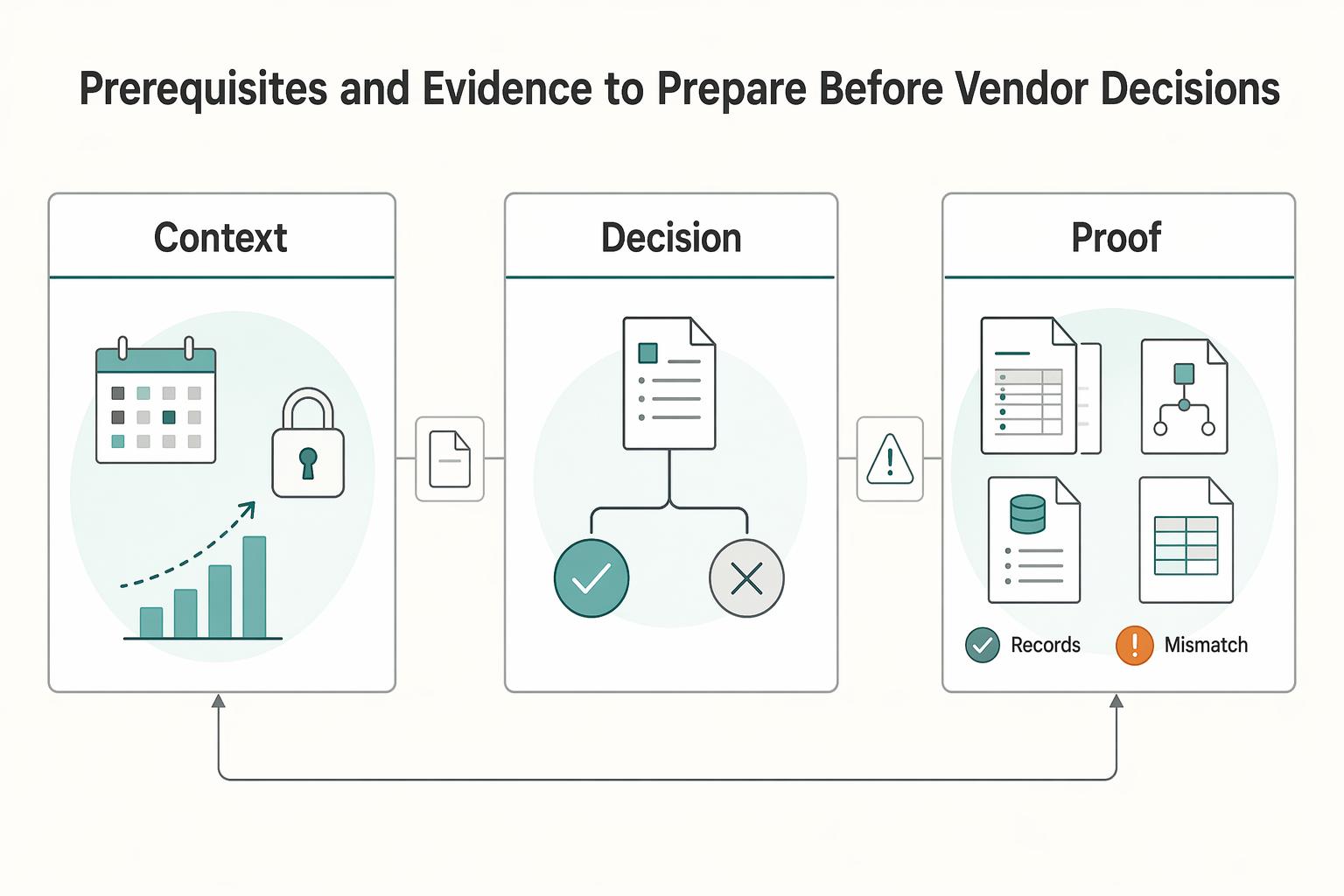
Prerequisites and evidence to prepare before vendor decisions#
Do not evaluate vendors from memory or sales claims. Build one evidence pack first so lock-in risk is visible across contracts, data movement, and daily operations before you commit.
Gather contract facts before architecture debates. Start with contract terms that affect exit risk, including duration, renewal windows, termination language, and transfer charges where applicable. Lock-in often builds gradually as a vendor gets embedded in core operations, and long-term terms can add exit friction through early-termination penalties.
For each vendor, keep one record with the signed terms, known constraints, and open questions. If you cannot point to a clause, treat it as unverified.
Map where dependence becomes operational. Build a lock-in map across four areas and focus on where technical, contractual, data, and process dependencies overlap. If a hybrid or multi-cloud approach is in scope, account for its added complexity in that map.
Capture the actual artifacts your team uses and mark where proprietary formats or vendor-specific identifiers are embedded in workflows.
Treat portability as tested evidence, not a claim. A vendor saying data is exportable is not enough. Document what you can export now, what still appears vendor-specific, and which portability claims are untested.
Run a real export for a high-consequence workflow, then verify that key fields still map to your internal systems. Confirm the export is complete, machine-readable, and usable without vendor-specific tooling. Note any transfer barriers that appear when data needs to move at scale.
Assign owners so decisions stay aligned. Lock-in risk spreads across functions, so ownership has to be explicit. Assign named owners so no risk area is orphaned.
Define ownership for contract terms, technical dependencies, portability testing, and operating-risk review.
The outcome should be one shared evidence pack with verified facts, open questions, and red flags. That keeps contract, architecture, and operating decisions aligned before switching costs become urgent.
For a related walkthrough, see Net-30 Payment Terms for Platforms: How to Set Vendor Payment Terms Without Killing Contractor Cash Flow.
Step 1 Score lock-in risk before you sign#
Turn your evidence pack into an auditable scorecard before procurement moves to signature. If any critical portability item is unverified, keep commercial commitments narrow until proof gaps are closed.
A portability score is useful only when each rating points to evidence: a signed clause, API document, export sample, support response or stated cost assumption. Mark missing evidence unverified.
Use three practical risk classes to capture switching costs: technical dependency, contractual constraints and data friction. Add regulated program approvals, recipient mandates and non-portable credentials where they affect the payment flow.
| Risk class | What to inspect | Evidence to attach | Red flag |
|---|---|---|---|
| Technical dependency | Proprietary APIs, SDKs, provider-specific models, embedded business logic | API docs, integration inventory, example requests/responses | Core workflows depend on one provider's objects or event model |
| Contractual constraints | Term length, renewal windows, transition support, wind-down data access | Signed terms, order forms, legal markups, renewal dates | Long commitments with unclear exit support or vague data-access terms |
| Data friction | Proprietary formats, export limits, missing history, migration validation effort | Sample exports, field dictionary, export specs | Exports are partial, hard to map, or usable only in vendor tooling |
You do not need a universal formula, but you do need a consistent rationale for each critical criterion.
2. Add checks generic reviews miss. Generic reviews often stop at API quality and contract length. Add checks for renewal and wind-down terms, proprietary dependencies, and data-portability friction.
Score evidence, not claims. For each criterion, capture what is documented, under what conditions, and what your team would actually receive during migration. If the answer is "we'll handle that later," treat it as higher risk until documentation exists.
3. Require proof, not promises. Verbal assurance is not enough. Before signing, require three artifacts:
- Contract and policy references for renewal notice, wind-down data access, and transition support.
- Technical evidence such as API docs, integration inventory, and sample exports.
- Documented switching cost assumptions for time, validation effort, and risk.
Then test them. Verify that key fields map to your internal systems and reporting, confirm machine-readable output, and check whether historical records are included.
4. Apply the decision rule before legal close. This step should end with a score and a contract posture. If dependence is high and evidence is weak, keep commitments narrow until proof gaps are closed.
When portability is not measured, you lose leverage because you cannot credibly estimate switching time, cost, or risk. Even without explicit exit fees, switching can still require significant work once dependence deepens.
Checkpoint. Every critical criterion should have an evidence link, owner, and status, either verified, partially verified, or unverified. If any critical item is unverified, treat that as a commercial limit.
Related: Third-Party Risk Management for Payment Platforms: How to Vet and Monitor Your Payment Vendors.
Step 2 Negotiate contract terms that keep exits realistic#
Use your Step 1 scorecard to negotiate terms that keep switching costs bounded before signature. If portability is weak, do not trade that away for discounts. Tighten exit terms, data access, and commitments while you still have leverage.
| Term area | What to define | Watchout |
|---|---|---|
| Export obligations | What data you can export and how exports are delivered | Treat vague language such as "data available on request" as unresolved risk until deliverables, format, timing, and ownership are specific enough to verify |
| Transition support | What transition support is defined and which party owns each migration task | Treat vague language such as "reasonable assistance" as unresolved risk until deliverables, timing, and ownership are specific enough to verify |
| Egress fees | A clear pricing basis in writing | Avoid undefined "standard pricing" references |
| Long-term commitments | Align committed scope to what you have already validated | Avoid locking in more scope than necessary when export quality, transition support, or provider-specific dependencies are still only partially verified |
| Auto-renew | Review it alongside the constraints you can independently verify | Higher risk when paired with constraints you cannot independently verify |
Treat portability language as an enforceable obligation, not just reassurance. Contracts, data formats, and system limits are what keep teams tied to one vendor, so the agreement should define what happens when you leave, not only when you buy.
1. Prioritize exit terms over cosmetic concessions. Make exit viability the priority: clear contractual exit terms, explicit export obligations, and clear ownership of transition responsibilities. Headline terms like fees, term length, and support still matter, but lock-in risk often sits in hidden costs and unclear responsibilities.
Get these points defined in writing:
- what data you can export
- how exports are delivered
- what transition support is defined
- which party owns each migration task
If language is vague, such as "reasonable assistance" or "data available on request," treat it as unresolved risk until deliverables, format, timing, and ownership are specific enough to verify.
2. Narrow the commercial levers that increase pressure to stay. The contract levers that quietly harden dependence can include egress fees, long-term commitments, and renewal mechanics. You may accept some lock-in for reliability, speed, and integrated services, but make that tradeoff explicit and keep the downside bounded.
For egress fees, avoid undefined "standard pricing" references and ask for a clear pricing basis in writing. For long-term commitments, align committed scope to what you have already validated. If export quality, transition support, or provider-specific dependencies are still only partially verified, avoid locking in more scope than necessary.
Auto-renew is not always harmful, but it is higher risk when paired with constraints you cannot independently verify.
3. Turn portability promises into acceptance criteria. Portability language should be testable for both data portability and application portability.
For data portability, define the export path and what "usable" means for your team, including format, historical coverage, and export cadence. Before legal close, have engineering and finance ops review a sample export against internal ledger and reporting needs.
For application portability, require documentation of dependencies on proprietary APIs or vendor-specific tooling. The goal is not to ban all provider-specific features. It is to prevent contract language from overstating portability where implementation choices still create migration friction.
4. Treat resistance as a negotiating signal. Resistance to clear portability or exit language is a risk signal. It does not automatically end the deal, but it can point to weaker bargaining power later, once the service is embedded.
If risk is unresolved, lower exposure in the same negotiation: shorten the initial term, reduce committed volume, or avoid renewals tied to assumptions you cannot verify yet. Before signature, each portability obligation should map to the Step 1 evidence pack with an owner, document reference, and a clear pass or fail test.
Step 3 Architect integration so substitution is possible#
Contracts matter, but technical boundaries often decide whether switching is practical. Keep provider-specific behavior separate from core payment, ledger, and customer-facing logic, and keep your internal contracts stable as providers change.
1. Use one internal interface with standardized structures. Give core services a consistent internal payment interface, even if you only run one provider today. Keep provider SDK usage and payload mapping at the integration boundary so product, finance, and ledger logic do not depend on one vendor's API shape.
A practical release check is simple:
- core services do not treat raw provider payloads as system-of-record state
- integration boundaries own provider request and response translation into internal schemas
- Provider changes preserve core models where possible, while explicitly accommodating different capabilities, financial responsibilities and settlement semantics.
2. Standardize internal events and schemas early. This is a high-leverage control against lock-in. Define stable internal schemas for the events and records your teams rely on, then keep naming and structure consistent across providers.
That limits the spread of proprietary formats and improves interoperability and portability over time. Without that discipline, provider-specific assumptions leak into reporting, support flows, and product behavior long before anyone calls it lock-in.
Review security and supply-chain risks when integration scope changes. NIST SP 800-161 Rev. 1, Update 1 offers a cybersecurity risk-management framework; it is not proof of payment credential portability or a universal board-reporting obligation.
The goal is straightforward. Your teams should be able to trace what happened in product, operations, and reporting without depending on one provider's internal conventions.
4. Use direct CSP coupling only as an explicit tradeoff. Direct integration with a single cloud platform can be reasonable when speed, reliability, and integrated services are the priority. But treat that as an explicit tradeoff with a defined revisit point. Lock-in risk grows when switching becomes costly or complex and you lose flexibility and control.
Set a concrete trigger for tightening standardization and portability controls, and act on it before provider-specific assumptions spread into product behavior, reporting, and operations.
Step 4 Build operations that can survive provider change#
A portable integration is not enough if operations still depend on one vendor portal, one export, or one support path. For payments, provider-change readiness is also an operating-discipline issue: shared visibility, clear ownership, and access to the same key evidence across teams.
1. Anchor reporting in your internal records. If your team runs an internal ledger, use it as an operating record and reconcile provider outputs into it. This helps keep finance reporting and support investigations consistent when providers differ on fields, formats, or timing.
Define a minimum trace path that fits your systems, for example: internal request ID, provider request or transfer ID, settlement reference, and finance export batch. If key links exist only in a provider dashboard or raw export, portability risk increases.
A practical drill is to have finance ops reproduce a recent payout report and one exception case from internal records first. If the team still depends on the provider portal for basic status answers, treat that as an operations gap.
2. Define cutover controls before data migration starts. Before moving meaningful volume, align engineering, finance ops, and support on cutover controls, exception ownership, and rollback decision points. Exact dual-run windows and rollback thresholds are internal policy choices, not fixed by the sources here.
Use shadow comparisons or split mutually exclusive cohorts for a dual run; never execute the same authorized payment on both providers. Retain one durable intent with provider attempts and an owner for each unresolved original. Resolve its authoritative outcome or cancellation before cutover, retry or fallback creates a replacement.
Keep one shared cutover evidence pack visible to engineering, finance ops, and support:
- ledger-to-provider count and amount comparisons
- open exceptions with owner and age
- sample payouts traced end to end
- finance export comparison across old and new paths
- rollback decisions and current cutoff point
Cross-functional visibility is the control, not overhead. Not everyone needs commit privileges, but everyone should have access to the same operational evidence before cutoff decisions.
3. Require traceability and rehearse degraded paths. Define traceability so teams can follow payouts through key operational handoffs regardless of provider choice. That is what enables faster answers during delays, failures, and escalations.
Test this on a regular operations cadence, not only at the code layer. Use one degraded scenario, such as delayed provider status updates or a disabled route, and confirm the team can locate impacted payouts and run incident steps with internal visibility.
Watch for lock-in signals in tooling, not just contracts. A common warning sign is when basic visibility or operational changes must go through vendor engineering, which raises switching friction and incident-response risk.
Related reading: Webhook Payment Automation for Platforms: Production-Safe Vendor Criteria.
Step 5 Set governance triggers before lock-in becomes urgent#
Governance only helps if it gives you time to act. Set triggers before pressure peaks so you can respond while options are still open.
Use one scorecard on a fixed cadence your team can maintain. Watch trend lines for:
- switching costs, including time, money, and risk to change providers
- incident concentration in one vendor path, including outages or security incidents
- roadmap dependency on vendor-specific capabilities and architectural coupling
Escalate when those trends move the wrong way, such as pricing pressure from a highly depended-on vendor, repeated instability, or increasing migration difficulty. Also trigger a review at major renewal or scale events.
You can borrow AWS Well-Architected Framework style reviews as a discipline model, meaning question-driven checks across pillars, but validate payment portability independently. The cited AWS lock-in whitepaper is dated. Its publication date is June 21, 2021, and it should be treated as a structure for tradeoff review, not a current payment-specific readiness test.
Decide when single-provider simplicity is still the right call#
Single-provider simplicity can still be a sound choice when speed is your main constraint and dependency has not yet become material business exposure. Shift to phased optionality as soon as requirements, pricing, or contract terms could materially disrupt operations or force rushed rebuild work.
Step 1. Keep one provider while simplicity still pays. Stay with one provider when simplicity clearly improves delivery speed and added redundancy would create more drag than risk reduction right now. Treat that as a temporary choice, not proof that dependency is harmless.
Lock-in often looks acceptable early and becomes obvious later when requirements or pricing change. If you stay single-provider, keep an explicit record of provider-specific dependencies, export paths, and what would need rebuilding if you had to move.
Step 2. Watch for dependency turning into business exposure. The right time to start staged redundancy is when dependency stops being a technical preference and starts shaping business outcomes. Common lock-in drivers include proprietary technology, contract terms, and network effects, and they reduce flexibility by making switching harder.
Include engineering rebuild effort in your switching-cost view, not just vendor fees. If leadership cannot show evidence of what breaks first under a material change in requirements or pricing, optionality work should start now.
Step 3. Start phased optionality before full duplication. Do not jump straight to full dual-provider complexity unless the risk clearly requires it. First, improve portability where it matters most: isolate provider-specific logic, keep internal models stable, and verify that you can export the records needed to move key flows.
An exit strategy is a practical lock-in mitigation, alongside options like open-source components and multi-cloud. If you cannot run a credible dry-run export and name the integration points to replace, your optionality is still theoretical.
Step 4. Use multi-cloud only when it removes a named risk. Use multi-cloud only when it reduces a specific lock-in risk you can name in advance. It can help, but it is not automatically the right answer.
If it does not improve portability or substitution readiness, defer it and keep investing in a usable exit path. Evaluate the architecture against business outcomes, not architecture preference alone.
Common mistakes that destroy optionality and how to recover#
Lock-in failures are often gradual, not dramatic. They usually start as temporary choices that never get revisited. Examples include long renewals signed before portability is proven, export rights treated as enough, and vendor-specific logic spread across too many services.
| Mistake | Recovery action | What to verify |
|---|---|---|
| Long renewals signed before portability is proven | Review current licensing terms before renewal notice dates and identify any early-termination penalties | Keep one clear pack that shows contract language, renewal triggers, and penalty exposure |
| Export rights treated as enough | Run a dry-run data migration with representative records and load the output into your internal schema or neutral model | Validate counts, mappings, status history, timestamps, and reference IDs |
| Vendor-specific logic spread across too many services | Move routing, retries, and error handling behind a neutral integration layer with thin vendor adapters | Track reduction in direct vendor calls across services |
Step 1. Delay renewals until portability is proven. Do not sign a long renewal before you have evidence that you can leave. Review current licensing terms before renewal notice dates, and identify any early-termination penalties that discourage switching.
If renewal is near and portability is unproven, negotiate for time or for commitments tied to portability milestones. At minimum, keep one clear pack that shows contract language, renewal triggers, and penalty exposure so decisions are commercial and explicit, not rushed.
Step 2. Test data migration, not just export rights. An export clause is not proof of portability. Vendor-specific or unique formats can still block usable transfer even when files are technically available.
Run a dry-run data migration with representative records and load the output into your internal schema or neutral model. Validate counts, mappings, status history, timestamps, and reference IDs. If reconciliation fails without heavy manual cleanup from proprietary or unique formats, portability is still theoretical.
Step 3. Pull vendor logic behind a neutral integration layer. Scattered vendor-specific logic is a direct lock-in accelerator. Recover by moving routing, retries, and error handling behind a neutral integration layer with thin vendor adapters.
Track reduction in direct vendor calls across services to confirm progress. If retries, mappings, or other integration handling still sit outside that boundary, interoperability risk is still high.
For the contract and terms side of optionality, see Procurement Data Management for Platforms: How to Centralize Vendor Contracts and Payment Terms.
Build a 90-day execution sequence by team#
Treat this as a phased 90-day program, not a rip-and-replace move. By day 90, the goal is evidence-based optionality: what is proven, what is still unproven, and what changes are required next.
| Window | Primary work | Output |
|---|---|---|
| Days 1 to 30 | Build one evidence pack, use a standardized scorecard with live data and pre-agreed success metrics, and score each item as proven, partial, or unproven | Top governance blockers, top technical blockers, and top data gaps |
| Days 31 to 60 | Convert scorecard gaps into owned actions, tie each requested change to a documented risk, define acceptance tests, and contain provider-specific behavior behind clear integration boundaries where needed | Owned actions and pass/fail acceptance tests |
| Days 61 to 90 | Run one controlled migration rehearsal on a representative subset, complete one incident drill, and publish an executive risk update with next actions by owner | What works, what fails, and who owns each fix |
Days 1 to 30. Compile evidence and score risk exposure. Build one evidence pack across outcomes, integrations, and governance inputs. Use a standardized scorecard with live data and pre-agreed success metrics, and score each item as proven, partial, or unproven based on actual artifacts.
Prioritize the highest-risk governance and integration gaps first. Keep the output short and explicit: top governance blockers, top technical blockers, and top data gaps.
Days 31 to 60. Negotiate fixes and define test criteria. Convert scorecard gaps into owned actions. Tie each requested change to a documented risk, and define acceptance tests that can return a clear pass or fail result.
In parallel, contain provider-specific behavior behind clear integration boundaries where needed. Keep current operations stable while teams map data, test workflows, and plan training.
Days 61 to 90. Rehearse and report. Run one controlled migration rehearsal on a representative subset, then validate whether continuity holds in practice. Use the rehearsal to confirm what works, what fails, and who owns each fix.
Complete one incident drill, then publish an executive risk update with next actions by owner. Keep payment-specific portability and rail assumptions explicitly marked as unknown until separately validated.
Verification checkpoints
- Standardized scorecard completed with live data and pre-agreed success metrics
- Pass/fail results documented for prioritized workflow and integration tests
- Incident drill completed with findings and owners
Map provider-specific status handling, duplicate guards and reconciliation of settlement, fees and returns into the delivery plan.
Conclusion and copy-paste checklist#
You do not need to eliminate vendor lock-in to manage it. The practical goal is to keep a credible exit option while you continue to scale.
- Confirm your current risk score across contractual and implementation lock-in.
Use the same scoring criteria each cycle, and require evidence for each score, for example contract terms, change notices, licensing terms, fee structures, and handoff docs, not just team opinion.
- Validate portability and migration assumptions with a real test.
Test transaction-history export separately from payment credentials. Stripe’s card-data export, for example, transfers eligible card data securely to a PCI DSS Level 1-compliant processor and excludes Link credentials. That export does not include payment history or subscriptions; retrieve those separately. A portable report does not prove a portable token, mandate, balance or regulated program approval.
- Tighten contract language where switching costs hide.
Review renewal mechanics, licensing restrictions, fee structure, and exit-strategy language closely. Track contract checkpoints and amendments so financial and term changes stay visible over time.
- Reduce provider-specific coupling in your implementation.
Keep core logic and data handling from being scattered across proprietary interfaces. If you use a payment orchestration layer, treat it as one implementation choice, not proof of portability.
- Run recurring reviews with clear owners and trigger conditions.
Assign ownership across finance, legal, product, and engineering, and trigger out-of-cycle reviews around renewals, scope expansion, export friction, or restrictive licensing changes.
- Keep the objective practical.
Not all lock-in is avoidable, but unmanaged lock-in gets expensive. If you cannot show portability evidence, switching-cost visibility, and clear exit terms, assume your options are weaker than they look.
If you want a practical review of your current payout architecture before your next contract cycle, talk with Gruv.
Frequently Asked Questions
What is vendor lock-in risk in payment platforms, and how is it different from normal vendor dependence?
Vendor lock-in risk is when switching becomes difficult, not just inconvenient. Normal dependence can still be a deliberate speed or efficiency choice, while lock-in shows up when contracts, proprietary interfaces, or vendor-specific data formats make exit costly or slow. A practical principle is that you should be able to switch providers if you choose.
What is the difference between healthy standardization and harmful dependency on one provider?
Healthy standardization gives you speed now and still leaves a credible path to switch later. Harmful dependency appears when your implementation relies on proprietary interfaces or non-portable data formats that are hard to replace. Single-provider setups can save development time, but that tradeoff gets risky if price, features, or vendor viability changes and you have no practical alternative.
What are the first five controls to put in place before signing a payment vendor agreement?
A validated payment-specific "first five" standard is not established, so treat this as a practical starting checklist. Focus on five checks tied to switching-cost risk classes: exit and renewal terms, proprietary interface exposure, data format and export evidence, process dependencies, and migration-cost pressure, including potential egress fees. Require testable evidence where possible, not only assurances.
Which lock-in risks are contractual versus technical versus operational?
Contractual risk comes from terms that make early exit expensive or difficult, such as long commitments and licensing constraints. Technical risk comes from proprietary technology, incompatible interfaces, or data formats that are hard to move. Operational risk is process dependence, where day-to-day workflows are built around one provider and are difficult to transition.
When should a platform move from one provider to multi-provider readiness?
There is no validated numeric trigger. A practical signal is when a provider change in pricing, features, or continuity would create material business pain and leave you with limited options. That shift does not always require immediate live multi-provider production; teams can start by proving portability and reducing proprietary coupling.
How can finance, product, and engineering split ownership of optionality without slowing delivery?
No required ownership model is prescribed here, but a practical split is: finance on commercial constraints and migration-cost exposure, product on where provider-specific choices are acceptable, and engineering on interface boundaries and portability execution. A question-based review discipline can help teams stay aligned, but keep in mind the AWS lock-in whitepaper, June 21, 2021, is marked as historical reference, so use the method carefully rather than as current payment-specific guidance.
Try a related tool
Researched and edited by the Gruv editorial team. Gruv builds cross-border billing, payouts, and finance-operations software for global businesses.
Sources
Includes 1 external source outside the trusted-domain allowlist.
Educational content only. Not legal, tax, or financial advice.
Related Posts
Vendor Risk Assessment for Platforms: How to Score and Monitor Third-Party Payment Risk
Use this guide to build a practical, defensible approach to scoring and monitoring payment-adjacent vendor risk, with clear escalation points and named ownership. It is for compliance, legal, finance, and risk teams that need decisions and evidence that will hold up under scrutiny.
Third-Party Risk Management for Payment Platforms: How to Vet and Monitor Your Payment Vendors
Payment-vendor risk is easier to control when ownership, evidence, and escalation are explicit from the start.
Procurement Data Management for Platforms: How to Centralize Vendor Contracts and Payment Terms
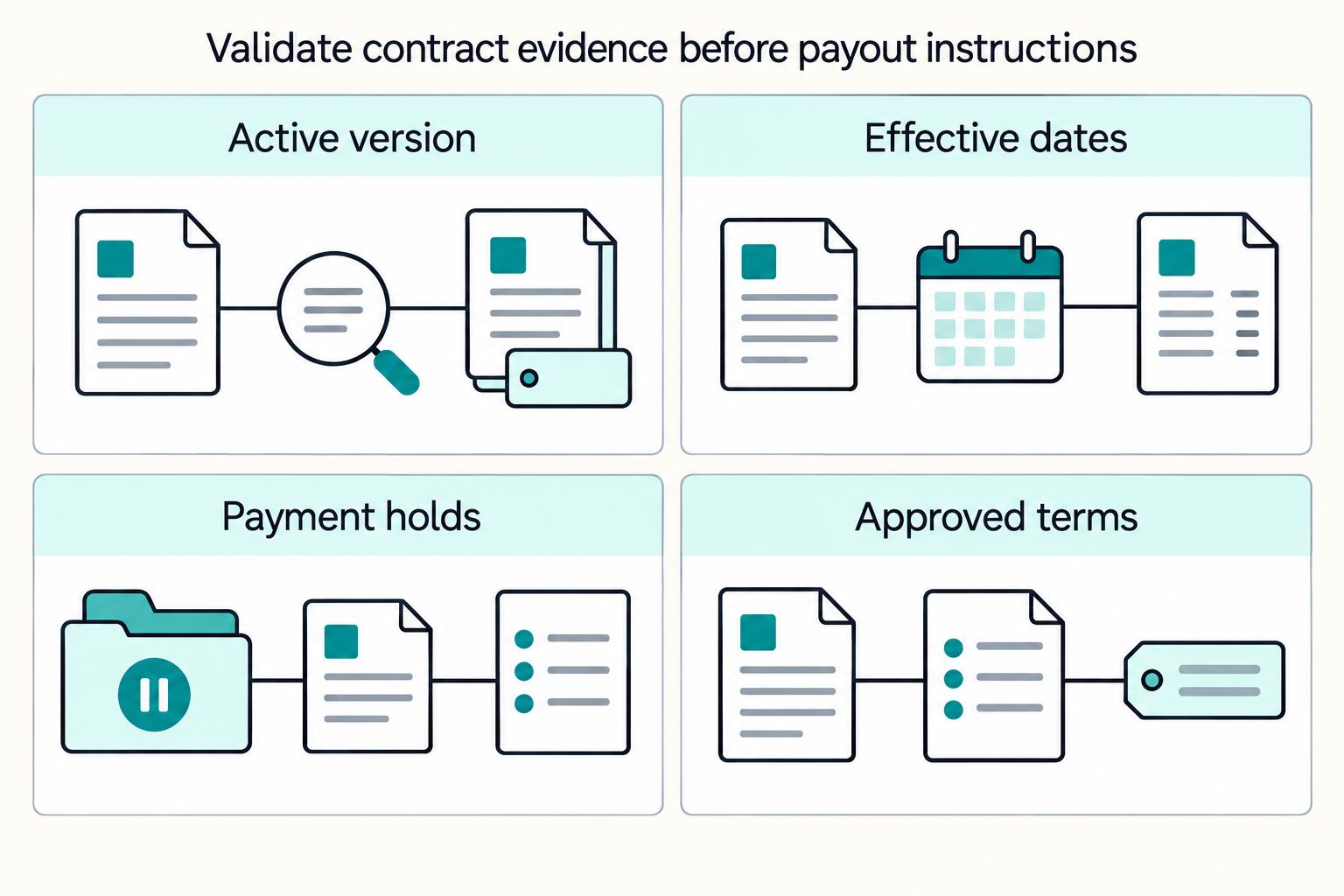
Treat every vendor contract and supplier agreement as a payment control, not a filing task. If a term can change approval, payout timing, or a payment hold, it needs to work inside your payment process, not sit in a PDF or get split across systems.