
Quick Answer
Centralize vendor contracts and payment terms by treating payment-related contract fields as executable control data in one authoritative record, then syncing them into ERP and AP for approval, due-date calculation, holds, and payout release. Standardize fields such as payment terms, renewal status, effective dates, and exceptions, keep execution telemetry linked by ID, and verify every change with an end-to-end audit trail.
Why Centralizing Vendor Contracts and Payment Terms Matters#
Treat every vendor contract and supplier agreement as a payment control, not a filing task. If a term can change approval, payout timing, or a payment hold, it needs to work inside your payment process, not sit in a PDF or get split across systems.
This guide focuses on one operational backbone from approval to payout, with an audit trail finance and engineering can both trust. The point is not to force everything into one tool. It is to reduce the enforcement and reconciliation problems that show up when procurement and contract records are fragmented. If your team already feels those breaks at close, we recommend treating this as a payment-ops design problem, not just a procurement cleanup task.
Start with the business path, not the software menu#
Define the process first, then map tools to it. Source-to-pay covers procurement from identifying a need through final supplier payment. Procure-to-pay runs that same lane through requisition, sourcing, purchase orders, receiving, invoicing, and payment, connecting procurement, finance, and Accounts Payable (AP).
Payment terms are operational, not theoretical. AP is short-term debt owed to suppliers for received goods or services, often due within 30 or 60 days. When approved terms live in one system but invoice approval and payment release happen in another, enforcing terms and reconciling mismatched data often becomes manual and difficult.
Know what each tool should own#
Clear ownership boundaries matter more than product labels. A practical ownership model is:
- Enterprise Resource Planning (ERP): day-to-day core operations such as accounting and procurement
- Contract Lifecycle Management (CLM): contract management from initiation through renewal
- Vendor Management System (VMS): finding, engaging, managing, and paying external workers or service providers
You do not need every category to centralize effectively, but you do need clear authority for the contract facts that affect payment. Start by standardizing which system is authoritative for active payment terms, contract owner, approval state, renewal state, and payout-affecting exceptions.
Use traceability as your first checkpoint#
A security audit trail is the record set used to trace transactions through related records and reports. Your first practical test is simple: can you trace one supplier payment end to end across approved terms, invoice decision, payment release, and who changed each record?
If you cannot, the process is not centralized yet. You may have visibility, but not enforceable contract data.
This guide stays practical. It covers system boundaries, the minimum fields to standardize, where ERP, AP, CLM, and VMS should connect, and what to verify before scaling rollout. The target is consistent execution of approved terms and a defensible record of what happened.
Related: Accounts Payable Document Management: How Platforms Organize Invoices Contracts and Payment Records.
Define what must be centralized and what must stay local#
Centralization works better when you decide which contract facts must control payment and which records can stay where they are created. Source-to-pay visibility still falls short if contract terms are not connected to payment actions. If you are standardizing this now, we recommend keeping a shared contract dataset for facts that can change whether, when, or under what approved exception a supplier gets paid. We use that rule when we want finance and engineering to read the same contract state.
Centralize fields that change payment behavior#
Centralize the contract fields that directly affect payment behavior. In practice, that includes payment terms and renewal-related contract data, with ownership and exception fields defined by your policy. In SAP, terms in master records are defaulted during document entry. In Oracle Payables, supplier-site terms default onto invoices, and changing invoice terms recalculates scheduled payment. Those are control fields, not reference text.
Use a quick check. Pick one supplier with a simple term like NET 30, enter a test invoice, and confirm due-date logic matches the contract record. If finance cannot clearly name the authoritative record when defaults differ from the signed agreement, centralization is still incomplete.
Keep execution telemetry local but linked#
Keep execution telemetry in the systems that generate it, then link it back by ID. Payout status, retry counts, processor response codes, and webhook events can stay in payment and operations logs when they are traceable to contract and invoice records. Stripe defines webhooks as asynchronous event notifications and retries undelivered events for up to three days, which supports treating them as operational evidence rather than contract master data.
Apply one rule for shared versus local records#
Apply one rule consistently. If a field can change payout approval, timing, hold logic, or exception handling, treat it as a candidate for the shared contract record. If it only describes execution, keep it local and traceable. We recommend writing that split down before integrations start so your team is not renegotiating field ownership in implementation meetings.
A common failure mode is unclear ownership across tools. That is when stale renewal status in one system, fresh retry events in another, and no clear owner for the payment decision start creating real control risk.
Pick system-of-record boundaries before you buy or integrate tools#
Decide field ownership before tool selection. Each payout-relevant field should have one allowed writer, clear consumers, and a defined update path. Do this before adding a CLM, extending ERP, or wiring integrations, because ownership problems get harder to fix once systems are connected.
Choose the authority pattern first#
Choose one authority pattern first, then enforce it field by field.
A CLM-led pattern fits when legal authoring speed is the constraint and approved terms must flow into operations. This lines up with CLM-to-operations behavior where contract terms drive downstream execution. Keep one caveat explicit: in Dynamics 365, the integration framework is not itself a full CLM solution, so you still need an external CLM and clear downstream integration rules.
An ERP-led pattern is usually the safer default when finance owns payment policy, supplier controls, and close discipline. If payment terms drive AP behavior, keep ERP as the executable owner. This matters even more where invoice controls are strict, such as setups that auto-reject non-PO invoices with non-matching payment terms.
A governed dual-write pattern is viable only when each side must author different fields and decision rights are explicit. Dual-write is built for tightly coupled bidirectional sync, but planning constraints still apply, including 1:1 environment mapping and limits such as no table-map scoping to a specific legal entity. If teams expect to edit the same executable field in multiple tools, this becomes high risk.
Use this rule of thumb. If finance owns payment policy and close controls, bias toward ERP with governed sync. If legal velocity is the bottleneck, bias toward CLM-led authoring with clear downstream integration rules and written field rules. We recommend picking one bias per field instead of debating tool ownership in the abstract, because your operators need a usable answer before rollout starts.
Verification point: for every critical field, state in one sentence where it is written, where it is consumed, and where it is not allowed to change.
Document field ownership in a hard table#
Document hard field ownership in a table. Tool ownership alone is not governance.
| Field | Legal owner | Finance owner | Engineering owner | Update path |
|---|---|---|---|---|
| Contract effective date and renewal status | Owns contract language and amendment timing | Reviews downstream close-cycle impact | Owns ingestion and mapping | Scheduled sync and approval-triggered event where available |
Payment terms, for example NET 30 / PT30 | Owns negotiated clause text | Owns executable AP value | Owns canonical mapping and validation | Sync/API into ERP/AP |
Early-pay discount terms, for example 3% within 15 days | Owns clause text | Owns operational enablement | Owns calculation and validation logic | Sync with import validation |
| Payment exception or payout hold flag | Can request contractual exception | Approves hold/release/override | Propagates status downstream and logs outcome | Event-driven update or scheduled sync |
If bidirectional sync is in scope, add a "last allowed writer" rule per field. A practical way to enforce this is through data contracts: define required fields and trigger immediate alerts when values arrive blank, malformed, or from a non-authoritative source.
Test the boundary with one real contract#
Test the boundary with one real contract before full rollout.
Use a simple term such as NET 30 or PT30, update it only in the designated source of truth, and confirm downstream AP due-date behavior matches within the expected sync window. Then verify auditability: who changed it, when, in which system, and which downstream record updated.
The core failure mode is not dual-write itself. It is dual-write without explicit field ownership and decision rights. That is when teams end up with conflicting values and the familiar finance conflict: "My data says this, your data says that." Once definitions split across independently owned pipelines, the problem moves from workflow friction to financial-control risk.
Expected outcome: one system authors each critical field, other systems consume it, and every exception has a named owner and update path. If that is not yet true, defer additional tooling.
Prepare the minimum inputs before migration starts#
Migration goes well only when the data is ready. Before you load suppliers or contracts, prove where each source record comes from, how fields map to the target, and which payment-term values will survive import as intended.
Build a preflight evidence pack#
Build a preflight evidence pack from the records you operate today. For many teams, that includes a current vendor contract list and active supplier agreement amendments. Include live amendment state, since an amendment changes an existing contract by adding, removing, or substituting terms.
Pair that pack with a simple data dictionary across ERP, AP, CLM, and any procurement tool in use. It should define each field, source, and allowed values so mapping in the staging layer stays consistent when source values are converted to target formats.
Use one checkpoint before import. For any record, you should be able to confirm the active contract version, the executable payment terms, and who owns corrections if imported values are wrong.
Normalize term labels before import#
Normalize term labels before import. Payment terms are ERP master data and can be included on orders, invoices, and payment documents, so label consistency matters.
Create one canonical term table. If PT30 means payment due within 30 days, map source variants to that code before migration rather than importing free text. Do the same for discount structures such as 3 percent within 15 days. For SAP Ariba enhanced payment-term imports, confirm ENHANCED_PAYMENT_TERMS is maintained and validate day-limit fields against the documented 0 (zero)-31 range.
Audit staged data before final migration by counting records and, where relevant, summing financial fields to confirm mapped output still ties back to source data.
Capture the integration inventory before scheduling the load#
Capture your integration inventory before scheduling the load window. Document the current ERP, AP, CLM, and any procurement contract management software that handles approvals or supplier changes, so import scope is explicit.
Also define what the import will touch in this wave. If Oracle Procurement is in scope, its supplier import path is designed for initial legacy loads and supports create and update operations for supplier records and child objects. Decide upfront whether supplier profiles and child objects move together or in separate waves.
Set a written readiness gate and prove it in staging#
Set a written readiness gate and prove it in staging before moving live vendors. A practical gate is simple: required fields are present in the target, and correction ownership is clearly defined.
Then run both pre-import testing and post-migration validation. Review ownership rules, confirm required source fields are captured in the target, and validate results after migration completes.
If you are building a single source of truth for vendor records, Vendor Relationship Management for Platforms That Finance and Ops Can Run shows how to keep ownership clear across finance and operations.
Design a contract-term schema that can drive payout behavior#
Your schema has to drive payout behavior, not just store contract text. It should tell AP when to pay, when to block payment, who can approve changes, and which supplier agreement version is allowed to trigger downstream payment actions. If schema ownership is still unclear across teams, pause integration until one owner and one required field set are agreed.
Model terms as executable fields#
Model terms as executable fields, not labels. Payment Terms = Net-30 alone is not enough, because payment terms drive automatic installment creation.
Use a minimum executable set such as:
term_codeand labeldue_date_methodasFixed Date,Days, orCalendarterms_date_source, for example purchase order default vs supplier-site default- installment fields, including due date and up to 3 discount dates per term line where relevant
approval_chainor approval-rule referencehold_conditionandrelease_owner, since held invoices are not payable until releaseend_date,renewal_lead_days, andrenewal_recipientsagreement_version,effective_start,effective_end, andsupersedes_version- optional local
dispute_owneror exception path if disputes can block release in your process
Checkpoint: from one live contract record, you should be able to predict payout behavior without opening the PDF. If you cannot, the schema is still descriptive, not operational.
Do not collapse date logic into one generic field. Days, Calendar, and Fixed Date are different execution modes and should stay distinct.
Map each term pattern to payout actions#
Map each term pattern to payout actions so policy becomes system behavior.
| Payment term pattern | Required machine fields | Payout action | Exception rule |
|---|---|---|---|
Net-30 Payment Terms | due_date_method = Days, days_due = 30, terms_date_source, no active hold | Create one installment due 30 days after the invoice terms date | If your team grants faster terms to select suppliers, store an approved override with owner and effective dates instead of changing the base label |
| Discounted term with discount windows | Days logic plus discount dates and amounts on the term line | Create standard due installment plus discount checkpoints (up to 3 discount dates per line where relevant) | Confirm discount fields survive import as structured data, not free text |
| Fixed day-of-month term | due_date_method = Fixed Date, day_of_month, such as 15 or 31, plus cutoff fields if used | Schedule payment on the configured day, including last-day-of-month behavior when 31 is used | Test month-end behavior in staging |
| Calendar-based term | due_date_method = Calendar, calendar reference | Compute due date from payables calendar periods | Do not merge this with Days logic in reporting or enforcement |
Keep exceptions explicit and approval-bound. Silent label edits reduce control quality and weaken your audit trail.
Version supplier agreement changes carefully#
Version supplier agreement changes so only the correct version drives payout. While a contract is under amendment, payout logic should continue to use the latest active version until the amended version is approved and effective.
Use strict version controls:
- one active version for execution
- one pending version under amendment
- explicit effective dates
- explicit supersession of the prior version at cutover
Test with a staged amendment. Run one invoice dated before the new effective date and one after. If both follow the same logic, version control is failing.
Also track manual schedule adjustments. Term edits can recalculate installments, and manual adjustments may need re-entry.
Bind every material term change to an audit trail#
Bind every material term change to an audit trail. Record who changed what, when, prior value, new value, approval evidence, and affected downstream payment objects. Keep previous values visible instead of relying on overwrite-only updates.
Control check: from one term change, you should be able to trace which installments recalculated, which holds were applied or released, and which payment event used the new version. If you can only see the latest value, the audit record is too shallow for reliable operations and review.
If your team still cannot align on a compact required field set, stop integration work and resolve schema ownership first. That helps prevent outdated terms from continuing to trigger payouts.
If your field map is ready, compare it against a payout flow with idempotent retries, status tracking, and audit-ready events in Gruv Payouts.
Connect contracts to payment execution without creating data drift#
A safer design puts validation between contract data and payout execution. Without that layer, stale versions, duplicate retries, and out-of-order events can push money under the wrong policy.
Validate contract events before payout instructions#
Route contract events through validation before any payout instruction. A practical order is: CLM or ERP event, then validation, then payout instruction, then webhook feedback into your records. That is a design choice, not a universal standard, but it keeps authoring, approval, and execution separate.
This boundary matters because integration depth differs by contract type. Microsoft's Dynamics guidance notes purchase agreement lifecycles can run between an external CLM and Supply Chain Management, and that some contract types are more deeply integrated than others. Treat upstream events as inputs to validate, not auto-approved execution commands.
Before emitting payout instructions, validate:
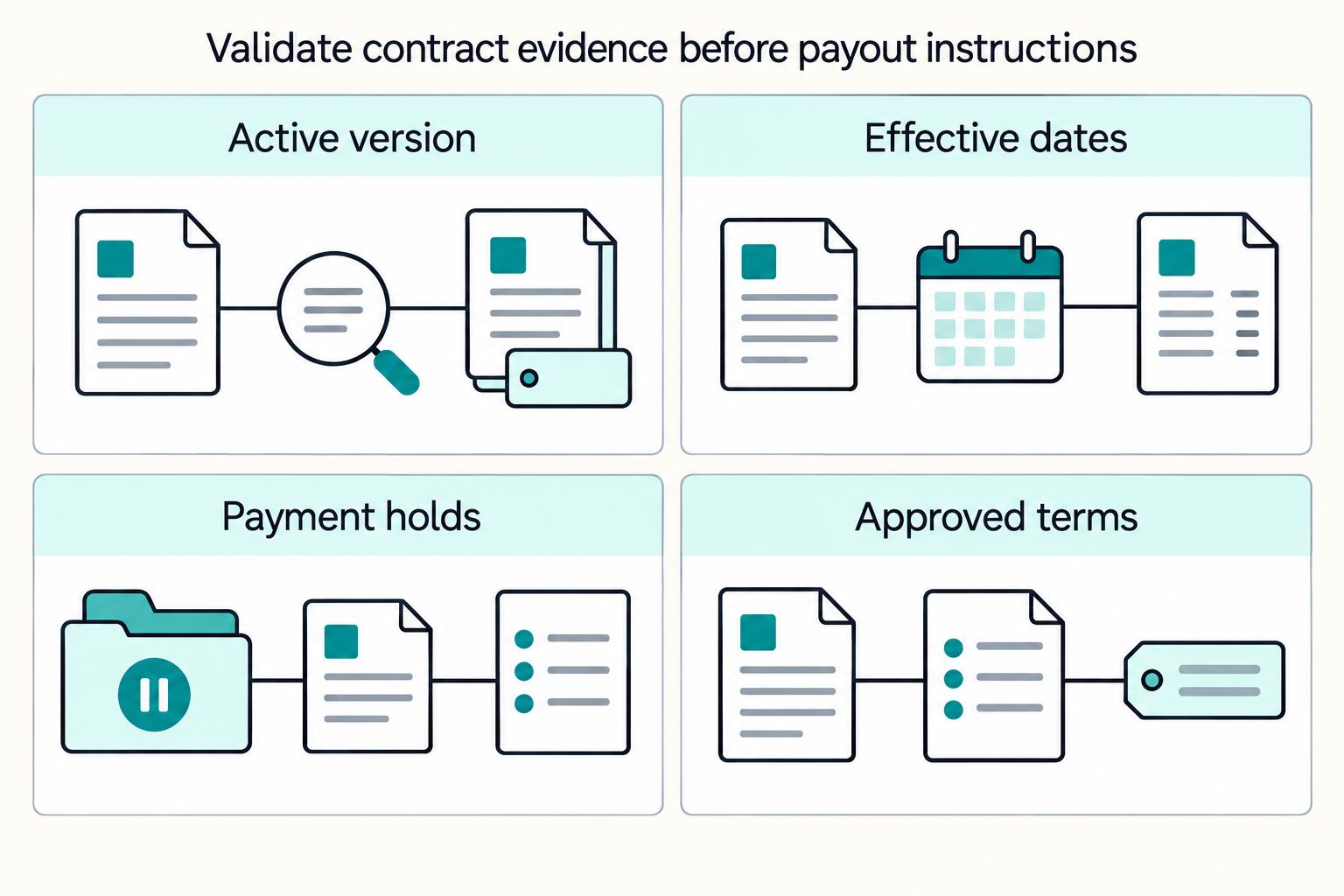
- the incoming contract or amendment version is the active executable version
- the effective date covers the payable or invoice in scope
- AP has not placed a matching hold or other payment block
- payout policy still matches approved terms in ERP
Make each state transition replay-safe#
Make each state transition replay-safe with idempotency and deduplication. Retries are normal, and webhooks can deliver duplicates, so your write path across AP, payout services, and rails must produce one intended outcome.
Stripe's API docs describe idempotent retries returning the original result, and idempotency keys up to 255 characters. Stripe's webhook docs also note the same event may arrive more than once. In practice, that means logging processed event IDs, skipping events you already handled, and attaching idempotency keys to payout create and update calls.
Use action-level keys, not broad keys like supplier alone or invoice alone. A compound key such as contract version plus payable ID plus action type helps avoid suppressing legitimate later changes.
Reconcile approval, invoice, and payout states on a cadence#
As an internal control model, reconcile contract approval, invoice approval, and executed payout on a fixed cadence. The goal is to confirm that commercial terms, invoice status, and cash execution still match after holds, retries, and settlement batching.
| Checkpoint | Primary record | What to verify | Common break |
|---|---|---|---|
| Contract-approved state | ERP or contract master | active version, approved terms, release state | amendment approved upstream but not propagated |
| Invoice-approved state | AP | invoice amount, hold status, matching result | 3-way matching hold blocks payment |
| Executed payout state | payout service or settlement report | instruction amount, execution status | duplicate execution or stale retry path |
Run this each cycle. Daily is practical when settlement reporting supports a daily cadence. Adyen documents batch-based settlement reporting, and Stripe frames reconciliation as matching transaction records to accounting records.
Monitor drift directly, not just failed payouts#
Monitor drift directly, not just failed payouts. You need to catch cases where payout execution policy no longer matches terms in ERP, even if no hard failure has fired.
Set an internal alert rule for unresolved mismatches based on your operating cadence. Then monitor fields that change payment behavior, such as active agreement version, effective dates, and hold status.
Also guard against stale or out-of-order webhook payloads. Stripe notes payloads can be outdated, partial, or out of order, so drift checks should compare current system state to current system state rather than trusting arrival order.
For a deeper look at keeping vendor records accurate, see Vendor Data Management: How Platforms Keep Contractor Payment Details Accurate and Compliant.
Turn payment terms into enforceable policy gates#
Payment terms only matter if AP can enforce them. If a term changes due-date calculation, approval requirements, or release eligibility, encode it as a machine-checkable gate so payment can be approved, held, or stopped by rule.
Encode terms as payment logic#
Map each term to fields the system can test: due-date method, required approvals, and hold triggers. Keep a simple rule: if it affects payment timing or eligibility, store it in structured logic, not only contract prose.
For Net-30 Payment Terms, store the due-date calculation and the approval or hold dependencies separately. Then verify behavior with two tests: a matching invoice should calculate the expected due date, and a term mismatch should raise an invoice exception instead of passing silently.
Use release gates for open risk or missing documentation#
Keep standard terms for due-date calculation, but gate release when control conditions are unresolved. If review criteria flag an invoice, or required invoice data is missing or invalid, route it to hold-and-review logic until the condition is resolved.
Do not overwrite the commercial term label to do this. Preserve the agreed term, and apply the conditional hold as a separate control state.
Route exceptions to named approvers and keep evidence#
Exception handling should run through the configured approval path in AP, including approve or reject decisions and optional review stages before disbursement. Use criteria-based routing so routine cases can auto-approve while exception cases go to authorized reviewers.
Capture an audit trail that includes:
- hold or exception reason
- approver decision history
- hold status history, current and released
Choose automation depth by payout pattern#
Automation depth should follow payout pattern, not ideology. A common pattern is criteria-based automation for repeatable volume, with a manual exception lane where terms are custom or risk conditions are flagged.
| Payout pattern | Gate style | Watchout |
|---|---|---|
| High-volume, repeatable payouts | Auto-approve standard cases and route exceptions for review | Review backlog if criteria are too broad |
| Low-volume, custom vendors | Manual exception review with an authorized reviewer | Decisions made outside workflow reduce traceability |
| Mixed population | Criteria split between straight-through and review | Thresholds that push nearly everything into one lane |
A practical starting point is to automate standard cases and manually review exceptions, then tune criteria based on actual exception volume and hold-release outcomes.
If you are reworking payment terms, Net-30 Payment Terms for Platforms: How to Set Vendor Payment Terms Without Killing Contractor Cash Flow covers the tradeoffs in more detail.
Set ownership across procurement, finance, ops, and engineering#
Once payment gates are in place, vague ownership becomes a control problem fast. Use a clear split of responsibilities, keep release and approval duties separate, and make escalation and handoff steps part of the operating model rather than informal side work.
Assign named accountability on each active contract#
Start with the vendor contract record. It should show a clearly accountable owner at the right seniority level, not just a department label, plus a backup contact. If procurement or commercial manages contract language and amendments, they can hold that accountability while the business outcome owner stays attached to performance decisions.
For every active supplier agreement, make it easy to see the accountable owner, current version, effective terms, and escalation contact. If ownership is a shared inbox, accountability is still unclear.
Separate policy control, monitoring, and integration reliability#
Define ownership for payment-policy and close-control fields in ERP and AP: term configuration, hold logic, approval dependencies, and close-period controls. Keep contract-authoring and release-approval duties separate where possible to preserve segregation of duties.
Define operational ownership for execution monitoring: KPI and event tracking, retry visibility, failed disbursements, and reconciliation issue routing. Define engineering ownership for each webhook integration path, including alerting and failure handling when deliveries fail.
A practical check is to trace one vendor from contract record to ERP term setup to AP release state to webhook receipt. If any step depends on "ask the team," ownership is incomplete.
Define a timed escalation route for term conflicts#
When supplier agreement language conflicts with ERP or AP constraints, use a timed escalation path with named decision owners. Define who decides whether the resolution is a contract amendment, temporary hold, or finance-approved exception, and set internal timing for triage and escalation.
Use formal routes, not ad hoc comment threads. For each conflict ticket, require the clause text, current ERP or AP configuration, impacted invoice or payout IDs, and the temporary control state while unresolved.
Add a renewal handoff checkpoint before payouts continue#
As an internal control policy, treat contract renewal as incomplete until updated terms are validated in the payment path. At handoff, confirm the new contract version is active, prior terms are retired, ERP and AP logic matches current terms, and old-version exceptions are closed or explicitly re-approved.
If you use this checkpoint, run a validation check before routine payouts resume. A sample invoice under renewed terms should follow expected due-date logic, and prior terms should no longer release payment. If validation fails, keep automated release off for that vendor until the sync is corrected.
For a step-by-step walkthrough, see What Is Procurement as a Service? How Platforms Can Outsource Vendor Sourcing and Contracting.
Choose the right stack for your maturity stage#
Choose for control at your current stage, not for the best demo. Early teams can start with lighter procurement contract management software, but when approvals, contract changes, ERP posting, AP release, and payout traceability span multiple teams, a coordinated CLM plus ERP plus AP stack can be a lower-risk path to evaluate.
If your main risk is cross-functional approval breakdowns or weak traceability from payment back to contract terms, prioritize stronger audit trail coverage and integration options over UI convenience. This is useful for positioning, but it does not provide deep implementation proof across the market.
Match the tool category to your operating stage#
For small teams with low volume and simple approval paths, a lightweight entry point can be enough. Tradogram is the clearest example: free basic with one user and five transactions per month, then PRO $225/month and PREMIUM $425/month, plus explicit approval-path audit trail positioning.
A common risk shows up after approval. Before you adopt a lightweight tool, verify whether approved contract data can move cleanly into ERP or AP, or whether finance still has to rekey terms manually.
For mid-market control needs, Procurify positions around intake-to-pay and explicitly highlights accounting, ERP, and PunchOut integrations. That can be a stronger fit for spend intake and approval routing, but renewal control depth, contract version retirement, or reconciliation detail are not established.
For contract-heavy and governance-sensitive environments, Zefort signals stronger contract control: built for large contract volumes and regulation, with a contract audit log and integration options such as ready-made integrations, APIs, and Zapier. Still validate how approved terms flow into ERP and AP for payout-policy enforcement.
At broader scope, GEP positions as source-to-pay orchestration across intake through payment. Rippling appears narrower in the excerpts and strongest for bill-approval routing, so treat it as a finance approval layer rather than proof of CLM replacement.
Compare the tradeoffs explicitly#
| Option | Likely fit by stage | Integration effort | Governance depth | Renewal controls | Payout-policy enforcement | Reconciliation support |
|---|---|---|---|---|---|---|
| Tradogram | Early start, smaller team | Lightweight entry signal, but ERP/AP handoff needs verification | Approval-path audit trail is visible | Not established in excerpts | Approval control is visible, but payment-policy linkage needs diligence | Not established in excerpts |
| Procurify | Mid-market intake-to-pay | ERP and accounting integration are explicitly positioned | Spend-control signal is clear, but deeper contract governance needs diligence | Not established in excerpts | Stronger purchasing-control signal than contract-to-payout enforcement | Not established in excerpts |
| Zefort | Contract-heavy, higher-governance teams | APIs, ready-made integrations, and no-code options are explicit | Strong contract audit and control signal in the excerpts | Not established in excerpts | Requires ERP/AP design to enforce terms in release | Not established in excerpts |
| GEP | Scaled source-to-pay scope | Broad orchestration signal across procurement to payment | Broad suite governance signal | Not established in excerpts | Strong breadth signal across the chain | Not established in excerpts |
| Rippling | Finance-first approval-routing need | Approval routing is clear, but broader procurement and CLM depth need diligence | Approval governance is visible in bill pay | Not established in excerpts | Strong bill-approval signal | Not established in excerpts |
Use this table conservatively. If a capability is not stated in the table, do not assume it exists.
Validate the riskiest workflow before committing#
Test one realistic record end to end: contract approval through payment-release impact. Confirm who changed the term, when it changed, where it synced, and how exceptions are held or approved.
Require a compact diligence evidence pack:
- one sample audit log or contract action history for a real record
- integration detail for ERP or accounting handoff, whether connector, API, or no-code path
- term-version behavior, including how prior terms stop affecting approvals and payments
- a reconciliation view tying approved spend or contract state to bill or payment state
If a vendor cannot show traceability across that handoff, the core risk is still there.
Handle pricing and rollout unknowns upfront#
Pricing transparency is uneven across vendors, so do not compare on headline price alone. Tradogram publishes tiers and notes that additional fees may apply. Zefort publishes €49 / month, €495 / month, €995 / month, and €1995. Procurify is request-pricing, and GEP is demo-first.
Use analyst material as input, not as a shortcut. Gartner Magic Quadrant material compares vendors on Ability to Execute and Completeness of Vision, and also states Gartner does not endorse vendors. Your diligence still needs explicit integration, security and compliance, and ROI scoping. Verified rollout timelines and verified ROI benchmarks are not established.
Avoid the common failure modes and recover quickly#
A common risk after tool selection is control drift: approved terms stop matching how people buy and release payments. Treat recovery as an operating-control problem, not a feature gap.
Link every purchase path to an active Vendor Contract#
If off-contract spending rises, your purchase flow is probably not carrying contract assignment consistently. In SAP terms, this is purchase-order spend without contract assignment, measured as (Purchase order amount without contract assignment *100) / Purchase order net amount.
Recover by enforcing contract-linked buying at requisition or PO creation, so orders route with a governing vendor contract or approved agreement. Oracle Purchasing's documented model is the target behavior: purchase orders enforce supplier-agreement pricing and terms.
Run a quick check on ten recent high-risk POs and confirm contract assignment, active status, and current pricing basis. If teams still allow routine non-contract purchases, negotiated terms will drift out of execution.
Tie renewal dates to AP review timing#
Stale contract renewal dates can create preventable approval risk. If status and notices are schedule-driven, date quality determines whether automation helps or hurts.
In SAP Ariba, status updates run daily, around 4:00 AM PST, and renewal or notice notifications are driven by expiration date plus notice-period offsets. The fix is to route upcoming expirations into AP review queues before invoice or payment release, not after.
Check one near-expiry contract end to end: expiration date, notice-period setup, and AP visibility before approval. A stale date can create repeatable workflow issues.
Force payment exceptions into named approvals#
Payment exceptions should be governed as explicit approvals, not informal overrides. In invoice reconciliation, an exception is a discrepancy between invoice data and related order, contract, or receipt data. SAP requires line-level exceptions to be reconciled before payment, and Oracle Payables does not pay invoices with unreleased holds.
Recover by requiring structured exception handling in your AP process, with clear reason capture and approver identity recorded in your audit trail where available. Your minimum release evidence should tie together the invoice, linked PO or contract reference, discrepancy or hold type, and release approver.
Spot-check the last five released exceptions. If you cannot quickly tell what failed, who approved, and whether the hold was actually released, governance is still bypassable.
Reconcile CLM and ERP against a canonical field set#
CLM and ERP mismatches are high risk when both systems look mostly correct but disagree on the fields that actually control payment. Microsoft's guidance is explicit that master data is essential for CLM integration and shows Supply Chain Management as the master system.
Recover by defining a canonical field set and reconciling it on a schedule you own. At minimum, include contract status, key dates, contract ID, supplier ID, and downstream financial terms. Coupa's Contracts API illustrates these integration-relevant fields, including key dates, status, and financial terms.
Assign clear ownership for mismatch triage and a remediation target aligned to your AP and close cadence. Then test with a live record: CLM value, ERP value, last sync timestamp, and correction path. If no one owns the mismatch queue, the gap is operational, not technical.
Related reading: How Payment Platforms Really Price FX Markup and Exchange Rate Spread.
Execute a 30-60-90 day rollout with verification gates#
Run this as gated releases, not a fast scale-out. Each phase should prove data quality, traceability, and control before scope expands.
Start with one controlled cohort and baseline the failure signals#
Start with a pilot group, not a broad cutover. In the first phase, prove contract data holds up in real AP, ERP, and payout workflows before other teams copy the model.
Keep the cohort small enough to inspect record by record. Baseline three signals for each in-scope vendor: whether active payment terms in the contract master match what AP enforces, how many payment exceptions are raised, and how long reconciliation takes across contract-approved, invoice-approved, and payout-executed amounts.
Make the first gate about data quality, not automation volume. Check accuracy, completeness, consistency, timeliness, validity, and uniqueness. If terms are duplicated, owner fields are blank, or one contract appears under multiple IDs, treat that as a no-go even when payments still move.
Use a live trace test at phase exit: contract ID to invoice, approval, and payout result. If that path still needs manual interpretation, traceability is not ready.
Expand integrations only after event handling is duplicate-safe#
Expand integrations in the next phase only after event handling is reliable. As contract-event ingestion, webhooks, and renewal signals drive more policy behavior, duplicate-safe processing matters more than feature count.
Assume webhook retries will happen. Stripe retries undelivered events for up to three days, and manual recovery covers only the last 30 days, so handlers need to be idempotent. If the same contract update or payment event arrives again, state should update safely without duplicate approvals, holds, or releases.
Before trusting automation, run a renewal sync check. Compare upcoming expirations from your contract source against policy dates in ERP. If your CLM reports agreements expiring in the next 12 months, use that window to catch mismatches early.
Harden governance before full rollout#
Before full rollout, make control bypass difficult. Separate approval duties from payment release duties, especially where someone could both change payment terms and approve or release the payment outcome.
Stand up exception analytics and recurring drift review between ERP and the contract master, aligned to your close cadence. Reconcile periodically before and after posting so drift control stays operational, not one-time.
Check approval logs for named approvers, reason codes, and timestamps. If exception trends rise while manual overrides stay invisible, governance is still weak.
Use one signed go or no-go checklist at each phase exit#
End every phase with one signed checklist for readiness, completeness, and quality. Do not advance only because a target date arrived.
Minimum go or no-go criteria:
- Data completeness: required contract metadata, owner fields, renewal dates, and active payment terms are populated and unique enough to trust
- Traceability quality: a reviewer can connect contract record, approval action, invoice state, and payout event without guesswork
- Manual intervention reduction: contract-driven controls are replacing ad hoc fixes, especially for term changes and exception release
If any criterion fails, hold the next phase. Delayed rollout is easier to recover from than scaled control drift.
Conclusion#
Treat payment terms as executable control data, not passive contract metadata. If a term can change how AP schedules, holds, or releases money, it needs a named owner, a clear system of record, and an audit trail showing who changed what and when.
Design for execution, not storage#
Design for execution, not storage. Procurement contracts include payment obligations, and source-to-pay runs from supplier contracting through final payment, so approved terms should drive due dates and payment holds, with exception and renewal actions defined in AP and payment workflows.
Use a simple control test. If a contract says Net 30, can your payables layer enforce it consistently? In Oracle AP, payment terms drive scheduled payment dates, and Net 30 is calculated as 30 days after the Terms Date. If someone still has to check a PDF or message thread to decide when to pay, the data is not operational.
Set field ownership before integrating systems#
Set field ownership before integrating systems. A source of record is authoritative for a domain or process, while a source of truth harmonizes multiple sources. Treating those as the same can create ownership gaps.
Assign one accountable data owner for each contract field that affects payment behavior, including active payment terms, exception status, renewal status, and override authority. If a field can change payment eligibility, define one business owner and one update path. Then confirm before go-live that term value, field owner, escalation contact, and latest approved amendment match across contract and payable records.
Build retry-safe event handling and keep proof of control#
Build retry-safe event handling and keep proof of control. Webhooks can deliver real-time events, but Stripe may retry undelivered events for up to three days, so handlers must process retries safely and return success for already-processed events to stop repeat delivery.
Apply the same rule to API writes: use idempotency keys for retry-safe create and update behavior, and account for keys that may be removed after they are at least 24 hours old. For high-impact actions, keep deduplication evidence tied to contract ID, invoice ID, and payout action, and reconcile approved contract amount, approved invoice amount, and executed payout amount at defined checkpoints.
A defensible audit trail can serve as the proof layer: who accessed the system, what operation they performed, and when it happened, linked to the downstream payment event.
- Define field ownership
- Normalize contract terms
- Map terms to payout gates
- Set exception approvals
- Verify reconciliation checkpoints
- Lock renewal controls before scale
When you lock your rollout plan, pressure-test webhook handling, reconciliation, and control checkpoints with the implementation guides in Gruv Docs.
Frequently Asked Questions
What is procurement data management for platforms, and how is it different from document storage?
Procurement data management turns contract terms into usable execution data across source-to-pay, not just stored files. It connects payment terms, effective dates, and expiration context to requisitions, purchase orders, invoice approvals, and payment processing. Document storage preserves evidence, while operational data management drives payment decisions and outcomes.
How do you centralize vendor contracts and payment terms without slowing payout operations?
Centralize the approved contract record, then connect it to payables and payout workflows so terms are enforced during execution. Keep sync behavior reliable and process webhook retries safely. That lets repeated events update state without duplicate approvals, holds, or releases.
What minimum fields should every Vendor Contract include to support payment execution?
Start with fields tied directly to execution: payment terms, agreement start date, and agreement end date. Include renewal and expiration notification details because those schedules depend on expiration dates. If these fields are incomplete or unclear, payment scheduling and control become inconsistent.
How should procurement, finance, and engineering split ownership for CLM, ERP, and payout integrations?
Use a RACI matrix with explicit ownership for key activities and one named owner for the end-to-end procure-to-pay process. Procurement or commercial can own contract language and amendments, finance can own executable AP values and payment-policy controls, and engineering can own ingestion, mapping, integrations, and alerting. Clear handoffs reduce ambiguity when terms, approvals, and payout execution must stay aligned.
What breaks first when contract data and payment systems are disconnected?
Term enforcement and reconciliation usually break first. When contract and payment records are fragmented, teams struggle to apply terms consistently and resolve mismatched data, which slows operational follow-through. Technically, retry events can also create duplicate effects if integrations are not idempotent.
What should we evaluate when comparing Vendor Management System (VMS) tools and broader procurement stacks?
Start with scope fit, because VMS tools and broader procurement stacks can serve different vendor categories and operating needs. Then test whether approved contract terms actually flow into ERP, AP, and payment execution instead of staying in supplier profiles or stored documents. Use a structured diligence checklist for integration behavior, audit trail coverage, term-version handling, payout-policy enforcement, and reconciliation support.
Researched and edited by the Gruv editorial team. Gruv builds cross-border billing, payouts, and finance-operations software for global businesses.
Sources
- cisa.gov/resources-tools/resources/assisting-small-an...trusted
- comptroller.war.gov/Portals/45/documents/fmr/Volume_10.pdftrusted
- csrc.nist.gov/glossary/term/Security_Audit_Trailtrusted
- csrc.nist.gov/glossary/term/audit_trailtrusted
- docs.stripe.com/webhooks/process-undelivered-eventstrusted
- docs.stripe.com/webhookstrusted
- ecfr.gov/current/title-21/chapter-I/subchapter-A/part...trusted
- gao.gov/products/gao-25-107721trusted
Educational content only. Not legal, tax, or financial advice.
Related Posts

The Freelance Payment Penalty: A Modeled Audit of Platform Fees, FX Spreads, and Payout Delays
The money rarely disappears through a single, easy-to-spot fee. The real loss is stacked. A marketplace takes its commission, a processor adds a charge for international cards, a bank or payment company converts the currency at a spread, a platform holds the funds before release, and a wire sheds a little to intermediaries on the way in. Each layer looks defensible on its own, but the worker feels the combined result as a smaller deposit and a later payday.

How to Respond to a Subpoena for Business Records
Move fast, but do not produce records on instinct. If you need to **respond to a subpoena for business records**, your immediate job is to control deadlines, preserve records, and make any later production defensible.

A US Expat's Guide to Investing in UCITS ETFs to Avoid PFIC Issues
The real problem is a two-system conflict. U.S. tax treatment can punish the wrong fund choice, while local product-access constraints can block the funds you want to buy in the first place. For **us expat ucits etfs**, the practical question is not "Which product is best?" It is "What can I access, report, and keep doing every year without guessing?" Use this four-part filter before any trade: