
Quick Answer
Start by separating SRM and VMS, then build your vendor relationship management platform around ownership, control gates, and proof. Define one accountable owner per decision in a RACI Matrix, require a canonical vendor record plus evidence pack before activation, and keep blocked vendors in pending status. Connect approval status to payout eligibility, enforce idempotent retries, and verify request-to-ledger traceability during reconciliation. The practical goal is not more vendor data, but fewer exceptions and clearer audit answers.
Start with the operating model before the product demo#
Start with the operating model before the product demo. If finance, operations, and product do not agree on who owns vendor intake, approval, activation, and review, a vendor relationship management platform becomes one more place where incomplete records pile up.
Vendor Relationship Management, or VRM, is a structured way to select, onboard, track, and improve vendor performance. For platform teams, it works best as day-to-day operations: explicit handoffs, control gates, evidence packs, and checkpoints you can verify before a vendor moves from intake to payout-enabled.
Step 1. Define the operating problem in execution terms. Teams usually do not struggle because they lack supplier features. They struggle because vendor decisions are split across tools and inboxes, and finance ends up reconciling around missing or inconsistent data. That is the practical problem this guide addresses. Your goal is not abstract "better vendor visibility." You want each vendor decision to have an owner, each approval to leave evidence, and each status change to be traceable when payout, ledger, or audit questions show up later.
Use a simple checkpoint from the start: for any approved vendor, you should be able to point to one current record, one accountable owner, and one visible status. If your team cannot do that today, expect manual reconciliation work and exception handling to continue.
Step 2. Separate SRM from VMS before you design anything else. This is the first decision that changes the rest of the work. Supplier Relationship Management, or SRM, is about the ongoing evaluation of vendors that provide goods, materials, and services. A Vendor Management System, or VMS, is built around the lifecycle of contingent workers. Those categories are not interchangeable. Mixing them early can create bad intake forms, wrong approval paths, and records that are harder to validate during finance checks later.
Use a simple rule. If most of the population is external suppliers delivering goods or services, start with SRM controls. If the real problem is contractor sourcing, assignment tracking, and contingent workforce oversight, start with VMS controls. If you have both, keep the process paths separate even if some finance controls are shared.
Step 3. Set the standard for evidence before you scale volume. The rest of this guide is about execution, not feature breadth. Every stage from onboarding through supplier performance review needs a defined handoff, a control gate, and a minimum evidence pack that proves the decision was reviewed. A practical opening standard is simple: no vendor moves forward if required documents, approvals, or classification details are missing.
That discipline supports cleaner payout operations, fewer reconciliation surprises, and a more traceable audit trail across vendor decisions. From here, the guide builds that operating model in order, starting with scope and ownership.
We covered this in detail in Document Management for Accounting Firms: Secure Intake, Retrieval, Retention, and Automation.
Set scope and ownership before tooling#
Set scope and accountability before you compare platforms. If External Suppliers and Contingent Workforce go through one intake path without a clear reason, controls and approvals drift.
Step 1. Define the in-scope vendor population#
Document whether this phase covers External Suppliers, Contingent Workforce, or both, and note why. These channels govern different types of work, so one undifferentiated process can create routing and record-quality problems.
Use one checkpoint for each in-scope group: can you name the onboarding inputs required before money moves? At minimum, define where tax IDs, banking details, and compliance documents are collected and reviewed.
Step 2. Build a tight RACI Matrix#
Create a practical RACI Matrix for finance, operations, product, and legal, and make each approval, exception, and activation decision clearly owned by one decision-maker. Single accountability keeps decisions from drifting.
If your RACI still shows shared final calls, pause tooling selection until accountability is clear. A platform can document ownership gaps, but it does not resolve them.
Step 3. Gather prerequisites before selecting a platform#
Collect four inputs before demos so you can test tools against your actual process:
| Prerequisite | What to gather | Use in review |
|---|---|---|
| Current contract inventory | Current contract inventory, or where contracts currently live | Evaluate tools against your actual process |
| Onboarding steps | Current onboarding steps and handoffs | Use concrete criteria during product review |
| Payout dependencies | Who must approve before activation | Evaluate tools against your actual process |
| Baseline KPI set | Onboarding cycle time and exception volume | Use concrete criteria during product review |
This gives you concrete criteria during product review instead of relying on broad "visibility" claims. If contract records are scattered, start by inventorying them, or use a deeper procurement data management approach.
Related: Vendor Contract Management for Platforms: How to Automate SOWs MSAs and Rate Cards.
Choose SRM or VMS based on your real vendor mix#
Choose based on your actual vendor mix, not generic labels. If most risk sits with goods and services suppliers, start SRM-first. If your harder control problem is contingent labor, staffing suppliers, and offboarding, start VMS-first.
Step 1. Map your vendor categories before you compare products#
Start with the in-scope groups you already defined, then classify real vendors into those groups. SAP's SRM definition (goods, materials, and services) is a useful label, but it should not decide your model by itself. VMS is centered on staffing and contingent labor, and often extends into SOW and outsourced services, so the records and controls are different by design.
Use a short review tied to your own data:
- Tag vendors as goods/services supplier, contingent workforce supplier, or mixed.
- Mark where worker lifecycle controls are required (for example requisition through offboarding).
- Mark where supplier lifecycle depth is required (for example onboarding through analysis, with risk and performance tracking).
Checkpoint: can your team classify key vendors by risk and operating path without ownership disputes? If not, fix the taxonomy before demos.
Step 2. Score SRM, VMS, and blended options against selection criteria#
Score options against your Supplier Lifecycle Management and contingent-workforce control needs, not vendor marketing summaries. SRM positioning from vendors like Proactis and Kodiak Hub emphasizes supplier lifecycle structure, onboarding, and risk/compliance visibility. VMS positioning emphasizes end-to-end contingent labor controls.
| Selection criteria | SRM-first fit | VMS-first fit | Blended model fit |
|---|---|---|---|
| Supplier lifecycle depth | Strong for goods/services supplier onboarding, approval, and ongoing analysis | Usually narrower outside labor-focused use cases | Useful when both supplier lifecycle depth and labor controls are material |
| Contingent worker controls | Usually weaker unless extended | Strong for staffing suppliers and contingent labor lifecycle controls | Viable only if worker and supplier paths stay explicitly separate |
| Risk monitoring | Strong for supplier onboarding/compliance/performance risk | Strong where labor compliance is the primary risk | Useful when risk models differ by vendor type and reporting stays distinct |
| Collaboration features | Better fit for supplier relationship workflows | Better fit for staffing and assignment workflows | Works if ownership and approval paths are already clear |
| Reporting needs tied to Supplier Lifecycle Management | Better for supplier-stage reporting | Better for labor lifecycle reporting | Best when you need both views and can operate both cleanly |
A blended model fails when one undefined intake path forces supplier and worker controls into the same flow. Keep the control paths separate even if the platform is shared.
Step 3. Read market signals carefully, then make the call#
Use vendor pages and rankings as directional signals, not proof of fit. Kodiak Hub and Proactis signal SRM-oriented lifecycle, onboarding, and risk/compliance strengths. SpendHQ signals stronger analytics, spend/performance, and supplier-risk visibility. Procurement Magazine rankings (including 2026 context) can show what products are known for, but they do not validate fit for your approval gates or operating model.
Decision rule: choose SRM-first when supplier risk in goods/services dominates; choose VMS-first when contingent workforce governance dominates; choose blended only when both populations are materially important and the split is explicitly documented before tool selection.
If you want a deeper dive, read What Is Vendor Management? A Platform Operator's Guide to Supplier Lifecycle Control.
Design the vendor data model and evidence pack#
Lock the vendor record before you configure screens or approvals. For External Suppliers, keep one gating rule: if required fields or required evidence are incomplete, status stays pending and the vendor does not become payout-enabled.
Step 1. Define one canonical record for each External Supplier#
Build the record around fields that drive transaction execution, not just directory details. Supplier master and site-level data should carry the terms, controls, and policies that drive procure-to-pay behavior.
Minimum canonical fields:
- legal entity name
- organization details and primary contacts from onboarding
- supplier-site or payment-site attributes where controls vary by business unit
- payment terms and payment method
- bank details required for automatic payments
- risk flags and current review status
- one internal owner assignment tied to your RACI Matrix
Store payment terms as structured data, not as contract notes. If a term is coded PT30, keep that code in the record so documents inherit configured terms without manual fixes. PT30 can represent payment due in 30 days, with a 3 percent discount if paid within 15 days.
If terms live only in contract files, invoice-policy mismatches and auto-rejections become more likely.
Step 2. Standardize the evidence pack#
Use a fixed set of artifact names so reviewers can verify decisions consistently.
| Artifact | What it should contain | Verification checkpoint before activation |
|---|---|---|
| Onboarding packet | Organization details, contacts, and bank account information | Record matches legal entity and payment data in master/site record |
| Policy approvals | Required internal approvals and policy-fit confirmations | Assigned approver in the RACI Matrix has approved or returned it |
| Credit Ratings snapshot | Current credit or financial-health view used for initial risk review | Snapshot date meets policy and is linked to the vendor record |
| Media Monitoring notes | Adverse-media findings and reviewer notes from onboarding review | Notes are reviewed and issues are dispositioned before activation |
| Exception history | Time-stamped approvals, returns, rejections, and overrides | Audit trail is visible on the record, not buried in email |
Higher-risk suppliers may require deeper evidence, but artifact names and checkpoint logic should stay consistent.
Step 3. Tie status changes to checkpointed sign-off#
Do not let intake completion alone set a supplier to active. Activation should require mandatory fields, the required evidence pack for that vendor tier, and a visible sign-off path in your RACI Matrix.
Before activation, answer two questions: is this supplier payment-ready, and can you show why approval was granted? Missing bank details or payment method means not payment-ready. Missing credit snapshot, Media Monitoring review, or exception history means not approval-ready. Keep status pending, return the packet, and require completion before payout is enabled.
Build onboarding and approval steps in strict order#
Run onboarding in one non-skippable sequence: intake, classification, due diligence, approvals, activation, then first-transaction review. If speed drops, reduce internal handoff time and queue delays, not the evidence required to move a supplier to active.
Once the vendor record and evidence pack are defined, every supplier should pass through the same stage logic. This keeps collection, validation, and approval ahead of transactions, with a traceable path from intake to payout-ready status.
Step 1. Implement the stage order#
Use one explicit path per supplier and require an exit check at each stage.
| Stage | Exit check before advance | Common blocked state | Escalation owner from the RACI Matrix |
|---|---|---|---|
| Intake | Onboarding packet is complete and canonical record exists | Missing or incomplete documents | Operations owner |
| Classification | Supplier is assigned to SRM or VMS path | Path is unclear or left undecided | Product or operations owner |
| Due diligence | Evidence pack is validated and risk flags are dispositioned | Incomplete or conflicting records; unresolved risk items | Legal or risk owner |
| Approvals | Policy fit and required sign-offs are documented | Missing approval or no accountable approver | Accountable approver |
| Activation | Mandatory fields are complete and supplier is payout-ready | Missing bank/payment setup or unconfirmed terms | Finance owner |
| First-transaction review | First transaction runs as configured without manual rescue | Terms mismatch, setup issue, or routing/coding error | Finance and operations owners |
Keep control depth proportional to risk and complexity, but do not skip stages.
Step 2. Add hard gates for compliance and payout readiness#
Before activation, require two hard gates: policy fit and payout readiness. Policy fit means required approvals are present and evidence supports the decision. Payout readiness means payment terms, payment method, and required bank details are complete for execution.
Make the checks explicit:
- legal entity in onboarding packet matches the master record
- payment terms in the record match approved commercial terms
- risk flags have a recorded disposition
- first setup test uses configured terms without manual edits
If either gate fails, keep status at pending and return the packet.
Step 3. Define blocked-state recovery before go-live#
Assume blocked states will happen and define recovery before launch, with one accountable owner per case.
| Blocked state | Response | Hold or escalation |
|---|---|---|
| Missing documents at intake | Return with a specific deficiency note | Do not advance until artifacts are attached and matched |
| Conflicting payment terms | Resolve the authoritative term, update the structured field, and log the exception | Freeze at due diligence or approvals |
| Unresolved risk flags | Legal/risk records a written disposition; reject if unresolved | Hold activation |
| No accountable approver | Escalate within the same stage to the named Accountable role | Do not bypass controls |
Keep the gate when onboarding speed conflicts with control quality. Improve reviewer turnaround, escalation discipline, and queue ownership instead.
Connect vendor controls to payouts, ledgers, and reconciliation#
Tie vendor approval controls directly to money movement so ineligible suppliers fail before payment execution, not after reconciliation.
Step 1. Enforce payout eligibility from approval status#
Map lifecycle status to payout eligibility in the platform, and make that status check mandatory at payout creation. If a supplier is pending, blocked, or rejected, payout execution should return an ineligible or failed status instead of relying on manual judgment.
For External Suppliers, keep the vendor record available while payout enablement stays off until required approval and payout-readiness checks are complete. If you also run a Vendor Management System (VMS) path for Contingent Workforce, keep eligibility logic separate so one path does not bypass controls in the other.
A practical test is simple: attempt payout creation for one approved vendor and one blocked vendor in a lower environment. The approved vendor should proceed, and the blocked vendor should fail before any payment instruction is sent.
Step 2. Preserve traceability from request to journal line#
Reconciliation depends on traceability across request, provider, and ledger records. Keep stable references linked and queryable so finance can reconcile by vendor and transaction state.
At minimum, keep these references connected across systems:
- internal request or onboarding ID
- canonical vendor ID
- provider payout or transfer reference
- journal entry or journal line reference
- reconciliation status
This gives finance a consistent chain for matching internal records with processor and bank records, and it keeps reconciliation-status review tied to journal-line references instead of spreadsheet stitching.
Step 3. Make retries duplicate-safe before go-live#
Build retries as duplicate-safe controls before go-live. Use idempotent payout requests so retries do not execute the same operation twice, and treat webhook delivery as potentially duplicated by logging processed event IDs before posting to the ledger or updating payout or reconciliation state.
The common gap is partial protection: idempotent API calls without webhook deduplication. Validate both controls together with controlled retries and repeated webhook delivery. Then confirm reconciliation outputs align ledger-derived balances with payout statuses and show no duplicate postings or orphaned provider references.
Run monthly performance and risk reviews with escalation triggers#
Run one monthly review cycle, but make review depth and escalation risk-based. Critical vendors should receive more frequent and detailed review than lower-risk vendors, so monitoring reflects risk, complexity, and business impact instead of a one-size-fits-all cadence.
Step 1. Build a small scorecard with fixed metric definitions#
Use a short KPI set with fixed definitions so finance and operations calculate the same numbers every month. KPIs only help when they are repeatable and tied to objectives.
| KPI | What to measure | Why it matters |
|---|---|---|
| Onboarding cycle time | Time from accepted intake to payout-enabled status | Shows whether controls are workable or delaying activation |
| Exception volume | Count of open and newly raised onboarding, compliance, or payment exceptions | Shows where manual fixes are building up |
| Payout failure rate | Failed payout attempts as a share of total payout attempts | Connects vendor performance to money movement risk |
| Remediation closure time | Time from issue logged to owner sign-off | Shows whether issues are actually being resolved |
Keep source fields stable month to month so trend lines stay trustworthy.
Step 2. Add external risk signals before vendor tier changes#
Use internal KPI trends and external risk signals together when reviewing vendor tiers. Credit ratings can inform tiering, but they are one input, not a standalone decision system; adverse media monitoring adds another risk signal that internal metrics may miss.
For each monthly review, include KPI trend, current credit-rating snapshot (if available), and a brief media-monitoring note with disposition and date checked. If delivery metrics are stable but external signals worsen, route to tier review rather than making an automatic block decision from a single signal.
Step 3. Set escalation triggers and owners in the RACI Matrix#
Define escalation triggers in writing and assign each trigger to a named owner in the RACI Matrix. Escalation should not depend on who notices an issue first.
At minimum, define triggers for:
- repeated misses against agreed KPI thresholds
- material increases in payout failure rate or exception volume
- overdue remediation items
- meaningful credit-rating changes or substantiated adverse media findings
For critical vendors, keep the rule explicit: if agreed thresholds are missed twice, require a corrective action plan before expanding volume. A review is only complete when each triggered issue has an accountable owner, due date, and closure evidence.
You might also find this useful: A Guide to Dunning Management for Failed Payments.
Fix common mistakes before they become audit problems#
Most audit issues in vendor operations are preventable: separate control paths, requirements-first tool checks, explicit ownership, and complete documented evidence before activation.
- Mistake: treating SRM and VMS as interchangeable. SRM focuses on long-term strategic supplier value, while a VMS manages contingent workforce lifecycle activity, so one generic path can hide control gaps.
Recovery: Split classification, due diligence, and approval flows by vendor type, and measure each population separately.
- Mistake: selecting tools before mapping your controls. A Kodiak Hub demo or a top-10 list in Procurement Magazine can show features, but neither validates your control design.
Recovery: Map intake, classification, document review, approval, activation, and monitoring checkpoints first. If signoff, artifact review, or exception handling cannot be enforced, treat that as a control gap now.
- Mistake: scorecards and exception classes with no single accountable owner. Governance gaps appear when accountability is unclear.
Recovery: In the RACI Matrix, assign one Accountable owner to each KPI and exception class so one person owns remediation approval, due dates, and closure evidence.
- Mistake: activating vendors with incomplete evidence. Auditability weakens when documented information cannot show planned controls were executed.
Recovery: Keep status pending until required artifacts are complete, reviewable, and linked to the vendor record with reviewer name, review date, and sign-off.
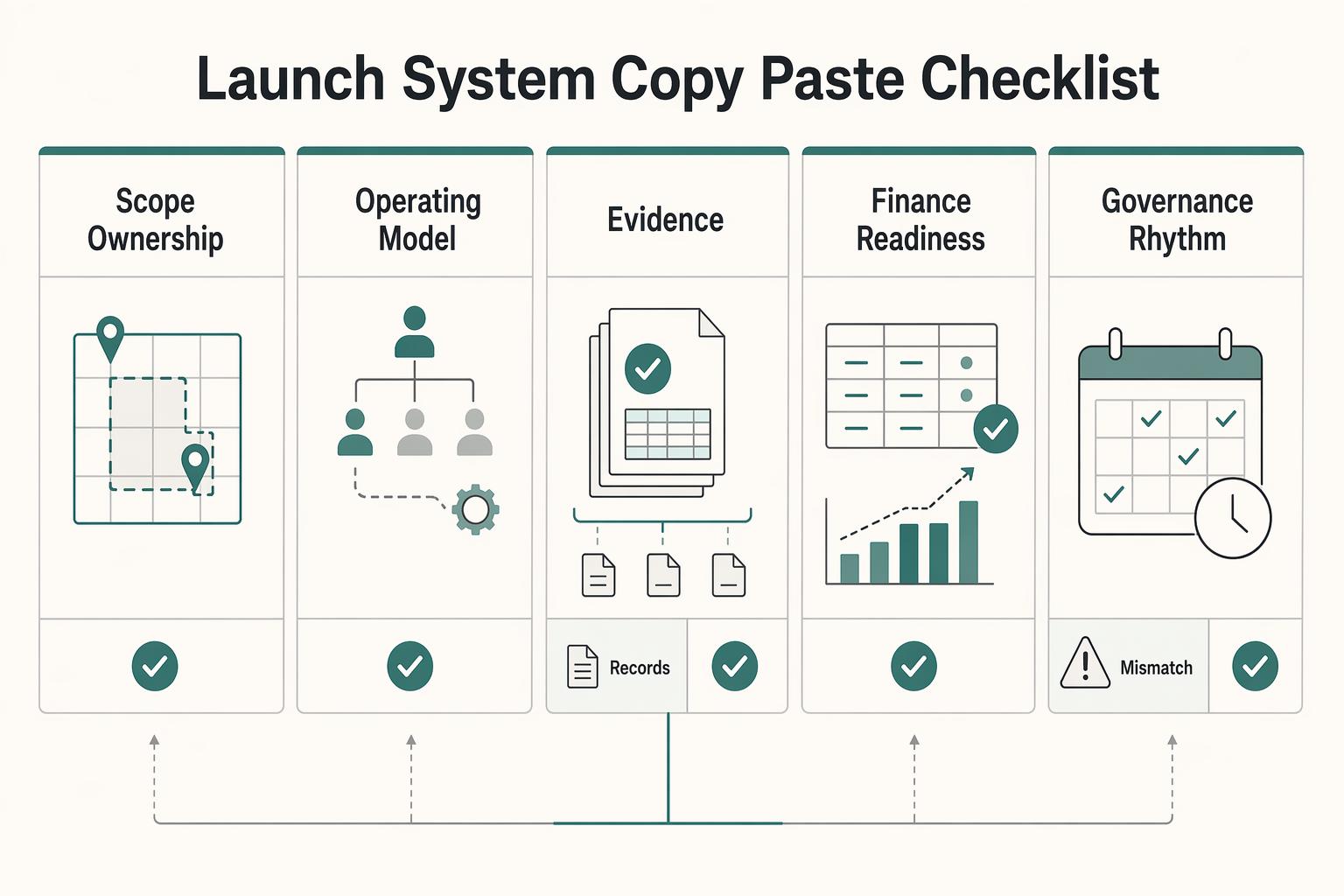
Launch your system with a copy and paste checklist#
Launch only when controls are already working, not when tooling is merely configured.
| Launch check | What to confirm | Pass condition |
|---|---|---|
| Scope and ownership | Finalize vendor categories in scope and approve a one-page RACI Matrix | Each approval, exception, and activation decision has one accountable owner |
| Operating model choice | Document SRM, VMS, or a hybrid, and record the decision criteria | Test one standard case and one edge case so no vendor falls into an undefined path |
| Onboarding sequence and evidence | Enforce an ordered lifecycle path with clear gates from due diligence through ongoing monitoring and termination | Keep the evidence pack reviewable in the vendor record |
| Finance readiness | Make approval status control payout eligibility, and use idempotency keys | Run reconciliation checks to confirm transaction records, payout status, and ledger records align |
| Governance rhythm | Schedule monthly KPI review before pilot start and assign owners now | Pair control-health KPIs with risk signals and explicit escalation triggers |
| Limited pilot | Run a 30-day pilot on a small vendor cohort | Scale only after checkpoint pass rates are stable across approved and blocked vendors |
Use the checklist in order:
- Confirm scope and ownership. Finalize vendor categories in scope and approve a one-page RACI Matrix before rollout. Verify that each approval, exception, and activation decision has one accountable owner.
- Confirm your operating model choice. Document whether you are running Supplier Relationship Management (SRM), a Vendor Management System (VMS), or a hybrid, and record the decision criteria. Test that choice against at least one standard case and one edge case so no vendor falls into an undefined path.
- Confirm onboarding sequence and evidence. Enforce an ordered lifecycle path with clear gates from due diligence through ongoing monitoring and termination. Keep the evidence pack reviewable in the vendor record, with dated approvals, risk notes, and escalation handling tied to named reviewers.
- Confirm finance readiness. Make approval status control payout eligibility, and use idempotency keys so retries do not duplicate processing. Then run reconciliation checks to confirm transaction records, payout status, and ledger records align.
- Confirm governance rhythm. If monthly KPI review is your chosen cadence, schedule it before pilot start and assign owners now. Track control-health KPIs and pair them with risk signals, including financial condition and news-based monitoring where relevant, with explicit escalation triggers.
- Run a limited pilot before broad rollout. A 30-day pilot on a small vendor cohort is a practical option to validate sequencing and controls before expansion. Scale only after checkpoint pass rates are stable across both approved and blocked vendors.
Frequently Asked Questions
What is a vendor relationship management platform for platform operators?
For operators, a vendor relationship management platform is the operating layer that governs supplier interactions across the full supplier lifecycle, not just contracting or record storage. In practice, that means defined operational expectations and a governance process for internal and supplier interactions across the lifecycle. If your tool stores vendors but cannot show how decisions were governed over time, it is functioning more like a directory than relationship governance.
When should we use Supplier Relationship Management (SRM) versus a Vendor Management System (VMS)?
Use Supplier Relationship Management (SRM) when your main problem is managing value, risk, and collaboration across suppliers over time. Use a Vendor Management System (VMS) when the dominant use case is external workers or service providers moving through the contingent workforce lifecycle from hiring and engagement to offboarding and evaluation. If one intake path handles both populations the same way, treat that as a design risk because control points can differ.
What are the minimum controls we need before scaling supplier payouts?
There is no universal fixed list. Before scaling payouts, define explicit operational expectations and a governance process for supplier interactions and approvals across the lifecycle. A practical verification point is to sample a live vendor record and confirm the required approval evidence is present, readable, and dated. A common risk is treating “files are attached” as equivalent to completed governance when reviewer and decision context are unclear.
Which KPI metrics best show vendor relationship health in operations?
Start with KPIs that show whether suppliers are reliable and controllable: delivery timeliness, quality outcomes, and compliance trends. For timeliness, use on-time, early, and late percentages by fiscal period, usually a month, so you can spot drift instead of arguing from anecdotes. Do not force one universal score across all vendor types; different supplier populations may need different KPI views.
What breaks most often in supplier onboarding and approval flows?
Typical breakpoints are governance gaps: vendor misclassification, unresolved risk flags, inconsistent approval sequence, or evidence that exists but is not reviewable. Another failure mode is bypassing sequence, such as activating before due diligence is complete to “keep things moving.” If you want a fast diagnostic, test one blocked vendor and one approved vendor and confirm both followed the same ordered steps from intake to activation.
How should we prioritize capabilities if we cannot implement everything at once?
Start with controls that set scope and governance: SRM versus VMS classification, clear operational expectations, and ordered approval flow across the supplier lifecycle. Next, standardize reviewable records and make sure core KPI tracking covers delivery timeliness, quality outcomes, and compliance trends. After that, expand into richer supplier scorecards and collaboration features.
Try a related tool
Researched and edited by the Gruv editorial team. Gruv builds cross-border billing, payouts, and finance-operations software for global businesses.
Sources
- crowncommercial.gov.uk/news/procurement-essentials-supplier-relatio...trusted
- csrc.nist.gov/pubs/sp/1326/ipdtrusted
- department.va.gov/financial-policy-documents/financial-documen...trusted
- fdic.gov/news/financial-institution-letters/2023/fil2...trusted
- govlab.hks.harvard.edu/wp-content/uploads/2025/04/Essential-Proc-Pe...trusted
- occ.gov/news-issuances/news-releases/2023/nr-ia-2023...trusted
- occ.gov/news-issuances/news-releases/2023/nr-ia-2023...trusted
- stripe.com/resources/more/supplier-and-vendor-onboardingtrusted
Educational content only. Not legal, tax, or financial advice.
Related Posts
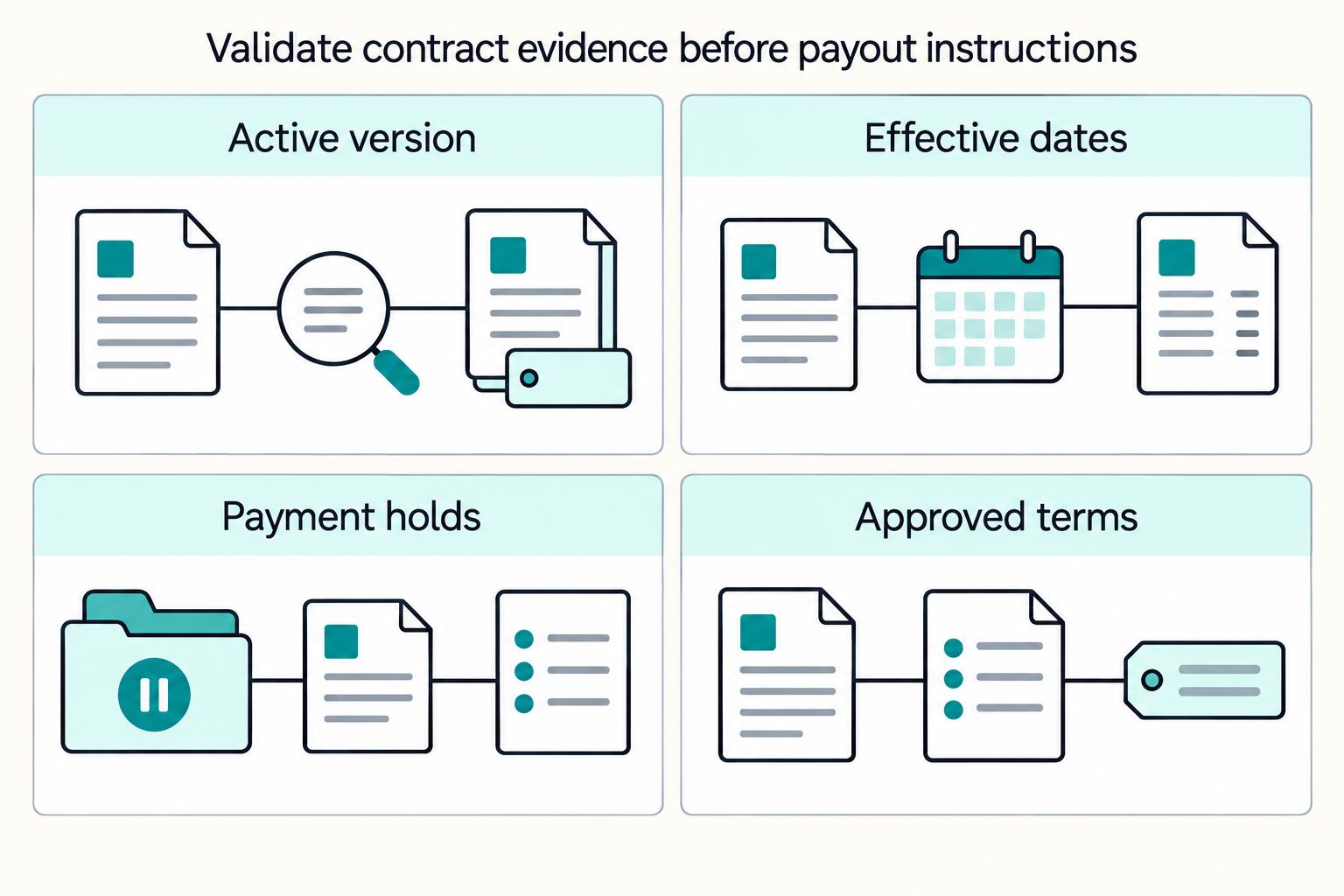
Procurement Data Management for Platforms: How to Centralize Vendor Contracts and Payment Terms
Treat every vendor contract and supplier agreement as a payment control, not a filing task. If a term can change approval, payout timing, or a payment hold, it needs to work inside your payment process, not sit in a PDF or get split across systems.
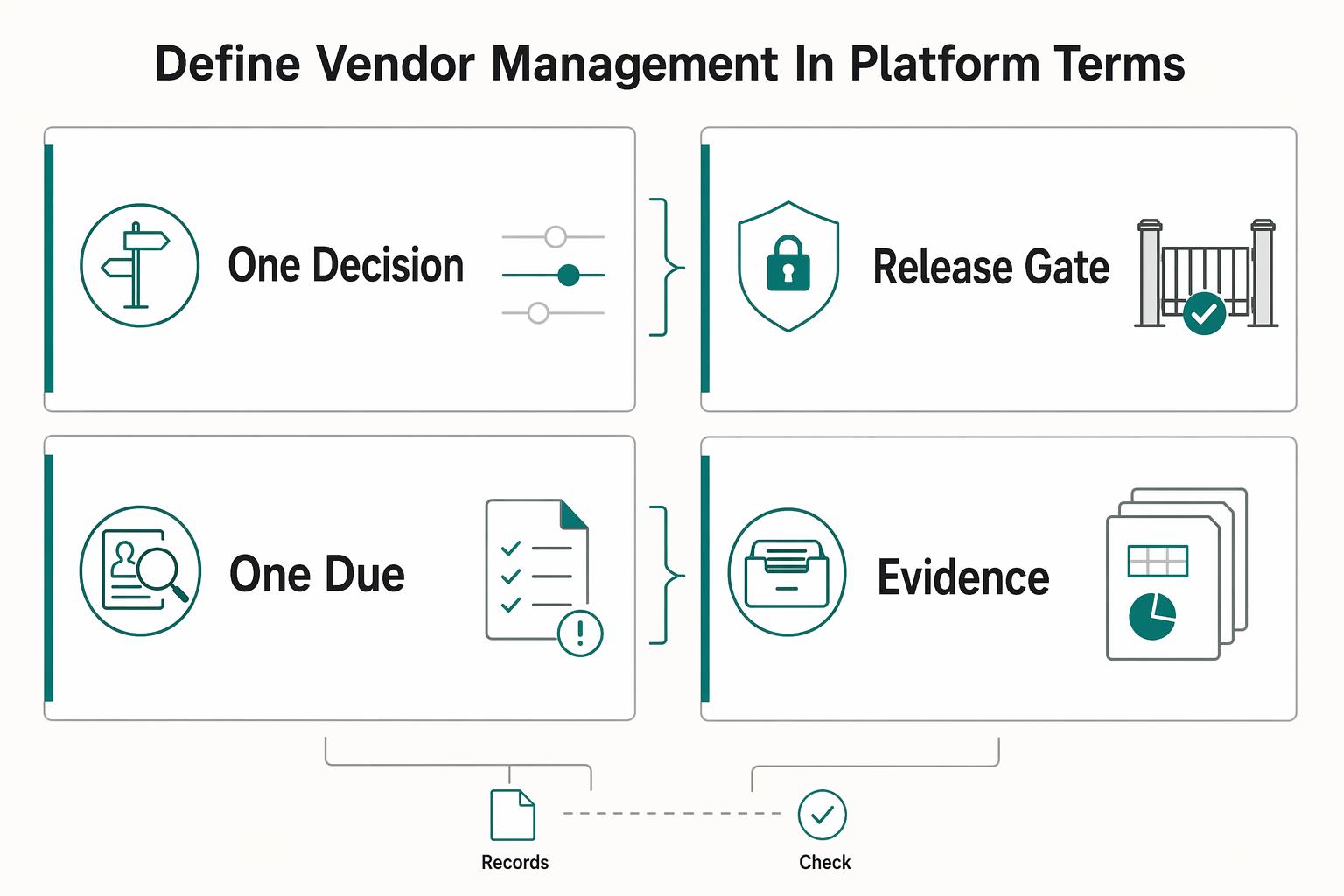
What Is Vendor Management? A Platform Operator's Guide to Supplier Lifecycle Control
Vendor management in a platform business is not back-office admin. It is a core control point in the business. It determines which third parties can influence core operations, service quality, and customer experience, and under what conditions they can do it.
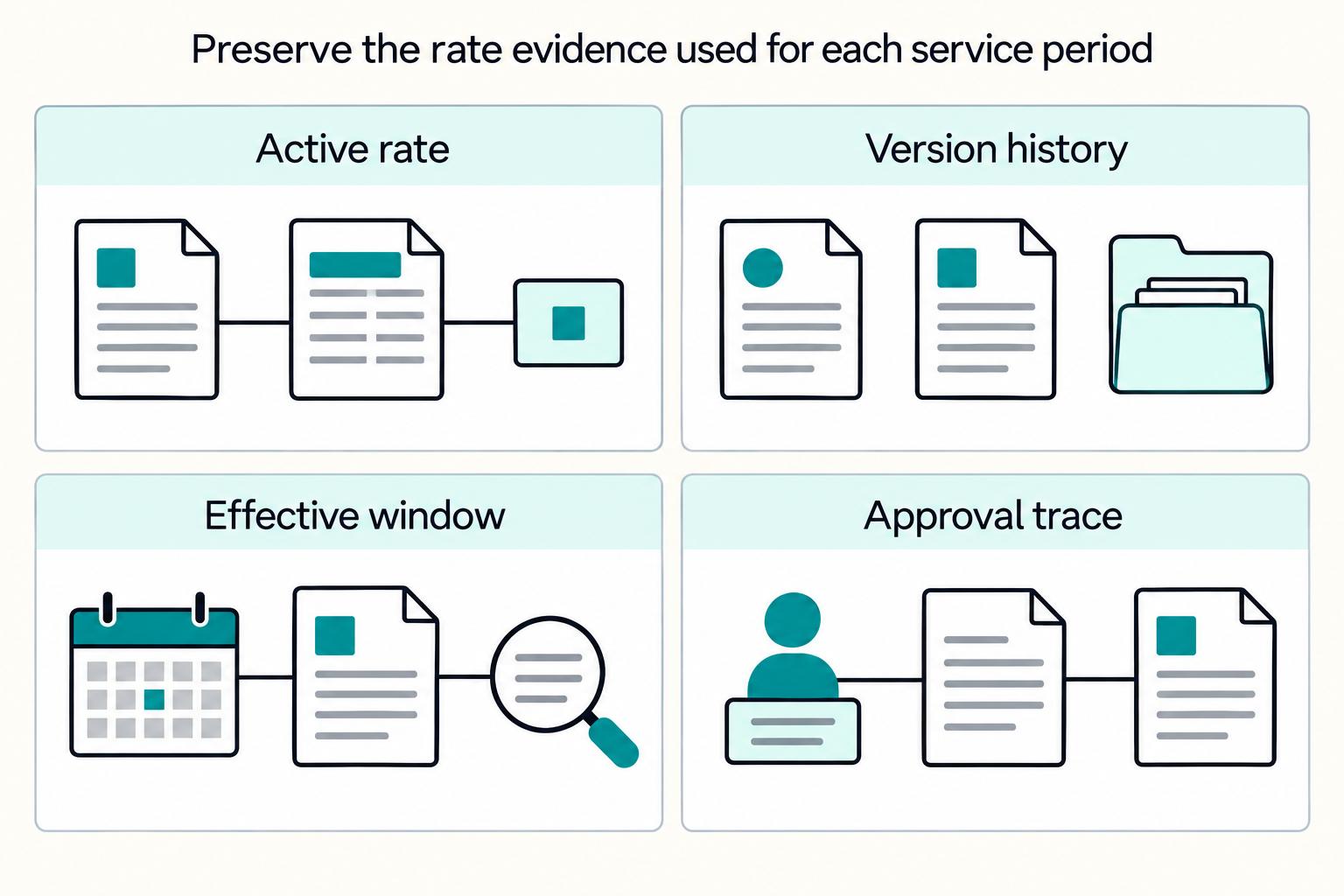
Vendor Contract Management for Platforms: How to Automate SOWs MSAs and Rate Cards
If you are evaluating how **vendor contract management platforms automate SOWs, MSAs, and rate cards**, start with the control chain, not a feature grid. You need a governing **Master Service Agreement (MSA)**, the right **Statement of Work (SOW)** for each engagement, a current **Contract Rate Card**, and checks before anyone is approved, activated, or paid.