
Quick Answer
Platforms can automate MSAs, SOWs, and rate cards end to end only if they preserve a real parent-child contract hierarchy, keep version and approval history, and gate activation and payouts with compliance checks. The MSA should govern each SOW, the active rate-card version should stay linked to the SOW record, and pricing or legal changes should follow controlled change-order or amendment paths.
Why Platforms Need a Better Way to Manage SOWs, MSAs, and Rate Cards#
If you are evaluating how vendor contract management platforms automate SOWs, MSAs, and rate cards, start with the control chain, not a feature grid. You need a governing Master Service Agreement (MSA), the right Statement of Work (SOW) for each engagement, a current Contract Rate Card, and checks before anyone is approved, activated, or paid.
These documents do different jobs. The MSA sets baseline terms between the parties, and the SOW defines how specific work will be executed. A Contract Lifecycle Management (CLM) layer manages review, approval, signature, and storage. The rate card is not just reference pricing. In contract tooling, it can hold detailed prices used to generate recurring expenses, so it should stay in the same control path as the signed agreement.
Your first decision is structural: do you need tooling configured to preserve a real parent-child relationship between the MSA and each SOW, with version control and a reliable history log, or is a lighter setup enough? If SOWs can move forward without confirming a valid MSA, downstream controls can drift across approvals, spend, and payout readiness.
This gap can surface late. Signature collection may be automated, but the operating evidence can still be weak if Finance cannot confirm which rate version was active, Legal cannot trace clause-change approvals, or Product lacks a clear signal for payout readiness. You need a record that shows who changed what and when, and the approval flow should follow the approver defined on the contract record, with status history intact.
Before you start#
Set ownership before you configure workflows:
| Team | Decision area | Examples |
|---|---|---|
| Legal | Baseline clause policy | What can vary between the MSA and SOW |
| Finance | Rate-card governance | Pricing-change approvals |
| Product and Engineering | Contract events that trigger downstream actions | Provisioning or payout readiness |
| Operations | Evidence pack | Audits, exceptions, and payment disputes |
- Legal owns baseline clause policy and what can vary between the MSA and SOW.
- Finance owns rate-card governance, including pricing-change approvals.
- Product and Engineering own contract events that trigger downstream actions, such as provisioning or payout readiness.
- Operations owns the evidence pack for audits, exceptions, and payment disputes.
Define compliance gates up front. Payment eligibility is not only a contract-status issue. Country-specific KYC requirements can determine whether charges and payouts can be enabled, and platforms may need to collect and verify information before enabling those capabilities. In the US, tax onboarding often includes Form W-9 to provide taxpayer identification details. If these dependencies are not set early, contract and payout workflows can fail at different points and create manual cleanup.
By the end of this guide, the goal is not a cleaner contract repository. It is a production-ready operating model with clear ownership, decision rules, MSA-SOW parent-child checks, governed rate changes, timestamped approvals, and an evidence pack Finance, Legal, Product, and Engineering can rely on when a vendor is activated, changed, or paid.
Related: Tail-End Spend Management: How Platforms Can Automate Long-Tail Contractor Payments.
What to prepare before you automate contracts#
Prepare your control model before you shortlist tools, or you will automate speed without improving control.
-
Inventory every governing template. Put your current Master Service Agreement (MSA), Statement of Work (SOW), Change Order, and Contract Amendment templates into one review set and mark conflicts. Confirm which terms belong at the relationship level, meaning the MSA, versus the project level, meaning the SOW. Separate in-scope work changes from legal-term changes. If "change order" and "amendment" are used interchangeably today, fix that before you automate routing.
-
Assign clear ownership by decision area. You need named decision rights for each approval and field, not shared ownership with no final approver. Keep ownership explicit across cross-functional stakeholders, including teams like Legal, Finance, and Procurement. The test is simple: every step has a person who can approve, reject, or escalate.
-
Define a minimum evidence pack for each contract event. For create, modify, approve, sign, and delete actions, preserve who acted, what changed, which version was active, and the date and time. Version Control should preserve prior information rather than overwrite it, and the event history should let you reconstruct the full sequence. Where needed, capture the meaning of an approval, not just a generic approved status.
-
Confirm compliance gates before payout activation. If payouts touch regulated rails, document which KYC- and KYB-like checks and AML-related controls exist in your provider stack and where status is stored. In U.S. bank rules, customer identification procedures are part of AML programs, and legal-entity checks often appear through beneficial-ownership verification. Do not assume those requirements apply the same way on every platform. Ask for a written answer on what blocks activation and what evidence is collected.
For a step-by-step walkthrough, see Guided Buying for Marketplace Operators Enforcing Preferred Vendor and Rate Policies.
Decide if you need specialized CLM or can keep a lighter stack#
Start with one practical test: can the tool keep your MSA and related SOW records in a real parent-child hierarchy, or does it mostly manage standalone files?
Step 1 Test hierarchy first#
Run the demo on your structure: one MSA, two SOWs, one Change Order, and one Contract Amendment. Ask the vendor to show the records staying linked through edits, approvals, and repository storage.
One market article from Bind makes the point that generic tools may treat documents as independent units. Use that as a caution, not proof for every product, and verify the behavior live.
ServiceNow documentation gives a grounded example: parent-child contract requests appear hierarchically, and associated repository records are automatically linked. If a vendor cannot show equivalent linkage without manual naming workarounds, treat it as a lighter stack.
Step 2 Require version and audit depth for frequent changes#
If you run recurring change-order and amendment cycles, do not buy on storage and signature alone. Require all three: linked hierarchy, strong Version Control, and a usable activity log.
Version control preserves and retrieves all revisions. A log records the chronological actions taken on the contract. Together, they help Legal and Finance reconstruct which terms were active at key decision points.
There are grounded buyer signals, but they still need live proof. ServiceNow documentation states that changed contracts are copied into contract history, and JAGGAER markets version control and real-time editing. In demos, ask for an export of version history and audit logs after a live edit, not just an on-screen view.
Step 3 Score shortlist tools with evidence plus proof#
"CLM" should mean lifecycle management from initiation through negotiation, execution, compliance, and renewal, not just storage or signature.
| Candidate | Public signal you can rely on | What you still need to prove live |
|---|---|---|
| ServiceNow | Docs show parent-child hierarchy, automatic repository linkage, and contract history capture | Whether your MSA, SOW, Change Order, and Contract Amendment process works without fragile workarounds |
| JAGGAER | Publicly markets version control and real-time editing | Whether hierarchy, approval evidence, and post-signature history match your process |
| ContractSafe | Public materials define version control and audit trail clearly | Whether it enforces parent-child structure for your operating model |
| Bind | Publishes the view that generic tools may isolate documents | Whether it can demonstrate linked hierarchy in your scenario |
| eSignGlobal | Verify hierarchy and audit depth with each vendor | Treat claims as unproven until shown live |
Step 4 Use review sites as secondary filters#
Use G2 and Gartner to narrow options, not to make the final call. G2 showed 138 CLM listings and 8,789 verified user reviews at crawl time, and Gartner Peer Insights also supports verified-review comparisons.
Those signals are useful for spotting patterns, but your process-critical path still has to work in the demo. A lighter stack may be enough for simpler, low-change workflows, but confirm that fit in your own live evaluation.
For the handoff from signed terms to vendor setup, see Vendor Data Management: How Platforms Keep Contractor Payment Details Accurate and Compliant.
Define the contract hierarchy and ownership model before tooling#
Write the contract family rules before you configure anything: one governing Master Service Agreement (MSA), multiple SOWs, and controlled change paths that do not quietly rewrite parent terms.
Step 1 Set the contract object model in writing#
Treat this as an operating rule, not tribal knowledge. The MSA is the foundational agreement for the relationship, and each SOW defines project scope, timeline, and cost. Keep a true parent-child family model: one parent can have many children, and each child has only one parent.
Minimum model:
- One active MSA can govern multiple SOWs
- Each SOW links to one parent MSA
- Each Change Order references the specific SOW or order record it modifies
- Changes to governing terms follow a formal Contract Amendment path
Checkpoint: test one MSA plus two SOWs, then try to create a new SOW without a valid parent. If the workflow still allows execution, your hierarchy control is too weak.
Step 2 Define precedence and inheritance rules#
Do not assume the MSA always overrides the SOW. One common pattern is MSA-first unless a SOW explicitly overrides a specific MSA section, but precedence can be drafted differently. Pick your rule and make it explicit in templates, approvals, and tooling logic.
Split terms into two buckets:
- Terms that flow down from the MSA unless formally amended
- Terms a SOW may vary only through an explicit, approved override
Use Change Orders for controlled operational or commercial updates, such as dates, deliverables or services, or value changes, within the approved structure. Use a Contract Amendment when the change affects governing terms or precedence.
Step 3 Assign owners by decision type#
Approval should follow authority, not a generic "contract owner."
- Legal: clause library and non-standard language approvals
- Finance: pricing controls and rate-card records
- Procurement/Ops: routing and execution-readiness checks in contract history
At a minimum, require records to show who changed what, when they changed it, and which version is current under Version Control.
Step 4 Add a hard stop for conflicting edits#
Put one internal escalation control in place before launch: no signing when parent-child consistency checks fail.
Apply the stop when, for example:
- A SOW override does not cite the MSA section it overrides
- A Change Order tries to alter parent-level terms
- A rate-card update conflicts with signed commercial terms
Escalation evidence should include version history, the contract change log with editor and timestamp, and the electronic-signature audit trail showing when, where, and by whom the document was signed. If those records do not align, treat the contract family as incomplete.
If your team outsources vendor sourcing and contracting, What Is Procurement as a Service? How Platforms Can Outsource Vendor Sourcing and Contracting covers that model.
Build your clause baseline for Limitation of Liability Indemnification and Termination#
Set Limitation of Liability, Indemnification, and Termination at the Master Service Agreement (MSA) first, then define tightly what a Statement of Work (SOW) can vary. That helps keep parent-child contracts consistent and can cut avoidable redline churn.
Step 1 Standardize the MSA baseline and narrow SOW flexibility#
Set the default risk position in the MSA, then document any allowed SOW-level variation. This matters most for indemnity because it appears in most commercial agreements, is heavily negotiated, and is often construed narrowly. Vague carve-outs can create interpretation risk.
Treat each clause as a governed object, not free text:
| Clause | Keep at MSA level | Allow at SOW level only if pre-approved | Escalate out of SOW path |
|---|---|---|---|
| Limitation of Liability | Liability structure, cap logic, exclusions, survival | Project-specific references that do not change cap mechanics | Any change to cap basis, exclusions, or clause priority |
| Indemnification | Scope, covered claims, exclusions, defense or control language | Named project context that fits approved language blocks | Any new indemnified risk, broadened scope, or new carve-out |
| Termination | Cause rights, convenience rights if used, survival, post-termination effects | Project wind-down details, transition deliverables, final milestone handling | Any change to termination rights, notice structure, or survival terms |
Checkpoint: generate two SOWs from one parent MSA and confirm these clauses either inherit automatically or present only approved options.
Step 2 Define when a Change Order works and when a Contract Amendment is required#
Write explicit triggers as an internal policy, not a universal legal rule. A practical approach is to use a Change Order for updates that stay within the signed risk structure, and require Contract Amendment review when governing rights, obligations, or clause precedence change.
Use two tests:
- Does the change alter legal risk allocation or who bears loss? If yes, route it for Contract Amendment review.
- Does the change affect only execution details already allowed by the MSA-SOW structure? If yes, a Change Order may be enough.
Checkpoint: test one scenario with a milestone change, spend change, and incident-notice revision. Operational changes may fit a Change Order if already permitted. Obligation-level notice changes should trigger amendment review.
Step 3 Add operational clauses that match payout and data reality#
Your contract language should match how work and payments actually run. If payments are tied to deliverables or milestones, structure the terms so one line item tracks one deliverable or milestone.
For data handling, assign responsibilities clearly: who provides data, who may use it for performance, who handles security obligations, and what evidence is required when issues occur. For cross-border personal-data exposure, incident-notification language should be deliberate. Where GDPR is relevant, legal may align timing to the Article 33 outer window of 72 hours after awareness, where feasible, without treating that as a universal SLA.
The evidence set should include the signed MSA, linked SOW, any Change Order or Contract Amendment, and the approval and version history with timestamps. E-signature event records should be part of that package too.
Step 4 Require legal review before any non-standard clause reaches production#
Treat non-standard redlines as a template-governance event. If standard language for liability, indemnity, termination, incident notice, or data handling is materially edited, require legal review before it is promoted into reusable templates.
Use a hard gate for promotion: final redline, legal approval, and an updated clause version record must all exist. If any artifact is missing, do not publish the template change. This is also where procurement data management helps keep parent-child records aligned.
The operating rule is simple: freeze baseline risk in the MSA, allow bounded SOW variation, and route real risk shifts through an amendment path with review and evidence.
For the operating rhythm after signature, see Vendor Relationship Management for Platforms That Finance and Ops Can Run.
Set Governing Law Jurisdiction and Dispute Resolution rules that scale cross-border#
Set default Governing Law, Jurisdiction, and Dispute Resolution terms by vendor cohort at the MSA level, then have each SOW inherit them by default unless Legal approves a Contract Amendment.
Step 1 Separate the three decisions in your template#
Treat these as separate controls, not one clause block. Governing Law selects which law applies, Jurisdiction/Forum selects the court and location, and Dispute Resolution sets whether disputes go to court or arbitration under defined rules.
Because a forum clause does not itself select controlling law, keep each field distinct in your template and make SOW-level overrides explicit and controlled. Verification point: create two SOWs under one MSA and confirm project teams cannot override law, court, seat, or dispute method without Legal approval.
Step 2 Use a pre-approved fallback menu#
A short fallback menu can be faster and easier to govern than ad hoc drafting. For each cohort, pre-approve one default position plus limited fallback options, with clear approvers for deviations.
If arbitration is a fallback, define the rules and place of arbitration clearly and account for enforcement locations. Ambiguous wording creates delay and uncertainty when disputes actually happen.
For each deviation, the contract history should capture the default term, approved fallback, approver, clause version, vendor country pair, and whether the change sits in the MSA or a Contract Amendment, along with signed redlines and timestamps.
Step 3 Tie cross-border money movement to due-diligence and AML/CFT controls#
If payouts or account activation are in scope, legal venue terms and compliance intake need to run together. AML and CFT are core cross-border design constraints, and country programs differ, so use a risk-based approach rather than one global rule set.
For payout-enabled vendors, gate activation on the risk-based checks required in your program, including country-context due diligence and beneficial-ownership review where applicable. Where a U.S. covered financial institution workflow applies, beneficial-ownership procedures under 31 CFR 1010.230 must be included in the AML program before activation.
Step 4 Prevent conflicting venue language across MSA SOW and change documents#
Keep venue architecture stable. Governing law, jurisdiction, and dispute method should stay at the MSA level unless Legal intentionally changes them by amendment. As a default, do not use a Change Order to rewrite those terms.
Final checkpoint: compare the signed MSA, active SOW, latest change document or amendment, and the contract history. If more than one active clause names different law, court, or arbitration terms, pause signature or payout activation until the conflict is resolved.
Related reading: Global Treasury Management for Platforms Across 50+ Countries.
Design Contract Rate Card governance and change control#
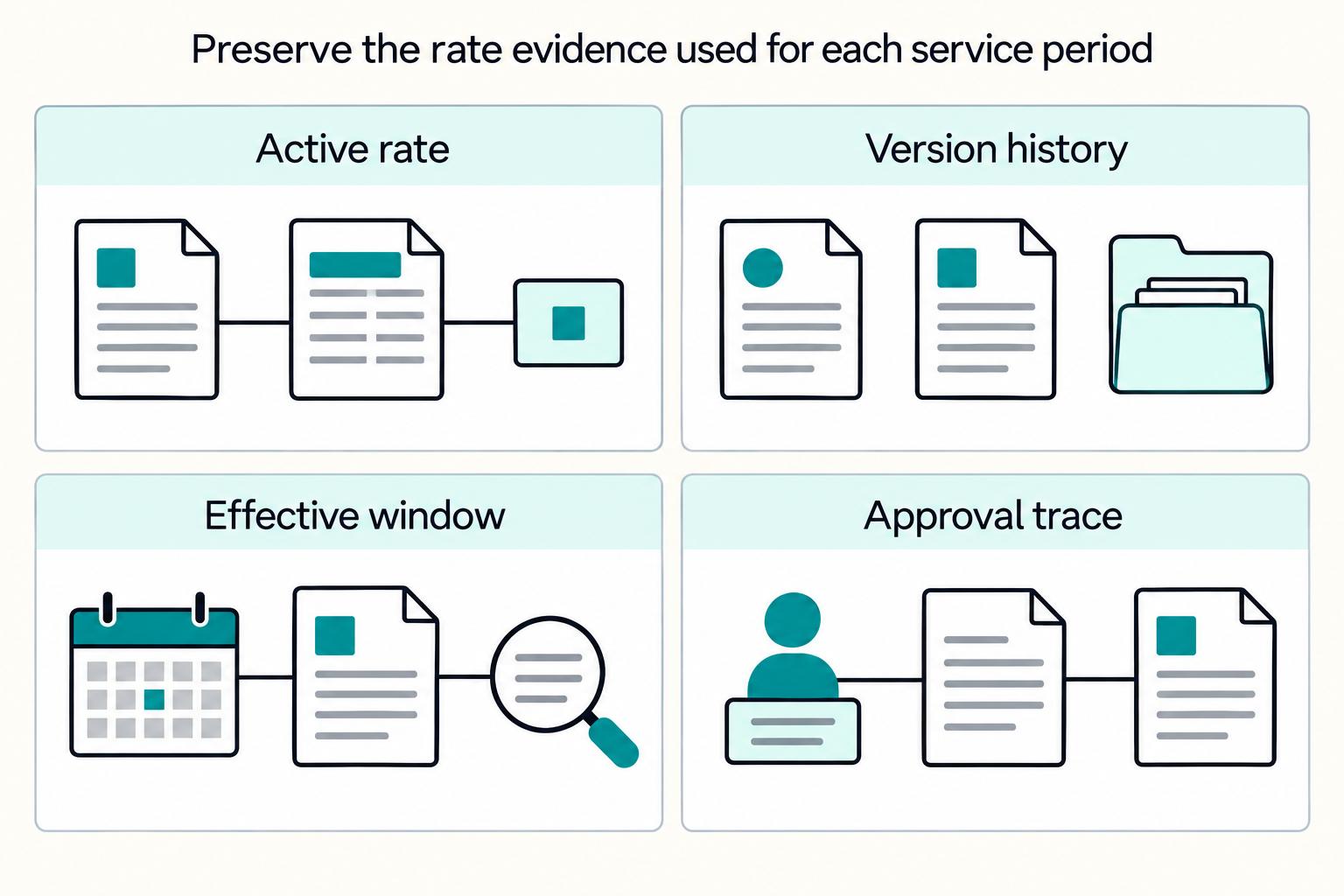
Treat the Contract Rate Card as governed contract data linked to the relevant SOW execution record, not as a spreadsheet in email or a loose CLM attachment. If a rate can change what Finance pays, the active rate version should live on the SOW record with approval history and version history intact.
Step 1 Link the rate card to the SOW, not just the file folder#
The control you need is the rate object tied to execution. Keep the active rate on the SOW path so billing reads from one governed source, not from renamed uploads or side files.
Set a hard rule: each SOW points to one current signed rate-card version, and prior versions remain visible in Version History. Verification point: revise a test SOW rate card and confirm the prior version is retained, not overwritten.
Step 2 Require effective-date and approval traceability on every rate change#
Every rate change should carry effective and expiration dates plus approval traceability, with version history. That gives Finance a defensible record of which rate applied for a given service period and who approved the change.
Block or explicitly approve parent-child date conflicts. If a child rate becomes effective before its parent rate, record that exception clearly before invoice approval.
Practical check: compare the MSA, active SOW, and rate-card effective window before approving invoices. If billed service dates fall outside the active rate window, pause and resolve the contract record first.
Step 3 Separate Change Order use from Amendment use#
Do not let pricing changes drift into a vague middle ground. Use a formal Change Order when the contract's existing change mechanics permit that pricing update. Use a Contract Amendment when the change alters agreement components such as value, dates, deliverables, or services.
| Scenario | Path | Rule |
|---|---|---|
| In-path pricing update under existing change mechanics | Change Order | Use Change Order for in-path pricing updates under existing change mechanics |
| Update changes value, timing, deliverables, or services beyond that path | Contract Amendment | Require Contract Amendment |
| Mixed case such as price plus scope or time | Escalate | Escalate mixed cases to Legal and Finance together |
Use these rules:
- Use Change Order for in-path pricing updates under existing change mechanics.
- Require Contract Amendment when the update changes value, timing, deliverables, or services beyond that path.
- Escalate mixed cases, such as price plus scope or time, to Legal and Finance together.
Checkpoint: classify your last five rate changes. If owners cannot explain why each was a Change Order versus an Amendment, tighten the rule before automating.
Step 4 Define dispute handling before disputes happen#
State which rate version governs billing disputes: the signed rate-card version effective for the invoiced service period, unless a later signed document explicitly applies retroactively. That prevents decisions based on draft redlines, email chains, or old spreadsheet tabs.
Finance should verify from the contract history. Keep an evidence pack with the signed SOW, the governing rate-card version, approval status history showing who approved and when, and transaction-signature records, such as completion or audit records from your e-sign system.
Implement the automation sequence from intake to signature to payout gating#
Do not map signed directly to payout-ready. Treat intake and compliance, contract execution, and payout release as separate states with explicit gates.
Step 1 Start with vendor intake and compliance checks#
Start with intake and verification before drafting. Confirm the core party and onboarding details first; if your workflow uses an MSA-SOW stack, draft it after those details are in place so bad upstream data does not spread across records.
Run compliance checks as early as your onboarding model allows. Depending on your product and provider flow, this can include KYC information needed to enable account capabilities, beneficial-owner collection for legal entities, and risk-based identity verification controls. In API-led onboarding models, the platform is responsible for collecting required verification information.
Checkpoint: only open an MSA draft once intake is complete enough to identify the contracting party and the required compliance path.
Step 2 Generate the contract stack in the right order#
Keep the sequence explicit and consistent for your MSA, SOW, rate-card linkage, and approvals. This keeps pricing tied to the governed work record instead of a loose attachment.
Before activation, block on these checks:
| Blocking check | What to verify | Why it blocks activation |
|---|---|---|
| Required fields complete | Contracting entity, effective dates, owner, service dates, rate-card version | Missing core fields can create unreliable downstream sync |
| Clause package approved | Approved MSA clause set or approved deviation | Unresolved legal terms should not flow into activation |
| No parent-child conflicts in Version Control | SOW and rate-card timing align to parent terms, or exceptions are explicit and approved | Hidden conflicts can turn into billing and approval disputes |
Verification point: before signature, confirm MSA version, SOW version, and linked rate-card version are visible in your version history or audit trail with effective dates.
Step 3 Separate signed status from payout readiness#
A signed contract confirms execution, not payout eligibility. Keep a dedicated payout-readiness flag that turns true only when policy gates pass.
Where enabled in your flow, include compliance and tax-document gates. For example, require the appropriate form before payouts continue: W-9 for U.S. payees providing TIN information, or W-8BEN for foreign beneficial owners when requested by the payer or withholding agent. Some onboarding configurations can also block payouts when W-8 or W-9 remains missing after configured volume thresholds.
Operationally, unresolved verification requirements can restrict account capabilities, and missed deadlines can lead to payout disablement. Your contract record should show release or hold status with a clear reason code.
Step 4 Make event processing retry-safe and auditable#
Assume retries and delayed webhooks will happen. Contract-event handling should be idempotent so repeated events do not create duplicate activation or payout side effects.
Use one external event ID, or idempotency key, per state transition, and return the same result on replay. Record a time-stamped event log that includes event source, external event ID, receive time, outcome, repeat detection, and the resulting contract version reference.
This matters because undelivered webhook events can be resent for up to three days, manual event recovery is limited to the last 30 days, and provider idempotency-key retention can be pruned after at least 24 hours. Keep your own processed-event history long enough to handle retries, replays, and backfills.
Before rollout, map each contract checkpoint to payout activation gates and validate the handoff flow in the Gruv docs.
Connect contract controls to finance and compliance evidence#
Finance should be able to prove, quickly, which terms, approvals, and tax context were in force when a vendor was paid.
Step 1 Build a minimum reconciliation pack for every active vendor#
Treat this as an internal operating control, not a legal label. For each active vendor, keep one reconciliation pack that ties contract terms to payment execution:
- signed Master Service Agreement (MSA) and active Statement of Work (SOW)
- current Contract Rate Card version with effective dates
- approval history for active terms, including Change Orders or amendments
- payout linkage evidence, such as the vendor or payee ID and payment configuration tied to that contract record
Verification test: from one vendor record, Finance can open the signed MSA and SOW, confirm the active rate-card version, and identify the exact payout profile used at payment time.
Step 2 Map tax and compliance artifacts to the right payment context#
Do not collect tax artifacts as generic uploads. Map each one to the reporting path you actually use.
| Artifact | Context | Note |
|---|---|---|
| Form W-9 | U.S. payees | Used so the payer can obtain the payee's correct TIN for information reporting; given to the requester rather than sent to the IRS |
| Form W-8 BEN | Foreign individuals | Submitted when requested by the withholding agent or payer |
| Form W-8 BEN-E | Foreign entities | Documents status for chapter 3 and chapter 4 withholding and reporting |
| Form 1099-NEC | Nonemployee compensation | Reports nonemployee compensation |
| Form 1042-S | Nonemployee compensation paid to nonresident aliens | Reporting branch should be explicit in your records |
| FBAR / FinCEN Form 114 | U.S. persons with qualifying foreign financial accounts | Filed with FinCEN, not the IRS; applies when aggregate value exceeds $10,000 at any point in the year |
| Form 8938 | Foreign-account reporting | Does not replace FBAR |
| Form 2555 / FEIE | Individual tax context | 2026 maximum exclusion is $132,900 per person; not a standard vendor onboarding document |
For U.S. payees, Form W-9 is used so the payer can obtain the payee's correct TIN for information reporting, and it is given to the requester rather than sent to the IRS. For foreign individuals, Form W-8 BEN is submitted when requested by the withholding agent or payer. For foreign entities, Form W-8 BEN-E documents status for chapter 3 and chapter 4 withholding and reporting.
The reporting branch must also be explicit in your records: Form 1099-NEC reports nonemployee compensation, while nonemployee compensation paid to nonresident aliens is reported on Form 1042-S.
Track FBAR and FEIE as separate contexts. FBAR, FinCEN Form 114, is filed with FinCEN, not the IRS. Form 8938 does not replace it, and it applies to U.S. persons with qualifying foreign financial accounts when aggregate value exceeds $10,000 at any point in the year, due April 15 with an automatic extension to October 15. FEIE is an individual tax-context item documented on Form 2555, with a 2026 maximum exclusion of $132,900 per person, so it should not be treated as a standard vendor onboarding document.
Step 3 Require searchable Audit Trail records for every commercial change#
Every commercial change should create a searchable history entry that proves which MSA, SOW, and rate-card version governed a payment on a specific date.
At minimum, make entries filterable by vendor, effective date, approver, and version, and capture before state, after state, approval timestamp, and resulting version reference. This aligns with IRS recordkeeping expectations that records substantiate items reported on returns and be retained as long as needed to prove income or deductions.
Step 4 Run a monthly sample check across active vendors#
A monthly sample check can be a practical internal control.
Sample active vendors and confirm that contract version, rate-card version, and payment configuration still match. If you find repeated drift between signed terms and payout setup, fix the data model and workflow before volume scales.
Pilot with one vendor cohort and verify before rollout#
Start with one contained cohort so you can validate the operating model before you scale. Use a standardized MSA, a repeatable SOW pattern, and a consistent rate-card policy for that cohort.
Step 1 Choose a contained cohort#
Pick a vendor group with low variation so you can test the workflow, not edge-case exceptions. Keep the parent-child structure consistent, with the MSA as parent and the SOW as child.
Step 2 Run acceptance tests against written criteria#
Test against written criteria, not gut feel. Verify parent-child linking, including expected inheritance from MSA to SOW. Test change-order handling to confirm written changes are captured on the intended records. Confirm approval history records are created and trackable, and confirm the event history is complete and time-stamped, including e-sign event history.
Step 3 Monitor pilot behavior in live use#
Once the pilot is live, monitor the system continuously during phased rollout. Check system load and component health, and watch for issues in contract linking, approvals, and history tracking before expanding the cohort.
Step 4 Expand only after objective pass criteria are met#
Scale only when acceptance criteria are met and documented under Version Control. Store test cases, outcomes, approved template versions, and exception decisions. If parent-child integrity, approval traceability, or history completeness is still unreliable, fix that before adding volume.
If contract approval needs to happen before a PO exists, How Platforms Automate Pre-PO Approval with Purchase Requisitions covers that workflow.
Common mistakes and how to recover quickly#
When rollout goes sideways, fix the control points first, not just the templates. Common problems include orphaned SOWs, unapproved rate changes, unclear legal defaults, and weak traceability.
Step 1 Re-link every SOW to the governing MSA#
Treat SOWs as child documents under the governing MSA, not standalone contracts. Sample contract language explicitly incorporates SOW terms into the master agreement, so your signing flow should enforce that relationship.
Enforce a Parent-Child Contract Relationship check at signature time: an SOW should not be signed without the correct parent MSA, the active MSA version, and the expected clause inheritance. If your contracts define precedence when MSA and SOW terms conflict, surface that rule directly in the record.
Step 2 Force rate changes through a signed change path#
Rate controls can fail when teams treat the rate card like an editable spreadsheet instead of a governed contract object. Recover by requiring versioning, approval ownership, and a documented reason on every rate change, then route execution through your Change Order or Contract Amendment rules.
As a control principle, formal modification practice uses written, authorized changes, and bilateral modifications require both sides to sign. Even if FAR does not govern your commercial contracts, it is still a useful baseline: pricing and commercial changes should not bypass authorized approval.
Step 3 Publish fallback legal menus before the next negotiation starts#
Set default legal positions before negotiation starts. Parties may choose governing law and jurisdiction terms. If they do not, fallback conflict-of-law rules may apply, which can increase ambiguity and delay decisions.
Publish approved fallback menus for Governing Law, Jurisdiction, and Dispute Resolution by vendor cohort, with clear escalation authority for exceptions. Keep one default path and one documented deviation path in templates and intake, and block progression when neither is selected.
Step 4 Rebuild traceability so every change can be reconstructed#
If you cannot reconstruct contract history, your controls are not reliable. Rebuild the audit record so it is secure, computer-generated, time-stamped, and preserves prior records instead of obscuring them.
For each contract event, capture owner, timestamp, action type, document, version, and linked artifact, such as approvals, signed files, or redlines. Then verify that you can replay one vendor's full sequence from MSA to current rate card using the audit record alone.
Conclusion#
Signature is not the finish line. Contract automation holds up when it is tied to operating controls: clear MSA/SOW hierarchy, clause policy, governed rate changes, and records you can reconstruct later.
Step 1 Set clause defaults before volume hits#
Set baseline MSA language before scale, including terms such as Limitation of Liability, Indemnification, Termination, Governing Law, Jurisdiction, and Dispute Resolution. Governing law determines which law applies in a dispute, indemnity allocates specified losses, and arbitration is one dispute-resolution path outside court litigation.
Use one approved template set, then define what can vary at SOW level and who can approve exceptions. If these clauses are still free-typed deal by deal, rollout can slow into redlining and exception handling.
Step 2 Verify hierarchy across every contract path#
Require an explicit parent-child contract relationship, not just related files. Each SOW should link to its parent MSA, and Change Order and Contract Amendment records should stay connected through drafting and negotiation.
Test from an active child SOW: confirm the governing MSA, active parent version, linked modifications, and the applicable rate card or negotiated rate set. If you cannot reconstruct that chain quickly, you increase the risk of orphaned records and conflicting terms.
Step 3 Enforce named approvals and evidence-grade records#
Before activation, assign a named approval owner and enforce Version Control on every path. Approval should route to the approver defined in the contract, with automatic approval-history records for status tracking.
Your system history should be secure, computer-generated, and time-stamped so the date, time, and operator actions are independently recorded. Validate this before go-live with one sample export that includes approver, approval status, timestamps, version, and linked signed files.
Step 4 Validate compliance and tax gates tied to payout readiness#
Do not assume every vendor flow needs the same compliance stack. Decide by jurisdiction, entity type, and payment flow whether KYC/KYB/AML and tax-document gates apply, and tie enabled gates to contract readiness.
Keep tax-form logic exact: Form W-9 provides a TIN to a requester filing an IRS information return, W-8BEN is for individuals, and W-8BEN-E is for entities. For AML and CDD controls, onboarding may also include relationship-purpose and beneficial-owner identification for legal entities.
Step 5 Pilot, measure failure modes, then scale#
Start narrow: one cohort, one MSA pattern, one repeatable SOW shape, and one governed rate-change path. Track concrete failures such as manual overrides, missing approval history, unsigned rate changes, incomplete W-8 or W-9 collection, or payment activation before required checks.
Scale only after you can pass a reconstruction test. For any sampled vendor, Finance or Legal should be able to pull the signed MSA-SOW set, current commercial terms, approval history, and time-stamped audit evidence without cross-team gap filling.
When your legal, finance, and ops owners are aligned, use Gruv Payouts to plan a controlled go-live path for compliance-gated vendor disbursements where supported.
Frequently Asked Questions
Can one platform automate both MSA and SOW processes end to end?
Yes, if the tool does more than storage and signature. It needs a true parent-child contract relationship where the MSA is the parent and each SOW is a child record that inherits baseline terms. In demos, verify one MSA, multiple SOWs, and visible version history as parent terms change.
Why does parent-child linking matter so much in service agreements?
Because the MSA-SOW structure depends on hierarchy, not just document filing. Without that linkage, change orders and amendments are harder to align across versions. From any active SOW, you should be able to see the governing MSA, active parent version, and related amendments immediately.
What does a Contract Rate Card actually control?
It defines which pricing terms are approved for the work under a given SOW. Pricing can change during the life of one SOW, including multiple values for the same rate over time. The rate-card path should include effective dates, version history, and approvals.
Are generic CLM tools enough for most platform teams?
They can cover lifecycle basics, but this use case depends on specific controls. Validate MSA-to-SOW hierarchy, version tracking, and a clear history of who changed what and when. If those checks fail in the demo, exception handling may shift outside the system.
What should buyers verify in demos before signing?
Ask for a live workflow, not slides. The vendor should show version control during edits, audit trail details with actor and timestamp, a parent MSA with multiple child SOWs, and a rate change captured through the required approval or modification flow. You should be able to reconstruct one vendor record from parent agreement to current commercial terms inside the product.
How do legal clauses affect operational rollout speed?
Rollout is often smoother when default legal positions are set before heavy negotiation starts. Limitation of liability, price or charges, and indemnification remain among the most negotiated terms. If those positions are unresolved, teams should expect additional negotiation cycles before broad rollout.
What is the fastest low-risk starting point?
Start with one cohort and a narrow document pattern: one standard MSA, one repeatable SOW shape, and one governed rate-card change path. Use concrete pass criteria such as no orphaned SOWs, no unsigned rate changes, and a complete audit record for contract events. Scale only after those checks pass.
Researched and edited by the Gruv editorial team. Gruv builds cross-border billing, payouts, and finance-operations software for global businesses.
Sources
Educational content only. Not legal, tax, or financial advice.
Related Posts

The Freelance Payment Penalty: A Modeled Audit of Platform Fees, FX Spreads, and Payout Delays
The money rarely disappears through a single, easy-to-spot fee. The real loss is stacked. A marketplace takes its commission, a processor adds a charge for international cards, a bank or payment company converts the currency at a spread, a platform holds the funds before release, and a wire sheds a little to intermediaries on the way in. Each layer looks defensible on its own, but the worker feels the combined result as a smaller deposit and a later payday.

How to Respond to a Subpoena for Business Records
Move fast, but do not produce records on instinct. If you need to **respond to a subpoena for business records**, your immediate job is to control deadlines, preserve records, and make any later production defensible.

A US Expat's Guide to Investing in UCITS ETFs to Avoid PFIC Issues
The real problem is a two-system conflict. U.S. tax treatment can punish the wrong fund choice, while local product-access constraints can block the funds you want to buy in the first place. For **us expat ucits etfs**, the practical question is not "Which product is best?" It is "What can I access, report, and keep doing every year without guessing?" Use this four-part filter before any trade: