
Quick Answer
Start by enforcing guided buying marketplace operators preferred vendor rate policies as one control layer tied to money events, not as a front-end recommendation feature. Keep preferred and approved vendor routing, rate checks, and release gates distinct, then require one record that carries policy version, quote status, approver, and payout reference end to end. Use conditional exceptions only with named authority and logged evidence, and switch affected cohorts to approved fallback when outages or stale quotes become systemic.
What guided buying looks like in a marketplace#
Treat guided buying as a control layer, not a shopping convenience. For marketplace operators, the real job is to steer supplier choice, enforce policy, and keep compliance decisions attached to the transaction instead of scattered across inboxes and side spreadsheets.
Before you start#
Step 1 Define the problem as one policy question, not three separate ones. Standard guided buying is meant to steer users toward pre-approved items and contract-compliant suppliers to reduce off-policy purchasing. That helps, but it is not enough for a marketplace where the same transaction may also need a preferred supplier decision, a policy check, and an approval path. When those controls live in different places, approvals slow down, exceptions become inconsistent, and the evidence trail gets weak when something goes wrong.
Step 2 Put the policy into a format you can actually review and enforce. A Preferred Vendor Program should not live as a slide, an email thread, or a vague procurement principle. It needs a policy object with a name, scope, conditions, and action. The Supplier Selection Policy File pattern is a good model because it turns supplier routing into something you can upload, review, and change deliberately.
That matters more than it sounds. In SAP Guided Buying administration, supplier selection policies take effect immediately after the configuration file is uploaded, so your first checkpoint is basic but critical. Confirm the file owner, version, and rollback copy before anything is published. Even the 256 character limit for policy name and description helps. Use that space to encode scope and owner clearly, not to write a mini essay.
Step 3 Decide where you will be strict and where you will allow controlled exceptions. This guide treats supplier selection and policy checks as one control system across procurement workflows, so you can route demand to approved options without turning every edge case into a fire drill. If a supplier is preferred but unavailable, or a quote is valid at approval but no longer acceptable at execution, you need a named fallback and a record of who approved the exception. The failure mode to watch is not just an off-policy purchase. It is the unowned exception, the silent rules change, or the manual workaround that fixes today's issue and creates tomorrow's audit gap.
By the end, you should have a practical set of checkpoints: what gets blocked, what gets routed, what evidence must travel with an exception, and who makes the call when policy and operational reality collide. That is the focus here. Fewer abstract procurement ideals, more decisions you can enforce and recover from.
For a step-by-step walkthrough, see MoR vs. PayFac vs. Marketplace Model for Platform Teams.
Why marketplace teams need a different guided buying model#
Marketplace teams need a different guided buying model because classic guided buying is built for employee self-service and small-scale spend. It works when users can complete routine purchases on the approved path, but behavior shifts fast when that path is slow, incomplete, or too manual.
Step 1 Treat classic guided buying as a partial fit#
Use classic guided buying for what it does well: compliant routing for routine purchases without constant procurement involvement. But treat bypass behavior as a design signal, not a user problem. If items are missing, pricing is stale, or approvals feel heavy for routine buys, people work around policy, and unmanaged suppliers and fragmented spend follow.
Step 2 Keep policy checks and evidence in one flow#
Avoid splitting policy checks across disconnected tools or inbox threads. For each request, keep the selected supplier, the policy outcome, and the approval record together so review and audit do not depend on manual reconstruction later.
Step 3 Set an explicit exception posture#
Decide in advance which edge cases can use logged exceptions and which must stay in strict manual review. The risk is usually not one blocked request. It is an untracked workaround that bypasses control and leaves weak evidence.
If you use SAP Guided Buying Parameters, use them as the configurable routing layer for requests to SAP S/4HANA and SAP S/4HANA Cloud, then make sure your exception and approval evidence is captured in the same operating flow.
If you want a deeper dive, read Two-Sided Marketplace Dynamics: How Platform Supply and Demand Affect Payout Strategy.
What to prepare before you enforce anything#
Prepare evidence and ownership before you turn on enforcement, or you will create avoidable exceptions on day one. The working order is: map the flow, separate routing inputs from release blockers, then lock tax evidence requirements.
Step 1 Map the flow before you write any rule#
Map the full path first: RFQ intake, supplier selection, FX or rate check, payout execution, and reconciliation handoff. For each stage, record the decision, the required data, and the owning team in one place.
Use one recent transaction as a readiness check: you should be able to trace RFQ notes, rate approval, and tax/release evidence end to end inside the transaction record. If evidence is split across tools and inboxes, enforcement will stall at payout.
Step 2 Separate routing inputs from release blockers#
Keep commercial routing and release controls as two distinct layers. Preferred Vendor Program and Approved Vendor logic should handle supplier priority, pricing constraints, and geography or program coverage where coverage varies by market or program.
Then define release prerequisites separately (KYC, KYB, AML, VAT validation) with named owners and explicit statuses: blocks release, triggers review, or informational only. This avoids confusion between a commercial exception and a release stop.
Step 3 Define tax evidence up front, especially for cross-border cases#
Set tax evidence requirements before rollout, including where records for W-8, W-9, 1099, FEIE, and FBAR are stored, who reviews them, and what supports conditional release versus a hard stop.
| FEIE point | Detail |
|---|---|
| Applies only to | A qualifying individual with foreign earned income |
| Tax home | The person's tax home must be in a foreign country |
| Physical presence test | At least 330 full days in a 12-month period |
| Consecutive days | The 330 days do not need to be consecutive |
| U.S. reporting | The income still must be reported on a U.S. tax return |
| Partial-year qualification | The maximum exclusion must be prorated by qualifying days |
| Tax year 2025 maximum | $130,000 per qualifying person |
| Tax year 2026 maximum | $132,900 per qualifying person |
For FEIE, keep the checks specific: it applies only to a qualifying individual with foreign earned income, and the person's tax home must be in a foreign country. One route is the physical presence test: at least 330 full days in a 12-month period. The 330 days do not need to be consecutive. Claiming FEIE does not remove U.S. income reporting; the income still must be reported on a U.S. tax return.
If qualification applies to only part of a year, the maximum exclusion must be prorated by qualifying days. For planning reference, the maximum FEIE is $130,000 for tax year 2025 and $132,900 for 2026 per qualifying person.
Set the policy stack and name one owner per decision#
Keep supplier priority, rate boundaries, and execution controls as separate policy objects. If you mix them into one rule set, your team will end up troubleshooting every exception by hand, and it will be hard to tell whether a failure came from supplier policy, pricing, or a release gate.
Step 1 Separate the policy objects#
Split controls into three clear objects so each failure has one primary cause:
| Policy object | Defines | Examples |
|---|---|---|
| Supplier priority | Who should be used first | Preferred supplier logic; approved fallback paths |
| Rate boundaries | Whether commercial terms are acceptable | Limits; tolerances; approval triggers |
| Execution controls | Whether funds can move | Release-gating checks such as KYC, AML, and tax evidence where the program requires them |
Each object should answer one question only: who should be used first, whether the commercial terms are acceptable, and whether funds can move.
A good test: for any failed transaction, operators should be able to identify one object as the reason without stitching together notes from multiple systems.
Step 2 Use a stable rule schema#
Use a repeatable rule format for every policy entry: policy name, lookup key, scope, condition, and action. This keeps routing auditable and easier to replay.
Use stable internal matching keys instead of free text where possible, such as category or unit identifiers your team can version and audit. If the same transaction can route differently because labels changed in notes or spreadsheets, the schema is still too loose.
Step 3 Assign one owner per decision point#
Record ownership directly in each rule. A common operating split is: Finance for rate guardrails, Ops for exception handling, Engineering for enforcement logic, and Compliance for gated actions. Treat this as an internal governance decision and approve it explicitly.
When a rule depends on legal or procurement authority, store the jurisdiction and authoritative source with the rule. In North Carolina, non-IT procurement authority is centralized under the Division of Purchase and Contract, while IT procurement authority is governed separately under Chapter 143B, Article 15. Also keep source quality strict: FederalRegister.gov page content is useful for research, but it is not the official legal edition and does not provide legal notice by itself, so verify against an official edition before encoding a legal gate.
This pairs well with our guide on Day Rate or Project Rate for Consulting Engagements.
Want a quick next step on this topic? Try the free invoice generator.
Choose your enforcement architecture#
Choose the lightest architecture that still gives you replay safety and a complete audit trail. If volume is low and policy is still changing, start with manual approvals and strict logging. If RFQs, supplier changes, or payout events are stacking up, move to API enforcement with automated status checks and idempotency controls.
Step 1 Match the architecture to your current maturity#
Manual approvals fit when you are still learning edge cases. You can change routing or rate logic quickly without waiting on engineering, but you trade speed and consistency unless every decision is structured. At minimum, each approval or rejection should include RFQ ID, policy name, policy version, chosen supplier, quote version, approver, reason code, and timestamp in one record. If decisions sit in Slack, email, or call notes, enforcement is not reliable.
| Architecture | Fits when | Main risk |
|---|---|---|
| Manual approvals | You are still learning edge cases | Speed and consistency suffer unless every decision is structured |
| An internal rules engine | Policy objects are stable and inputs are repeatable, such as commodityCode, UNSPSC, or PurchasingUnit | Logic drift can make past routing hard to explain |
| API-first orchestration with webhooks and idempotency controls | Throughput and downstream dependencies dominate operations | Duplicate or out-of-order events can trigger duplicate financial actions or conflicting statuses |
An internal rules engine fits when policy objects are stable and inputs are repeatable, such as commodityCode, UNSPSC, or PurchasingUnit. This reduces decision latency and improves replayability, but only if you version rules and retain the inputs that produced each result. The failure mode is logic drift: rule conditions change and you can no longer explain why the same case routed differently over time.
API-first orchestration with webhooks and idempotency controls fits when throughput and downstream dependencies start to dominate operations. It is strongest when supplier status, quote acceptance, conversion, or payout release can change after the first decision and the platform must react automatically. The red flag is duplicate or out-of-order events: if retries are not replay-safe, you can trigger duplicate financial actions or conflicting statuses. A practical test is replaying the same event and confirming one final business outcome.
Do not confuse recommendation maturity with enforcement maturity. SAP Ariba 2305 says recommendation quality depends on behavior data, including at least 100 unique users and 1,000+ Add to cart clicks, and notes fully recommended carousels may take three to six months to appear. If buying signals are still sparse, keep supplier and rate enforcement rule-based while guided recommendations mature.
Step 2 Pick the enforcement posture before you automate it#
Posture is separate from architecture. You can run strict policy manually, or automate with conditional exceptions. Decide posture first, then implement it.
| Enforcement posture | Conversion impact | Risk impact | Ops load |
|---|---|---|---|
| Strict enforcement | Lower when preferred suppliers are unavailable or quotes sit just outside policy | Lowest policy drift and cleaner compliance boundary | Lower day-to-day handling, higher escalation pressure |
| Conditional exceptions | Usually better than strict blocking because urgent cases can move with approval | Moderate if exception reasons and approvers are logged well | Highest, because teams must review, approve, and reconcile overrides |
| Open choice | Usually highest in the moment because fewer transactions are blocked | Highest, especially for rate leakage, supplier drift, and weak audit evidence | Low at the front door, high later when Finance or Compliance cleans up |
For most marketplace teams, conditional exceptions are the practical middle state: use them while you learn where strict blocking hurts fulfillment or revenue, then tighten categories that produce repeat clean exceptions.
Step 3 Score the choice against four operating tests#
Pressure-test your choice against four checks:
- Latency impact: Manual handling adds human delay; engines reduce delay; API orchestration handles status changes without constant operator intervention.
- Exception throughput: A queue that works at ten exceptions per week may fail at fifty when outages or stale quotes hit multiple cohorts.
- Replay safety: You should be able to rerun a past RFQ with stored inputs and the recorded policy version and explain the same result.
- Audit trail completeness: Governance expects defined roles, lifecycle controls, and records retention. The Kansas procurement manual explicitly includes key employee roles, a lifecycle process overview, and retention of records; your architecture should preserve who decided what, when, and on what basis.
Related: AP Automation vs. Manual AP Processing: A Cost-Benefit Analysis for Marketplace Operators.
Build rate policy logic and exception rules that operators can actually run#
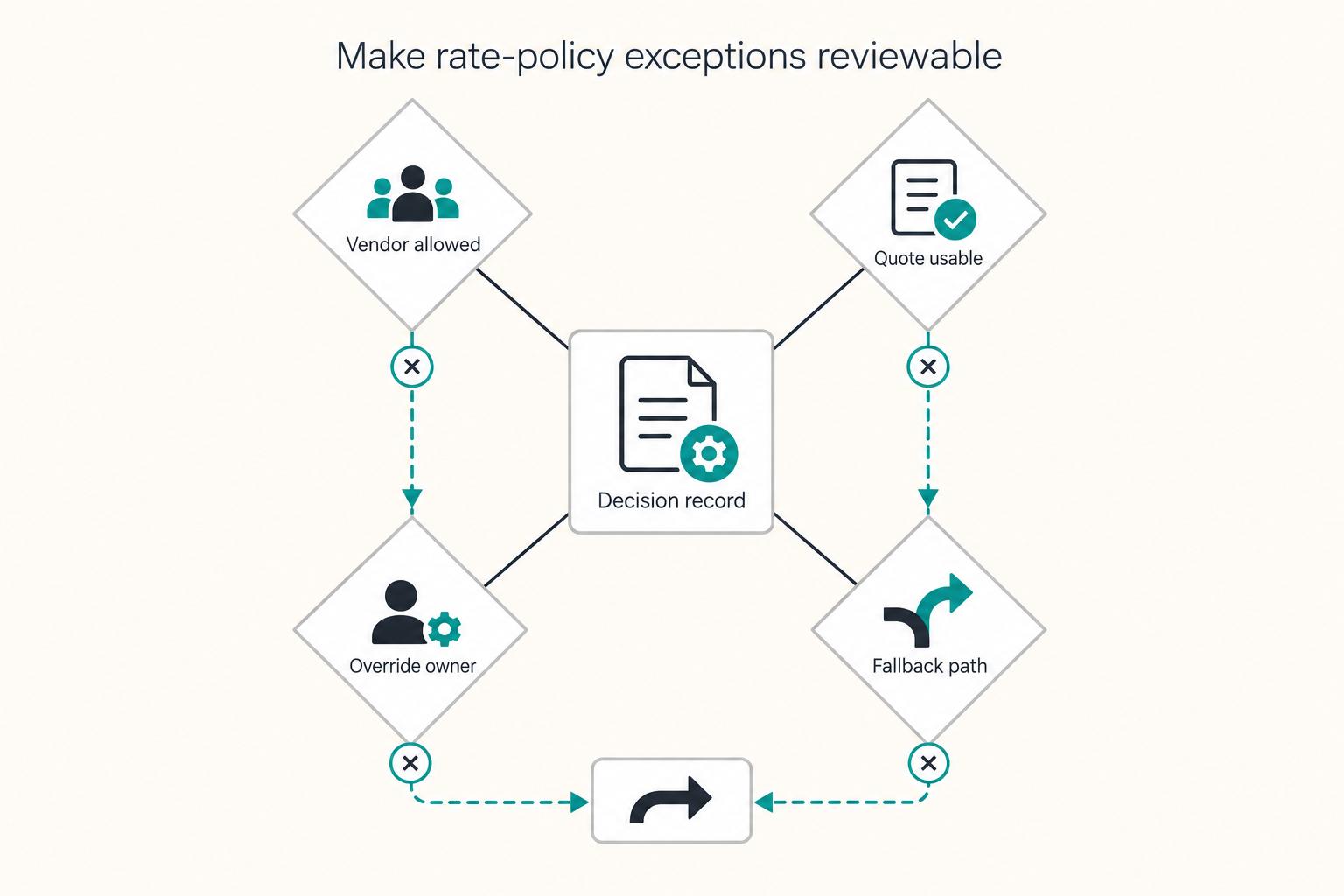
Your rate policy should answer four questions immediately: is this vendor allowed, is this quote still usable, who can override, and what happens if the preferred path fails. If those answers are scattered across chat, email, and tool screens, the policy is not ready for live traffic.
Step 1 Define policy primitives in one versioned record#
Keep one versioned policy record for each scope you already route on, such as commodityCode, UNSPSC, or PurchasingUnit. In that record, define:
- Allowed vendor set for the scope
- Rate rule being enforced
- Quote-validity rule and stale-quote condition
- Named override authority
State the rate rule in explicit terms, such as fixed cap, allowed band, or must match accepted quote version. There is no universal timeout here, so quote-validity timing must be your own documented program rule.
Use a quick readiness check on a live RFQ: can an operator see policy version, quote version, vendor tier, quote issue time, expiry status, and override owner in one place? If not, exception handling will break under load.
On multisided platforms, this discipline matters because demand on one side can influence demand on another side. Keep rate logic narrow and visible so teams can see the tradeoffs before they scale.
Step 2 Write the decision path before automating it#
Write the logic as plain if/then flow first, then code it:
- If quote is valid at execution time and within policy, proceed.
- If quote is expired at execution time, trigger re-quote.
- If re-quote is within policy, proceed.
- If re-quote breaches policy, route to named approver.
If you use fallback routing, define it in the same policy record. A common operating pattern is preferred vendor, then approved vendor, then controlled manual path, but treat that as your policy choice and define what counts as vendor failure in your environment.
| Rule type | Trigger | Owner | Expected operator action |
|---|---|---|---|
| Quote validity | Execution attempted after quote expiry, or quote version missing | Finance defines, Engineering enforces | Re-quote automatically or stop with stale-quote reason |
| Rate breach | Returned quote falls outside allowed rule | Finance owns threshold, named approver owns override | Route for approval or reject and record decision |
| Preferred vendor failure | Preferred vendor cannot provide an executable quote or is unavailable | Ops owns fallback | Try approved vendor path and capture failure evidence |
| Manual exception | No automated path clears policy and transaction is time-sensitive | Ops with Finance or Compliance per policy | Approve or reject manually, then assign reconciliation follow-up |
Verification is simple: replay an expired-quote case and confirm it ends in exactly one path, not ambiguous branching.
Step 3 Tie every exception to evidence that survives review#
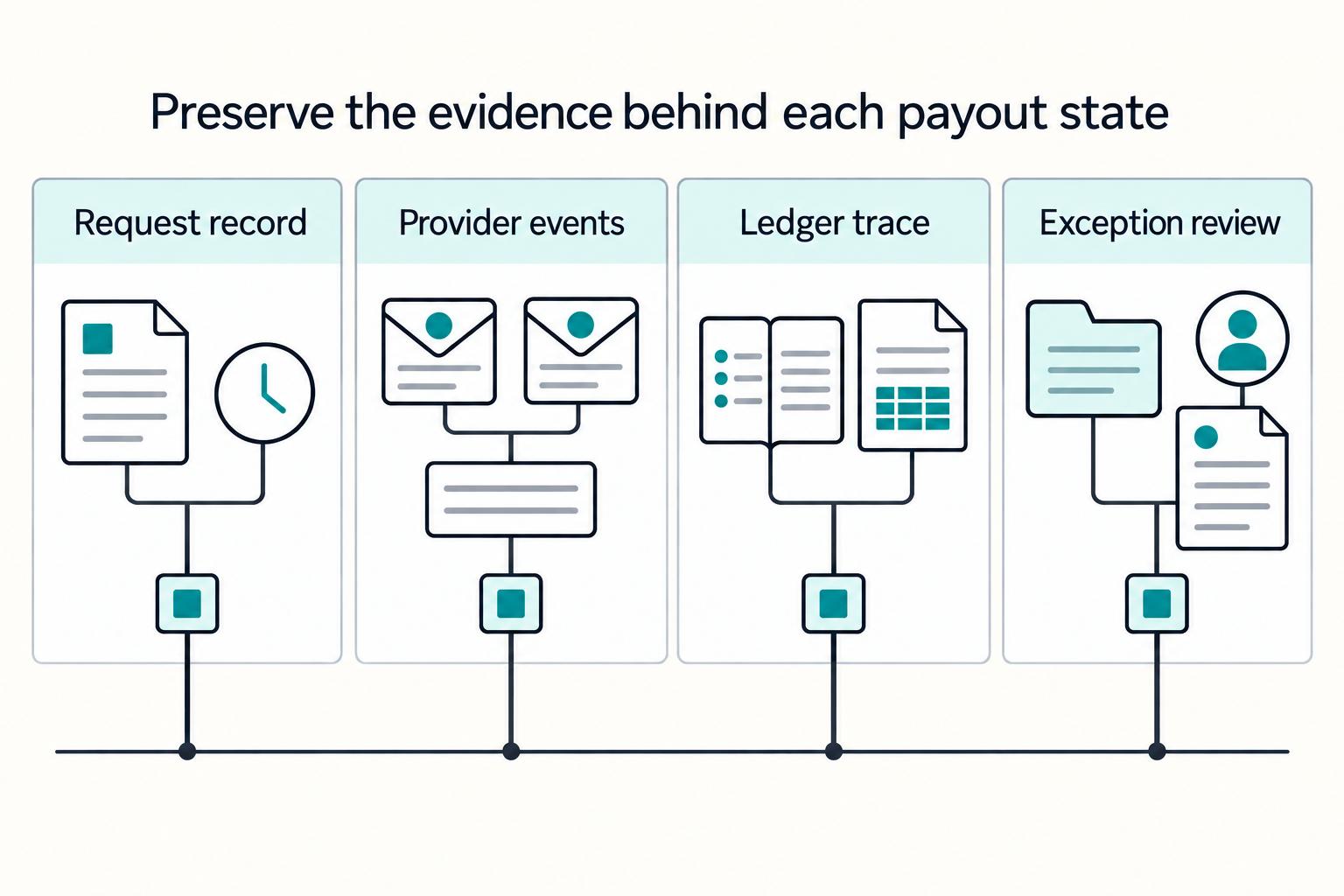
For each exception, capture a minimum evidence pack: reason code, approver, timestamp, affected transaction or RFQ, and reconciliation note. Also retain policy version, quote version, and supplier response that triggered the exception.
This aligns with governance reality: FAR Companion Version 2.0 treats contract financing (Part 32) and disputes or appeals (Part 33) as formal topics. If a decision is questioned later, you need evidence that is easy to trace end to end.
Run a monthly audit sample and trace exceptions from RFQ to execution to reconciliation. If approvals only exist in chat or timelines cannot be reconstructed, tighten the policy before volume increases.
Implement controls across collection, conversion, and payout#
Put enforcement on money-status events, not on the guided buying surface. SAP's guided buying recommendations are customer configured and can initially show popular items, so they are useful for routing choices but not for proving that collection, conversion, or payout followed policy.
Step 1 Map each policy decision to a money event#
Attach your policy record to the exact points where funds can move or be reclassified: payment or invoice confirmation, wallet update, conversion, and payout release. At each point, define one clear outcome: proceed, hold, re-quote, or route for approval.
Step 2 Keep one traceable record from decision to release#
Use the same policy version and decision context across each event so Ops can trace what happened without reconstructing it from chat or inboxes. Your checkpoint is straightforward: follow one live transaction end to end and confirm the policy outcome is visible at every money event.
Step 3 Do not treat recommendation maturity as financial control evidence#
SAP states recommendations use organizational purchase history and AI, but right after enablement the carousel shows popular items first. SAP also notes organizations typically need at least 100 unique users and 1,000+ Add to cart clicks, and often three to six months, before carousels contain only recommended items. Use that behavior as front-end guidance, not as evidence that execution controls are working.
Monitor policy drift and recover fast when things break#
Once your execution gates are live, watch for drift early and treat missing evidence as a control failure, even if money moved.
Step 1 Track weekly signals against the policy record#
Track your own week-over-week signals for each cohort: policy compliance, exception rate, end-to-end cycle time (RFQ to release), failed payout recovery time, and manual-touch ratio. You are looking for breaks in your own pattern, not external benchmarks.
Run one fixed sample check each week. Confirm the RFQ, selected vendor, quote timestamp, payout reference, and exception reason all tie to the same policy version. If an approved fallback route was used, the record should also show why the preferred path failed and who approved the switch.
Step 2 Separate isolated incidents from systemic breaks#
Treat repeated issues across a vendor, corridor, or product cohort as systemic until proven otherwise. Look for issues such as preferred-vendor SLA misses, stale rates at execution, delayed webhooks, or incomplete tax or compliance evidence.
If the issue is systemic, switch the affected cohort to the approved fallback, freeze noncritical policy edits, and confirm root cause before reopening the preferred path. This keeps your audit trail intact during incident recovery.
Step 3 Review market and legal exposure monthly#
Run a monthly review to confirm your evidence collection still fits your active markets and legal risk profile.
For UK tax-related records, keep the key dates and process checks explicit: first-time filers must register for Self Assessment before using the service; notification may be required by 5 October 2025 for the prior tax year (6 April 2024 to 5 April 2025); telling HMRC late can lead to a penalty; tax bills are due by 31 January; and records such as bank statements or receipts should be kept. If someone files without reactivating an existing account, the return may be delayed.
Where relevant, include Online Safety Act UK adjacency in the same monthly review, and log policy or evidence changes in one place before the next cycle.
Related reading: How to Negotiate a Higher Rate with a New Client.
Conclusion#
Treat guided buying as an operational control, not just a cleaner request experience. Supplier priority, rate governance, and execution controls have to agree at the point of release, or your team will spend time fixing avoidable exceptions after money has already moved.
- Scope the flows before you automate anything.
Map the real path from RFQ or intake through supplier selection, quote check, payout execution, and reconciliation. Your first verification point is simple: for any completed transaction, you should be able to point to the policy decision, the selected vendor, the quote or rate reference, and the payout record without asking three teams to reconstruct it later. If that chain is not visible yet, hold off on deeper automation.
- Define policy objects and assign one owner per decision.
Keep supplier priority, rate boundaries, and execution gates separate so operators can tell what failed and who can act. This is the practical lesson behind formal policy structures such as FAR Part 52, including explicit instructions for using provisions and clauses: clear structure matters, even if FAR itself is not your marketplace implementation guide. A strong starting rule is Finance owns rate guardrails, Ops owns exceptions, Compliance owns blocking checks, and Engineering owns enforcement behavior.
- Configure only the controls you can verify in production.
In SAP S/4HANA guided-buying contexts, the Guided Buying Parameters documentation shows this clearly: request behavior can be controlled down to whether accounting splits, comments, custom fields, and line-level edits are allowed in submitted requisitions. That is a useful reminder that policy becomes real when it is expressed in concrete settings and evidence, not just in an ops memo. Your checkpoint here is whether each exception captures reason code, approver, timestamp, policy version, and transaction ID before release.
- Implement enforcement that is idempotent and has a named fallback path.
Preferred vendor first, Approved Vendor fallback second, controlled manual path last. If a quote expires, re-quote. If the provider is unavailable, route to the approved fallback. If the same exception repeats, stop treating it as one-off noise and change the rule or provider setup. A common failure mode is automating the happy path while leaving outages and stale rates to human guesswork.
- Instrument KPIs and review policy on a regular cadence.
Watch compliance rate, exception rate, cycle time, failed payout recovery time, and manual touch ratio, then review policy regularly. Fragmented buying does not just create noise. It can also reduce your leverage with preferred suppliers when spend leaks into one-off vendors. And if you are tempted to solve ambiguity with AI alone, keep the real limit in mind: when policy, budget, risk, and delivery constraints conflict, the decision still needs a human.
If you want a copy-paste launch list, use this: scope flows, define policy objects, assign owners, set compliance gates, implement idempotent enforcement, enable fallback routing, instrument KPIs, and schedule policy reviews. That sequence can be enough to get these policies live without locking yourself into brittle logic too early.
Frequently Asked Questions
What is the difference between a preferred vendor and an approved vendor in a marketplace setting?
For this guide, treat a preferred vendor as your first choice under policy, and an approved vendor as an allowed fallback when the preferred path cannot be used. The important part is not the label but the rule. Your policy should state when the first choice applies, when fallback is allowed, and who can approve that switch. If those conditions are not written down, operators will improvise and your audit trail will weaken.
How do marketplace operators enforce preferred vendor and rate policies without blocking urgent payouts?
Use conditional enforcement, not all-or-nothing blocking. A good pattern is to auto-route to the preferred path, then allow a controlled exception only when a documented policy condition is met (for example, provider unavailability or a named urgency condition). Capture the reason code, approver, timestamp, and transaction ID before release. Every urgent payout should still map back to one policy version and show why the normal route was bypassed.
When should we allow policy exceptions instead of hard blocking transactions?
Allow exceptions when delay creates a bigger operational or commercial risk than the policy breach, but only if the fallback is already approved and the evidence pack is complete enough to reconcile later. Hard block when compliance gates fail, ownership is unclear, or the same issue is repeating, because that is no longer a one-off case. If the same reason keeps appearing, treat it as a rule or provider problem to fix.
What controls are required for audit-ready records across procurement and payouts?
At minimum, keep documented procurement policies, which aligns with 2 CFR 200.318(a) requiring procurement policy to be documented rather than implied. In each completed case, keep the request record, selected vendor, quote timestamp, policy outcome, exception reason (if any), payout reference, and reconciliation note in one chain. If card settlement is involved, remember the OCC treats merchant processing as settlement activity and as separate from card issuance, so keep settlement-side references clear.
How should we handle stale FX quotes and provider outages during execution?
Do not let operators guess whether an old quote is still safe to use. Your policy should define re-quote handling on expiry and the next step, including approver escalation or an approved fallback when a provider is unavailable. Avoid releasing the payout before the policy decision and supporting evidence are recorded.
Which minimum policy fields should every team define before going live?
Keep the starting set small but explicit: policy name, owner, scope, lookup key, condition, action, fallback path, and required evidence. Also define who has authority to commit the business to a purchase or payout decision. A single-office authority model can work well, and the WashU procurement example shows the value of assigning that authority clearly rather than letting teams imply it. One red flag: do not rely on a FAQ or ops note as the binding rule, because agency FAQs can be informative without being binding.
Try a related tool
Researched and edited by the Gruv editorial team. Gruv builds cross-border billing, payouts, and finance-operations software for global businesses.
Sources
- admin.ks.gov/media/cms/SoK_OPC_Procurement_Manual_11_3b8e...trusted
- commercerecovery.nc.gov/procurement-manual-non-ittrusted
- ferc.gov/power-sales-and-markets/electric-market-base...trusted
- irs.gov/individuals/international-taxpayers/foreign-...trusted
- irs.gov/individuals/international-taxpayers/figuring...trusted
Educational content only. Not legal, tax, or financial advice.
Related Posts
How Supply and Demand Dynamics Should Set Your Marketplace Payout Strategy
In a two-sided marketplace, payout strategy is not back-office plumbing. It can shape whether sellers stay active, whether transactions complete reliably, and whether buyers can find supply that is ready to transact.

UK Online Safety Act Compliance for Marketplace and Platform Operators
Treat the UK Online Safety Act as operating work now, not a policy debate. The most practical way to reduce uncertainty is to run an auditable implementation plan: make an initial scope call, stand up baseline controls, assign owners, and keep records you can defend if Ofcom asks questions.
AP Automation vs Manual AP Processing for Marketplace Operators
For marketplace operators, this is not a generic AP explainer. The real choice is whether you should stay with manual AP, move to rules-based automation, adopt AI-powered automation, or run a staged hybrid while volume, controls, and integrations catch up.