

Quick Answer
To negotiate a higher rate with a new client, design a safer deal instead of defending a number. Set your private floor first, then counter with structured options that tie price to scope, acceptance, and payment terms. If they cannot raise budget, trade scope, timeline, or payment structure before cutting rate. Finalize everything in writing with a clear SOW, named approver, and documented payment triggers.
Negotiate the rate, scope and payment terms together#
When negotiating a higher rate with a new client, consider the whole deal. A rate that looks attractive can be weakened by avoidable rework, unclear approval steps or delayed payment.
As a business-of-one, your pricing is only as strong as the system around it.
Clients will pressure price. That does not make you greedy. It makes you an operator.
When a client asks for a lower price, ask which constraint matters most: budget, scope or timing. Respond with a specific tradeoff rather than an immediate discount.
The mindset shift: negotiate the deal, not just the number#
If you only negotiate rate, you can leave the real risk drivers untouched. You can win the number and still lose the project.
Here's the difference:
| What you optimize | Price-only negotiation | Risk-first negotiation |
|---|---|---|
| Success metric | "They accepted my rate" | "I deliver predictably and get paid predictably" |
| Scope control | Vague deliverables, fuzzy edges | Clear outputs, clear boundaries, documented change handling |
| Approvals | Informal, scattered | Named approver, defined acceptance, written confirmations |
| Payment terms | Assumed, not discussed | Clear expectations on timing and what "done" means |
| Disputes | Handled emotionally, ad hoc | Handled via a documented path and paper trail |
Run this sequence on every rate negotiation#
Run this sequence every time, whether you call it rate negotiation, pricing strategy, or basic client communication:
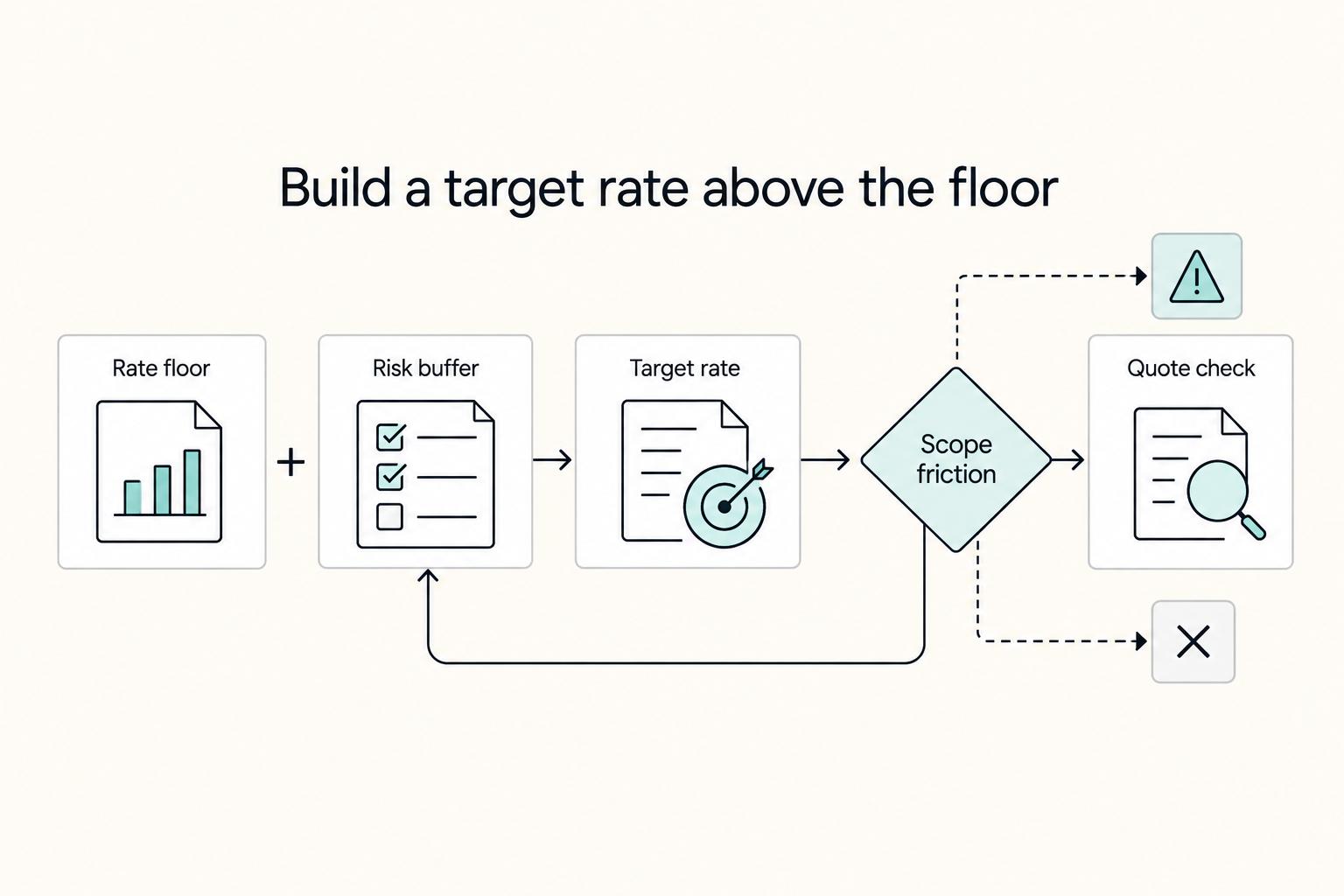
- Define your floor. Set the minimum deal you will accept, not just the minimum rate. Tie it to scope clarity and getting paid reliably.
- Counter with a structured range. Present clear options so the client negotiates within a system, not across a blank page.
- Trade terms, not ego. When budget pushes back, do not reflexively discount. Rebalance the deal so expectations and accountability stay tight.
- Lock it in writing. Reduce ambiguity with one source of truth, for example a single thread plus a written scope, so you prevent "I thought that was included" fights.
Common enough: a new client asks for "a little flexibility." You respond with options that keep the outcome intact, and you document the agreement the same day. No defensiveness. No scrambling. That's sales skill with operator discipline.
By the end of this guide, you'll have a reusable system and practical templates you can run on every new client.
Prerequisites: what to prepare before you negotiate (so you don't wing it)#
Prepare a simple negotiation packet (brief, draft SOW, and payment terms) so you negotiate from written reality, not verbal momentum.
Once you shift from "asking for more" to designing a safer deal, you need artifacts you can point to mid-call. That is how you stay specific under budget pressure.
Build your negotiation packet (one folder, three artifacts)#
Gather everything you need so you can handle these conversations without guessing.
- Client brief (theirs): Copy the exact outcomes, constraints, and deadlines they stated. If the brief lives in chat, paste it into a doc and date it.
- Statement of Work (SOW) (yours): Draft deliverables, boundaries, timeline, and what "done" means in plain language. Treat the SOW as your pricing foundation, not post-deal paperwork.
- Payment terms (yours): Decide your default invoice cadence and when you require payment, for example an upfront deposit and/or milestone payments. Write it down as a policy so you can trade terms intentionally during negotiation.
Use this table as your safe default:
| Item | What it protects | What to decide before the call |
|---|---|---|
| Client brief | Misalignment, "that's not what I meant" edits | What outcome they actually want |
| Draft SOW | Scope creep, rework, unclear acceptance | Deliverables, exclusions, approver, acceptance method |
| Payment terms | Cashflow risk, slow pay, awkward follow-ups | Deposit or first payment trigger, milestone schedule, due timing |
Illustrative scenario: you agree to USD 20/hour for up to 40 hours a month, but leave changes undocumented. After the first invoice, the client proposes USD 10/hour for the next three months. Agreeing rate, capacity, change process and effective dates before work gives you a clear basis for accepting or declining the proposed change.
Run a 10-minute pre-call check (so you anchor on outcomes, not nerves)#
Before the call, write one sentence you can repeat calmly: "This project delivers X result by Y date, with Z handoffs." That line anchors your freelance rates to delivery clarity.
| Pre-call item | Default / wording |
|---|---|
| Anchoring sentence | "This project delivers X result by Y date, with Z handoffs." |
| Stance | "I require written scope (SOW) and written payment terms before kickoff." |
| Paper trail | Keep everything in one email thread with the SOW attached and a same-day recap after any call. |
| Floor prep | Know your baseline rate so you can negotiate without spiraling. |
Then confirm these operator defaults:
- Your stance: "I require written scope (SOW) and written payment terms before kickoff."
- Your paper trail method: Keep everything in one email thread with the SOW attached and a same-day recap after any call.
- Your floor prep: Know your baseline rate so you can negotiate without spiraling. If you need a refresher, use How to Calculate Your Billable Rate as a Freelancer.
Hypothetical: a new client asks, "Can you sharpen your rate?" You open your packet, point to the SOW boundary, and offer to adjust scope or payment mechanics first. You stay in control because you prepared.
Step 1 - Set your "floor" and walk-away line (your minimum acceptable rate + minimum safe terms)#
Set a private walk-away floor first, and do not name it on the call.
With your prep done, you now need one internal boundary and one external posture. This is what keeps the conversation calm.
Define your floor without giving away leverage#
Your floor is the minimum you would accept to do the work. Calculate it privately using your own baseline math. If you need a clean starting point, use How to Calculate Your Billable Rate as a Freelancer. Treat the floor like a boundary, not an opening offer.
Keep your minimum private. When asked for it, explain the price for the defined scope and ask what the client can change if that price exceeds their budget.
Try: "What budget range have you approved for this scope?" Then assess whether a smaller scope or different timeline can fit without crossing your floor.
Verification point: you can state your target rate without referencing your minimum or sounding defensive.
Write your walk-away line (for you, not them)#
Put your walk-away line in writing for yourself: your target, your private minimum, and the point where you politely decline. Do this before you talk numbers, so you are not improvising under pressure.
Step 2 - How much higher should you counter with a new client?#
Counter a bit higher than your target, but make it inseparable from scope and written acceptance criteria. With a clear floor and a clear "done," your counter becomes a system, not a guess.
Optional: Offer 2-3 scoped choices (so the number doesn't stand alone)#
If you send a single rate, the client can only negotiate rate. Giving choices shifts the conversation to what they actually need and what "done" means.
Keep each choice consistent on: (1) what's delivered (scope), (2) the rate/price, and (3) how you define acceptance. That last part matters more than most freelancers admit.
For each option, state the deliverable and acceptance test in your own draft. For example: "The handoff includes the agreed files and passes the test cases listed in Appendix A; the named reviewer responds within the agreed review window." Confirm the actual test, remedy and review period with the client.
Here's a simple template you can copy:
| Option | What's delivered (scope) | How acceptance works | Rate/price |
|---|---|---|---|
| A (Premium) | Full scope, faster turnaround, clearer limits on revisions | Written approval steps plus a short acceptance criteria list (your "Acceptance Test Plan" equivalent) | Highest |
| B (Standard) | Core scope, normal turnaround | Same acceptance criteria, fewer review cycles | Mid |
| C (Budget-fit) | Reduced scope (fewer deliverables or narrower outcomes) | Same acceptance criteria (do not loosen "done") | Lowest |
Anchor above your target, then concede on scope, not on "vibes"#
If you plan to negotiate, you need room to move. Set your first counter above what you want so you can concede without crossing your floor. When they push back, concede by adjusting scope or tightening acceptance, what's included and what counts as complete, not by shaving the price with no operational change.
A counteroffer can be declined or the offer withdrawn. Keep a pipeline and decide what you can accept before responding; no counter percentage guarantees that you retain the client.
Before you hit send, verify every option answers:
- What's delivered (specific outputs).
- What it costs (rate/price).
- How approvals work (who approves, what counts as acceptance).
Then put the final scope, rate, and acceptance criteria in writing so everyone is aligned.
Want a quick next step? Try the free invoice generator.
Step 3 - What if the client won't raise the rate? Use a term-bundle ladder (ranked by cashflow safety)#
Trade scope, timeline, and payment structure before you change your rate.
After you send an Option A/B/C counter, you will often hear "We can't move on budget." This is where people accidentally negotiate against themselves.
Ask about the constraint before conceding. Keep your current offer clear while the client decides which scope, timeline or payment term they can adjust.
Build your concession ladder (and only move one lever at a time)#
Pick the order that fits your deal and your BATNA (your best alternative to no agreement). The key is consistency: one clear concession per round, written down, so you do not accidentally give away multiple things at once.
| Lever to adjust | What you protect | What to write down |
|---|---|---|
| Scope in the SOW | Your rate integrity | Updated deliverables, revision caps, acceptance criteria |
| Timeline and responsiveness | Your workload boundaries | New dates, feedback windows, meeting limits |
| Payment structure | Cashflow predictability | Payment terms, invoice cadence, deposits, milestone payments |
| Rate | Everything above | New rate tied to a clearly smaller commitment |
"Budget-fixed, risk-reduced" bundles can work well here. You keep the rate, and you adjust terms that reduce operational risk, for example deposits or milestone billing, framed as conditions that help you deliver reliably, not as personal asks.
Negotiate for reliability (especially cross-border)#
If they truly cannot move on freelance rates, negotiate for fewer failure points:
- Named approver + approval expectations: "Who can sign off, and how fast will reviews happen?"
- Clear sign-off steps: Define what counts as accepted, and what triggers a change request.
- Documented dispute path: Decide where issues go before they become nonpayment.
For cross-border deals, get the basics in writing (rules and enforcement can vary by jurisdiction). If you work with UK clients, use a clause-level reference like How to Write a Contract for a UK-Based Client.
Practical check: if the client refuses a higher rate and also refuses safer payment structure, like a deposit or milestones, treat that as a risk signal. In that case, offer a smaller paid discovery SOW instead of forcing a full project into a shaky deal.
Hypothetical example: you propose a short discovery with a tight acceptance checklist. Then you roll the learnings into a revised SOW and pricing conversation with real specifics.
Step 4 - How do you lock better terms at the first contract moment (without sounding "difficult")?#
Agree on scope, approvals, and payment mechanics before work starts, and frame it as delivery hygiene.
Once you can hold the line with a term-bundle ladder, the next job is landing the agreement while momentum is high. This is where systems beat improvisation. It is also where cashflow gets protected or quietly lost.
Treat onboarding as leverage (without making it a debate)#
You do not need a confrontation. You need a repeatable checklist that makes the deal operable:
| Onboarding step | What to confirm | Timing |
|---|---|---|
| Get the scope in writing | What "done" means and who signs off | Before kickoff |
| Set the payment trigger | "Once the first milestone is paid, I'll put you on the calendar." | Before you schedule time |
| Share standard terms up front | Timeline, revision/approval flow, and when payments are due | In the same document set |
- Get the scope in writing before kickoff. Frame it as: "So we both know what 'done' means and who signs off."
- Set the payment trigger before you schedule time. For example: "Once the first milestone is paid, I'll put you on the calendar."
- Share your standard terms up front, in the same document set. Keep it operational: timeline, revision/approval flow, and when payments are due. The goal is to avoid chasing "later paperwork" when deadlines hit.
Invite a specific decision: "Which option matches your approved budget and deadline?" A collaborative counter can keep discussion moving, but cannot guarantee agreement.
Calculate your internal hourly target from required annual business revenue divided by realistic billable hours. Include business costs, nonbillable work, leave and appropriate reserves in the revenue target. For illustration, USD 60,000 of required gross revenue over 1,000 billable hours implies USD 60/hour; it is not USD 60,000 of take-home income or a universal capacity assumption.
Reduce ambiguity (this is where delays and payment disputes start)#
Do not rely on "looks good" vibes. Write acceptance like an operator:
| Control | What to define | Note |
|---|---|---|
| Acceptance criteria | What the client receives, in what format, and what counts as complete | Write acceptance like an operator |
| Approval method | What counts as approval | Use the agreed approval channel and authorized person; preserve required signatures/formalities |
| Named approver | One person who can accept deliverables and request changes | No committee-by-surprise |
| Payment-method caution | Keep dated handoffs, approvals, and the current scope/version handy if the client pays by card | Useful if a payment dispute shows up later |
- Acceptance criteria: what the client receives, in what format, and what counts as complete.
- Approval method: agree the authorized person and channel, such as email where permitted by the contract and applicable formalities; keep the confirmation with the agreed version.
- Named approver: one person who can accept deliverables and request changes. No committee-by-surprise.
- Payment-method caution: if the client pays by card, keep dated handoffs, approvals, and the current scope/version handy in case a payment dispute shows up later.
If you work with UK clients, here's a deeper guide: How to Write a Contract for a UK-Based Client.
If asked to start before the full build paperwork is ready, offer a separately agreed paid discovery milestone. Confirm its scope, price, payment timing, acceptance and authorized approval in the required form before discovery begins. The build remains unapproved until its own terms are agreed.
Hypothetical scenario: a launch is late and the client asks you to jump in. First agree a limited paid discovery engagement with explicit terms and an authorized approver; start only that work, then price the build from the resulting scope.
Step 5 - The scripts: counters, conditional yes, and clean no (so you keep the client and the boundary)#
Use short scripts that connect flexibility to clearer scope and cleaner terms.
With baseline terms ready, you now need language you can use in real time. This is where sales skills stop feeling personal and start running like a system.
1) Run the "conditional yes" and options framework (keeps it collaborative)#
Start with agreement, then attach the condition. Keep your tone neutral and operational.
- Conditional yes (terms-for-price trade):
"Yes, I can take this on at [rate or fixed fee] if we tighten scope and align on the delivery plan and terms in writing. That keeps delivery predictable on both sides."
- Professionalism normalizer (removes friction):
"Happy to adjust. This is the point in onboarding where we lock scope and key terms so delivery stays predictable."
Then move them into choices so you stop debating a single number. Send three packages with clear scope differences so the negotiation stays concrete.
| Option | Scope posture | Structure | Best for |
|---|---|---|---|
| A | Full scope | Standard engagement | Clients who want speed and certainty |
| B | Lean scope | Reduced scope or phased approach | Budget-sensitive clients who can move fast on approvals |
| C | Discovery only | Small first step | Clients who feel uncertain and need a lower-commitment start |
Hypothetical scenario: a new client pushes back and asks for "something more flexible." You keep your price, tighten scope in Option B, and reshape the work so the risk stays manageable. You keep the relationship and your boundary.
Use your required gross business revenue and realistic billable capacity to calculate a private baseline. Compare project estimates against that baseline, including revisions and nonbillable coordination. See How to Calculate Your Billable Rate as a Freelancer.
2) Reset risk when they push for extended payment terms (without threats)#
Use a risk reset script that offers structure, not attitude:
- "I can't start under extended payment terms. To keep timelines reliable, we can either adjust the scope for this budget or phase the work so we're aligned on terms before moving into the full build."
Practical check: send a same-day recap email. After any call, send a recap that locks the decision in writing:
- Chosen option (A/B/C) and what changed.
- Confirmed scope, deliverables, and timeline.
- Confirmed price and payment terms.
- Next step and who owns it.
Step 6 - Payment-risk mechanics competitors skip: how to get paid faster and reduce disputes#
Treat payment terms as negotiable until you verify they're fixed, and revise your ask when new information changes the scope or cost.
Scripts help you negotiate. Specific asks are what make the agreement hold up once work starts.
1) Get specific about what you're negotiating for#
Do not negotiate "better terms" in the abstract. Negotiate the parts: payment timing, deposit or first payment trigger, milestone payments, acceptance criteria, and who approves what.
Verification point: you can state, in one sentence, what you want changed and why.
2) Find out if there's actually room to move#
Your first job is to find out whether the term is actually fixed or just being presented that way. Ask who can approve exceptions, then tailor the ask accordingly.
3) If the scope changed after you named a number, say so plainly#
If you named a rate or range and then learned the responsibilities were broader than expected, say that directly. Frame it as updated scope and revised requirements: new information, recalculation, updated requirement, specific ask.
Keep it clean. No drama. Just: new information, recalculation, updated requirement, specific ask.
Step 7 - Common mistakes (and how to recover when things go wrong)#
Recover margin by tightening documents and decision paths, not by re-litigating the rate.
Even with a solid process, projects drift. When they do, the fix is often a small written change that restores scope, objectives, or approvals before the work, and the value, leaks.
Step 1: Diagnose the failure mode, then pick the smallest corrective lever#
Use this table like ops triage. Your goal is one corrective move, in writing.
| Mistake you made | What you'll notice | Recovery move (tight, written, immediate) |
|---|---|---|
| You negotiated with the wrong person (not the person who can approve) | Lots of "sounds good," but everything has to be "run by" someone else | Pause the back-and-forth and ask, in one email, who can approve the purchase and any changes. Re-send a crisp summary to that person for written confirmation. |
| You didn't prepare properly (you don't know the buyer's constraints, or your own offer details) | Surprises late in the conversation: objections you can't answer, new constraints, circular questions | Reset with a short written recap of what you're delivering and what you need from them. Then ask the minimum set of clarifying questions (constraints, timeline, internal process) before you propose changes. |
| No clear objectives and priorities | The contract or "final details" drag on; stakeholders disagree on what matters | Send a one-page objectives/priorities note and ask which constraints are fixed and which can change. |
| Scope and acceptance are fuzzy | "Can you also..." keeps showing up; milestones slip; nobody will sign off | Issue a short written scope reset: what's in, what's out, what "done" means, and what requires a change. Ask for explicit approval before you proceed. |
| Approval is stuck in limbo | Work is delivered, but there's no sign-off and no next step | Send one clear approval request to the approver with a deadline and the exact decision you need (approve / request changes). If they can't decide, ask who can. |
Step 2: Send the "reset" message to the right person#
Confirm who can authorize the purchase and changes before requesting an amendment. A stakeholder who likes the work may still need another person to approve budget or bind the client.
Copy structure (client communication that keeps you in control):
- Subject: Confirming next steps for Phase 2
- Body: "To keep delivery predictable, I'm proposing a short written reset covering (1) the updated scope and acceptance criteria, (2) the approval path, and (3) who will sign off. Who is the final approver for these changes?"
Hypothetical scenario: a stakeholder says "Looks good" on a call, but later you're told someone else needs to approve. You forward the reset email, get the correct approver to confirm in writing, then restart delivery against the clarified scope. Clean, boring, effective.
If you're working across borders and terms create friction, keep the language clear and consistent and sanity-check it against local expectations where needed with How to Write a Contract for a UK-Based Client.
Conclusion: the full loop from floor to written agreement#
You win rate negotiation with a new client by getting specific, not by getting "tough." Specificity creates leverage because it removes ambiguity, and ambiguity creates rework, delays, and awkward payment conversations that quietly crush your effective freelance rates.
At this point you have the full loop: define your floor, counter with options, trade terms before rate, lock the agreement in writing, then enforce it with clear acceptance and payment expectations. Keep it boring. Keep it auditable.
The principle (what you standardize)#
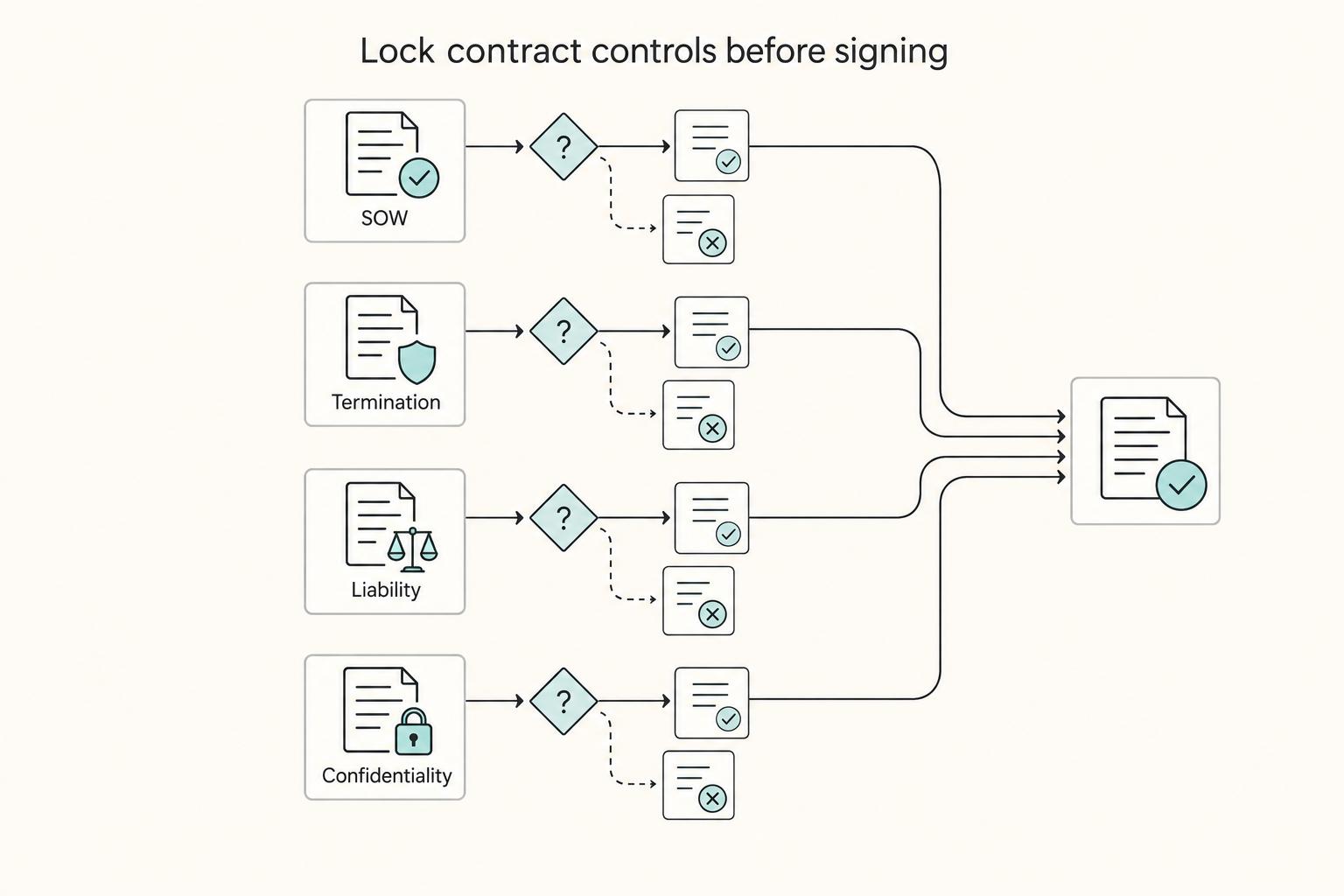
Use the SOW as a delivery reference: outputs, boundaries, responsibilities, schedule, acceptance and payment terms, either in a standalone agreement or incorporated into the governing contract.
Define acceptance for each deliverable, including review period, approver, correction process and revision limits. Separately identify actual billing/payment triggers, including deposits or time-based invoices where agreed.
Confirm how this particular SOW becomes binding, which terms it incorporates and how conflicting documents or later changes are handled. The document label and a recap email alone do not establish authority or satisfy every required formality.
Hypothetical scenario: a new client asks for "a few revisions" after delivery. You point to the acceptance criteria, collect sign-off, and put additional work into a separately agreed scope. You protect the relationship and the margin.
Copy/paste checklist (run this on every new client)#
- I calculated my floor as a bundle: minimum rate, minimum acceptable payment terms, and minimum scope clarity. If you need the calculator, use How to Calculate Your Billable Rate as a Freelancer.
- I drafted or updated the SOW with clear scope, roles/responsibilities, deliverables, schedule, service levels (if relevant), and acceptance criteria, plus a named approver.
- I prepared 3 options (A/B/C) that bundle rate, scope, and timeline so the client can choose instead of haggling.
- I documented the payment expectations clearly (what gets paid, when it gets paid, and what "accepted" means for billing).
- I sent a recap email that confirms the final option, the SOW version, and the approvals workflow.
Want to confirm what's supported for your specific situation? Talk to Gruv.
Frequently Asked Questions
How much higher should I counter with a new client without losing the deal?
Counter above your private floor with a price you can explain through scope, estimated effort, expertise, costs and capacity. There is no percentage that guarantees the deal. Offer clear choices and explain what changes at each price. See How to Calculate Your Billable Rate as a Freelancer.
What if the client says they can't raise the budget - what should I negotiate instead of rate?
Negotiate the tradeoffs first. If the number can't move, make sure what you're agreeing to is specific and controllable: what's included, what's not, who approves, and what "done" means. If you must concede, concede on scope in the Statement of Work (SOW), not on ambiguity.
Can I negotiate and still keep the client if they already sent an offer?
You can counter collaboratively, but the client can decline or withdraw the offer. Explain the scope and terms for your proposed price, offer alternatives and confirm the authorized decision maker. Do not present a counter as acceptance of the original offer.
What are the most important payment terms to negotiate to protect cashflow?
Prioritize clarity on timing and responsibility: when you bill, when they review, how approvals happen, and what triggers the next phase of work. Get those expectations written into the SOW or contract so you're not improvising under pressure.
Should I ask for an upfront deposit with a new client? How much?
Sometimes, yes, especially when the relationship carries unknowns and your work starts before you can verify smooth approvals and payment behavior. Deposit practices vary, so choose an approach that matches your risk tolerance and keeps expectations clear in writing. If they resist, you can also restructure the engagement so you're not carrying as much unverified risk up front.
How do I reduce chargeback risk when a client pays by card?
Keep the agreed scope/version, payment terms, dated delivery evidence, acceptance records and client communications linked to the transaction. If disputed, check the provider notice and response deadline and submit evidence relevant to the stated reason. Documentation supports the response; it does not guarantee a chargeback outcome.
What's the best way to document negotiated terms so there's no ambiguity later?
Put the agreement in writing in one place (SOW/contract) and mirror it with a short recap that both sides can reply to. Make sure changes later become written changes, not "we said in chat."
Try a related tool
Researched and edited by the Gruv editorial team. Gruv builds cross-border billing, payouts, and finance-operations software for global businesses.
Educational content only. Not legal, tax, or financial advice.
Related Posts
How to Calculate a Freelance Rate You Can Actually Get Paid On
A workable rate is not the neat number a calculator produces. It is the number that still works after you account for real billable capacity, non-client time, scope drift, and the gap between sending an invoice and receiving cleared cash. Start with hourly math even if you do not plan to bill hourly, then turn that number into a quote with clear `payment terms`.
How to Write a Contract for a UK-Based Client
Start with the legal names of the client and supplier, their addresses and any company numbers. Identify who can approve changes and sign. Then make the work, payment, rights and exit terms specific enough that both sides can follow them during a dispute.

The Freelance Payment Penalty: A Modeled Audit of Platform Fees, FX Spreads, and Payout Delays
The money rarely disappears through a single, easy-to-spot fee. The real loss is stacked. A marketplace takes its commission, a processor adds a charge for international cards, a bank or payment company converts the currency at a spread, a platform holds the funds before release, and a wire sheds a little to intermediaries on the way in. Each layer looks defensible on its own, but the worker feels the combined result as a smaller deposit and a later payday.