
Quick Answer
Set vendor control before activation: assign one decision owner, one approval path, one due diligence file, and one system of record for each supplier. Keep commercial selection separate from payout release, and block first disbursement until compliance checks, technical tracing, and rollback steps for Payout Batches are documented.
How platform operators control the supplier lifecycle#
Vendor management in a platform business is not back-office admin. It is a core control point in the business. It determines which third parties can influence core operations, service quality, and customer experience, and under what conditions they can do it.
That matters because vendors are not just outside suppliers doing isolated tasks. In practice, they often function like extensions of your company and shape operational integrity and outcomes. So this guide treats vendor management as more than contract negotiation, price pressure, or basic procurement hygiene. The real question is not just, "Did we buy well?" It is, "Did we approve the right vendor, with the right checks, and can we prove why?"
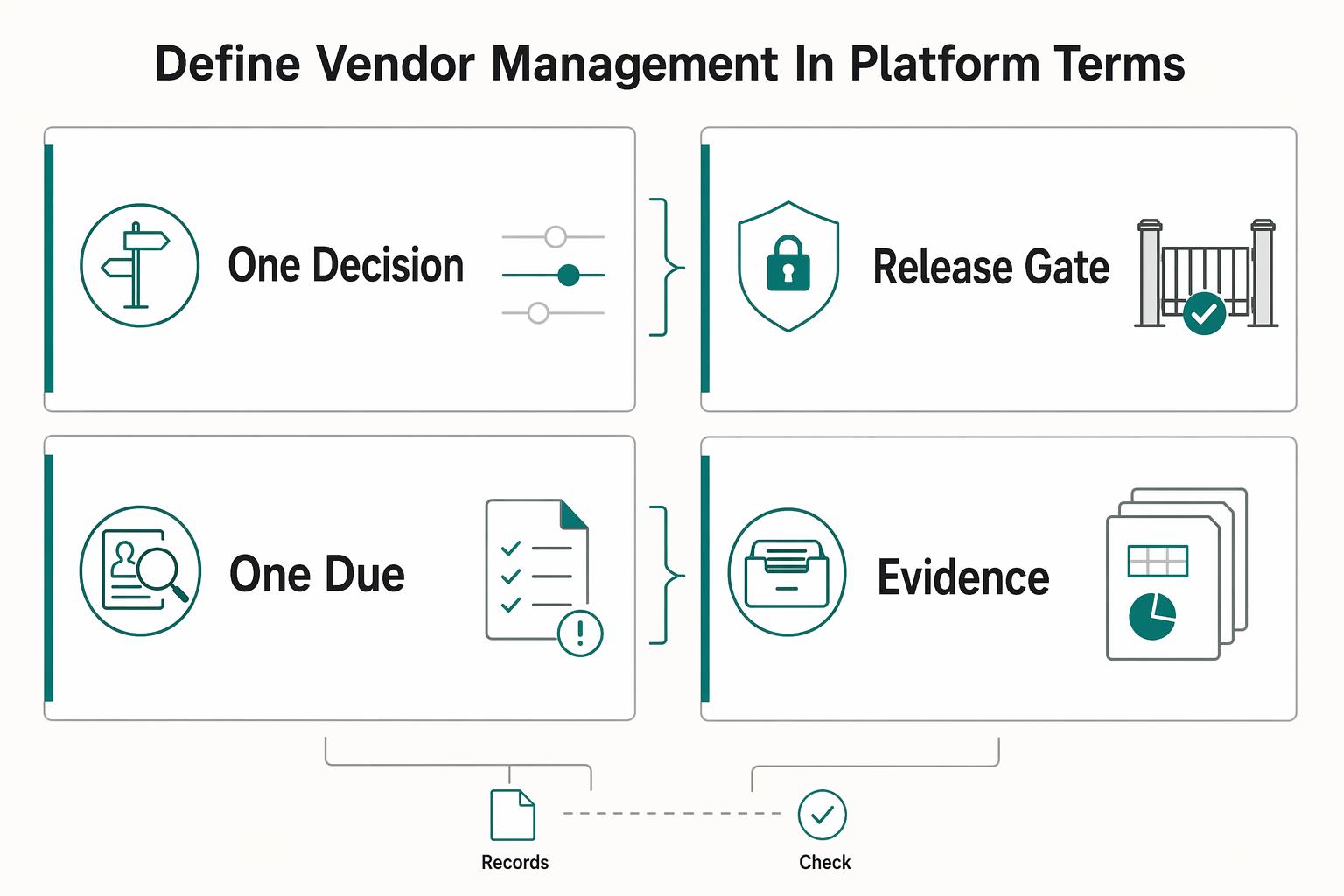
A useful starting point is to think in terms of enforceable decisions, not admin steps. Before any vendor is activated for meaningful work, four things should be clear: who owns the decision, who must approve it, what evidence supports it, and where the official record lives. If even one of those is fuzzy, oversight fragments fast. Relationships end up scattered across inboxes and spreadsheets, review standards drift, and there is no clean answer when Finance, Ops, Engineering, or Compliance asks who signed off.
That is why due diligence cannot start at contract signature. The review needs to begin earlier, while you still have room to reject the vendor, narrow the scope, or add conditions. For a platform team, that means looking beyond commercials and asking whether the vendor fits the operating reality you need to protect. Cost alone should not decide fit: a lower-cost vendor may still create meaningful risk if it sits near a critical process or customer touchpoint, while a higher-cost option may be easier to govern if its controls, documentation, and accountability are clearer.
The practical aim of this guide is simple: help you build a supplier lifecycle your teams can actually run. You should come away with a concrete model for intake, review, approval, onboarding, monitoring, renewal, and offboarding that works across Finance, Ops, Engineering, and Compliance. The focus is on decisions you can enforce and records you can defend, not abstract policy language.
If you want the short version, use this rule: do not let vendor selection outrun ownership and evidence. A structured approach only helps if each step leaves a visible trail. The rest of the guide turns that principle into a lifecycle you can implement.
Define vendor management in platform terms#
Vendor management for a platform operator is lifecycle control, not just procurement. You decide which suppliers can be used, under what conditions, and what evidence is required from intake through offboarding.
| Activation test | What it covers |
|---|---|
| One decision owner | Who owns the decision |
| One approval path | Who must approve it |
| One due diligence file | What evidence supports it |
| One official system record | Where the official record lives |
Procurement work still matters, including RFx, pricing, contract terms, and commercial fit. Vendor management adds the control layer: due diligence before signature, clear ownership, a defined approval path, and a durable system record.
Use a simple test before activation:
- One decision owner
- One approval path
- One due diligence file
- One official system record
If a supplier looks commercially attractive but you cannot verify operational reliability, security posture, financial health, or reputation, it is not a safe operating choice yet. Apply the same standard to low-spend suppliers when they sit close to critical processes, because operational impact can outweigh contract value.
If you want a deeper dive, read What Is Procurement? The Platform Operator's Complete Guide to Strategic Sourcing and Vendor Management.
Map the supplier lifecycle to owners decisions and evidence#
Control comes from consistency: at every lifecycle stage, require the same four artifacts before a supplier moves forward.
Use one lifecycle map across identification, qualification, selection, onboarding, monitoring, renewal, and offboarding. Assign one accountable owner per stage, even when Product, Finance, Engineering, and Compliance all contribute. If no single owner can approve and defend a decision, you have coordination, not control.
For each stage, require:
- Decision owner
One named person.
- Approval rule
The rule that allows progression, for example single approval, dual approval, or exception escalation.
- Evidence pack
The supporting records behind the decision.
- System of record
The official location for the decision and evidence.
That is what makes Third Party Risk Management auditable instead of informal.
What belongs in the evidence pack#
Store underlying proof, not just status labels. You can track items such as KYB/KYC status, VAT validation records, W-8 or W-9 collection status, and whether Form 1099 or FBAR support is enabled, but your legal and policy requirements still need to come from your own compliance and tax framework.
| Evidence item | Record detail |
|---|---|
| KYB/KYC | Status |
| VAT | Validation records |
| W-8 or W-9 | Collection status |
| Form 1099 | Whether support is enabled |
| FBAR | Whether support is enabled; calculation trail and review ownership |
For FBAR-related support, capture the calculation trail and review ownership, not only a final flag. FinCEN identifies FBAR as the Report of Foreign Bank and Financial Accounts. FinCEN guidance also states that each account must be valued separately, amounts are recorded in U.S. dollars rounded up to the next whole dollar, for example $15,265.25 becomes $15,266, and non-U.S.-currency accounts use the Treasury rate for the last day of the calendar year.
Stage controls at a glance#
| Stage | Control and owner | Required documents or evidence | Verification checkpoint |
|---|---|---|---|
| Identification | Product confirms business need | supplier request, proposed use, initial risk notes | business purpose and named sponsor are present |
| Qualification | Compliance and Finance confirm scope | required status fields and exception notes | required fields are complete before selection |
| Selection | Finance approves commercial path; Product confirms fit | decision record and approval record | selected supplier matches approved use and risk posture |
| Onboarding | Engineering and Compliance approve activation | onboarding checklist and required records | no production activation until approvals and evidence are stored |
| Monitoring | Compliance coordinates periodic review | incident notes, exceptions, status updates, FBAR support review where enabled | open issues have owner, date, and resolution path |
| Renewal | Finance owns renewal with Compliance input | current evidence pack and unresolved findings | no renewal with expired evidence or critical open exceptions |
| Offboarding | Engineering and Finance complete exit | access revocation and retained audit artifacts | access is disabled and records remain in system of record |
For FBAR due-date evidence, keep the applicable path in the record: FinCEN states April 15, 2026 for all other individuals with an FBAR obligation, and April 15, 2027 for certain individuals covered by the notice chain.
Choose your operating model before tool selection#
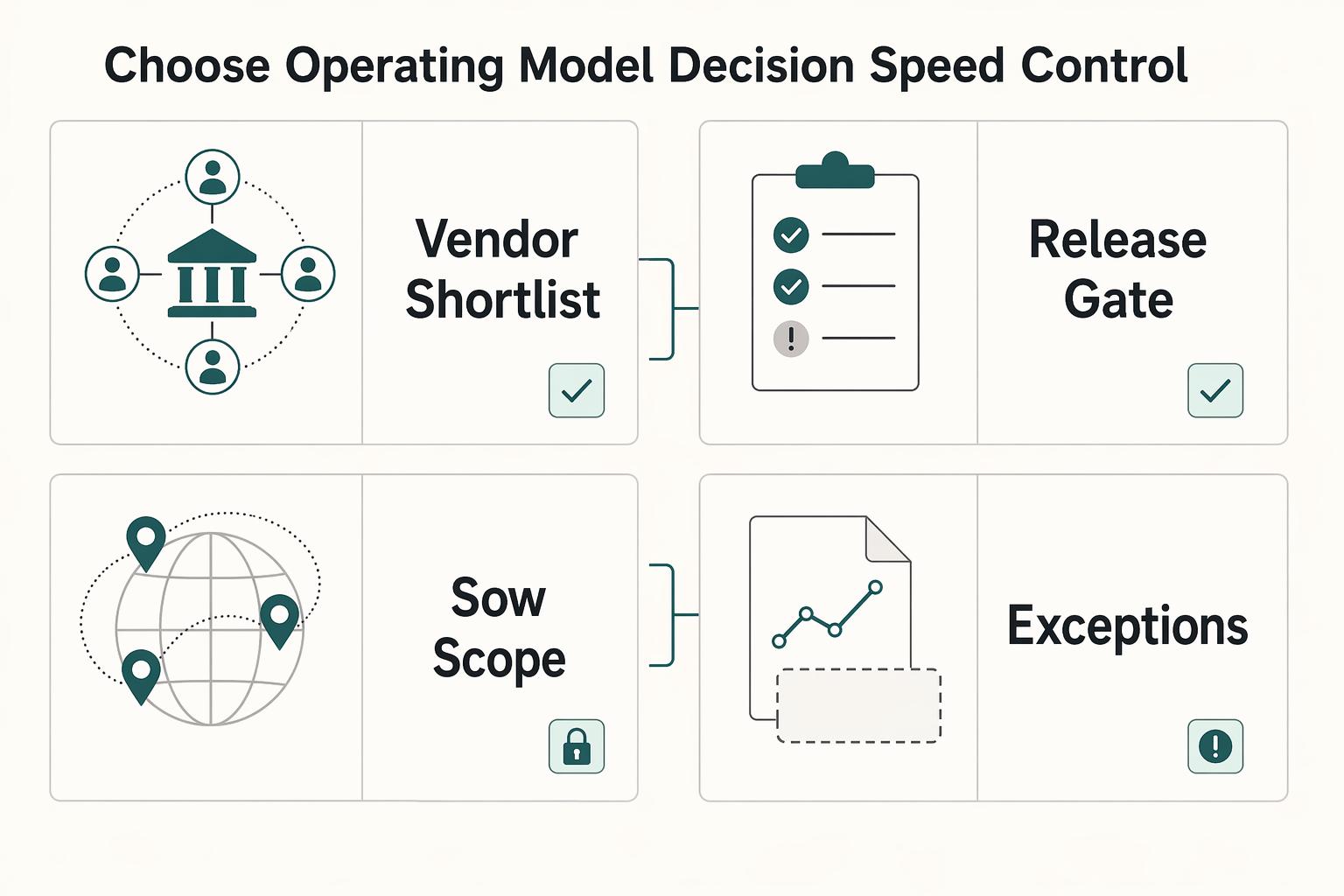
Choose the operating model first, then select tools that match it. If your team is small and audit pressure is high, favor central control with fewer systems. If your process depends on product-specific workflows at scale, a modular stack can fit better, but only if you can own the integration load.
Use due diligence for this decision, not price alone. Treat your comparison criteria as internal checkpoints: control depth, ERP integration fit, implementation speed, and operational overhead. The practical test is whether ownership, approvals, and evidence stay traceable across onboarding, monitoring, renewal, and offboarding in your real workflow.
ServiceNow Supplier Lifecycle Operations and Source-to-Pay Operations can be used as examples of a centralized pattern at the network level, not as proof of specific out-of-the-box controls. Public ServiceNow documentation shows release notes grouped by product family, and the Store release-notes index includes Governance, Risk, and Compliance and Platform Analytics categories. That supports a suite-oriented orchestration pattern, but you still have to validate your exact control path.
Your go/no-go check is simple: run one real supplier scenario and confirm the request, approvals, and evidence remain connected after updates and role changes.
| Area | Integrated platform bias | API-first modular bias | What you should verify |
|---|---|---|---|
| Procurement Case Management | Centralizes intake and exception handling in fewer systems | Uses specialist tools, with cross-system linkage owned by your team | Can one reviewer trace case, owner, approvals, and status without manual reconciliation? |
| Knowledge Management | Keeps policy context closer to operating records | Keeps docs in your preferred stack, with separate governance to maintain | Can you show which policy version applied to a past approval? |
| Performance Analytics | Leans on suite-native relationships for reporting | Enables custom metrics, with ongoing data-definition maintenance | Do reporting outputs match source records for exceptions and renewals? |
| Engineering maintenance burden | Fewer moving parts, but suite updates still require validation | More connector and API ownership, but more customization freedom | Is break-fix ownership clear when fields, permissions, or endpoints change? |
Modular programs usually fail through split truth across systems. Integrated programs usually fail through false comfort, when teams assume centralization equals control. If you cannot staff ongoing integration ownership, reduce system count. If you can, and your supplier lifecycle is tightly coupled to product behavior, modular can be the stronger fit. Related: Vendor Relationship Management for Platforms: How to Systematize Supplier Partnerships.
Lock pre-payout controls before first live transaction#
Treat first payout as a controlled release, not an automatic result of contract approval. For any supplier tied to disbursements, keep activation behind a pre-payout gate that is explicit, testable, and easy to audit later.
Make activation a separate decision#
Keep supplier selection and supplier activation as separate approvals. A vendor can be commercially approved and still be unready for live payouts if your required onboarding, compliance, technical, or payment-readiness checks are incomplete.
Write the gate as a short policy with clear owners, approval rules, and exception handling. Define the activation sequence your team will follow, then require completion evidence before production enablement.
Block go-live when readiness evidence is incomplete#
A common failure mode is false readiness: contract signed, credentials issued, and live payouts enabled before end-to-end behavior is proven in your environment. If your payout flow depends on external events, verify those events can be traced from receipt through internal state changes to the expected payout outcome in controlled testing.
If that evidence is incomplete, keep live payouts blocked until it is complete.
Define the minimum go-live evidence pack#
Keep one activation record with the minimum evidence needed for audit and incident review:
- activation approvals and decision owners
- test evidence for the critical pre-live flow
- documented policy exceptions and approvers
- rollback path for pausing or reversing payout activity, including Payout Batches
Version your activation criteria the same way formal governance pages do. The AFARS definitions page shows both a change record and an effective date (07/11/2025); use the same discipline in your own approval trail so the governing rule at go-live is unambiguous.
For a step-by-step walkthrough, see A Guide to Notion for Freelance Business Management.
Run continuous monitoring instead of one-time due diligence#
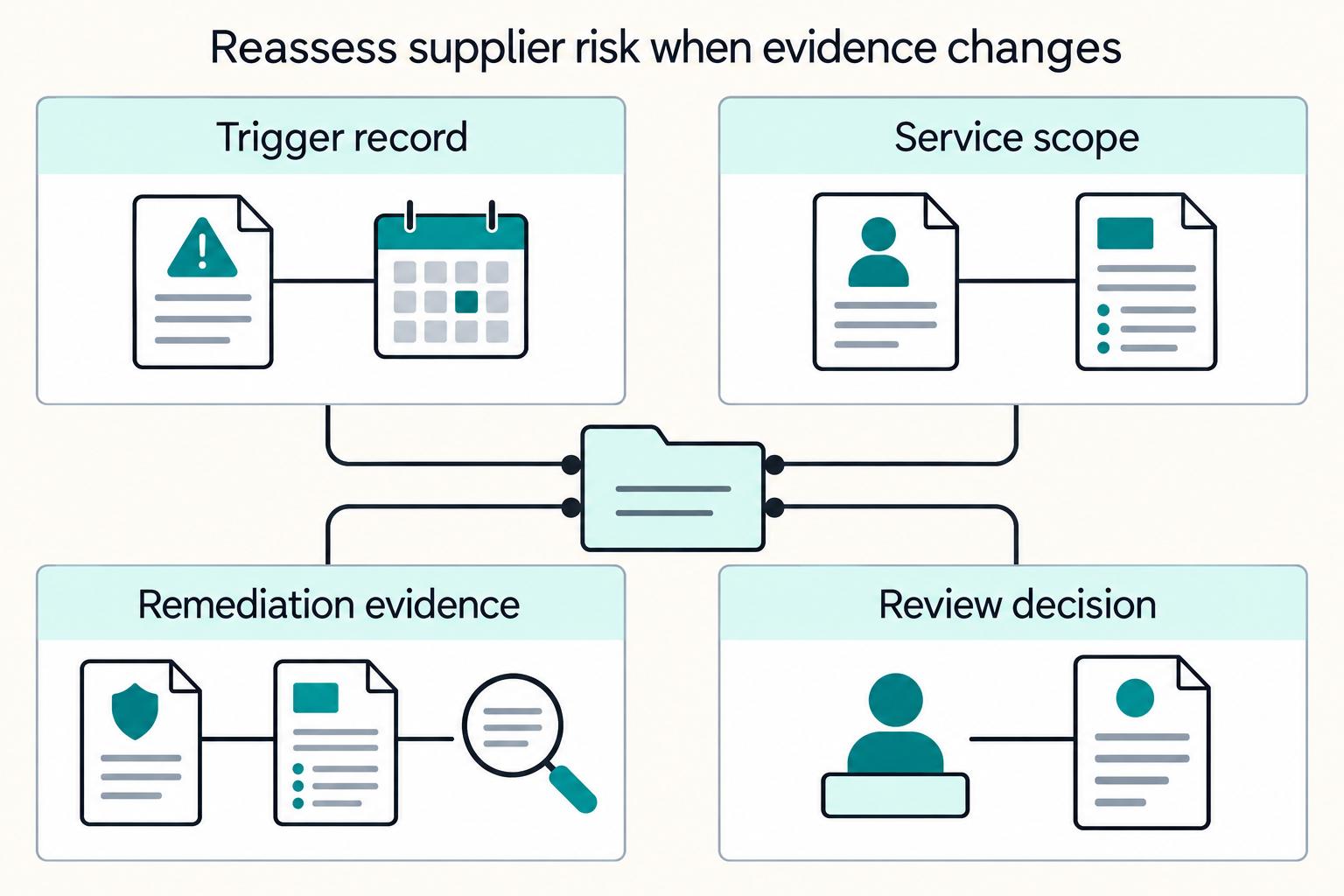
Once a supplier is in production, treat due diligence as continuous monitoring rather than a completed onboarding task. One-time checks are necessary, but they are not enough when supplier risk can change after go-live.
In a mature third-party risk model, monitoring is a standing supplier-lifecycle step. Reassess by risk tier, and keep the deepest scrutiny on suppliers that can influence payouts, create ledger-impacting events, or hold funds in transit. For payout-critical suppliers, the practical question is: what changed since the last approved risk view?
Watch for control drift in operating signals#
Your earliest warnings are often operational. Monitor signals like:
- rising webhook failure patterns
- reconciliation breaks between supplier events and internal records
- payout exceptions that keep requiring manual handling
- unresolved AML holds without clear disposition
Focus on traceability. For any exception, your team should be able to follow the chain from event or payout instruction to internal record, ledger impact, owner action, and final outcome. If that chain is hard to reconstruct, your monitoring is too shallow even if onboarding was clean.
Define incident triggers before the next incident#
Set explicit triggers in policy so teams know when to escalate from routine monitoring to incident handling. Typical triggers include repeated status mismatches between API events and ledger records, delayed returns in Virtual Accounts, and unexplained payout reversals.
These signals do not automatically prove supplier failure, but they do justify immediate investigation. Without clear triggers, teams normalize manual workarounds, backlogs grow, and cleanup costs surface late in close or audit.
When a trigger fires, open an incident record and preserve evidence. Route it to decision owners across Finance, Engineering, and Compliance based on exposure, event integrity, and AML or policy impact.
Make remediation visible and auditable#
Use a trend view so you can see whether exceptions and control issues are improving or compounding over time. Then keep remediation in one documented channel, with supplier responses, root cause, corrective actions, owners, and closure approvals in the same record.
Avoid splitting remediation history across chat threads and inboxes. Fragmented records are how repeat issues stay invisible until renewal.
Set renewal and offboarding rules before problems force them#
Set renewal criteria and exit triggers before an incident forces a rushed decision. Define what keeps a supplier active, what escalates review, and what starts offboarding so teams can act on policy instead of pressure.
Renewal should be a documented review against criteria your team already agreed internally, such as:
- SLA performance
- risk trend direction
- current compliance posture
- total operating cost, including recurring manual exception work
Make renewal evidence repeatable#
Use one record format each cycle so decisions are based on the same evidence set every time. Keep the file focused on operating evidence and current approvals, not scattered discussion threads.
Set offboarding triggers in advance#
Write explicit triggers for offboarding, including persistent control failures, unresolved audit findings, contract non-performance, or strategic deprecation. If risk is trending the wrong way in payout, ledger, or compliance workflows, treat that as a decision point.
Sequence the exit to protect continuity and auditability#
Define the exit order before you need it. A practical sequence is:
- Freeze new activity.
- Settle open balances and in-flight items.
- Export audit artifacts and decision records.
- Revoke API credentials and related access.
- Confirm data retention and deletion obligations with the relevant owners.
If a replacement is not production-ready, use a staged transition window to reduce payout disruption.
Execute a 90-day implementation sequence your team can actually ship#
Use 90 days to ship one controlled, auditable path, not to force every vendor rollout into the same timeline. Keep scope tight: one payout flow, a small pilot group, and one system of record for both operating evidence and contract lifecycle dates.
| Phase | Focus | Key record or check |
|---|---|---|
| Days 1 to 30 | Lock ownership and the minimum evidence pack | INITIAL EFFECTIVE DATE, contract term, expiration, renewal options, and any certification expiry date |
| Days 31 to 60 | Implement controls for API calls, Webhooks, Virtual Accounts, and payouts | Each test transaction should map from request record to provider reference to ledger posting to exportable artifact |
| Days 61 to 90 | Run a pilot with real vendors and real exception handling | Publish renewal and offboarding rules alongside onboarding records; track Provisional Certification Expiration Date values such as 1/22/2026 |
Days 1 to 30#
Lock ownership and the minimum evidence pack first. For each supplier, capture named owners and the contract fields you will need at renewal or audit: INITIAL EFFECTIVE DATE, contract term, expiration, renewal options, and any certification expiry date.
Use date-level records, not status labels. A contract view like 10/1/2025 start, 9/30/2028 initial end, and 2 - 1 Year renewal options is decision-ready; "active" is not.
If required in your environment, treat vendor-responsibility and insurance documentation as production gates. Missing dates or unlabeled files are an immediate control gap.
Days 31 to 60#
In this phase, implement controls for API calls, Webhooks, Virtual Accounts, and payouts. The checkpoint is traceability: each test transaction should map cleanly from request record to provider reference to ledger posting to exportable artifact.
If Webhooks are landing but not updating the same transaction record reliably, pause rollout and fix that before widening access.
Days 61 to 90#
Run a pilot with real vendors and real exception handling, not only happy-path tests. Publish renewal and offboarding rules alongside onboarding records so ownership, dates, and evidence stay connected.
Track expiry fields that can quietly invalidate approval, including Provisional Certification Expiration Date values such as 1/22/2026.
End the launch review with one question: can you explain any payout from request to provider reference to ledger posting to export artifact? If not, you are not ready to scale.
Conclusion#
Strong vendor management is lifecycle control you can prove, not cleaner procurement paperwork. If you cannot show who owns a supplier decision, who approved it, what evidence supported it, and where that record lives, you are still operating on trust and memory.
That is the real shift for a platform operator. Supplier relationship management is not only about price or contract terms. A vendor can look fine when volumes are low and everything is calm, then fail the moment pressure rises. The practical test is how the relationship holds up under stress, plus whether the record of decisions survives turnover, incidents, and audits. Treating vendors as transactional line items can hide this until recovery costs outweigh the original savings.
So the right move is not tool shopping first. It is getting ownership, decision rules, and records aligned before customer impact scales. Whatever tool you use as the system of record, the standard should be the same. You need one place to confirm current status, latest approval, open exceptions, renewal date, and offboarding state without stitching screenshots and inbox threads together. If your evidence is split across email, chat, and personal docs, that is a control gap, not an inconvenience.
A good closing check is simple: pick any active supplier and ask your team to retrieve the current owner, approval rule, evidence pack, and most recent review outcome. If that takes longer than it should, or depends on one person remembering the history, you have found where the supplier lifecycle is weak. A common failure mode is a relationship that looks commercially fine but becomes fragile because no one can prove what was approved, what changed, or who is accountable when performance slips.
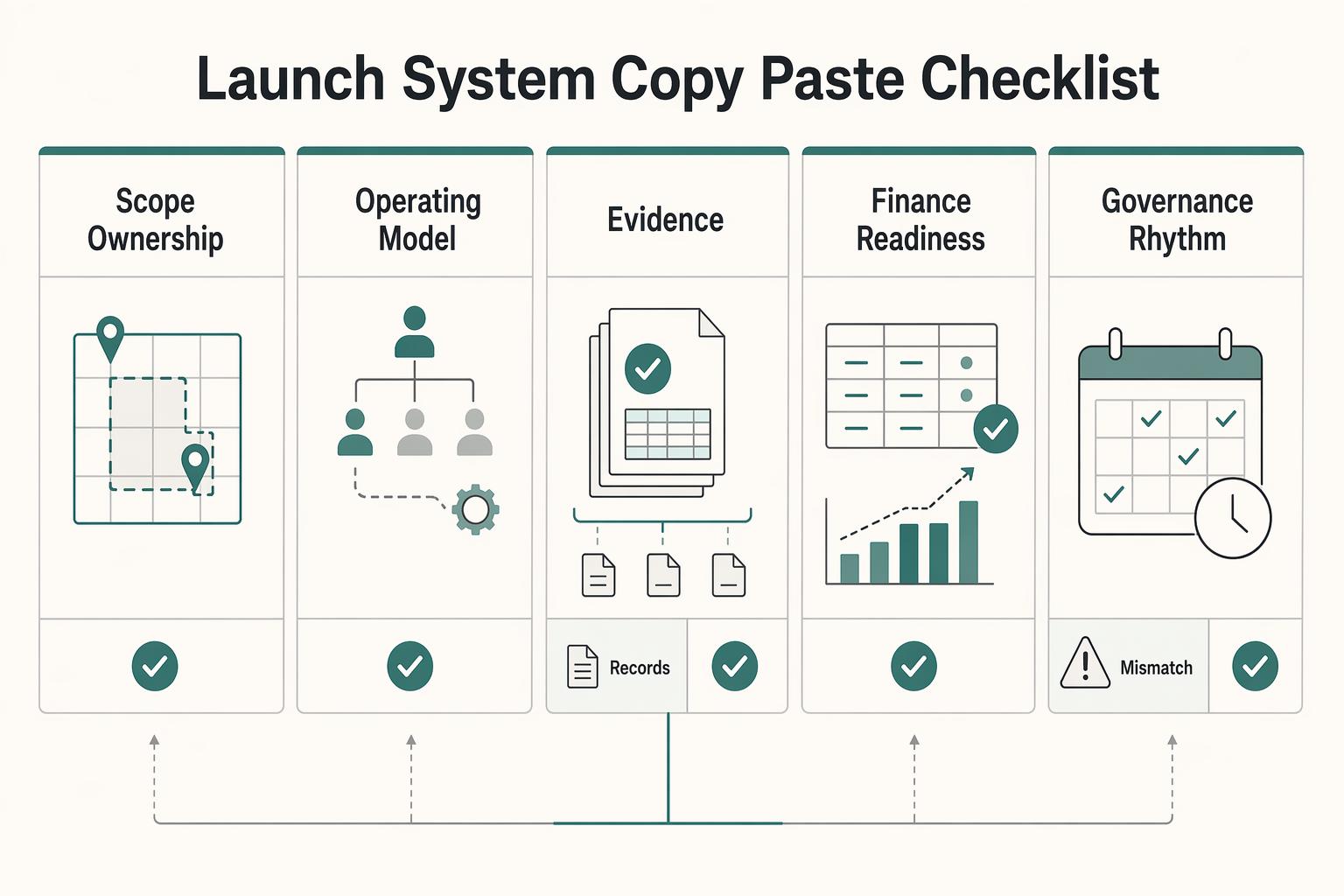
Use this outline against your current vendor list this quarter and make the first pass practical:
- Pick your highest impact suppliers first, especially the ones tied to customer-visible operations, critical data access, or core delivery.
- For each one, verify four fields: named owner, approval rule, evidence pack, and system of record.
- Rank the first three gaps by operational risk and ease of repair, then assign dates and a single accountable owner for each fix.
If you do only that, you will already be moving from vendor administration to real control. The point is not to create more ceremony. It is to make sure the next incident, renewal, or audit does not force you to reconstruct decisions after the fact.
Related reading: Choosing Creator Platform Monetization Models for Real-World Operations.
Frequently Asked Questions
What is vendor management in a platform business?
It is not just supplier admin or price negotiation. In a platform context, vendor management is a strategic approach focused on reducing risk, maintaining service quality, and building collaborative supplier partnerships across the lifecycle.
What stages are mandatory in a supplier lifecycle for payment operations?
There is no single universal stage list you should copy without adjustment. A practical sequence is due diligence before contract signature, onboarding, ongoing lifecycle management, and planned offboarding, with clearly defined roles and responsibilities at each point. If ownership is fuzzy across teams, approvals and response quality usually weaken later.
Which controls are non-negotiable before first payout?
Do not treat contract signature as enough. This guide supports due diligence before contracting that goes beyond price and covers financial health, operational reliability, security posture, and reputation. Before first payout, define clear ownership and onboarding readiness criteria so go-live decisions are explicit.
How often should we reassess vendor risk after onboarding?
This guide does not prescribe a fixed reassessment cadence. Set reassessment timing from your risk model and lifecycle governance design, rather than copying a default schedule. If you need a deeper model for that, start with a formal supplier risk management approach.
When should we choose one integrated platform versus a best-of-breed stack?
Choose the approach that best supports risk control, service quality, and clear accountability across your supplier lifecycle.
What should trigger supplier offboarding for a platform operator?
Offboarding should be planned as part of lifecycle management, and continuity risk is a clear trigger, including vendor exit or merger. Use a staged transition with clear ownership so operational coverage is maintained while replacement plans are executed.
Try a related tool
Researched and edited by the Gruv editorial team. Gruv builds cross-border billing, payouts, and finance-operations software for global businesses.
Sources
- acquisition.gov/afars/chapter-5-definitionstrusted
- azmag.gov/Portals/0/Documents/ITS_2010-07-06_MAG-Regio...trusted
- bsaefiling.fincen.gov/docs/XMLUserGuide_FinCENFBAR.pdftrusted
- fincen.gov/reporting-maximum-account-valuetrusted
- fincen.gov/report-foreign-bank-and-financial-accountstrusted
- irs.gov/pub/irs-pdf/i990.pdftrusted
- michigan.gov/dtmb/-/media/Project/Websites/dtmb/Procureme...trusted
- nyscr.ny.gov/Home/DownloadDailyIssuetrusted
Educational content only. Not legal, tax, or financial advice.
Related Posts
What Procurement Means for Platform Operators Managing Strategic Sourcing and Vendors
**For a platform operator, procurement is a control point for selecting, contracting, and overseeing third parties that affect money movement, compliance exposure, and customer trust.** That matters even more when your product depends on Virtual Account Management, payouts, or a merchant of record model, because outside providers can sit close to customer payments, cash visibility, and legal responsibility for processing funds.
Assessing Supplier Risk Across a Payment Platform Vendor Base
**Treat supplier risk as a control function, not a procurement task.** If a third party can affect payouts, customer data, service continuity, or your ability to meet legal obligations, oversight typically needs shared ownership across compliance, legal, finance, security, and operations.
Vendor Relationship Management for Platforms That Finance and Ops Can Run
Start with the operating model before the product demo. If finance, operations, and product do not agree on who owns vendor intake, approval, activation, and review, a vendor relationship management platform becomes one more place where incomplete records pile up.