
Quick Answer
Start by freezing scope, ownership, and evidence before any scoring. Build one vendor register, tier suppliers by payout disruption and regulated-data exposure, then set control gates by tier and jurisdiction. Use trigger-based reassessment instead of annual-only review, and escalate quickly when high-risk remediation slips. For SEC registrants, route potential material cyber issues fast enough to support Form 8-K Item 1.05 timing. This keeps oversight proportional while avoiding deep diligence on every low-impact supplier.
How Payment Platforms Should Assess Supplier Risk#
Treat supplier risk as a control function, not a procurement task. If a third party can affect payouts, customer data, service continuity, or your ability to meet legal obligations, oversight typically needs shared ownership across compliance, legal, finance, security, and operations.
A practical baseline is the U.S. interagency third-party relationship guidance, final as of June 6, 2023. It frames the work as a lifecycle, not a one-time onboarding check: planning, due diligence and third-party selection, contract negotiation, ongoing monitoring, and termination. Even where that guidance is not directly binding, it is a useful way to structure payout-related oversight.
Before you score any vendor, confirm four basics: the service provided, the business process it supports, the internal owner, and the business impact if it fails. If those are unclear, you are still building inventory, not managing risk.
Keep oversight proportional to actual exposure. Review depth should reflect the level of risk, complexity, and size of the organization and the nature of the relationship. Two common mistakes are applying the same review depth to every supplier and treating onboarding as the finish line. NIST's supply chain framing is a systematic process over time, with response built in.
A simple rule works well: apply tighter scrutiny and ongoing review where a supplier can materially disrupt payout operations or create regulated-data exposure. Use lighter controls where impact is limited.
Set scope around dependency, not just spend. In this section, Supplier Risk Management, Vendor Risk Management, and Third-Party Risk Management are overlapping labels for the same operating problem: controlling outside relationships that support payout activity, including upstream dependencies that can affect those services.
That matters even more across multiple markets. EU guidance has emphasized the higher impact of outsourcing critical and important functions, and DORA reflects deeper financial-sector dependence on ICT third-party providers. That does not mean every platform sits under the same rule set, but it does support a control-oriented, lifecycle approach instead of procurement-only oversight.
Failure mode to avoid: launching tooling or questionnaires before scope, ownership, and escalation are clear. That usually creates a lot of review activity with very little decision value on the suppliers most likely to disrupt payouts.
For a step-by-step walkthrough, see How Marketplaces Build Vendor Trust Through Supplier Relationship Management.
Set scope and prerequisites before you assess anyone#
Freeze scope, ownership, and required evidence before you score a supplier. Teams create avoidable errors when questionnaires start before scope, decision rights, and required proof are defined.
Define the in-scope relationship types#
Define the in-scope relationship types for your payout program, then name the service each one provides. Scope should explicitly include payment-processing relationships, and may also include outsourced arrangements and other third-party services your model depends on.
For each vendor, confirm three basics: the business process supported, whether it touches funds movement or regulated data, and the internal owner. If a supplier is not tied to a service in your inventory, you are still setting scope, not doing third-party risk work.
Assign decision rights before you pick tooling#
Assign decision rights before you pick tooling. You do not need one universal org chart, but you do need named owners for onboarding approval, ongoing signal review, and escalation signoff. Outsourcing does not remove your accountability, so avoid vague "shared" ownership.
Use a simple failure test: if an incident hits on Friday night, can your team name who reviews contractual obligations, who checks operational impact, and who decides whether to escalate? If not, ownership is not ready.
Prepare a minimum input pack#
Prepare a minimum input pack before assessment starts: supplier-service inventory, contract terms, data-flow maps, and current assurance artifacts such as SOC 2 and ISO/IEC 27001 material where relevant. Include expectations for due diligence, contract management, and ongoing monitoring at the start. SOC 2 reports describe controls relevant to security, availability, processing integrity, confidentiality, or privacy. ISO/IEC 27001 indicates an information security management approach. Neither replaces contract review or due diligence.
Common red flags include stale assurance reports, missing data-flow diagrams, or incomplete contract records. Those gaps make scoring look precise while hiding the real exposure.
Set a market-by-market regulatory baseline#
Set a market-by-market regulatory baseline before you standardize controls. For DORA-relevant programs, contractual ICT third-party arrangements should fit a register-of-information structure, with DORA application in this context from 17 January 2025. For SEC registrants, cybersecurity disclosure rules matter for both process disclosure and Item 1.05 Form 8-K timing. That is generally four business days after a material cyber incident determination.
Do not assume DORA or SEC rules apply to every entity in your group. If applicability is unclear, confirm with counsel before rolling out one standard across markets.
Related: Third-Party Risk Management for Payment Platforms: How to Vet and Monitor Your Payment Vendors.
Build your vendor inventory and risk tiers#
Start with one canonical register, then tier by operational and regulatory impact. If your inventory misses non-contracted relationships or critical dependencies, your scoring can still look disciplined while missing the real risk.
Create a single vendor register#
Create a single register for all supplier relationships, not just signed contracts. A third-party relationship can exist even without a formal contract or payment, so include any service your teams rely on, including tools or providers introduced through other vendors.
For each entry, capture the service, internal owner, legal entity using it, payout impact, data access, and known critical dependencies. Mark unknown dependencies explicitly instead of leaving them invisible. That is how dependency risk becomes manageable instead of theoretical.
Checkpoint: sample a few vendors your operations team considers critical and confirm each one has an owner, service description, and dependency field populated or marked unknown.
Tier vendors by criticality and risk profile#
Tier vendors by criticality and risk profile, not spend. Oversight should scale with the activity supported and the exposure created. A practical rule is simple: if a vendor can block payouts or expose regulated data, consider treating it as top tier. Apply tiering at the service level, because one vendor may support both low-impact and high-impact services.
Use these screening questions:
- Can this service stop, delay, or materially degrade payouts?
- Can it access, store, transmit, or process regulated or sensitive customer data?
- Does it support core compliance controls?
- Would failure likely force escalation, disclosure, or an emergency workaround?
If yes to question 1 or 2, assign top-tier review and tighter reassessment triggers. If no across all four, keep the vendor in scope with lighter evidence. Tiering and baseline diligence work together.
Set minimum evidence by tier#
Set minimum evidence by tier, and do not approve high-impact vendors on SOC 2 or ISO/IEC 27001 alone. Those are useful assurance signals, but they do not replace contract terms, incident obligations, or evidence that the controls fit the service you are buying.
For top-tier vendors, require contract language that clearly defines business continuity and incident responsibilities. Where banking-style incident benchmarks are relevant, use concrete notification expectations for material disruptions, including outages lasting four or more hours. Include access, information, and audit-right terms in the contract evidence set.
| Tier | Typical trigger | Minimum evidence |
|---|---|---|
| Top tier | Can block payouts, involves funds movement or custody, or exposes regulated customer data | Current SOC 2 and/or ISO/IEC 27001 posture; contract terms for incident disclosure and continuity responsibilities; audit-right language; evidence of compliance-control support where relevant; named critical dependencies or declared unknowns |
| Tier 2 | Important service with limited sensitive-data exposure and no direct payout blocking on its own | Relevant SOC 2 or ISO/IEC 27001 posture; contract review for security and incident notice clauses; confirmed compliance-control role if any; dependency disclosure for material subprocessors |
| Lower tier | Replaceable service with no regulated-data exposure and no direct payout impact | Basic inventory record, owner, service description, light contract review, and confirmation of no payout-critical or regulated-data exposure |
Final checkpoint: if assurance artifacts are stale, scope is unclear, or contract incident or audit language is missing, pause approval and close the evidence gap first. For more detail, see Vendor Relationship Management for Platforms: How to Systematize Supplier Partnerships.
Define control requirements by tier and jurisdiction#
Once you set tiers, make them change behavior. A top-tier label should affect onboarding checks, remediation timing, reassessment cadence, and offboarding triggers.
Set control gates that differ by tier#
Write tier rules as approval conditions, not policy slogans. For each tier, define onboarding checks, remediation deadline bands, reassessment cadence, and offboarding triggers. Do not use one timetable for every vendor. Higher-impact vendors need tighter review and faster escalation, but exact deadlines should reflect the service, market, and legal exposure.
For top-tier vendors, require complete evidence and required contract terms before launch. If a vendor can block payouts, handle regulated data, or support sensitive compliance workflows, pause approval when key evidence is stale, required processor-contract language (where applicable) is missing, or incident responsibilities are unclear. Lower tiers can use lighter evidence, but they still need a named owner, clear service scope, and a reassessment point.
Quick check: compare two vendors in different tiers. If they get the same questionnaire, escalation path, and review timing, your tiering is not controlling anything.
Split global requirements from local add-ons#
Use a two-layer model: a global baseline for all in-scope vendors, plus jurisdiction or entity add-ons that activate only when relevant. That keeps you from applying one country's strictest rule to every supplier by default.
| Control layer | When it applies | What to require |
|---|---|---|
| Global baseline | All in-scope vendors | Tier-based onboarding checks, named owner, contract review, incident escalation path, reassessment rule, offboarding trigger |
| EU add-on | Vendor processes EU personal data, or supports EU financial-entity obligations | GDPR Article 28 processor contract terms where the vendor is a processor; if DORA is relevant, treat ICT third-party monitoring as ongoing, with focus on ICT services supporting critical or important functions |
| US public-company add-on | Your organization is a registrant or must support registrant disclosure readiness | Fast internal escalation for cyber incidents so legal can assess Form 8-K Item 1.05 exposure; governance records that support annual disclosure on board oversight and cyber risk processes |
| Tax and payout add-on | Vendor supports payee onboarding, tax collection, or payment reporting | Form W-9 collection where applicable, foreign-status documentation such as Form W-8BEN-E where applicable, VAT validation approach, and Form 1099 reporting readiness |
Do not blur scope. GDPR Article 28 requires processor handling to be governed by a contract or other legal act under Union or Member State law. DORA has applied since 17 January 2025, but it is not a universal global rule. Where it is relevant, monitoring is strategic and ongoing, especially for ICT services supporting critical or important functions.
Add payments and tax controls where services touch payee data#
If a vendor helps collect payee information, supports onboarding, or prepares payout data for reporting, include tax-handling checks in onboarding and reassessment.
| Item | When relevant | Article note |
|---|---|---|
| Form W-9 | Where applicable | Confirm handling in onboarding and reassessment |
| Form W-8BEN-E | For foreign entities where applicable | Confirm whether it is supported |
| VIES | If EU VAT validation is relevant | Record the result and check date; VIES is a search engine, not a complete compliance database |
| Form 1099 thresholds | Before hard-coding thresholds into controls | Treat thresholds as year-sensitive and verify the current-year IRS source your finance team uses |
Confirm handling for Form W-9 and, for foreign entities, whether Form W-8BEN-E is supported where applicable. If EU VAT validation is relevant, check whether cross-border VAT registration can be validated via VIES. Record the result and check date. VIES is a search engine, not a complete compliance database.
Treat Form 1099 thresholds as year-sensitive. Current IRS FAQ language references $600 and notes $2,000 for payments made after December 31, 2025, while older IRS newsroom content states $600. Before hard-coding any threshold into controls, verify the current-year IRS source your finance team uses.
Also test execution, not just labels. If a provider says it supports tax forms, ask for evidence of intake fields, validation logic, exception handling, and ownership of rejected or incomplete records.
Route unclear regulatory questions to counsel before launch#
Use one bright-line rule: if legal interpretation is unclear, pause launch and route it to counsel instead of creating internal precedent. This applies when GDPR Article 28 terms are disputed, DORA relevance is unclear, a cyber incident may affect SEC disclosure readiness, or tax-form treatment is contested.
Require a written determination, named approver, required control change, and next review date. That keeps decisions consistent and stops one rushed exception from becoming the default.
Related: Currency Risk for Platforms Collecting USD and Paying INR.
Choose platform capabilities that reduce real risk#
Choose a platform that can enforce controls across the full vendor relationship, not just generate scores. If ownership, evidence, remediation status, and termination records do not stay connected end to end, consistent oversight gets harder as the vendor base grows.
Prefer lifecycle control over ratings alone#
Start with one question: can the product manage intake through offboarding, or does it mostly show outside-in ratings? Interagency guidance finalized June 6, 2023 treats third-party risk as a full lifecycle: planning, due diligence, contract negotiation, ongoing monitoring, and termination.
Ratings tools can still help. NIST includes third-party assessment and security ratings platforms as an input, and notes that outside-in analyses may need supplementation. Use ratings for signal, then confirm the platform can track remediation ownership, evidence, and outcomes through exit.
Require end-to-end coverage before feature polish#
Map the tool to your actual control path: intake, due diligence, ongoing monitoring, remediation, and offboarding. Documentation and reporting should hold across that full lifecycle, including periodic reporting, not just onboarding artifacts.
For higher-risk vendors, verify decision traceability, not just document storage. You should be able to follow a finding from detection to assignment, remediation, closure evidence, and reassessment outcome.
Prioritize integrations that reduce rekeying and stale data#
Treat integrations as risk controls only when they reduce manual re-entry in critical workflows. API or webhook ingestion, a vendor portal, and audit exports can help operationally, but they are not mandated by the cited guidance.
Use a practical check: trace one field, such as a failed control or expired document, from source to review to reporting. If teams retype the same field in multiple places, error and lag risk can increase.
Judge operational fit before you sign#
A tool is only useful if you can get the right controls live in time. Select tooling that is commensurate with your size, complexity, risk profile, and relationship mix. A feature-rich platform is still a poor fit if it cannot put priority controls into production for current exposure.
Using a third party does not transfer accountability away from your organization. Ask directly how quickly ownership, evidence requirements, and ongoing monitoring can run in production. If those controls only work after a long implementation, plan an interim manual control layer or choose a narrower tool you can deploy now.
For more detail, read Vendor Risk Assessment for Platforms: How to Score and Monitor Third-Party Payment Risk.
Standardize intake and due diligence evidence packs#
Standardize intake by risk tier, then hold the line on evidence quality. Onboarding decisions should account for incomplete, stale, or mis-scoped evidence.
Build tier-based packs instead of one universal checklist#
Use a risk-based pack, not one universal checklist for every supplier. Due diligence sits inside a full third-party lifecycle, and baseline supplier understanding should apply broadly, with deeper evidence for higher-impact vendors.
For vendors with material data access, payout impact, or regulated processing, a core pack can include SOC 2 examination materials, ISO/IEC 27001 evidence, your security questionnaire, and relevant compliance attestations. Request what fits the actual service and tier, not every artifact by default.
Start by validating scope match: the legal entity, product or service, and coverage in the submitted evidence should match what you are buying.
Add payments and tax artifacts only where exposure exists#
If the service creates payment, lending, deposit, tax, or funds-movement exposure, extend the pack beyond security artifacts. Where relevant, collect AML procedure summaries, the Form W-9 or Form W-8 BEN handling approach, and VAT invoicing or control descriptions for EU activity.
Keep the form logic tied to the context. Form W-9 supports correct TIN collection for information returns, and Form W-8 BEN is provided by a foreign beneficial owner to a withholding agent or payer. If that requester or withholding context does not apply, record why instead of forcing irrelevant uploads.
For U.S. AML programs where legal-entity customer ownership rules apply, include written procedures for identifying and verifying beneficial owners. For VAT, do not use one EU checklist everywhere, because EU-wide baseline rules still allow member-state variation.
Define acceptance rules for completeness and freshness#
Define completeness and freshness explicitly at each tier. A pack is complete when required artifacts are present, attributable to the correct vendor and service, and reviewed by the right owner. It is fresh when the documents still reflect the current control and operating context.
Treat expired, superseded, undated, or draft artifacts as gaps. If onboarding proceeds with a gap, document a named approver, residual-risk statement, and re-review date.
Store evidence so decisions are reconstructable#
Store artifacts in a traceable system tied to the vendor record, not scattered inboxes or local files. A practical baseline is to keep ownership, approval date, renewal or revalidation date, and reviewer decision with each artifact so audits and regulator requests are answerable.
This is especially important for DORA-scoped entities, which must maintain a complete register of ICT third-party contractual arrangements, applicable from 17 January 2025. Even outside DORA, test the same way: pick one approved vendor and confirm you can show what was reviewed, who approved it, when, and what renews next. Related: How to Build a Float Management Strategy for Marketplace Platforms.
Run continuous monitoring with trigger-based reassessment#
Annual review alone is usually not enough. Use ongoing monitoring, and increase depth and frequency for vendors tied to higher-risk or critical activities.
Define reassessment triggers#
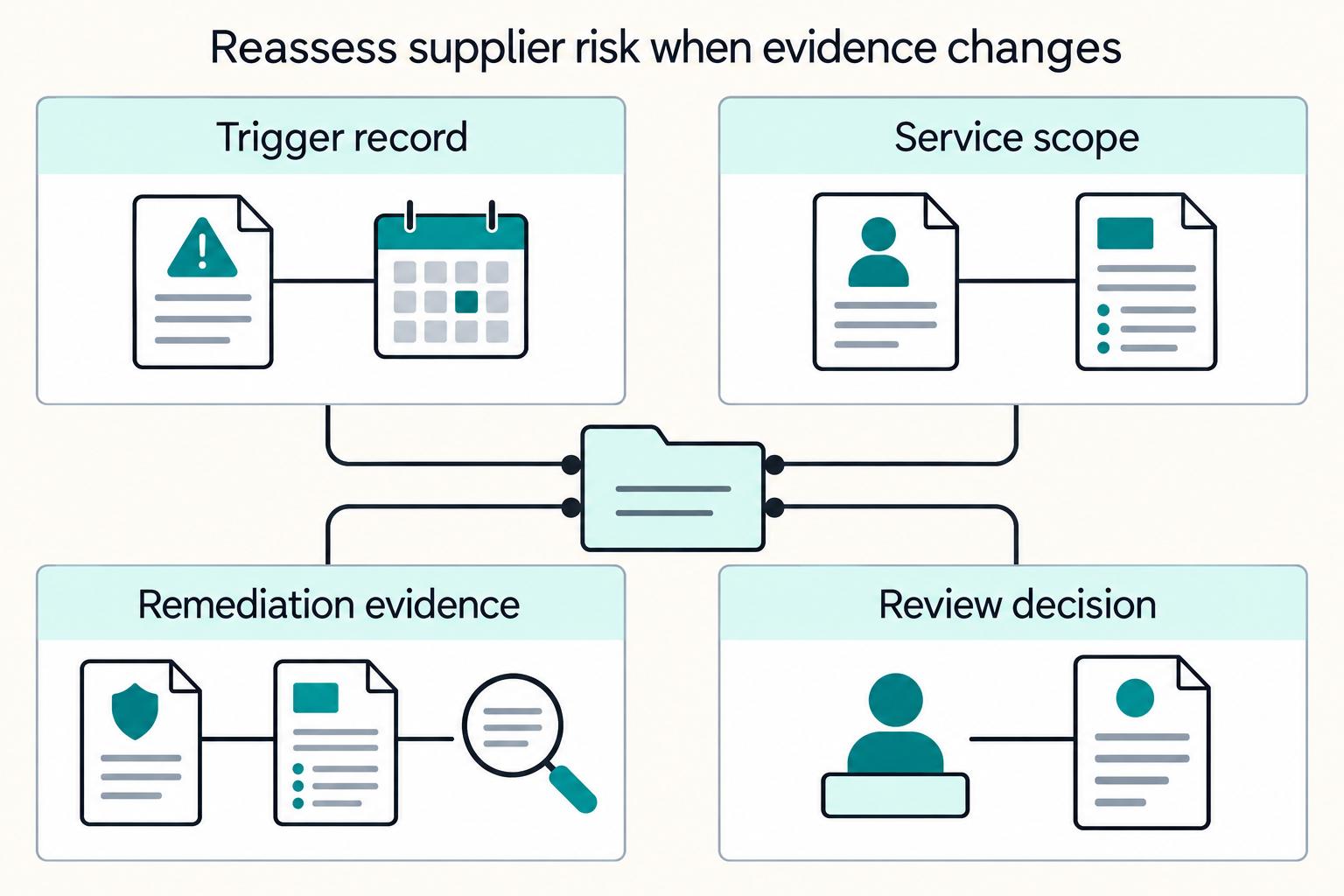
Create a short trigger register by vendor tier, then run it as an operating process. Use triggers that can change exposure between scheduled reviews, such as security incidents, failed control attestations, overdue remediation, material service changes, or adverse nth-party supply-chain signals.
Use annual review as a backstop, not your main detection point. If ownership changes are risk-relevant in your policy, you can include them as an internal trigger, but not as a regulator-mandated one. The expected outcome is simple: each trigger creates a dated reassessment record with an owner, reason, and decision: in bounds, remediation, or escalation.
Assign monitoring channels by function#
Do not rely on one signal type. Split channels by what each function can actually verify:
- External risk telemetry for cyber-exposure signals
- Internal control attestations and remediation evidence for control and contractual compliance
- Contractual performance indicators for higher-risk or critical suppliers
This split prevents false closure. External telemetry can show change, but it does not prove a required control is in place. For DORA-scoped ICT third-party arrangements, define ongoing performance measures and indicators as part of your ICT third-party risk strategy.
Set response thresholds by tier#
Apply written, tier-based response rules. Higher-tier vendors should get more frequent monitoring and more complete oversight than lower-impact vendors. Avoid precision you cannot operate. Define escalation rules for unresolved risk, route material issues through named governance channels, and require an explicit residual-risk decision for exceptions.
If you are an SEC registrant, include a cyber-incident escalation path that supports Form 8-K Item 1.05 timing, which is tied to four business days after materiality determination.
Verify implementation before closing findings#
Close findings only after you verify the control is operating, not when remediation is merely promised. Require dated evidence tied to the specific issue and service, then confirm the outcome reflects actual control performance.
At minimum, confirm the evidence maps to the correct legal entity, service scope, remediation date, and reviewer owner. Keep items open when evidence is stale, mis-scoped, or unresolved, and escalate unresolved risk through governance channels.
Related reading: Device Fingerprinting Fraud Detection Platforms for Payment Risk Teams.
Define escalation paths and decision rights#
Escalation needs to answer three questions immediately: who decides, by when, and against what threshold. Define that before the next incident or missed deadline, with stricter thresholds for vendors tied to critical activities.
Write escalation thresholds in plain language#
Use threshold language first-line reviewers can apply consistently, not broad labels that depend on interpretation. For higher-tier vendors, set escalation thresholds that reflect higher-risk or critical activities, including concentration risk when reliance on a small number of providers could affect critical services.
Concentration risk can show up at portfolio level, not just in one vendor file. If a core service depends too heavily on one provider or sequence, treat that as escalation-worthy even when individual control checks look acceptable.
Test clarity against recent cases. If different reviewers would route the same issue to different owners, the threshold is still too loose.
Assign decision rights to named roles#
Escalation breaks down when many teams are consulted but no one is clearly accountable. Map each decision to a named authority for regulatory interpretation, risk acceptance, and continuity action.
Role patterns vary by governance model, so document your actual structure instead of copying a template. Committee review can support the process, but named decision authority should remain explicit for accepting residual risk, pausing scope, or triggering contingency action. Where applicable, define how board oversight holds senior management accountable for execution.
For SEC registrants, ensure cyber escalation reaches materiality decision-makers without unreasonable delay and can support Form 8-K timing of four business days after materiality determination. For DORA-scoped ICT arrangements, document ICT-supported business functions, roles, and responsibilities in ICT risk governance. DORA applies from 17 January 2025.
Build explicit if-then actions#
Do not stop at "escalate." Define what escalation unlocks, and keep actions tier-based and service-specific so controls stay proportionate.
- If remediation on a higher-tier vendor misses deadline for a control tied to critical services, trigger predefined continuity or risk-reduction actions.
- If a material risk condition persists, require reassessment and a documented decision rather than rolling deadlines by default.
- If concentration risk increases around a critical dependency, trigger continuity planning and executive review.
Require a documented outcome for every escalation#
Document each escalation outcome so the decision trail is auditable: what was decided, who decided it, by when, what residual risk was accepted, and when it will be reviewed again.
Where ICT third-party arrangements are in scope, include enough implementation and monitoring context for a later reviewer to understand what changed and why. If a reviewer cannot reconstruct the reasoning from the record alone, the escalation is not yet defensible.
If you are turning escalation rules into operational workflows, map each decision point to concrete controls in Gruv Docs.
Report what leadership and auditors actually need#
Build reporting so leaders can decide quickly and auditors can trace the decision. A regular reporting pack should show current exposure, what is changing, and the evidence behind each material claim, with more complete or frequent monitoring for higher-risk relationships.
Build a decision-grade reporting pack#
Use a small metric set leadership can act on, such as tier distribution, open high-risk items, overdue remediation, and active escalations. Keep the same cuts each cycle by business owner, vendor category, and criticality so concentration risk stays visible.
Before you present trends, reconcile report totals to your vendor inventory and risk ranking, including related subcontractor dependencies. If counts do not match, fix the source data first.
Add trend signals that show drift early#
A single snapshot can hide repeat failure, so add trend views for recurring control failures, concentration risk by vendor category, and unresolved subcontractor dependency issues that can increase fourth-party exposure.
Separate repeated control failures from new findings, and keep unresolved dependencies open until verified. For DORA-scoped ICT arrangements, make sure reporting can be traced to your Register of Information so contractual ICT relationships remain auditable.
Attach evidence references to every material claim#
Every material statement should map to evidence by record ID or document title, not summary text alone. Typical evidence includes internally prepared risk and incident reports, internal or external audit reports, independent review outputs, and board or committee minutes.
This is often where programs struggle under pressure. Teams can report status, but legal, compliance, or finance may not be able to prove it quickly. If SEC cybersecurity disclosure rules apply, that gap matters even more because Item 1.05 Form 8-K is generally due four business days after materiality determination, and governance disclosures require a clear view of board oversight and information flow.
For more on lifecycle control, see What Is Vendor Management? A Platform Operator's Guide to Supplier Lifecycle Control.
Avoid common mistakes and recover fast#
Common weaknesses include over-investing in low-risk vendors, weak closure evidence, blurred ownership, and stale artifacts. A practical fix is to make oversight risk-based, lifecycle-complete, and explicitly accountable.
Tighten tier criteria#
Do not apply the same deep-review intensity to every vendor. Keep the deepest diligence and most frequent monitoring for higher-risk and critical relationships, and reduce intensity for lower-risk vendors.
If your highest tier is crowded, consider narrowing the criteria before adding more controls. Not all third-party relationships carry the same risk, so they should not get the same treatment.
Require proof beyond ratings#
Use security ratings as triage signals, then back decisions with lifecycle controls. A complete program still has to cover planning, due diligence and selection, contract negotiation, ongoing monitoring, and termination.
For each closed finding, keep a compact evidence chain:
- finding or control ID
- remediation owner
- target completion date
- implementation proof
- documented closure verification
If you cannot show ownership, action, and verification, the item is not defensibly closed.
Assign one accountable risk owner and one escalation authority#
Set a clearly accountable risk owner per vendor and a clear escalation authority. Cross-functional support helps, but accountability has to be explicit.
This aligns with NIST CSF 2.0 GV.RR-02: roles, responsibilities, and authorities for cybersecurity risk management should be established, communicated, understood, and enforced. If teams give different answers on who owns, who closes, and who escalates, fix role mapping first.
Audit artifact validity, not just artifact presence#
A document repository alone is not enough. Outsourcing does not remove your accountability, so evidence needs validity checks, renewal tracking, and periodic quality review.
In payment-card contexts, PCI DSS 12.8.4 sets a minimum cadence: monitor TPSP PCI DSS compliance status at least once every 12 months. More broadly, track what evidence you rely on, when it was reviewed, who approved it, and what remains open. If an artifact is stale, unowned, or unverified, treat it as incomplete and reopen it.
Final takeaway and copy-paste checklist#
Use this checklist before you add more tooling. If these six controls are weak, decisions will be slower and harder to defend across the full third-party lifecycle: planning, due diligence and selection, contract negotiation, ongoing monitoring, and termination.
- Confirm scope before you score anything.
Maintain one vendor register that covers direct suppliers and the subcontractor chains behind critical services. For payout operations, do not stop at your processor, KYC vendor, tax provider, or bank partner if critical service delivery depends on downstream providers. In DORA context, the core control is a register of information covering contractual ICT service arrangements. For each top-tier vendor, you should be able to identify the service owner, contract, and critical downstream dependency.
- Tier vendors by impact, not by spend.
Set top tier based on operational and regulatory impact: vendors that can interrupt payouts, expose sensitive or regulated data, or create significant compliance risk if they fail. Spend can be a supporting signal, but not the main one. If a vendor sits in a critical control path, tier it accordingly even when contract value is modest.
- Define evidence packs by tier and jurisdiction.
Apply broad baseline due diligence across most suppliers, then require deeper evidence for higher-risk relationships. Keep required artifacts explicit so onboarding cannot pass on partial documentation. Security questionnaires, contractual risk clauses, incident notification terms, audit-right language, and similar evidence can all be part of the pack depending on context. Track owner, approval date, renewal date, and acceptance note for each artifact.
- Use trigger-based monitoring, not calendar-only review.
Scheduled reviews alone are not enough for higher-risk relationships. Add triggers for security events, control failures, ownership changes, subcontractor risk signals, and overdue remediation. Close findings only after implementation evidence is verified and contractual compliance is confirmed.
- Publish one decision-grade report on a defined internal cadence.
Pick a cadence that fits your risk profile and operating model. Keep it decision-focused: open high-risk items, overdue actions, active escalations, concentration concerns, named owners, exposed services, and evidence references. If ownership and next action are unclear, the report is not decision-ready.
- Re-test decision rights through periodic independent review.
Use periodic independent review to test whether decision rights still work under pressure. Clarify who decides regulatory sufficiency, exposure tolerance, continuity actions, and risk acceptance before an incident forces that decision. If a top-tier remediation misses its date and escalation authority is unclear, fix the escalation path immediately.
When your checklist is finalized and you need to confirm market-by-market fit, talk with Gruv.
Frequently Asked Questions
What does a supplier risk management platform actually do?
A supplier risk management platform should support the full third-party lifecycle, not just produce a score. In the regulatory framing used here, that lifecycle covers planning, due diligence and selection, contract negotiation, ongoing monitoring, and termination. In practice, the platform is most useful when each vendor record clearly shows ownership, required artifacts, open findings, target dates, and closure verification.
How do we monitor a large vendor base without creating a heavy process?
Start with a risk-based criticality model, then scale monitoring to that risk. The cited guidance is explicit that third-party relationships do not carry the same risk or criticality, so oversight should be commensurate with risk profile, complexity, and the criticality of the supported activity. A practical pattern is baseline due diligence across most suppliers, with deeper monitoring for higher-risk relationships.
What is the difference between security ratings and full vendor risk management?
Security ratings are a signal, not a complete program. Even commercial positioning separates scorecard tracking from broader third-party risk capabilities such as ongoing monitoring, assessments, and risk intelligence. Use ratings to triage attention, but close issues with evidence, ownership, implementation proof, and documented verification.
What should be included in a supplier risk report for leadership each month?
If leadership receives a monthly supplier risk report, keep it decision-focused and traceable, not just summary text. If you are in SEC reporting scope, it should clearly reflect your processes to assess, identify, and manage material cybersecurity risk, including oversight of risk tied to third-party service providers. For each material item, include the owner, affected vendor, business service at risk, target date, and the evidence reference behind the status.
When should a vendor risk issue be escalated immediately?
Escalate immediately when an issue could affect a critical service, involve sensitive or regulated data, or require executive risk-acceptance or continuity decisions. If a high-risk issue misses remediation with no credible containment, escalate without waiting for routine reporting. If you are an SEC registrant, potential material cybersecurity incidents should move to legal, security, and executive review promptly because Item 1.05 filing timing is generally four business days after materiality is determined.
How often should reassessment happen for top-tier versus lower-tier vendors?
Set reassessment cadence by risk and complexity, not by a fixed universal interval. The supervisory framing used here supports ongoing monitoring throughout the relationship, commensurate with risk and complexity. Top-tier vendors can use both scheduled reassessment and trigger-based review, while lower-tier vendors can run lighter cycles but still require periodic refreshes and baseline due diligence.
Try a related tool
Researched and edited by the Gruv editorial team. Gruv builds cross-border billing, payouts, and finance-operations software for global businesses.
Sources
- advocacy.sba.gov/2026/02/18/fincen-issues-exceptive-relief-to...trusted
- cisa.gov/resources-tools/services/continuous-monitori...trusted
- csrc.nist.gov/glossary/term/supply_chain_risk_managementtrusted
- csrc.nist.gov/pubs/sp/1326/ipdtrusted
- eba.europa.eu/publications-and-media/press-releases/eba-am...trusted
- ecfr.gov/current/title-17/chapter-II/part-229/subpart...trusted
- fdic.gov/news/financial-institution-letters/2023/fil2...trusted
- federalregister.gov/documents/2023/06/09/2023-12340/interagency-...trusted
Educational content only. Not legal, tax, or financial advice.
Related Posts

The Freelance Payment Penalty: A Modeled Audit of Platform Fees, FX Spreads, and Payout Delays
The money rarely disappears through a single, easy-to-spot fee. The real loss is stacked. A marketplace takes its commission, a processor adds a charge for international cards, a bank or payment company converts the currency at a spread, a platform holds the funds before release, and a wire sheds a little to intermediaries on the way in. Each layer looks defensible on its own, but the worker feels the combined result as a smaller deposit and a later payday.

How to Respond to a Subpoena for Business Records
Move fast, but do not produce records on instinct. If you need to **respond to a subpoena for business records**, your immediate job is to control deadlines, preserve records, and make any later production defensible.

A US Expat's Guide to Investing in UCITS ETFs to Avoid PFIC Issues
The real problem is a two-system conflict. U.S. tax treatment can punish the wrong fund choice, while local product-access constraints can block the funds you want to buy in the first place. For **us expat ucits etfs**, the practical question is not "Which product is best?" It is "What can I access, report, and keep doing every year without guessing?" Use this four-part filter before any trade: