
Quick Answer
Treat it as an operating decision system, not a purchasing task. For platform operators, procurement covers Source-to-Pay ownership, strategic sourcing handles vendor selection on total cost and risk, and vendor management governs live performance after signature. A workable baseline is to set owners and success metrics first, then require an approval record, integration acceptance, and a reconciliation pack before launch. That structure keeps API choices, payout operations, and contract terms aligned when issues appear.
Why Procurement Matters for Platform Operators#
For a platform operator, procurement is a control point for selecting, contracting, and overseeing third parties that affect money movement, compliance exposure, and customer trust. That matters even more when your product depends on Virtual Account Management, payouts, or a merchant of record model, because outside providers can sit close to customer payments, cash visibility, and legal responsibility for processing funds.
Too often, procurement gets reduced to "buying software" or "getting a contract signed." In practice, it is broader. Procurement management is the strategic function for sourcing and purchasing the goods and services a business needs. In an end-to-end setup, it runs across source-to-pay, from identifying need, to finding and contracting suppliers, to final payment. For a platform team, vendor choice is only one checkpoint. The control problem starts before selection and continues after signature.
This guide separates three jobs that often get blurred together. Procurement is the overall commercial and control function. Strategic sourcing is the structured selection phase, where you gather information, compare suppliers, and choose based on total cost, risk, and business priorities rather than the lowest headline price. Vendor management is the post-signature work: checking whether the supplier is performing, handling issues, and deciding whether the relationship should continue.
That split matters because these jobs are not interchangeable. Virtual Account Management is used to improve cash visibility and reduce reliance on physical accounts. A payout is a transfer of funds from a merchant account into a business bank account. A merchant of record is the entity legally authorized and responsible for processing customer payments. If you treat all three as the same vendor-buying exercise, you can miss different approval needs, integration risks, and accountability questions.
A common failure mode is familiar: product pushes for a faster launch, engineering likes an API, finance focuses on price, and no one owns the full decision. The result is often not one big mistake. It is a stack of smaller gaps: unclear approval history, weak contract coverage, and no clean record of why a provider that touches payments or cash structure was accepted in the first place. When something breaks, the team can be left arguing about ownership instead of fixing the issue.
The practical move is to set decision checkpoints before you evaluate vendors. Verify which third parties will touch payment processing, virtual account structure, or payout flows. Name the owner for the commercial decision, the technical signoff, and the post-launch relationship. Keep a simple evidence pack from day one: documented approval, signed terms, and a clear note on how the provider fits your operating model. That discipline lets finance, ops, product, and engineering move faster without creating audit gaps.
If you are also tightening contractor controls, What Is Spend Management? A Platform Operator's Guide to Controlling Contractor Costs is a useful companion.
Define the three jobs before you buy anything#
Treat procurement, strategic sourcing, and vendor management as three separate owned jobs before any demo, RFP, or pricing call.
| Job | When | What it covers |
|---|---|---|
| Procurement | Across Source-to-Pay and the broader supplier lifecycle | Need identification through supplier payment; decisions are documented, approved, and aligned to how your platform operates |
| Strategic sourcing | Selection phase inside procurement | Finding and evaluating suppliers, then choosing based on overall value and total cost of ownership, not headline price alone |
| Vendor management | After signature | Onboarding, contract administration, performance and risk review, and renewal or offboarding; the SLA is a core control point |
Procurement is the end-to-end commercial and control function across Source-to-Pay and the broader supplier lifecycle. It covers need identification through supplier payment, and it ensures decisions are documented, approved, and aligned to how your platform operates.
Strategic sourcing is the selection phase inside procurement. It covers finding and evaluating suppliers, then choosing based on overall value and total cost of ownership, not headline price alone.
Vendor management starts after signature. It covers onboarding, contract administration, performance and risk review, and renewal or offboarding. The Service-level agreement (SLA) is a core control point because it defines what the provider will deliver and the standards they are obligated to meet.
Before selection, use one checkpoint:
- Owner: who is accountable for each job
- Scope: what stage or decision each job covers
- Success metric: how you will measure execution quality
If you cannot name all three for each job, pause before you start selection. That is where approval gaps and ownership disputes usually start.
For a step-by-step walkthrough, see The Freelancer's Bill of Rights: What You Should Demand from Your Platform.
Map procurement to your platform money lifecycle#
Procurement should follow your money lifecycle, not just your spend line. Anchor scope to collection, conversion, and Payouts. Then map every place a vendor touches your API, Webhooks, and Ledger so approval, integration, and operations follow the same event path.
Before you compare vendors, build a touchpoint map for each provider: what they initiate, what they receive, and what they change. For payout flows, that usually means an API action to create a payout, webhook event delivery to your endpoint, and references your ledger or internal books must reconcile later. Use that map as a gate: if product, engineering, and finance cannot validate the same flow, you are not ready to approve.
| Supplier lifecycle stage | What you confirm | Evidence output |
|---|---|---|
| Requirements | In-scope money surface (collection, conversion, or Payouts), relevant API/webhook events, required ledger entries | Approval record |
| Selection and onboarding | Operational fit, due diligence, and market/program compliance gates (KYC, KYB, AML, VAT validation) | Approval record with gate decisions |
| Integration and launch | API behavior, webhook handling, reconciliation path to the Ledger, exception ownership | Integration acceptance |
| Live operations and renewal | Performance, unresolved exceptions, reconciliation quality, and control fit for active markets | Reconciliation pack and exception log |
Use Supplier lifecycle checkpoints from onboarding through renewal or termination, not one-time procurement events. Failures often show up after selection, during live event handling, reconciliation, or market expansion, so a process that ends at signature leaves vendor management blind.
Apply compliance gates the same way. Do not assume one global order for KYC, KYB, AML, and VAT validation; AML/CFT implementation is risk-based and varies by jurisdiction. For EU cross-border VAT, VIES can be an early gate, and for UK entities note that VIES no longer validates UK (GB) VAT numbers through the former route as of 01/01/2021. Confirm market-specific and program-specific dependencies before contract execution, not during integration.
Treat evidence outputs as operating controls, not paperwork. The approval record should show accepted scope and risk, integration acceptance should prove expected events are handled, the reconciliation pack should tie provider references to your Ledger, and the exception log should track open breaks with owners and aging.
If you are deciding whether to keep sourcing in house or outsource parts of it, What Is Procurement as a Service? How Platforms Can Outsource Vendor Sourcing and Contracting goes deeper.
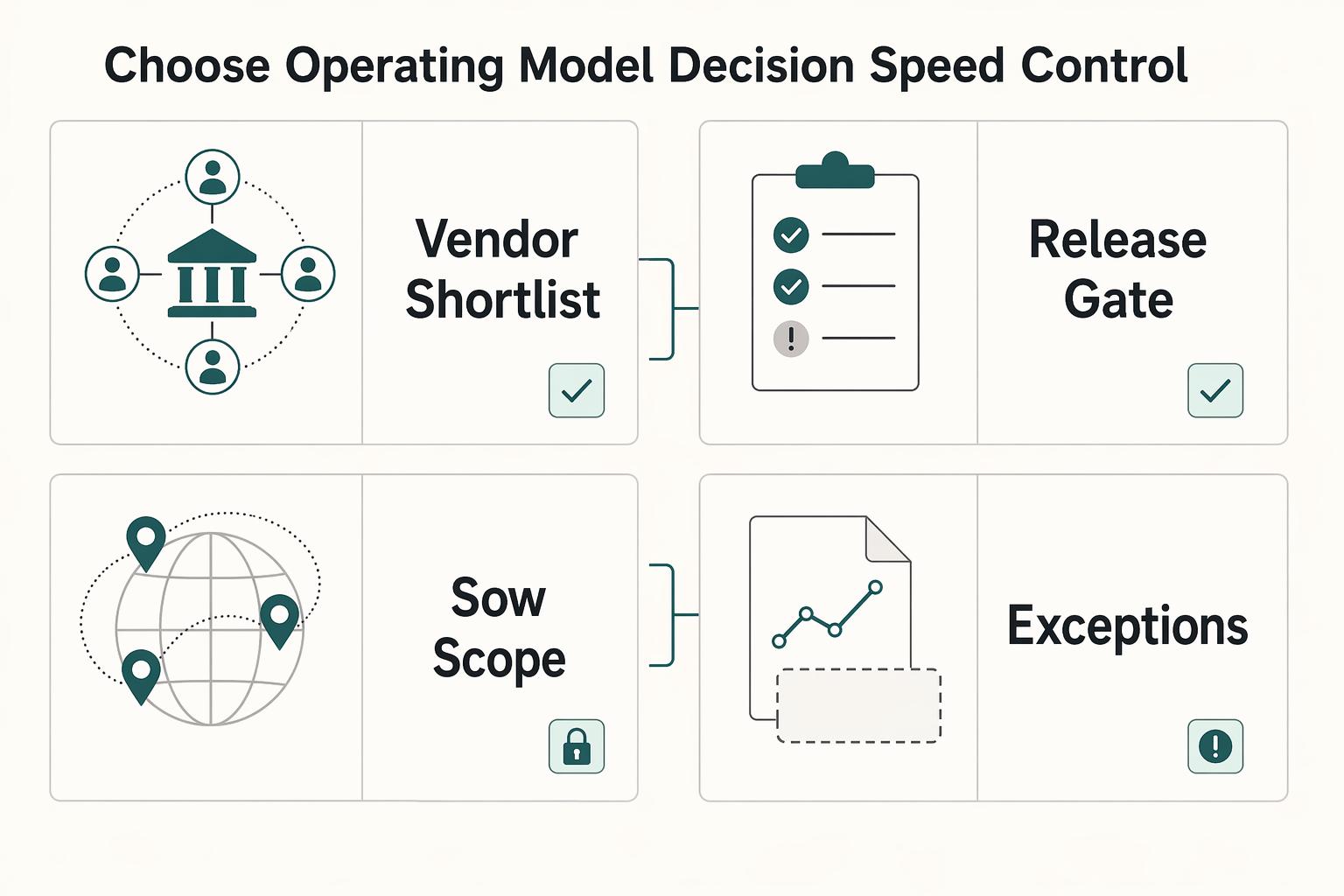
Choose your operating model for decision speed and control#
Use a hybrid model: centralize decisions where failure creates shared exposure, and allow team-level autonomy only for narrow, low-risk tools that are easy to unwind.
Centralized procurement gives you standardization and control. Federated ownership gives product and engineering speed and local context. Choose based on triggers, not the org chart: centralize when spend is concentrated in common categories, when a vendor touches cross-border Payouts, or when integration changes API, Webhooks, Ledger, tax handling, or AML/CFT obligations across markets.
Cross-border programs need tighter central gates. FATF's risk-based framing means AML/CFT implementation differs by jurisdiction, so similar payout flows can still require different controls by country. If a flow depends on W-8 reliance, treat that as an operating requirement for the party acting as broker or withholding agent, not just a finance detail. In these cases, centralize strategic sourcing criteria, contract review, and control design even when product owns the business case.
Before shortlisting vendors, publish a RACI chart and confirm signature authority. Name who is Responsible, Accountable, Consulted, and Informed for selection, signing, scope changes, and incidents. Do not assume operational sponsors can sign contracts unless authority is formally delegated.
| Decision type | Central owner | Team input | Why this split works |
|---|---|---|---|
| Vendor shortlist | Procurement or finance-led strategic sourcing | Product and engineering define requirements and integration constraints | Maintains consistent cost-control and governance standards |
| Contract sign-off | Authorized signer in finance, legal, or delegated executive authority | Product, engineering, and ops confirm scope and acceptability | Signature authority must be formal, not assumed |
| SOW scope changes | Central commercial owner with finance review | Product and engineering propose change and effort impact | Prevents scope creep from expanding compliance or support obligations |
| Incident escalation | Vendor management or operations lead with a named escalation path | Engineering and product handle technical triage and customer impact | Formal escalation procedures reduce delay during live incidents |
A federated model without hard boundaries is the failure mode. If you want speed without losing control, centralize policy, sign-off, and incident gates for shared-risk vendors, then give teams limited autonomy inside those guardrails.
If you also need invoicing support, try the free invoice generator.
Build a vendor scorecard that survives executive scrutiny#
Use a scorecard built for best value, not lowest price. For payout and money-movement vendors, lower fees can still raise total cost once you include implementation drag, reconciliation effort, compliance gaps, and tax-document handling.
Use weighted criteria across reliability, implementation effort, compliance readiness, market coverage, and Total cost of ownership, but put pass/fail control gates before scoring. If a vendor fails your control minimums, disqualify before contract negotiation.
Gate first, then score#
Treat controls and reconciliation as non-negotiable entry criteria. Disqualify early if you cannot verify payout-safe request handling, recoverable event delivery, or a clean path from provider activity to your Ledger records.
For technical fit, do not stop at "has an API" or "supports webhooks." Check whether the API covers required payout and reversal actions, whether Webhooks include usable event detail and retry behavior, and whether Idempotency is supported so retries do not perform the same action twice. In payout operations, that is the difference between a recoverable timeout and a duplicate movement incident.
Before final scoring, ask for three artifacts: API docs for payout and reversal actions, a webhook event catalog with retry/replay behavior, and a sandbox test showing duplicate client retries. A common failure mode is a vendor that demos well but shifts deduplication and reconciliation burden to your team after integration starts.
| Area | Pass or fail gate | Weighted scoring focus | Evidence to request |
|---|---|---|---|
| Reliability and reconciliation | Can activity be matched cleanly to your Ledger, with clear identifiers and exception handling? | Incident recovery, data clarity, support burden | Sample reconciliation output, event payloads, exception flow |
| Technical fit | Does the API cover required actions, with usable Webhooks and idempotent request support? | Integration effort, retry safety, operational resilience | API docs, webhook catalog, sandbox demo of retries and replay |
| Compliance readiness | Can the vendor support your risk-based KYC, KYB, and AML policy gates? | Depth of verification and ongoing due diligence support | Policy documentation, onboarding fields, review checkpoints |
| Tax-document support | Can the process handle W-8, W-9, and Form 1099 reporting needs where enabled? | Tax ops effort, withholding risk, reporting completeness | Tax form flow, collection ownership, export or report samples |
| Commercial and coverage fit | Does pricing work across the markets and use cases you actually need? | Total cost of ownership, market expansion friction | Pricing schedule, country coverage list, implementation assumptions |
Score the work you will actually do#
Total cost of ownership should include vendor fees plus your internal engineering effort, manual ops, exception handling, reconciliation cleanup, support escalation load, and market-by-market workaround costs where coverage is partial. Price importance should vary with risk, and in higher-risk selections, technical and performance factors can outweigh price.
Give compliance readiness its own weight. Assess support for risk-based identity verification and ongoing due diligence, not only document collection at signup. For US tax handling, confirm who collects Form W-9, who supports Form W-8 BEN when requested by the withholding agent or payer, and whether Form 1099-NEC workflows are supported where applicable, including the $600 or more nonemployee compensation context.
Keep the decision rule simple: weighted score only matters after control gates are passed. If commercial terms look strong but reconciliation, idempotent retry handling, or required document support fails, disqualify before legal review. Missing controls marked as "phase two" usually become permanent manual workarounds.
Contract and onboarding details that prevent expensive rework#
After a vendor passes scorecard gates, turn those decisions into enforceable terms immediately. If a requirement affected selection, it should appear in the SLA or SOW as a measurable obligation, with clear evidence and an escalation path when performance misses.
Put measurable obligations into the contract#
An SLA is useful only when it defines how performance is measured. Write obligations against events and outputs you can verify, not broad promises about reliability or support. If webhook delivery, reconciliation output, or incident response mattered in selection, define those checks and response expectations in the signed contract.
Use the SOW to lock in implementation outcomes and acceptance criteria. If the vendor commits to event-driven updates, the SOW should name webhook endpoint setup inputs, enabled event scope, reconciliation format, and the handoff needed for your Ledger mapping. Do not leave these commitments in slides or email threads.
Get onboarding artifacts before kickoff#
Make kickoff conditional on a minimum artifact pack:
| Artifact | Required details | Availability |
|---|---|---|
| Integration plan | Milestones, dependencies, sandbox access, and owners | Before build starts |
| Webhook event catalog | Destination URL and enabled event list | Before build starts |
| Reconciliation format | Identifiers needed to match provider activity to your Ledger | Before build starts |
| Incident response contacts | One primary contact and at least one backup | Before build starts |
If these artifacts are not available before build starts, pause and resolve ownership first.
Make go-live conditional on acceptance tests#
Define acceptance tests before implementation begins. In test, simulate transactions, confirm activity can be posted and matched in the Ledger, and verify Idempotency behavior for retry scenarios.
Test event replay and missed-event recovery directly. Confirm duplicate deliveries do not create duplicate effects, and that your endpoint returns success when appropriate to stop retry loops. If sandbox retry behavior is documented, use it in planning; one documented pattern is retries three times over a few hours. If missed events cannot be queried and reconciled over a defined period, the integration is not launch-ready.
Run vendor management as an operating cadence#
Run vendor management as a standing monthly and quarterly operating rhythm, not a renewal-time exercise. Use your onboarding acceptance tests as the live baseline, and review evidence on controls, incidents, and change requests alongside spend.
A practical cadence is:
- Monthly: verify SLA performance as written, including measurable outcomes, breaches, response times, and active remedies.
- Quarterly: review incident themes, scope or roadmap changes, and whether the vendor still fits current operating needs.
Your review pack should include:
- SLA adherence, open incidents, repeated breach categories, and status of committed fixes.
- Live-control health: failed Webhooks, unresolved payout exceptions, and reconciliation breaks between provider references and Ledger records.
- Requested changes to API behavior, onboarding scope, support coverage, or commercial terms.
Watch the controls that fail quietly#
Track reconciliation and exception aging directly, because spend reports rarely show these failures early. Ask for evidence that provider references still match ledger postings cleanly and that payout exceptions have clear owners and resolution paths.
Give webhook delivery its own line item. One documented pattern retries undelivered events for up to three days, so a provider can appear operational while your endpoint backlog grows. Review failed-delivery counts, oldest undelivered-event age, replay status, and incidents where duplicate or missed events affected downstream posting.
Bring compliance and tax ops into the same review#
Where the vendor supports KYC, KYB, or AML, review exception trends, aged cases, and customer-information refresh activity, not only throughput. Risk-based AML programs rely on ongoing suspicious-transaction monitoring and risk-based customer-information updates.
For EU tax handling, track VIES VAT validation outcomes as an operational signal. VIES is a search engine backed by national VAT databases, and a failed result means the VAT number is not registered in the relevant national database. Keep case records simple: outcome, date, country, and owner.
If your platform supports cross-border tax workflows, define support boundaries clearly. FBAR can apply to qualifying U.S. persons with foreign-account interest or authority when aggregate balances exceed $10,000 during the year, with filing due April 15 and an automatic extension to October 15. FEIE is calculated on Form 2555. Keep vendor support aligned to contracted scope, especially if coverage is limited to data exports or account statements.
If recurring control failures exceed agreed tolerance in your SLA or governance notes, trigger corrective action immediately. If the same control continues failing into the next quarterly review, move renewal reconsideration into the decision path. Related: What Is Vendor Management? A Platform Operator's Guide to Supplier Lifecycle Control.
Execute the first 90 days with concrete checkpoints#
Treat the first 90 days as three decision gates: lock scope and ownership first, prove integration and service terms second, then launch with monitoring and reconciliation evidence.
| Period | Focus | Key checkpoints |
|---|---|---|
| Days 1 to 30 | Finalize scope and ownership in writing | Keep the SOW clear and complete; freeze the scorecard criteria; publish a one-page control map |
| Days 31 to 60 | Complete contract terms and prove the integration path | SLA should define measurable commitments; SOW should point to API scope, webhook event catalog, reconciliation format, incident contacts, and test responsibilities; run controlled end-to-end testing |
| Days 61 to 90 | Launch only with thresholds you can monitor and act on immediately | Track webhook delivery status (Delivered, Pending, Failed); plan for live retry windows that can run for up to 3 days; validate reconciliation to the Ledger and bank-settlement evidence |
Days 1 to 30#
Finalize scope and ownership in writing. Keep the SOW clear and complete on required work and end objectives, especially where the vendor touches Payouts, tax-document support, and compliance gating. Freeze the scorecard criteria used in selection so implementation does not dilute them.
Publish a one-page control map that names who owns payout exceptions, tax-doc handling, and compliance dependencies, plus the evidence each owner must provide before go-live. If external dependencies are still unclear, treat the launch date as provisional.
Days 31 to 60#
Complete contract terms and prove the integration path. The SLA should define measurable commitments, and the SOW should point to concrete implementation artifacts: API scope, webhook event catalog, reconciliation format, incident contacts, and test responsibilities.
Run controlled end-to-end testing across system integration, performance, and user acceptance. For Webhooks, test endpoint handling locally with Stripe CLI and verify failure and delay behavior, not just happy-path delivery.
Days 61 to 90#
Launch only with thresholds you can monitor and act on immediately. Track webhook delivery status (Delivered, Pending, Failed) and plan for live retry windows that can run for up to 3 days.
Validate reconciliation to the Ledger and bank-settlement evidence before declaring steady state. Use a payout reconciliation report to match bank payouts to underlying transaction batches, then publish a short go-live checklist, written rollback criteria, and named post-launch owners across finance, engineering, and ops. Record the first governance decisions while implementation context is still fresh. For related reading, see A Guide to Dunning Management for Failed Payments.
The decision that matters most#
The most important decision is your system, not your shortlist winner: run procurement, strategic sourcing, and vendor management as one connected model with named owners and explicit checkpoints. When those functions stay separate, selection can look clean while execution turns fragmented after go-live.
Treat the vendor lifecycle as one connected chain#
Run each vendor relationship across the full lifecycle: planning, due diligence, contract negotiation, ongoing monitoring, and termination. Most control gaps appear after selection, when scope shifts, service levels slip, or exit becomes urgent.
Connect scorecards, contract terms, and post-launch reviews. If a control matters at selection, it should appear again in your operating documents and recurring reviews. A practical check: for each material vendor, can you name the owner, evidence file, and next review date?
Match oversight to risk, not habit#
Use risk-tiered governance. Not every vendor has the same criticality, so vendors tied to money movement, onboarding controls, or shared compliance logic should face tighter approval and monitoring than low-impact tools.
Choose your operating model as a tradeoff, not a doctrine. Centralized models improve standardization and control; federated models improve agility and local context. For most platform teams, the practical path is to centralize policy, approval, and evidence requirements for high-risk vendors, then allow narrower team autonomy where blast radius is genuinely small.
A common failure mode is fast local selection followed by delayed central accountability. The result is inconsistent terms, escalation paths, and review cadence.
Lock this before you expand scope#
Before you add countries, payout rails, or new product dependencies, lock first-quarter governance basics:
- Choose ownership for shortlist decisions, contract sign-off, and post-launch monitoring.
- Use one scorecard that feeds contract terms and ongoing review criteria.
- Set first-quarter checkpoints for live vendors, including due diligence evidence, named escalation contacts, and a planned review of whether ownership structure still matches objectives.
Governance only holds when responsibility and authority are reviewed periodically, especially after scope or vendor criticality changes.
Frequently Asked Questions
What is the difference between procurement, strategic sourcing, and vendor management for a platform operator?
Procurement is the full acquisition scope across external goods and services, from approval through contract and payment. Strategic sourcing is the analytical part: a structured look at spending patterns, alternatives, and overall value so you choose on more than headline price. Vendor management continues through contract negotiation, ongoing monitoring, and termination after third-party selection.
Is lowest price ever a good enough selection rule in cross-border payments infrastructure?
Sometimes, but only when the requirement is clearly defined and the risk of failed performance is low. Cross-border payout infrastructure can miss that test when API behavior, reconciliation, compliance gating, and operational support matter as much as unit cost. If a cheaper vendor creates payout exceptions or manual finance work, your real cost goes up fast.
What should be in a vendor scorecard for API-driven payout operations?
At minimum, score reliability, implementation effort, compliance readiness, and total cost of ownership. For technical controls, include API coverage, webhook resilience, duplicate-event handling, reconciliation output, and idempotency, because the same idempotency key should return the same result on retries, including error responses. A good checkpoint is to ask for sample payloads, retry behavior, and a reconciliation file before contract signature, not after.
When should we centralize procurement decisions versus let product teams choose vendors?
Centralize when the vendor touches money movement, cross-border payouts, tax-document collection, or shared compliance controls. Let product teams choose only when the tool is narrow, low risk, and does not create a new operational dependency for finance or ops. A practical rule is simple: if the vendor can affect payouts, ledger matching, or customer onboarding controls, central sign-off should usually be required.
Which controls must be verified before signing for payout and money-movement vendors?
Verify the controls you will actually operate: SLA commitments, escalation contacts, reconciliation format, API and webhook behavior, and evidence that duplicate events will not create duplicate payout actions. Where applicable, confirm support for tax-document collection such as Form W-9 for TIN reporting workflows and Form W-8BEN for foreign-status cases. Do not sign based on a sales deck alone. Ask for the SOW artifacts, sample event catalog, and named owners for exceptions.
How do we confirm requirements that vary by country or program without overpromising internally?
Treat country and program requirements as a live evidence matrix, not a single policy statement. FATF makes clear that countries have diverse legal and operational frameworks, so your answer should be market-specific: supported, unsupported, or pending confirmation. For EU VAT checks, remember that VIES is a search engine, not a database, and do not promise universal validation behavior without testing the exact use case.
Try a related tool
Researched and edited by the Gruv editorial team. Gruv builds cross-border billing, payouts, and finance-operations software for global businesses.
Sources
- acquisition.gov/far/15.101trusted
- acquisition.gov/far/2.101trusted
- bsaaml.ffiec.gov/manual/AssessingComplianceWithBSARegulatoryR...trusted
- bsaaml.ffiec.gov/manual/AssessingComplianceWithBSARegulatoryR...trusted
- cisa.gov/news-events/alerts/2025/09/23/cisa-releases-...trusted
- csrc.nist.gov/pubs/sp/1326/ipdtrusted
- govinfo.gov/content/pkg/GOVPUB-C13-PURL-gpo19570/pdf/GOV...trusted
- gsa.gov/buy-through-us/purchasing-programs/federal-s...trusted
Educational content only. Not legal, tax, or financial advice.
Related Posts
What Is Procurement as a Service? How Platforms Can Outsource Vendor Sourcing and Contracting
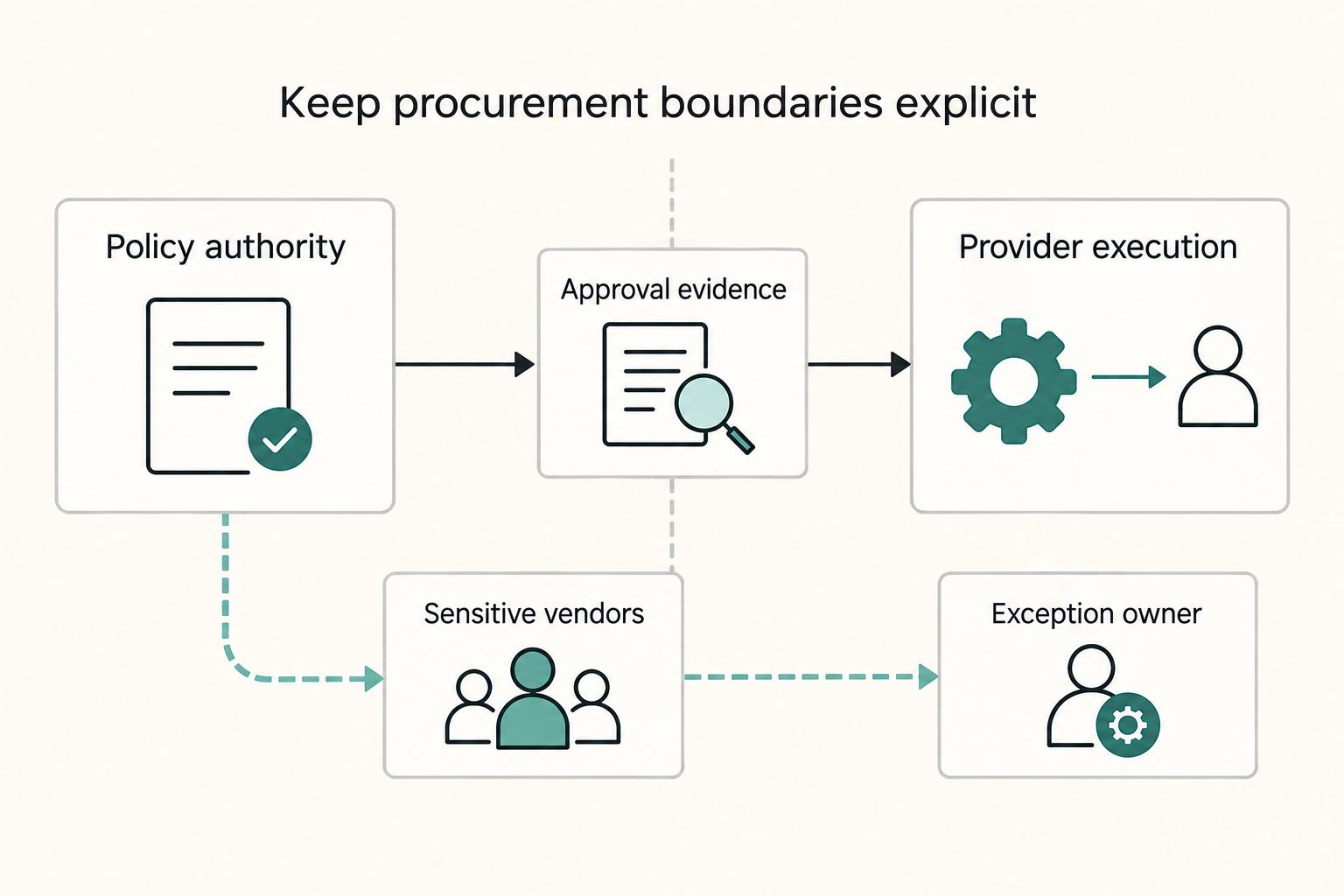
If you are evaluating procurement as a service for vendor sourcing, start by drawing control boundaries before you outsource anything. Hosted services can scale quickly, but faster access to vendors or contracts does not automatically mean better procurement. The harder question is still who owns approvals, evidence, and exceptions.
What Is Vendor Management? A Platform Operator's Guide to Supplier Lifecycle Control
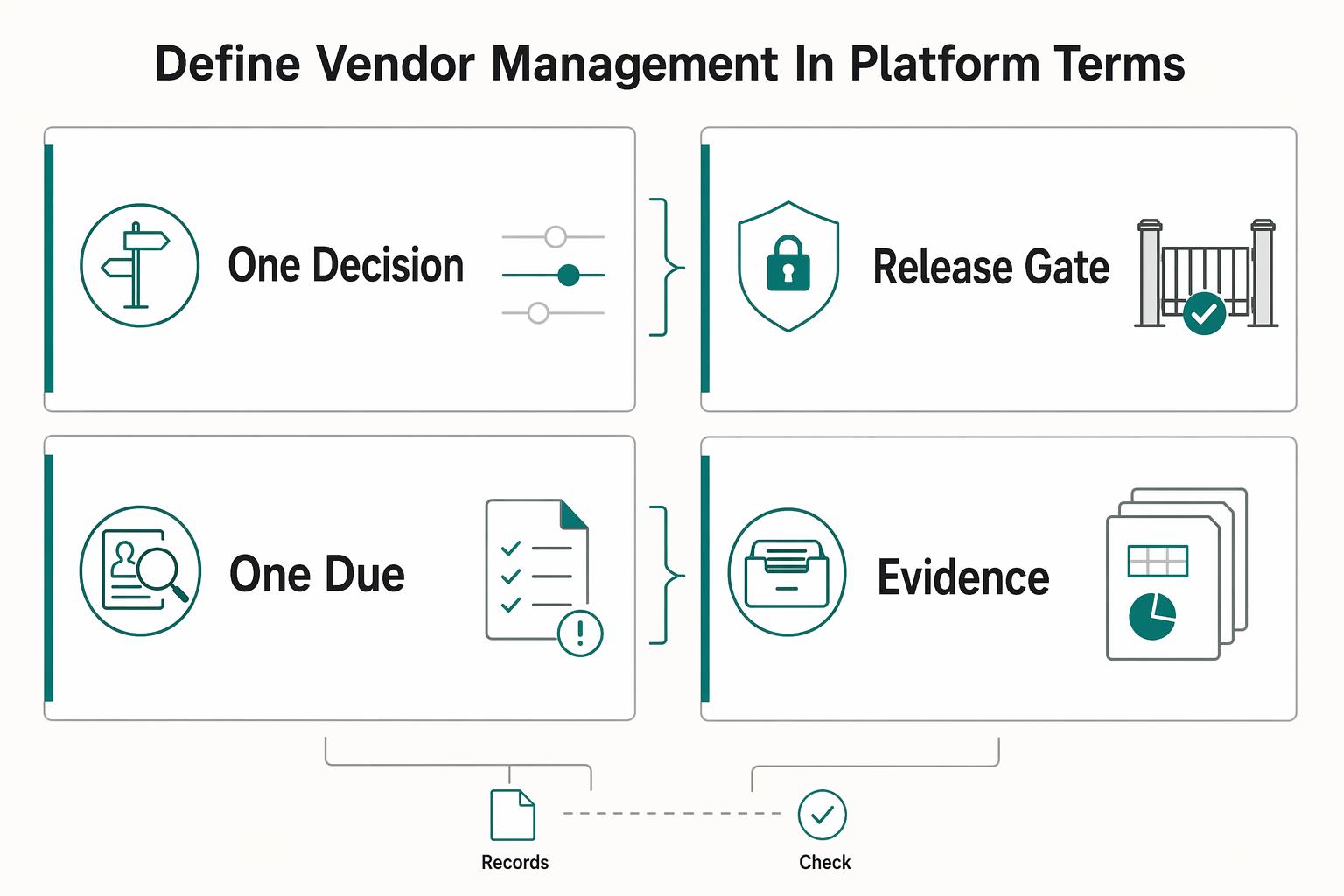
Vendor management in a platform business is not back-office admin. It is a core control point in the business. It determines which third parties can influence core operations, service quality, and customer experience, and under what conditions they can do it.
Contractor Spend Management: Total Cost and Payout Controls
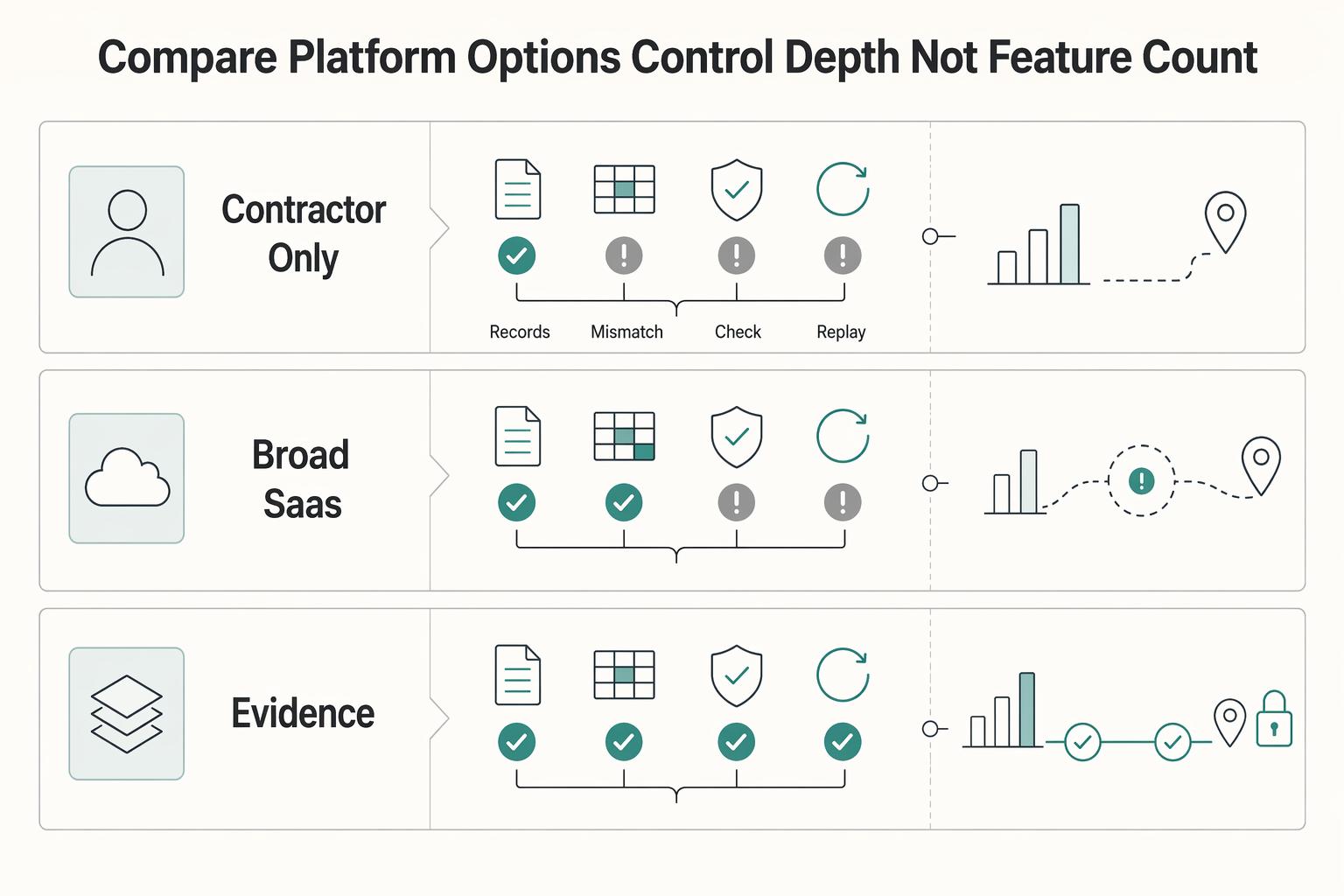
For platform operators, contractor spend is not a simple software seat decision. The real cost shows up in money movement, verification gates, failed or delayed payouts, and the finance time required to reconcile what actually happened against what should have happened. That mismatch often starts with the accounting boundary between [accrued expenses and accounts payable for contractor liabilities](/blog/accrued-expenses-vs-accounts-payable-contractor-liabilities-platform).