
Quick Answer
Ask for clear agreed terms, transparent fees, reliable evidence access and a usable dispute process. Verify the actual protection conditions for your contract type, distinguish authorization from funding and receipt, and assess classification and benefits under applicable law. Save authentic records outside the platform when needed; a missing export does not erase your rights.
The Freelancer's Bill of Rights starts with the platform you choose#
Platform records help you prove what happened, but legal rights do not depend on a setting or export button. This bill of rights is a platform-selection checklist, not a single statute. Compare the platform’s contractual promises with applicable law, then test whether you can retain the evidence needed for a complaint or claim.
Ask for written terms, clear scope, due dates, transparent fees and usable payment records. Identify who owes you money: the client, platform or another party. A platform’s user agreement and any applicable escrow instructions may govern different parts of the relationship; save the versions you accepted.
At a minimum, your Independent Contractor Agreement should spell out deliverables, how much you are paid, and when payment is due. That document anchors the Scope of Work and timing. Classification is separate; do not rely on labels alone.
What to verify before you start#
- Contract artifact: attach or generate an Independent Contractor Agreement and confirm it renders scope, amounts, and due dates in invoices or records.
- Payment mechanics: set payment terms and see them on the invoice; check for clear payment instructions where available.
- Logs and versions: edit a milestone or due date and confirm a versioned audit entry appears with who changed what and when.
- Exports: download a single PDF or CSV timeline that lists delivery timestamps, approvals, and payment authorization events.
Good exports reduce the work of proving a dispute. A missing export does not erase an agreement or a statutory protection: save the signed terms, original messages, invoices and bank records separately. Compare tools on evidence access and the actual dispute process, not on an assumed promise of recovery. See Freelance Platform Dispute Resolution.
Turn rights into configurable features you can export#
Map each practical protection to evidence: agreed scope and price, payment timing, delivery, acceptance and receipts. A combined export is convenient; a well-indexed folder of authentic records can serve the same purpose. Product fields should reflect the agreement rather than silently replace it.
Agree payment timing and any lawful late-fee terms before work starts. Putting a new fee on an invoice does not automatically make it enforceable. Retain accepted terms and later agreed changes, along with the platform’s terms-of-service acceptance record.
By default, your milestone schedule should create timestamps and appear on invoices and exports. Edits should version and log who changed what and when. Your export should carry the same fields you rely on to get paid. If the exporter lets you choose columns, include due dates, line items, payment terms, approvals, and payment authorization so the bundle stands on its own.
Verification checklist#
- Payment terms (and any late-fee language) render on the invoice and in the export.
- Due dates show in the export, not only on a dashboard or in chat.
- Platform fees are itemized; compare your export to any published fee summary the platform provides.
- Editing a milestone creates a versioned audit entry with editor and timestamp.
- A single PDF or CSV lists deliveries, approvals, and payment authorization events.
If exports omit due dates, fees or version history, retain those records outside the tool and assess whether that extra work is acceptable. Test the export before a live project. Missing software fields are an evidence problem, not proof that timely payment cannot be enforced.
Reduce nonpayment exposure before work starts#
Clear terms, deposits, funded milestones where available, reminders and an accessible dispute process can reduce nonpayment risk. None eliminates insolvency, a contested delivery or a payment reversal. Choose a billing arrangement that fits the work and the platform’s actual protection conditions.
Protection rules can differ even within one platform. Upwork’s hourly protection requires an eligible hourly contract, qualifying Desktop App time tracking with relevant activity and memos, hours within the weekly limit, verified identity and billing method, and an account in good standing. Manually entered time is excluded. Read the actual conditions before relying on a general payment-protection badge.
Anchor expectations in documents you can export. Put your Payment terms clause on the invoice itself, not just in messages. If you include a Late fee clause, display it next to the due date so accounts payable sees it while the invoice is open. Keep language consistent with your Independent Contractor Agreement and avoid promises your platform cannot reflect in exports.
When payment slips, evidence closes gaps. Build a Milestone schedule that timestamps submissions and approvals, and ensure those events appear in the export you'd attach to a claim. Common delays stem from a lost invoice or accounts payable bottlenecks. A single export listing due date, delivery timestamps, approvals, and payment authorization gives you a clean thread to escalate without re-explaining context.
Agree any payment-before-final-handoff condition upfront and follow contractual and platform rules before withholding delivery. A client approval, internal payment authorization or pro forma invoice is not cleared money. If your arrangement requires a deposit or funded milestone, verify the actual funding state; for net terms, handoff may precede payment by agreement.
Practical mechanics#
- Set a dated invoice due field and enable reminders near the due date.
- Make sure the Payment terms clause and any Late fee clause render on the invoice PDF and in the CSV export.
- Confirm your Milestone schedule writes timestamps and that edits create versioned entries showing who changed what and when.
- Store a copy of your contract alongside each invoice export so the agreement and the ledger travel together.
For example, a 2000-dollar project has a 500-dollar received deposit and a 1500-dollar balance due after acceptance. A client’s approval to pay the balance leaves 1500 outstanding until an actual receipt is confirmed. If the platform deducts a disclosed 40-dollar fee and credits 1460, reconcile gross payment, fee and bank credit separately; do not show 40 as unpaid client debt. These are hypothetical amounts, not a platform fee schedule.
Before each handoff, check the evidence and the agreed payment condition. If a required deposit has not arrived, raise it through the agreed process. If payment is not due until after delivery, a new authorization gate can conflict with the contract. Document any mutually agreed change rather than silently imposing one.
Classification transparency with jurisdiction tags#
Classification context can be recorded, but a jurisdiction tag and acknowledgement do not determine status or waive employee rights. Record where work is done, the relevant legal regimes and actual control, investment and business practices for a qualified review.
Different laws can apply different tests to the same relationship: federal wage law, state employment rules and tax rules are separate. California’s ABC test has statutory exceptions; a common-law label is not a universal alternative. Record the applicable analysis and its date rather than asking a freelancer to choose a convenient tag.
Keep neutral records of schedules, supervision, tools, training and changes in the work. They support a classification review; they do not cure misclassification. If the facts indicate employment under an applicable law, address classification and the resulting obligations rather than editing labels.
Tagging and logs checklist#
- Record work location, relevant laws and the date and owner of a classification review.
- Keep actual scheduling, supervision, investment and business-practice evidence.
- Version material changes without overwriting the previous record.
- Seek the appropriate agency or professional review when facts or status change.
- Use an employment-rights agency route appropriate to the issue; an EEOC link does not resolve wage classification.
Missing context or overwritten records should prompt a review of the facts and evidence. A clean export is not classification approval. Check the actual working arrangement and seek an appropriate legal or agency assessment when status is disputed.
Evidence and audit trails that win disputes#
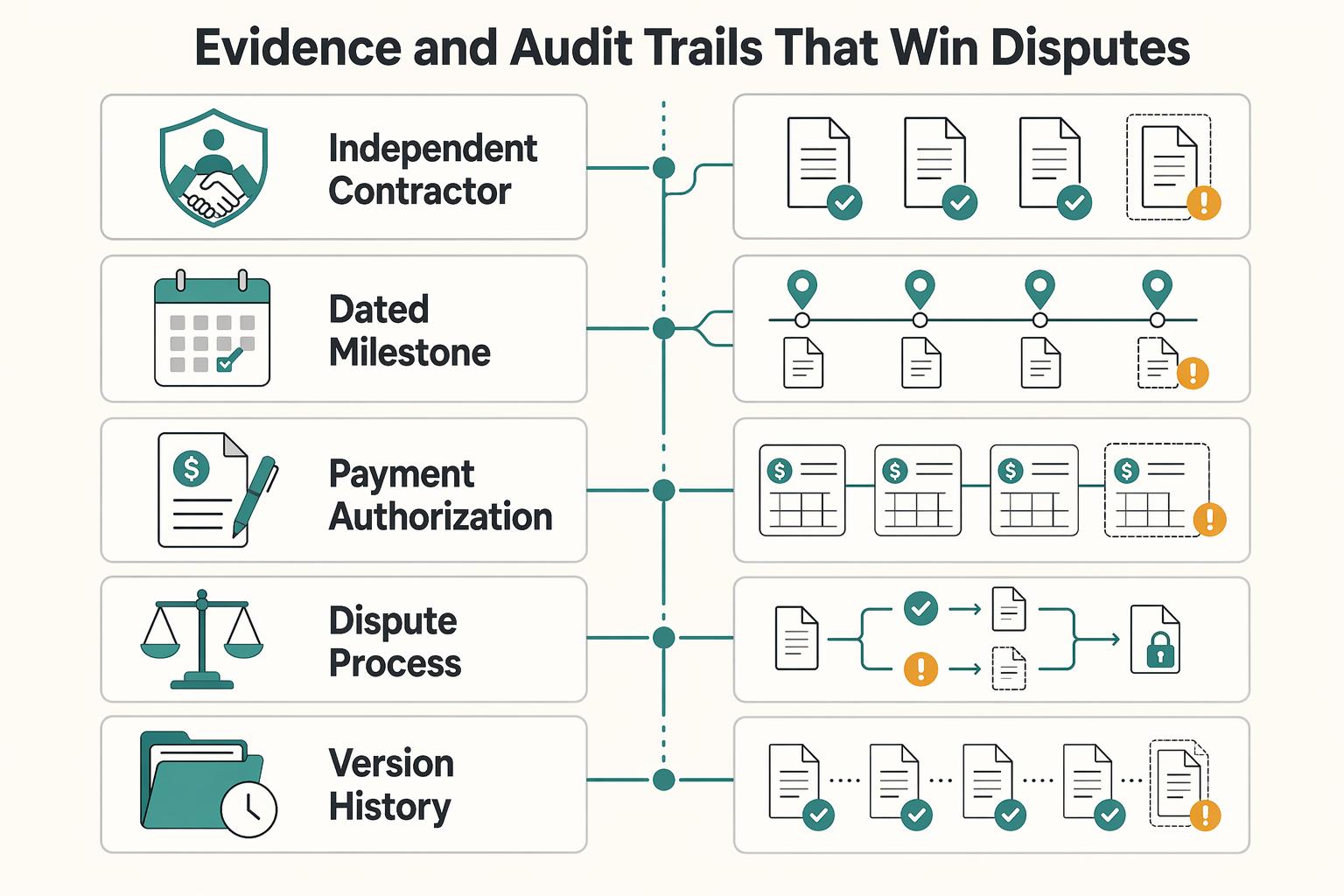
An evidence pack connects scope, milestones, deliveries and payments so a reviewer can understand your claim. It can support a dispute without guaranteeing the result. Keep original records alongside the assembled timeline; the diagram illustrates evidence categories, not a legal outcome.
| Artifact | What it should show |
|---|---|
| Independent Contractor Agreement | Scope of Work with deliverables, acceptance criteria, and deadlines |
| Dated milestone schedule | Separate submission/delivery time from acceptance time and identify the approver |
| Payment authorization events | Who, when, and amount linked to the related invoice |
| Dispute process reference | Reference to the contract's dispute process so reviewers see the agreed path |
| Version history | Who changed what and why |
Keep a structured, time-ordered log of status changes. Capture actor, time, object, and before/after values, and keep IDs consistent across contracts, milestones, invoices, and payouts so events join cleanly. When a claim arises, export a single timeline (PDF or CSV) that orders entries by timestamp. If your tool can't produce it, assemble the timeline from your records and store it with the artifact pack.
Verification checkpoint:
- Reconcile invoice line items and totals against posted entries before you submit.
- For each milestone, confirm approved status, approver name, timestamp, and linked deliverable.
- Confirm payment authorizations match invoice ID, amount, and currency.
- Lock the invoice after review and store the export alongside the artifact pack.
- Keep a short post-dispute checklist; organized evidence beats long emails.
Reconcile totals and fill evidence gaps before escalating. If the platform cannot export a complete timeline, assemble one from authentic records and identify the missing items. Do not assume the absence of a platform export extinguishes a right or permits you to breach an existing delivery obligation.
Payouts, FX, and access to funds across borders#
Make payout states and FX decisions exportable. Require visible, dated states - pending, credited, or held - with a clear reason and a target release window tied to your Payment terms clause. Exportable transparency beats guesswork you can't prove.
Expect the payout path to vary by rail. "Payment sent" is not the same as money available; bank transfers can pass through intermediary steps before crediting your account. Some platforms hold funds after project completion to manage disputes or fraud risk. Record the hold reason and intended release date in your export, and keep every state transition in your timeline.
Where the provider offers a firm FX quote, record its rate, currency pair, fee, expiry and reference. If conversion happens at a later variable rate, save the applicable terms and actual execution rate instead. An expired quote needs a new quote and any required approval; a failed conversion needs support or the applicable dispute route, not an automatic legal claim.
Verify the payout methods available for your country, currency and account type, including destination eligibility and fees. Identity or compliance checks can delay withdrawal independently of milestone acceptance. Request the reason and next step where disclosure is permitted, and retain the support reference; completing a milestone does not override a legal hold.
Verification checkpoint#
- Download payout history and attach it to any claim before escalation.
- Reconcile invoice totals with credited amounts and FX conversions on the chosen rail.
- Confirm hold reason and target release date match your Payment terms clause.
- Check the conversion quote reference and expiry; re-quote if expired.
- Verify the rail and destination account, then lock the export.
Investigate unexplained rate changes, missing fees, incorrect beneficiary details or inconsistent payout states. Keep receipts and open an issue through the applicable process. A payout timeline may not follow one universal sequence: fixed-price funding can precede work, while bank credit follows release. See Freelance Platform Trust.
Benefits and limits you should see upfront#
Correctly classified independent contractors generally lack the employee minimum-wage and overtime protections of the US FLSA. Unemployment, workers’ compensation and other coverage depend on the applicable law, facts and policy. A contractor label or benefit disclaimer cannot remove rights that actually apply.
Ask for the actual coverage terms: insurer or scheme, eligibility, exclusions, limits, premiums and claim procedure. Identify which coverage is legally required and which is voluntary. Keep policy and enrollment records separately from invoices; a platform toggle or promotional summary is not the full policy.
For example, California DIR explains that the ABC test generally presumes employment unless the hiring entity satisfies all three conditions, while specified exceptions can invoke another test. Acknowledging a platform classification note does not establish those conditions.
Verification checkpoint#
- Verify required and voluntary coverage through actual policy or scheme documents.
- Keep the applicable classification review and relevant working-practice records.
- Store dated enrollment evidence, coverage dates, premiums and policy identifiers.
- Check summaries against the underlying terms and flag any contradiction.
- Identify the claim route and deadline before relying on coverage.
Challenge coverage claims that omit eligibility, exclusions or the actual insurer. Verify the underlying documents before relying on a benefit. If a claim or statutory deadline is approaching, seek the correct procedure rather than waiting indefinitely for a cleaner export.
Set this up before your first invoice#
Before your first invoice, finalize a written contract and make sure its essentials - payment terms, late-fee policy, a dated milestone schedule, and invoice reminders - show up in your invoicing.
Set the payment window you'll give clients and decide whether you'll charge late fees. Add a clear timeline with milestone dates so expectations and timing are explicit. A written contract is your first line of defense, and setting these basics up front helps protect expectations and payment. Enable automatic invoice reminders aligned to your payment window so due dates stay visible and follow-ups happen on time.
Verification checkpoint#
- Generate a draft invoice or preview (if available); confirm payment terms and due date appear.
- Verify each milestone shows a date consistent with the contract timeline.
- Turn on invoice reminders and confirm the schedule matches the payment window.
- Save the draft invoice alongside the contract notes for your records.
Resolve inconsistent billing records before invoicing where possible. Whether to pause work depends on the agreement and applicable obligations; a missing invoice field does not automatically authorize suspension.
Choose a platform with a simple, testable rubric#
Compare platforms on terms, evidence access, payment-protection conditions, dispute routes and coverage disclosures. Decide which gaps can be covered by your own records and which create unacceptable exposure. Export convenience supports a claim; it does not create or extinguish the underlying right.
Ask how the platform structures work and who makes operational decisions. Dated change logs can support review of the relationship. Classification needs the applicable legal tests and actual facts, not a dropdown label.
| Criterion | What to test | Fail pattern |
|---|---|---|
| Payment protection | Verify eligibility, exclusions, required funding or time tracking, protection limits and dispute deadlines for your intended contract type. Test records needed to meet those conditions. | A protection badge without applicable terms, or a workflow that misses the funding, tracking or deadline conditions. |
| Classification review | Check the relevant law and actual work facts, the review date and how changes are reassessed. Use labels and logs as evidence only. | A contractor tag treated as approval, or required employee obligations left unaddressed. |
| Evidence quality | Bundle contract references such as an Independent Contractor Agreement, Scope of Work clause, and milestone schedule into one exportable timeline. | Artifacts are scattered; approvals lack names or times. |
| Jurisdiction support | Verify whether the product surfaces a state view and clearly labels optional programs as available or not. | Marketing claims differ from what exports show; no jurisdiction context on records. |
Verification checkpoint#
- Create a sample project with milestones, generate a draft invoice, and download the export; confirm terms and milestone dates appear.
- Edit a control-related setting and confirm a dated change entry is added rather than overwriting the prior state.
- Attach contract references to the record and verify IDs stay consistent across contract, milestones, and invoice.
- Save a single timeline file and confirm it orders events by timestamp.
Before choosing, test an export, read the dispute rules and confirm the payment-protection eligibility for your intended contract type. If an important gap cannot be addressed with reliable external records or agreed terms, choose another arrangement. Keep statutory complaint routes and deadlines separate from platform support.
The takeaway you can act on today#
New York State provides a concrete statutory example. Its Freelance Isn’t Free Act, effective 28 August 2024, protects defined engagements at the 800-dollar threshold. Coverage depends on the worker, hiring party and work; exclusions include specified sales representatives, lawyers, licensed medical professionals and construction contractors. These protections are not contingent on having a platform export.
| New York point | Detail |
|---|---|
| Effective date | 28 August 2024 |
| Threshold | 800 dollars alone or across contracts with the same hiring party in the preceding 120 days; statutory definitions and exclusions apply |
| Contract essentials | Names and mailing addresses; itemized services and value; rate and method of compensation; payment date or mechanism; deadline for submitting services list for internal payment processing |
| Retention | Both parties retain a copy; hiring party keeps the contract at least six years |
| Payment timing | Agreed date or mechanism; if absent, generally within 30 days after completing services, subject to law |
| Enforcement | Attorney General complaint or eligible civil action; remedies and time limits depend on violation |
Start with documents you can point to and verify:
- Agree and retain terms that identify the correct parties, scope, price, payment timing and processing requirements.
- Keep the original agreement and amendments, invoices, authentic delivery/acceptance records and payment receipts together.
- Reconcile invoices with credits and actual receipts; preserve their original issue and send dates.
- If a required contract or field is missing, obtain advice and preserve existing evidence: the Act says noncompliance does not itself invalidate the contract or underlying claim.
For a covered New York State engagement, you can complain to the Attorney General or consider a civil claim under the Act. Remedies depend on the violation and successful proof; nonpayment can support double damages and reasonable attorneys’ fees and costs. The Act has distinct filing periods: generally two years for the written-contract requirement and six for payment or retaliation. Check the applicable route and deadline rather than assuming a platform dispute suspends them.
Pick a platform that lets you store and export your signed contract and invoice details without friction, then apply this setup on your next job. Do the paperwork once, reuse the template, and keep an evidence bundle for every engagement. For longer-term resilience beyond any single marketplace, see How to Build a Freelance Business That's Platform-Independent.
Frequently Asked Questions
Do freelancers get benefits like unemployment or workers' comp?
In the US, correctly classified independent contractors generally are not covered by employee FLSA minimum-wage and overtime rules. Other benefits depend on state law, policy and actual status, including possible voluntary coverage. A platform’s contractor label or benefit disclaimer cannot waive applicable employee rights. Verify advertised coverage through the policy and eligibility terms.
Which test does my state use to classify freelancers?
The applicable test depends on jurisdiction and purpose, not just the state named in a profile. Federal wage law, state employment law and tax rules may differ. Record where you work and actual scheduling, supervision, investment and business practices, then use the relevant agency guidance or qualified advice.
If a client does not pay, what are my immediate options on a platform?
Confirm the debt, due date, agreed terms and any applicable platform-protection requirements. Save the agreement, delivery proof, messages and payment history; use the dispute channel within its deadline. Suspend further work only as permitted by your agreement and applicable rules, and keep statutory complaint or court deadlines in view.
Does the contract label decide if I am an employee?
No. Agencies and courts assess the actual relationship under the applicable law. Record relevant facts honestly and address employee classification where required; an independent-contractor clause, acknowledgement or invoice does not decide status.
Does the Freelance Isn't Free Law apply on platforms and invoices?
Coverage varies by jurisdiction and the parties and work involved. New York State’s Act, effective 28 August 2024, covers defined freelance engagements meeting an 800-dollar threshold alone or across contracts with the same hiring party in the preceding 120 days, with exclusions. A marketplace is not automatically the hiring party; identify who retained you and assess coverage. An invoice alone is not a substitute for the required contract.
What records should I export before filing a dispute?
Export an evidence pack you can hand to a reviewer. Include your contract with the Payment terms clause, Scope of Work and milestones, an invoice with a due date and reconciled totals, plus delivery proofs and approvals with names and times. Verification checkpoint: reconcile invoice totals to posted entries before you submit. Missing due dates or approvals without timestamps weaken a claim.
How do state paid-leave or retirement programs show up in practice?
Some jurisdictions allow self-employed people to opt into paid-leave coverage. New York, for example, requires combined Paid Family Leave and disability coverage; enrolling within the first 26 weeks of business leads to eligibility 26 weeks after coverage, while later enrollment generally carries a two-year waiting period. Check the scheme’s current eligibility and keep the policy and enrollment evidence. Retirement arrangements and tax treatment require a separate review.
Try a related tool
Researched and edited by the Gruv editorial team. Gruv builds cross-border billing, payouts, and finance-operations software for global businesses.
Sources
Includes 1 external source outside the trusted-domain allowlist.
- dir.ca.gov/dlse/faq_independentcontractor.htmtrusted
- dol.ny.gov/freelance-isnt-free-acttrusted
- nysenate.gov/legislation/laws/GBS/1410trusted
- nysenate.gov/legislation/laws/GBS/1411trusted
- paidfamilyleave.ny.gov/self-employed-individualstrusted
- support.upwork.com/hc/en-us/articles/211068288-How-Hourly-Payme...external
Educational content only. Not legal, tax, or financial advice.
Related Posts

How to Compare Freelance Hiring Paths by Trust, Evidence, and Control in 2026
In 2026, **freelance platform trust issues** can surface after work has already started, not just while you are scanning profiles. The real question is simple: when delivery gets messy, can you still prove what was agreed, control who approves payment, and show whether the work met the standard?

Build a Platform-Independent Freelance Business in 90 Days
Real independence is easy to describe and harder to build: if one account on Upwork, Fiverr, or another marketplace gets limited, your business should keep moving. Marketplaces can stay in the mix, but they should not control your pipeline, onboarding, or payment.
Why Freelance Platform Dispute Resolution Breaks Down and How to Protect Yourself
Start by checking the **next deadline, the disputed payment and the process available to your role**. Money still held in a platform is one useful signal, but it is not the whole eligibility test: Upwork hourly protection concerns recorded hours, and its fixed-price terms also allow mediation for eligible disputes over recently released funds. An invoice that never used a platform normally follows the agreement and the applicable collection or legal process.