
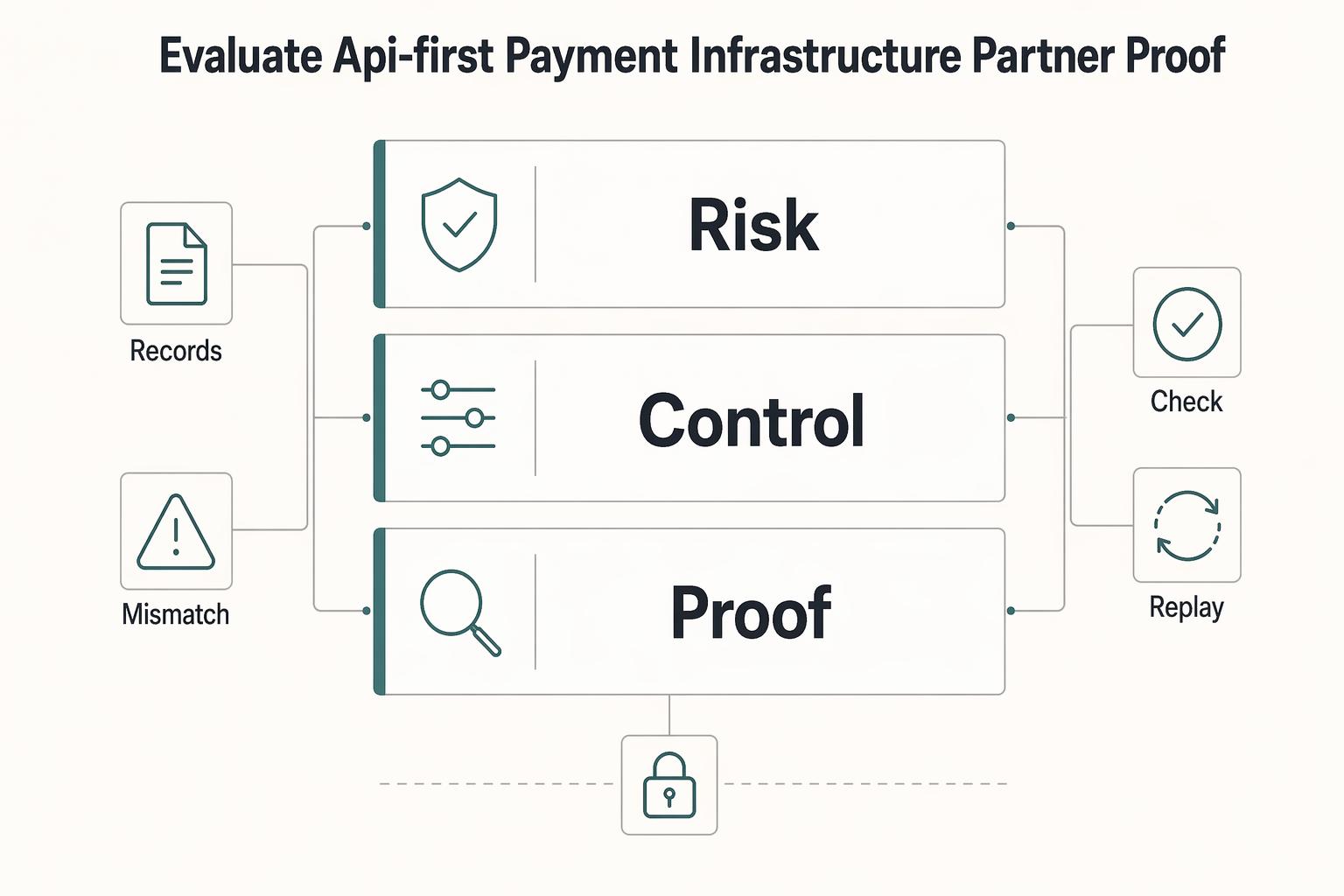
Quick Answer
Choose the API-first payments partner that proves retry-safe webhooks, reconciliation-ready exports, payout controls, and clear compliance ownership under real test conditions.
How to evaluate an API-first payment infrastructure partner on proof, not demo polish#
An API-first payment infrastructure evaluation should end with a shared decision record, not just a polished demo. That record keeps product, engineering, finance, and risk aligned on one decision path, one proof plan, and one pass-or-fail standard before cutover pressure takes over.
This guide is for platform founders, product owners, finance and ops leads, and engineering owners evaluating the same partner choice from different angles. The goal is practical: produce a defensible shortlist, run proof tests in sandbox, and reach a final cross-functional recommendation you can operate in production.
Anchor early on the execution risk that shows up after money starts moving, not on feature tours. Focus your proof tests on whether the provider can support reliable operations when events are delayed, duplicated, retried, or blocked.
- Webhooks are asynchronous, and payment updates can arrive much later than the original action.
- Providers warn that the same webhook event can be delivered more than once, so your flow needs deliberate duplicate-event handling.
- Safe retries depend on idempotency keys, and retry assumptions are time-bound. For example, Stripe notes keys can be removed after at least 24 hours.
- Webhook handling should durably store a verified event before returning a quick 2xx acknowledgment, then process it downstream without duplicate side effects.
Verify the identity, capability and legal controls required for the actual program before payouts. Keep reconciliation evidence usable for the general ledger and close workflow.
Use this guide to choose the partner your team can run in real conditions, not just the one that demos well. The right choice is the one you can trust during retries, delayed events, compliance holds, and cutover.
Set the decision scope and non-negotiables first#
Start by narrowing the decision before any demo. Define scope, ownership, and operating controls up front, or every vendor will appear to fit.
Step 1. Define the scope in one sentence#
State the scope plainly: collection, payouts or both. Name any additional services you actually need, such as Merchant of Record responsibilities, virtual accounts or payout batches; a full money flow does not always require a MoR.
Then force every vendor response against that sentence, not a generic product tour. Use a written scope matrix that shows what is native, partner-supported, or unavailable by market or program. Treat vague “supported where available” language as a red flag unless they specify the variant, country set, and payout combination.
Step 2. Lock three non-negotiables before vendor calls#
Set three hard gates before the first call:
- Compliance controls, including KYC/AML responsibilities, risk-based identity verification, and beneficial ownership verification for legal entities where required
- Reconciliation to the general ledger, so finance can close books from exports, not just inspect event logs
- SLA commitments, with explicit reliability and response-time language plus an escalation path
Ask for documents early: SLA terms, a sample reconciliation export, and written compliance responsibility language.
Step 3. Separate table-stakes from differentiators#
Treat payment API reliability and webhook correctness as table-stakes, not differentiators. Webhooks are asynchronous HTTP POST events, and retries can span days. Stripe documents redelivery for up to three days, and PayPal states non-2xx responses can trigger up to 25 retries over 3 days.
Differentiate on useful operator tooling, virtual accounts, payout batches and actual program coverage. Where MoR is part of the model, require its contractual scope and residual platform liability; otherwise establish the relevant seller and payment liability boundaries.
Prepare the evidence pack before any demo#
Bring your own evidence pack to the first demo so you get proof, not a polished tour. If you do not control the test cases and document requests, you cannot compare vendors on execution risk.
Step 1. Bring one real transaction map#
Use one map that starts at your real entry point and ends at a finance-close artifact. Show invoice or payment-link creation, payment authorization or confirmation, relevant webhook events, payout trigger, payout outcome, and the expected general ledger posting at each stage.
Make the vendor walk the map and label native, partner-supported and unavailable steps. Trace a payment and payout into finance exports. Stripe’s payout reconciliation report associates automatic payouts with included transactions; manual and instant payouts require a separate operator mapping. Ask for equivalent evidence from other providers.
Step 2. Bring the policy artifacts that can block money movement#
Bring your KYC and any KYB/AML gating points, VAT validation needs, and tax-document steps. Be explicit about where a gate applies, such as stopping payouts until verification clears, and ask how that state appears in API fields or dashboards.
Stripe Connect states that connected accounts must satisfy KYC requirements before accepting payments and sending payouts, and non-empty requirements.currently_due can indicate unresolved requirements that restrict capabilities. Use that level of field-level checkpoint with every vendor.
For tax and VAT, bring your actual decision points where applicable:
- W-9 for taxpayer identification details used by payers filing IRS information returns
- W-8BEN when requested by the withholding agent or payer
- Form 1099 handling, including that card and third-party network transactions are reported on Form 1099-K, not 1099-MISC or 1099-NEC
If you need EU VAT checks, ask whether validation uses VIES, a search engine that queries national VAT databases.
Step 3. Run three failure scenarios live#
Before the call, define these scenarios and require a live walkthrough.
- Duplicate request: verify provider-specific key scope, retention, parameter matching and error behavior. Resolve an uncertain original before a fresh key or cross-provider send.
- Stale FX quote: test supported lock durations, expiration fields and post-expiry rejection or repricing for the actual API and account region.
- Asynchronous payout status reversal: test how a reversal event, such as
PAIDOUT_REVERSEDwhen a financial institution rejects a payout, is surfaced, how ops detects it, and what finance receives for reconciliation.
Step 4. Require one standard return package from every vendor#
Ask each vendor for the same evidence set:
- API contract docs and, where available, machine-readable specification files
- Webhook retry semantics
- SLA terms
- Audit-export examples
Do not treat a status page as contractual SLA language. Compare actual SLA terms with published support commitments. For webhook behavior, require concrete retry details. For example, Stripe's undelivered-event guidance documents live retries for up to 3 days with exponential backoff and sandbox retries three times over a few hours. For audit evidence, request sample exported CSV files, not screenshots. If you want a deeper dive, read API versioning strategies for payment changes.
Build a weighted scorecard your teams can actually use#
Once each vendor returns the same evidence pack, score them immediately with a weighted table. Penalize unresolved operational unknowns more than demo polish. Those unknowns can create post-launch risk across money movement, compliance, and finance close.
Step 1. Score seven categories on proof, not impressions#
Score seven categories on evidence, not impressions. A 1 to 5 scale is enough if each score is tied to proof: API contract artifacts, webhook retry behavior, verification-state examples, payout reporting, reconciliation exports, and contract language for support and commercial terms.
| Category | Weight | Pass or fail gate | Product fit | Engineering complexity | Finance and ops controllability | Risk and compliance confidence |
|---|---|---|---|---|---|---|
| Payment API and Webhooks quality | 20 | Idempotent retry behavior proven | Covers your real payment and payout path, not just sample flows | OpenAPI documents or equivalent are usable; webhook handling is explicit; retry and dedupe behavior is testable | Event timing and failure states are visible enough to run exceptions | Incident evidence is retained and attributable |
| Compliance controls and verification (KYC) | 15 | Verification gates for payments and payouts are shown, not described | Onboarding friction is acceptable for your user type | Verification states and capability restrictions are exposed in API or dashboard | Ops can see who is blocked and why | Provider responsibilities are clear before funds move |
| FX handling | 10 | Stale quote behavior is explicit where FX is used | FX options fit your corridors and user promise | Rate-lock behavior and expiry are testable | Ops can detect expired quotes and failed conversions | Rate exposure and exception ownership are clear |
| Payout operations including payout batches | 15 | Payout status changes and batch reporting are exportable | Payout routes and timing meet your product promise | Async payout states are easy to consume | Batch cadence, reversals, and retries are operationally visible | Funds movement controls are documented |
| Reconciliation to General ledger | 20 | Traceable provider references and exportable audit trail | Finance artifacts match your close process | Reference chain from transaction to ledger record is machine-readable | Exports support close without manual reconstruction | Audit trail is complete enough for review |
| Support and SLA | 10 | Contractual SLA terms supplied | Coverage matches your launch markets and hours | Escalation path and incident artifact requirements are clear | Ops knows what evidence support will ask for | Contract terms are usable during incidents |
| Commercial terms | 10 | Pricing covers your real path, not a simplified one | Fees fit your margin model | Engineering dependencies are reflected in cost | Finance can forecast fees by payment, FX, and payout path | Liability and commercial triggers are not ambiguous |
These default weights emphasize money movement and close readiness. Tune them if needed, but do not let commercial terms outweigh reconciliation, compliance controls, or retry correctness.
Step 2. Enforce three hard gates that scores cannot offset#
Keep the weighted score, but enforce three hard gates that cannot be offset by a high total score.
The first gate is safe request retry behavior within the actual provider’s key scope and retention window. Test changed parameters and cached errors, and ensure an uncertain original is resolved before another send. Keep internal duplicate-payment protection after provider keys expire.
The second gate is traceable provider references. You need proof that one payment and one payout can be traced from API request to ledger-like record to close artifact through provider references. If finance cannot follow that chain without manual reconstruction, fail the gate.
The third gate is an exportable audit trail. Screenshots are not enough. Require downloadable or API-accessible records that finance and audit can use operationally.
Score provider-specific webhook handling. Verify signatures, durably store events before acknowledging with 2xx, then process safely. Confirm retry, deduplication, order and missing-event recovery behavior.
Step 3. Add reviewer notes from each team#
Add four reviewer columns and require one sentence per row from each team, not only a numeric score.
Product should confirm fit to your actual user promise. Engineering should assess contract clarity, webhook handling, async state complexity, and partner dependencies hidden behind “supported.” Finance and ops should judge exception control, payout and batch reconciliation, and close readiness from exports. Risk and compliance should confirm ownership for KYC and related verification document requirements before payments and payouts are enabled.
Use a blunt decision rule: choose the vendor with fewer unresolved operational unknowns, not the vendor with the fastest demo. If scores are close, prefer cleaner provider references, stronger export evidence, and clearer verification and webhook retry behavior.
Validate integration quality in sandbox before commercial talks#
Treat pricing and legal decisions as provisional until sandbox tests validate your real request path, webhook behavior, and FX edge cases with evidence you can inspect.
Before you start, fix the sandbox scenarios#
Use the same duplicate-request, delayed-webhook and stale-quote scenarios. Request the vendor’s actual machine-readable contract and supported specification version where available; a particular OpenAPI version alone does not prove the integration is complete.
| Test area | What must be observable | Red flag |
|---|---|---|
| Payment API and contract | Real request and response objects for your flow, required fields, async states, and error cases | Sample app only, hidden required fields, or no machine-readable contract |
| Webhooks and retries | Duplicate-delivery handling, delayed redelivery, dedupe logic, and latest-state fetch behavior | Claims of exactly-once delivery, no duplicate handling, or no retry evidence |
| FX quotes | Quote type, expiration timestamp, and post-expiry behavior | “Guaranteed” language with no expiry test or no visible stale behavior |
Step 1. Test your real payment flow against the contract#
Test your actual product path, not the vendor demo path. Sandbox should mirror your business object model so you can see whether the API maps cleanly to implementation.
In one session, verify object-model clarity, including resource names, statuses, and required fields, plus async transitions and practical error responses. A strong result is that an engineer can build and explain the full state path from contract and docs alone. If polished docs hide an incomplete contract, treat that as integration risk.
Use sandbox to debug API calls and integration logic with your own payloads and expected states, not copied snippets.
Step 2. Force retries, duplicates, and delayed webhook delivery#
Test the actual provider’s idempotency contract: same-key/same-parameter requests, changed parameters, cached errors, account or regional scope and expiry. For Stripe, the first executed result is cached, including 500 responses. Resolve an uncertain original operation before changing keys or providers; keep internal duplicate-payment protection beyond the provider’s retention window.
Force webhook failure by returning non-2xx or timing out, then verify retries and delayed redelivery. Some providers can resend undelivered events for up to three days, and duplicate deliveries can occur, so your consumer must handle both.
Assume event snapshots can be stale. Re-fetch current resource state before final action, and confirm logs show event ID, first-seen versus duplicate, linked idempotency key or provider reference, and the follow-up fetch.
Step 3. Confirm quote validity and stale FX behavior#
If FX is in scope, separate indicative quotes from firm or locked quotes at the start. Indicative rates may differ from the conversion rate, so they are not enough for fixed customer promises.
Run at least one conversion inside validity and one after expiry. Where supported, test 5 minute, 1 hour, and 24 hour quote durations. You need explicit behavior: clear expiry rejection or repricing at prevailing rate.
Focus on observable fields, not marketing labels: quote type, expiration timestamp, and final conversion reference. If expiry behavior is not testable in sandbox, your commercial exposure is still unclear.
Step 4. Escalate missing failure modes as procurement risk#
Passing sandbox tests does not prove live network behavior, because sandbox is isolated from live rails. But missing failure-mode evidence is still a procurement risk.
If a vendor cannot show retry behavior, delayed delivery handling, or FX expiry outcomes, consider pausing legal review until equivalent proof exists. Acceptable proof includes documented sandbox-versus-live differences, redacted production webhook logs, audit artifacts, or explicit retry and quote-validity semantics in docs and contract language. Do not accept “production behaves differently” without evidence.
Pressure-test compliance gates and regional caveats#
Compliance ownership and regional eligibility must be explicit before launch planning. If you cannot name who collects, verifies, and acts on KYC and related verification checks, withdrawal controls, and tax workflows by market and program, stop.
Step 1. Map every payout blocker by country and program#
Require a country-by-program matrix, not a generic compliance summary. It should show what must be complete before accounts can accept payments or send payouts, what can trigger restrictions or disabled charges/payouts, and which controls are provider-enforced versus platform-configured.
Document who collects updated verification information, who verifies it and what deadline or status restricts each capability. For Stripe Accounts v1, inspect current_deadline, past_due, disabled_reason, charges_enabled and payouts_enabled; currently_due alone is not an unconditional block or a universal 14-day grace period.
Pressure-test withdrawal behavior the same way. Manual payout settings can hold funds until release, and holding periods can vary by country, for example: Thailand 10 days, United States 2 years, all other countries 90 days. Also confirm initial payout timing if launch assumes immediate withdrawals. One documented baseline is 7-14 days after the first successful live payment.
Step 2. Decode "where supported" and "when enabled"#
Treat these phrases as gating language until they are converted into a written eligibility matrix.
| Area | What to confirm in writing | Why it blocks launch |
|---|---|---|
| Virtual Bank Accounts | Merchant-country availability, customer-location support, matching or reconciliation flow, and unreconciled-funds handling | "Supported" may not include your country mix or operating model |
| Stablecoin payouts | Program status, platform-country eligibility, recipient entity-type limits, and supported-country list | Features can exist in docs but still be preview-only or narrowly scoped |
| Tax workflows | Which forms are collected, who files 1099s, and which transaction types are excluded | Ownership shifts by control or commercial model |
For virtual accounts, establish the receiving function, program eligibility, deposit matching and return rules. Stripe customer-balance bank transfers can attempt return of funds unreconciled for 75 days; that rule does not apply to all virtual accounts. For stablecoin payouts, obtain current eligibility, program status, entity-type support and redemption details for the actual provider.
Step 3. Separate VAT checks from tax-document ownership#
VAT validation and tax-document ownership are different controls and should be reviewed separately.
If VIES is used, document its limits and escalation path. It is a search engine into national VAT databases, not a standalone database, and the European Commission does not guarantee web-response accuracy.
Then separate payer-collected forms from taxpayer-side filings. W-9 provides TIN details to payers for information returns, and W-8BEN establishes foreign status for eligible individuals. Treat taxpayer-return obligations as separate from the payer-side forms you collect or rely on, and do not accept all of that work as one vague "global tax support" bucket. If your intake process is still manual, review how to automate W-9 collection and 1099 workflows.
Step 4. Lock the responsibility split before launch planning#
Do not proceed until compliance ownership is explicit in vendor responses and contract language.
Determine the actual reporting entity and transaction classification, alongside the provider’s contractual role. Platform pricing control can affect responsibility in particular Stripe Connect arrangements; it is not a universal legal test. Qualifying payment-card and third-party network transactions fall under Form 1099-K rules rather than duplicate 1099-NEC or 1099-MISC reporting.
Decision rule: if responsibility is ambiguous for collection, verification, monitoring changed requirements, filing, or payout-block notifications, stop launch planning. Ambiguity here turns into blocked payouts and filing risk.
Verify reconciliation and auditability end to end#
Traceability is the next hard gate. If you cannot follow one real payment and one real payout from API request to provider references, webhooks, exports, and general ledger journals, stop. For an architecture checkpoint, compare your evidence flow with this guide to connecting payment infrastructure to the general ledger.
Step 1. Trace one payment and one payout with stable identifiers#
Use two real test cases: one inbound payment and one outbound payout from a payout batch. Start at your API request and keep the full reference chain across systems: your internal transaction ID, provider transaction ID, payout ID, and any settlement reference the provider exposes.
The chain must stay intact in both event streams and exported reports. In Adyen, the PSP reference is the unique transaction identifier and anchor across related events. In Stripe, balance transactions represent each movement into or out of account balance. Finance and engineering should be able to point to the same money movement using the same identifiers.
Step 2. Prove balances come from ledger events, not dashboard snapshots#
Require evidence that balance or wallet movements are event-derived. Stripe’s model is explicit: each movement creates a balance transaction, and your provider should show an equivalent event-level trail even if the naming differs.
Document timing gaps after an accepted request, the authority for each status, and close cutoffs. Align provider reporting timezone and date range with your accounting policy rather than assuming every report uses the same calendar boundary.
Step 3. Define exception handling for VBAs and payout reversals#
Require a documented unmatched-deposit path: provider reference, amount and currency, proposed customer or invoice match, verification, age and owner. Track any return or refund as a linked but distinct action. Stripe’s 75-day customer-balance return attempt is specific to that product; confirm the relevant provider’s rules.
Request the exact payout-reversal eligibility, deadline and failure states for your provider, country and account. A recall or reversal request is not proof that funds returned. Preserve original and reversal references and account for confirmed outcomes; do not automatically repeat a failed or uncertain recovery.
Step 4. Run a close-readiness test from exports only#
The acceptance checkpoint is simple: finance should be able to close a small period from exported records without manually rebuilding missing links. GL reconciliation still means comparing ledger balances to supporting records and resolving differences.
Require downloadable transaction and payout reports with usable references. Stripe’s automatic payout report can link included transactions; manual and instant payouts require your own mapping. Test your actual close process, including fees, returns and adjustments. For another operating pattern, see monthly payout reconciliation.
Evaluate commercial model and contract risk before final selection#
After reconciliation is proven, convert those operating facts into contract terms. The highest late-stage risk is clear pricing with unclear responsibility. If the model is easy to quote but hard to run from the contract, treat it as high risk.
Step 1. Match price to your actual money path#
Price the real flow, not a blended headline rate. Define the exact FX conversion path, whether rates are indicative or locked, who decides fee pass-through, and how payout routing works when funds leave the platform. If FX quotes are in scope, the validity window is a commercial risk lever because it shifts rate-movement exposure, including provider-documented windows such as 1 hour or 24 hours.
Apply the same standard to payouts. If the account holder manages external payout accounts while your platform schedules payouts, that split should be explicit in the contract so support and exception-handling ownership is clear.
Use one practical test: map one commercial schedule to one inbound payment, one FX conversion, and one payout in a payout batch. If finance or ops cannot trace each fee and timing assumption to provider reports and your general ledger, the pricing is not decision-ready.
Step 2. Lock Merchant of Record and liability boundaries in writing#
Stripe Connect assigns merchant-of-record responsibility by charge configuration: direct charges make the connected account the MoR, while indirect charges without on_behalf_of make the platform the MoR. Confirm the specific configuration, legal-seller responsibilities and residual loss liability; this Stripe model is not a universal rule for every payments provider.
Your API contract and order form should name the exact integration pattern being sold, not broad terms like “marketplace support.” If the platform is MoR, dispute performance can be monitored by card networks. Even when a connected account is MoR, some setups still leave the platform responsible for covering losses from negative balances.
Use strict decision rules:
- If MoR changes by flow, require written responsibility allocation by flow.
- If dispute ownership, loss coverage, or compliance control ownership is only high-level, send it back.
- If important subcontracted functions sit in layered providers without direct contractual clarity, flag them for legal and risk review before selection.
Step 3. Put incident evidence into the Service Level Agreement#
A usable SLA should name the evidence used in real incidents, not just promise “commercially reasonable support.” Require contract references to webhook delivery records, idempotency evidence, and downloadable audit or reconciliation exports.
Keep provider-specific key, request, response and lookup evidence for incidents. Stripe caches the first executed result for a key, including status and response; other providers have different error and retention behavior.
Do the same for webhooks. If the provider documents automatic redelivery for up to three days and querying missed events over a time range, your incident clause should confirm those records are available for investigation and post-incident review. If docs mention these artifacts but contracts do not, support risk rises when incidents happen.
Step 4. Reject vague operational obligations even when price looks good#
Before final selection, request the exact documents you would use during a live issue: SLA, API contract, sample audit exports, and the incident evidence path for webhooks and idempotent requests. Then verify that those documents match the product behavior you already tested.
A failure mode to watch for is attractive pricing with no clear owner for missed webhooks, payout delays, or month-end dispute evidence. Written responsibility allocation is the control point. If a provider cannot name the artifact, owner, and contract section for operational duties, the contract is still ambiguous.
Related reading: A Deep Dive into Wise's API for Automated Payments.
Run a production-readiness drill and cutover plan#
Signed commercials are not launch readiness. The final gate is a cutover drill that proves ownership, rollback readiness, and finance or ops reconciliation under real conditions.
Step 1. Define the cutover order and rollback trigger#
Build the cutover plan as an execution tracker, not a slide: sequence, planned timing, and a named owner for each checkpoint across product, engineering, and finance or ops. Keep rollback documented inside the plan.
At minimum, assign owners for:
- product signoff on user-facing switch timing and support messaging
- engineering signoff on payment API traffic routing, webhook endpoint health, and retry behavior
- finance or ops signoff on payout creation, payout status tracking, and ledger comparison
Compare old and new outputs through shadow processing or mutually exclusive live cohorts; only one system may send each intended payment. Before cutover or rollback, resolve in-flight and uncertain payments, retain their original provider ownership and pause new sends where needed. A routing rollback does not cancel money already submitted.
Step 2. Execute a controlled pilot with real payout flows#
When feasible, run the pilot on real money paths, not only sample transactions. Include at least one flow that creates a payout batch, captures provider references, posts entries to your ledger, and is checked by finance or ops without manual reconstruction.
If your traffic is batch-based, test real payout batches because duplicate handling, partial failures, and timing issues can surface there. Validate duplicate protection during retries. For example, PayPal Payouts uses sender_batch_id, and reusing one from the last 30 days is rejected. If your provider documents a batch limit, test a production-like batch shape. For PayPal, documentation states up to 15,000 payments per call. The goal is not max volume. The goal is to prove that your expected batch volume, retry pattern, and reconciliation process behave as documented.
Your pass condition is simple: finance can trace batch ID, provider reference, amount, status, and settlement outcome in the exports you will use after launch.
Step 3. Verify monitoring, failure handling, and SLA escalation before go-live#
Before launch, rehearse monitoring and recovery, not just alert setup. The team should be able to show how delivery lag is detected, how failed deliveries are retried or queued for each provider, and who owns recovery when endpoints fail.
Provider behavior differs and should drive your operating plan. Adyen documents that if acknowledgment is not received within 10 seconds, the webhook is marked failing and queued for retries with documented intervals, with automatic retries for up to 30 days. Stripe documents automatic resend of undelivered events for up to three days, and its recovery flow returns events from the last 30 days. Use provider-specific behavior as your operating baseline.
Tie this directly to your SLA path. If your support plan includes 24x7 access or business-critical response commitments, record the exact escalation steps in the cutover notes and test them. If owners cannot name the dashboard, export, queue, or support escalation path they would use during a live incident, do not switch.
Common mistakes that delay launch and how to recover#
Launch delays are often self-inflicted. Common causes are false confidence, not missing API endpoints: a quick first payout, late compliance ownership, weak ledger linkage, or rollback based on debate instead of alarms.
Step 1. Re-test beyond time to first payout#
A fast first payout is not proof you are production-ready. First payout timing can vary by country and risk, and test mode does not interact with banking networks.
Recover by rerunning live-like tests around webhooks, idempotency keys, and exception paths. Confirm the same request can be retried safely without duplicate operations, and that webhook handling tolerates duplicate or delayed delivery. Stripe documents automatic redelivery for up to three days and manual recovery limited to events from the last 30 days, so test backlog handling and replay tooling before calling the integration stable.
Step 2. Pull compliance review forward#
If compliance ownership for KYC/KYB/AML and VAT checks is still unclear during pricing talks, the review is likely already late. Customer identification requirements can apply before account opening, and providers can restrict capabilities or disable payouts when required information remains outstanding.
Recover by moving ownership checks ahead of final commercials. Assign one owner to confirm who collects what, when it is required, and what blocks payout activation. If you run EU intra-Community flows, verify whether VAT number checks through VIES are required in your path.
Step 3. Require ledger traceability before signoff#
Weak reconciliation design will delay go-live, especially in manual payout models where transaction-to-payout linkage may not be preserved automatically.
Recover by making general ledger traceability a hard gate. You should be able to trace one payment and one payout from API request to provider reference to journal entry and export without manual reconstruction. If that trail is incomplete, pause launch and fix it, or review payout structures that preserve transaction-to-payout association. If helpful, use this deeper guide on connecting payment infrastructure to any General ledger.
Step 4. Define rollback with alarms, not debate#
Predefine alarms, owners and the routing rollback path. Pause affected new sends and resolve in-flight or uncertain originals before changing their route. Keep old-provider reconciliation active for payments already submitted.
For each trigger, name the owner, dashboard and tested response. Choose thresholds for the actual risk. Reverting software or routing does not reverse existing payments; never replay their intents solely because an alarm fired.
Related: How to Scale Global Payout Infrastructure: Lessons from Growing 100 to 10000 Payments Per Month.
Make the final decision with explicit go or no-go rules#
Make the decision binary: go only when every hard gate is passed and documented, and no-go if any critical unknown is still open in SLA terms, MoR boundaries, or tax and compliance workflow ownership.
Step 1. Apply hard pass or fail gates#
Approve only when the applicable hard gates are evidenced: SLA terms, webhook recovery, provider-specific retry safety, relevant MoR or seller/liability boundaries, and named tax and compliance owners. Test key scope and expiry, resolve uncertain original payments before new attempts, and confirm recovery against each provider’s delivery windows.
Step 2. Stop on unresolved contract or ownership gaps#
Treat unresolved SLA and liability language as a no-go. "High availability" is not enough if response targets and failure conditions are not explicit, for example latency targets and what counts as a failed response. Do the same for MoR and tax or compliance scope: if ownership is unclear for KYC, AML, tax handling, or tax-information requests such as Form W-9, do not move forward.
Step 3. Break close calls with documented tradeoffs#
If two vendors pass the same core gates, choose the one with the stronger documented tradeoff case for your operating model. Keep tie-break evidence explicit and testable, including how each vendor handles retries, duplicate webhook events, and recovery expectations in SLA terms.
Step 4. Document the decision and approvals#
Close with a decision memo that records the selected option, rejected option, open assumptions, and the rationale behind each tradeoff. Get signoff from the relevant operating and risk owners so accountability is clear. The final check is simple: another team should be able to read the memo and understand why this API partner is a go.
Conclusion and copy-paste launch checklist#
Choose the provider that proves control under failure, not the one that promises the fastest onboarding. The right partner is the one you can operate when webhooks retry, idempotent requests are replayed, compliance checks delay payouts, and finance needs traceable records into the general ledger. If the shortlist is close, compare it against monthly payout reconciliation patterns for contractor platforms.
Step 1. Lock the decision record#
Close with one shared scorecard, one evidence pack, and one short decision memo every owner can review quickly. The memo should define the exact scope you are buying: collection only, payouts only, or a broader model that includes Merchant of Record responsibilities, virtual accounts where supported, and payout batches.
Your evidence pack should contain decision artifacts, not demo screenshots. Include API contract details, webhook retry behavior, idempotency test results, sample exports, and contract language for SLA and incident handling. If two vendors look similar, cleaner evidence is usually the safer operational choice.
Step 2. Choose on operational proof#
Make webhooks and idempotency your first go or no-go gate. Stripe states webhooks are the most reliable payment confirmation path and that undelivered events can be retried for up to three days, so handlers must be retry-safe. Reprocess an already handled event and confirm your endpoint returns success without duplicate side effects.
PayPal Payouts rejects a sender_batch_id reused within the prior 30 days; test batch and item outcomes against its current contract. For reversals and recalls, verify the actual provider’s eligibility, failure states and retry procedure. A request or posted status does not prove recipient receipt or recovery. Resolve the original and recovery outcomes before another payment.
Step 3. Clear compliance ownership before cutover#
Confirm applicable KYC, AML, beneficial-owner and VAT responsibilities for the regulated role and program. U.S. bank CIP and FinCEN CDD requirements do not apply identically to every platform; covered-institution scope, exemptions and 2026 account-opening relief need review. Assign collection, verification, restriction and remediation ownership explicitly.
Be equally specific on tax and VAT evidence. If IRS reporting inputs are needed, confirm who collects Form W-9 for a correct TIN and when a foreign individual provides Form W-8BEN to establish foreign status. If you need an operator playbook, pair that review with automating W-9 collection and 1099 workflows. If EU VAT validation matters, confirm whether VIES is used and what happens when a VAT number returns invalid status. Treat mixed responsibility language without explicit handoffs as a red flag.
Step 4. Approve launch only with cutover evidence#
Sandbox success is necessary but not production proof, because test mode does not interact with banking networks. Before go-live, require a dated cutover plan, a named rollback owner, finance signoff on exported records, and an incident path tied to concrete artifacts such as webhook logs and audit exports. Stripe migration guidance explicitly calls for a migration plan, timeline, and KYC information. Expect that level of detail.
Use this final gate:
- Scope confirmed (MoR/VBAs/Payout batches)
- Compliance ownership clear (KYC/AML/beneficial ownership/VAT)
- Sandbox failure tests passed
- Reconciliation proven to General ledger
- SLA and incident terms accepted
- Cutover and rollback approved by all owners
If you are still choosing, shortlist two vendors, run the same proof tests against both, and decide from the evidence pack. That is the cleanest way to finish an API-first payment infrastructure evaluation without letting marketing claims outrun operator reality.
Frequently Asked Questions
How do we evaluate an API-first payment infrastructure partner without bias?
Use one RFP format for every provider, with the same requirements and evidence requests, so answers are directly comparable and less vague. Score only what you can verify in provider docs, sandbox behavior, or export artifacts: documented API behavior, webhook handling, idempotent retry behavior, payment method coverage, and reconciliation outputs. If a claim cannot be validated, treat it as unproven.
What are true table-stakes versus differentiators for marketplace and contractor payouts?
For this evaluation, table-stakes are the controls required to operate safely: required payment method support, webhook handling you can run reliably, retry safety through idempotent requests, and consistent identifiers across API responses, webhooks, and reports. A missing required payment method is a direct commercial risk, not a minor gap. Differentiators are day-2 operational gains, like better audit exports, faster payout operations, and quicker access to transaction history during incidents.
What must be proven in sandbox before we sign a contract?
Test request replay, changed parameters, cached errors, key scope and expiry against each provider’s contract. Stripe keys can be up to 255 characters and may be removed after at least 24 hours; Adyen accepts up to 64 characters and retains keys for at least seven days. Test duplicate and missing webhooks, and resolve uncertain original payments before a new attempt.
Which risks usually appear after integration, and how do we catch them early?
Operational failures often show up as duplicate processing, missed or delayed webhook handling, and reconciliation gaps during finance close. Catch them early by testing duplicate-event handling, timeout retries, delayed delivery, and event reprocessing without duplicating outcomes. A practical check is whether one transaction can be traced end to end across API records, webhooks, and exports using consistent identifiers.
What does “audit-ready” mean in practical terms for finance and ops teams?
Audit-ready means finance can reconcile from transaction-level records, not only dashboard summaries. In practice, that includes itemized exports and lifecycle-level reporting that ties status changes, events, and modifications to invoice reconciliation. It also means controls and artifacts are relevant to financial reporting needs, so teams can match fees, statuses, and identifiers across APIs, webhooks, and reports.
What should finance, ops, and engineering each validate before go-live?
Engineering should validate API contract behavior, webhook deduplication, and idempotent retry behavior under timeout and replay conditions. Finance should validate that exported records support reconciliation workflows. Ops should validate incident procedures for webhook replay and undelivered events, and confirm teams can trace issues with transaction history and reconciliation artifacts.
Researched and edited by the Gruv editorial team. Gruv builds cross-border billing, payouts, and finance-operations software for global businesses.
Sources
Includes 1 external source outside the trusted-domain allowlist.
- developer.paypal.com/docs/api/payments.payouts-batch/v1trusted
- docs.stripe.com/webhooks/process-undelivered-eventstrusted
- docs.stripe.com/connect/manual-payoutstrusted
- fincen.gov/system/files/2026-05/CDD-Rule-Consolidated-F...trusted
- irs.gov/forms-pubs/about-form-w-9trusted
- docs.adyen.com/development-resources/api-idempotencyexternal
Educational content only. Not legal, tax, or financial advice.
Related Posts

The Freelance Payment Penalty: A Modeled Audit of Platform Fees, FX Spreads, and Payout Delays
The money rarely disappears through a single, easy-to-spot fee. The real loss is stacked. A marketplace takes its commission, a processor adds a charge for international cards, a bank or payment company converts the currency at a spread, a platform holds the funds before release, and a wire sheds a little to intermediaries on the way in. Each layer looks defensible on its own, but the worker feels the combined result as a smaller deposit and a later payday.

How to Respond to a Subpoena for Business Records
Move fast, but do not produce records on instinct. If you need to **respond to a subpoena for business records**, your immediate job is to control deadlines, preserve records, and make any later production defensible.
A US Expat's Guide to Investing in UCITS ETFs to Avoid PFIC Issues
The real problem is a two-system conflict. U.S. tax treatment can punish the wrong fund choice, while local product-access constraints can block the funds you want to buy in the first place. For **us expat ucits etfs**, the practical question is not "Which product is best?" It is "What can I access, report, and keep doing every year without guessing?" Use this four-part filter before any trade: