
Quick Answer
To automate Wise payments safely, approve the obligation, create a quote and recipient-based transfer, persist customerTransactionId for identical creation retries, and track funding separately. Verify callbacks and query unresolved transfers before replacing anything. Account country and credential type determine whether funding and statement retrieval can be automated.
Your Cashflow System Should Not Depend on Manual Payment Chasing#
Manual payment runs can work well at low volume, but scattered approvals and receipts make status harder to verify as the team grows. A contractor asking “Was this paid yet?” should get an answer tied to a transfer reference, not a guess from an inbox thread.
Start with one approved payment record and a clear owner for exceptions.
Wise API automation connects transfer creation, funding, status tracking, and accounting evidence. This guide shows how to keep those stages traceable through timeouts, batch runs, and returns. For the wider finance workflow, see Automating Freelance Finances.
Where manual cashflow breaks first#
| Risk | Manual pattern | Operational impact |
|---|---|---|
| Timing risk | Someone has to log in and push transfers | Late invoices stack up |
| Status risk | Payout updates live in inbox threads instead of a shared ledger view | You lose clean visibility |
| Reconciliation risk | Payment evidence sits in scattered files | You close the month with mismatches |
In practice, these failures show up as late sends, unclear payout status, and messy month-end closes.
The control baseline for Wise API automated payments#
Wise lets eligible accounts create transfers programmatically. Its API overview describes API use as free; transfer fees, exchange costs, and any separately agreed partner terms still need checking. Creating a transfer does not fund it or establish that the recipient has received money.
| Control principle | Practical action | Risk reduced |
|---|---|---|
| Single source of truth | Match internal payment records to transfer status and statements; download statements manually if API access is unavailable | Hidden status drift |
| Standardized execution | Route payout creation through one API-driven flow | Ad hoc process variance |
| Explicit exception path | Keep human review for edge cases before release | Untraceable fixes |
Use this guide as operations advice for freelancers and small teams, not legal or tax advice. Coverage varies by market and program, and Wise does not support every location.
Think of a small creator team handling cross-border invoices. They keep manual review for exceptions, but they stop rebuilding the same payout run from scratch every cycle.
Build the Mental Model Before You Automate a Single Payment#
Choose the payment obligation first, then define who approves it, how it is funded, and what evidence closes it. Faster submission helps only if operators can still explain an unresolved or returned payment.
A contractor invoice or employee payroll run is a business use case; it is not a distinct Wise API endpoint. Standard transfers use quotes and recipient accounts. Batch groups organize multiple transfers for funding, while scheduled transfers in the Wise website or app provide a separate scheduling workflow. Verify which functions your credentials support before combining them.
| Primitive | What it does | Operator rule |
|---|---|---|
| Standard transfer | Creates a payment order from a quote and recipient account | Approve the obligation before creation; track funding separately |
| Batch Group | Groups up to 1000 transfers for a supported funding path | Track each transfer separately; group COMPLETED means closed to modification, not paid |
| Transfer-create retries | Uses customerTransactionId to identify a repeat creation request | Persist the UUID and payload before sending; reuse both on identical retries, not on different actions |
| Webhooks | Notify you about state changes | Verify the signature, durably store the event, return HTTP 200 within 5 seconds, then process asynchronously |
Use each primitive to answer one risk question#
- Workflow fit: Is the obligation a one-off invoice, repeat payment, or multi-recipient run?
- Funding model: Which funding method is available for this account, country, and credential?
- Retry safety: Which endpoint supports idempotency, and how will you resolve an unknown outcome?
- Status evidence: Can you match callbacks, queried transfer states, and statement entries to the same obligation?
Run one controlled scenario before scale#
Consider a creator studio running weekly contractor payouts and ad hoc invoices. It approves each invoice internally, assigns a transfer-create UUID, and groups eligible transfers for funding. Rejected items stay in a named exception queue; callbacks update individual transfer records.
An internal payment record should retain the approved amount and currency, quote ID, recipient ID, customerTransactionId, Wise transfer ID, funding evidence, and all attempts. One obligation can have several attempts; those attempts must not become several amounts owed.
When Should You Use Manual Runs, Recurring Transfers, or Batch Group Flows?#
Use manual review for irregular or disputed items, Wise scheduled transfers for eligible repeat payments, and batch groups for multi-recipient runs. A timer in your application can initiate an API workflow, but that is your scheduler, not proof that the API exposes every website scheduling feature.
Pick the mode that removes avoidable moving parts for your current stage. Add complexity only when your payout pattern justifies it. If you want a broader setup guide, Automating Your Freelance Finances: A Guide to Tools and Workflows gives useful context.
| Mode | Best fit | Strength | Main risk | Safe default |
|---|---|---|---|---|
| Manual runs | Irregular payments, frequent exceptions, early-stage teams | No integration build, fast operator judgment on one-offs | Status drift and inconsistent execution when volume grows | Keep one checklist for approval, send, and reconciliation |
| Scheduled transfers or standing orders in Wise | Predictable invoice payments on a fixed cadence | Consistent execution for repeat obligations | Stale recipient data, variable execution fees or FX, and funding/approval delays | Start with a narrow set of trusted recipients and fixed rules |
| Batch Group flows | Payroll and vendor cycles, including monthly or quarterly runs and larger mass payments | Group up to 1000 transfers for supported funding | A funded or closed group can still contain delayed or failed transfers | Use explicit pre-send validation, approvals, and exception queues |
Roll out in stages that protect cashflow#
| Stage | What to do | Checkpoint |
|---|---|---|
| Stage 1: Sandbox account first | Test flow logic, payload quality, and failure handling | Before you touch live funds |
| Stage 2: Limited production cohort | Move a small recipient set first | Verify status updates and reconciliation behavior every cycle |
| Stage 3: Controlled expansion | Add cohorts only after you define escalation paths for failed or ambiguous outcomes | Expand only after escalation paths are defined |
In practice, test in sandbox, move a small cohort, then expand only after you have clear escalation paths.
Apply the matrix to real payout patterns#
For monthly contractor invoices, a batch can simplify funding without changing worker classification or payroll obligations. For stable repeat payments, evaluate Wise scheduling separately from an application-owned API schedule.
For mixed invoice payments, route predictable items through automation, then keep edge cases in a manual lane. This blended model keeps control intact while you scale.
What Do You Need to Go Live Safely With Wise API Automation?#
Before sending live funds, verify account access, approval compatibility, creation retries, funding, and status recovery. Sandbox success does not establish production eligibility or bank delivery timing.
Start with account and credential readiness. Confirm your account is verified and enable 2-step verification. Then choose the right auth path for your team.
A personal API token is intended for automating your own Wise Business account. Partner OAuth access is a separately onboarded model, including applications serving customers. For personal tokens, Wise currently limits API funding and balance-statement retrieval to accounts based in the US, Canada, Australia, New Zealand, Singapore, and Malaysia. Elsewhere, design an authorized manual funding and statement-download step rather than assuming a different credential will unlock access.
If business and personal finances are still mixed, separate those workflows before go-live. Separating Business and Personal Finances: An Important Step for LLCs can help.
Use this go live checklist in order#
| Control layer | What to implement before production | Risk you reduce |
|---|---|---|
| Access governance | Verify account and country eligibility, 2-step verification, secret storage, and approval compatibility | Unauthorized or unclear credential use |
| Environment discipline | Test in a sandbox environment, then promote to production with a formal sign-off | Live failures from untested request and response behavior |
| Execution safety | Persist customerTransactionId and creation payload; define endpoint-specific timeout recovery | Duplicate payout creation after transient failures |
| Status observability | Verify/store callbacks, query unresolved transfers, and link statements to internal obligations | Blind spots during exceptions and month-end reconciliation |
| Compliance gates | Pre-check KYC and KYB requirements, including paths for additional verification evidence where required | Surprise payout blocks when compliance checks trigger late |
Run a controlled first release#
In a first contractor-invoice cohort, reuse the original customerTransactionId only when retrying the same transfer creation. Query a known transfer ID before deciding what to do next. Funding, cancellation, and a corrected replacement are different actions with their own documented behavior and audit records.
Wise’s transfer-create reference says website Business Payment Approvals are incompatible with API transfer creation: personal-token accounts with those rules can receive a missing-approval error. Test this before launch. Keep an internal approval gate, and have the account owner resolve the configuration with Wise before production; do not silently remove an approval rule to make a test pass.
Install the Control Layer That Prevents Duplicate and Untraceable Payouts#
Persist approved inputs before submission, use the documented transfer-create identity on retries, and retain provider references through funding and reconciliation. Approval belongs before the first instruction, as well as before any replacement.
Validate the recipient and transfer requirements for the actual currency route and amount. A quote, recipient account, and transfer creation are separate resources; required fields can change. Use the applicable Wise reference version and requirements endpoints rather than a permanently cached template.
If you want a broader process frame, Automating Your Freelance Finances: A Guide to Tools and Workflows pairs well with this control layer.
Lock controls into every payout path#
| Control | Enforcement rule | Failure you prevent |
|---|---|---|
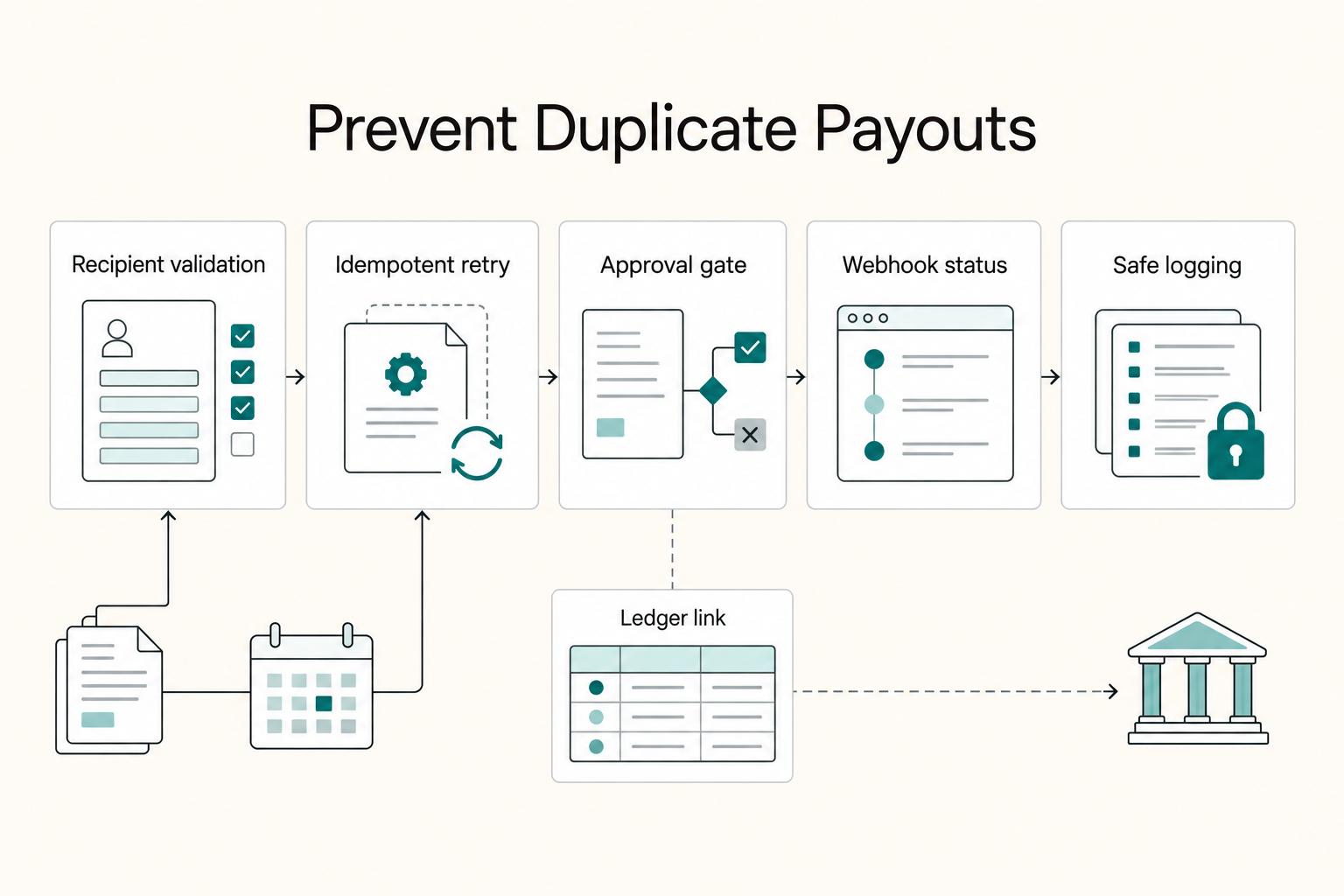
| Pre-send recipient validation | Query recipient requirements before instruction creation, then block submits that miss required fields | Rejected or misrouted payouts from stale templates |
| Idempotent retries | Reuse customerTransactionId and the unchanged payload for the same creation; link separate attempt records to one obligation | Duplicate payouts after network or timeout errors |
| Webhook-driven status | Verify callbacks, deduplicate deliveries, handle ordering, and query current state for gaps or ambiguity | Hidden drift between provider state and internal records |
| Internal approval gates | Add explicit internal approval for higher-risk payout runs before release | Unreviewed bulk errors that amplify quickly |
| PII-safe logging | Keep tokens out of logs; restrict and redact operational copies of sensitive data without altering the raw body used for signature verification | Credential leakage and sensitive data spread |
Keep the same discipline in code and deployment. Never hardcode API credentials in application code. Assign an owner for token issuance, store tokens in a secrets manager, and document how to revoke and regenerate a token on suspected compromise. Limit who can view unmasked operational data.
Test failure behavior before scale#
Suppose a transfer-create call times out. The worker keeps the obligation unresolved, checks for a known transfer reference, and uses a bounded identical retry with the same customerTransactionId when necessary. Once it has a transfer ID, it tracks that transfer instead of creating another. A missing webhook is a reason to query status, not resend money.
Individual transfer states also matter. incoming_payment_waiting means Wise awaits funding; processing means work is underway; outgoing_payment_sent means Wise sent the payout, not that the recipient bank credited it. bounced_back can still lead to delayed delivery or refund. Retain return and refund events even after a transfer was previously marked sent.
The same recovery applies if the operator clicks twice or the worker restarts: the persisted creation identity survives the retry.
How Do You Handle Failed Payouts and Month End Reconciliation Without Chaos?#
Separate invalid inputs, incomplete funding, returned funds, and unknown outcomes. Each needs a different next action; a universal “retry” button can create a second payment.
Start by defining internal exception buckets so every incident lands in one queue with one owner. Then tie each exception bucket to a first action and a replay policy.
| Exception bucket | Typical signal | First action | Replay policy |
|---|---|---|---|
| Rejected input | Definitive validation failure before creation | Correct details and approve the changed request | Use a new creation identity for corrected inputs; retain the original failed attempt |
| Pending funding | Existing transfer waits for funding or required action | Check the original transfer and funding evidence | Resume its supported funding path; resolve a funding timeout before submitting again |
| Returned payment | Bounced-back or refunded state | Confirm current state, recipient details, and refund evidence | Authorize a replacement only after the original outcome is resolved; link a new identity to the same obligation |
| Timeout ambiguity | No reliable response or unclear completion | Keep outcome unknown; query a known reference or reconcile the original creation | Bound identical creation retries with the original customerTransactionId; never switch provider while the outcome is unknown |
Run one replay and reconciliation runbook#
- Persist the same creation UUID and payload across identical retries; do not apply this rule blindly to funding or cancellation.
- Cap retries, use backoff, and escalate when the documented recovery path cannot resolve the outcome.
- Verify and deduplicate callbacks; use event ordering fields and query provider state when events are missing or conflict.
- Reconcile daily, then close the month with separate cleared, pending, returned, and unknown queues.
- Match source debits, target amounts, FX, fees, and refunds to transfer IDs and approved obligations.
- Assign a named owner and response deadline to every unresolved item.
Protect critical windows with explicit escalation#
For payroll and high-trust invoice payments, define a failsafe that triggers fast human review before cutoff risk grows. Imagine a small team processing contractor payouts when one transfer stalls in an ambiguous state. Their runbook blocks duplicate sends, checks webhooks and provider status, and escalates only that item while the rest of the batch continues.
Keep expectations market-aware. Wise feature availability is not universal across countries, and behavior or costs can vary by transaction context. Document these constraints in your ops notes so your workflow stays predictable where supported.
What Costs and Coverage Limits Should You Confirm Before You Depend on Automation?#
Wise describes ordinary API use as free in its help overview. That is not a zero-cost payout promise: budget quoted transfer fees, currency conversion, and your integration operations. For a Wise Platform partnership, confirm the agreed commercial terms separately.
Price the actual route and funding method, including whether the obligation fixes a source amount or the recipient’s target amount. Monitoring, incident response, testing, and compliance work remain operating costs even when there is no separate API subscription charge.
Validate unknowns before rollout#
Treat unknown behavior as a test case, not a guess. Docs help, but they do not replace production validation.
| Area | What to test | Specific condition |
|---|---|---|
| Endpoint behavior | Test endpoint behavior | Normal, slow, and timeout conditions |
| Auth edge cases | Validate auth edge cases early | A personal API token has limited access and cannot be used for certain endpoints |
| Batch transfers | Run batch transfer tests | Include partial failures inside one batch |
| Jurisdiction constraints | Confirm jurisdiction constraints | Account country, supported currencies, verification requirements, and any required manual funding |
| Webhook and reconciliation | Verify the flow still closes cleanly after retries | After retries |
You want to see how the flow behaves under slow responses, limited token scope, partial batch failure, jurisdiction constraints, and post-retry reconciliation.
In a hypothetical launch rehearsal, a team discovers that its personal token can draft a transfer but cannot fund it for the account country. It keeps the approved transfer, adds an authorized manual funding step, and verifies statement access. If it needs broader API access, it discusses partner eligibility with Wise before committing to that design.
Ask due diligence questions before scale#
Use this checklist with your Wise contacts before you depend on payment automation at scale.
| Area | Question to ask | Why it matters |
|---|---|---|
| Support ownership | Which support path owns Wise Open API incidents for our account type and workflows? | You avoid handoff delays during live issues. |
| Incident visibility | Where should our team monitor incidents and maintenance updates? | Wise publishes a public status surface, so your operators need one place to decide next actions. |
| Availability planning | What service expectations should we design around for our workflow? | You set failover and escalation rules without assuming guaranteed uptime terms. |
| Compliance controls | Who owns KYC, KYB, and AML tasks, additional verification requests, and the review cadence required for our actual program? | You prevent policy drift and surprise blocks. |
| Market scope | Which countries, products, and verification paths apply to our exact program? | Requirements vary by jurisdiction and configuration. |
Record the tested account country, credential type, endpoint version, currencies, funding method, and approval configuration. An operator should be able to see which step is automated and which still needs authorized human action.
Treat Wise API Automated Payments Like Core Operations Before You Scale#
Scale only when each obligation can be traced from approval through transfer creation, funding, status changes, and reconciliation. That trace makes a late or returned payment manageable without duplicating it.
Keep it simple. Pick the right mode for the work: manual runs for true exceptions, repeatable flows for predictable timing, and Batch Group patterns when you need coordinated mass payments. Then install the control layer: use customerTransactionId for idempotency checks, define retry boundaries, and assign ownership for every exception.
Before you scale in production, run this checklist:
- Map one payout path end to end, from request creation to transfer status.
- Test in a sandbox account first so you can validate logic without touching live funds.
- Verify webhook signatures, durably store events, return HTTP 200 within 5 seconds, and process asynchronously; query status when callbacks are missing.
- Reconcile statement debits, FX, fees, and refunds on a fixed cadence, using authorized downloads when API access is unavailable.
- Confirm credentials and endpoint access early, since token scope can differ by auth approach.
In a hypothetical internal run of three independent standard transfers, USD 200, USD 300, and USD 500 obligations total USD 1,000 before fees; each transfer has its own funding step. The USD 200 transfer is sent, USD 300 is waiting for funding, and the USD 500 creation response times out. The operator resolves the unknown creation with its original identity and resumes the existing unfunded transfer. This is not partial Batch Group funding. For a Batch Group, close the group and meet its full funding requirements, then track each member’s outcome; group COMPLETED never marks all recipients paid.
Expand only after a small production cohort has demonstrated the supported funding path, callback handling, recovery, and statement matching for the account and routes you will actually use.
If you want a practical implementation companion, read Automating Your Freelance Finances: A Guide to Tools and Workflows. Then use Wise docs, request access, or contact sales to validate fit before you expand automated payouts.
Frequently Asked Questions
Can I automate batch payments with Wise API and what are the practical limits?
A batch group can contain up to 1000 transfers for supported funding methods. Create the group with a source currency, add validated transfers while it is NEW, then set it to COMPLETED to close modifications before funding. COMPLETED describes the group, not successful delivery. Check each transfer and resolve partial failures separately.
What is the difference between recurring transfers, standing orders, and batch transfers?
A scheduled transfer is a one-time payment arranged at least two days ahead; a standing order is a recurring scheduled payment. Wise manages these on its website or app. The chosen date is a sending or funding date, not a guaranteed arrival date: use the transfer’s estimate. A batch instead groups multiple transfers for a funding cycle.
What do I need first to start automation with Wise Business, API token setup, and sandbox testing?
Use a verified Wise Business account for live payments and set up 2-step verification. Wise’s sandbox setup guide describes new test environments as pre-funded with 1,000,000 GBP of test credit; this is not spendable live money. Test creation, funding access, approval compatibility, failures, and reconciliation, then verify production permissions independently.
Does Wise charge extra for API automation workflows?
Wise describes API use as free, but transfers and FX still carry the applicable quoted costs. Separately agreed Wise Platform terms need their own commercial check. Include monitoring, exception handling, testing, and reconciliation in the operating budget.
How should I design retries so I do not create duplicate payouts?
For the same transfer creation, persist and reuse customerTransactionId with the original payload on bounded retries. Query a known transfer ID to resolve ambiguity. A corrected replacement needs a new identity and approval after the original outcome is resolved. Funding and cancellation need their own documented recovery rules; a timeout does not authorize a second payout.
What should freelancers check before moving from manual payments to API-driven workflows?
Check five items before go-live: account verification status, credential scope, payout mode fit, exception ownership, and reconciliation readiness. Keep tests focused on real failure paths, not only happy paths. If you want a practical rollout sequence, use Automating Your Freelance Finances: A Guide to Tools and Workflows.
How do I reconcile webhook events and payout statuses at month end for cross-border transfers?
Use verified webhook events alongside queried transfer states and statement evidence. Match transfer IDs, source debits, FX, fees, target amounts, and refunds to your internal obligations. Keep pending and unknown items open at month end. Download statements manually if the personal token cannot retrieve them for your account country.
Watch
Wise API for Automated Payments
Try a related tool
Researched and edited by the Gruv editorial team. Gruv builds cross-border billing, payouts, and finance-operations software for global businesses.
Sources
Educational content only. Not legal, tax, or financial advice.
Related Posts

How LLC Owners Separate Business and Personal Finances
For an LLC, separating business and personal money is best treated as a weekly habit, not a one-time bank setup. It keeps records cleaner, cuts month-end cleanup, and creates clearer boundaries as the company grows.

Automating Freelance Finances Without Losing Cashflow Control
Automate repeated administrative steps while keeping invoice, payment, settlement and available-cash records distinct. A scheduled invoice saves work; it does not guarantee collection or make funds available.

How to Create a Signature Talk for Your Freelance Expertise
A signature talk can be a reusable business asset, not a one-off performance. Keep one core argument stable, then adapt examples, pacing, and the close for the room in front of you.