
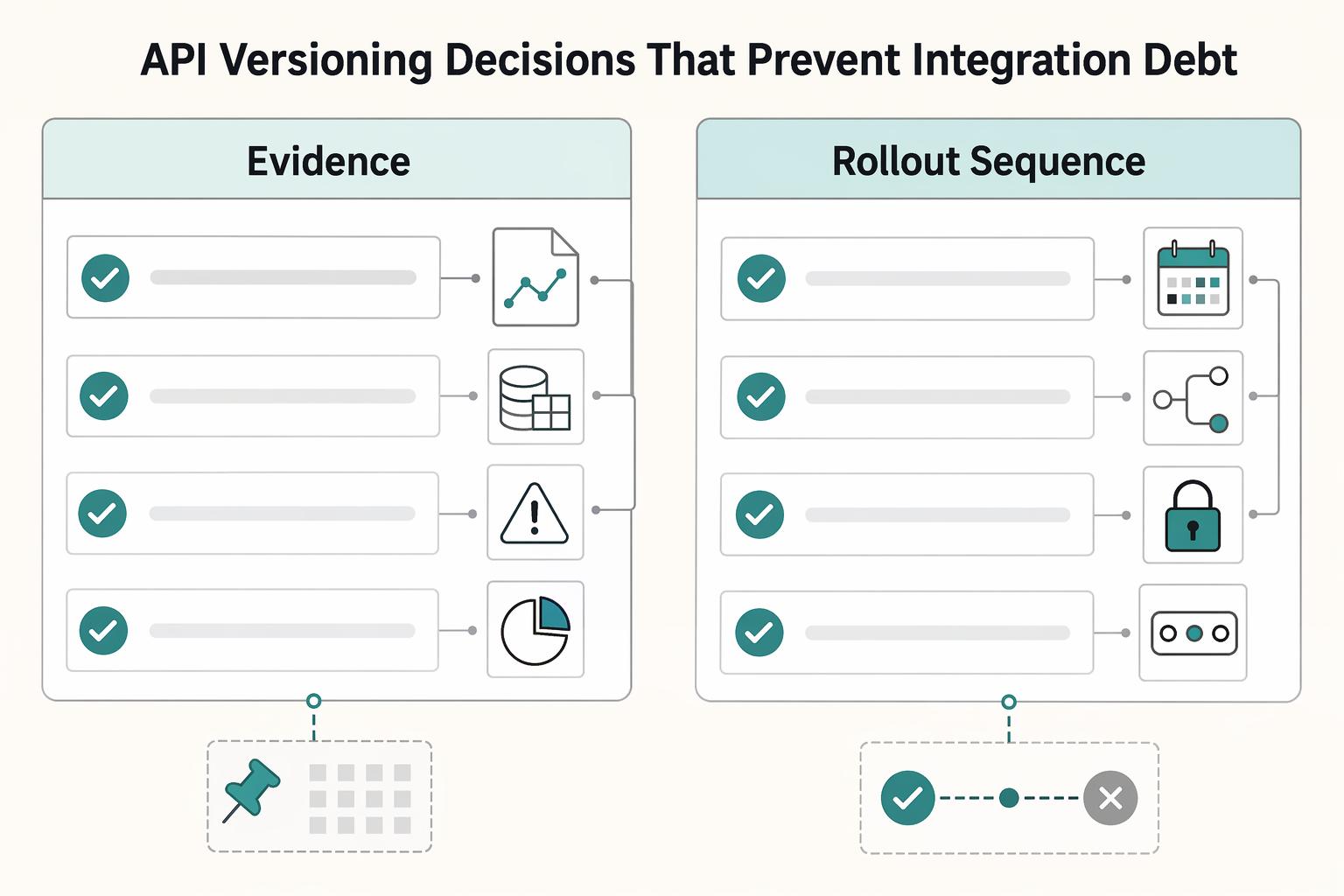
Quick Answer
Map consumers first, then choose your versioning path from real upgrade behavior. Build an endpoint inventory with owners, classify surfaces as Public API or Experimental API, and treat any change that can fail unchanged clients as breaking. Ship only with migration artifacts in hand: before/after payload examples, status-code mapping, and auth-scope changes. Enforce a bounded migration window, monitor adoption by cohort, and retire old paths only after reliability checks pass.
API versioning decisions that prevent integration debt#
If your team ships payments, onboarding, reporting, or payouts, treat versioning as a risk decision first and a design choice second. A weak call here does not stay inside the API team. One breaking change can trigger broken applications, frustrated consumers, and technical debt that gets harder to unwind with every release.
Step 1: Define the blast radius before you debate style. This guide is for CTOs and engineering leads who run APIs that other teams, partners, or customers depend on in production. In that setting, versioning is not an abstract architecture topic. It is about whether existing consumers keep working while you change contracts, auth rules, and data shapes under delivery pressure.
That is the real job of API versioning: let you change an API without breaking current consumers. The usual failure mode is familiar. Teams treat versioning as an afterthought, and the damage shows up later as broken applications, frustrated users, and rising technical debt. If your current API grew organically from something like "Version 1.0" into a broader platform surface, assume there may be hidden coupling until you prove otherwise.
Use one simple checkpoint before you go further: can you name the client groups that would be affected if one response field disappeared or one required parameter changed tomorrow? If not, you are not choosing a versioning approach yet. You are still discovering risk.
Step 2: Set the outcome you actually want. The goal here is narrower, and more useful, than "just version it." You should leave with a practical way to choose an approach, sequence the rollout, and retire old versions without breaking critical consumers.
Before implementation starts, you need three concrete outputs:
- A documented decision on how you will version public changes.
- A rollout sequence that includes coexistence, migration, and shutdown.
- Evidence that clients can move safely, such as contract diffs, before and after payload examples, and a record of which consumers have validated the change.
One published case study from May 26, 2025 described a team evolving across four major versions without breaking a single client. That is not industry proof. It is a credible reminder that careful sequencing can work even after an API has already accumulated debt.
Step 3: Scope this for regulated and audit-heavy work. For audit-heavy integrations, generic advice is not enough. You need an explicit deprecation policy, migration evidence you can point to later, and operational checkpoints that show the old and new behavior were understood before anything was closed down.
A clear red flag is vague language like "clients should be fine" or "this is non-breaking" with no saved contract comparison and no named owner signoff. If the change touches payment flows, onboarding eligibility, reporting exports, or payout timing, require written migration artifacts and a checkpoint confirming that critical consumers were tested against the new contract. That keeps API governance real instead of aspirational.
What to prepare before you touch a production API#
Before you choose a versioning style, confirm what is live and who depends on it. If you cannot name the affected Endpoint, client app, and owner, you are still in discovery.
| Step | Action | Details |
|---|---|---|
| 1 | Build a working endpoint inventory | List each externally consumed Endpoint and map it to a named owner, known client apps, and business criticality |
| 2 | Pull usage evidence before risk calls | Use API usage analytics to identify active endpoints, real Request parameter usage, and adoption trend |
| 3 | Confirm constraints that will shape strategy | Check Deployment environment limits, Database schema coupling, and Monitoring system coverage |
| 4 | Classify interfaces and document change policy | Mark surfaces as Public API or Experimental API, then write the allowed change policy for each |
Step 1: Build a working endpoint inventory. List each externally consumed Endpoint and map it to a named owner, known client apps, and business criticality. Keep it lightweight, but require an owner on every row so compatibility risk is visible before changes are proposed.
Step 2: Pull usage evidence before risk calls. Use API usage analytics to identify active endpoints, actual Request parameter usage, and adoption trend. This is how you estimate blast radius from production behavior instead of assumptions.
Step 3: Confirm constraints that will shape strategy. Check Deployment environment limits, Database schema coupling, and Monitoring system coverage before design debates. If you cannot observe old and new behavior clearly, version rollout and rollback decisions become guesswork.
Step 4: Classify interfaces and document change policy. Mark surfaces as Public API or Experimental API, then write the allowed change policy for each. Keep it explicit and reviewable, and align it with documentation, automated testing, and Backward compatibility.
Related: How to Do a 1031 Exchange for Investment Property.
What is a breaking change in real integration terms#
Treat a change as breaking if a client that worked yesterday can fail after release without changing its code. In practice, common break signals include removed Endpoints, renamed Response property values, newly required Request parameters, different HTTP status codes, and tighter Authorization requirements.
| Signal | Example from the section |
|---|---|
| Endpoint removal | removed Endpoints |
| Response value rename | renamed Response property values |
| Required parameter change | newly required Request parameters |
| HTTP status change | different HTTP status codes |
| Authorization tightening | tighter Authorization requirements |
| Behavior model change | sync-to-async behavior changes |
| Authentication tightening | stricter Authentication requirements |
Classify a change as backward compatible only when default client behavior still works under your documented Backward compatibility rule. Additive changes are not automatically safe if they change how existing consumers behave in production.
Handle gray zones conservatively. Shifts like sync-to-async behavior changes or stricter Authentication requirements can still break real integrations even when the schema diff looks small. If your current consumer contract tests can fail, treat the change as breaking and version and communicate it accordingly.
How to choose API evolution or explicit versioning#
Choose API evolution when most consumers can move within one planned Migration window without breaking existing behavior. Choose Explicit versioning when mission-critical consumers upgrade more slowly and you need parallel contracts for a period.
That decision follows the break test from the previous section: if unchanged clients can fail, either coordinate one migration or run coexistence deliberately.
Decide from consumer upgrade reality, not architecture preference#
Start with actual consumers in each Deployment environment. If clients are mostly coordinated and can adopt changes together, evolving one contract is usually simpler to operate. If you support external partners or other slow-moving consumers, explicit versioning is often safer for containment.
For Public APIs, SailPoint provides a policy example: public APIs generally avoid breaking changes, while compatibility-preserving additions can still ship. It also lists adding an optional parameter as a non-breaking change example. Use that as a practical litmus test: if current clients keep working unchanged, evolve; if not, plan coexistence.
Compare tradeoffs in your environment#
There is no universal cost or speed winner. Use your own constraints to choose.
| Criterion | API evolution fits when | Explicit versioning fits when |
|---|---|---|
| Client diversity | Consumers are mostly known and can migrate on a similar cadence | Consumers vary widely and upgrade on uneven cycles |
| Compliance impact | One coordinated migration can be approved together | Different consumer groups require staged approvals or evidence |
| Parallel-run cost | Running old and new behavior in parallel is not worth the overhead | Parallel support is acceptable relative to migration risk |
Monitoring system maturity | You want fewer moving parts to monitor | You can monitor behavior separately by version/cohort |
| Incident containment | Broad coordinated rollout and rollback are realistic | You need tighter isolation by version or client segment |
Write lifecycle policy before announcing the change#
Decide the path together with lifecycle rules: Deprecation policy, migration window, sunset criteria, and rollback triggers. Versioning is both change management and communication to consumers, so define the contract and the communication plan together.
SailPoint is useful as one policy example: it describes an annual release schedule for introducing new APIs and deprecating unsupported APIs, recommends using the latest public API version, and notes its own versioning process can change. Your cadence can differ, but consumers should know it in advance.
You might also find this useful: How to Version Your Payment API: Strategies for Backward-Compatible Changes.
Pick one versioning mechanism and document why#
Pick one primary versioning mechanism and make it the default across teams. Using multiple signaling methods for the same API surface usually creates confusion during migrations and incidents, and versioning still requires clear communication to consumers.
Evaluate mechanisms against your operating reality#
Compare URI path versioning, Header versioning, Query parameter versioning, and Content negotiation against the way your teams actually build, support, and troubleshoot the API. For public APIs, even small contract changes can break integrations, and adding a version number in the URL alone does not remove that risk.
| Mechanism | Prefer it when | Confirm before standardizing |
|---|---|---|
| URI path versioning | Discoverability and operational simplicity matter most in your environment | Teams can consistently identify and communicate versions in docs, tooling, and support workflows |
| Header versioning | URL stability is a hard requirement | Clients and support processes can reliably send, read, and troubleshoot version headers |
| Query parameter versioning | You need a visible version signal without changing path structure | Clients and platform tooling handle the parameter consistently |
| Content negotiation | You already manage representation through negotiation patterns | Consumers and teams can operate that pattern consistently under change |
Keep consumer-based versioning as an exception path#
Use Consumer-based versioning selectively for strategic clients with real contractual, SLA, or dependency constraints. Do not make it the default model if you want support and deprecation to stay measurable.
Pair mechanism and naming policy in standards#
After you choose the mechanism, pair it with one naming policy: Semantic versioning or Date-based versioning. Either can work if you apply it consistently. Document the exact rule in API standards, release checklists, and change notices so every team can explain and apply the same contract logic.
Execute a zero-surprise rollout in four phases#
A zero-surprise rollout depends less on the version label than on staged evidence at each step. Use four phases as an operating pattern: make breaking deltas explicit, control client impact, and keep migration from drifting.
| Phase | Action | Evidence or control |
|---|---|---|
| 1 | Publish the contract diff before release | Document every changed Endpoint, Request parameter, and Response property; call out removed or renamed elements and changed response structures in plain before and after examples; confirm documentation and automated contract tests agree on expected behavior |
| 2 | Dual-run where your architecture supports it | Run old and new behavior in parallel when feasible; use the Monitoring system to watch error drift and confirm the new behavior matches the documented contract in production-like conditions |
| 3 | Run a bounded migration window and track real adoption | Set a clear Migration window; ship SDK updates, examples, and change notes tied to the contract diff; track cutover by consumer cohort with API usage analytics |
| 4 | Complete deprecation and cleanup | Apply the Deprecation policy; retire old paths deliberately; remove dead code and stale docs; close the rollout only after current-version tests and monitoring show stable behavior post-cutover |
Step 1: Publish the contract diff before release. Document every changed Endpoint, Request parameter, and Response property so consumers can see what is additive and what is breaking. Call out removed or renamed elements and changed response structures in plain before/after examples. Do not move forward until your documentation and automated contract tests agree on expected behavior.
Step 2: Dual-run where your architecture supports it. Run old and new behavior in parallel when feasible so you can compare real traffic outcomes before full cutover. Use your Monitoring system to watch error drift and confirm the new behavior matches the documented contract in production-like conditions. If dual-run is not feasible in your design, make that constraint explicit and tighten testing before migration.
Step 3: Run a bounded migration window and track real adoption. Set a clear Migration window, then ship only the migration assets clients need: SDK updates, examples, and change notes tied to the contract diff. Track cutover by consumer cohort with API usage analytics, not just aggregate traffic, so lagging high-impact clients are visible early. Keep compatibility and contract checks running throughout migration.
Step 4: Complete deprecation and cleanup. When the window closes, apply your Deprecation policy and retire old paths deliberately rather than leaving partial compatibility in place. Remove dead code and stale docs so teams are not supporting two versions by accident. Close the rollout only after current-version tests and monitoring show stable behavior post-cutover.
Apply this sequence consistently and versioning becomes controlled change management instead of long-lived integration debt.
Need the full breakdown? Read How to Choose API Testing Tools by Cost, Compliance, and CI/CD Fit.
Manage deprecation and migration communication without ambiguity#
Clear deprecation communication should answer what changed, who is affected, when migration is expected, and what still works during the transition.
Step 1: Publish one source of truth for every Public API change. Use a single change notice for affected Public API surfaces, and point docs, support replies, and release notes to it. Include impacted endpoints, migration timeline, exact contract deltas, and fallback behavior during migration. Be explicit about deltas like renamed fields, new required parameters, or changed HTTP status code behavior.
Step 2: Separate Experimental API communication from production commitments. For Experimental API surfaces, state clearly that interfaces may change quickly and are not appropriate for production-critical dependencies. Keep that label consistent across docs, changelogs, and onboarding examples so expectations stay aligned.
Step 3: Ship migration artifacts clients can execute immediately. A deprecation notice is not complete without client-ready migration material:
- Before/after request and response payload examples
HTTP status codemapping for old and new behavior- Auth scope or authorization requirement changes
- A short staging or pre-production test checklist
Step 4: Use API usage analytics to govern milestones, not calendar dates alone. Keep timeline dates, but gate enforcement with API usage analytics by endpoint and consumer cohort. If high-impact consumers are still active on the old version, keep migration support focused there before cutoff decisions.
Common failure modes and recovery steps#
Most versioning incidents come from weak deprecation discipline and risky contract changes, not the version label itself. Use this recovery pattern: reduce live-version sprawl, re-check auth behavior with real client access, restore broken response contracts quickly, and extend migration only where it is truly needed.
| Failure mode | Recovery step |
|---|---|
| Teams underestimate multi-version cost and keep too many versions active. | Cap concurrent versions and enforce stricter Deprecation policy gates. No versioning strategy removes old-version burden, so the lifecycle must be clear, communicated, and enforced. |
| Hidden auth breakage appears after release. | Re-validate Authentication requirements and Authorization requirements against real client credentials, not only internal or staging checks. |
| A "non-breaking" change causes client crashes. | Treat it as breaking in practice: restore the prior Response property contract first, then hotfix docs and tests before retrying rollout. |
| Migration stalls and support load rises. | Re-segment affected consumers by criticality, extend only targeted Migration window cohorts, and escalate account-level support where adoption is blocked. |
Related reading: How to Create a Secure Backup Strategy for Your Freelance Business.
Final checklist for handling breaking changes with less risk#
Breaking-change risk is usually a release-discipline problem more than a design problem. Before rollout, make the decision, evidence pack, and retirement plan explicit and approved.
- Lock the decision before traffic moves.
Document the change classification, strategy choice, and mechanism choice in one place. State whether this is truly breaking, whether you are evolving the current contract or creating a new version, and whether you are using URI or Header versioning. URI versioning is generally easier to implement, test, and cache; Header versioning keeps URIs clean but adds caching complexity. Check: approval includes affected Public API surfaces, owner, rollback trigger, and exact contract deltas.
- Build the rollout evidence before release day.
Do not treat CI as sufficient. Silent breaking changes are still backward-incompatible changes, and tests can miss behavior shifts until after deployment. Include contract diffs, before/after payload examples, status-code mapping, auth-scope changes, and at least one failing old-behavior request/response pair. Check: validate with real client tokens, not only internal service accounts; watch for shifts like 401 Unauthorized and 405 Method Not Allowed.
- Roll out in phases with explicit checkpoints.
Run old and new behavior in parallel where possible, then monitor usage and error drift by consumer cohort before expanding exposure. No versioning strategy removes old-version retirement work, so define a clear, communicated, and enforced deprecation lifecycle before migration starts. Check: retire old versions only when usage and reliability targets are met on the new version.
- Use one calendar and one policy owner.
Align product, platform, and ops on one release calendar and one source of truth for version policy. That policy should define what counts as breaking, who approves exceptions, how deprecation notices are sent, and what evidence is required to shut down an old version. Check: every team can quickly answer which version is live, which is deprecated, and where the notice is published.
For a step-by-step walkthrough, see How to Build a 'Glocal' Marketing Strategy for Your SaaS Product.
Frequently Asked Questions
What is a breaking API change?
A breaking change is any change that can make an existing client fail without that client changing its code. In practice, teams look for breaks across endpoints, schemas, parameters, and related contract behavior. If you want a verification step, add automated contract-diff checks in pull requests.
When should you create a new API version instead of evolving the current one?
Create a new version when you cannot preserve backward compatibility for current clients on the existing surface. If existing clients keep working as-is, you can often evolve the current version instead. A practical heuristic is this: if current consumer contract tests fail, a new version is usually safer.
Can a `Public API` ever ship breaking changes?
Yes, but treat them as explicit, planned changes rather than silent edits to the current contract. Use clear versioning and migration communication when you do. The red flag is shipping a “small” response change directly to production when clients may use strict JSON parsers that can fail on unexpected fields.
How should teams treat an `Experimental API` in production planning?
Treat it as changeable and avoid making it production-critical unless you are prepared for churn. Your docs should state that its stability expectations differ from a versioned public contract. If a critical flow depends on it, promote it to a versioned public contract first.
Why does supporting multiple API versions become expensive so quickly?
Supporting multiple live versions often adds operational overhead because each version needs ongoing validation and coordination. The exact cost depends on your system and consumers. A practical checkpoint is to track an owner and retirement condition for every active version.
Which is easier to operate at scale: `URI path versioning` or `Header versioning`?
URI path versioning is one established option, and alternatives exist. This guide does not establish a universal winner. Choose the approach your tooling can verify and your support team can operate reliably.
What should be in a pre-release and migration checklist before deprecating an old version?
Include contract diffs for affected endpoints and validate behavior with real client integrations. Keep concrete failing request/response examples when issues appear. This helps catch parser-related risks, including strict JSON parsers that can choke on unexpected fields.
Try a related tool
Researched and edited by the Gruv editorial team. Gruv builds cross-border billing, payouts, and finance-operations software for global businesses.
Sources
Includes 5 external sources outside the trusted-domain allowlist.
- cs.cmu.edu/~ckaestne/pdf/tosem21.pdftrusted
- dodcio.defense.gov/Portals/0/Documents/CMMC/AssessmentGuideL2v2...trusted
- www2.eecs.berkeley.edu/Pubs/TechRpts/2024/EECS-2024-3.pdftrusted
- dev.to/eugenioenko/identifying-silent-breaking-chan...external
- developer.sailpoint.com/discuss/t/a-smoother-development-experience-...external
- developer.sailpoint.com/docs/api/v2024/api-versioning-strategyexternal
- developers.dev/tech-talk/api-versioning-strategies-in-a-mic...external
- digitalapi.ai/blogs/critical-api-fixes-for-leaders-before-...external
Educational content only. Not legal, tax, or financial advice.
Related Posts
Tax-Loss Harvesting for U.S. Expats Living Abroad
Before you sell anything, settle one question: which country may tax the sale, and which records will support the filing. If residency is clear, move on. If you see dual-residency signals or treaty uncertainty, stop and sort that out before you trade.
How to Do a 1031 Exchange for Investment Property
A 1031 exchange is a tax-deferral strategy, not a tax eraser. Use it when you are selling real property held for business or investment and plan to stay invested in other real property. If you need immediate cash, want a simpler close, or may not buy again on schedule, a standard sale is often the simpler, lower-risk path.
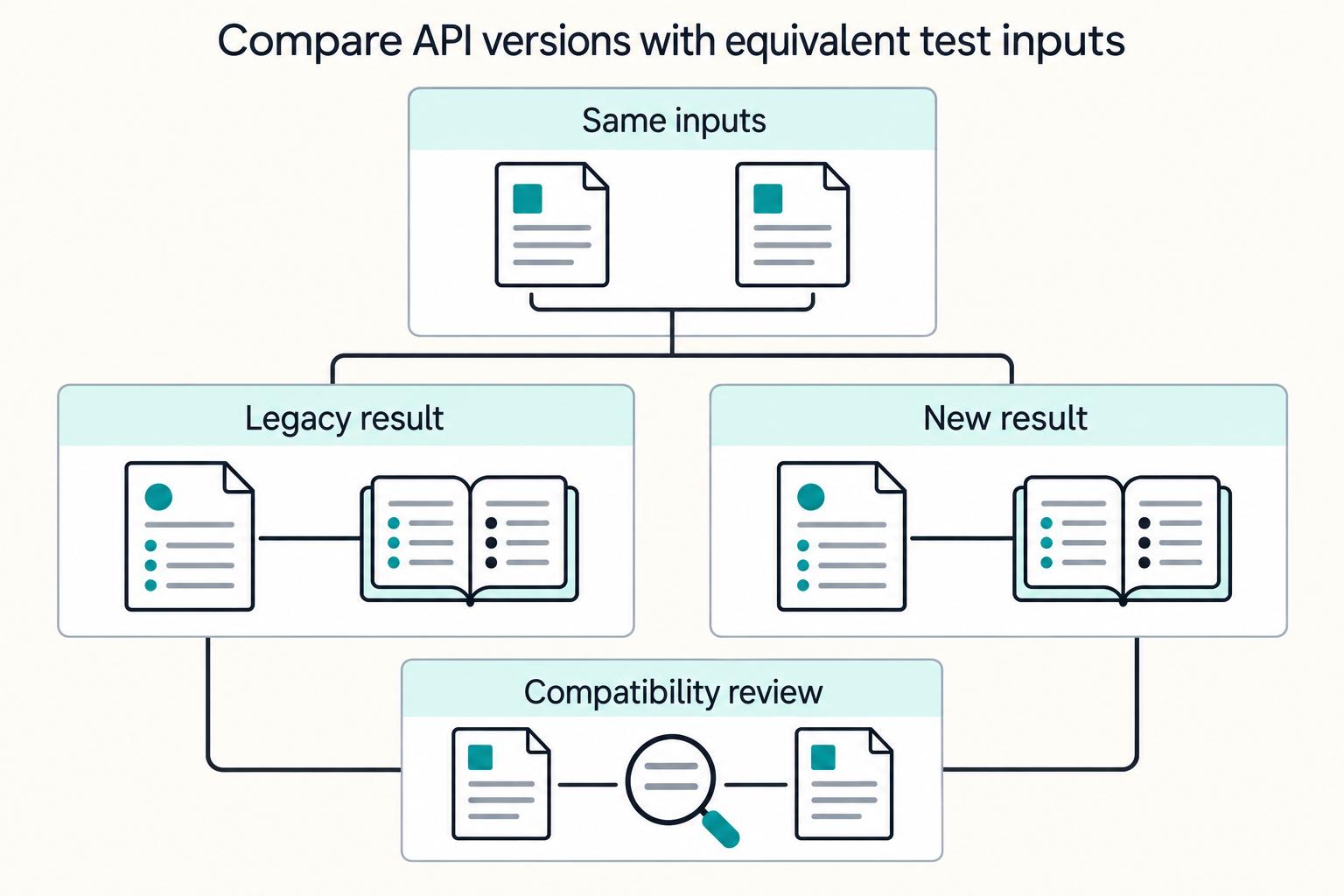
How to Version Your Payment API: Strategies for Backward-Compatible Changes
Version only when an unchanged client would fail or behave differently. Otherwise, keep the change in the current version. That distinction between `Non-breaking change` and `Breaking change` is the core rule for versioning.