
Quick Answer
Version your payment API only when an unchanged client would fail or behave differently. If existing consumers can keep working without code changes, keep the change in the current version and prove compatibility with contract, integration, and cross-version tests. When behavior must change, introduce a new version, support both versions in parallel, and publish deprecation and migration guidance early.
Why Versioning Strategy Matters#
Version only when an unchanged client would fail or behave differently. Otherwise, keep the change in the current version. That distinction between Non-breaking change and Breaking change is the core rule for versioning.
API versioning lets you evolve contracts without breaking existing integrations. In practical terms, backward compatibility means current consumers keep working without code changes, so many updates can stay in the same version when they preserve existing behavior.
That matters even more in payments. Small contract shifts can have outsized downstream effects. A change to a required field, format, or error shape can break dependent systems even when the update looks minor.
REST API contracts and event-driven integrations span onboarding, invoicing, payouts, and reporting. The focus here is practical version choice and contract evolution, whether you are changing an endpoint response or an event payload.
You will evaluate common versioning surfaces, including URI paths, request headers, and query parameters, without treating one as universally correct. The goal is to keep version signals intentional and stable so old and new behavior can coexist while clients migrate.
Use one check throughout: can an existing client keep current behavior without code changes? If yes, prefer the non-breaking path. If no, treat the change as breaking and plan a new version.
When a new version is necessary, plan deprecation early. Keep older behavior available for migration, and announce deprecation well before removal with a clear timeline.
By the end, you will have a practical approach for choosing a version surface, classifying compatibility, supporting migration, and retiring older behavior with less version debt.
If you're evaluating payment infrastructure, see Evaluate an API-First Payments Partner for Your Platform.
Prerequisites and evidence to gather before you touch a version#
Start with evidence, not assumptions. Even minor updates can disrupt downstream consumers, so your version decision should reflect what clients actually send and consume today.
Step 1 Gather the live contract behavior#
Map the API contracts actually in use. For each active contract, confirm the current shape and whether clients still depend on it.
Step 2 Confirm how version signals are carried#
Verify how clients select behavior today, because that sets migration risk. Common patterns include explicit path versions, such as /api/v1/users and /api/v2/users, or a versioned Accept header, such as application/vnd.myapp.v1+json.
Step 3 Check compatibility expectations before classifying the change#
Before you label a change, check whether unchanged clients still work. Keep semantic versioning intent explicit while you decide scope: MAJOR for incompatible changes, MINOR for backward-compatible functionality, and PATCH for backward-compatible fixes.
Step 4 Validate integration prerequisites that can break flows#
Before rollout, confirm any required integration setup that affects runtime behavior. For mobile redirect flows, for example, verify app return URL or deep-link configuration and account for provider constraints such as prohibitions on embedded WebViews where applicable.
Related: Working Capital Optimization for Platforms: How Payment Timing Affects Your Cash Position.
Choose your versioning surface before you ship#
Choose the versioning surface early, then prove it in staging before rollout. If you delay this choice, you raise the odds of older-client bugs and production failures when consumers receive a contract they did not explicitly target.
Step 1 Check what your gateway can actually route and observe#
Audit existing API usage, then start with capability rather than preference. For URI path, header, and query-parameter approaches, validate in staging what each option supports for routing, observability, and handling missing or unsupported versions.
If a candidate surface cannot be operated and observed reliably in staging, take it off the table before rollout.
Step 2 Match the surface to your client reality#
Pick the surface that fits your client mix and operating model, not the one that looks cleanest on a diagram. Compare URI path, header, and query parameter versioning against how integrators actually send requests and how quickly your team can identify the active version during support and incident response.
Treat assumptions like "this is cleaner" or "this is easier for partners" as hypotheses until traffic patterns and support workflows back them up.
Step 3 Refuse silent fallbacks#
Avoid defaulting missing version signals to latest unless that behavior is explicitly documented and tested. Silent fallback can hide compatibility issues and delay detection in older clients.
Prefer explicit behavior. If the version is missing, malformed, or unsupported, return a clear error with the valid version choices.
Step 4 Keep REST API and Webhook policy aligned#
Where feasible, align compatibility and deprecation handling across synchronous and asynchronous contracts so behavior stays predictable. Reflect that policy in your contract artifacts: update and validate your OpenAPI spec for REST, document webhook version identification, and keep both under the same changelog and deprecation process.
For the full breakdown, read How to Expand Your Subscription Platform to Europe for Payment and VAT Readiness.
Classify every proposed change before coding#
Classify each change before implementation. This is where teams ship a "minor" update that still breaks older clients even when responses continue to return 200 OK.
Step 1 Build a binary change matrix#
Use one shared matrix with fixed columns: proposal, compatibility label, required action, and merge evidence. Keep the labels strict: Non-breaking change or Breaking change.
| Proposal | Compatibility label | Required action | Merge evidence |
|---|---|---|---|
| Add optional response field | Non-breaking change only if older clients can ignore it safely | Keep version, update OpenAPI, run compatibility checks | API contract testing, Integration testing, Version comparison testing |
| Add new endpoint | Non-breaking change only if existing behavior is unchanged | Keep version, document endpoint, validate no regression | Integration testing, Version comparison testing on unchanged flows |
| Add required header or parameter | Breaking change unless backward compatibility is proven | Cut a new version or preserve legacy behavior | Contract diff plus legacy-client test evidence |
| Change field type/format (for example, integer to string) | Breaking change by default | New version or explicit dual handling | Contract diff, parser compatibility checks, version comparison results |
| Change error body shape/semantics | Breaking change unless compatibility is proven | Preserve legacy error contract or version it | Negative-path contract tests and legacy-client assertions |
Step 2 Treat additive changes as non-breaking only after proof#
Additive is not automatically safe. Mark additions as non-breaking only when your OpenAPI diff and backward-compatibility tests show older clients still work unchanged.
Use this checkpoint:
- Diff current vs proposed
OpenAPI. - Run
API contract testing. - Run
Integration testingwith at least one legacy client or fixture. - Run
Version comparison testingfor legacy flows. - Capture request identifiers such as
x-request-idin test evidence for troubleshooting.
Step 3 Default risky contract edits to breaking#
Adding required inputs, changing types or formats, or changing error models should be treated as breaking unless tests prove backward compatibility. Response status alone is not enough; removed or reshaped fields can still break consumers even when the response is successful. Compare response shape and behavior across versions.
Step 4 Block merge until each row has evidence#
Do not merge on intuition alone. Require the same evidence for every row before merge: contract test results, integration results, version-comparison results, the OpenAPI diff, and sample request traces.
That keeps version decisions auditable and stops "looked safe" changes from slipping through.
If you want a deeper view on choosing the surface itself, API Versioning Strategies for Payment Infrastructure is a useful companion.
For downstream sync concerns, read ERP Integration Architecture for Payment Platforms: Webhooks APIs and Event-Driven Sync Patterns.
Decide when to keep the same version and when to cut a new one#
Use one rule consistently: stay on the current version only when existing clients keep working without code changes. If consumers must change requests, parsing, or behavior assumptions, treat the change as breaking and plan a new version.
Step 1 Test consumer impact, not engineering intent#
Let client impact drive the version decision, even when the internal change looks small. API versioning includes communicating changes to consumers, and breaking changes can create backward-compatibility failures, including unexpected errors or data corruption.
Run unchanged legacy client fixtures against the proposed release. If the same calls and parsing logic still work with compatible behavior, staying on the current version is usually reasonable. If clients must add required inputs, handle changed types, or reinterpret response meaning, treat that as a breaking change and version accordingly.
Step 2 Keep internal and external version signals aligned#
Use clear versioning signals across your API surface, for example URL or headers, and keep those signals consistent with release notes. That keeps change communication and external routing aligned.
- Clearly label backward-compatible vs. breaking changes.
- Call out consumer impact in release notes and changelog entries.
- Keep spec diffs and compatibility test results aligned with the announced version decision.
Your release notes, Changelog, spec diff, and compatibility test evidence should tell the same story.
Step 3 Use dual support when behavior changes are unavoidable#
When behavior must change, support old and new versions in parallel, publish a retirement timeline, and provide explicit migration guidance. Pair that guidance with compatibility testing and a clear deprecation timeline so consumers can move without guesswork.
Keep the dual-support period intentional. It protects consumers, but it also adds technical debt and can slow delivery.
Step 4 Record the consumer impact in the Changelog#
Tie every version decision to a plain consumer-impact statement, not just an engineering description. Document what changed, who is affected, whether existing clients need code changes, and what action or timeline applies, including retirement timing when relevant.
If you cannot explain consumer impact clearly, you probably do not have enough evidence yet to justify the version decision.
Design compatibility rules for webhooks retries and idempotency#
When a change may affect compatibility, apply the same discipline to async delivery. In practice, breakage often comes from unclear retry and compatibility behavior, not just from a visible field addition.
Step 1 Write webhook compatibility as testable contract rules#
Write webhook requirements so reviews and tests can verify them. Explicit MUST and SHOULD language works because it turns intent into a contract.
For each event family, publish both a human-readable spec and a machine-readable schema. Treat those artifacts as a release checkpoint. If you publish capability metadata with spec and schema URLs, validate that URL origin and namespace authority stay aligned. Mismatches are a release risk because consumers may trust the wrong contract source.
Before merge, require updated spec and schema artifacts and a note that explains the compatibility impact for current consumers.
Step 2 Keep event evolution explicit#
Document the event schema version separately from the request API version. For example, Stripe webhook endpoints can pin an event version independently of a per-request Stripe-Version header. Preserve documented timestamp formats and currency units; test old event payloads as well as events created after an upgrade.
Do not assume consumer tolerance. Define the tolerance behavior you expect in the contract, then verify it in tests so compatibility rests on evidence rather than convention.
Step 3 Make retry and replay behavior explicit#
Treat retries as a reliability concern that needs explicit handling. Integration layers are often fragile, and weak controls can amplify failures across systems.
Keep one business-operation identity across API versions, backed by durable duplicate protection. A version change must not turn an existing payment into a new payment attempt. Verify provider key scope and retention, reject incompatible reuse of a key, and resolve an unknown remote outcome before submitting again. For webhook consumers, commit the processed-event marker and its local effect atomically.
Step 4 Validate async failure modes before rollout#
Before enabling new event shapes, run pre-release checks for retry-related failure modes. The pass condition should confirm compatibility expectations and stable downstream processing under retry stress, not just successful parsing.
If a change only works with stricter assumptions than your current contract, treat that as a compatibility decision and version it accordingly.
Handle payment-specific edge cases across versions#
Treat payment-edge changes as compatibility decisions first. If old and new versions can produce different business outcomes for the same scenario, assume break risk until side-by-side checks prove otherwise.
Step 1 Model business outcomes before payload differences#
Start with lifecycle outcomes, then inspect fields. For a stale, missing, or rejected quote, record whether each version rejects before creating a payment, requires a new quote, or permits a documented fallback. Make amount, currency and expiry assumptions visible in the comparison.
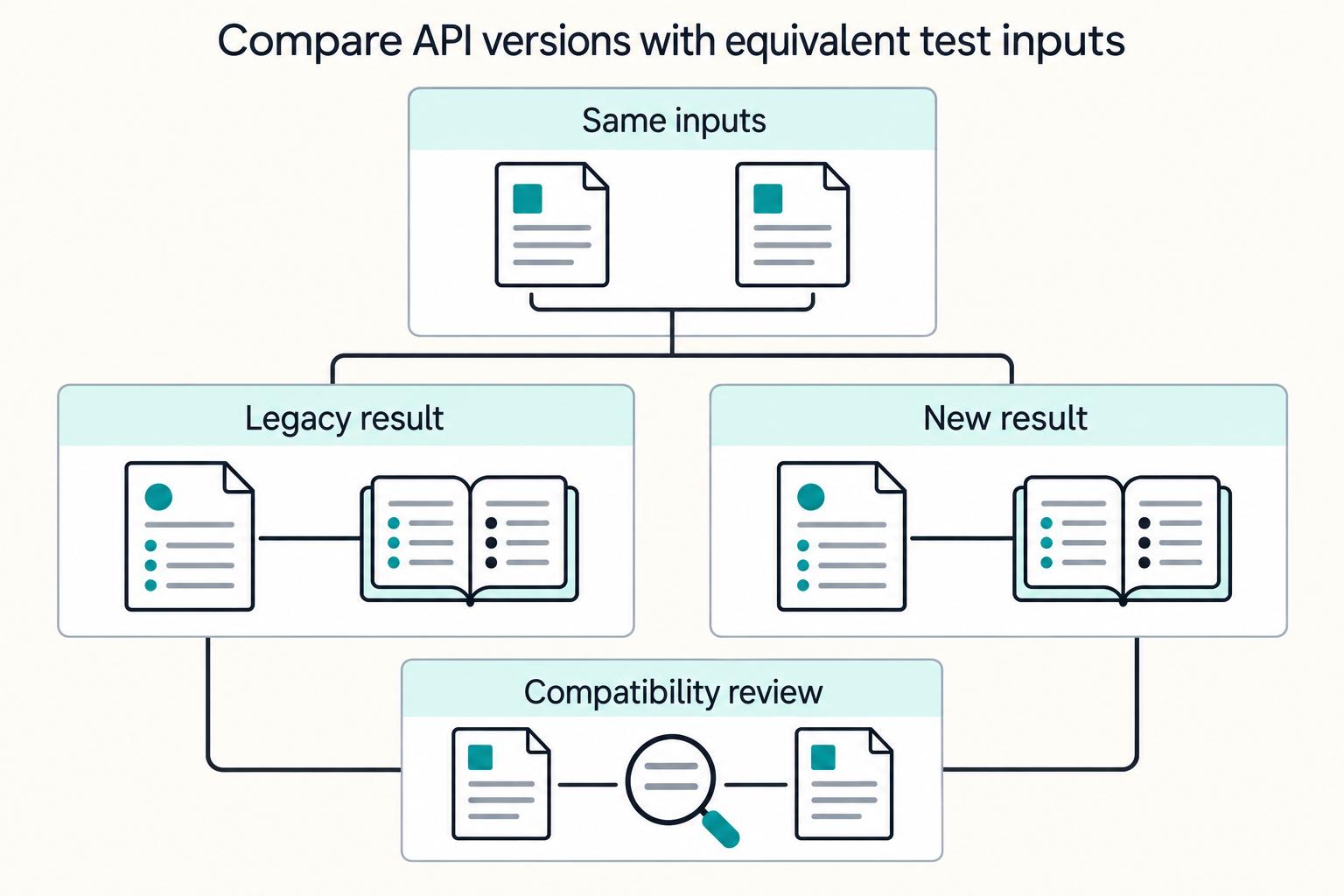
Use equivalent isolated fixtures for the comparison matrix: same input and starting state, old-version result versus new-version result. Never execute two live money movements merely to compare versions. Use a sandbox or a shadow evaluation that cannot submit payments. A changed outcome for unchanged old clients is breaking behavior.
Step 2 Preserve traceability across invoice, payout, and reversal flows#
Carry the original business-operation ID through invoice, payout and reversal records. Compare amounts, currencies, fees and links to provider transactions across versions. A renamed status must not change whether money was submitted, settled, returned or still unresolved; retain the evidence behind each mapped state.
Post-release integration breakage is a known risk: existing customer integrations can stop working suddenly, and downstream apps and automations can fail.
Step 3 Keep payout outcome meaning stable during status evolution#
When payout statuses are renamed, split, or regrouped, preserve their externally visible meaning for existing consumers until migration is complete. Publish the mapping and any ordering limits. A new label must not make a submitted payout appear settled or turn an unresolved outcome into a safe-to-retry failure.
This expectation does not change if you version by URL path or headers. Routing can differ, but backward-compatibility planning still applies.
Step 4 Treat policy-gate updates as behavior changes#
Treat KYC/KYB/AML gate changes as changes to behavior when acceptance, timing or required follow-up differs for existing consumers. Publish old-versus-new examples. If an urgent legal or security obligation requires an immediate change, explain the exception and mitigation instead of promising an overlap that cannot lawfully continue.
For planned changes, publish a phase-out plan for old versions. Document the exceptional conditions under which security, legal or critical bug fixes can shorten that plan.
Related reading: How to Handle Breaking Changes in API Versioning.
Build and run your test gates before rollout#
Do not promote a payment API change based on schema diffs alone. Use explicit rollout gates to verify contract compatibility and regression behavior across the flows you are changing before production.
| Gate | Focus | Evidence |
|---|---|---|
| Contract diff | Diff the current and proposed contract; flag removed or renamed fields, type changes, and optional fields becoming required | Diff evidence plus representative legacy pass and fail cases |
| End-to-end flows | Run regression across full transaction paths and downstream dependencies; retest the specific fix first, then broader suites | Retest record for the fix plus broader regression-suite results |
| Cross-version outcomes | Compare old and new versions using equivalent isolated fixtures or a shadow path that cannot submit live payments | Legacy result, new result, and compatibility judgment |
| Staged rollout check | Validate the same changed flows again in staged rollout conditions | Verification of API-visible results and downstream-system outcomes |
| Promotion review | Compile findings before full exposure | Contract-diff findings and regression results from pull requests, main merges, and canary stages |
Small interface updates can still break downstream payment jobs and checkout-critical paths. Run regression checks at pull requests, main-branch merges, and staged rollouts such as canaries so breakage is caught before full exposure.
Step 1 Run a contract gate from your API diff#
Start with the contract: what URL is called, which inputs are accepted, what responses look like, and what fields mean. Diff the current and proposed contract, then flag likely breaking changes such as removed or renamed fields, type changes, or optional fields becoming required.
Then add tests for legacy request shapes so compatibility is proven, not assumed. For each changed endpoint, keep evidence of the diff plus representative legacy pass and fail cases.
Step 2 Exercise end-to-end payment flows, not isolated endpoints#
Once contract checks pass, run regression testing across full transaction paths and downstream dependencies. Endpoint-level success is not enough if downstream services still depend on older headers or response assumptions.
Keep the sequence tight: retest the specific fix first, then run broader regression suites for affected services.
Step 3 Add a cross-version outcome gate#
Because multiple client versions are usually active at once, compare old and new versions under equivalent inputs. The key question is outcome meaning, not just response shape.
Use paired scenarios and record the legacy result, new result, and compatibility judgment. If legacy clients see different business outcomes for equivalent inputs, treat it as break risk.
Step 4 Re-check behavior in staged rollout conditions#
Validate those same changed flows again in your staged rollout path so contract and regression results still hold before full exposure.
Verify outcomes across API-visible results and the downstream systems those flows depend on, not only single-endpoint assertions.
Step 5 Promote only with complete evidence#
Before promotion, compile the contract-diff findings and regression results from pull requests, main merges, and canary stages so the decision trail is clear and auditable.
Related: How to Build a Payment Reconciliation Dashboard for Your Subscription Platform.
Before rollout, translate your gate checklist into concrete request/response checks in the Gruv API docs.
Plan deprecation and migration communications that teams follow#
Clear, centralized migration communication is part of compatibility work, not release polish. If teams have to infer what changed, when support ends, or how to validate success, breaking changes are more likely to turn into downstream rework and unexpected failures.
Step 1 Publish one source of truth#
Use one canonical deprecation notice and link it directly to a step-by-step Migration guide. Keep complete API documentation in your developer portal aligned with both.
The notice should answer what changed, who is affected, and what action is required. The Migration guide should map old behavior to new behavior and define migration order.
Checkpoint: an integrator should be able to identify affected API versions/endpoints and required actions without opening a ticket.
Step 2 State lifecycle milestones in plain terms#
Define lifecycle states and what each state means operationally. One documented model uses three states: active, deprecated, and retired. In that model, deprecated means retirement has begun while service remains available, and retired means no longer available, supported, or documented.
Then map those states to migration milestones, for example:
- Announcement
- Dual-support window
- Soft warnings
- Hard cutoff
- Post-cutoff support stance
If you publish dates, keep them in one canonical location. An 18-month deprecated-to-retired window can be a reference from a specific provider policy, but not a universal promise unless it is your own documented policy.
Step 3 Keep the message operational#
Tell teams exactly what to verify: affected API versions/endpoints, version identifiers, and whether multiple versions remain active during migration. Also state where verification happens and what success looks like for equivalent scenarios across versions.
That reduces ambiguity that would otherwise turn into integration rework and client-facing failures.
Step 4 Prove teams can follow it#
Run a dry run with at least one internal team or design partner before broad announcement. If they cannot complete the migration steps or produce clear verification evidence, revise the notice and guide before publishing cutoff expectations.
Execute rollout sequence with hard checkpoints and rollback triggers#
Treat rollout as a controlled migration, not a release toggle. Keep versioning explicit, and advance only when checkpoint evidence supports the move.
Step 1 Ship with explicit version routing and make behavior observable#
Deploy the new version so it is available without assuming broad selection, and keep version routing explicit from day one.
Before you increase traffic, confirm API monitoring and logging are version-specific. Keep contract-testing, integration-testing, and version-comparison evidence linked to each rollout decision so behavior differences can be triaged quickly.
Step 2 Validate end-to-end outcomes, not edge success only#
A checkpoint is successful only if end-to-end outcomes hold, not just request-level success. Validate behavior with integration testing and contract testing, and use a clear test-environment strategy.
Define rollback triggers before traffic moves: sustained version-specific degradation, repeated regressions or reduced availability. If a trigger fires, pause expansion and stop new exposure. Roll back routing only after checking that the old version can handle current state. Preserve accepted payments, reconcile pending outcomes and avoid resubmitting an operation merely because the application version changed.
Step 3 Expand only when checkpoints remain stable#
Increase exposure in controlled increments only when version-specific signals remain stable. Keep migration decisions tied to evidence for both old and new versions rather than aggregate-only reporting.
Review runtime monitoring alongside test evidence before each expansion. This keeps rollout decisions grounded in observed behavior instead of assumptions.
Step 4 If migration risk rises, pause breakage and protect availability#
When migration risk is elevated, pause additional breaking scope until stability recovers. That keeps compatibility risk contained while teams resolve issues.
Use operational evidence as the decision signal: persistent version-specific failures in monitoring/logging, repeated integration or contract test failures, or resilience concerns from chaos engineering experiments. In that state, availability matters more than rollout speed.
Common mistakes and recovery actions when versioning payment APIs#
Many versioning failures start with changes that looked safe but changed client behavior in practice. A practical recovery path is to validate real integration behavior early, document the delta clearly, and align enforcement with migration readiness.
| Issue | Risk | Recovery |
|---|---|---|
| Additive payload changes treated as automatically safe | Existing parsers, SDKs, and client assumptions may not continue to work | Run compatibility probes against key client SDKs and integrations, then back them up with API contract testing |
| Error semantics changed per version | Status-code, error-shape, or retry-meaning changes can push clients into the wrong path | Keep the legacy error contract intact for the old version and document the delta in the Changelog |
| Only synchronous paths tested | A version can pass request and response checks and still fail in downstream integrations | Include downstream integration validation and retry scenarios, and confirm behavior under the idempotency design |
| Deprecation enforced before migration support is ready | Deprecation can become a support and trust problem | Improve the Migration guide, align it with the Changelog and Deprecation policy, and avoid enforcement if integrators still need repeated support |
Step 1 Probe additive payload changes against real clients#
Treat additive fields as conditionally safe, not automatically safe. Non-breaking changes preserve existing behavior while adding capability, but only when existing parsers, SDKs, and client assumptions continue to work.
Recovery: run compatibility probes against the client SDKs and integrations that matter most, then back that up with API contract testing. Use request and response contract checks plus integration-behavior checks as the checkpoint, not just a schema diff.
Step 2 Preserve error semantics per version#
Error-contract changes can be breaking changes. Some clients may ignore extra data, but changes to status codes, error shapes, or retry meaning can push them into the wrong path.
Recovery: keep the legacy error contract intact for the old version and document the delta in the Changelog. State what changed, which version changed it, and what action the client must take.
Step 3 Test downstream consumers, not only synchronous paths#
A version can pass request and response checks and still fail in downstream integrations. Unexpected behavior changes tend to multiply across dependents instead of staying isolated.
Recovery: include integration validation for downstream consumers and retry scenarios, and confirm behavior remains correct under your idempotency design. The checkpoint is stable end-to-end outcomes, not only successful API calls.
Step 4 Fix migration support before enforcing deprecation#
When migration support is incomplete, deprecation can become a support and trust problem.
Recovery: improve the Migration guide with concrete before-and-after examples, align it with the Changelog, and keep your Deprecation policy aligned with actual migration readiness. If integrators still need repeated support to complete the move, enforcement is premature.
For a concrete ACH workflow example, see ACH API Integration to Programmatically Initiate and Track Transfers in Your Platform.
What to do next and the checklist to copy into your release ticket#
Turn the version decision into an explicit release ticket before rollout. If version choice, evidence, and communication stay implicit, the odds of client breakage go up, including for changes that looked minor during review.
Step 1 Lock the versioning surface and document it once#
Lock the versioning surface and document it once across your consumer-facing interfaces. Name the exact selector and where it appears. If you use path-based versioning, show the concrete pattern, for example /v2/. If you use header-based versioning, record the header contract, for example Accept: application/vnd.company.v2+json.
Verification point: the same approach is used consistently across services, docs, SDKs, and your developer portal.
Step 2 Label every planned change with a compatibility decision#
Label every planned change with a compatibility decision, and attach evidence. Keep this in a compact table so reviewers can challenge assumptions early.
| Proposal | Compatibility note | Evidence required |
|---|---|---|
| Add optional response field | Can still affect some consumers | Consumer parsing evidence and rollout monitoring plan |
| Add required request field or header | Likely to affect existing consumers | Migration evidence for affected consumers, or version separation |
| Change field type, format, or error shape | Often affects consumer handling | Cross-version comparison and migration notes |
Base decisions on a usage map, not assumptions. Pull the last 30-90 days of usage signals, including call patterns and performance envelope (p50/p95/p99, payload sizes, timeouts, retries), then attach a release risk report and migration priority list.
Step 3 Run pre-rollout checks and link evidence in the ticket#
Run pre-rollout checks and link evidence in the ticket. Keep compatibility and rollout evidence visible in one place so claimed compatibility can be reviewed against real usage.
Step 4 Publish client-facing change documentation before announcing timelines#
Publish client-facing change documentation before announcing timelines. Documentation should make required client action explicit and easy to execute.
At minimum, clients should be able to see what changed, who is affected, what they need to do, and when. An endpoint diff alone is usually not enough for migration planning.
Step 5 Communicate changes and monitor rollout from first release onward#
Communicate changes and monitor rollout from first release onward. Start with limited exposure if that matches your release process, monitor behavior, then widen exposure only if signals remain healthy.
Before release, define version-specific alert thresholds, rollout-stop conditions and rollback triggers. Record them in the release ticket with the person responsible for acting on each signal.
If you run overlap between versions, define retirement criteria using migration evidence. Do not retire an older version based only on documentation updates or test completion.
Use migration and runtime evidence from higher-risk consumers as the retirement gate. If migration stalls, extend support or pause additional breaking scope instead of forcing cutover.
For a step-by-step walkthrough, see How to Maximize Your Xero Investment as a Payment Platform: Integrations and Automation Tips.
If you want a second set of eyes on versioning rollout and migration risk for your payment flows, contact the Gruv team.
Frequently Asked Questions
What is a backward-compatible payment API change in practical terms?
A backward-compatible change is one that lets existing clients keep working without required code changes. They should be able to send the same requests and handle responses as they do today. If you delete fields, change response formats, or change validation rules, treat it as breaking unless compatibility is proven.
Which is usually the better first choice for platforms, `URI path versioning` or `Header-based versioning`?
Neither is automatically better. Choose the version surface your team can route, document, support, and debug consistently. If version selection is hard to observe or explain, that operational gap matters more than whether the version lives in the path or headers.
Which changes are normally safe, and which should be treated as breaking by default?
Backward-compatible additions and fixes usually stay in the same major version. Additions are safe only when existing clients still work without required changes. Deleted fields, changed response formats, and changed validation rules should be treated as breaking by default.
When should we introduce a new major version under `Semantic Versioning`?
Introduce a new major version when a change is not backward-compatible. If existing clients must change code to preserve current behavior, it belongs in a new major.
How long should dual-support and deprecation windows run for payment integrations?
Set the window from your published policy, migration effort and contractual obligations. J.P. Morgan typically maintains functionality for 18 months from deprecation notice to retirement, but permits urgent exceptions for critical bugs, legal, security and privacy needs. This is a provider example rather than a universal minimum.
What must be included in a migration package besides an endpoint diff?
Include clear documentation and client communication, not just request and response deltas. Make lifecycle status explicit, such as active, deprecated, or retired, and state deprecation and retirement expectations when known. The required client action should be clear, not implied.
How do we keep `Webhook` retries and `Idempotency key` behavior stable during version transitions?
Keep request-version selection separate from webhook schema selection, preserve one business-operation identity across versions, and verify the provider’s key scope and retention. Make local webhook effects atomic with duplicate recording. If a request times out, retrieve its outcome before another submission; changing versions does not make a second payment safe.
Researched and edited by the Gruv editorial team. Gruv builds cross-border billing, payouts, and finance-operations software for global businesses.
Sources
Includes 4 external sources outside the trusted-domain allowlist.
- docs.stripe.com/api/versioningtrusted
- docs.stripe.com/webhookstrusted
- sei.cmu.edu/documents/5953/On_the_Design_Development_and...trusted
- developer.payments.jpmorgan.com/api/versioningexternal
- docs.klarna.com/acquirer/klarna/mobile-payments/prerequisite...external
- semver.orgexternal
- ucp.dev/2026-01-11/specification/overviewexternal
Educational content only. Not legal, tax, or financial advice.
Related Posts

The Freelance Payment Penalty: A Modeled Audit of Platform Fees, FX Spreads, and Payout Delays
The money rarely disappears through a single, easy-to-spot fee. The real loss is stacked. A marketplace takes its commission, a processor adds a charge for international cards, a bank or payment company converts the currency at a spread, a platform holds the funds before release, and a wire sheds a little to intermediaries on the way in. Each layer looks defensible on its own, but the worker feels the combined result as a smaller deposit and a later payday.

How to Respond to a Subpoena for Business Records
Move fast, but do not produce records on instinct. If you need to **respond to a subpoena for business records**, your immediate job is to control deadlines, preserve records, and make any later production defensible.

A US Expat's Guide to Investing in UCITS ETFs to Avoid PFIC Issues
The real problem is a two-system conflict. U.S. tax treatment can punish the wrong fund choice, while local product-access constraints can block the funds you want to buy in the first place. For **us expat ucits etfs**, the practical question is not "Which product is best?" It is "What can I access, report, and keep doing every year without guessing?" Use this four-part filter before any trade: