

Quick Answer
Create one durable transfer record, confirm authorization and account readiness, then submit using the provider’s supported retry contract. Track authoritative status and events separately from settlement. Reconcile later returns and journal effects, and keep unmatched real movements visible for investigation.
What an ACH API Integration Needs to Handle#
Step 1 Set the scope#
Treat this as an architecture guide, not an ACH 101. An ACH API lets your platform initiate, send, and track ACH payments. The harder part is often not the first create-transfer call. It is deciding where transfer intent lives, how asynchronous status updates enter your application, and which records you keep when finance or support asks what happened to a specific payment.
If your team is still choosing between API-native initiation and manual spreadsheet, CSV, or bank-portal uploads, make that call early. ACH APIs are meant to replace those manual steps with automated, API-first payment handling. That changes more than integration style. It changes ownership, state design, retries, record matching, and how much operational work lands on engineering later.
A common risk is treating ACH as just another endpoint and discovering too late that the hard problems start after submission.
Step 2 Define the outcome#
Do not aim for generic ACH support. Aim to programmatically create ACH debit and ACH credit transfers, track each one through provider responses and later events, and close the loop with finance matching and an audit trail that operations and finance can actually use.
Every transfer needs a durable internal record that ties together the original request, the provider reference, later status changes, and the finance-side posting or journal entry. A good checkpoint at design time is simple. Pick one test transfer and ask whether you can trace it from initiation to final accounting evidence without hopping across disconnected tools or guessing which event changed its state.
If the answer is no, your integration may process payments, but it will still fail under investigation, close, or incident review.
Provider and market differences can matter, especially around initiation shape, event delivery, batch handoffs, and what data is available for finance matching. Some ACH implementations are built for fully automated collection and disbursement at scale, including recurring payment use cases. Depending on the provider, important edges like exports, exception handling, or status mapping may still sit with your team.
Use this guide as a decision structure: how you initiate, how you observe changes, how you match outcomes, and how you retain evidence. The red flag is an integration that makes transfer creation look easy but gives you weak visibility once money movement becomes asynchronous.
If you cannot point to the exact records you will keep for each ACH debit or ACH credit, including the provider reference and the artifacts finance needs later, pause there before writing more code.
For invoice integration, see Invoice API Integration: How to Programmatically Generate Invoices for Your Platform.
What to prepare before you write a line of code#
Before implementation, lock down what transfer types you will send through the ACH API and what must be true before any transfer is initiated. If you skip this, the rework usually shows up later in onboarding, exception handling, and finance matching.
Step 1 Define the transfer types you will support#
Treat each transfer type as a separate product decision: one-off ACH debits, one-off ACH credits, and recurring ACH payments. If your provider offers multiple ACH speed or processing options, model those as explicit choices instead of a single generic "bank transfer."
A quick checkpoint is to draft one sample record per type and confirm you can identify direction, initiator, and the provider reference or downstream event you expect to track.
Step 2 Confirm onboarding and access gates#
Map account linking and verification before initiation. For debits, retain the applicable authorization and select the correct SEC code; linking an account alone is not debit authorization. Apply the onboarding and transaction checks required by your provider, regulated partner and program.
Also set expectations on network access early: direct participation in payment networks is tied to financial-institution status, so most platforms integrate through a provider or bank partner.
Step 3 Pick one source of truth and test failure paths#
Choose one authoritative internal record for money movement and keep initiation, status changes, and reconciliation tied to it. Then stand up sandbox tests that include failed verification, failed linking, duplicate submissions, and delayed status updates, not just happy-path transfers.
As a final readiness check, confirm your provider exposes the core developer surface you need: documentation, API status visibility, and sandbox access.
Related: ERP Integration Architecture for Payment Platforms: Webhooks APIs and Event-Driven Sync Patterns.
Choose your ACH initiation path without future rework#
If you need transfer-level control and clearer status handling, use an API-first path. If your team already runs stable scheduled file operations, batch processing can be a practical starting point, but define your migration trigger up front.
An API submission and ACH settlement are different events. Same Day ACH and standard options follow operator and provider cutoffs; verification, funding legs, holds and receiving-bank processing can add time. Record the expected window for the chosen flow rather than promising one universal1–3 day cycle.
Compare options by operating fit, not launch speed#
| Initiation interface | Operating fit | Visibility to verify | ACH behavior |
|---|---|---|---|
| API, directly or through an SDK | Programmatic transfer initiation and tracking | Granularity depends on provider endpoints and events | An SDK is a client for the API, not a different settlement rail |
| File-based ACH submission | Scheduled bank or provider batch operations | Item detail and returns depend on reports and identifiers | Can still support automated item-level reconciliation |
Decide based on exception handling#
Choose API-first when you need granular retries, clearer status mapping, and product-level orchestration across different payment flows. Choose batch-first when your immediate goal is reducing manual CSV uploads to bank portals and your transfer patterns are stable.
Set migration criteria before batch hardens into debt#
If you start with batch, define migration criteria now. Typical triggers are needing transfer-level retries, earlier and clearer status visibility, and reliable mapping from each initiation record to later outcomes.
Also avoid assuming initiation alone solves scale. A basic ACH API can help, but by itself it is not enough without solid outcome matching and internal state handling.
Design the transfer state model before integrating endpoints#
Before you integrate endpoints, decide that your platform is the system of record for transfer state. Provider responses, webhooks, and bank-side updates are inputs, but your internal history should be deterministic and auditable from stored evidence.
Step 1 Define the platform states you will own#
Use a short, stable internal set: requested, submitted, pending network, settled, returned, failed, and reversed. Treat these as product states, not universal provider labels, so external status wording does not control your logic.
Step 2 Attach evidence to every transition#
Store a consistent evidence object for each state change: provider reference, webhook event (or payload record), internal event timestamp, and ledger journal link.
| State | Minimum evidence to persist |
|---|---|
requested | Internal transfer record showing accepted intent |
submitted | Provider reference tied to the transfer |
pending network | Correlated webhook/polling update after submission |
settled | Evidence used to confirm final ledger effect |
returned / failed / reversed | Exception outcome plus linked ledger impact/adjustment trail |
This is what keeps reconciliation from turning into a manual, ambiguous process later.
Step 3 Separate provider truth from platform truth#
API-first platforms can expose payments and payouts as programmable building blocks, including webhook- and idempotency-driven flows. Your platform still needs explicit transition rules for what evidence is sufficient to move a transfer forward.
If an incoming webhook cannot be correlated to a known transfer and provider reference, do not advance state automatically. Route it to an explicit exception branch with clear reconciliation ownership so return and failure paths do not sit in limbo.
Implement initiation endpoints with idempotent retries#
Make transfer creation idempotent before optimizing anything else: one idempotency key for one transfer intent should map to one outcome, even when calls are retried.
Step 1 Require and enforce an idempotency contract#
Require a client-supplied idempotency key on every create call, persist it on first receipt, and apply the same replay behavior in your API and worker layers. In a REST-based interface that returns JSON with standard HTTP methods and status codes, this prevents duplicate creation when a timeout or server error leaves the caller unsure whether the request completed.
Step 2 Validate intent and readiness before submission#
Validate transfer intent and platform readiness checks before provider submission, including your bank account verification status and compliance flags (AML/KYC). If prerequisites are incomplete, keep the transfer in a review path instead of submitting and retrying. If your integration uses OAuth 2.0, plus separate sandbox and production environments and credentials, confirm the environment at initiation time to avoid cross-environment errors.
Step 3 Retry only uncertain failures and keep immutable evidence#
After an uncertain result, query the transfer or use the provider’s supported identical-request retry mechanism. Reuse the original key and parameters within its supported window; do not create a replacement while the original result is unknown. Returned entries are separate business outcomes: reinitiation requires the applicable ACH rules and authorization, not a transport-retry policy. Keep a protected request snapshot, response references and timestamps.
This pairs well with our guide on How to Choose API Testing Tools by Cost, Compliance, and CI/CD Fit.
Build event handling and tracking your ops team can trust#
Trust in this layer comes from explicit mapping, not from webhook payloads alone. Treat each webhook as an input to your state model, define what it can change, and make that logic visible to both engineering and payments ops.
| Event category | Internal action | Evidence and recovery |
|---|---|---|
| Onboarding/link completion | Update linking state only | Verify authorization and account eligibility separately; do not imply funds moved |
| Transfer pending or processed | Update only through provider-specific transition rules | Store provider ID, event identity and authoritative status; processed is not always irrevocable |
| Transfer failed or returned | Record return reason and financial impact | Apply return-code rules before considering reinitiation |
| Duplicate or unmatched event | Deduplicate or queue for investigation | Do not create a second transfer or discard an uncorrelated money event |
Handle duplicates and ordering as first-class concerns. Correlate on provider event ID when available, tie back to your internal object, and keep creation-time correlation data such as your idempotency key context. Design for out-of-order delivery so older events do not overwrite newer internal state unless you explicitly allow that transition.
Add verification checkpoints outside the handler path. Keep a queue for unmatched events, sweep for stale pending states, and run status-drift checks between provider-facing status and your internal Ledger state so webhook acceptance is not mistaken for operational completion.
Give ops a single tracking view that answers "what now?": current state, last event, blocked reason, next action, owner, and reconciliation status in one place, with raw notification type or reason code available for investigation.
For partner API design, see How to Build a Partner API for Your Payment Platform: Enabling Third-Party Integrations.
Reconcile ACH outcomes to your ledger and reporting#
Reconcile in one direction: initiated transfer, settled outcome, returns or adjustments, then finance export tied to Ledger journals. Starting from exports or dashboard totals makes breaks harder to explain and harder to close.
| Stage | Rule | Handling |
|---|---|---|
| Initiated transfers | Build the match set from what you initiated, with internal transfer ID, provider reference, creation timestamp, amount, direction, counterparty or account reference, and the expected journal path | Keep pending items in this set until they settle, fail, or are explicitly canceled under your state rules |
| Settled outcomes | Match them back to the initiated set using internal transfer ID plus provider reference | Process returns and adjustments in a separate pass after this match |
| Returns or adjustments | Run them as a second pass | Record unresolved items under approved provisional accounting and route to investigation; preserve them in reporting |
| Exports | Tie each exported line to journal evidence | A report is close-ready only when each exported line maps to journal evidence |
Step 1 Reconcile initiated transfers first. Build your match set from what you initiated, not from what was later reported back. For each transfer, keep one immutable creation record with your internal transfer ID, provider reference, creation timestamp, amount, direction, counterparty or account reference, and the expected journal path.
Keep pending items in this set until they settle, fail, or are explicitly canceled under your state rules.
Step 2 Match settled outcomes, then process returns or adjustments in a separate pass. Match settled outcomes back to the initiated set using internal transfer ID plus provider reference. After that, run returns and adjustments as a second pass so finance can clearly see whether a posted item needs a compensating journal, a status correction, or both.
If a return cannot yet be matched to an initiation record, open a reconciliation exception and have finance record the appropriate suspense or other provisional treatment. Preserve it in reporting with its unresolved status; do not omit a real money movement merely because correlation is incomplete.
Step 3 Tie exports to journal evidence, not status labels. A report is close-ready only when each exported line maps to journal evidence. Where your finance stack exposes journal runs by API, use that object as the shared reconciliation anchor. For example, Zuora's v1 API includes listing summary journal entries in a journal run.
For each exported line, keep a compact evidence pack: transfer ID, provider reference, internal status, journal or journal-run ID, export batch ID, and immutable event-history links.
Step 4 Run daily break controls and define handoffs. Before downstream reporting, check for:
- initiated transfers with no matched settlement or terminal outcome
- duplicate journal postings for the same transfer reference
- unresolved returns or adjustments with no finance treatment
Then document handoffs with ERP/reporting: who owns status mapping, who owns journal exceptions, when an export is final, and where the shared reconciliation status lives. If platform says settled but finance has no journal evidence, treat reporting as incomplete.
Automating settlement and reporting through APIs can speed reconciliation and reduce manual work when platform and finance review the same records.
Handle compliance gates and risk controls without blocking good transfers#
Anchor compliance decisions to the same transfer record you reconcile, and run gates at fixed checkpoints so only genuinely risky items pause for review.
| Checkpoint | Evaluate | Record |
|---|---|---|
| Before initiation | Applicable authorization, account verification and program-required compliance checks | Gate name, decision, policy version, and timestamp |
| Before release | Active restrictions and any changed eligibility required by the program | Gate name, decision, policy version, and timestamp |
| Post-event exception review | Webhook updates as they arrive | Gate name, decision, policy version, and timestamp |
Place program-required checks at named checkpoints: authorization and account readiness before initiation, active restrictions before release, and exception review after events arrive. Record decision, policy version and timestamp. Do not infer that every transfer requires repeating full KYC/KYB at each step.
Step 2 Use policy-based gating, not blanket holds. Payment APIs can abstract onboarding, fraud, compliance, and settlement, but your platform still needs explicit decision policy. Let transfers proceed when required checks pass, and pause higher-risk items with a clear blocked_reason, named owner, and required remediation evidence. Avoid a generic "pending compliance" state that hides ownership and blocks good transfers.
Step 3 Minimize sensitive data and keep controls consistent across rails. In logs and events, keep only what is needed for investigations and audit trail integrity, and avoid storing full identity payloads by default. Where supported, apply the same gating model to virtual accounts and payout controls so risk handling stays consistent.
Need the full breakdown? Read How to Secure a REST API: Prevention, BOLA Protection, Detection, and Response.
Final checklist to ship without platform debt#
Launch only when engineering, payments ops, and finance can all reference the same transfer record, evidence trail, and owner when something breaks.
| Launch check | Verification |
|---|---|
| Document the chosen integration path and migration trigger | One approved design note exists with the current path, key dependency, and a named migration trigger |
| Validate operational evidence capture before go-live | Sample records include request details, reference IDs, timestamps, current state, and assigned owner |
| Define control gates and exception handling clearly | Exception records consistently show reason, timestamp, actor, and next action |
| Rehearse close with finance-facing outputs | No missing or duplicate records, and finance can trace from transfer ID to exported line item without manual reconstruction |
| Assign ownership and freeze launch artifacts | Escalation ownership is clear before the first live transaction |
Name engineering, payments-operations and finance responders and store the launch pack with approved mappings, provider documentation versions and escalation contacts. Verify ownership before the first live transaction.
Frequently Asked Questions
How do I programmatically initiate and track ACH transfers from my platform end to end?
A practical pattern is to keep one transfer record in your platform and attach related initiation requests, provider references, events, and matching results to it. An ACH API lets you initiate, process, and track bank payments through software rather than bank portals or CSV uploads. In a sandbox, verify that one transfer view can show what was requested, what was sent, what came back, and the latest known outcome before you trust the live flow.
What transfer statuses should every ACH integration include to avoid ambiguous states?
Map the provider’s actual statuses to your internal requested, submitted, pending, settled and exception states. Keep event and provider references, owner and next action. A settled or processed status can still receive a later ACH return; preserve that adjustment path.
How do `Idempotency key` strategies prevent duplicate ACH transfers across retries and webhook replays?
Persist a durable transfer-intent ID and replay record. Reuse the original provider key for identical requests within its supported retention window, deduplicate webhook event processing separately, and check authoritative status before replacing an uncertain transfer.
When should we auto-retry a failed transfer versus send it to manual review?
Retry a transport failure only through the provider’s supported same-request mechanism after checking the original status where available. Do not treat an ACH return as a network retry; evaluate its return code, permitted reinitiation and authorization with the operations owner.
How do `Webhooks` and scheduled reconciliation jobs work together without creating status conflicts?
Webhooks append evidence and drive permitted state transitions. Scheduled jobs compare stale or unmatched records with authoritative provider status and reports. Deduplicate both paths and preserve later returns without allowing an old event to overwrite a newer state blindly.
Should we start with `Batch processing` or a `REST ACH API` for a new platform integration?
API-first workflows can replace manual file operations and improve payment status visibility, so choose based on your operating model and provider capabilities.
How do we map ACH outcomes into a `Ledger` without breaking finance reporting?
Link each initiated transfer to provider outcomes and journal entries. Record settlements and later returns as related events with approved financial treatment; keep unmatched real movements visible as reconciliation exceptions rather than excluding them from reports.
Try a related tool
Researched and edited by the Gruv editorial team. Gruv builds cross-border billing, payouts, and finance-operations software for global businesses.
Sources
Includes 6 external sources outside the trusted-domain allowlist.
- docs.stripe.com/api/idempotent_requeststrusted
- docs.wise.com/api-referencetrusted
- agilepayments.com/ach-apiexternal
- airwallex.com/docs/global-treasury/use-cases/vendor-payout...external
- developer.zuora.com/v1-api-reference/api/summary-journal-entries...external
- developers.dwolla.com/docs/transfer-lifecycleexternal
- dwolla.com/updates/what-is-ach-automationexternal
- finlego.com/blog/how-to-build-a-scalable-wallet-as-a-ser...external
Educational content only. Not legal, tax, or financial advice.
Related Posts

Invoice API Integration for Programmatic Generation on Your Platform
An invoice API creates a receivable that finance must be able to explain later. The integration needs to preserve who was billed, what was issued, how payments were applied, and which records reached accounting. A successful create call is only the first part of that work.
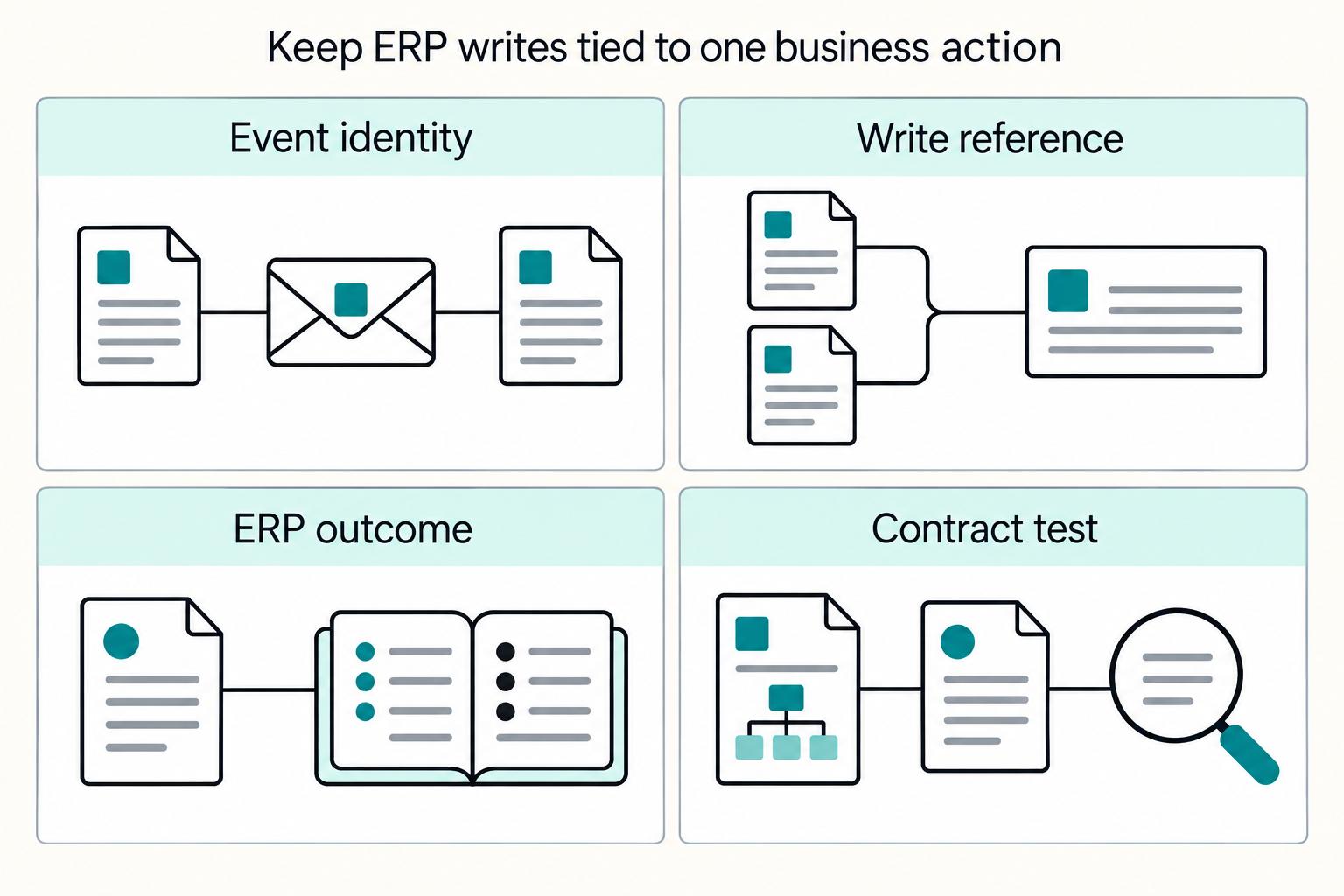
ERP Sync Architecture for Payment Platforms Using Webhooks, APIs, and Event-Driven Patterns
If you run payouts into an ERP, "just use an API and a webhook" is not enough. The design has to survive retries, late events, and finance scrutiny without creating duplicate payouts or broken reconciliation. The real question is not which transport looks modern. It is which pattern keeps postings correct, traceable, and recoverable when delivery gets messy.
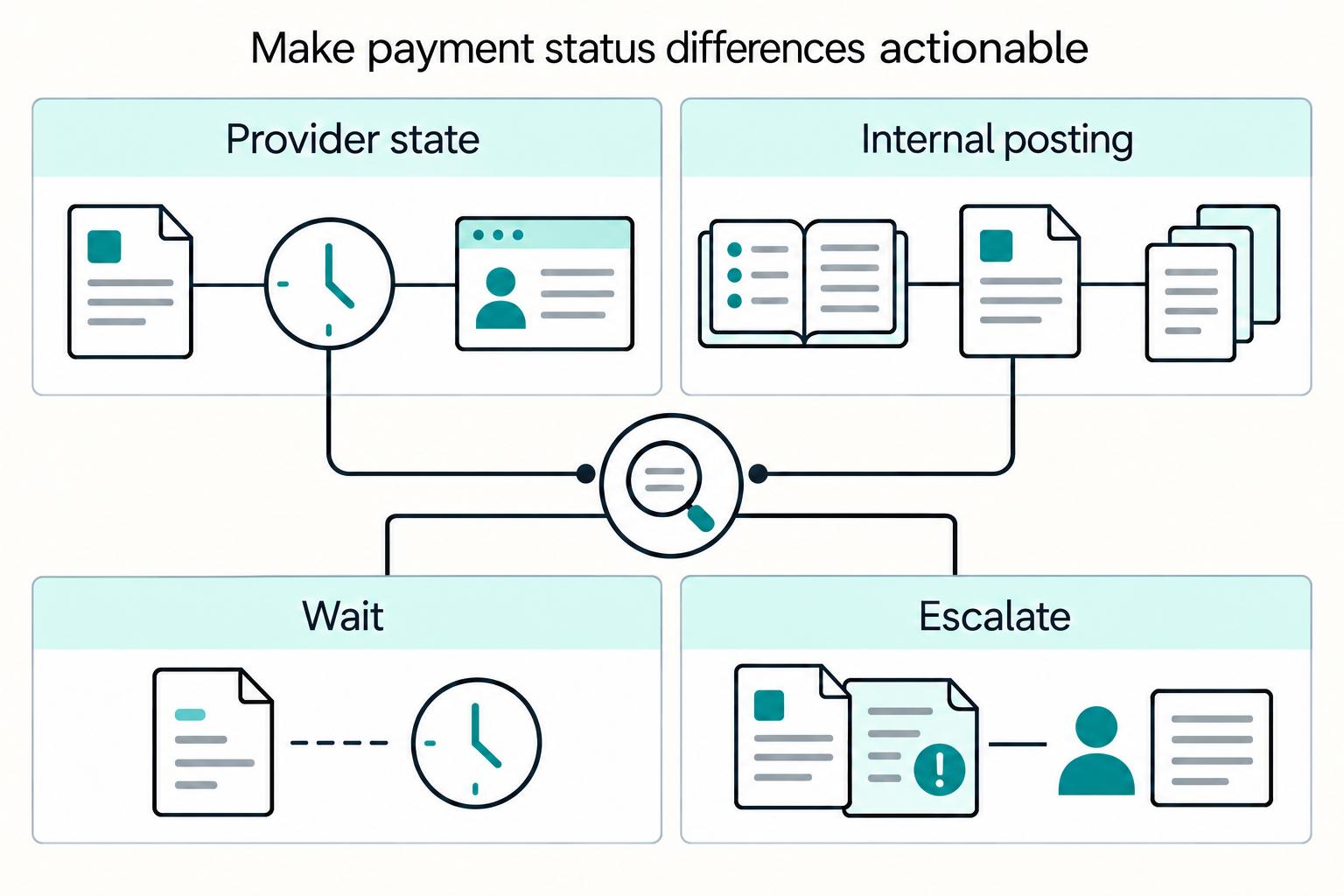
How to Build a Partner API for Your Payment Platform: Enabling Third-Party Integrations
Treat payment partner work as an architecture decision, not a quick integration ticket. If provider-specific objects, statuses, and errors leak into your public API, switching providers later can force client-facing changes.