
Quick Answer
Build the portal around the real integration path from sandbox credentials to production approval. Start with a guided get-started flow, auth and API key setup, complete API reference with try-it capability, job-based guides, and troubleshooting. Treat sandbox readiness as the baseline, document when to use Hosted Checkout, direct API, or SDKs, and require evidence-based go-live gates.
What a Payment Developer Portal Needs to Deliver#
Build your portal so teams can move from the first sandbox call to production approval without guessing what comes next. The goal is speed without hidden integration debt: clear auth setup, explicit test expectations, and a defined go-live path.
Before you start#
This guide is for CTOs, engineering leads, product teams, and solution architects shipping payments, onboarding, reporting, or payouts. It focuses on docs architecture, sandbox design, SDK strategy, and go-live controls. It does not generalize provider-specific rate limits, quotas, or SLA terms. Verify those directly in the provider docs and commercial terms you use.
Map the portal to the real integration path#
Structure the portal around the integration path developers actually follow. A practical benchmark is the Global Payments getting-started flow, which includes:
- Register / Create an App
- Create an Access Token
- Postman Collection
- Going Live
Use that flow to pressure-test your docs. If someone outside the payments team cannot register an app, create an access token, and run a request from the Postman Collection without live help, your docs likely have transition gaps, even if the endpoint pages are complete.
Define who the portal is for#
Be explicit about who the portal serves and which jobs it supports. For many platforms, that includes checkout, merchant onboarding, reporting, and payouts, each with different users and failure points. Put implementation-critical details up front: environment boundaries, credential ownership, test behavior, SDK coverage, and production controls.
Treat sandbox readiness as the baseline#
Treat sandbox readiness as the baseline, not a demo pass. Clover’s legacy developer platform describes sandbox as a testbed for integration work and states that testing in sandbox must be completed before app approval. Clover also warns that production test merchant accounts may not validate card validity or full request correctness, and it supports creating additional test merchants to simulate region, time zone, currency, and permission differences.
Keep one scope limit in view: environment models vary by provider. For example, Clover notes its legacy developer platform uses two separate developer accounts for sandbox and production access. Do not assume that exact model everywhere. Do document environment separation, credential custody, and approval gates with the same level of clarity.
Set the success criteria before writing docs#
Before you draft pages, decide what successful adoption looks like. Otherwise, the portal can look complete while teams still get stuck in the same places.
Measure integration progress, not portal traffic#
Define success as integration progress, not portal traffic. Track outcomes such as time to first successful API call in sandbox and how often teams get stuck troubleshooting authentication or entering support loops. Page views show what was opened, not whether friction was removed.
Use a practical checkpoint: can a new engineer get credentials, authenticate, submit a test payment, review logs, and verify the payment without live help? Square's sandbox flow explicitly includes "View the API Logs" and "Verify the Payment," which is the kind of end-to-end proof you want.
Use provider portals as prompts, not defaults#
Use provider portals as structural prompts, not architecture defaults. Aim for clear coverage from getting credentials to authentication to first call and verification steps, without copying provider-specific naming or account assumptions.
Lock the authentication page early. It should clearly state supported auth methods, where credentials come from, and how token refresh and expiration are handled. Auth confusion is a common source of integration delay and support burden.
Set v1 scope boundaries in plain language#
Decide v1 integration surfaces explicitly, then document scope boundaries in plain language. If your v1 includes checkout flows, direct API flows, or admin APIs, make that coverage clear. If a surface is out of scope, say so directly.
Partial coverage can create dead ends. A common pattern is documenting primary payment calls while leaving setup or admin actions unclear.
Create release gates before launch#
Set documentation release checkpoints before external launch. A practical baseline is complete guidance for authentication, first-call success paths, and known troubleshooting paths. Tie each one back to a single source of truth - your API spec - to reduce drift across docs and SDKs.
For each required path, include one runnable success example and one known failure case, such as token expiration.
Prepare the inputs your team needs before build#
Gather the API specification, auth and credential flows, supported environments, test fixtures, webhook contract and SDK inventory. For each flow, include a runnable request, expected response and an example failure. Record the team that owns the underlying behavior so documentation changes reach the right reviewer.
Agree on the first integration journey and release scope before building the navigation. Identify what can be self-service, what needs approval and which credentials or production permissions differ from sandbox. Use those decisions to shape the get-started path.
Build the minimum portal architecture developers actually need#
Your minimum portal should do one thing well: move a new developer from discovery to a first successful request, with complete reference docs and nearby troubleshooting support.
Publish a guided path instead of a link dump#
A portal needs one obvious starting path. New teams should know where to begin and what comes next without bouncing across unrelated pages.
A practical sequence can include: get started, app registration or API key setup, authentication, first API or SDK call, testing, callback guidance (if applicable), and go-live readiness (if approvals apply).
That lines up with the core journey stages: discovery, get started, develop, and support or troubleshooting. Check it with a simple test. A new engineer should be able to make a first successful request without searching across unrelated pages.
Organize by integration job, not by your org chart#
Organize docs around the outcome the reader is trying to deliver, not around internal team ownership. Use job-based groups that match real integration work.
Under each group, map the API families you actually expose. Include product-specific API names inside the job guide, and add plain-language context that explains when to use each one.
Make the reference usable on its own#
Your API reference has to stand on its own: request and response schemas, parameters, auth requirements, and example payloads should be complete and easy to work with. Include an interactive try-it experience so developers can move from reading to real calls quickly.
To reduce drift, keep reference docs generated from OpenAPI so they stay aligned with implementation. Also keep API key management self-service, including create, rotate, and revoke, so credential handling does not become an adoption bottleneck.
Add operator pages next to the build docs#
A minimum portal still needs support and troubleshooting content. Keep operator guidance next to integration docs so teams can investigate issues without leaving the portal.
Operator pages should explain how to investigate, what evidence to collect, and how escalation starts. If you publish pages for incident handling, replay policy, reconciliation exports, or escalation routes, treat them as practical operator guides rather than universal required pages.
| Page or module | Priority | Why it belongs now |
|---|---|---|
| Get started guide | Required | Gives the shortest path from discovery to first action |
| Auth and API key setup | Required | Removes blockers before the first request |
| API reference with try-it capability | Required | Turns docs into executable validation |
| Job-based integration guides | Required | Helps readers choose the right surface quickly |
| Troubleshooting and support page | Required | Keeps support and troubleshooting in the core developer journey |
| SDK tutorials, changelog hub, community/forum areas | Nice to have at launch | Valuable after the core sequence is complete and current |
If you review larger developer portals, use them as inspiration for scope, not as proof of what your minimum must include. If you need to cut scope, cut breadth before sequence.
Related: IT Staffing Platform Payments: How to Pay Developers and Consultants on Milestone and Retainer.
Choose API, SDK, or hosted paths with explicit rules#
Pick one default route, define when alternatives apply, and make ownership explicit for each choice. If this decision stays fuzzy, the rest of the docs will too.
Make the route decision explicit#
Use Hosted Checkout as the default only when the hosted experience fits your product and customization needs are limited. Use the direct API path when you need custom orchestration and direct request-and-response handling, and validate whether embedded UX requirements justify it.
| Path | Use when | Notes |
|---|---|---|
| Hosted Checkout | the hosted experience fits your product | customization needs are limited |
| direct API | your team needs custom orchestration | direct request-and-response handling |
| SDK | after choosing the API path it wraps | the contract is still the HTTP API |
Keep the decision rule short and repeatable:
- Choose Hosted Checkout for limited-customization checkout flows.
- Choose direct API for highly customized flows where you need direct API handling.
- Choose an SDK only after choosing the API path it wraps.
- Include legal and regulatory readiness checks before public launch.
Treat SDKs as acceleration, not the contract#
SDKs can reduce boilerplate and provide typed responses, but the contract is still the HTTP API. Publish SDKs as first-class only where you can keep examples current and support drift over time.
If your supported footprint spans multiple languages, list each one explicitly with ownership and update status. For each SDK quickstart, include the equivalent raw API request plus at least one representative error response.
Keep the raw API path stable and testable#
Decide your public URL structure early and keep it consistent across docs, SDK config, and tooling. A dedicated subdomain pattern, for example api.example.com, separates API and frontend concerns. A path-based pattern, for example example.com/api, can be simpler to deploy with frontend but adds configuration and maintenance work.
Require sandbox proof before go-live: the same operation should work in a sandbox account as a raw API request and, where supported, through the SDK path.
Isolate additional integration surfaces and define support boundaries#
If you offer additional integration surfaces beyond the core API and SDKs, keep them on separate tracks with clear prerequisites, owners, and change policies. Dated, component-level change tracking helps teams verify what changed and where to investigate next.
| Path | Implementation time | Control | Upgrade risk | Long-term maintenance |
|---|---|---|---|---|
| Hosted Checkout | Document expected setup steps and dependencies | Document which UX and flow controls are configurable | Document what hosted changes can affect your integration | Document what you still own vs what the provider owns |
| Direct API | Document build and test scope for each flow | Document full ownership of request and response handling and recovery logic | Document how API, auth, and webhook changes are monitored and handled | Document ongoing ownership for integration code and operations |
| SDK | Document setup by supported language and version | Document what the SDK exposes vs what requires raw API calls | Document SDK release tracking and compatibility process | Document library update cadence and fallback to raw API |
If you are turning this decision table into implementation tickets, map each path to concrete API calls and webhook events in the Gruv docs.
Design a sandbox that catches failures early#
Your sandbox should prove integration behavior under failure, not just pass a clean demo call. Use it to validate how auth fails, how async events arrive, and how recovery works before go-live decisions.
Set parity targets you can verify#
Define parity targets explicitly for auth, webhook signatures, async state changes, and reversals, then document what is full, partial, or unavailable in sandbox. Do not imply full production parity unless you can verify it.
| Surface | Sandbox guidance |
|---|---|
| auth | Define parity targets explicitly and document what is full, partial, or unavailable in sandbox |
| webhook signatures | If production uses signed webhooks, expose signing and verification in sandbox where supported |
| async state changes | If async flows include intermediate states, provide at least one delayed test path |
| reversals | If reversal behavior differs, state that clearly in docs |
Map credential setup to the actual API family and environment. For Global Payments’ unified API, document app credentials and access-token creation together; other API families may use different fields. Your setup page should carry the same auth model, base URL and credential names as the runnable examples.
Name fixtures against Sandbox Credentials and a sandbox merchant label#
Use named, repeatable fixtures tied to specific Sandbox Credentials and a sandbox merchant label you control. Avoid vague instructions like "run test cards."
| Fixture | Defined condition |
|---|---|
auth-expired-token | one sandbox app, one sandbox merchant label |
duplicate-request | same payload submitted twice for the same merchant |
invalid-state-transition | reversal or capture from a rejected state |
webhook-timeout-retry | receiver intentionally times out once |
For each fixture, document preconditions, expected API response, expected event behavior, and cleanup. Also define required failure logs: redacted response body, status code, request ID, merchant ID, and whether an async event arrived later. This avoids the "payment failed" with no useful detail pattern seen in real sandbox support threads.
Put negative paths in the Postman Collection#
Your Postman Collection should validate recovery logic, not only first success. Add negative-path requests for auth expiry, duplicate requests, invalid transitions, and timeout retries.
Use Postman scripts to chain and mutate states between requests. Postman supports sandboxed pre-request and test scripts, plus environment-variable chaining, for example extracting a token from one response for a later protected call. That makes failure-path testing reproducible. Assert expected failures and reconciliation outcomes, not just happy-path 200s.
Gate production access with evidence#
If your team uses a production-access gate, require test evidence and publish the pass/fail rule in the portal. One practical gate is an executed collection run, masked request and response logs, and webhook replay evidence for at least one async scenario.
Ask for artifacts operators can verify quickly: run report or export, masked logs, request IDs for failed and successful cases, and replay traces linking API request, webhook attempt, and final status. If webhook docs are split, keep both Testing Webhooks and Retries after Failure easy to find before launch.
Add migration guardrails for cutover#
Treat cutover as a config validation exercise, not a credential swap. Check drift across base URL, app or client ID, webhook endpoint, signing secret, redirect URLs, merchant mapping, and SDK environment flags.
Then run a low-risk production validation sequence: confirm auth, run a non-destructive call or status check, verify webhook receipt where supported, and compare live config to approved sandbox config. If unexpected drift appears, stop and fix it before processing live funds.
For a deeper implementation pattern, see how to build a payment sandbox for testing before going live. For the full breakdown, read How to Build a Payment Health Dashboard for Your Platform.
Treat SDK docs as a product with lifecycle policy#
SDK docs need lifecycle ownership, not just a download page. Drift between docs, SDKs, and live APIs can become an integration risk, so make ownership and update expectations explicit.
Publish a support matrix you can maintain#
A single matrix can show what is supported, sample-only, or community-maintained. For each row, include the current SDK version, target API version, install path, and support status.
Developers may choose their integration path from this table, so do not imply equal support where it does not exist. A practical bar is that each supported row points to a working, example-driven guide and the API reference version it targets.
Write lifecycle policy explicitly, including unknowns#
Do not leave versioning or deprecation behavior implied. State how SDK versions map to API versions, what compatibility means in your docs, where deprecation notices are published, and who owns breaking-change decisions.
If policy timing matters, use an explicit date format, for example "effective as of 4 March 2026." If cadence or deprecation timing is not fixed, say that plainly. Teams can then plan a risk buffer instead of assuming certainty.
Document install expectations for distributed artifacts#
If you distribute SDK artifacts outside managed package channels, document the install path and expected setup steps before first use. Keep the guidance practical and clear about what is officially supported versus still evolving.
If these details are unclear or outdated, onboarding friction increases and docs quality drops.
Keep SDK docs and API docs synchronized under clear ownership#
Use a single-source workflow where possible so docs and SDK examples stay aligned as endpoints and fields change. When one spec or source drives both docs and SDK outputs, example drift is easier to control.
Also make ownership visible on every SDK page with clear update context and an owning team or role. Avoid bolted-on explorers that break navigation, duplicate configuration, or force developers to re-enter credentials for each request, because that friction can signal the docs and real integration path are diverging.
Document retries eventing and reconciliation before launch#
Before launch, remove state ambiguity. Document what is known, and label unknowns plainly for retries, events, and reconciliation.
Document approval checkpoints before retry guidance#
For payer approval, show the sequence used by the API and account configuration. With PayPal Orders v2, create the order, inspect returned HATEOAS links and follow the applicable approval or payer-action link. Explain how the integration confirms the result through the server API and events; a browser return alone is not proof of capture.
Publish timing and redirect behavior with account-specific caveats#
Document order expiry, approval and capture windows for the exact API flow and account configuration. Show what happens after an abandoned redirect, expired order or lost browser return, and how to recover by retrieving server-side status. Keep timing values versioned with the provider instructions.
Split eventing and reconciliation into documented vs pending#
Do not imply webhook ordering, replay windows, or reconciliation guarantees you have not published. For each flow, separate what is documented now from what is still pending or manual. For ops and finance, list any identifiers and records your portal exposes, and explicitly mark gaps as manual reconciliation required.
Provide one troubleshooting path in the portal#
Keep launch-critical troubleshooting in your portal so teams are not forced into forum archaeology. A practical minimum evidence pack is: environment (for example sandbox), returned links including rel:approve, and redirect or return outcome. If support still cannot resolve cases from that packet, the launch documentation is not ready.
For a step-by-step walkthrough, see How to Build a Payment Reconciliation Dashboard for Your Subscription Platform.
Make compliance and security ownership explicit#
Compliance language causes expensive confusion when ownership is implied instead of stated. Be explicit about what is approved versus what is still pending.
Separate documented duties from unresolved control ownership#
Publish a responsibility matrix for merchant, integrator and platform duties. Cover API credential custody, webhook verification, production access, data handling and incident contacts. State which integration paths are approved and what evidence supports that approval.
PCI scope and SAQ eligibility depend on the integration and entity role. Link the applicable assessment guidance and record the responsible owner; outsourcing payment handling does not by itself settle every compliance duty. Resolve launch-blocking scope questions before enabling the affected production path.
Publish prerequisites and deadlines as operator checks#
Make identity, account status, and timing checks visible in your production checklist.
| Checkpoint | What to verify | Why it matters |
|---|---|---|
| Production credentials | Correct environment, owning account and permitted scope | Prevents test/live or tenant mix-ups |
| Webhook verification | Signing secret, raw-body handling and invalid-signature rejection | Prevents untrusted events from changing payment state |
| Integration approval | Applicable payment-data scope and responsibility matrix | Makes remaining merchant/integrator duties visible |
| Access and incident handling | Rotation/revocation process and incident contact | Supports recovery from compromised credentials |
Keep personal and financial data out of docs and support intake#
Use synthetic payment data in public examples and redact secrets, tokens and personal information from logs and support packets. Keep request IDs, timestamps and environment labels so support can investigate without collecting live card details.
For troubleshooting, request non-sensitive context such as timestamps, reference numbers, and environment details instead of personal identifiers.
Require a compliance evidence pack before production approval#
Gate launch on a compact evidence pack you can also reuse for periodic audits:
- Approved data-flow and responsibility matrix
- Credential custody, access scope and rotation process
- Webhook signature and negative-path test results
- Applicable PCI assessment and integration approval records
- Redacted support evidence and incident contacts
- Resolved launch-blocking security or compliance issues
Unclear ownership creates integration risk. Explicit ownership and explicit gaps keep teams from building on assumptions.
Run staged go live gates with rollback criteria#
Treat go-live as a controlled promotion path, not a single approval. Use staged gates, require concrete evidence at each gate, and define rollback conditions before any live expansion.
Define gates and owners before promotion starts#
Use a staged path: sandbox completion, pre-production verification, limited production cohort (canary), then full rollout. Assign clear owners to each gate so approvals stay explicit.
Require evidence that behavior is verified#
At each gate, require a completed validation checklist plus observability evidence. Keep artifacts replayable and operator-friendly: logs, traces, metrics, and run replay data should be easy to retrieve during incidents.
Keep promotion controls explicit#
Keep environment promotion decisions explicit instead of treating promotion as a routine handoff. Use approval gates to limit broad privileges, since weak control can lead to unintended and costly actions.
Predefine rollback conditions and actions#
Define stop conditions before launch, then pair each one with a clear rollback action. Where possible, use automated rollback conditions. Otherwise, make manual rollback steps explicit.
| Gate | Owner | Required evidence | Stop condition | Rollback action |
|---|---|---|---|---|
| Sandbox completion | Engineering owner | Validation checklist complete, baseline logs/traces/metrics available | Checklist incomplete or observability evidence missing | Stay in sandbox and close gaps before promotion |
| Pre-production verification | Engineering + operations | Promotion approval confirmed, diagnostics evidence, run replay available | Verification cannot confirm expected behavior from diagnostics or replay | Block promotion and remediate configuration or runtime issues |
| Limited production cohort | Release owner | Canary plan, live observability, rollback readiness confirmed | Predefined rollback condition is triggered | Stop cohort expansion and execute rollback plan |
| Full rollout | Platform/product approver | Cohort stability evidence, all gate approvals complete | Any unresolved stop condition from cohort stage | Halt rollout and return to controlled cohort state |
Avoid the mistakes that create platform debt#
Once go-live gates are in place, a common source of debt is docs that look complete but do not drive consistent decisions. The fix is to turn each weak spot into an explicit rule or evidence checkpoint.
Add decision rules, not just a catalog#
When a portal exposes both REST APIs and SDK tracks, missing usage rules push architecture risk onto integrators. State clear guidance for when to start with direct API integration versus an SDK, and make SDKs an accelerator rather than the only path. A practical check is whether SDK guidance maps back to the underlying request and response model, auth behavior, and error handling.
Turn sandbox into failure testing, not a demo#
A happy-path sandbox is not enough for payments. Require failure-path evidence before promotion. Use checkpoints that prove teams can execute a first API call, inspect API logs, and verify the payment outcome, and include negative testing and idempotency behavior in that flow. For deeper sandbox design, see How to Build a Payment Sandbox for Testing Before Going Live.
Publish SDK lifecycle policy before pushing downloads#
Publish supported API versions and migration instructions before developers adopt an SDK. When an API is deprecated, link the current replacement for the operation being used; payment creation, order approval and capture may live in different API families.
Add operational pages that hold up in incidents#
Docs that read like marketing can break down once production issues start. Include operator-ready pages with concrete checkpoints, and make diagnostics easy to find. If reviewers cannot quickly locate log inspection and payment-verification checkpoints, the portal is still not production-ready.
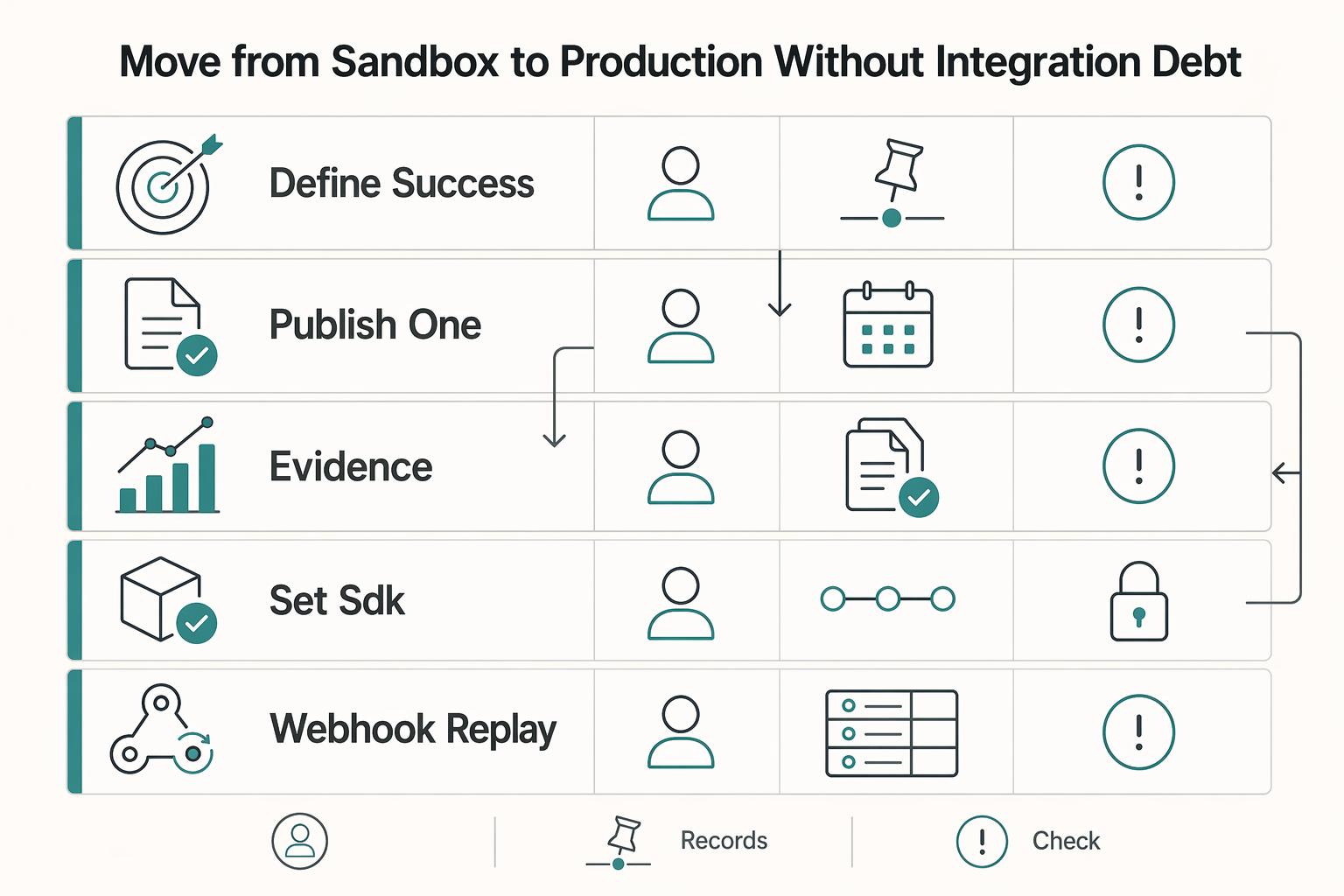
Move from sandbox to production without integration debt#
Production readiness is an evidence-and-ownership exercise: assign each launch decision a named owner, a checkpoint, and a stop rule.
Use this as an internal launch checklist for one flow at a time:
- Define success metrics you can inspect end to end.
- Publish one required docs path in a fixed order.
- Validate sandbox-to-production parity with recorded evidence.
- Set an SDK lifecycle policy, or label SDKs as examples rather than dependencies.
- Document retries, webhook or event handling, and reconciliation behavior.
- Assign explicit ownership for PCI DSS and SAQ Self Assessment Questionnaire decisions.
- Enforce go-live gates, rollback rules, and required approval artifacts.
Separate internal documentation and rollout choices from external obligations. API retry behavior follows the actual contract; PCI and other applicable duties follow the integration’s scope. Publish both clearly so an internal checklist cannot override a provider or compliance requirement.
Exercise the checklist with one payment journey: credentials, first request, asynchronous result, reconciliation and operator recovery. Keep the version, owner and outcome of each check so the next release can repeat it.
If you need a deeper sandbox checklist, use: How to Build a Payment Sandbox for Testing Before Going Live.
Next step: run this checklist against one flow, checkout or payouts, end to end. Stabilize evidence, then expand to other surfaces.
Related reading: How to Expand Your Subscription Platform to Europe for Payment and VAT Readiness.
Before production cutover, pressure-test your go-live gates, replay handling, and reconciliation evidence with your real flow by requesting an architecture review through Gruv contact.
Frequently Asked Questions
What are the minimum pages every payment developer portal should publish before inviting external integrators?
Publish get started, credential/auth setup, API reference, one job-based integration guide and troubleshooting. Test the path with a new engineer: they should obtain test credentials, execute a request and inspect the result without asking the owning team to fill documentation gaps.
What must be included in a payment sandbox before any production launch request is approved?
Include scoped test credentials, runnable examples, success and failure fixtures, webhook verification and a documented parity matrix. Publish the production-approval evidence for each supported path and name any behavior that must be tested outside sandbox.
When should a team choose direct API integration instead of SDKs or **Hosted Checkout**?
Choose direct API when you need tighter control over request/response handling and can own the error-handling work. Choose SDKs when prewritten methods and classes reduce implementation effort, while keeping in mind that SDKs are often language- or network-specific. For Hosted Checkout, use your provider's documentation and constraints, because there is no universal threshold that applies across platforms.
What is the safest order from first **Access Token** call to production cutover?
There is no safest universal sequence. A cautious pattern is to obtain sandbox credentials, execute a known reference example, and validate both success and failure behavior before requesting production access. Treat "worked once" as incomplete evidence unless the same path is documented and repeatable. Also settle versioning early, since some providers recommend the latest API version and deprecate older versions over time.
How do you prevent duplicate charges or payouts during retries and webhook replays?
Use outbound idempotency for each logical operation and inbound event deduplication as separate controls. Document key lifetime, duplicate-response behavior and operation identifiers. Resolve unknown timeout outcomes through status lookup or reconciliation before creating another charge, and test concurrent retries and replays.
What should a payment API error model include so integration teams can recover quickly?
Document a stable error code, HTTP status, correlation/request ID and recoverable next action. Separate validation, authentication, retryable transport and final payment failures. Show redacted request/response examples and explain when a timeout leaves the payment outcome unknown.
How should docs be structured so engineers, payments ops, and compliance reviewers can all sign off?
Organize docs by integration workflow first, then add role-specific operational and review pages. Keep sandbox setup, credentials, API examples, and version guidance easy to locate in one path instead of scattering them across disconnected pages. If those groups cannot follow the same documented flow end to end, sign-off risk increases.
Researched and edited by the Gruv editorial team. Gruv builds cross-border billing, payouts, and finance-operations software for global businesses.
Sources
Includes 5 external sources outside the trusted-domain allowlist.
- developer.paypal.com/api/rest/integration/orders-api/api-use-case...trusted
- docs.stripe.com/webhookstrusted
- docs.stripe.com/api/idempotent_requeststrusted
- buildwithfern.com/post/api-documentation-best-practices-guideexternal
- cycloid.io/blog/api-developer-portal-a-hands-on-guide-f...external
- developer.globalpayments.comexternal
- developer.globalpayments.com/docs/getting-started/overviewexternal
- developer.squareup.com/docs/devtools/sandbox/paymentsexternal
Educational content only. Not legal, tax, or financial advice.
Related Posts

The Freelance Payment Penalty: A Modeled Audit of Platform Fees, FX Spreads, and Payout Delays
The money rarely disappears through a single, easy-to-spot fee. The real loss is stacked. A marketplace takes its commission, a processor adds a charge for international cards, a bank or payment company converts the currency at a spread, a platform holds the funds before release, and a wire sheds a little to intermediaries on the way in. Each layer looks defensible on its own, but the worker feels the combined result as a smaller deposit and a later payday.

How to Respond to a Subpoena for Business Records
Move fast, but do not produce records on instinct. If you need to **respond to a subpoena for business records**, your immediate job is to control deadlines, preserve records, and make any later production defensible.

A US Expat's Guide to Investing in UCITS ETFs to Avoid PFIC Issues
The real problem is a two-system conflict. U.S. tax treatment can punish the wrong fund choice, while local product-access constraints can block the funds you want to buy in the first place. For **us expat ucits etfs**, the practical question is not "Which product is best?" It is "What can I access, report, and keep doing every year without guessing?" Use this four-part filter before any trade: