
UAE marketplace operators should treat the CBUAE instant payment platform as a go or no-go validation exercise, not a market-expansion story. Before building, confirm in writing your access route, settlement behavior, fees, dispute ownership, support model, and reconciliation controls. Public descriptions can orient partner questions, but they are not enough to prove direct onboarding or launch readiness for your exact marketplace flow.
Treat this as a go or no-go decision, not a market-expansion story. The question is simpler: can you verify a workable access route, acceptable economics, and enough operational control to explain each payment state before you commit product and GTM budget?
Some public facts are clear enough to use as starting points. CBUAE introduced Aani, and it was developed by Al Etihad Payments (AEP), a CBUAE subsidiary, under the FIT programme. Public descriptions position it as instant, secure, and available 24/7, with Request Money, Split Bills, and QR merchant payments. Public references to real-time direct debit and e-checks are framed as future plans, so do not treat them as live launch capabilities.
What matters for your launch decision is narrower than the public narrative. You need to know whether your exact marketplace flow can use the route, how money and exceptions move through it, and who owns the operational and regulatory edges when something goes wrong.
Prepare these three items before partner conversations:
This prep matters because CBUAE rulebook context explicitly notes that many payment transactions are highly intermediated and can create visibility gaps. For a marketplace flow, that can reduce end-to-end visibility and make exception ownership harder to track.
Start with what you can support, then separate assumptions. For this topic, the public positioning around the platform, AEP, CBUAE, FIT, 24/7 instant processing, and the named user features can help frame partner questions. They are not enough, on their own, to prove direct onboarding, known pricing, or finalized operating rules for your marketplace model.
A practical checkpoint is simple: can your team show a clean list of what is confirmed live versus what is still commercially or operationally unknown?
The unknowns usually decide the project. Keep these front and center: access path, settlement behavior for marketplace flows, fee structure, dispute handling, and support ownership when issues occur.
Two practical failure patterns to watch for are starting engineering before you have written confirmation for your model, and assuming consumer-facing instant payments automatically imply seller payout readiness for your marketplace flow.
Use a simple sequence: verify the rail reality, choose an access path, test economics, confirm control points, then make the launch call. That keeps you from doing early work against the wrong constraint.
Bring compliance into the first round of conversations. If your route depends on a Licensed Financial Institution, CBUAE consumer protection standards apply to that institution. That includes Arabic and English disclosure availability and use of official documents for consumer transactions. Use that as a meeting prompt. Confirm which disclosures, documents, and responsibilities sit with the LFI versus your platform.
The goal of this guide is not a feature recap. It is a decision memo: which rail facts are firm, which assumptions still need evidence, and whether you have enough operational certainty to proceed or pause. For the full breakdown, read Payment Guarantees and Buyer Protection for Platform Operators.
Use public descriptions as orientation, not as implementation proof. For launch decisions, treat only primary documentation or written partner confirmation from the relevant operator, regulator, or your counterparty as enough to scope work.
Do not build your initial case from secondary summaries, launch chatter, or recycled market posts. This evidence pack is not an official product specification. The highest-risk assumptions are usually the ones about live capabilities, onboarding route, participant model, and settlement behavior.
Use one checkpoint: can your team point to a primary artifact that names the capability, operating party, and current live status? If not, treat it as an assumption, not a requirement.
Keep each entity and role separate in your notes so teams do not turn public narrative into integration scope. Public positioning can tell you where to ask questions. It does not settle the operating facts for your marketplace flow.
Sort every statement into:
If a statement does not fit cleanly into one of those buckets, take it out of launch scope.
Version one should rely only on capabilities and counterparties you can verify in writing today. Anything framed as planned or upcoming stays out of the launch model until your target partner confirms availability for your exact marketplace flow.
Ask for current product documentation, implementation notes, and a written breakdown of what is live now versus roadmap. If a partner cannot separate those clearly, mark the path early as high-risk for later reconciliation, support ownership, and exception handling.
Do not guess where it sits in the CBUAE rail stack. If you cannot place it from primary rail documentation, you should not use it to drive architecture, ownership, or timeline assumptions.
Your baseline should come from documents that clearly state rail classification, operating context, and current live status. Ask CBUAE, AEP, or your implementation partner for one written artifact that answers:
| Question to verify | What you need in writing | Why it matters |
|---|---|---|
| Rail classification | Whether the rail is documented as RPS or LVPS | Prevents design assumptions about payment behavior |
| Role of Aani | How it is described, and whether that description is current | Prevents marketing labels from becoming requirements |
| Adjacent dependencies | Whether any other domestic rails, clearing systems, or switches are explicitly named for your flow | Shapes exception and reconciliation planning |
If that artifact is unavailable, mark rail placement as unverified and keep it out of integration scope.
Start from your flow constraints, not the label on the rail. If your core customer leg needs real-time behavior, verify that behavior in primary rail documentation before committing product work. If your main risk is settlement timing, treasury control, or reconciliation, map dependent systems from written specifications before you commit.
Keep potentially related rails and clearing systems in your notes as items to validate, not confirmed dependencies. That keeps the design honest and forces the right partner conversations.
A useful check is to label each source as rail architecture, participant marketing, or general industry commentary. In this evidence pack, the available excerpts are not enough to confirm the platform's placement relative to RPS or LVPS.
Use one checkpoint: do you have written confirmation of rail role for your exact marketplace flow? If yes, move into scoped integration planning. If not, hold placement as unverified and map non-platform dependencies first.
You might also find this useful: Digital Platform Trends 2026: What Payment Infrastructure Shifts Mean for Marketplace Operators.
Before you scope product work, get one potential counterparty to confirm in writing that your marketplace can use a specific access route. Also confirm who owns the regulated obligations in that route.
Start with three candidate paths: LFI-led, acquirer-led, and hybrid. Treat names like Emirates NBD, First Abu Dhabi Bank, Magnati, Network International, and Mashreq/Neo Pay as outreach targets only, not confirmed marketplace access paths for this flow.
| Candidate route | Who you speak to first | What is known now | What must be confirmed |
|---|---|---|---|
| Via participating licensed financial institutions | Bank or other LFI (for example Emirates NBD, First Abu Dhabi Bank) | LFIs are subject to mandatory, enforceable CBUAE Consumer Protection Standards when carrying out licensed financial activities. | Whether the LFI will onboard this marketplace flow, technical onboarding model, settlement behavior, dispute ownership, and support model |
| Via merchant acquirers | Acquirer-side counterparties (for example Magnati, Network International, Mashreq/Neo Pay) | This is an exploratory outreach route, not a confirmed marketplace access path. | Whether this flow is supported, contract structure, pricing or commercial terms, settlement mechanics, and exception handling |
| Hybrid bank plus acquirer model | LFI and acquirer in parallel | This is an exploratory route that can help separate acceptance questions from treasury or settlement questions. | Primary onboarding owner, dispute or support ownership, reconciliation across parties, and route availability |
The point is not to predict the winning route. It is to stop architecture decisions from being made on assumptions.
If an LFI is in the route, confirm regulatory ownership early. The CBUAE Consumer Protection Standards, part of Circular No. 8 - 2020, are mandatory and enforceable. Your route choice can change who owns disclosures, complaint handling, transaction records, and support obligations.
Use a concrete check: ask for a specimen customer-facing transaction document or receipt. For LFIs, it should include the institution name and a statement that it is licensed by the Central Bank. If that document or ownership model is unclear, do not estimate engineering yet.
Also confirm channel coverage. The standards reference disclosures across branches, telephone banking, mobile apps, internet banking, and other channels, and require disclosure information in Arabic and English.
Order outreach by your primary uncertainty, not by brand recognition. If your biggest risk is merchant acceptance, start with acquirer conversations. If your biggest risk is treasury control or settlement visibility, start with LFI conversations.
This is sequencing logic, not proof of outcome. Current evidence does not establish that acquirer-first is faster or that bank-first gives better control.
Leave first meetings with written answers to:
Do not treat general guidance language as launch evidence. CBUAE VA/VASP guidance sets expectations, but it does not replace legal or regulatory requirements. ADGM IT risk guidance is not legally binding.
The avoidable failure mode is building against a guessed route, then learning late that the route is unavailable or that obligations were misassigned. Before approving engineering tickets, require a short evidence pack with the named route, counterparties, written eligibility confirmation, and explicit owners for compliance, settlement, disputes, and support. If you cannot get that in writing, keep the access path out of scope.
For a step-by-step walkthrough, see UK Online Safety Act Compliance for Marketplace and Platform Operators.
Partner meetings go better when they are built to answer decisions, not to collect vague interest. Put together a short evidence pack that forces clear answers on eligibility, controls, and operating ownership before anyone starts talking about build timelines.
Start with one page that maps your exact marketplace flow: buyer payment, platform fee, seller payout, and exception handling. If you want to explore this route, label it as the proposed option and split the memo into verified and assumed so assumptions are never presented as facts.
If specific counterparties are in scope, show a separate variant for each proposed counterparty and state the decision question tied to that variant. One variant might test buyer-side acceptance questions, while another tests payout visibility or treasury control. This does not claim support. It simply defines what you need confirmed.
Decide what your team cannot operate without before the call, and frame each item as a decision question:
If these are unclear, treat the route as unresolved even if commercial interest is strong.
Do not let the discussion collapse into pricing and timelines. Bring a short control checklist with ownership and document requests. Ask who owns required risk-management systems and controls for the proposed flow, and what evidence they need from you to confirm eligibility.
Use ADGM Information Technology Risk Management Guidance, 20 November 2024, to shape diligence questions, but do not treat it as legally binding by itself. If onboarding touches AML/CFT review, ask what is required under Federal Decree by Law No. (10) of 2025, shown in force from 14/10/2025, and require written requirements instead of assumptions.
Keep one living document across calls and mark each line as verified, unknown, or assumed, with evidence next to each claim. That keeps decisions current as market, technology, and legal context evolve.
If you get a commercial yes but no clear answer on reconciliation, status visibility, or control ownership, log it as an open issue rather than progress. The pack is doing its job when weak routes become visible early. This pairs well with our guide on Payment Gateway Outage Playbook for Platform Operators.
A route is not rollout-ready because the feature set looks attractive. Use a red-yellow-green scorecard to judge viability, and require written clarity on both economics and operations before you treat any path as real.
Score each path on these five dimensions: access certainty, settlement clarity, fee clarity, dispute model clarity, and implementation complexity.
Use this standard consistently:
Keep unknowns in the scorecard, not buried in notes. Require an owner, action, and date for each one.
| Dimension | Known now | Unknown now | Owner / action / date | Status |
|---|---|---|---|---|
| Access certainty | Partner discussion is active | Eligibility for your exact model | Payments lead / request written eligibility / date | Yellow |
| Settlement clarity | High-level payment flow discussed | Timing, states, exception handling, liquidity visibility | Finance lead / request settlement note + sample reporting / date | Red |
| Fee clarity | Commercial discussion started | Full fee schedule and exception-related charges | Commercial lead / request written terms / date | Red |
| Dispute model clarity | Support process acknowledged | Complaint ownership, redress path, mismatch escalation | Ops lead / request escalation matrix / date | Yellow |
| Implementation complexity | Technical discussion started | Required fields, event model, manual fallback burden | Engineering lead / request technical pack + test scope / date | Yellow |
If fee terms and settlement behavior are still unconfirmed after initial partner calls, keep the path yellow or red even if product capability looks strong.
Use disclosure and redress as minimum checkpoints. The updated March 2026 OECD compendium explicitly lists Disclosure & Transparency (Principle 7, p. 69) and Complaints Handling and Redress (Principle 12, p. 128). These are useful diligence lenses, but they do not confirm your partner-specific UAE terms. If disclosures are unclear or complaint ownership is vague, fee or dispute clarity is not complete.
Use liquidity visibility as a core internal checkpoint, not as evidence that partner terms are settled. If finance cannot see when funds are expected, held, released, or under review, treasury risk can remain high.
Assign each unknown to an internal owner and an external counterparty contact. Track them like delivery blockers, not admin follow-ups. If unknowns stay broad across two call rounds, stop treating that path as near-term.
Do not approve full UAE rollout budget until at least one path is green on both economics and operations. If that threshold is not met, limit spend to targeted discovery and keep rollout budget locked.
Before approving rollout budget, stress-test partner economics with a consistent scenario model using the payment fee comparison tool.
Once one partner path looks commercially viable, the next gate is operational. You should be able to explain each state change from customer payment to seller payout without guesswork. For this route, treat anything not explicitly verified in writing by your partner as an assumption, not design truth.
Map the flow as states that product, finance, and ops all use the same way. A practical state model can include payment initiation, provider acknowledgment, funds-confirmed status, internal ledger posting, payout eligibility, payout execution, and payout completion. If a transition is unclear, duplicate handling and exception routing will be unclear too.
Keep labels neutral unless confirmed. Use "Aani intake" only where your partner has confirmed event model, timing, and failure signals in writing. Otherwise use labels like "instant payment attempt" or "partner-confirmed payment event."
For each state, define:
If advancement depends on ad hoc checks such as email, portal screenshots, or calls, the flow is not launch-ready.
Fallback cannot stay a generic box on a diagram. Name the primary rail, fallback candidate, and exception queue owner at each failure point. If a bank rail or UAEPGS path is discussed, keep it as a candidate until written confirmation shows it is available for your exact marketplace flow.
Design controls for the narrow operational failures that matter most:
For each case, define whether you pause fulfillment, route to manual review, retry status retrieval, or invoke a separately consented fallback path.
Use a pre-live proof standard similar to the "live-proving phase" discipline described in other CBUAE-supervised activation contexts, including the 23-12-2025 CBD announcement. Do not treat that as evidence of platform-specific behavior for your marketplace.
Set internal idempotency rules before launch. A practical baseline is:
Retries can repeat communication, but they should not create new financial state unless your rules explicitly allow it. If the same provider reference arrives twice, the second pass should confirm prior handling and exit cleanly.
Choose a minimum reconciliation reference set before launch across provider events, internal ledger entries, and payout records. For each test transaction, prove:
If a transaction appears successful in a dashboard but cannot be traced to ledger and payout decisions, treat that as a launch blocker. CBUAE guidance explicitly says guidance does not replace legal or regulatory requirements, so anchor controls to binding obligations, partner contracts, and your audit evidence pack.
We covered this in detail in How to Handle VAT on Platform Fees Across the EU: A Marketplace Operator's Guide.
Launch readiness here is an evidence test. Do not go live until you can trace what each partner sends, what your ledger records, and how each test transaction reaches its payout decision.
Get the technical contract in writing before implementation. If a partner references Aani or CBUAE infrastructure, treat that as context, not implementation detail.
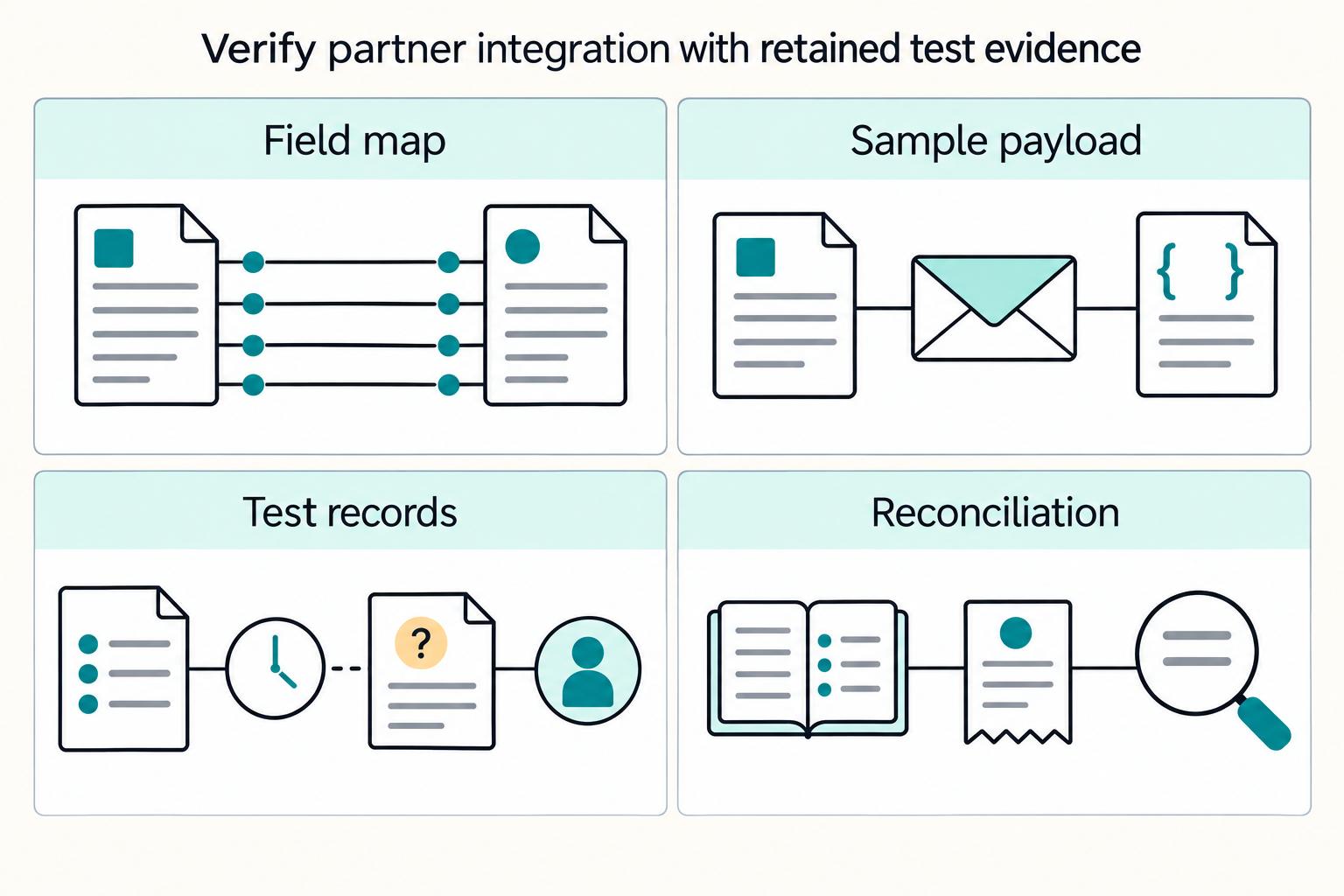
Confirm three items early: message standard where relevant, exact field mappings, and the report or export that serves as your reconciliation source of truth. If ISO 20022 is mentioned, clarify whether it is native, translated, or only used on part of the route. Then pin down operational fields such as payment intent ID, partner reference, event timestamp, status code, amount, and any payout or settlement reference that appears in reporting.
Your checkpoint should be concrete: sample payloads, sample reports, and a written field map approved by engineering and finance.
Do not design around a single partner's blind spots. Compare at least two candidate counterparties as an internal control. Emirates NBD and Network International can be used as comparison examples without assuming either supports your exact marketplace flow.
| Check | Emirates NBD | Network International | Evidence to retain |
|---|---|---|---|
| Access model fit for your marketplace flow | Written confirmation required | Written confirmation required | Email, contract note, or solution summary |
| Message and event format | Confirm ISO 20022 relevance, if any, and document proprietary fields | Confirm ISO 20022 relevance, if any, and document proprietary fields | Sample request or callback and field map |
| Reconciliation coverage | Confirm reporting for transaction fees, authorization rates, and payout schedules | Confirm reporting for transaction fees, authorization rates, and payout schedules | Sample report or export |
| Exception ownership | Name owner for delayed, ambiguous, or missing events | Name owner for delayed, ambiguous, or missing events | Escalation matrix with named owners |
Do not optimize for headline price alone if reporting quality is weak and creates downstream operational and dispute overhead.
Failure handling is a pre-launch requirement, not cleanup for later. Test delayed confirmations, external success with missing platform event, partial failure after acknowledgment, and manual investigations.
For each scenario, define one owner and one recovery action, then log trigger, action taken, evidence collected, and final ledger and payout result. If a counterparty is an LFI, expect it to perform its own assessment of how it should meet statutory obligations. CBUAE guidance helps set expectations, but binding legal and regulatory frameworks prevail where conflicts exist.
Make reconciliation sign-off the last go-live gate. No production launch until your reconciliation report explains every test transaction end to end.
At minimum, each record should show internal payment intent ID, partner reference, timestamps, status history, ledger postings, fee treatment, payout eligibility decision, and investigator notes for manual cases. If a transaction appears successful in a portal but cannot be tied to ledger and payout records, treat it as a launch blocker.
Related reading: Subscription Benchmark Report for Platform Operators: Churn Trials Payment Declines and LTV.
A common failure pattern in this area is treating public launch context as implementation proof. For marketplace flows, do not proceed until access, settlement behavior, and control ownership are confirmed in writing.
| Mistake | What still needs confirmation |
|---|---|
| Treating launch messaging as proof of your onboarding path | Onboarding model, who the regulated entity is, and which documents or reports you will receive |
| Testing speed but not post-acceptance operations | Settlement outcomes, exception handling, failed payout states, and complaint ownership across buyer, seller, and platform touchpoints |
| Assuming rail labels settle system design | System placement and dependency mapping verified with your partner stack |
| Letting timelines outrun controls | Signed ownership for delayed confirmations, missing events, and manual investigations, with evidence that reconciliation works end to end |
Public messaging about the platform or broader CBUAE infrastructure does not confirm your specific marketplace route. Your path is still unconfirmed until a counterparty documents the onboarding model, who the regulated entity is, and which documents or reports you will receive.
Instant acceptance alone is not settlement readiness for a marketplace. Test settlement outcomes, exception handling, failed payout states, and complaint ownership across buyer, seller, and platform touchpoints.
This is a control issue, not a nice-to-have. CBUAE Consumer Protection Standards are mandatory and enforceable for LFIs, and they explicitly include complaint management and resolution (Article 8). Check that customer-facing disclosures are consistent across branches, telephone, mobile, and internet channels, and that transaction documents include the institution name and Central Bank licensing disclosure.
Labels like RPS and LVPS are not design shortcuts. The excerpts here do not confirm system placement for the platform, UAEFTS, or UAEDDS, so dependency mapping has to be verified with your partner stack rather than assumed.
If launch dates move faster than reconciliation and exception handling, operational risk can rise quickly. Make go-live conditional on signed ownership for delayed confirmations, missing events, and manual investigations, with evidence that reconciliation works end to end.
Keep the hierarchy clear too. Guidance can describe good practice, but it does not replace binding legal, regulatory, or contractual obligations.
If you want a deeper dive, read State of Platform Payments: Benchmark Report for B2B Marketplace Operators.
A 30-60-90 plan can force pre-launch decisions as an internal operating cadence, not a regulator-mandated timeline. In instant-payment environments, funds can move across accounts within seconds, and recovery gets much harder after money has moved.
| Phase | Focus | Exit or review item |
|---|---|---|
| Days 0-30 | Confirm counterparties and access routes | Named counterparty, commercial and technical owners, required artifacts, and a tracked list of unresolved unknowns |
| Days 31-60 | Run controlled integration and reconciliation tests | Test one primary path and one fallback path for initiation, event delivery, reconciliation, failed states, reversals, and manual investigations |
| Days 61-90 | Finalize economics and operating ownership | Finalize fee model, support coverage, incident escalation, complaint handling, and dispute ownership; run one launch-readiness review with open items, owners, due dates, and launch blockers |
Days 0-30: confirm counterparties and access routes. Get written confirmation of your available partner path, onboarding model, and control ownership. Exit this phase with a compact evidence pack: named counterparty, commercial and technical owners, required artifacts, and a tracked list of unresolved unknowns.
Days 31-60: run controlled integration and reconciliation tests. Test one primary path and one fallback path for initiation, event delivery, reconciliation, failed states, reversals, and manual investigations. Treat "payment accepted" as incomplete unless finance can trace each test transaction end to end.
Days 61-90: finalize economics and operating ownership. Finalize what is confirmed on fee model, support coverage, incident escalation, complaint handling, and dispute ownership, and clearly label remaining assumptions. Run one launch-readiness review with finance, ops, and product leads, with open items, owners, due dates, and explicit launch blockers.
Final rule: if key unknowns remain on fees, settlement behavior, or dispute ownership, delay launch rather than force a high-risk market entry.
Use this as a go or no-go gate, not a planning note. Do not treat interest in the platform or partner enthusiasm as proof that your exact marketplace flow is launch-ready.
| Gate | What to confirm | Output or checkpoint |
|---|---|---|
| Separate verified facts from assumptions | Buyer pay-in, platform fee capture, seller payout, refunds, reversals, and manual exceptions in primary documentation or written counterparty confirmation | One page showing verified versus unverified items, owner, and target closure date |
| Choose one primary access path and one fallback path | The route you expect to launch with and the fallback if onboarding, commercials, or support fails | Named primary path, named fallback path, and a documented switch trigger |
| Lock economics and compliance ownership in writing | Fees, settlement timing, reversals, complaint ownership, manual investigations, and any reserve or prefunding requirement | Operating evidence pack from the regulated institution |
| Run tests that prove reconciliation and recovery | Duplicate submission, retry handling, delayed confirmation, failed payout after successful collection, and manual investigation | Reconciliation report tracing each tested transaction from initiation to final state |
| Use an internal red-yellow-green sign-off | Product, payments ops, and finance sign-off on customer states and disclosures, exception handling and escalation, booking logic, settlement visibility, and daily reconciliation | Launch only when the team can explain dirham movement end to end with partner-specific confirmation |
Build a two-column sheet for buyer pay-in, platform fee capture, seller payout, refunds, reversals, and manual exceptions. Mark items as verified only when they are in primary documentation or written confirmation from the counterparty you would contract with. Keep platform capabilities, onboarding rights, settlement behavior, and exception handling in the assumed column until confirmed in writing.
Checkpoint: one page showing verified versus unverified items, owner, and target closure date. If your route depends on a Bank (as defined by CBUAE), name the exact legal entity. CBUAE states capital adequacy requirements apply to all banks and may impose additional requirements beyond listed minimums.
Name the route you expect to launch with, then name the fallback if onboarding, commercials, or support fails. Do not assume both routes are available in the same way until that is confirmed in writing.
Output: a named primary path, a named fallback path, and a documented switch trigger.
Before launch timing is discussed seriously, require written terms for fees, settlement timing, reversals, complaint ownership, manual investigations, and any reserve or prefunding requirement.
Also request an operating evidence pack from the regulated institution: ownership for Risk Assessment Methodology and Documentation, Documentation and Updating, and handling when sanctions or reporting-obligation issues are triggered. Use CDD Measures Concerning Wire Transfers as a practical prompt for who checks what in money movement.
Include duplicate submission, retry handling, delayed confirmation, failed payout after successful collection, and manual investigation. For each scenario, require a partner transaction reference plus a matching internal ledger record.
Checkpoint: a reconciliation report that traces each tested transaction from initiation to final state, with gross amount, fee, payout effect, and reversal effect shown separately.
Use a shared launch gate: product for customer states and disclosures, payments ops for exception handling and escalation, and finance for booking logic, settlement visibility, and daily reconciliation.
Keep unresolved items yellow until each has an owner, action, and target date. Launch only when the team can explain dirham movement end to end with partner-specific confirmation, including non-happy-path failures.
Related: Platform-to-Platform Payments: How to Build B2B Settlement Between Two Marketplace Operators.
After you complete your validation checklist, confirm program coverage, control gates, and integration fit for your UAE launch plan through Talk to Gruv.
The provided excerpts do not confirm a platform name. Treat naming as unconfirmed until it appears in primary CBUAE documentation or signed partner documentation for your route.
The provided excerpts do not confirm real-time or 24/7 transfer behavior. Get written confirmation from your licensed financial institution on processing hours, cutoffs, pending states, and failure handling before you plan around it.
The reviewed excerpts do not confirm a platform feature set such as Request Money, Split Bills, or QR merchant payments. If any of those features are critical to your flow, ask for current product documentation, API docs, and event examples before you commit engineering scope.
The provided excerpts do not show a clear marketplace-specific direct onboarding path. The practical decision is the counterparty model: who contracts with you, who owns onboarding, and who owns disputes, reconciliation breaks, and escalation.
Those details are not specified in the reviewed excerpts. Require written commercial and operating terms, including settlement timing, reversal handling, complaint ownership, and any reserve or prefunding requirements.
CBUAE guidance for licensed financial institutions on payment-related risks is shown as in force from 1/8/2022, with expected compliance demonstration within one month. The same guidance states it does not replace legal or regulatory requirements, and the legal and regulatory framework prevails where there is a conflict.
Consumer Protection Standards tied to Circular No. 8 - 2020 are mandatory and enforceable. The disclosure scope covers branches, telephone banking, mobile applications, internet banking, and other channels, so disclosures should stay consistent across partner-served touchpoints.
Yes. Mbank states its Ojoor payroll service was developed in collaboration with MOHRE, CBUAE, and Al Etihad Payments. That is not proof of platform naming, onboarding rights, or marketplace eligibility.
Ethan covers payment processing, merchant accounts, and dispute-proof workflows that protect revenue without creating compliance risk.
Includes 6 external sources outside the trusted-domain allowlist.
Educational content only. Not legal, tax, or financial advice.

**Start with the business decision, not the feature.** For a contractor platform, the real question is whether embedded insurance removes onboarding friction, proof-of-insurance chasing, and claims confusion, or simply adds more support, finance, and exception handling. Insurance is truly embedded only when quote, bind, document delivery, and servicing happen inside workflows your team already owns.
Treat Italy as a lane choice, not a generic freelancer signup market. If you cannot separate **Regime Forfettario** eligibility, VAT treatment, and payout controls, delay launch.

**Freelance contract templates are useful only when you treat them as a control, not a file you download and forget.** A template gives you reusable language. The real protection comes from how you use it: who approves it, what has to be defined before work starts, which clauses can change, and what record you keep when the Hiring Party and Freelance Worker sign.


