
Quick Answer
Choose the rail only after your team can run the full claim path. PayPal is the strongest baseline in this review because it names Item Not Received and Significantly Not as Described, uses the Resolution Center, and sets a 180-day dispute window. Keep Venmo scoped to eligible transactions, and avoid broad guarantee copy for Cash App or Zelle unless you add your own intake rules, evidence standards, and refund logic.
What Buyer Protection Means for Platform Operators#
Buyer protection is more credible when your team can point to clear claim scope, clear decision ownership, and a clear dispute path.
- Start with named claim scope
Check whether the policy actually names what it covers. PayPal Buyer Protection explicitly lists Item Not Received and Significantly Not as Described claims. Consumer-facing reassurance, such as Venmo Purchase Protection offering "peace of mind" for eligible payments at no extra cost, may help with user messaging, but it is not enough for operational review.
- Confirm who decides claims
A protection promise is only as strong as the party that adjudicates it. PayPal says it determines claim eligibility in its sole discretion. The FTC also notes that some marketplaces leave payments, returns, refunds, delivery, and related issues entirely to buyers and sellers.
- Treat policy pages as operating inputs
Use the live policy text as a launch input, not just marketing copy. Record version details and last-updated markers. For example, the Buyer Protection page shows Last updated on 26 January 2026. That gives your team a current baseline when disputes occur.
- Assume protection varies by marketplace model
The FTC is explicit that different marketplaces offer different protections. Some provide a refund-help process when goods are not as advertised, and some do not intervene. Do not treat "buyer protection" as a uniform feature across providers.
- Frame trust as a broader operating commitment
UNCTAD links digital-economy growth to consumer trust, and reports internet use rising from 54% to 66% from 2019 to 2022, reaching 5.3 billion users in 2022. It also frames platform consumer protection broadly: information and advertising, education, product safety, data protection, dispute resolution, responsibility and liability, and enforcement.
Before you compare options, build one evidence pack per provider or marketplace: the policy page, named claim categories, decision owner, and refund or escalation path. If you are embedding payments into your platform or marketplace, as providers like Adyen describe, treat that as an operating choice and define dispute-handling responsibility up front.
How to pick a buyer protection model that fits your platform#
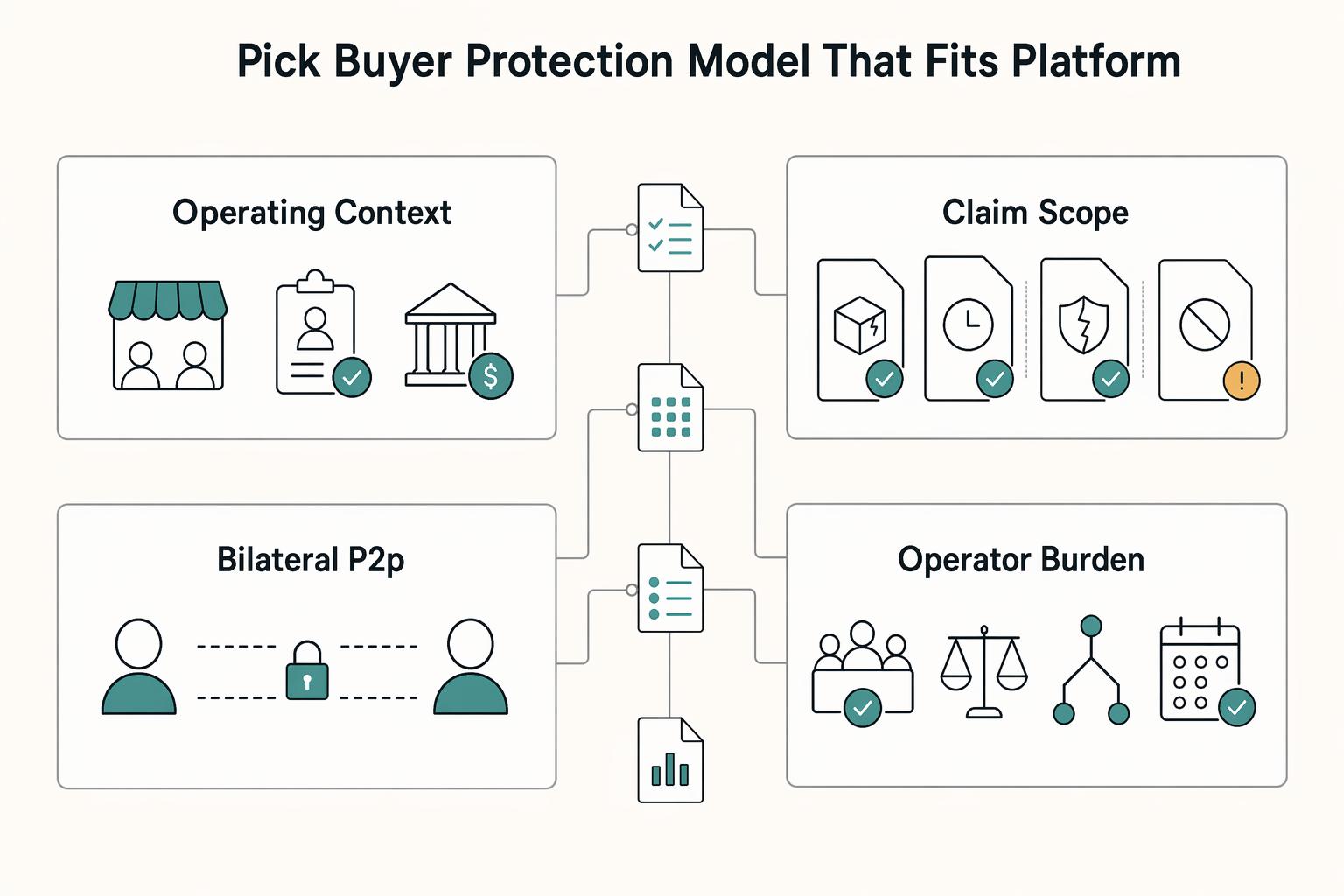
Pick the model you can actually adjudicate. If you cannot name covered claim types, decision ownership, and the dispute path before launch, you are not ready to promise buyer protection.
| Decision point | Grounded signal | Implication |
|---|---|---|
| Operating context | Built for marketplace or similar platform flows where the platform handles onboarding, verification, and payouts | Not for a one-off consumer purchase in a single app |
| Claim scope | Support Item Not Received, Significantly Not as Described, or only one; PayPal explicitly names both and states a 180-day dispute window | If your process only supports non-delivery, say that plainly |
| Bilateral P2P rails | Zelle says it does not offer purchase protection for purchases; Cash App says app-to-app payments are usually not cancelable and does not guarantee refunds for undelivered goods or services | Do not market these rails as broad buyer-protection rails unless you add explicit controls and clear user notices |
| Operator burden | A PayPal-style promise requires intake, evidence handling, state management, and audit-trail discipline; the lifecycle includes validate-eligibility, send-message, escalate, and UNDER_REVIEW | The cited 14-day average settlement timing is only a useful benchmark if your process can support comparable rigor |
- Match the model to your operating context
This guidance is for teams running marketplace or similar platform flows where you handle onboarding, verification, and payouts. It is not for a one-off consumer purchase in a single app. The real distinction is responsibility. These models are built for operators managing participant onboarding, verification, and payout operations, not just a single bilateral payment.
- Start with claim scope, not brand comfort
Confirm whether your model supports both an Item Not Received claim and a Significantly Not as Described claim, or only one. PayPal Purchase Protection is a useful baseline because it explicitly names both and states a 180-day dispute window. If your process only supports non-delivery, say that plainly. If it also supports not-as-described outcomes, define that path with the same clarity.
- Use a hard rule for bilateral P2P rails
If your model depends on bilateral P2P transfers, treat Zelle and Cash App as higher-policy-risk choices for broad buyer guarantees. One says it does not offer purchase protection for purchases and warns these transactions can be high risk with unknown parties. The other says app-to-app payments are usually not cancelable and does not guarantee refunds for undelivered goods or services. You can still allow these rails, but do not market them as broad buyer-protection rails unless you add explicit controls and clear user notices. If a financial institution claims extra coverage for Zelle, verify the exact terms directly.
- Price in operator burden before using PayPal-style language
A PayPal-style promise takes real dispute operations: intake, evidence handling, state management, and audit-trail discipline. The process requires unresolved issues to move through the Resolution Center, and its dispute lifecycle includes actions and states such as validate-eligibility, send-message, escalate, and UNDER_REVIEW. Before launch, decide who handles ineligible claims, missing evidence, and conflicting submissions. The cited 14-day average settlement timing is only a useful benchmark if your own process can support comparable rigor. For more on payout operations at scale, see Airline Delay Compensation Payments: How Aviation Platforms Disburse Refunds at Scale.
Side by side comparison of major buyer protection patterns#
If you need policy language your support, finance, and product teams can defend, PayPal and eBay are the clearest anchors. If you rely on Cash App or Zelle, do not present that as broad buyer protection unless you add your own adjudication rules, notices, and evidence handling.
| Attribute | PayPal | Venmo | Amazon | eBay | Airbnb | StubHub | Cash App | Zelle | Confidence |
|---|---|---|---|---|---|---|---|---|---|
| Covered claim types | Explicitly names Item Not Received and Significantly Not as Described claims. | Public dispute materials reference Item Not Received and Significantly Not as Described timeframes, but coverage is tied to eligible transaction types. | A-to-z says it covers timely delivery and condition of items. | Money Back Guarantee covers item didn't arrive, is faulty or damaged, or doesn't match the listing. | AirCover applies to home bookings, covering booking issues and rebooking help. | FanProtect promises valid tickets or money back and says it tries to find replacement tickets if there is an issue. | No broad formal claim coverage surfaced here. It says it cannot guarantee a refund if you don't receive what you pay for. | States it does not offer purchase protection for purchases made with the service. | High for PayPal and eBay. Medium for Amazon, Airbnb, StubHub. Thin for Venmo breadth. High confidence on the negative signal for Cash App and Zelle. |
| Eligibility language | Coverage applies to eligible claims, and it says eligibility is decided in its sole discretion. | Purchase Protection is available only on eligible Venmo Debit Card and Venmo business profile transactions. Marking a payment as purchase or goods/services does not automatically mean protection applies. Exclusions exist. | Amazon says you can file a claim directly and its team will check if you are eligible for a refund. | Public policy is reason-based and references eligible purchases for refund coverage. | Every home booking comes with AirCover for guests, which is the clearest eligibility anchor. | Guarantee language is tied to ticket validity and order issues, but detailed exclusions were not surfaced here. | Confirm eligibility with the relevant authority. | Eligibility for purchase protection is effectively absent because the service says it does not provide it. | Good visibility for PayPal, Venmo, Amazon, Airbnb. More limited on detailed exclusions for StubHub. Cash App and Zelle are clearer about limits than about any covered eligibility path. |
| Filing window visibility | 180 days to open a dispute from payment date. After opening a dispute, you must file a claim within 20 days. | 180 days for Item Not Received or Significantly Not as Described disputes, 60 days for other errors. | Eligibility example references orders where the last possible delivery date is 90 days or less. | After starting a return the buyer must send the item back within five business days. | Verify in-app. | Verify in-app. | No buyer-protection filing window surfaced. | Not applicable for purchase protection. | Strong for PayPal and Venmo. Partial for Amazon and eBay. Thin for Airbnb, StubHub, Cash App, and Zelle. |
| Shipping-cost treatment | US legal terms say eligible claims may cover full purchase price plus original shipping, but return shipping is not reimbursed. A separate locale page mentions return shipping refunds, so treat shipping language as locale-sensitive. | Confirm with the relevant authority. | Confirm with the relevant authority. | Publicly says eligible refunds include purchase price plus original shipping. For returns, sellers must cover return shipping if the item is damaged or not as described. In most other cases, buyers pay. | Not a shipping-led protection model. | Not a shipping-led protection model. | Not surfaced. | Not applicable. | High for PayPal and eBay. Low elsewhere. The first column needs a locale check before you mirror shipping language in product copy. |
| Resolution path | PayPal Resolution Center. | Dispute path exists, but the public detail reviewed here is thinner than the first column on step-by-step handling. | Claim directly to Amazon. | eBay Money Back Guarantee flow tied to return handling in My eBay. | AirCover guest support includes help finding comparable accommodation for covered issues. | StubHub support under FanProtect, with replacement-ticket attempts or money-back remedy. | Support may assist, but no guaranteed buyer-protection outcome for non-delivery. | No purchase-protection path for purchase disputes. | Highest clarity for PayPal, Amazon, and eBay. Medium for Airbnb and StubHub. Thin for Venmo, Cash App, and Zelle. |
| Operator recommendation | Default choice if you need explicit policy anchors and a named dispute channel. | Use as a secondary option only after you verify the exact eligibility page and exclusions for your transaction type. | Good benchmark when you want direct platform adjudication. | Strong benchmark for listing, delivery, and returns disputes. | Use as a category model for bookings, not as a general goods template. | Use as a category model for ticketing and access disputes, not as a general goods template. | Avoid for broad guarantees unless you add your own controls. | Avoid for broad guarantees unless you add your own controls. | High confidence on the recommendation split. |
The operational takeaway is simple: headline protection language is not the same as an operable promise. PayPal gives you one of the clearest public sequences to mirror, and eBay is also strong because covered outcomes and shipping treatment are more visible than most.
Before launch, verify the live policy page for each rail you support, then lock your product copy to that exact eligibility language. For PayPal, confirm which locale terms govern your users before you promise anything about shipping reimbursement.
Treat payment tags as routing hints, not coverage decisions. Venmo says purchase or goods-and-services labeling does not automatically apply protection, and exclusions exist. For Cash App and Zelle, the reviewed policy language here is mostly a limit signal. Keep them outside a broad guarantee unless you run your own claim intake, evidence standards, and refund rules.
For a step-by-step walkthrough, see How Payment Platforms Really Price FX Markup and Exchange Rate Spread.
PayPal Purchase Protection as the baseline reference option#
If you need one public policy model to anchor buyer-facing promises, PayPal is a useful baseline. PayPal Purchase Protection / PayPal's Purchase Protection Program is specific about claim labels, filing path, and timing, which makes it easier to turn into product and support copy.
Its practical strength is specificity. Item Not Received and Significantly Not as Described are explicitly named claim types, and buyers are directed to the Resolution Center when direct seller resolution fails. It also states disputes for those claim types must be opened within 180 days of payment.
This can fit marketplace checkout flows where qualifying transactions are routed through Goods & Services and you want a clear buyer-facing dispute path.
The main risk is expectation drift. The policy says eligibility is determined in its sole discretion, and outcomes can vary by payment context. Paying through the service does not mean the same protection in every case. The same caution applies to shipping language. Policy text may include full purchase price plus original shipping costs for eligible claims, but that is not the same as saying all shipping is always covered.
If you choose this route, mirror the policy structure directly in your copy:
- Coverage applies to eligible transactions, not every payment.
- Claim categories are Item Not Received and Significantly Not as Described.
- Escalation runs through the Resolution Center.
Keep checkout, receipts, help content, and refund messaging aligned to that scope so users do not confuse all payments on this rail with the same protection outcome.
Venmo Purchase Protection for social commerce and light marketplace flows#
Use Venmo as a secondary protection option when your buyers already transact in the app and your promise is tightly scoped. For many teams, it fits U.S.-leaning social commerce or peer marketplace flows better than a primary, policy-heavy buyer-protection model.
The key distinction is operational. Venmo separates person-to-person transfers from purchases of goods or services. It says eligible buyer payments are covered by the Venmo Purchase Protection Program if the buyer selects that option. If your checkout or support copy blurs those modes, users can assume protection where the program may not apply it.
Where it fits#
This can be strongest in community-driven, relatively simple U.S. flows. The US User Agreement (effective March 17, 2026 in the surfaced result) says users must be in the United States and have a U.S. bank account, so cross-border activity is a clear constraint.
There is also a margin tradeoff. When a buyer indicates goods or services in the app context, the seller is charged a 2.99% transaction fee. That can work in lower-complexity community transactions, but you should model it before a broad rollout.
What you get, and where detail is thinner#
Venmo states Purchase Protection can reimburse the full payment plus original shipping costs for eligible transactions. Keep eligible explicit in every buyer-facing message.
Compared with PayPal, the surfaced material here is less explicit on claim mechanics. PayPal publicly names Item Not Received and Significantly Not as Described and publishes a 180-day dispute window. The surfaced Venmo pages here do not provide the same visible depth on exclusions, evidence standards, or step-by-step dispute handling.
What to verify before launch#
Do not treat "marked as goods/services" as guaranteed coverage. The legal eligibility page says designating a transaction as a Purchase or Goods and Services does not automatically make it eligible, and says ineligible purchases may receive no refund.
Before you promise protection, verify:
- Your flow records that the buyer selected the purchase option, not just that payment occurred in Venmo.
- Your policy notes reflect both the current purchase protection eligibility page and US User Agreement, including version date.
- Your first-line review packet is defined internally, for example, order record, chat history, shipment or handoff proof, and payment-label screenshots.
If your risk team cannot tolerate ambiguity, keep this method behind stricter internal rules and use it as an option rather than your primary public protection anchor.
Marketplace native guarantees when you control the full transaction context#
Choose a marketplace-native guarantee when most dispute evidence already sits on your platform. This model is strongest when you control listings, buyer-seller communication, shipping or handoff records, and the decision workflow itself.
| Pattern | Use when | Key detail |
|---|---|---|
| Amazon A-to-z Guarantee pattern | Timely delivery and item condition disputes; buyers can file claims directly with Amazon | Sellers have 5 business days to respond; buyers must contact the seller first for many claim paths; some delivery cases require waiting 3 days past the maximum estimated delivery date |
| eBay Money Back Guarantee pattern | Most transactions, including item-not-received and not-as-described outcomes | Sellers can submit new information within 30 calendar days of case closure; eBay says it normally responds within 48 hours; signature confirmation is required in certain scenarios at $750 or more |
| Your managed marketplace version | Item metadata, shipment events, communication logs, and payout history are first-party and auditable | Common failure points include off-platform messaging, manual shipping entries without carrier events, and weak listing normalization |
The advantage is evidence quality, not branding. Amazon A-to-z and eBay Money Back Guarantee show a similar high-level pattern: the marketplace reviews claims against platform records. The exact rules, timelines, and evidence requirements differ by policy.
- Amazon A-to-z Guarantee pattern
Amazon says A-to-z covers timely delivery and item condition, and buyers can file claims directly with Amazon. That is the core pattern.
The operational details are specific. Amazon Pay says sellers have 5 business days to respond to a claim notice, and missing that window can auto-assign the claim to the seller. Amazon Seller Central also says buyers must contact the seller first for many claim paths. For some delivery cases, they must wait 3 days past the maximum estimated delivery date before a claim is eligible. If you adopt this model, capture those timestamps and events cleanly.
- eBay Money Back Guarantee pattern
eBay says its guarantee covers most transactions, including item-not-received and not-as-described outcomes. For structured marketplaces, that matters because listing data becomes claim evidence.
eBay is also explicit that sellers are responsible for delivering what was described in the listing. Preserve the listing snapshot at checkout so later edits do not break not-as-described reviews. For appeals, eBay says sellers can submit new information within 30 calendar days of case closure. eBay says it normally responds within 48 hours. Signature confirmation is required in certain scenarios at $750 or more.
- Your managed marketplace version
Use this approach only when your marketplace is truly managed. It fits best when item metadata, shipment events, communication logs, and payout history are all first-party and auditable.
Common failure points include off-platform messaging, manual shipping entries without carrier events, and weak listing normalization. If you cannot reliably show what was promised, what happened, and when the parties responded, keep coverage narrower or use a clearer third-party policy anchor.
Decision rule: if the evidence already lives on your platform, a native guarantee can be a strong fit. If evidence mostly lives in screenshots, emails, and seller assertions, you inherit operational responsibility without enough control.
Related reading: Business Process Automation for Platforms: How to Identify and Eliminate the 5 Most Expensive Manual Tasks.
Travel and ticket style guarantees for experience based transactions#
Use a travel- or ticket-style guarantee when your disputes are about access, cancellation, or service delivery, not parcel delivery status. For reservations, services, and event inventory, category-specific rules can reduce the ambiguity that generic goods-style claim logic often creates.
1. Airbnb style protection for stays and hosted experiences#
Best fit: bookings where the dispute is whether access was provided or the experience was delivered as promised. Airbnb states that every home booking includes AirCover for guests, including support if a host cancels before check-in or a guest cannot check in.
For services and experiences, Airbnb uses defined "Covered Issue" logic and says refunds can be full or partial based on severity and impact. It also sets concrete operating requirements. Refund requests must include evidence such as photos, host-guest communications, or other documentation. For services or experiences, the request must be submitted within 72 hours of the issue. One listed covered-example threshold is host lateness of more than 15 minutes. Also keep scope clear: Airbnb says home-reservation cancellation policies vary by listing.
2. StubHub style protection for event access and ticket validity#
Best fit: event transactions where the core question is valid entry. StubHub's FanProtect framing is explicit: valid tickets or money back, with an attempt to find replacement tickets when there is an order issue.
Build your policy around two limits StubHub makes clear. Coverage applies to tickets bought and sold on StubHub properties, so off-platform inventory may fall outside guarantee coverage. Cancellation remedies can also vary by page or market. One StubHub page describes 120% credit or a cash refund option for canceled, non-rescheduled events. A regional page states a full refund for cancellations.
3. What to copy before launch#
Before launch, benchmark your reservation or event guarantee language against Airbnb and StubHub patterns. Define access and cancellation triggers, evidence requirements, submission windows, and whether remedies vary by market or inventory source.
A common failure mode is importing goods-style "item not received" logic into service disputes. If you cannot reliably evidence check-in or access failure, timing, and communications from first-party records, dispute decisions can become inconsistent and harder to defend.
When to avoid positioning Cash App and Zelle as core buyer guarantee rails#
If you want broad buyer-guarantee messaging at checkout, do not position Cash App or Zelle as your core protection rails. Use a hard rule: when policy language limits purchase protection or reversibility, avoid "guaranteed buyer protection" claims. For this part of your payment stack, aim for exclusion clarity, not broad assurance.
- Zelle: exclude from core buyer-guarantee positioning
Zelle says it does not offer purchase protection, recommends not using it for potentially high-risk transactions, states that authorized payments generally cannot be canceled once the recipient is enrolled, and notes that only certain impostor scams qualify for reimbursement. That combination is a poor fit for item-not-received or not-as-described guarantee messaging. If you still offer this rail, confirm the exact terms that apply to your users before writing policy copy.
- Cash App: same messaging boundary
Cash App says Cash App-to-Cash App payments are instant and usually cannot be canceled, and it says it cannot guarantee a refund when buyers do not receive what they paid for. That supports convenience positioning, not broad buyer-protection promises.
- Forum volume is not protection evidence
Discussion volume in forums is not a policy basis for guarantee claims. Base checkout language on documented protection scope, cancellation limits, and reimbursement wording.
If you keep either rail live, limit use to lower-risk scenarios and add a clear notice at payment selection that protection may be limited for buyer disputes.
Build the claims operation before launch day#
Do not launch buyer-protection messaging until you can move each case from complaint to finance entry with clear ownership, evidence rules, and a policy-based outcome.
| Step | What to check | Policy note |
|---|---|---|
| Intake | Route the case to Item Not Received claim, Significantly Not as Described claim, or outside Purchase Protection scope | Keep unauthorized transaction complaints out of this queue |
| Triage | Confirm policy eligibility, timing, and whether the payment method is in your buyer-protection scope | Do not publish a single simplified SNAD deadline as universal if your referenced sources show different timing language |
| Evidence request | Request evidence by claim type | Define handling for missing seller proof, seller delivery evidence, late submissions, and policy-ineligible transactions |
| Decision | Record the exact policy basis and event record behind each outcome | If parties cannot resolve the dispute, escalate it to a claim in the Resolution Center instead of implying your team controls final eligibility decisions |
| Payout adjustment | Apply payout logic by policy rail and claim outcome | Do not include return shipping under PayPal Purchase Protection, and do not merge different rail behaviors into one generic refund rule |
If you anchor coverage to PayPal, mirror that path: start with a dispute, escalate unresolved disputes to a claim, and run it through the Resolution Center.
- Intake
Route the case into the correct lane immediately: Item Not Received claim, Significantly Not as Described claim, or outside Purchase Protection scope. Keep unauthorized transaction complaints out of this queue, since PayPal treats them separately.
- Triage
Before evidence review, confirm three things: policy eligibility, timing, and whether the payment method is in your buyer-protection scope. Do not publish a single simplified SNAD deadline as universal if your referenced sources show different timing language.
- Evidence request
Request evidence by claim type, not with a generic document ask. Missing seller proof, seller delivery evidence, late submissions, and policy-ineligible transactions should each have a defined handling path.
- Decision
Record the exact policy basis and event record behind each outcome. If parties cannot resolve the dispute, escalate it to a claim in the Resolution Center instead of implying your team controls final eligibility decisions.
- Payout adjustment
Apply payout logic by policy rail and claim outcome, then post it cleanly to finance. Do not include return shipping under PayPal Purchase Protection, and do not merge different rail behaviors into one generic refund rule.
Before launch, enforce one checkpoint: every decision should trace back to policy text, event records, and finance entries so ops and engineering can reconcile outcomes.
Buyer protection due diligence checklist before you promise coverage#
Do not promise coverage until you can verify each rail's policy scope, filing window, and payout components in current primary docs. Breakdowns usually happen when teams publish one clean promise and only discover rail-by-rail differences after the first claim.
Use one operating rule: every buyer-facing statement must map to a current policy page, a defined dispute path, and a payout rule finance can post without debate. Keep the source URL, page date, and your interpretation note together, for example, PayPal's Purchase Protection page date and Venmo's User Agreement effective date.
- Coverage map by rail
Build a rail-by-rail matrix for PayPal, Venmo, Cash App, and Zelle, and leave unknowns explicit. PayPal explicitly defines Item Not Received claim and Significantly Not as Described claim; unresolved issues must go through the Resolution Center, and eligibility is still at its discretion. Venmo defines "Purchase" for goods or services, but marking a payment as a purchase does not automatically apply Purchase Protection. Cash App says completed person-to-person payments cannot be canceled or refunded by the service, and Zelle says it does not offer a protection program for authorized payments.
- Timeline commitments you can actually meet
Separate customer filing windows from your own communication SLA. PayPal requires disputes within 180 days and says claims settle in 14 days on average; Venmo also lists 180 days for item-not-received and not-as-described disputes. Cash App uses different timing: disputes within 60 days of the statement, an update within 10 business days, and investigations up to 45 days. Your support promise should reflect those differences, not force a single cross-rail timeline.
- Payout components and refund math
Define exactly what "refund" includes before it appears in product or policy copy. PayPal may cover full item price plus original shipping, but not return shipping; Venmo marketing also says reimbursement can include full payment plus original shipping. Encode components explicitly in finance rules and macros: item value, original shipping, and excluded return shipping.
- Abuse and edge-case stress test
Stress-test policy language against scam patterns before launch, especially authorized-payment scenarios. Consumer Reports describes ambiguity in how providers treat fraudulently induced payments and reports $210 million in 2023 losses on these platforms; Zelle also distinguishes scams where users knowingly send money and says certain impostor scams can qualify for reimbursement. Use Reddit cases only as test inputs, not as policy authority, and tighten wording anywhere one scenario could reasonably produce conflicting interpretations.
If your checklist is mostly complete, map each dispute state to webhooks, payout states, and reconciliation checkpoints in the Gruv docs before launch.
Conclusion#
The point is not the loudest guarantee claim. It is the protection model your team can run end to end, with clear eligibility, dispute ownership, and evidence handling.
- Choose the model you can actually execute
PayPal is more operationally explicit than generic trust messaging because it defines Item Not Received and Significantly Not as Described and routes disputes through the Resolution Center. You can map support and finance work to real checkpoints, including PayPal timing rules (180 days for INR, 30 days from delivery for SNAD, or 180 days from payment, whichever is sooner, and a 20 days auto-close if a dispute is not escalated). If your team cannot manage those clocks and evidence requirements, narrow the promise.
- Commit only to coverage you can verify
Do not market blanket protection on eligibility-bound rails. PayPal says eligibility is determined in its sole discretion, and Venmo Purchase Protection applies only to eligible payments, including use of the purchase-protection toggle before sending payment. Keep a rail-level evidence pack with source URL, last-checked date, covered claim types, filing window, refund components, and final decision owner. If your team cannot point to exact policy text, do not ship the claim.
- Say where protection changes and route users to the right method
If coverage varies by rail, product type, or market, say that directly in product copy and the payment UI. Zelle says it does not offer purchase protection and recommends not using it with people you do not know, while Cash App says payments are instant and usually cannot be canceled. If a transaction needs stronger safeguards, route to the method with the clearest dispute path, and only use broader marketplace-style guarantees when you are ready to own the added investigation and abuse-handling workload.
If you're evaluating payment guarantees buyer protection platforms, the practical finish is straightforward: compare rails transparently, promise only what policy terms support, and align your operations with what you publish.
When coverage rules vary by rail or market, do a quick policy review with your ops and risk owners. Confirm what you can safely promise in production with Gruv's team.
Frequently Asked Questions
What do buyer protection programs usually cover on payment platforms?
Coverage depends on the rail. PayPal explicitly focuses on two failure cases: the item never arrives, or it arrives significantly different from what was promised, through Item Not Received and Significantly Not as Described claims. Do not assume every rail follows that same structure.
Are item-not-received and not-as-described claims handled the same way?
No. They can sit under one protection program, but they are different claim types and may involve different review details. Treating them as one operationally can create inconsistent outcomes.
Do buyer guarantees include shipping costs or only the purchase amount?
It depends on the rail and the scenario. PayPal says reimbursement can include the full purchase price plus original shipping costs paid, when applicable. If you promise a "full refund," define whether that includes original shipping.
Are all payment methods equally protected when checkout runs through one platform?
No. Venmo says only eligible payments are covered in specific contexts, and its legal definition of a Purchase excludes gifts, charitable contributions, and reimbursements. One checkout flow does not mean one protection standard across all methods.
How should a marketplace operator verify eligibility rules before launch?
Use current primary policy docs, not summary copy, and keep a rail-level evidence pack with source URL, date, covered claim types, dispute path, and refund components. For PayPal, confirm the Resolution Center workflow, the 180 days dispute window, and that eligibility is decided by PayPal. This is the simplest way to avoid overpromising.
Which is safer for both sides in practice: PayPal, Venmo, Cash App, or Zelle?
There is no universal ranking across these platforms. PayPal explicitly documents claim types, dispute workflow through the Resolution Center, and an average 14 days claim-settlement timeline. Cash App says payments are instant and usually cannot be canceled, and Zelle says it does not offer purchase protection and recommends not using the service with people you do not know.
What should we say in product copy when policy terms are incomplete or still being validated?
Keep the claim narrow and method-specific. Name the covered method, link to the current policy, and state that protection applies only to eligible transactions. Avoid blanket statements like "all payments are protected" until policy validation is complete.
Try a related tool
Researched and edited by the Gruv editorial team. Gruv builds cross-border billing, payouts, and finance-operations software for global businesses.
Sources
Includes 3 external sources outside the trusted-domain allowlist.
- consumer.ftc.gov/consumer-alerts/2023/08/do-you-use-payment-a...trusted
- consumer.ftc.gov/articles/buying-online-marketplacetrusted
- ftc.gov/news-events/news/press-releases/2025/03/new-...trusted
- paypal.com/us/digital-wallet/buyer-purchase-protectiontrusted
- paypal.com/us/legalhub/paypal/buyer-protectiontrusted
- airbnb.com/help/article/3218external
- amazon.com/gp/help/customer/display.htmlexternal
- cash.app/help/us/en-us/3051-canceling-a-paymentexternal
Educational content only. Not legal, tax, or financial advice.
Related Posts
When Instant Payout Matters for Gig Platform Payments
Instant payout is a tool, not the goal. The real operating decision is where instant timing creates measurable value, where batch timing is enough, and where both should run side by side.
Airline Delay Compensation Payments for Customer Experience and Control
If you are evaluating an `airline compensation payments customer experience delays platform`, split the work into three lanes first: legally owed refunds, discretionary compensation, and outsourced claims recovery. Vendor pages often blur these together, but they lead to different policy choices, ledger treatment, and customer outcomes.
Solving Esports Prize Payment Distribution: How Tournament Platforms Pay Winners Globally
Choose your payout path based on your operating model and control requirements, not on esports messaging alone. Public pages from Payment Labs, Dots, and i-payout are useful for a shortlist, but they are not enough on their own to sign confidently or run payouts without finance and engineering surprises.