
Quick Answer
Treat a primary gateway failure as a live revenue incident: detect it fast, classify the failure domain, and fail over only the affected segment when the backup path is proven healthy. Watch authorization rate, decline rate, and latency first, verify signal quality before rerouting, preserve idempotent retries, and hold state-dependent actions until webhook and record flow are clean again. Resolve in-flight payment outcomes before retrying them through another gateway; provider idempotency keys do not protect cross-provider replacements.
What to Do When a Gateway Goes Down#
Treat a gateway failure as a live revenue incident#
When your primary payment gateway fails, treat it as a live revenue incident and protect transaction continuity first. Watch authorization rate, decline rate, and payment latency right away, because partial failures often show up there before they look like a clean outage. If those metrics move sharply and checkout complaints rise, start incident response and assume it is real until the evidence says otherwise.
Follow a decision sequence instead of a theory lesson#
Use this playbook in order: detect, decide on Gateway Failover, stabilize traffic, and verify recovery before you close the incident. Payment failover means automatically rerouting transactions to a backup path when the primary gateway, processor, or network path fails. Use threshold-based triggers so brief noise does not force an unnecessary switch. Avoid broad routing changes until your signal quality is good enough to trust. Recovery validation is a separate step. If approvals rebound but downstream processing is still delayed, the incident is not over.
Check your routing scope before you rely on it#
Before you count on automation, confirm that Payments Orchestration and Multi-Gateway Routing support the payment paths you need. That support is not universal. Processor compatibility, feature availability, payment method, country, currency, and product constraints can all block a route you expected to use.
If support is unclear, default to containment, communication, and manual controls rather than assumed automation. Payment orchestration is a rule-based routing layer, not a guarantee that every payment feature works everywhere. Related reading: Understanding Payment Platform Float Between Collection and Payout.
For a broader routing design review, see Payments Orchestration: What It Is and Why Every Platform Needs a Multi-Gateway Strategy.
Outage Types and Blast Radius You Must Classify Fast#
Separate the failure domain before you reroute#
Classify first and reroute second. Before you change routing rules, decide whether the issue is in the Payment Gateway, the Payment Processor, or your own integration path.
Those are different failure domains. A gateway transmits payment data between customer, business, and processor. A processor authorizes transactions and facilitates fund movement. Internal faults are separate and often show up as invalid API calls or failures in your own handling paths. Compare your application errors with provider status signals, timeout patterns, and connectivity before you move traffic.
Is this a full outage, partial outage, or degraded performance?#
Use observed signals, not labels borrowed from a status page. A major outage is complete unavailability. A partial outage is complete breakage for only a subset of users or paths. Degraded performance means the component still works but is slow or otherwise impaired.
Check for approval collapse, timeout spikes, response-time spikes, and error concentration by payment method or acquirer. Confirm the label only when success rates, error codes, response times, and connectivity point in the same direction.
Map the blast radius by payment flow#
Treat each payment flow as its own lane. Checkout authorization, Payout Batches, and Virtual Bank Accounts (VBAs) can fail in different ways, so triage them separately. Payouts are a different service domain from checkout authorization. VBAs are virtual account numbers used for bank-transfer collection and reconciliation, so they need their own operational view. If webhooks lag while authorizations succeed, classify webhook delivery risk separately instead of treating it as direct proof of gateway or processor failure. If payout continuity is in scope, Mass Payouts for Gig Platforms: Complete Guide is a useful adjacent runbook.
Create an explicit unknowns lane#
Build your incident view around three buckets from minute one: confirmed facts, suspected cause, and unknowns. That simple split cuts down early over-attribution and bad routing changes.
Webhook delay alone does not prove a gateway outage. For Stripe, automatic retries can continue for up to three days. Inspect the payment’s authoritative status and contain dependent actions while event ingestion recovers.
Prerequisites and Evidence Pack Before You Need It#
Before an incident starts, put these basics in place: clear ownership, one escalation lane, a ready evidence pack, retry-safe write behavior, and compliance controls that still hold in degraded mode.
Assign one incident owner and one escalation lane#
One person needs to own the incident in real time. Set one Incident Commander (IC) as the coordinator, then pre-assign supporting owners for engineering, product, finance ops, and compliance. Keep those owners, plus primary and backup contacts, in one Incident Response Runbook.
Run the incident in one escalation channel. If teams split across threads, routing, reconciliation, and customer messaging drift fast.
Pre-stage the evidence pack you will actually use#
Build the evidence pack before the first outage so it is ready when you need it. At minimum, include:
Ledgeror ledger-like transaction viewsWebhooksdelivery visibility and replay access- Direct provider status links
- An on-call contact matrix with escalation paths
It should let responders answer the questions that matter under pressure. What changed first? Which transactions were affected? Are events still arriving? Who needs to be contacted at the provider? Transaction-level provider records support reconciliation. Webhook replay tooling becomes critical when events are delayed. For Stripe specifically, automatic redelivery can continue for up to three days, and undelivered-event retrieval is limited to the last 30 days.
Use provider status pages as one input, not a verdict or a substitute for SLA terms.
Require idempotency on payment and payout writes#
Lock retry behavior down before you need to rely on it. Require Idempotency keys on POST actions that might be retried manually, including payment and payout writes. Store each key with your internal payment or payout ID.
Provider behavior differs, so your playbook cannot assume one universal retention window. Stripe keys can be up to 255 characters and may be removed after at least 24 hours. Adyen keys are valid for a minimum of 7 days. Validate retry safety in testing by replaying the same request with the same key and confirming no duplicate posting. On supported PayPal REST APIs, omitting PayPal-Request-Id can duplicate the request.
Decide how compliance behaves in degraded mode#
Define degraded-mode behavior in advance for onboarding, activation, payout release, and higher-risk transaction review: queue, hold for review, or reject. Outage handling should not become a hidden compliance bypass.
If you operate under U.S. AML obligations, keep the runbook explicit on ongoing internal controls, risk-based customer identification procedures, and beneficial ownership procedures for legal-entity customers. Controls can degrade operationally, but they should not disappear.
Detection Matrix With Trigger to Action to Owner#
Use the matrix to decide what to do before you debate root cause. If the signal is weak, do not switch traffic yet. First confirm with transaction-record checks and Webhooks delivery state.
That only works if the prior section is already in place. Without fast transaction views, webhook status, and provider health details, this matrix turns into guesswork.
Classify by customer symptom first#
Start with the failure your customers can feel, then work inward. In practice, monitor transaction success, error rates, response times, and connectivity in real time.
Keep the domain split simple. A Payment gateway transmits payment information between the customer, your business, and the processor. A Payment processor processes payments on behalf of the business's bank.
If checkout attempts fail broadly before meaningful processor responses appear, start with gateway suspicion. If requests get through but refusals cluster by method, acquiring path, or normalized refusal reason and result code, start with processor-side degradation. If authorizations succeed but internal payment state stalls, treat it as webhook or internal-recording risk first, not route failure. Wrong rerouting is expensive. False Gateway Failover can shift healthy traffic, add reconciliation noise, and slow diagnosis.
Set trigger levels and attach named owners#
Do not use one universal threshold. Tune thresholds to your traffic, payment methods, and geography, but write explicit triggers so on-call decisions are not improvised.
Set route-specific thresholds from normal traffic and error patterns. The 5,20 and45 consecutive-failure values below are illustrative planning values, not provider defaults or standards. Pair them with error type, elapsed time and sample size.
| Symptom | Likely domain | Trigger and action | Verify before acting | Owner handoff |
|---|---|---|---|---|
| Broad checkout failures across multiple methods with rising latency or connectivity errors | Payment Gateway | 5 consecutive failures on the same route: engineering lead investigates transport/auth path. 20: mark route unstable and prepare selective reroute. 45: IC approves failover for that route only if the secondary path is healthy. | Check recent transaction records for the route to confirm a real drop, not delayed state updates. Confirm Webhooks are not the only failing signal. | Engineering lead first, payments ops lead confirms provider impact, finance controller starts a watchlist if captures or refunds may be affected. |
| Requests succeed to provider but refusals cluster by one method, acquiring path, refusal reason, or result code | Payment Processor | Treat as method or processor degradation, not full gateway failure. Prepare selective routing only for the affected segment. | Review raw acquirer response mapped to refusal reason and result code. Record creation usually remains normal, and webhook delivery often remains normal. | Payments ops lead owns diagnosis with engineering support. Finance controller joins if settlement or payout timing may move. |
| Auths succeed but internal order or payment states stop advancing | Internal webhook or ledger ingestion path | Contain first, do not reroute first. Hold state-dependent actions like auto-capture, release, or payout progression until event flow is understood. | In Webhooks, check Delivered, Pending, Failed, and lag trend. In your transaction records, confirm auth entries exist while downstream transitions are missing or delayed. | Engineering lead owns recovery. Finance controller opens reconciliation review. |
| Provider status or internal metrics show partial recovery after disruption | Mixed or still unknown | Do not declare healthy yet. Keep traffic controls until recovery is sustained. | Confirm webhook backlog is shrinking and stuck transitions are clearing. For Stripe live mode, webhook redelivery can continue for up to 3 days, so lag can outlast the original fault. | IC stays in control, engineering lead verifies catch-up, payments ops lead validates customer impact. |
| Single latency spike or isolated alert without a clear rise in failed customer actions | Unknown or noisy | Do not act yet. Watch and gather evidence. Avoid route switching on one noisy signal. | Check customer-visible failure rate, high-level record parity, and whether webhook lag is actually growing. If none move, continue monitoring. | IC logs a watch item. No failover handoff. |
A practical rule is to keep the finance controller out of every first alert, then pull them in as soon as money movement may drift from customer state. Common triggers are successful auths with delayed internal state, manual retries, refunds in flight, or payout dependencies.
Verify signal quality before any route change#
Before you reroute, check record parity and Webhooks delivery lag together. They answer different questions. Parity checks whether attempts and financial records still align at a high level. Webhook lag shows whether your internal state machine is being fed or starved.
If approvals appear down but records are still flowing and webhooks are mostly Delivered, suspect reporting or aggregation first. If approvals look stable but webhooks are Pending or Failed, failover is unlikely to fix the core issue. Contain state-dependent actions instead.
Keep customer-failure signals at the top of the matrix. Each row should let you answer one question quickly: investigate, contain, reroute, or wait.
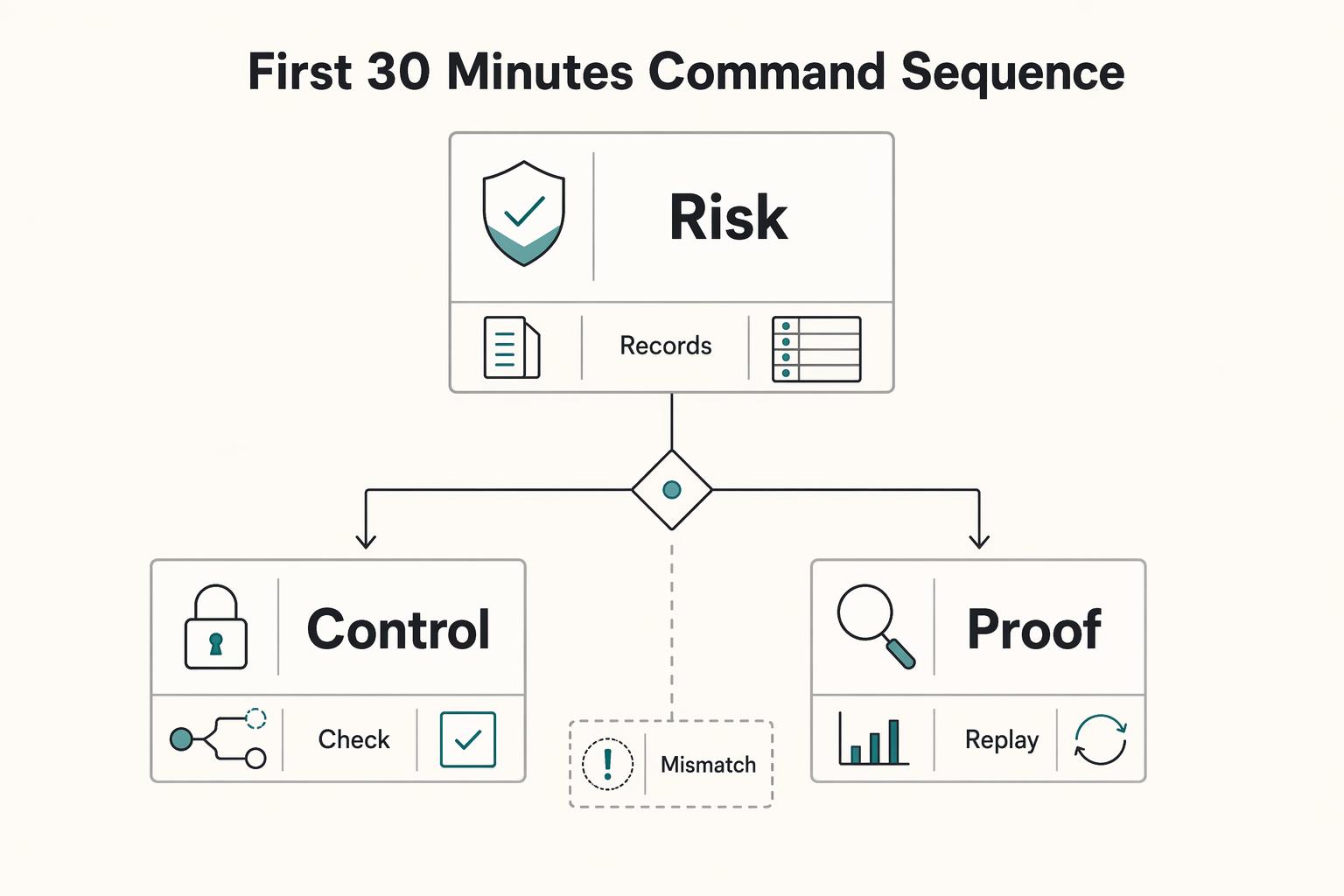
First 30 Minutes Command Sequence#
In the first 30 minutes, optimize for control, not certainty. Establish command, make one careful routing decision, and protect money movement while the evidence catches up.
| Minute window | Primary objective | Action | Owner |
|---|---|---|---|
| 0-10 | Establish command | Freeze risky config changes, assign the incident commander, and capture one evidence snapshot | Incident commander + engineering lead |
| 10-20 | Route carefully | Move only affected segments that pass route, idempotency, and webhook prechecks | Payments engineering lead |
| 20-30 | Protect books and support | Open the reconciliation watchlist and align finance ops and support on the next checkpoint | Finance ops lead + support lead |
| 30+ | Hold state-dependent actions | Keep refunds, payout releases, and auto-capture behind recovery checks until event ingestion is clean | Incident commander |
Freeze drift and assign command in minute 0 to 10#
Freeze risky payment configuration changes, move responders into the pre-defined incident call and chat channel, and open the Incident Response Runbook immediately. Name the Incident Commander (IC) and a scribe up front. That makes decision authority and timeline logging clear from the start.
Keep command and execution separate. The IC stays the single source of truth and makes decisions under uncertainty, while engineering and payments specialists investigate and execute changes.
Capture one comparable snapshot before dashboards move: Payment Gateway health, Payment Processor health, high-level transaction-record parity, and Webhooks delivery states of Delivered, Pending, and Failed. Save IDs or screenshots so later reconciliation is based on evidence, not memory.
Route selectively in minute 10 to 20#
If you use Multi-Gateway Routing, move only the affected segment that passes prechecks. If the error origin is still unclear, keep risky segments pinned instead of shifting all traffic and creating a second failure surface.
Before rerouting any segment, confirm:
- The secondary route is healthy for that exact segment.
- Retry handling preserves
Idempotencybehavior for the same request. - You can reconcile auth, capture, refund, and webhook outcomes after the change.
- Original attempts have definitive outcomes before their transactions are retried on a different provider; provider idempotency keys do not deduplicate across gateways.
For an identical request on the same supported provider endpoint, reuse the original idempotency key. If the original outcome is unknown, query status or reconcile provider records before creating a payment elsewhere. Keep a stable business-operation ID across routes; the same key on another provider does not prevent double charging.
Sync finance and support in minute 20 to 30#
By minute 20, this is cross-functional whether you planned for it or not. Finance ops and support need the same current view of impact and the same next checkpoint. Set internal message tiers based on observed impact, and give external updates that are fast, explicit, and time-boxed.
Use ETA bands and checkpoint times instead of precise restoration promises. The most useful support update says what changed since the last check and when the next firm update will come.
Open a reconciliation watchlist now. Track successful auths awaiting state transition, captures or refunds attempted during degradation, manual retries, and any rerouted segments in one working queue. That operating queue becomes easier to trust when finance and engineering share a deterministic record; How to Build a Deterministic Ledger for a Payment Platform covers that design choice.
Hold state-dependent actions until event ingestion is clean#
Do not call recovery based on successful auths alone if Webhooks are still delayed. Auth recovery shows one path improving. It does not prove internal state transitions are reliable.
Hold state-transition-dependent actions until ingestion normalizes, including auto-capture, release logic, refund progression, payout dependencies, and final-status customer messaging. Confirm backlog shrinkage, clearing stuck transitions, and missed-event reconciliation before you give the all-clear. For Stripe live mode, webhook retries can continue for up to 3 days.
Log every manual override in the Incident Response Runbook with timestamp, actor, exact change, affected segment, and reason. That timeline matters for audit, reconciliation, and postmortem traceability.
Related: Payments Orchestration: What It Is and Why Every Platform Needs a Multi-Gateway Strategy.
60 to 120 Minute Stabilization and Customer Handling#
By the second hour, shift from emergency moves to controlled throughput. Keep failover targeted by segment, not platform-wide. Broaden it only if your predefined thresholds support the move and the backup path covers the same payment methods, currencies, and compliance requirements.
Tune Gateway Failover in segments, not one big cutover#
A broad cutover is usually the wrong move unless the failure is broad and the backup path is already proven. Use Multi-Gateway Routing to move load in measured slices by payment method, market, currency, or merchant cohort. That limits unnecessary switching during brief issues and keeps the blast radius smaller if a secondary path underperforms.
Make routing changes from pre-set thresholds, not ad hoc judgment under pressure. After each change, confirm the shifted segment can complete the full flow you need, not just initial authorization.
Prioritize the money paths that matter most#
Protect the highest-impact money paths first, then work down the queue. That usually means high-value transaction paths before time-sensitive obligations like queued Payout Batches. Treat payout timing as rail-specific and operator-specific, not universal.
For Same Day ACH planning, one grounded reference point is submission until 4:45 p.m. ET in the third window, with interbank settlement at 6:00 p.m. ET. Confirm your operator's actual schedule before promising timing. Record holds, releases, deadlines, and approvers in the Incident Response Runbook.
Publish updates with knowns, unknowns, and the next checkpoint#
Keep updates direct and time-boxed: what is affected, what is working, what actions are in progress, and when the next update will be posted. Include an explicit checkpoint time instead of vague reassurance.
If recovery is partial, say which transactions are processing and which may still be delayed or retried.
Keep AML controls live even in degraded mode#
Do not relax AML holds or suspicious-activity escalation to increase throughput. Ongoing compliance and ongoing monitoring still apply during incident conditions.
Before widening routing, verify the backup path still meets compliance requirements and that suspicious-activity monitoring can observe the right events. If monitoring visibility degrades, limit routing to segments you can still monitor and escalate immediately.
Failover Decision Rules That Prevent Expensive Mistakes#
After initial stabilization, the core rule is simple: fail over only when the failure pattern is broad and the secondary path is already proving healthy for the same segment. If failures are narrow, route narrowly.
| Observed pattern | Routing action | Why |
|---|---|---|
| Broad failures across methods, markets, and merchants | Fail over the proven backup path for that same segment | Revenue protection is worth the route change when the backup is already healthy |
| Method-specific or acquirer-specific degradation | Route only the affected segment | Narrow routing limits reconciliation noise and avoids shifting healthy traffic |
| Approvals look normal but webhooks or internal state are delayed | Do not fail over yet; contain state-dependent actions first | A route change will not fix an event-ingestion problem |
| Backup path lacks the same compliance visibility or rollback safety | Keep routing scope pinned and escalate | Transaction continuity does not justify losing control evidence |
Classify the failure before you move traffic#
The first decision gate is still failure type. Stripe separates failures into issuer declines, blocked payments, and invalid API calls. It says each type should be handled differently, so one spike is not evidence that your whole primary Payment Gateway is down.
Route new attempts only to a proven backup for the affected segment. Separately reconcile in-flight attempts before retrying them elsewhere. Test the full transaction flow, including payment-method credentials, capture, refunds and event delivery; a successful first call does not establish safe failover.
Weigh cutover speed against Ledger cleanup#
Fast cutover can protect revenue, but it can also make reconciliation more expensive if retries and payment state changes stop lining up. The practical rule is simple: if transaction integrity is not proven on the backup path, keep routing scope small.
Verify a sample end to end, from request through final posting, and confirm retries are not creating second objects. Stripe's idempotency guidance is explicit. With idempotency, retries after connection errors can be repeated safely without duplicating the operation.
Also check retry timing. Stripe notes idempotency keys can be removed once they are at least 24 hours old, so delayed retries may not behave the same way.
Route only where Idempotency and rollback are proven#
Dashboard health is not enough. Expand only where production-like testing has already validated retry safety, rollback behavior, and endpoint-level support.
PayPal idempotency-header support is API-specific. Test each payment, capture, refund or payout action, including a timeout after processing. If the original result is unresolved, hold and investigate it; manual resubmission is not a substitute for duplicate protection. A routing rollback cannot undo completed money movement.
Stop expansion when Merchant of Record (MoR) responsibility changes#
If routing changes the Merchant of Record or contractual responsibility for tax, fraud, refunds or customer support, require legal and finance sign-off before expanding. Record those responsibilities by route and market.
Decision rule: if route-level MoR responsibility differs by country or segment, pause expansion until ownership is explicitly approved for the exact markets and customer cohorts being moved.
Before expanding failover coverage, align routing rules with idempotent retries, webhook handling, and ledger reconciliation in your own runbook using the Gruv docs.
Keep Payout and Compliance Flows Intact During Checkout Disruption#
A checkout outage should not automatically freeze money-out or compliance work that is still healthy. Run card acceptance, disbursements, and regulatory controls as separate lanes with separate toggles, owners, and checkpoints.
Split checkout controls from Payout Batches#
Keep collection and transfer lanes separated during the incident if your stack already supports that model. In a separated model, charges on the platform can be decoupled from transfers to connected accounts, and payouts can continue without tying them to the same checkout path.
The common mistake is one broad incident switch that pauses both incoming checkout and outgoing Payout Batches. If disbursement timing is contractual or operationally sensitive, contain only the affected checkout path and keep approved payouts on their own control plane.
After any routing change, confirm payout files still progress and disbursement state remains visible independently from authorization state. If you cannot prove that separation in your transaction records and operational tooling, treat it as a coupled risk and reduce the change scope.
Use Virtual Bank Accounts (VBAs) only where they are already enabled#
Bank-based continuity paths can help when card rails degrade, but only if they already run in production. Virtual bank accounts are supported payout destinations in some stacks, and instant bank-transfer infrastructure exists that runs near real time at all hours.
The rule is not to move everyone to bank transfer. Keep existing bank-based lanes available and route the smallest viable segment. Support for VBAs does not, by itself, mean automatic card-outage failover.
Before relying on this path, verify:
- The destination type is enabled for the exact segment and market in scope.
- Reconciliation is visible from transfer creation through bank-delivery status.
- User and support messaging makes clear this is a temporary continuity path.
Keep KYC, KYB, and AML checks in degraded mode#
Compliance controls should degrade gracefully, not disappear. CDD expectations include suspicious-activity monitoring and reporting, and risk-based ongoing monitoring includes maintaining and updating customer information, including beneficial-owner information for legal entity customers.
If a dependency is down, use queued review, slower review, or restricted access, but do not bypass checks to clear backlog. A practical incident guardrail is to block higher-risk capability upgrades while identity, business review, or suspicious-activity screening is unavailable.
Track exceptions with timestamps, approvals, missing data, and re-review deadlines. Keep that evidence complete in case escalation is required, including SAR timing obligations.
Isolate W-8, W-9, and Form 1099 data collection from outage toggles#
Do not let checkout toggles break tax-document workflows. Form W-9 is used to provide a correct TIN, and Form W-8BEN is used by foreign individuals to establish foreign status, so these collection paths should stay isolated from payment-routing flags.
A frequent failure mode is accidental coupling. Checkout controls pause onboarding, and payees stop submitting W-8 or W-9 information. That creates downstream tax-ops risk, especially when recipient copies of Form 1099-K have fixed delivery timing.
Also protect classification logic during rerouting: card and third-party network transactions are reported on Form 1099-K, not 1099-MISC or 1099-NEC. At minimum, confirm forms can still be submitted, stored, and retrieved during the incident, and keep reporting logic stable while rails are being stabilized.
Recovery Verification Before You Announce All Clear#
Do not announce all clear until two things are true: customer-facing payment outcomes are stable again, and your internal records show complete, consistent money movement. A rebound in approvals alone is not enough when webhook lag or replay effects can outlast the visible outage.
Confirm customer recovery and Ledger recovery separately#
Treat customer recovery and backend recovery as separate checks. They often recover on different timelines. Verify successful and failed outcomes look normal again for affected routes and methods. Then verify those same outcomes are reflected correctly in your Ledger or equivalent transaction records.
The check is not just whether counts are rising again. It is whether auth, capture, refund, payout, and reversal states line up with the events, retries, and route changes logged during the incident. Use the reconciliation watchlist you opened earlier and work through successful auths awaiting state transition, captures or refunds attempted during degradation, manual retries, and any rerouted segments.
If customer outcomes look healthy but the ledger still shows gaps, duplicates, or stuck transitions, recovery is still incomplete and the incident stays open.
Conclusion#
A good outage playbook protects revenue without creating a bigger reconciliation problem. Route narrowly, keep compliance active, reuse idempotency keys, and do not call recovery until both customer outcomes and ledger evidence are back in sync.
- Classify the failure before you change routes.
- Move only the segment that has a healthy backup path.
- Keep one reconciliation watchlist from the first 30 minutes onward.
- Treat the all-clear decision as a customer-and-ledger checkpoint, not an approval-rate checkpoint.
Frequently Asked Questions
When should we trigger gateway failover?
Trigger selective failover when customer-impacting failures are confirmed and the backup supports that segment. Route new attempts carefully; resolve the original outcome before retrying any in-flight transaction on another provider.
What must be verified before we reroute transactions?
Verify route coverage, credential portability, provider-specific retry protection, authoritative transaction states and event delivery. A route change should follow both customer-impact signals and transaction evidence.
How do idempotency keys change outage handling?
On a supported provider endpoint, reusing the original key protects retries of the same request within that provider’s retention window. It does not deduplicate across gateways. Preserve a durable business-operation record and reconcile unknown results before creating a replacement payment.
Should payouts and compliance checks pause during checkout disruption?
Do not treat checkout disruption as permission to relax payout or compliance controls. Keep KYC, KYB, AML, and tax-document rules active, and isolate payout batches from checkout toggles until monitoring, queue state, and approval evidence are stable again.
When is it safe to declare all clear?
Only after customer outcomes are stable and the ledger shows complete, consistent money movement. A rebound in approvals is not enough if webhook lag, stuck transitions, or duplicate retries still need reconciliation.
What should finance ops track during recovery?
Track successful auths awaiting state transition, captures or refunds attempted during degradation, manual retries, rerouted segments, and any payout dependencies. The fastest way to close the incident is to keep one watchlist finance, engineering, and support can all work from.
Researched and edited by the Gruv editorial team. Gruv builds cross-border billing, payouts, and finance-operations software for global businesses.
Sources
- bsaaml.ffiec.gov/manual/AssessingTheBSAAMLComplianceProgram/0...trusted
- bsaaml.ffiec.gov/manual/AssessingComplianceWithBSARegulatoryR...trusted
- cisa.gov/sites/default/files/publications/Incident-Re...trusted
- csrc.nist.gov/pubs/sp/800/61/r3/finaltrusted
- developer.paypal.com/api/rest/reference/idempotencytrusted
- docs.stripe.com/api/idempotent_requeststrusted
- docs.stripe.com/webhooks/process-undelivered-eventstrusted
- ecfr.gov/current/title-31/subtitle-B/chapter-X/part-1...trusted
Educational content only. Not legal, tax, or financial advice.
Related Posts

The Freelance Payment Penalty: A Modeled Audit of Platform Fees, FX Spreads, and Payout Delays
The money rarely disappears through a single, easy-to-spot fee. The real loss is stacked. A marketplace takes its commission, a processor adds a charge for international cards, a bank or payment company converts the currency at a spread, a platform holds the funds before release, and a wire sheds a little to intermediaries on the way in. Each layer looks defensible on its own, but the worker feels the combined result as a smaller deposit and a later payday.

How to Respond to a Subpoena for Business Records
Move fast, but do not produce records on instinct. If you need to **respond to a subpoena for business records**, your immediate job is to control deadlines, preserve records, and make any later production defensible.
A US Expat's Guide to Investing in UCITS ETFs to Avoid PFIC Issues
The real problem is a two-system conflict. U.S. tax treatment can punish the wrong fund choice, while local product-access constraints can block the funds you want to buy in the first place. For **us expat ucits etfs**, the practical question is not "Which product is best?" It is "What can I access, report, and keep doing every year without guessing?" Use this four-part filter before any trade: