
Quick Answer
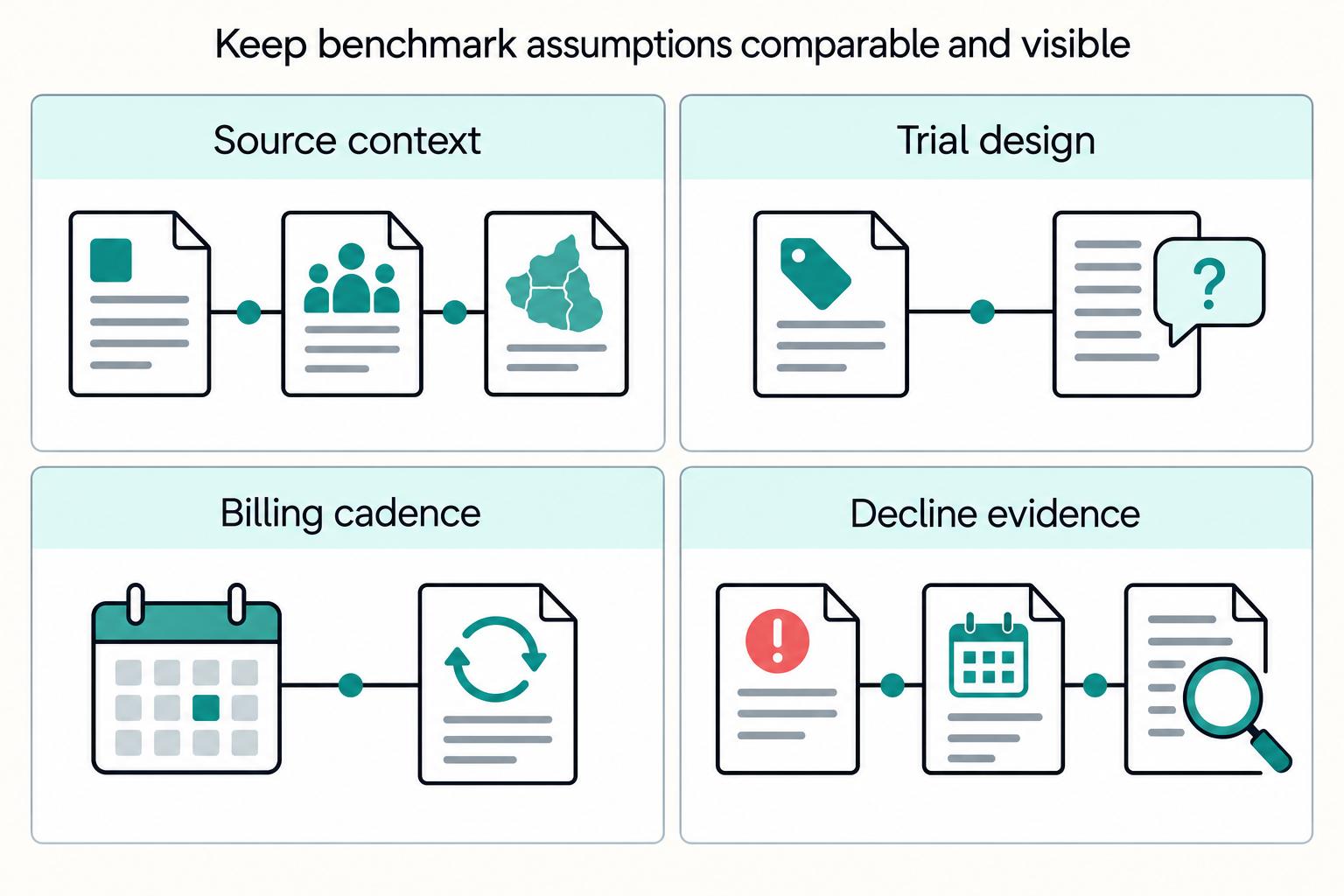
Platform operators should use subscription benchmarks as a filter, not as a launch order. A market is worth prioritizing only when the benchmark source matches your segment, trial model, plan cadence, and geography, and when payment recovery and compliance readiness are clear. Strong conversion or LTV alone is not decision-grade if decline handling, payout readiness, or verification still look weak.
What This Benchmark Report Covers#
Use benchmark data as a filter, not a launch order. The real decision is not which market shows the highest headline LTV. It is which market can support your trial design, absorb payment friction, and clear compliance checks without turning early churn into noise.
This report ties churn, trials, payment declines, and LTV back to the operational constraints that usually decide launch outcomes. Those constraints include checkout and renewal performance, fallback payment options, payout readiness, and compliance gates. If a country looks strong on conversion or retention but decline management is weak, or onboarding stalls on policy checks, the benchmark may still be interesting. It is not decision-grade.
What the benchmark signals can and cannot do#
Public benchmarks can help you spot patterns, but they are not interchangeable. Adapty's 2026 in-app subscription report is filterable by category, region, and country, and is benchmarked against 16,000 apps with $3B in subscription revenue. That makes it useful for spotting app-subscription patterns, especially when country or regional context matters.
Piano and Recharge answer different questions. Piano's 2024 benchmark report reflects publisher performance, not app-store or general DTC merchant cohorts. Recharge reports on analysis of over 15,000 merchants and supports filtering by seven product verticals and four subscriber-count ranges, with LTV included in its KPI set. These are strong inputs only when the source population, trial structure, and plan cadence are close enough to your own model.
Before you reuse any benchmark, confirm cohort type, segment, and geography. If those fields are vague or missing, treat the number as directional. Comparing app-subscription, publisher-subscription, and merchant-subscription data as if they reflect the same buyer behavior is a common market-entry error.
Why declines belong in the launch decision#
Payment performance belongs in the launch decision, not in the postmortem. Recurly is explicit that high card decline rates are tied to involuntary churn, which can pressure realized LTV even when top-line conversion looks healthy. That is why this report evaluates declines alongside churn and LTV, not after the fact.
A common failure mode is strong acquisition followed by weaker renewals when authorization failures stay high and decline management is weak. In that case, the benchmark did not fail. The decision process did. We will keep grounding each number in where it came from, the buyer motion it reflects, and the payment constraints that can break outcomes after launch.
What you should leave with#
You should leave with a market-entry path you can execute through Gruv, starting with the module that matches the constraint in front of you. Gruv positions Merchant of Record (MoR), Virtual Accounts, and Payouts as modular starting points, not an all-or-nothing setup.
The right module depends on the bottleneck. If compliance gates, tax document handling, and payout orchestration are slowing you down, MoR can be the right lens. If card dependence is the issue, Virtual Accounts can matter where enabled because Gruv describes them as dedicated bank-transfer receiving details for deposit attribution without relying on card checkout flows. If settlement visibility and downstream money movement are the concern, Payouts can be the relevant path where supported. Do not assume uniform delivery across countries. Gruv states that coverage, methods, and timelines vary by market and are subject to compliance and policy checks.
The outcome is not a universal benchmark table. It is a decision path. Normalize the benchmark source, test whether payment performance supports the model, confirm compliance readiness, and then choose where to launch next.
For a step-by-step walkthrough, see Subscriber Acquisition Benchmarks for Platform Operators on CAC, LTV Ratio, and Payback.
Define the metrics before comparing any benchmark#
Write your metric definitions down before you compare anything. Many benchmark mistakes start because two numbers sound comparable but are measured at different points in the subscriber journey.
| Metric | Working meaning | What you must verify first |
|---|---|---|
| first-term churn | Not a universal metric; it depends on the renewal checkpoint being measured. | Which renewal event counts as the first failure or exit |
| monthly churn | Churn measured over a monthly time frame. | Whether the plan is actually monthly and whether annual plans are excluded |
| trial-to-paid | Share of trial users who become paying subscribers. | Free trial or paid trial, and when conversion is counted |
| paid trial | An introductory trial period that can be paid rather than free. | Trial price, duration, and what happens when the intro period ends |
| LTV | Expected revenue from the average customer over their lifespan. | Whether it is projected or realized, and which customer window is used |
Where comparability usually breaks#
Comparability usually breaks on plan duration, acquisition method, or renewal checkpoint. Do not compare OTT, DTC, and B2B marketplace benchmarks unless plan type, billing cadence, trial model, and cohort window align closely enough.
A common mistake is treating first-term churn from one dataset and monthly churn from another as direct market evidence. Often, the gap is measurement mismatch first. If cadence, trial structure, or cohort window is unclear, treat the number as directional.
Use a source trust rule#
Treat Adapty, Piano, and Recharge as separate benchmark families until comparability is explicit. Adapty's 2026 report is filterable by category, region, and country across 16,000 apps and $3B in revenue, which helps when your segment and geography are explicit. Piano is publisher-specific and framed around Q3 2024 vs. Q3 2022. Recharge recalculates benchmark comparisons monthly, and after 12 months of subscription activity it adds benchmark views used for first-year subscriber vs. non-subscriber comparisons.
Before you blend figures, confirm that cohort scope, time window, and geography are explicit. If they are not, do not combine the numbers into a single model.
Build a benchmark comparability matrix before making bets#
Do not put a benchmark into a forecast or launch plan until it passes a simple test: can you compare it on the same fields as every other source? Set one internal cutoff before you start: for this matrix, if more than two core fields are unknown, treat that source as hypothesis input, not capital-allocation evidence.
Check these five fields side by side: segment, trial type, plan cadence, region coverage, and whether payment-decline handling is disclosed. The decline field matters because involuntary churn can come from payment failure or banking issues, not just customer intent. If a source covers conversion and LTV but not sign-up or renewal declines, your revenue view is incomplete.
| Source | Segment | Trial type disclosed | Plan cadence disclosed | Region coverage | Payment decline handling disclosed | Operator fit | Missing fields |
|---|---|---|---|---|---|---|---|
| Adapty 2025 to 2026 | App subscriptions; filterable by category, region, country; benchmarked against 16,000 apps and $3B in subscription revenue | Trial effects discussed, but paid vs free trial treatment is not established in the cited material | Yes. 2025 material compares weekly, monthly, yearly plan structures | Yes. Region and country filters are explicit | No equivalent sign-up or renewal decline fields disclosed in the cited pages | OTT: Use for app-centric OTT. DTC: Caution. B2B marketplace: Reject | Exact trial model details; payment-decline disclosure; observation window not clear from cited pages |
| Piano 2024 | Publisher-oriented subscription benchmarks | Not clear in the cited material | Not clear in the cited material | Not clear in the cited material | No equivalent decline-handling fields disclosed in the cited pages | OTT: Caution for similar content-subscription buyer motion. DTC: Reject. B2B marketplace: Reject | Trial model, cadence, region coverage, decline disclosure |
| Recharge 2023 | Subscription commerce merchants; filterable by seven product verticals and four subscriber-count ranges; analysis of over 15,000 merchants in 2022 | Not clear in the cited material | Not clear in the cited material | Global scope is documented for the 2021 methodology, but 2023 region coverage is not explicit in the cited page | Not disclosed in the cited 2023 report page | OTT: Reject. DTC: Use. B2B marketplace: Reject | Trial model, plan cadence, 2023 region granularity, decline disclosure |
| Recurly acquisition and 2024 state reports | Subscription commerce; explicit OTT/SVOD trial-usage differences; more than 1,200 sites in a 15-month acquisition study and over 2,200 merchants with more than 58 million unique subscribers in the 2024 state report | Trial conversion is defined, but paid vs free trial is not established in the cited material | Yes. Plan length is explicitly defined as billing interval | Not explicit in the cited materials | Yes. 2024 report contents list sign-up decline rate and renewal invoice decline rate | OTT: Use. DTC: Use. B2B marketplace: Reject | Paid vs free trial distinction; region coverage; separate report windows should not be blended casually |
Treat missing fields as decision blockers, not footnotes#
Missing fields are not a footnote issue. If a number is detached from cohort definition, filter settings, or observation window, it is no longer decision-grade evidence. Keep the matrix tied to the original source URL and log the exact window for each source.
The windows here are already different. Piano is framed as Q3 2024 vs. Q3 2022, Recharge's 2023 report is based on 2022 performance, and Recurly's acquisition benchmark covers a 15-month period. Similar-looking charts do not make those windows comparable.
For each source, keep one evidence line before it enters your model: original link, segment, cadence detail, trial detail, geography detail, and decline-metric presence. If a field comes from a repost instead of the original report page, mark it unknown.
Use operator fit to decide whether a source can guide action#
Operator fit is a buyer-motion check, not a quality score. The real question is whether the source is close enough to your operating model to guide pricing, trials, or rollout sequencing.
For OTT, Recurly is a direct fit in this set because the cited acquisition benchmark explicitly flags higher trial usage in OTT/SVOD. Adapty is also useful for app-led OTT because it is filterable by category and geography and compares weekly, monthly, and yearly plans. Piano can still inform content subscriptions, but use it as caution input rather than a direct proxy for streaming or app billing.
For DTC subscription commerce, Recharge is closer to the buying motion, and Recurly is also usable. Keep Adapty in caution unless app billing is central. For B2B marketplace decisions, reject these sources as primary evidence because the cited materials do not provide B2B marketplace-specific cuts.
Make one hard rule before you spend#
Set the rule before you model anything. Treat this as an internal gating rule, not an external standard: if more than two core matrix fields are missing, do not use that source to justify launch budget, country sequencing, or LTV assumptions. Keep it in the research stack and label it directional.
That one rule prevents a common failure mode: blending app, publisher, and commerce benchmarks into one market number and treating the differences as noise. Those differences are part of the decision.
For a streaming-specific view of billing, trials, and churn, see Streaming Media Subscription Billing: How OTT Platforms Handle Billing Trials and Churn.
Read trial results in context of plan cadence and buyer intent#
Trial results are only useful when you read them against plan cadence and acquisition path. Weekly, monthly, and annual plans produce different retention patterns, and trial users can behave differently from direct buyers. One blended churn or LTV view is not enough to make a rollout decision.
If your cohort data shows annual trial cohorts improving LTV while monthly trial cohorts do not, test annual first for that segment. Do not roll out monthly broadly until monthly shows fit for your buyer intent.
| Plan cadence | What the cited data suggests | What to verify before acting | Common misread |
|---|---|---|---|
| Weekly | In one Adapty dataset, weekly had the strongest install-to-trial pull (9.8%) but the fastest drop-off (65% churn by day 30; about 5% still active after one year) | Whether users reach value in the first session and before first renewal | Treating strong trial starts as durable demand |
| Monthly | In the cited app data, monthly had weak install-to-trial conversion (0.3%); Recurly reports monthly plans as flexible and more recoverable in its own dataset | Whether first-time buyers perceive monthly pricing as too risky, and whether trial and direct cohorts diverge in your category | Assuming monthly is the default baseline across categories |
| Annual | Lower initial trial take-up in cited app data (1.8%), and Recurly reports annual plans can drive 50-60% higher revenue per user; churn timing is harder to read because annual churn is back-loaded | Early cancellations versus renewal behavior (one RevenueCat dataset reports nearly 30% annual cancellations in month one) | Declaring annual a win before renewal cohorts mature |
Separate direct buyers from trial users#
Do not blur trial users and direct buyers together. Keep at least four cohort lines: direct annual, trial annual, direct monthly, and trial monthly. The cited evidence says trial impact is category-dependent, and Recurly's panel discussion describes trials as more exploratory than automatically conversion-positive.
Use consistent checkpoints across cohorts from onboarding through first bill and first renewal. For annual plans, add an early-cancel view before you treat LTV expansion as durable.
Treat causality as a test, not a story#
Pricing shock, early value realization, and onboarding friction are hypotheses to test, not conclusions to assume after the fact. Because many trial starts happen on install day, first-session value and paywall timing can heavily shape outcomes.
Use the same discipline across categories. Do not make causal claims until event-level funnel data shows where the drop-off happens. That keeps plan and trial decisions tied to measured buyer behavior instead of blended trial noise. Related reading: How B2B Platform Operators Design Free Trials That Convert Profitably.
Tie payment declines directly to churn and LTV#
Do not treat strong trial starts as proof of a healthy market if failed payments are not being recovered. Declines are a churn-and-LTV control problem because the chain is measurable: authorization failure can become involuntary churn, and unrecovered churn lowers realized LTV.
The chain starts at card authorization, where the issuer checks available funds or credit. When authorization fails, you risk a lost signup or a failed renewal. If recovery also fails, that loss can become involuntary churn. Recurly defines involuntary churn as non-intent loss, for example expired cards, bank changes, or failed payments, and ties reducing it to higher customer lifetime value.
Measure each break in the chain#
Track three checkpoints together, even if different teams own them.
At the payment layer, measure first-attempt failed-payment volume and failure rate. Stripe defines failure rate as the percentage of subscription payment volume that fails on first attempt. Recharge's 7% figure is directional, not a universal baseline across markets or segments.
At the recovery layer, measure recovery rate and not-recovered volume. Stripe defines recovery rate as failed volume later recovered, and not recovered as failed volume that could not be recovered. This is where payment issues become retention outcomes.
At the diagnostics layer, keep refusal-level detail. Adyen calls out resultCode, refusalReason, and refusalReasonCode for failed authorizations. This helps avoid a common mistake: applying generic retries when failures may need customer action or a different payment path.
Before you change pricing, trial design, or plan cadence, review unrecovered renewals by decline or refusal reason. Otherwise, avoidable payment loss can be misread as weak demand.
Stack choice changes your control surface#
Your stack changes what you control and how quickly you can act. MoR versus direct processing changes ownership, not guaranteed performance. A Merchant of Record is the legal seller to the end customer. In a direct gateway model, you retain responsibilities like taxes and local-law compliance. That ownership split can shape how quickly you operationalize diagnostics, retries, customer messaging, and reconciliation when payments fail.
Virtual Accounts can add a fallback rail where bank transfer is viable. Stripe and Adyen both describe flows that provide a unique virtual bank account number for payment and reconciliation, and Adyen describes bank transfer as low-cost and asynchronous. This is not a universal churn fix, but it can reduce dependence on card-only recovery paths in some markets.
Use a fixed checkpoint table before you score a country#
| Control point | What to verify | Why it matters | What to tie back in Gruv |
|---|---|---|---|
| Retry strategy | Whether retries are enabled, attempt logic, and retry-eligible refusal reasons | Smart retries can recover temporary failures and reduce involuntary churn | Match recovered vs unrecovered renewals to ledger evidence and transaction records |
| Fallback rail | Whether bank transfer or Virtual Accounts are available where cards underperform | Adds a non-card completion path in applicable markets | Confirm incoming funds and downstream Payouts status reconcile to the same customer balance |
| Customer messaging | Whether failed-payment outreach triggers quickly with a clear update path | Messaging gives customers a chance to intervene before churn | Compare outreach timing with recovery outcomes and account-status changes |
| Recovery window | How long failed accounts remain recoverable before they are treated as not recovered | Too short loses recoverable revenue; too long can blur churn reporting | Tie recovery-window definitions, ledger entries, and Payouts visibility to one operational timeline |
Do not assume the Gruv column is automatic. Confirm that your ledger trail and Payouts records can trace a failed renewal to either recovery or a not-recovered outcome.
Let recovery quality veto a market#
Recovery quality can veto a market. Stripe's metrics on involuntary churn and recovery rates are useful context, not country-level guarantees.
Move a market down the queue if recovery is weak, customer intervention is slow, or no workable fallback rail exists, especially if you cannot trace outcomes cleanly in your operational records. In practice, poor recovery can erase the LTV upside implied by trial benchmarks.
For forecasting work tied to churn and expansion, see Subscription Revenue Forecasting for Platform Teams Modeling MRR Churn and Expansion.
Factor country and compliance gates into expansion timing#
If compliance readiness is still moving, do not read early churn or trial results as clean market signal. KYC, KYB, AML, and tax-document requirements can affect activation or payout readiness, so early losses can be operational rather than behavioral.
A market can show strong signup intent and still be a weak launch choice if accounts cannot complete verification, receive payouts, or satisfy required tax documentation in time.
KYC, KYB, and AML define when a market is actually live#
In connected-account models, KYC is a launch gate, not back-office admin. Before connected accounts can accept payments and send payouts, required verification must be completed, and those requirements vary by country.
Expect variance over time, not just across countries. Requirements can change as regulators, card networks, and financial institutions update expectations. For legal entities, beneficial-owner identification can also be required at account opening in U.S. contexts. FATF sets a common AML framework, but countries implement it through different legal and operational systems, so onboarding friction is not uniform.
Use a strict definition of live: the target account type can pass required verification and reach payout readiness in that market. Keep awaiting verification separate from churn until accounts are eligible to transact and receive funds.
Tax forms and VAT can block readiness after demand appears#
Tax and documentation work can block launch even after demand appears. Some requirements affect onboarding and documentation flow, some affect payout readiness, and some can affect both.
| Requirement | What it is | Where it can slow launch | What to verify first |
|---|---|---|---|
| VAT | Consumption tax on goods/services in and into the EU | Tax setup and country-level VAT handling | Which countries you serve and how VAT is applied there |
| Form W-8 BEN | Form for foreign beneficial owners in U.S. withholding/reporting context | Tax documentation in relevant non-U.S. payee flows | Whether the payee is foreign and whether required owner details are complete |
| Form W-9 | Form to provide a correct TIN for IRS information returns | Tax documentation in relevant U.S. payee flows | TIN collection and whether this payee type requires it |
| Form 1099-NEC | Form used to report nonemployee compensation | Reporting readiness in supported program flows | Whether the payment flow is in a 1099-capable path and what data must be collected |
In one Stripe tax-verification workflow, payouts can be disabled if required information is not collected and verified by 600 USD in charges. Stripe also indicates initial payout timing is typically 7-14 days after the first successful live payment, with possible delays by risk profile and country. Treat payout timing as part of launch readiness, not as a finance cleanup step.
Use conditional language for rollout claims. VAT and tax-document handling vary by market, entity type, and program, so "where supported" and "for this flow" are often more accurate than universal statements.
Sequence the work in the right order#
The order matters.
- Confirm compliance readiness first. Validate KYC or KYB requirements, AML-sensitive onboarding steps, tax-form collection, and payout path readiness.
- Then test trial structure. Evaluate trial performance only after accounts can activate and receive payouts.
- Then test pricing. Run price tests after you have removed verification and tax friction as confounders.
For each market, keep an evidence pack with required documents, pending verification items, tax-form status, VAT handling notes, and earliest realistic payout state. If you test trial or pricing before that, it is harder to tell whether losses come from demand or from compliance and documentation blockers.
Choose launch markets with explicit if-then decision rules#
Once you have separated compliance drag from demand, make the market call with explicit rules, not intuition. Use a structured scorecard so one strong benchmark cannot hide payment or compliance risk.
Score the market on four axes#
| Axis | What you are judging | Verification checkpoint | Red flag |
|---|---|---|---|
| Benchmark quality | Whether the benchmark population matches your model, plan cadence, and market context | Validate source fit and method: Adapty is app-focused, Piano reflects publisher performance, Recurly covers subscription-commerce operators within its own merchant base, and Recharge comparisons are recalculated monthly | You treat app, publisher, and merchant-base benchmarks as interchangeable, or key fields such as cohort window, geography, or cadence are missing |
| Decline risk | How much payment failure can cut completed transactions and drive involuntary churn | Confirm visibility into declines, retries, recovery, and attempted-versus-completed outcomes | Strong signup or trial activity but weak decline visibility or recovery readiness |
| Compliance overhead | How much KYC, KYB, AML, tax, and payout-readiness work must clear before the market is truly live | Check country-specific verification requirements, beneficial-owner requirements for legal entities where relevant, and tax or VAT handling in your flow | Accounts can register but cannot complete verification or reach payout readiness |
| Operational complexity in Gruv | How much setup, exception handling, and monitoring your team must run in Gruv | Validate the operating path across MoR, Payouts, and any supported alternative rails, with clear ownership for reviews and ledger checks | The launch depends on manual exceptions your team cannot sustain |
Apply explicit if-then rules#
If benchmark quality is high and compliance overhead is high, run a narrower pilot with tighter onboarding controls and the cleanest documentation path. Use a risk-based approach and confirm country verification, beneficial-owner requirements where applicable, and tax or VAT handling before you widen scope.
If benchmark quality is medium and decline risk is high, delay launch and prioritize payment-ops readiness first. Because payment failures can drive involuntary churn, validate recovery performance and, if needed, evaluate MoR or supported alternative rails before reopening the market decision.
Set go/no-go on evidence completeness#
A market is a true go only when each axis is documented: benchmark-fit notes, decline-path visibility, country-level compliance checks, and a workable Gruv operating path with named owners. Keep a market in pilot or hold status when any axis is still assumption-heavy, even if top-line LTV looks strong.
For the expansion side of retention, see What Is Negative Churn? How Platform Operators Achieve Revenue Expansion Without New Customers.
Turn your go/no-go rubric into an implementation checklist with policy gates, payout statuses, and reconciliation touchpoints in the Gruv docs.
Build the evidence pack your leadership team should require#
Leadership does not need a thicker deck. It needs a tighter one. A market is decision-ready only when its evidence fits on one page with auditable attachments and ends in one clear call: proceed, pilot narrowly, or hold.
Start with source quality, not headline metrics#
Start with benchmark fit, because weak source fit distorts every downstream conclusion. For each market, document:
- What you used from Adapty, Piano, and Recharge
- What each source actually covers
- Whether each metric is usable, caution-only, or hypothesis-only
- What is missing, such as cohort window, geography, cadence, or definition detail
Keep scope notes explicit:
- Adapty covers mobile in-app subscriptions
- Piano reflects publisher performance
- Recharge benchmarks are recalculated monthly, and dashboards refresh daily by 8 AM ET
Also flag accounting differences before comparison. For example, Recharge revenue metrics include taxes and shipping, and returns or refunds are not deducted.
Attach payment evidence leadership can audit#
Leadership should be able to trace decline risk from attempt to settlement, not just see top-line churn. Include:
- Decline funnel snapshot, including attempted, failed, recovered after retry, and unrecovered outcomes
- Retry outcomes, since many payment failures are recoverable and retry strategy is an explicit control for reducing involuntary churn
- Reconciliation trail that ties transaction flow to settlement-batch categories and failed payout breakdowns
Then map that trail to Gruv operations:
- Ledger event trail for the relevant flow
- Matching payout statuses, including whether outcomes are still pending or in transit, or have moved to paid, failed, or canceled
If you cannot connect subscriber events to reconciliation and payout outcomes, treat the market as assumption-heavy.
Add compliance and tax gates before approval#
Do not approve a market before policy gates are documented for KYC, KYB-relevant entity checks, AML, and tax-document readiness where enabled and required by program.
Your checklist should show:
- Identity verification procedures
- Beneficial ownership checks for legal entities
- AML controls and operating responsibility, including MoR responsibility where applicable
For tax, keep requirements conditional and market-specific:
- If required in the program, note readiness for Form W-9, Form W-8BEN, and/or Form 1099-NEC
- Include VAT handling in relevant markets
Red flag: strong commercial upside, but the seller or entity base cannot clear documentation fast enough to reach payout readiness.
Execute a 90-day pilot with clear checkpoints#
Run the pilot to answer one question cleanly: is this market promising and operationally clean enough to scale. If you cannot instrument first-term churn and payment-failure recovery by day 15, pause. Aggregate churn and top-line conversion can hide the actual failure points.
Days 1 to 15#
Set a narrow scope before traffic goes live: one country, or one tightly similar cluster, one trial model, one pricing hypothesis per cadence, and one fixed definition of first-term churn. Treat this as an experiment, not proof of a universal strategy.
Instrument the minimum event set so you can separate voluntary cancellation from involuntary churn: trial start, trial cancellation timestamp, first billing attempt, payment status, retry attempts, recovery outcome, and plan cadence. If you log only one churn number, you will not know whether losses came from pricing, onboarding friction, or failed collections.
Prioritize the early window. RevenueCat reports that 55% of all 3-day trial cancellations happen on Day 0, so if you miss week-one data, you miss your most diagnostic window.
Days 16 to 45#
Keep the test clean. Change trial cadence or pricing, but do not change onboarding and support policy at the same time.
Track first-term churn separately from aggregate monthly churn throughout this phase. A market can look acceptable on aggregate churn while underperforming at first renewal.
Read benchmarks with scope discipline. Adapty's benchmark data is App Store subscription data from 2024-2025, and Piano's benchmark context is publisher performance. Both are useful inputs, not direct pass or fail standards for every stack.
If longer-commitment tests outperform, verify that the improvement comes from retained cohorts, not just from a higher upfront ask. In some app datasets, hard paywall behavior can outperform freemium, but first-renewal behavior still decides quality.
Days 46 to 75#
Now shift focus to decline recovery and settlement visibility. Automated retries are a direct involuntary-churn control, and Stripe's documented default baseline is 8 tries within 2 weeks.
Review retry timing and customer messaging in the highest-recovery window. For at least some insufficient-funds declines, strongest recovery is reported within 2 to 7 days, so month-end review is too late.
Verify operational observability in Gruv. In Payouts, confirm each payout can be matched to the transaction batch it settles and that reconciliation totals can be drilled down to the underlying transactions. Where enabled, use Virtual Accounts to confirm settlement-path visibility and whether funds movement is clear enough for finance and support to explain outcomes. If payment statuses are visible but payout reconciliation is not, you still have a blind spot.
Treat legacy infrastructure drag as a risk signal if it slows retries, obscures status transitions, or prevents support from seeing key payment outcomes.
Days 76 to 90#
Make the call using pre-agreed criteria, not narrative.
- Scale when first-term churn is stable, decline recovery performs within the target window, and Payouts evidence reconciles cleanly.
- Hold when demand is credible but recovery, settlement visibility, or support resolution is still incomplete.
- Exit when performance depends on assumption-heavy reporting or on operating changes you cannot run consistently.
Archive an audit-ready record for leadership: cohort cuts, decline funnel, retry outcomes, payment-status snapshots, payout reconciliation, and the exact test log. If finance cannot trace what happened end to end, the pilot is not ready for scale.
Avoid the benchmark mistakes that create false confidence#
False confidence often comes from benchmark mismatch, not from lack of data. If source scope, cohort framing, or metric definitions are unclear, treat that input as hypothesis-only.
Treat LinkedIn as a pointer, not evidence#
Use LinkedIn commentary to find sources, not to validate assumptions. A reposted chart that omits core fields such as cohort window, geography, trial model, plan cadence, or decline-handling context is not decision-grade on its own. Save the underlying source page in your evidence pack and log missing fields. If two or more core fields are missing, keep that input as hypothesis-only.
Do not port OTT trial logic into a B2B marketplace#
OTT trial logic does not automatically transfer to marketplace buyers. Recurly reports higher trial use in OTT and media, but trial behavior varies by segment and cadence. In the same benchmark set, B2B monthly plans converted 8.9% higher than annual, while B2C monthly plans were 5.4% higher than annual. If you copy consumer trial logic without controlled testing in your own segment and plan cadence, trial uptake can look like demand when it is not. State of Platform Payments: Benchmark Report for B2B Marketplace Operators
LTV is not stable while payment and compliance gates are moving#
Treat LTV as provisional while decline recovery and onboarding requirements are still changing. Recurly ties failed payments to involuntary churn and estimates 7.2% of subscribers are at risk each month from that channel. Stripe also notes that KYC requirements can change over time, and connected accounts must satisfy them before accepting payments and sending payouts.
Apply the same normalization rule across vendors. Adapty benchmarks app subscriptions, Piano reports publisher performance, and Recharge reports DTC merchant operations while noting that some metrics can use different calculation methods in Home Analytics. If you compare these figures without normalizing segment, cadence, and metric definitions, you are comparing different cohorts, not like-for-like outcomes.
Related: State of Subscriptions 2026: Key Benchmarks Platform Operators Need to Know.
Conclusion#
Choose the market where benchmark quality, payment recovery, and compliance readiness are all clear enough to defend. The right call is often not the market with the highest headline LTV. It is the market where those three signals align.
Public benchmarks are useful, but they are not automatically decision-grade. If you cannot state the segment, geography, cohort window, update cadence, and failed-payment context, treat the number as directional.
Keep payment recovery inside the core decision. Failed renewals, recovery outcomes, and post-recovery churn belong in one chain because they can materially shape realized LTV, not just headline conversion figures.
Treat compliance as a launch constraint, not a cleanup task. AML/CFT implementation, tax handling, and payout readiness vary by country and program. If those operations are unsettled, early churn and LTV signals may reflect operational friction more than market demand.
Build one short, auditable market evidence pack before scaling:
- Benchmark proof: source scope, segment fit, and missing methodology fields.
- Payment proof: failed-renewal snapshot, recovery results, and unresolved gaps.
- Compliance proof: country-specific readiness notes and filing dependencies.
- Decision rule: what will make you scale, hold, or reject after a small pilot.
Then validate assumptions with a small, instrumented rollout through Gruv so you can review traceable payment events, operational status, and compliance checkpoints before broader expansion.
If your top market passes evidence quality but payment or compliance risk is still unclear, map a scoped rollout with Gruv Merchant of Record.
Frequently Asked Questions
What is first-term churn, and why does it matter more than average monthly churn for launch decisions?
First-term churn measures subscriber loss at the first billing cycle or renewal checkpoint, not as a blended monthly average across the whole base. It matters more at launch because plan duration, acquisition method, and checkpoint timing can make average monthly churn look healthier than early breakage. If you miss that early loss, you can overstate LTV.
When can annual paid trials increase LTV while monthly paid trials do not?
Annual paid trials can improve realized LTV only when early renewal retention stays stronger than it does in monthly cohorts. There is no universal rule, and category context can reverse the result. Use your own early retention and renewal data before shifting more traffic to annual paid trials.
Why might direct buyers outperform trial users in some subscription categories?
Direct buyers can outperform trial users when the category does not benefit from exploratory trial behavior. High trial volume at install does not automatically mean durable demand. If direct buyers retain better in your data, keep trial and direct cohorts separate.
Can I compare subscription benchmarks across OTT, DTC, and B2B marketplace segments directly?
No. Adapty, Piano, and Recharge reflect different populations and reporting windows, so they should not be treated as interchangeable. Normalize segment, geography, cohort window, cadence, and trial model before using them in one decision.
How should payment declines change my interpretation of churn and LTV benchmarks?
Treat payment declines as a core churn driver, not just a billing-ops detail. Review authorization failures, retry recovery, recovered revenue, and eventual churn together because unrecovered payment failures reduce realized LTV. Strong trial starts can hide a weak market if recovery is poor.
What minimum fields must a benchmark source include before I treat it as decision-grade?
Use a benchmark source only when it provides enough context to test comparability. At minimum, look for segment, geography, cohort window, plan cadence, and trial model, and account for payment-decline effects when interpreting churn and LTV. If key fields are missing, keep the source directional rather than decision-grade.
How do KYC, KYB, AML, and VAT requirements affect market rollout timing?
These requirements affect when a market is truly live because accounts may need to complete verification before they can accept payments and send payouts. AML implementation and VAT handling vary by jurisdiction, so rollout assumptions must stay country-specific. Validate verification status, tax documentation, invoicing operations, and payout readiness before trusting early churn or LTV signals.
Researched and edited by the Gruv editorial team. Gruv builds cross-border billing, payouts, and finance-operations software for global businesses.
Sources
Includes 1 external source outside the trusted-domain allowlist.
- ecfr.gov/current/title-31/subtitle-B/chapter-X/part-1...trusted
- ecfr.gov/current/title-31/subtitle-B/chapter-X/part-1...trusted
- fdic.gov/banker-resource-center/anti-money-laundering...trusted
- irs.gov/forms-pubs/about-form-w-9trusted
- irs.gov/forms-pubs/about-form-w-8-bentrusted
- oag.ca.gov/sites/default/files/LinkedIn%20California%20...trusted
- stripe.com/resources/more/involuntary-churn-101-what-it...trusted
- adapty.io/state-of-in-app-subscriptionsexternal
Educational content only. Not legal, tax, or financial advice.
Related Posts

The Freelance Payment Penalty: A Modeled Audit of Platform Fees, FX Spreads, and Payout Delays
The money rarely disappears through a single, easy-to-spot fee. The real loss is stacked. A marketplace takes its commission, a processor adds a charge for international cards, a bank or payment company converts the currency at a spread, a platform holds the funds before release, and a wire sheds a little to intermediaries on the way in. Each layer looks defensible on its own, but the worker feels the combined result as a smaller deposit and a later payday.

How to Respond to a Subpoena for Business Records
Move fast, but do not produce records on instinct. If you need to **respond to a subpoena for business records**, your immediate job is to control deadlines, preserve records, and make any later production defensible.
A US Expat's Guide to Investing in UCITS ETFs to Avoid PFIC Issues
The real problem is a two-system conflict. U.S. tax treatment can punish the wrong fund choice, while local product-access constraints can block the funds you want to buy in the first place. For **us expat ucits etfs**, the practical question is not "Which product is best?" It is "What can I access, report, and keep doing every year without guessing?" Use this four-part filter before any trade: