
Quick Answer
Start by locking definitions, then benchmark. For subscriber acquisition benchmarks platform cac ltv ratio payback, use CAC payback period to manage cash-recovery timing and use LTV:CAC ratio to test long-term efficiency, but only after finance, growth, and product align on paying-customer criteria, sales and marketing cost scope, and gross-margin assumptions. If those inputs are inconsistent, benchmark targets are directional at best and should not drive budget moves.
How to use subscriber acquisition benchmarks#
CAC, CAC payback period, and LTV:CAC ratio only help when you read them together. A low acquisition cost can still be a bad trade if cash comes back too slowly, and a strong ratio can still mislead when payback and calculation assumptions are unclear.
That is the lens for this article. It is for founders, revenue leaders, product teams, and finance operators who need to make monthly decisions, not just report KPIs. Customer Acquisition Cost (CAC) tells you what it costs to win a paying customer. CAC payback period tells you how many months it takes to recover that spend. LTV:CAC ratio compares customer lifetime value with acquisition cost. Each answers a different question, and none is reliable on its own.
That distinction matters because benchmark content often makes these numbers look cleaner than they are. Search results surface familiar reference points, including the often-cited 3:1 LTV:CAC benchmark, but those numbers often arrive without enough context. Payback is even harder to compare. There is no universal framework, so comparisons break as soon as the inputs differ. In a subscription business, that is not a technical footnote. It changes whether a benchmark is useful or misleading.
So the goal here is not to hand you a magic target band. It is to help you separate what is known from what is still unknown before you set targets or move budget.
Use a simple checkpoint. If your team cannot say exactly what counts as a paying customer, which sales and marketing costs sit inside CAC, and how payback is calculated, you are not ready to publish benchmark conclusions.
From there, the work becomes operational. Acquisition choices affect CAC and how quickly cash returns to the business. LTV assumptions affect how the LTV:CAC ratio reads. Treat those as separate conversations and you can end up with good-looking headline metrics and poor growth decisions.
The sections that follow stay close to that reality. We will define the metrics tightly, show where benchmark evidence is thin, and use decision rules that hold up under cashflow pressure. The aim is not prettier dashboards. It is better monthly calls on spend and growth durability for subscription platforms. Related: A Guide to Lifetime Value (LTV) to CAC Ratio.
Define the metrics and measurement scope before benchmarking#
Benchmarking is only useful after you standardize definitions and inputs. If teams use different meanings for customer, cost, margin, or payback, you are comparing math, not performance.
| Metric | Tight definition | What it answers |
|---|---|---|
| Customer Acquisition Cost (CAC) | Sales and marketing expenses divided by the number of new customers | What did it cost to win one paying customer? |
| Cost Per Acquisition (CPA) | Cost of a specific acquisition event that may not be a customer | What did it cost to drive a signup, lead, install, or other non-customer action? |
| Customer Lifetime Value (LTV) | Estimated total profit from a customer relationship | How much profit should one customer generate over time? |
| CAC payback period | Months needed to recover acquisition cost | How fast does the upfront spend come back? |
The critical boundary is CAC vs CPA. CPA can guide channel optimization, but it is not CAC unless the event is a paying customer. Define one paying-customer standard and use it across finance, growth, and product before you benchmark.
Apply the same discipline to cost scope and formulas. Document which marketing, advertising, and sales investments are included in CAC. Then lock your LTV and payback inputs: (ARPA × Gross Margin) ÷ Churn Rate for LTV and S&M expense ÷ (New MRR × Gross Margin) for payback. Using revenue-only payback instead of gross-margin payback changes the result.
Run one final scope check before publishing benchmark conclusions. If finance, growth, and product are using different customer contribution margins, customer lifetime assumptions, or calculation methods, reconcile first and publish later.
If you need to improve the LTV side of the equation, read Customer Lifetime Value Optimization for Subscription Platforms: 7 Operational Levers.
Build your benchmark baseline and show what is unknown#
Before you benchmark, build a baseline that makes data limits explicit. For B2B SaaS, broad averages are usually directional, not decision-grade, unless the method and peer set are clear.
You can still use market signals, but keep them in context. Reports may show shifts like New CAC Ratio being 14% higher in 2024 and NRR at 101%, but those points alone do not define a healthy CAC payback period or LTV:CAC ratio for your customer mix, contract model, or channels.
| Metric | Formula inputs | Decision use | Common distortion risk |
|---|---|---|---|
| CAC payback period | CAC, new recurring revenue contribution, gross margin, months | Shows how quickly acquisition spend is recovered and whether spend can scale | Using revenue instead of gross profit, mixing annual contracts into monthly recovery math, excluding sales costs tied to acquisition |
| LTV:CAC ratio | LTV and CAC; LTV often depends on ARPA, gross margin, churn assumptions | Tests acquisition efficiency across the customer relationship | Inflated lifetime from weak churn data, mismatched margin assumptions, using CPA instead of CAC |
| MRR | Predictable recurring monthly customer income | Tracks recurring revenue momentum and near-term booking quality | Counting setup fees, services, credits, or other non-recurring items as recurring revenue |
| ARR | Recurring revenue components measured across one year | Supports annual planning and revenue pacing | Annualizing unstable monthly revenue or including non-recurring components |
| NRR | Starting recurring revenue cohort, plus expansion, minus contraction and churn | Shows retention quality after expansion and churn effects | Cohort switching, ignoring contraction, confusing logo retention with revenue retention |
Treat this as an operating baseline, not a public benchmark sheet. If a row cannot be reproduced from your finance and growth inputs, keep it provisional and do not benchmark it outward yet.
Capture the context most benchmark pages skip#
Capture context alongside every benchmark ratio. Even benchmark publishers note that results should be evaluated against the company attributes most tied to metric performance, and B2B SaaS comparisons are strongest against like-company peers.
| Context field | What to record | Why it changes interpretation |
|---|---|---|
| Segment | SMB, mid-market, enterprise, plus ACV range | Sales motion and payback expectations differ by segment |
| Growth stage | Early, repeatable, scaling, plus current ARR band if tracked | Stage affects how much inefficiency is tolerable |
| Channel mix | Self-serve, outbound, partner, product-led, field sales shares | Blended CAC can hide an expensive channel inside a healthy average |
| Contract model | Monthly, annual prepaid, annual invoiced, multi-year | Contract structure shifts MRR shape, ARR visibility, and payback timing |
| Usage-based billing exposure | Share of recurring revenue tied to usage or hybrid pricing | Revenue can ramp after acquisition, slowing early payback and improving later NRR |
If you run usage-based billing, record it directly in the baseline so seat-model comparisons do not create false underperformance signals.
Unknowns to keep visible#
Keep a short list of unknowns visible in the baseline:
| Unknown | Keep visible |
|---|---|
| No universal payback target bands | Current evidence does not support one payback standard for all B2B SaaS or platform operators |
| No reliable channel-level ranges without method detail | If sample, method, and segmentation are missing, do not use channel CAC or LTV ranges for budget decisions |
| Missing cohort context | If a benchmark does not specify new customers, all customers, or a retained cohort, treat planning conclusions as high risk |
Those unknowns do not make benchmarking useless. They tell you how much weight to put on the number and whether it belongs in planning, budget setting, or just background research.
Use a simple label for every outside benchmark: comparable, directional, or not decision-ready. If peer segmentation, contract detail, or cohort definition is missing, keep it out of budget-setting.
If your team needs consistent definitions for CAC, LTV, churn, and related metrics, use our SaaS Revenue Metrics Glossary: MRR ARR Churn NRR LTV CAC Explained for Platform Operators.
Which metric should you optimize first#
Optimize the metric tied to your current constraint: if cash pressure is immediate, prioritize CAC payback period; if growth quality is unclear, prioritize LTV:CAC ratio with churn rate and NRR.
When cash is tight, lead with payback. CAC payback period tracks how long it takes to recover acquisition spend, so it directly affects cash flow and how much growth spend you can finance. A strong LTV:CAC ratio can still coexist with real cash constraints, because lifetime efficiency does not tell you when cash returns.
When growth quality is the issue, use a multi-metric view. Do not read LTV:CAC in isolation. Pair it with churn and NRR so you interpret efficiency against retention reality. The common 3:1 LTV:CAC reference is directional, not a universal target.
Use an escalation trigger before raising budget. If ARR is growing while CAC payback period worsens, investigate acquisition mix and sales efficiency before increasing spend.
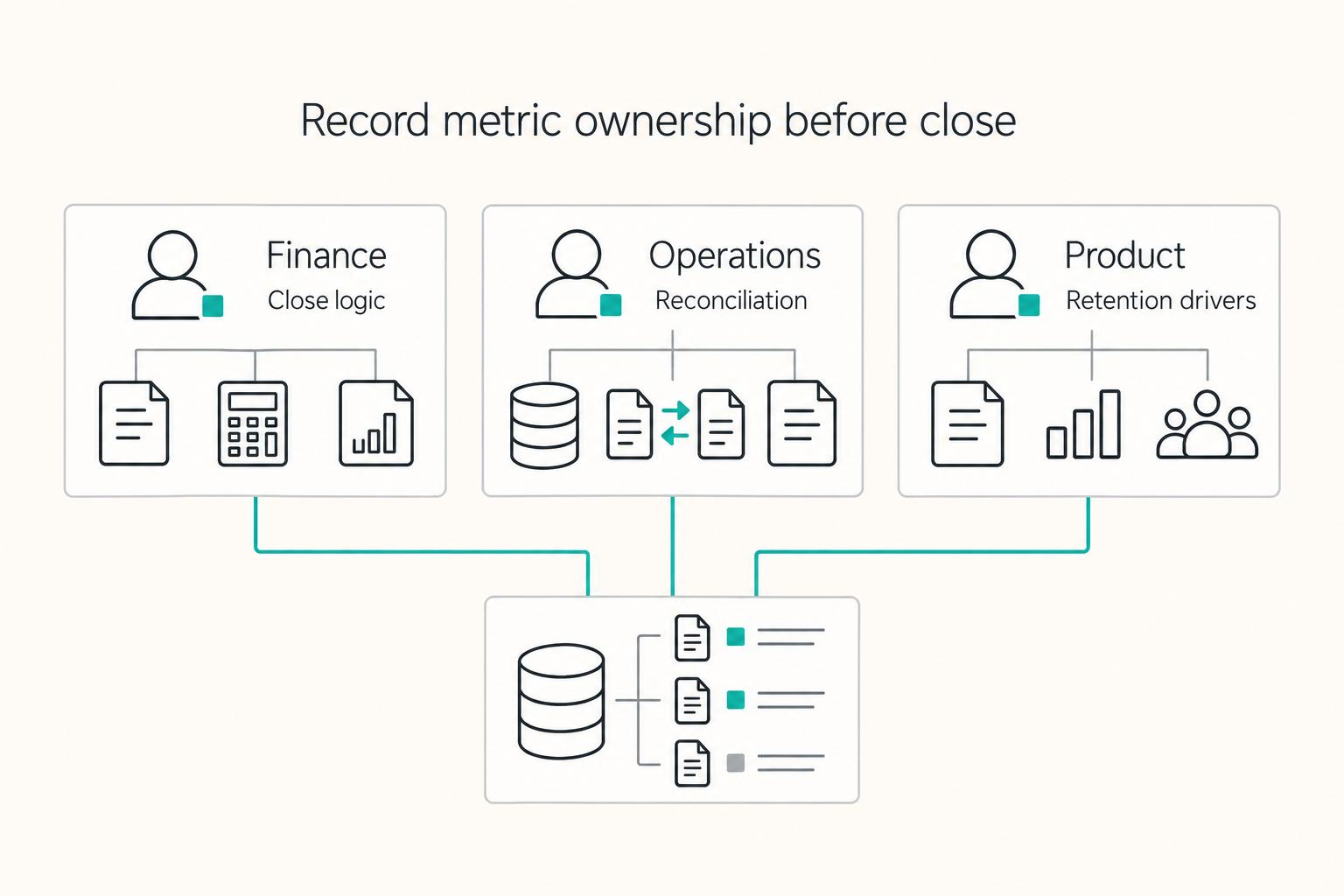
Set explicit ownership before reviews. A common operating split is:
- Growth owns CAC inputs and acquisition mix detail.
- Finance validates margin assumptions used in payback and LTV.
- Product owns retention drivers reflected in churn and NRR.
That split is not universal, but unclear ownership is a warning sign. If owners cannot show their exact inputs, you are not ready to optimize confidently. Related reading: Build a Platform-Independent Freelance Business in 90 Days.
Set channel and pricing decisions with explicit tradeoffs#
Make channel and pricing decisions only after the tradeoff is explicit: a lower CPA or a new billing model is not a win if CAC, lifetime value, or retained revenue weakens.
Separate upstream efficiency from paying-customer economics first. CAC is the cost to acquire a paying customer, while CPA is usually a non-customer event or leading indicator. Use CPA as an early signal, but do not scale spend until CAC and retention quality hold.
| Channel | CPA signal | CAC check | Conversion quality check | Customer lifetime risk |
|---|---|---|---|---|
| Paid search | Cheap trial or lead volume can look efficient early | Confirm cost per paying customer after sales-assist and wasted clicks | Compare trial-to-paid or lead-to-paid by cohort | Shallow intent can show up as early churn |
| Content or organic | CPA may look low because cost lands earlier and less directly | Reconcile production and distribution cost before calling CAC low | Check whether conversions are slower but higher quality | Longer consideration can help lifetime only if activation holds |
| Partners or referrals | CPA can look attractive at the top of funnel | Include commissions, rev share, and onboarding load in CAC | Validate whether referred accounts reach expected revenue contribution | Incentives can reward signups over retention and hide poor-fit accounts |
Use a hard rule: if a channel lowers CPA but raises churn risk, do not scale it until cohort LTV direction and NRR remain healthy. If MRR rises but contraction and churn appear in early billing cycles, treat that as low-quality growth.
Apply the same discipline to pricing. Usage-based billing can align price with value, but it can also increase revenue volatility and make forecasting harder. Where contracts include variable consideration under ASC 606, estimate expected consideration before broad rollout. Compare seat-based and usage-based options on three outcomes: gross profit profile, CAC payback trend, and RevRec effort your team can sustain.
For any channel or pricing change, require a 30/60/90-day readout owned by growth and finance:
- 30 days: MRR movement, CPA trend, early activation or conversion quality
- 60 days: CAC movement, gross profit contribution, early churn signal
- 90 days: payback trend, cohort LTV direction, NRR impact
If a readout is missing, treat the change as an experiment, not a scaling decision.
For a step-by-step walkthrough, see How to Calculate Customer Acquisition Cost (CAC).
Catch metric illusions before they distort strategy#
These 30/60/90 readouts only help if the underlying math is complete, conservative, and tied to cash timing. The biggest failure is trusting a clean CAC or LTV:CAC ratio when the inputs are partial or optimistic.
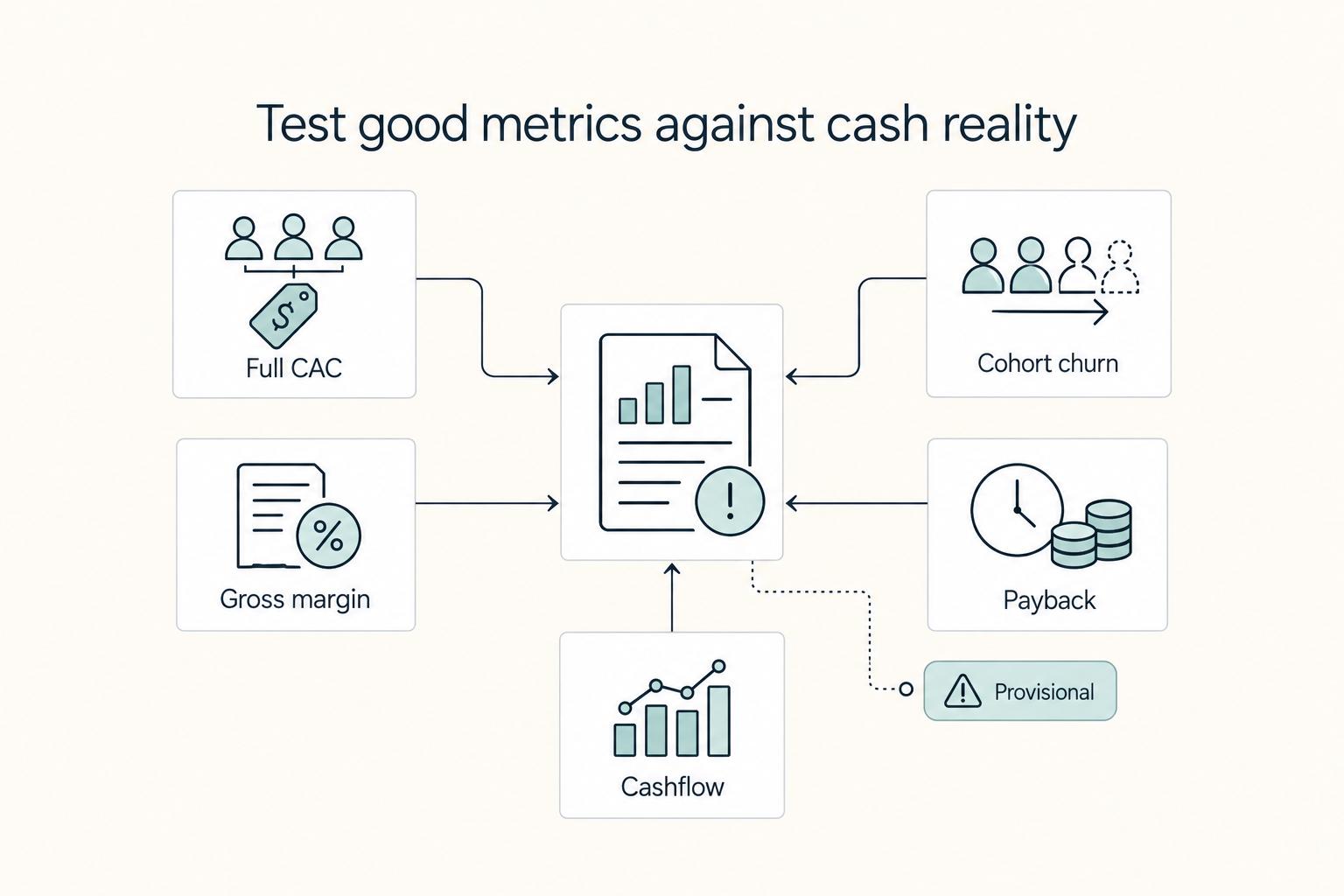
Start with fully loaded CAC. If CAC excludes sales and marketing costs required to win new customers, it is a partial bill, not acquisition efficiency. Ad spend, creative development, commissions, salaries, and overhead tied to acquisition can all matter. Before you use CAC to reset budget or report performance, make growth and finance reconcile the same cost-inclusion list for the same period; otherwise, treat CAC as provisional.
Next, pressure-test customer lifetime. In common SaaS LTV framing, churn sits in the denominator, so higher churn can pull LTV down quickly. That creates a common trap: CAC improves early, then LTV:CAC weakens once cohorts age and cancellations show up. If CAC is down while churn is up, do not call it efficiency yet.
Model payback on gross profit, not revenue alone. A common formulation is CAC payback period = S&M expense ÷ (New MRR × Gross Margin). If payback is shown on top-line MRR without a gross margin assumption, recovery speed is likely overstated.
A quick "good metrics, bad business" checklist:
- High LTV:CAC on paper, but slow CAC payback after gross margin adjustment
- CAC trending down while churn trends up in the same cohorts
- Weak cashflow even when ratio metrics look acceptable
- Unstable NRR, so retained existing-customer revenue is hard to trust
- No documented cost-inclusion policy, gross margin assumption, or cohort window
Premature scaling is the risk pattern to avoid. When one metric improves, confirm what must also hold true across retention, payback, and cash before you scale.
Run a monthly operating cadence that ties finance, growth, and product#
A monthly cadence is only decision-grade after the month-end close and reconciliation are complete. If budget or pricing moves before finance has collected, reviewed, and reconciled the prior month's activity, you are still steering on estimates.
Put the steps in a fixed order#
Use the same sequence every month:
| Order | Step |
|---|---|
| 1 | Close the month |
| 2 | Reconcile metric definitions and data sources |
| 3 | Review actuals versus plan and benchmark deltas |
| 4 | Decide budget, channel-mix, or pricing changes |
| 5 | Assign owners, deadlines, and next-review checks |
This order keeps teams from using different assumptions under the same labels. If you skip the reconciliation step, the review usually turns into a debate about definitions instead of a decision about spend. If finance, growth, and product are not aligned on the inputs behind CAC, LTV, CAC payback period, and LTV:CAC ratio, treat any strategy move as provisional until those inputs are reconciled.
Require an evidence pack that can be audited quickly#
Keep one compact pack for each review:
| Pack item | Include |
|---|---|
| Metric dictionary | KPI definitions, formula inputs, system of record, and owner |
| Cohort cuts | Views that distinguish durable MRR from short-lived spikes |
| Channel performance | Source, spend, conversion, and early quality signals |
| RevRec notes | Pricing, packaging, contract, or billing changes that affect comparability |
| Decision log | What changed, why, owner, and success or rollback signal |
The pack should be short enough to audit quickly and specific enough that someone outside the meeting can reproduce the number. That is what turns a monthly review from commentary into an operating tool.
RevRec belongs here because comparability can break even when cash looks stable. Under ASC 606, software and SaaS revenue accounting depends on judgments and estimates, so packaging or contract changes can alter how revenue is recognized period to period.
Set rollback conditions before experiments scale#
Define rollback signals before you scale a pricing or channel experiment. Practical signals include worsening CAC payback period, weaker NRR, or MRR growth that does not hold in retention.
If a lower-cost channel improves CAC but the cohort shows weaker net revenue retention, pause scaling and resolve retention and payback first. That keeps decisions tied to revenue quality and cash-recovery timing, not ratio optics alone.
Apply these benchmarks to cross-border platform monetization decisions#
Use benchmark targets only after you validate how each cross-border corridor actually collects, converts, and pays out cash. For subscription platforms, keep the sequence tight: lock metric definitions first, optimize acquisition mix second, then tune collection, conversion, and payout mechanics.
Cross-border payments run across multiple jurisdictions, so they are harder than domestic billing and expose tradeoffs in cost, speed, access, and transparency. Those constraints hit cashflow timing and realized margin before they fully show up in headline CAC, payback, and LTV ratios. In practice, corridor mechanics help determine when cash is actually available to reinvest.
Before setting targets for a new country or seller base, verify corridor details:
- processing currency
- settlement currency
- payout country
- whether like-for-like settlement is supported
- the explicit conversion path when processing and settlement currencies differ
Where like-for-like settlement or local payout routes are available, they can reduce conversion exposure and potential cross-border transfer fees. Where they are not, model the margin impact directly instead of assuming parity with domestic flows.
Do not lock a benchmark from acquisition metrics alone. A lower CPA can still underperform if settlement is slower, payout options are narrower, or conversion friction delays recovery. Coverage is also country-dependent, and some conversion features are limited or pilot-gated. Even if a provider supports payouts to more than 50 countries, feature coverage still varies by market and corridor.
Before committing to a benchmark target, talk to sales and confirm market and program coverage for your exact countries, currencies, and payout flows.
Conclusion#
The practical takeaway is straightforward: treat CAC benchmarking as an operating discipline, not a vanity KPI. Use CAC payback period to answer the cash-timing question. Use LTV:CAC ratio to answer the value-efficiency question. Then sanity-check both against retention and revenue quality signals such as churn rate, MRR, and NRR.
That pairing matters because no single metric is reliable on its own. Good operator guidance is consistent on this point. Do not read one metric in isolation, and do not assume large benchmark reports are comparing businesses that truly look like yours. If your ratio looks strong but payback is stretching, or MRR is growing while NRR weakens, do not call that progress yet. You may have a mix, pricing, or retention issue hiding behind a neat headline number.
Your first checkpoint is definition governance. Subscription analytics tools make it easy for teams to change how MRR, churn, and active subscriber calculations are defined. That flexibility is useful, but it also means your benchmark trend is only trustworthy if finance, growth, and product are reading from the same metric dictionary every month. If those definitions moved, compare the old and new logic before you act on any apparent improvement.
The second checkpoint is revenue quality. Net Revenue Retention (NRR) tells you how well you retain revenue from existing customers over time, but it should confirm what churn and MRR already suggest, not replace them. A healthy payback number with weak churn signals can still be misleading. In the same way, a good LTV:CAC read built on inconsistent assumptions is not a useful planning input.
A good next move is one clean monthly decision cycle:
- Lock the definitions for CAC, LTV, MRR, churn rate, and NRR.
- Review one evidence pack with the current numbers, the assumptions behind them, and the cohort or channel context needed to interpret changes.
- Change pricing or channel allocation only after that baseline is stable enough to compare month to month.
If you want one simple rule to carry forward, use this one. When cash pressure is the constraint, start with payback. When growth quality is the concern, read the ratio with churn and NRR beside it. That is the most useful way to apply subscriber acquisition benchmarks for platform CAC, LTV:CAC ratio, and payback in the real world because it keeps the conversation tied to actual cash recovery, actual retention, and actual revenue durability rather than benchmark theater.
Frequently Asked Questions
What is the practical difference between CAC payback period and LTV:CAC ratio?
CAC payback period answers speed: how long it takes to recoup what you spent to acquire a customer. LTV:CAC ratio answers efficiency: how much lifetime value you expect relative to acquisition cost. If cash is tight, payback usually deserves first attention because a strong ratio can still coexist with slow cash recovery.
How do I calculate Customer Acquisition Cost (CAC) and Customer Lifetime Value (LTV) quickly without oversimplifying?
A standard CAC shortcut is total sales and marketing spend divided by new customers in the same period. For LTV, a practical shortcut is value per customer multiplied by customer lifespan, and in subscription analytics one common method is ARPS divided by subscriber churn rate. The checkpoint is consistency: use one paying-customer definition, one time window, and note whether your LTV is revenue-based or adjusted toward customer contribution margin.
What should count in sales and marketing (S&M) costs for subscription benchmarking?
Treat this as a high-level rule, not a universal accounting policy. CAC is commonly calculated from sales and marketing expenses divided by new customers. In practice, the important move is to write down your inclusion policy and keep it stable month to month so the number stays comparable. A common failure mode is moving costs in or out of S&M between periods and then treating the trend as operational improvement.
How is Cost Per Acquisition (CPA) different from CAC in real budget decisions?
CPA is an advertising pricing model tied to a defined acquisition action, so it is usually narrower and more channel-specific. CAC is broader because it is meant to capture the cost to acquire a new customer across your sales and marketing motion. If CPA drops but those customers churn faster or require heavier sales effort, you have not actually improved full acquisition economics.
When can a “good” LTV:CAC ratio still hide risk in cashflow and growth execution?
It happens when payback stays long. A healthy ratio can still leave you under pressure because long CAC payback periods can create cashflow strain, especially when spend is front-loaded and collections arrive later.
How should I interpret benchmark claims for B2B SaaS when segmentation details are missing?
Treat them as directional, not as a target you can paste into your plan. CAC payback differs by customer segment, and even large reports with 700+ participants still aggregate diverse company contexts. If a claim cites numbers like 3x LTV/CAC or payback under 6 months, check the context first. Those figures are often repeated far more broadly than the underlying comparison really supports.
Try a related tool
Researched and edited by the Gruv editorial team. Gruv builds cross-border billing, payouts, and finance-operations software for global businesses.
Sources
Includes 5 external sources outside the trusted-domain allowlist.
- documents.worldbank.org/en/publication/documents-reports/documentdet...trusted
- documents1.worldbank.org/curated/en/099626506172223111/pdf/IDU0ead444...trusted
- stripe.com/resources/more/what-is-annual-recurring-reve...trusted
- airtree.vc/open-source-vc/startup-metrics-cac-payback-a...external
- andrewchen.com/how-to-actually-calculate-cacexternal
- bvp.com/atlas/scaling-to-100-millionexternal
- chartmogul.com/saas-metrics/nrrexternal
- corporatefinanceinstitute.com/resources/valuation/cac-payback-periodexternal
Educational content only. Not legal, tax, or financial advice.
Related Posts
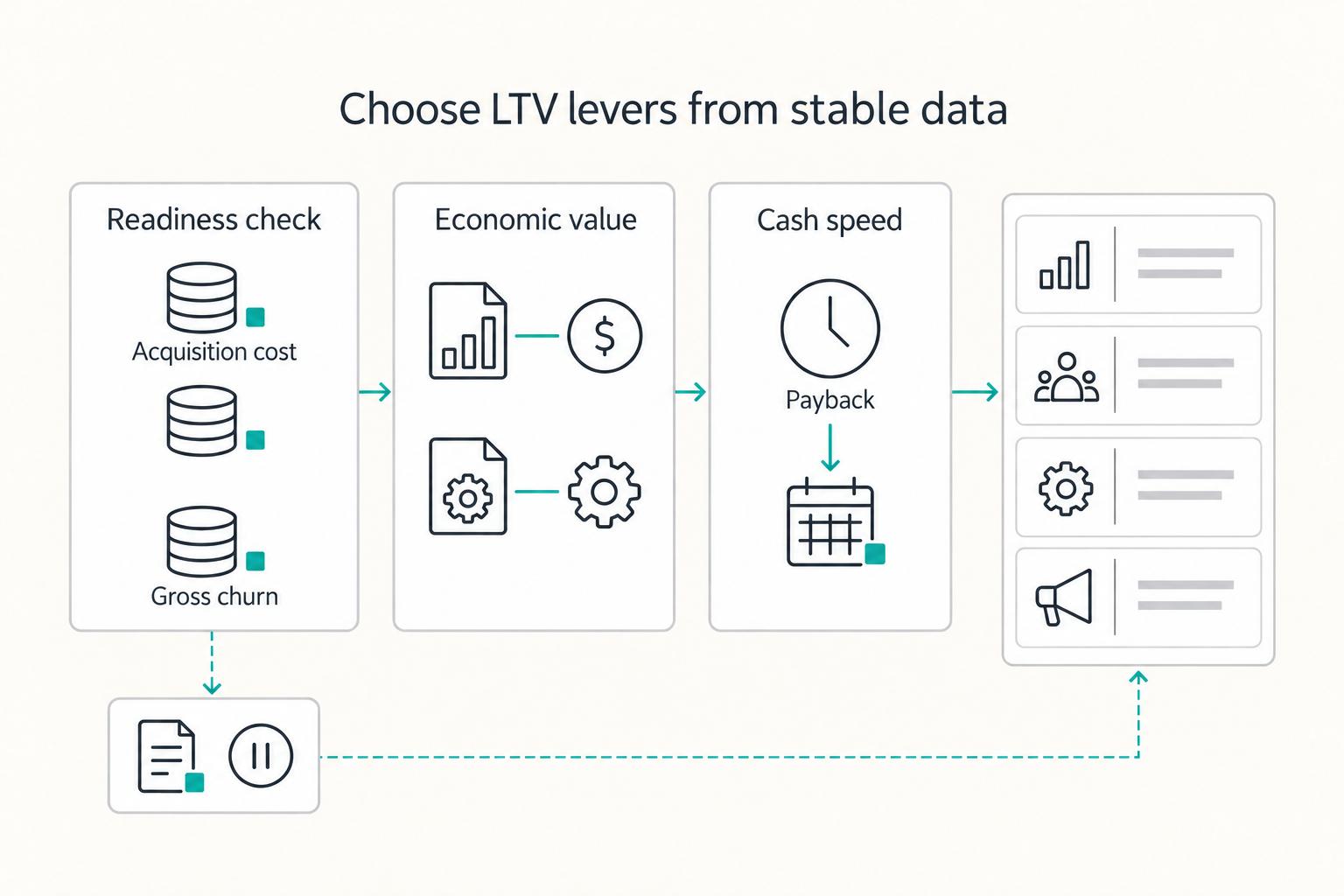
Customer Lifetime Value Optimization for Subscription Platforms Using 7 Operational Levers
For a subscription platform, Customer Lifetime Value is first a unit economics question. It rises or falls based on how reliably you turn acquired demand into recurring revenue over time. It also depends on how much of that revenue you retain and the margins behind it.
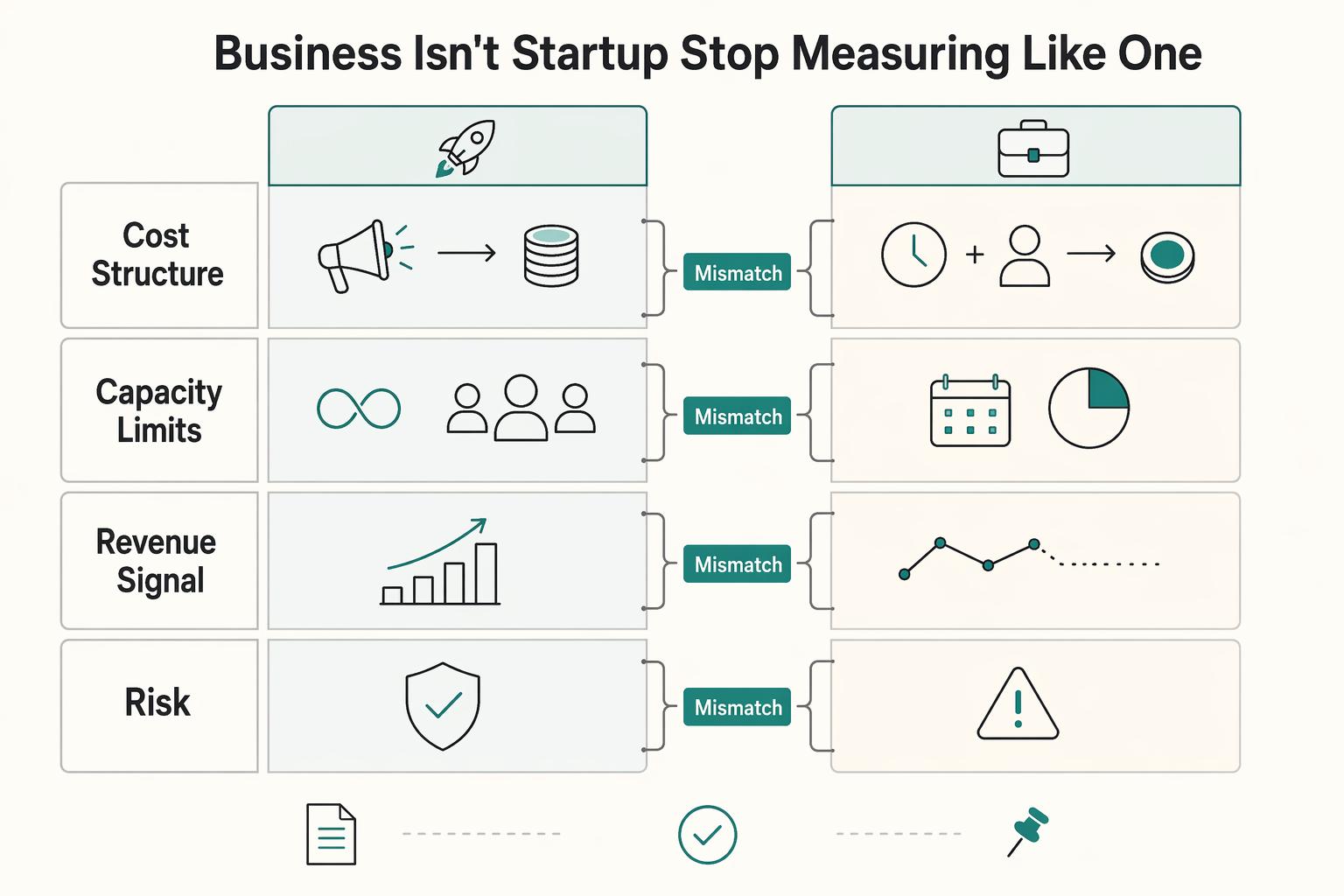
LTV to CAC Ratio for Freelancers Who Need Predictable Cashflow
If you run a service business, startup-style metrics can hide cashflow risk behind decent-looking revenue. The classic **LTV:CAC ratio** is common in startup and new-venture contexts, and CAC is usually built from sales and marketing spend. Your constraint is tighter: your time and when clients actually pay you.
SaaS Revenue Metrics Glossary for Platform Operators
This glossary is for platform operators, not a generic SaaS KPI refresher. If your team owns the ledger, reconciliation, settlements, or payout execution, the real question is not what MRR or NRR means in theory. It is whether the number can be tied back to source records, period cutoffs, and settlement evidence before it reaches board reporting.