
Quick Answer
Use actual cost and invoice data: adjust price or scope when delivery margin falls, and negotiate billing or payment changes when profitable work takes too long to turn into cash. Interest rates affect financing costs; inflation affects purchasing power. Keep those effects separate from processing fees and verify the account-specific payment price.
Separate rising costs, borrowing costs, and delayed collection#
Inflation can make your living costs and business inputs more expensive. Interest rates can change the cost of financing a cash gap and influence client budgets. Payment delays and fees add separate pressures. Measure each one before deciding whether to change price, scope, billing cadence, or collection method.
The receivables lag you can control (even on Net Terms)#
When you deliver work today and wait on Net Terms (Net 30/45/60), you create a receivables lag. These are days where you already did the work, but you cannot redeploy the cash.
You do not need a macro forecast to manage this. You need a tracking habit. Add these columns to your invoice tracker:
- Invoice issue and due dates, plus the agreed billing trigger
- Customer payment date, provider availability date, and bank receipt date separately
- Amount invoiced, partial payments, credits, remaining balance, and days overdue
- Payment method, invoice/settlement currency, actual fees, and net received
- Approval or reference problems such as missing PO, changed approver, or rejected invoice
Do this for every client. Patterns show up fast: who says "Net 30" but pays later, and where preventable process slop keeps you waiting.
Stop treating late payment as an annoyance. Treat it as operational risk you can reduce.
Your 30-minute, risk-first system (pricing triggers, controls, rails)#
Most advice ends at "raise your rates." That helps, but it is incomplete. You also need to tighten the system that protects your earnings after you send the invoice:
| Lever | What it covers |
|---|---|
| Pricing triggers | Review when scope expands, renewals approach, or payment behavior degrades |
| Contract controls | Define acceptance criteria, sign-off steps, and "pause work on overdue balances" language |
| Invoicing cadence | Invoice at milestones, not only at the end |
| Payment rails | Pick the rail that matches the situation |
The fee examples below are from Stripe's US standard pricing, checked on 5 October 2026. They are not worldwide rates. Your account market, negotiated terms, product charges, refunds, and currency path can change total cost.
| Payment method | US standard example | What to confirm |
|---|---|---|
| Online domestic card | 2.9% + $0.30; listed add-ons include 1.5% international,1% conversion,0.5% manual entry where applicable | Account terms and other product fees; card confirmation is not bank receipt |
| Instant bank payments | 2.6% + $0.30 | Eligibility and actual availability/payout timing; do not assume instant bank credit |
| Other bank transfer | Bank and corridor-specific | Originating, intermediary and recipient deductions; references and returns |
Hypothetical: a new client insists on Net 60 and wants to pay by card. You can keep the headline rate, but tighten milestones, collect a deposit, and document acceptance. That way you keep the amount outstanding smaller while you deliver.
If you need help selecting Stripe setups for a non-US business, use this: How to Open a Stripe Account for a Non-US Business.
Match the change to the cause of the cash pressure#
Use actual cost, hours, financing, and invoice data to decide what changes. If work is underpriced, a faster payment does not repair its margin. If it is profitable but cash arrives too late, a larger invoice does not remove the timing gap. You may need both a price review and new billing terms.
Start with definitions that affect real work (not headlines)#
Inflation is an increase in the general price level, not a requirement that every item becomes more expensive. The BLS CPI measures average changes in consumer prices. Your tools, subcontractors, rent and personal spending can move differently, so use a dated cost basket as well as a published index.
Interest rates influence borrowing costs and spending. For your business, record the actual rate, fees and repayment terms of any credit you use; a policy rate is not your loan rate. A fixed-rate loan may not reprice immediately, while variable-rate debt can. Clients may also revise budgets, but do not infer an individual client's financial condition from a central-bank announcement.
Build your cashflow model with three dials you control#
Think in dials, not slogans. You will make better decisions faster.
| Dial | What you define | What "good" looks like | Your safe default move |
|---|---|---|---|
| Price | Rate card, scope boundaries, renewal language | Price matches current costs and effort | Review rates on a schedule and at renewal |
| Timing | When you bill, how you follow up, and what "done" means | Shorter time between delivery and cash | Reduce ambiguity and tighten your follow-up loop |
| Risk | Your payment process plus enforcement and documentation habits | Fewer disputes and fewer surprises | Get approvals in writing and keep clean records |
Choose the lever from the evidence. Rising unit costs with timely collection point toward price, scope or delivery-cost changes. Profitable work with late receipts points toward billing and collection changes. Where both occur, address both.
For a hypothetical annual cost basket, $200 monthly software rising 10% adds $20; $800 subcontracting rising 5% adds $40; $1,000 workspace cost unchanged adds nothing. The basket rises from $2,000 to $2,060, or3%, despite unequal changes. At 100 billable hours per month, the added overhead is $0.60 per hour before any payment fees, tax or profit target. This is your cost change, not a universal recommended price increase.
Hypothetical: a client asks for a lower rate "because budgets tightened." Respond like an operator. Keep your rate card stable, clarify scope and sign-off, and set a clear internal trigger for when late payment changes how you proceed next time. That protects cashflow first, then preserves pricing power.
Keep a rolling cash forecast alongside the client tracker: starting usable cash, expected receipts, unavoidable payments, and credit repayments. Include uncertain receipts as a scenario rather than treating every issued invoice as cash.
How do inflation and interest rates actually hit your invoices (not just your budget)?#
Track four mechanisms separately: input-price changes, actual financing costs, time-to-cash, and payment deductions. A payment fee is a provider charge; it is not caused by inflation merely because both reduce what you keep.
1) Quantify the "waiting cost" hiding inside Net Terms#
Stop treating Net Terms as a contract detail and start treating them as an operational KPI.
Make this non-negotiable in your tracker:
- Invoice issued date
- Paid date (the date funds land, not the date the client "processed" it)
Then segment the same data two ways:
- By client: full-settlement days for completed invoices, plus the age and remaining balance of open invoices. Paid-only averages can hide your slowest accounts.
- By method: customer payment, provider availability and bank-posted timing separately, with partial receipts and fees retained.
For a hypothetical $1,000 outstanding balance financed at a12% annual simple rate for 60 days on a365-day basis, the interest is $1,000 ×0.12 ×60/365 = $19.73, before loan fees. Thirty days would cost $9.86. Use the actual amount borrowed and the lender's day-count and compounding rules; do not apply this to the full invoice if only part needs financing.
An inflation comparison answers a different question. If prices rose4% over a year, an unchanged $1,000 fee has purchasing power of $1,000/1.04 = $961.54 in the prior year's prices. Maintaining that purchasing power would require $1,040 under this simplified example. This is not an extra cash charge or a reason to add inflation, borrowing interest and foregone savings returns indiscriminately.
2) Identify leakage competitors ignore (fees)#
Two leaks eat invoice value: fees you can price in and fees you can reduce by choosing the right rail. Use a quick comparison table as your default audit:
| Leakage type | Where it shows up | What to track (per invoice) |
|---|---|---|
| Processing | Actual charges under your account terms; use the US fee examples above only where applicable | Invoice/capture amount, fee, net provider balance, and bank receipt |
| Conversion | Executed rate and explicit fee, where the freelancer bears them | Currency pair, amounts, execution time, fee currency; avoid counting embedded FX twice |
| Platform payouts | Connect fees belong to the party billed under the platform's arrangement, not automatically to every freelancer | Platform deductions in your statement; do not add another platform fee without evidence |
If timing or payment fees are the bottleneck, improve agreed billing terms, submission, and eligible payment methods. If delivery margin is inadequate, change price, scope, or delivery costs as well; faster collection alone does not make underpriced work profitable.
If Stripe sits in your stack and you operate outside the US, keep your setup clean so fee and currency choices stay deliberate: How to Open a Stripe Account for a Non-US Business.
Want a quick next step? Try the free invoice generator.
Diagnose your exposure in 30 minutes: the 3-part freelancer risk score (rate, timing, and client behavior)#
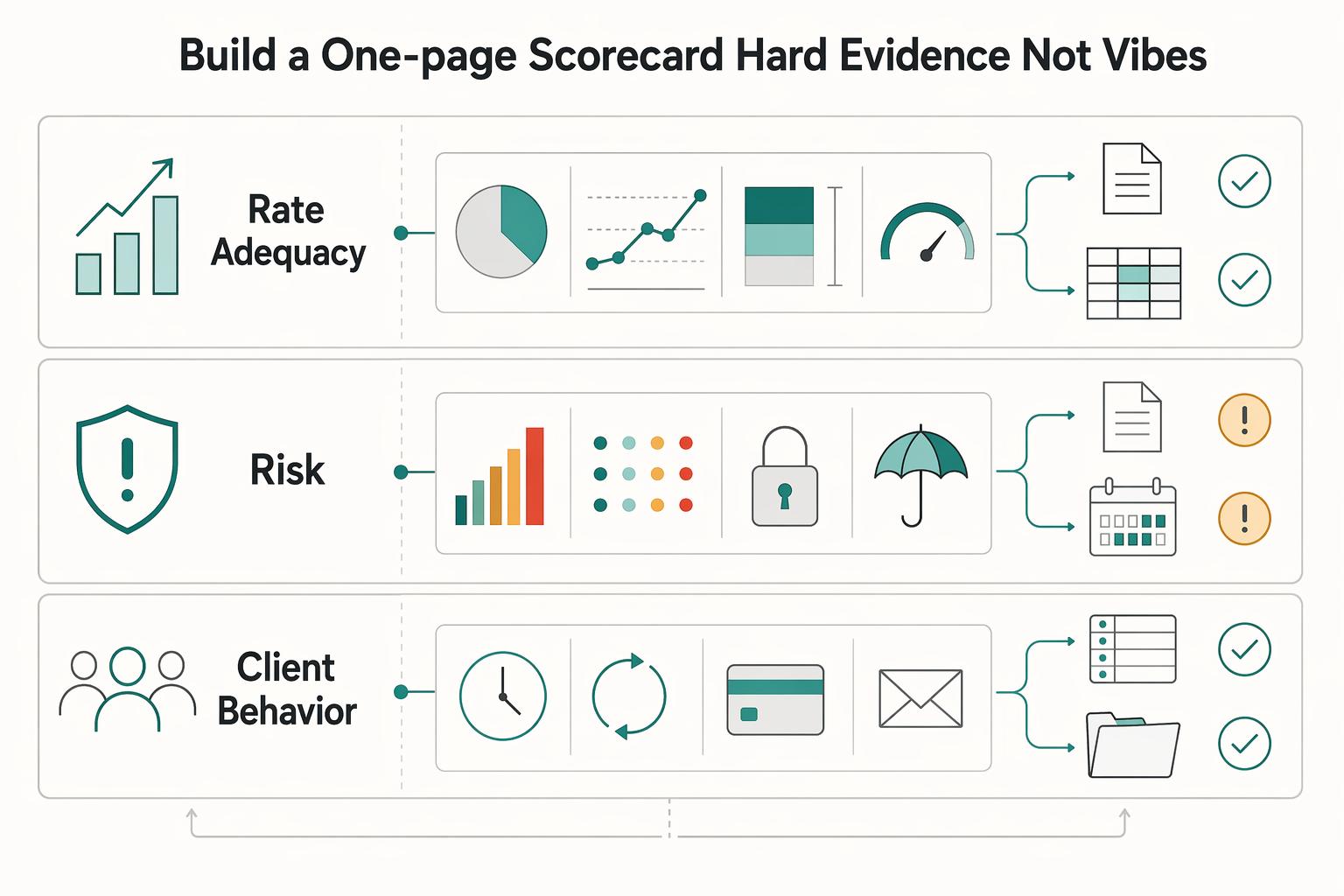
Build a one-page scorecard per client across rate, timing, and behavior, then tighten the right control first (price, terms, or workflow). Once you have days-to-cash and payment-method behavior in one place, you can stop treating inflation like background noise and start managing it client by client.
Build a one-page scorecard (hard evidence, not vibes)#
Open a sheet, list your active clients, and fill one row per client. Keep it boring and factual. You do not need a perfect scoring formula. You need consistent inputs you can compare.
| Risk area | What you record (per client) | Evidence to pull (fast) | What "good" looks like (your definition) |
|---|---|---|---|
| Rate adequacy | Last rate review date, current rate, margin notes | Your proposal/SOW, last increase email, current scope notes | You can explain why today's rate still fits today's cost reality (inflation, tools, subcontractors) without guessing a universal % |
| Timing risk | Stated payment terms, actual days-to-cash, late frequency | Invoice issued date vs paid date from your tracker | Actual payment behavior matches what the contract says, with minimal chasing |
| Client behavior | Change-request pattern, acceptance clarity, payment method exposure | Your change logs, approval emails, payment method used | Clear "done" criteria and a payment path you can reconcile without surprises |
Record actual method costs from statements instead of assigning the same public rate to every client. A higher-cost method can still be worthwhile if it meets a client requirement or materially improves collection. Compare eligible options on total cost, receipt timing, references, and reversibility.
Hypothetical: you review a client and realize the rate feels fine, but the scope changes weekly and nobody signs off. Do not lead with "rate increase." Lead with acceptance criteria and milestone checkpoints.
Turn the scorecard into actions (controls, not drama)#
Attach one default action to each risk area so you move fast:
- If rate adequacy looks weak, schedule a rate review tied to scope options (keep scope, adjust rate, or reduce scope).
- If timing risk looks weak, tighten billing cadence (more frequent invoicing) and consider Milestone Billing or Advance Deposits for new work.
- If behavior looks weak, require written acceptance criteria, keep a delivery log, and standardize change requests before you expand scope.
Also capture friction points you personally observe in how invoices get approved and paid. Treat each one like a system bug. Write the fix into your invoice checklist so the process is easier to follow and reconcile.
Should you raise rates, tighten terms, or change billing cadence first? (use this decision tree)#
Choose cadence and terms when timing causes the problem; choose price or scope when unit economics cause it. Agree changes before the next affected work period, subject to existing contract terms. A new invoice does not unilaterally rewrite an accepted agreement.
The decision rule: address timing and cadence when timing causes the pain#
Use what your invoices already show you: when cash actually arrives, and whether clients are asking to space out work. If money shows up late, a rate increase can still leave you feeling broke because the constraint is timing, not pricing. If money shows up on schedule but your costs climbed, pricing (or scope) is usually the cleaner lever.
Here's a practical decision tree you can run client by client:
| Situation you observe | Your first move | Your "operator" implementation detail |
|---|---|---|
| Stable client, pays late | Tighten payment expectations and billing cadence | Put the updated expectations in writing before the next cycle. Invoice on a schedule you can actually follow. |
| Stable client, pays on time, margins shrinking | Adjust rate or re-scope | Offer two options: keep scope at a new rate, or keep price by reducing scope. |
| Client signals budget pressure | Offer a lighter cadence instead of forcing the same frequency | Make the new cadence explicit (what changes, what stays, and when you revisit). |
For a reliable but slow-paying client, identify whether the delay comes from the contract, approval, submission, or payment method. Propose scheduled milestone invoices and clear due dates where the client can agree to them. If costs have also risen, discuss the rate at the same renewal.
Avoid the competitor trap: bigger invoices with the same delays#
Rate increases help, but they can also amplify friction if you leave timing unchanged. A higher invoice with the same delays raises the stakes of every follow-up.
If a client wants to halve the meeting or delivery frequency to reduce its bill, document the smaller deliverable package and which fixed costs remain. Lower frequency can reduce scope; it does not necessarily justify halving the rate or expanding the same workload across a longer collection period.
How to adjust your rates during inflation (without making up a random percentage)#
Review the cost of delivering the work, your compensation target, realistic billable capacity, and collection costs. Then test the proposed price against scope and buyer value. Timing and fees matter, but they do not alone establish a sustainable price floor.
Build a rate-review policy you can repeat (and defend)#
Pick two triggers and treat them like systems, not moods:
- Calendar trigger: choose a review cadence you will actually follow. You do not need a perfect interval. You need a consistent one.
- Contract trigger: run a review at renewal, any scope increase, or expanded deliverables.
In each client file, keep a one-page "rate decision record" next to Net Terms and payment history:
- Last rate change date
- Current scope and what changed (tools, subcontractors, turnaround expectations)
- Actual days-to-cash vs stated terms
- Payment method and direct costs you pay to collect
For a simple hourly floor, suppose monthly overhead is $2,000 and your desired pre-personal-tax compensation is $4,000 across 80 billable hours. Before collection fees, the floor is ($2,000+$4,000)/80 = $75 per hour. At only 60 billable hours it becomes $100. Use billable capacity rather than total working hours; add an explicit profit or contingency target rather than assuming it is already included.
Communicate increases like an operator (date, reason, options)#
Send a simple notice that includes (1) effective date, (2) reason tied to cost and scope reality, (3) two paths:
- Option A: keep scope, move to the new rate.
- Option B: keep the old rate, reduce scope into a smaller package.
For existing clients, explain the cost or scope change plainly and give the notice required by your agreement. Do not promise faster turnaround or extra work merely to justify an increase unless the new price covers that commitment.
Use different defaults for different risk profiles:
| Client type | Price move | Terms move |
|---|---|---|
| Existing, pays on time | Smaller, predictable adjustments | Keep terms stable, tighten only if timing slips |
| New or late-pay pattern | Rate may stay similar | Add Advance Deposits and Milestone Billing early |
Hypothetical: a client wants "the same deliverables" but adds extra review rounds and slower approvals. Offer the new rate starting next cycle, or reduce rounds and lock milestones so both sides stop bleeding time.
To retain $1,000 before income tax after a2.9%+$0.30 processing fee alone, price the fee base as ($1,000+$0.30)/(1−0.029) = $1,030.18, with normal rounding. Adding2.9% to $1,000 is insufficient because the percentage applies to the larger charge. This example assumes no tax, add-ons or other deductions; it does not authorize a card surcharge.
If you need help setting up Stripe outside the US, use How to Open a Stripe Account for a Non-US Business.
When procurement or industry rules constrain pricing mechanics (like automatic escalators), ask the client for their policy and confirm what your contract jurisdiction allows before you promise anything.
What payment-term safeguards protect cashflow when inflation is high?#
Deposits and milestones can reduce the amount you finance before collection when the client agrees and pays them. Set clear due dates, acceptance and refund or credit treatment. Use a price review alongside these controls when costs or required effort have risen.
Set safer default terms (timing beats opinions)#
A deposit brings some cash forward; it does not necessarily become earned revenue immediately. Document whether it is credited to later invoices, when it becomes earned, and what happens on cancellation. Track deposit credits so the same amount is not billed twice.
| Term move | How it is described |
|---|---|
| Advance deposit | Collect a portion upfront to cover startup costs and protect your calendar |
| Shorter payment terms (by default) | Shorten your standard terms compared to what you used historically, then offer longer terms only after a client proves reliability |
| More frequent billing (when it fits the work) | Invoice as work is delivered instead of waiting until the very end, so cashflow is less back-loaded |
Use the following implementation checks alongside the term choices above:
- State the deposit amount, due date, crediting and cancellation treatment in the agreement.
- Name the milestone deliverable, acceptance process and billing trigger; approval should not depend on an unidentified person.
- Specify due-date counting, invoice destination, PO requirements, and payment reference; confirm receipt when submitted.
Hypothetical: a client insists they "only do Net Terms" but they also require multiple stakeholders to approve work. Keep the rate, but break delivery into smaller, clearly defined steps and invoice as each step is accepted, so you are not waiting on one giant approval bottleneck.
Put enforcement and invoicing into a workflow (not a debate)#
Write your contract in plain language, then back it up operationally:
-
Late charges: consider a late-fee clause only where your jurisdiction allows it, and treat it as a boundary setter, not your main plan.
-
Overdue handling: if you want consequences for overdue invoices, define them clearly and confirm the approach with local counsel for your contract and client type (rules and enforceability vary).
-
Invoice workflow that prevents "AP ping-pong":
-
Invoice at the agreed billing trigger; record delivery and acceptance separately where they differ.
-
Include billing contact, PO where required, correct entity, due date, payment instructions and reference.
-
Attach the supporting SOW or acceptance evidence required by the client's submission process.
Finally, run an escalation ladder based on missed commitments (not arbitrary dates). Start with a reminder and re-send. Then confirm payment method and AP status. If it continues, move to whatever formal notice and next steps your agreement supports, and consider outside help if needed.
Repeated delays can come from agreed long terms, disputed work, incorrect invoices, approval bottlenecks, provider holds or financial distress. Diagnose the cause before changing controls; a slow payment alone does not establish that the client is dishonest.
Cross-border invoices and FX: how to stop losing money between currencies, rails, and holds#
Treat currency and payment rail as part of your pricing system, because cross-border mechanics change what you keep after fees. Once terms are tighter, protect the "between" layer: conversion, processing fees, and operational friction that quietly taxes what you keep.
Make currency a deliberate choice (and document it)#
A cross-border invoice involves parties or payment locations in different countries; it need not involve different currencies. Record invoice currency, settlement currency and operating-cost currency separately. Agree the denomination and fee allocation before work begins.
Use this safe default decision rule:
- If you pay expenses in your home currency, invoice in that currency unless the client's procurement requires otherwise.
- If the client insists on paying in their currency, treat FX as a line item you manage (timing, conversion method, and fee visibility). Do not "hope it nets out."
Hypothetical: you work locally, but a client pays you in a foreign currency. Your headline rate stays the same, but the amount you retain changes when conversion happens. Solve it by (1) choosing one invoice currency, (2) stating who pays conversion costs, and (3) reconciling every deposit against the invoice total.
Choose rails based on fee visibility and reconciliation (not vibes)#
Compare supported methods using the applicable account price, actual received amounts and operational requirements. Public rates are a starting input, not a complete landed-cost quote.
- Use the merchant account's market and negotiated fee schedule.
- Record international, conversion, invoicing and payout charges only where they actually apply.
- Compare like amounts and deadlines; payment confirmation, provider availability and bank receipt are separate.
Compare rails like an operator:
| Decision factor | Card (Stripe) | Bank transfer |
|---|---|---|
| Fee transparency | Published fees (including international and conversion add-ons) | Varies by bank and corridor, confirm in advance |
| Reconciliation workload | Strong if you standardize invoice IDs and receipts | Can increase if references arrive inconsistent |
| Dispute readiness | Keep proof-of-delivery and signed milestones for any rail | Keep the same documentation discipline |
Operational checklist (copy/paste):
- Write "Invoice currency" and "Accepted payment methods" into the SOW.
- Track gross invoice, any tax, credits, actual provider fees, net payout and bank receipt per payment; partial receipts leave the remaining balance open.
- For Stripe, decide up front who absorbs international and conversion fees, then price accordingly.
- Confirm account and onboarding constraints before promising a method to an overseas client (use: How to Open a Stripe Account for a Non-US Business).
Your monthly operating loop + the "get paid" checklist (copy/paste into your process)#
Build a monthly cash-collection loop that spots leakage early and forces consistent actions. This is where your playbook becomes repeatable: one review, a few triggers, and a checklist you actually use.
The monthly review: one report, two leaks, one decision#
Start with your invoices and payment dates: pull issued date vs paid date and group by client, stated Net Terms, and payment method (card processor vs transfer). Then identify your top two leak sources:
- FX costs on Cross-Border Invoices: you cannot manage what you do not log. Track each conversion's timing and settlement amounts so you can explain variance later and choose better defaults next month.
- Late payers creating cash gaps: separate "slow rail" from "slow client." If a transfer method is slow to reconcile, fix the process. If a client pays late, change the terms.
Use a simple grouping table so the decision stays objective:
| What to group by | What you look for | What you change next |
|---|---|---|
| Net Terms | Clients who pay later than their terms | Tighten terms, add deposits, change billing cadence |
| Payment method | Rails that increase delays or disputes | Switch rails, improve invoice references, add documentation |
| Cross-border vs local | Patterns in FX variance | Standardize invoice currency and conversion timing |
Hypothetical: a solid client pays and suddenly disputes a deliverable. Do not argue about intent. Check your acceptance criteria, your proof-of-delivery, and your milestone sign-off trail, then tighten the workflow for the next milestone.
Hard triggers (so you do not renegotiate emotionally)#
Write triggers into your internal policy and apply them consistently:
| Trigger | Default response |
|---|---|
| Client pays late repeatedly | Move them to Advance Deposits + Milestone Billing for future work, or shorten Net Terms |
| Client disputes deliverables | Tighten acceptance criteria, require written approvals at each milestone, and store proof-of-delivery |
| Same payment method keeps slowing things down | Consider switching rails and tightening your invoicing details so payments reconcile cleanly |
Store the SOW, approvals, invoices, delivery evidence and payment records together. Define the relevant timezone, calendar or business-day convention, and holiday calendar in your own terms; a different client's or jurisdiction's holiday definition may not apply.
What should I do first this month? (copy/paste)
- Review top 5 clients by revenue and slowest days-to-cash.
- Propose revised terms for future work where delays repeat; preserve existing obligations.
- Use agreed deposits or milestones where they fit project costs, client process and cancellation terms.
- Update your rate card when your scope, costs, or positioning changes (add an effective date and scope options).
- Choose an FX and collection method for every Cross-Border Invoice.
Run a monthly cost and collection review#
Inflation can raise the cost of supplies, rent, and services, shrinking purchasing power and profit margins if your revenue does not rise accordingly. Treat it like a system: track CPI-driven cost pressure, then adjust pricing, budgeting, and vendor relationships on a schedule instead of reacting emotionally.
CPI is an average consumer-price measure, not a precise index of your business expenses. Keep your own cost basket and actual financing terms alongside it. The direction of policy rates changes over time; this workflow does not assume the Fed is currently raising rates or forecast the next decision.
Your inflation system (diagnose, control, review)#
Treat this as a monthly 30-minute financial planning block:
| Step | What you look at | What you decide | Output you document |
|---|---|---|---|
| Diagnose exposure | Costs that moved (tools, rent, contractors), invoice aging, client friction | Which lever matters most (price, timing, behavior) | A 1-page client note: terms, pay history, scope risk |
| Apply controls | Rate card, budget cuts, vendor renegotiations | What changes now vs at renewal | Updated rate card, updated budget, vendor plan |
| Operationalize | Review cadence + triggers | "If X, do Y" rules | A checklist you reuse every month |
Keep the review small enough to repeat: record the changed input, chosen lever, affected contract cycle, expected cash effect and next review date. Check actual receipts and margin before describing the change as successful.
Practical term hygiene (clean terms, clean proof, fewer surprises)#
Use contract and invoicing changes to address measured exposure. Shorter agreed billing intervals can reduce the outstanding amount, while rate or scope changes address delivery economics. Neither guarantees payment or removes disputes, provider holds, or FX risk.
- Shorten payment terms where appropriate, especially for new or inconsistent payers. Put the actual due date on the invoice.
- Use advance deposits and milestone billing when it fits the project and relationship. Treat it as clarity and risk allocation.
- Document acceptance in writing (email counts). Tie each invoice to a named deliverable and a clear sign-off moment so expectations are explicit.
If you work cross-border, be explicit up front about currency and payment method, and confirm what your bank, processor, or platform supports in your country and your client's country before you promise a method.
Hypothetical: you notice a client pays reliably but approvals drag. Keep the rate steady for now, tighten the billing cadence, and require written acceptance at each milestone so your cash planning stops hinging on one internal stakeholder.
If you want to evaluate tooling for collections and payouts, you can review platforms like Gruv (Virtual Accounts, Payouts, MoR workflows) and confirm availability for your market and client base before you standardize your process.
Frequently Asked Questions
How should freelancers adjust rates over time?
Treat pricing changes as a deliberate policy, not a gut call. Review your costs and delivery scope on a regular cadence that fits your business, document what changed, then publish a rate card with an effective date. When you communicate updates, offer two clean paths: the new rate for the same scope, or a reduced-scope option that keeps the budget stable.
How much can I raise rates with existing clients?
Your contract, renewal window, and relationship set the ceiling, not a universal percentage. Anchor the conversation in scope, timelines, and payment terms, then propose a clean option set: keep scope and update rate, or keep rate and reduce scope. If a client pushes back, treat that as a negotiation about priorities, not validation of your worth.
What matters more than raising rates right away?
The first priority depends on the constraint. Underpriced work needs a price, scope or cost change even if it is paid promptly. Profitable work with late receipts needs timing and collection changes. Measure both before choosing.
How do payment gateway fees affect cashflow?
Processing fees reduce provider net proceeds and may be deducted per payment or invoiced later. Other product and payout charges can apply. Reconcile the invoice, fees, provider payout and bank receipt so the same deduction is counted once.
Should I change payment terms or billing structure first?
Start with the lever that fixes your actual bottleneck, and be ready to test and iterate. If timing is the problem, consider tightening payment terms; if delivery spans a long timeline, consider breaking work into smaller billable checkpoints so cash and delivery stay aligned.
What Stripe fees should freelancers know about (cards, international, and Connect)?
The US standard online-card example is 2.9%+$0.30 with listed add-ons for international cards, conversion and manual entry where applicable. Other account markets, products and negotiated prices differ. Use the applicable fee schedule and actual statement before quoting net proceeds. Connect pricing is for platforms and depends on the pricing arrangement. In the US page's platform-managed model, listed fees include $2 per monthly active account and 0.25%+$0.25 per payout; other capabilities can add charges. These are not automatically fees for a solo freelancer accepting their own payments, nor necessarily deductions charged to every platform recipient.
What should freelancers do first this month to protect cashflow?
Do the simplest actions that reduce downside risk quickly: Compare delivery costs, billable capacity, debt terms and current rates. Review aged open invoices and partial balances, not only paid-invoice averages. Reconcile actual fees and receipt timing by method and currency. Propose agreed future-term changes for repeated delays and a price or scope change for inadequate margin. Use the non-US Stripe setup guide alongside current eligibility and account pricing.
Watch
Inflation and Interest Rates for Freelancers
Try a related tool
Researched and edited by the Gruv editorial team. Gruv builds cross-border billing, payouts, and finance-operations software for global businesses.
Sources
Educational content only. Not legal, tax, or financial advice.
Related Posts

How to Open a Stripe Account for a Non-US Business
**Treat your Stripe setup as a system for cashflow, not a quick signup, so your first payouts are more predictable.** If you run a small business, this is one of those setup decisions where "close enough" gets expensive later. If you are a nonresident operator, the pain usually shows up in a few places: payout delays, avoidable verification loops, and uncertainty about which path actually fits your business. If you guess early, you usually create rework later, especially when invoices are already waiting.

The Freelance Payment Penalty: A Modeled Audit of Platform Fees, FX Spreads, and Payout Delays
The money rarely disappears through a single, easy-to-spot fee. The real loss is stacked. A marketplace takes its commission, a processor adds a charge for international cards, a bank or payment company converts the currency at a spread, a platform holds the funds before release, and a wire sheds a little to intermediaries on the way in. Each layer looks defensible on its own, but the worker feels the combined result as a smaller deposit and a later payday.

How to Respond to a Subpoena for Business Records
Move fast, but do not produce records on instinct. If you need to **respond to a subpoena for business records**, your immediate job is to control deadlines, preserve records, and make any later production defensible.