
Quick Answer
Confirm the sending entity, recipient, currency and method before promising a payout route. Link each accepted job to a payable, available funding and an approved release. Retain provider attempt IDs, fees and terminal status evidence so retries and returns do not create duplicate payments.
What It Takes to Pay Freelance Linguists in 100+ Countries#
Paying freelance linguists across countries is first an operating decision, not a vendor shortlist exercise. It determines who holds funds, who carries compliance responsibility, which routes you can actually launch, and how payment costs and exceptions affect day-to-day operations.
For founders and operators, the goal is simple: choose the right payout model, verify country constraints before onboarding, and launch with fewer payment, compliance, and reconciliation surprises.
Start with three facts#
Before you compare providers, write down three facts:
- your sending entity country
- the first countries and language pairs you plan to support
- who will contract with linguists, approve work, and initiate payment
That groundwork matters because rollout is corridor-specific. A corridor is the route from the sending country to the receiving country, not a broad claim of "global coverage." The World Bank tracks 367 corridors across 48 sending and 105 receiving countries. That is a useful reminder that launch conditions vary by route.
Treat payout design as part of market entry#
Treat payout design as part of market entry from the start. Cross-border payouts can let you pay freelancers in local currencies across countries, but the compliance burden shifts depending on how you set them up. In some cases, managing customer funds may require a Money Transmitter license. That choice affects onboarding, legal review, and expansion speed.
Use one internal checkpoint before you go further: document the contracting entity, the payer of record, and the team that approves releases.
Keep scope tight and sequence the work#
Confirm the payment product and program before promising coverage. Stripe Connect self-serve cross-border transfers cover platforms and connected accounts in the US, UK, EEA, Canada and Switzerland; Stripe Global Payouts is a separate product. Payoneer’s public map does not guarantee a particular method. Record which product actually serves your sending entity and destination.
Use a strict rule here: if a provider cannot confirm your exact sending country, receiving country, currency, and payment method under your program, treat that route as unverified. Your minimum evidence pack for each launch market should include the exact corridor, supported payout method, currency path, and confirmation date.
This guide covers cross-border payout operations for translation and localization teams, not translation quality scoring. ISO 17100:2015 covers translation-service process requirements, but it is not payout compliance evidence.
FATF provides a shared framework, while countries implement different legal and operational rules. Measure your own payout costs by corridor. Consumer-remittance averages can illustrate how transfer fees and FX spreads combine, but they are not a quote for commercial linguist payouts.
Choose the operating model, verify the first corridors, then expand onboarding. Related reading: Freelance Crypto Payments That Protect Cashflow and Reduce Disputes.
What to prepare before you expand to new countries#
Prepare one pre-expansion packet before demos so each country decision is a clear go or no-go, not a sales conversation.
Define each rollout wave#
Create a brief for each rollout wave with the sending entity, target countries, language coverage needs, expected payout volume ranges, and required turnaround windows. Make deadlines explicit for each project type so turnaround expectations are operational, not implied.
Map your sourcing mix#
Map your current linguist sourcing mix across marketplace channels and direct pools.
Separate linguists recruited through a marketplace such as Smartcat from direct relationships and job-board recruits such as TranslatorsCafe. For each channel, record who contracts with the linguist, whether you receive a payable invoice, and whether payment stays on that platform. A sourcing channel is not automatically a payout provider.
Lock day-one controls#
Lock day-one controls before you compare vendors: multi-currency payment processing, a localization process baseline, and structured review and approval steps before work is considered complete.
Use ISO 17100:2015 as a quality-process reference point, but not as payments compliance evidence. For payment controls, verify the actual capability and workflow visibility rather than relying on product labels.
Assign go or no-go ownership#
Assign go or no-go ownership before demos begin across finance ops, payments ops, and legal or compliance. Use shared ownership with a risk-based compliance approach rather than siloing decisions with one team alone. If no one owns payout exceptions, approval authority, and compliance signoff, pause the process.
For a related look at payout design and compliance, see Building a Virtual Assistant Platform Around Payments Compliance and Payout Design.
Compare operating models before you compare vendors#
Pick the operating model first. It determines who controls talent, quality checks, and payout decisions long before the vendor demo matters. If you need direct control over talent pools and payout policy, a centralized Contingent Workforce Management model is usually the better fit. If sourcing speed by language pair matters most, a marketplace model can be faster.
| Model | Best fit | What you usually control | What you must verify |
|---|---|---|---|
| Centralized Contingent Workforce Management (for example, Worksuite) | You want a direct talent pool and internal payout policy | Talent pool selection, onboarding flow, approval rules, freelancer management | Onboarding effort, payout routing by country, exception ownership |
| Freelancer marketplace (for example, Smartcat) | You need fast sourcing across language pairs | More reliance on platform matching and payment flow | Total fee impact, country coverage, payout failure recovery path |
| Subscription-based translation service (for example, ATL) | You want managed delivery with dedicated linguists | Less day-to-day sourcing effort, more vendor-led delivery | How quality is measured, who handles exceptions, what payment evidence you receive |
Worksuite illustrates a managed direct-talent workflow; Smartcat combines linguist sourcing with supplier payments; ATL offers managed localization subscriptions with dedicated linguist teams. Use these as different procurement models. A service subscription buys delivery from the vendor, while a direct pool leaves your team responsible for each linguist’s acceptance and payable record.
Favor centralized management when you need a fixed talent pool and internal release rules; favor a marketplace when language-pair sourcing is the bottleneck. Smartcat’s current client Marketplace commission depends on plan and customer type: end-customer plans list 20%, 10% or 0%, while LSP rates distinguish freelancers from agencies. Payout Automation overages and payment-method charges are separate. Obtain the rate card for your actual account rather than treating one fee range as the total cost.
Treat ISO language as a prompt to verify, not proof by itself. ISO 18587:2017 applies to post-editing machine translation output, while ISO 17100:2015 covers process and resource requirements for translation services more broadly. If a vendor uses ISO-based quality messaging, verify which standard applies to the service you are actually buying and how that maps to your acceptance criteria.
Before procurement moves forward, require written answers on the hidden work:
- onboarding effort for linguists and internal approvers
- exception handling effort when work or payouts fail
- the explicit owner for payout failure recovery and confirmation
If a vendor cannot provide that operating detail, you are still comparing marketing claims rather than workable models.
Build a country and corridor scorecard you can defend#
Score each corridor rather than each vendor. If route eligibility or required compliance approval is missing, keep that corridor in sandbox or planning only. A small live pilot still requires an enabled route and all mandatory controls; pilot size does not make an unapproved transfer permissible.
A remittance corridor is the flow between an originating country or region and a receiving country or region. Each row should reflect that exact path and the language-pair demand tied to it.
Build one table per rollout wave, with one row per corridor:
| Wave | Corridor | Country readiness | Payout method availability | Compliance gating | Language-pair demand concentration | Worksuite confirmed | Payoneer confirmed | Lilt confirmed | ATL confirmed | Acclaro confirmed | Settlement assumption | Failed payout path | Reconciliation artifact | Launch status |
|---|---|---|---|---|---|---|---|---|---|---|---|---|---|---|
| 1 | Sender -> Receiver A | Confirmed / Partial / Blocked | Method + date confirmed | Required checks + owner | High / Medium / Low | Y/N | Y/N | Y/N | Y/N | Y/N | Method-specific assumption | Owner + reroute/retry rule | Sample report/export received | Sandbox/planning / Approved live pilot / Launch |
| 1 | Sender -> Receiver B | Confirmed / Partial / Blocked | Method + date confirmed | Required checks + owner | High / Medium / Low | Y/N | Y/N | Y/N | Y/N | Y/N | Method-specific assumption | Owner + reroute/retry rule | Sample report/export received | Sandbox/planning / Approved live pilot / Launch |
Keep the vendor confirmation fields strict with Y/N, and tie them to written corridor-level confirmation. Public claims are useful context, but they are not proof for your route. Broad country or currency claims and general compliance or quality messaging still do not confirm method availability, payout compliance, or reconciliation evidence for your exact path.
Require three evidence items for every row:
- settlement timeline assumptions by method, not one universal SLA
- failed-payout handling path, including owner and reroute, retry, or refund rule
- reconciliation artifact availability, including a sample status report or export with the identifiers your team needs to reconcile
FATF revised Recommendation 16 on June 18, 2025, with implementation of those revisions scheduled by the end of 2030. Record the law and provider requirements that apply now for each corridor, plus future data-field changes; the international revision does not itself make every new field an immediate local payout rule.
Do not start live payouts until route eligibility and mandatory controls are confirmed. Validate reconciliation exports in sandbox first; then use a limited live pilot to measure actual settlement and exception handling.
See also Partial Payments and Milestone Billing: How to Implement Flexible Invoice Terms on Your Platform. Before locking your pilot wave, validate payout statuses, compliance gates, and reconciliation steps in the docs.
Design the money movement sequence before onboarding linguists#
Fix the money movement sequence before you onboard linguists. Otherwise, month-end will surface unexplained balances instead of clear payout outcomes. Keep one sequence across corridors: payable event capture, funds confirmation, FX decision, payout initiation, status tracking, and reconciliation.
Capture the payable event before collection or disbursement#
Define one release trigger for each payable item: accepted work, approved invoice, or both. In linguist workflows, acceptance can be the point that puts work into payment, so that trigger needs to be explicit.
Record, at minimum, the internal invoice ID, linguist ID, corridor, source currency, target currency, gross amount, fee policy, and approval timestamp. If any of those fields are missing, stop the flow and do not initiate payout.
Check this before money moves: every payable record should map to a named owner and a ledger journal draft.
Confirm inbound funds and define inbound ownership#
Treat received cash and spendable funding as separate states. Match the deposit, resolve compliance or provider holds, then allocate funds to the correct payable population before release. A virtual-account reference can help identify a receipt; it does not by itself make the money available for every corridor or beneficiary.
Assign structured inbound accounts by client, program, or corridor before launch where possible. That makes it easier to match incoming cash to the right payable population.
Set explicit ownership for unmatched deposits: who investigates missing sender references, amount mismatches, and hold, allocate, or return decisions.
Fix the FX decision point before payout creation#
Select the FX step for your provider’s funding model. A balance-funded route can quote after available cash is confirmed; another route may create a quote and transfer before funding. In either case, payout execution requires sufficient available funds and the agreed rate/fees. Record the deadline for funding without treating transfer creation as settlement.
Wise Platform authenticated quotes normally remain valid for transfer creation for 30 minutes. A guaranteed-rate funding deadline is a separate field and can differ by route. Persist the actual quote expiry and funding deadline; refresh an expired quote, obtain approval for changed economics and reconcile an uncertain existing transfer before creating another.
Store the quote ID, timestamp, currency pair, and expiry window on the payout record.
Initiate payout only after recipient and compliance gates clear#
Create payouts only after recipient setup is complete and corridor compliance checks have passed. If an RFI is raised, treat it as a hard pause until it is resolved and logged.
Where enabled, this is where Gruv Payouts fits in the sequence: after approved payable capture, funds confirmation, and compliance clearance. Keep an audit checkpoint at every status change with the actor, provider reference, and internal journal mapping.
Retain a durable logical payout ID and each provider attempt ID. Reuse the supported provider idempotency key for retries within its retention window; if the window has expired, reconcile the earlier attempt before any fresh send. The provider’s key store is not your permanent duplicate-payment control.
Track internal status buckets for operations#
Keep requested, processing, held, credited, failed and returned distinguishable, with the original provider status retained. A successful API response means the request was accepted, not necessarily that the linguist received funds. Reconcile terminal provider evidence and returns against the payable and funding records.
Held states need active follow-up because missing required information can pause payouts. Returned or failed states need explicit rework because funds can bounce back from the receiving bank.
Set ownership clearly:
- unmatched deposits: finance ops
- held payouts: compliance or onboarding ops
- returned or failed payouts: payments ops
Reconcile from exported references, not screenshots
Run month-end close from payout reconciliation exports that link bank-received payouts to underlying transactions and metadata. Required fields include provider payout ID, transfer or batch ID, internal invoice ID, recipient ID, corridor, amount, currency, fee treatment, and ledger journal ID.
If a provider reference cannot be traced to a journal without manual searching, treat that as a launch risk. If it appears in pilot, pause expansion until traceability is fixed.
Set compliance and confidentiality gates before first payment#
First-payment readiness is a compliance and data-handling decision, not a quality badge. Before money moves, set explicit legal, payout, and confidentiality gates for each corridor, even when a vendor markets localization standards or ISO-backed quality.
Map the mandatory pre-payment gates#
Define the controls that can block payout release before launch. At minimum, map recipient verification requirements, AML coverage in your operating model, the contract or legal act governing any processor relationship, and confidentiality terms for linguist assignments.
Treat KYC as a practical release gate. Some payout providers require KYC completion before accounts can accept payments and send payouts, and verification can apply to individuals or companies receiving funds. If you pay sole-proprietor linguists, support an individual path. If you pay agencies or incorporated vendors, include legal-entity and controller or owner evidence where required.
Every live corridor should have a named evidence set, contract status, and review owner. If a country can receive a payout request but you cannot show supporting verification and contract evidence, treat it as not launch-ready.
Separate compliance evidence from quality signals#
Keep payout compliance evidence separate from translation quality evidence. ISO 17100 covers quality requirements for translation service delivery. It does not, by itself, prove KYC completion, AML control coverage, or processor-contract readiness.
Use separate review queues and document sets for quality and payment controls. If a packet is strong on "quality certified" language but weak on verification, AML, or contract evidence, treat it as incomplete for launch.
For AML baselines, use the FATF Recommendations as a global reference point. They inform control design, but they do not replace corridor-specific legal and operational review.
Minimize PII during linguist onboarding#
Confidentiality controls should begin at onboarding. Collect only the data needed for the stated purpose, protect sensitive data in storage and handling, and limit visibility by role.
In practice, use masked views where full values are not needed, protected storage with encryption or pseudonymisation where appropriate, and role-based access so teams see only the fields they need for their responsibilities. Run a screen-by-screen access review to confirm who can view identity, bank, contract, and assignment data, and remove access that exists without a clear role need.
If cross-border assignment data raises local handling questions, flag them before go-live. Then align the workflow with your policy guidance, including A Guide to Data Localization Laws for Global Freelancers.
Add a joint go-live control list#
Before a country goes live, use one shared internal control list across compliance review, payout ops, and finance ops. That list should confirm the recipient verification path, contract status, confidentiality handling, payout exception ownership, and reconciliation traceability.
Treat this as an internal governance control, not a substitute for corridor-specific legal requirements. If unresolved verification scope, reconciliation, or control questions remain, treat the corridor as not ready rather than partially launched.
Related: How to Launch a Legal Compliance Platform for Freelancers and Handle Their Payments.
Tie quality workflows to payment release rules#
Payment release should follow documented review evidence, not ad hoc approvals in chat. Tie each payout to explicit workflow states, artifacts, and deadlines so you can show why money was released or held.
Define release triggers from review states, not opinions#
Set a small set of required states that every assignment must pass before payment can be released. For translation work, use a defined deliverable or milestone, submission timestamp, reviewer action, revision outcome, and final approval. If you use fixed-price chunks, treat each milestone as both a delivery unit and a payment unit.
Your release rule should answer one question: what evidence shows that the submission matches the agreed scope? Keep the milestone description, delivered files, reviewer decision, and revision-close note in one record. Specific deliverable definitions reduce scope creep and expectation mismatch.
Keep milestone scope, submission date, reviewer, decision history and release timestamp together. If evidence is missing, assign a deadline and backup reviewer under the agreed payment terms. An internal documentation gap does not extend a contractual payment deadline indefinitely; record and pay undisputed amounts when due.
Set review windows and add second review where risk is higher#
For a concrete platform example, Upwork fixed-price submissions start a 14-day client review period when the freelancer uses Submit work. Approved or automatically released funds then have a five-day security hold. A freelancer normally has seven days to respond to a refund request; that is not a universal seven-day window to dispute every payment. Use your own contract’s review and payment deadlines for direct linguist work.
Then add a second layer where your own risk is higher. Use your internal criteria, such as revision patterns, reviewer disagreement, escalation frequency, or reviewer coverage. Where risk is higher, consider requiring a second review before final disbursement, with a named reviewer role and a maximum review window.
That extra step helps you avoid paying on first approval and then dealing with a later rejection. Lower-risk pairs can stay on single-review approval when your data supports it.
Require stricter evidence for marketplace-sourced talent#
Do not use the same acceptance path for every sourcing model. Smartcat supports templates for both in-house and Marketplace suppliers, and marketplace matching can be language-pair driven, so attach acceptance rules to the assignment template rather than to individual manager judgment.
When you use centralized contingent-workforce tooling, keep approvals and compliance checkpoints in the same freelancer flow so finance can verify release conditions without rebuilding proof across channels. For pre-vetted pools, one qualified reviewer approval may be enough. For marketplace-sourced linguists, require fuller release evidence: accepted scope, delivered files, reviewer sign-off, revision history if any, and the invoice record.
Apply the same internal rule to open marketplace channels: do not assume external platform controls replace your own structured acceptance workflow before payout release.
Run a pilot cohort before full rollout#
Run a narrow pilot before you expand. Limit the countries, limit the language pairs, and use one quality rubric tied directly to payout release.
Keep the pilot small enough to inspect every exception#
Keep the first cohort small enough that finance ops, payout ops, and localization leads can inspect failures end to end. That is the point of a controlled pilot.
In a manageable environment, you can see whether problems come from payment timing, review evidence, or country constraints before full implementation. Use one quality rubric across the cohort. If you vary rubrics, countries, and review rules too early, you lose a clean read on whether problems come from payout routing, review consistency, or reconciliation gaps.
Before the first live payout, each pilot assignment should produce a record with country, language pair, review outcome, payout status and reconciliation reference. A controlled spreadsheet can be adequate at small volume if IDs and owners remain traceable; widen the cohort only after the team can reconcile every item.
Track the three metrics that expose operational weakness#
Track operational pass or fail metrics, not sentiment.
| Metric | What to measure | What it tells you |
|---|---|---|
| Payout success rate | Share of initiated payouts that complete successfully | Whether your payout path is reliable in the selected countries |
| Exception resolution time | Time from failed or held payout to final resolution | Whether your team can absorb real payout issues |
| Reconciliation completion time | Time to match payout activity to your records and close the batch | Whether close processes stay manageable as volume grows |
Use a defined payout cohort and a fixed observation window. Count credited/completed items separately from processing, held, failed and returned items; show unknown outcomes explicitly so late events do not masquerade as failures or successes. Reconciliation finishes when funding, payable, fees and terminal movement evidence agree, including later returns.
Pause expansion when exceptions outrun the team#
Set a pause rule before launch: if exception volume starts to outpace current handling capacity, pause country expansion and fix controls first.
A practical check is whether the team clears exceptions as fast as new ones arrive. If failed payouts or unmatched reconciliation items keep spilling into the next payout cycle, treat that as a routing or control issue, not a sign of healthy growth. Fix ownership, status tracking, or required onboarding fields before widening the cohort. For the next stage, see How to Scale Global Payout Infrastructure: Lessons from Growing 100 to 10000 Payments Per Month.
Document results by model type#
Keep results by operating model: direct-talent management, marketplace procurement and vendor-led delivery. Record who approved the work, who owed the linguist and which party executed payment. If a vendor uses self-billing, test invoice issuance and recipient acceptance separately from actual payout settlement.
For each model, log actions taken, observations, unexpected challenges, and outcomes. Avoid a blended summary that says the pilot "worked" while hiding differences in reconciliation and exception handling.
Price your payouts with transparent FX and fee policy#
Set payout pricing policy before volume grows. If you cannot clearly state who pays FX, transfer, and bank charges on each corridor, the policy is not ready.
Publish one internal pricing sheet#
Use one internal sheet across finance ops, payout ops, and program owners. For each corridor, define the invoice currency, payout currency, who absorbs conversion cost, who absorbs payout or bank charges, and who can approve off-cycle payments.
Do not rely on headline claims alone. ATL's public "No platform fees" position does not, by itself, resolve FX handling, recipient-bank deductions, or exception costs. Worksuite's help documentation says an FX conversion fee of up to 4% may apply when payout currency differs from invoice currency and notes that receiving banks may also charge fees. Your sheet should make those cost buckets explicit before payment disputes appear.
Sample three recent payouts and confirm that the sheet predicts gross amount, expected deductions, off-cycle approver, and reconciliation reference for close.
Treat multi-currency processing as an ops cost center#
Treat multi-currency payment processing as an operations cost center, not just a product feature. It creates corridor-specific cost, review workload, and reconciliation effort, so track and review it that way.
Reconcile cost by corridor as well as provider and month. The World Bank’s consumer-remittance database covers 367 corridors and displayed a 6.36% global average when checked on October 4, 2026. Its methodology concerns consumer remittances, not your commercial payout rate. Build your forecast from the selected program’s fee schedule, FX spread and recipient-bank deductions.
Compare total cost, not only fee claims#
| Provider | Public signal | What you still need to verify |
|---|---|---|
| ATL | No platform fee claim | FX handling, bank deductions, off-cycle cost, exception recovery ownership |
| Payoneer | Fees can vary by marketplace, platform, network, country, and date | Your exact program rate card, corridor availability, fee-change notice process |
| Worksuite | Up to 4% FX fee may apply; recipient bank may deduct fees | Net-pay predictability by corridor, currency-pair policy, reconciliation detail |
Red flag: if a quote includes only a platform fee or only a coverage map, require corridor-level evidence before approval. That evidence should include the fee schedule, FX method, bank-charge responsibility, and the export you will use to reconcile actual received amounts.
For a step-by-step walkthrough, see How to Write a Payments and Compliance Policy for Your Gig Platform.
Handle common failures without breaking trust#
Incident handling should be predefined, not improvised. Classify the failure, assign one owner, run one timer, and keep one audit trail. If a payout fails, your process should show who acts, when they act, and what evidence supports the decision.
Classify the failure before touching the payout#
Start from the payout status, not the linguist complaint. A practical status set can include processing, posted, failed, returned, and canceled, plus corridor-specific variants where your provider exposes them. Some providers also distinguish arrival from completion, for example credited versus failed. That matters because funds movement and recipient completion are not always the same event.
Treat returned payouts as a separate class because incorrect destination details are a common cause. Check which beneficiary field changed since the original approval before you decide to resend.
Every incident record should include the corridor, current provider status, original beneficiary-data version, last provider event time, and named owner. If any of those are missing, route the case to manual review before retry.
Route the recovery with explicit triggers#
Use a small decision table that payout ops, finance ops, and approvers all follow. Your timers are internal controls, not universal provider SLAs, so set them by corridor and provider.
| Failure pattern | Trigger | Recovery path | Owner |
|---|---|---|---|
| Returned payout | Provider status changes to returned, or return code received | Correct beneficiary data, then reroute or reissue only after reapproval | Payout ops |
| Beneficiary mismatch before release | Name, account, or destination field fails validation or changes after approval | Hold and route to manual review; do not initiate payout | Compliance or payout ops |
| Delayed status | Item stays in processing past your corridor review timer | Escalate for provider review; do not duplicate send | Payout ops |
| Approval bottleneck | Payment is ready but release approval is stuck past internal cutoff | Escalate to backup approver or refund to payable balance | Program owner or finance approver |
Use retries only for transient technical failures, and make them idempotent so you do not create duplicate disbursements. If request acceptance is unclear, pause and reconcile before resubmitting.
Set return-investigation timers from the selected payout method and provider’s documented window. Keep the original attempt open until return evidence and any recredited funding are matched; a return notice alone is not permission to spend or resend unavailable funds.
Preserve the audit chain during recovery#
Recovery needs to stay audit-ready while the work is in progress. Map every retry, reroute, refund, and override to both the provider reference and your ledger record.
Do not overwrite the original failed payout. Append each action to the same incident chain so the full sequence stays visible from request through final financial outcome.
Your evidence pack should include the provider payout ID, return or refusal code, idempotency key if used, status timestamps, ledger or balance-transaction reference, approver identity, and beneficiary-data snapshot at send time. If a rail provides standardized return reasons, such as ACH return codes, store the exact code.
Under U.S. OFAC recordkeeping rules, covered transaction records generally remain available for at least ten years. Blocked-property records must remain available while the property is blocked and for at least ten years after unblocking. Keep blocked funds in the designated sanctions workflow; an operator cannot reroute them as an ordinary failed payment.
Communicate holds before disputes start#
Clear hold messaging prevents escalation. State which bucket applies, whether beneficiary correction, provider review, internal approval, or compliance review, what is needed from the linguist, who owns the review, and the next update time.
Give a provider-specific review estimate and a next-update time for held payments. If the estimate expires without resolution, retain the hold and investigate rather than relabeling it failed or sending through another rail. Request only the required recipient evidence through the approved secure channel.
If your process has multiple approvers, assign one communicator of record so linguists receive one consistent update stream.
Ask these due diligence questions before signing#
Do not sign on a "global coverage" claim alone. Before procurement approval, get written proof of your exact corridors, exception handling, and reconciliation evidence.
Demand corridor proof, not map screenshots#
Ask each vendor: "For this launch corridor, which payout route is enabled by country, currency, and payout method, and what restrictions apply?"
That check matters because public coverage tools and broad coverage claims can be guidance rather than commitment. Payoneer says its coverage map is illustrative and does not guarantee a specific payment method, Worksuite notes regulatory/compliance exceptions to broad global coverage, and Smartcat says payout methods can have country- or currency-specific limits.
Use one verification rule per rollout corridor: named route, known restriction, and explicit market caveat. If a vendor leads with broad claims like "190+ countries and 120+ currencies," treat that as an opening claim, not approval evidence.
Press on failure ownership before production#
Ask directly: "After release, who owns failed payout recovery, what triggers manual review, and what artifact do we receive for returned or blocked payouts?"
Public pages alone do not establish contractual ownership for Lilt, Smartcat, Worksuite, Payoneer, ATL, or Acclaro, so require those terms in your implementation scope or order form.
Test a returned-payment case: retain the original beneficiary version and attempt ID, match the return to the funding account, correct the details, then reapprove and resend only once the earlier attempt cannot still pay. Use the route’s documented return timing for investigation instead of one cross-country estimate.
Verify reconciliation outputs with a sample file#
Ask for a real sample export, not a generic "reporting available" answer. Confirm that your finance team can match a payout from platform event to ledger entry without manual stitching.
Worksuite says Worksuite Pay customers can export payment reports in .csv format. Payoneer offers downloadable statements and, where applicable, a card reconciliation report.
Score vendor positioning against rollout reality#
Treat vendor messaging as positioning, then test fit against your rollout scorecard.
Compare LILT’s domain-specialist delivery model, ATL’s managed subscription and marketplace sourcing against your actual ownership needs. For Smartcat, distinguish client Marketplace commission from Payout Automation fees and payout-method deductions. Talent access and service packaging do not determine who carries your payable liability.
For higher-risk routes, check the current FATF lists and the relevant sanctions rules before signing. The call-for-action and increased-monitoring lists have different implications; a grey-list entry does not itself call for blanket enhanced due diligence or rejection. Document the controls required by applicable law and your provider for the actual recipient and route.
Your next step and copy-paste launch checklist#
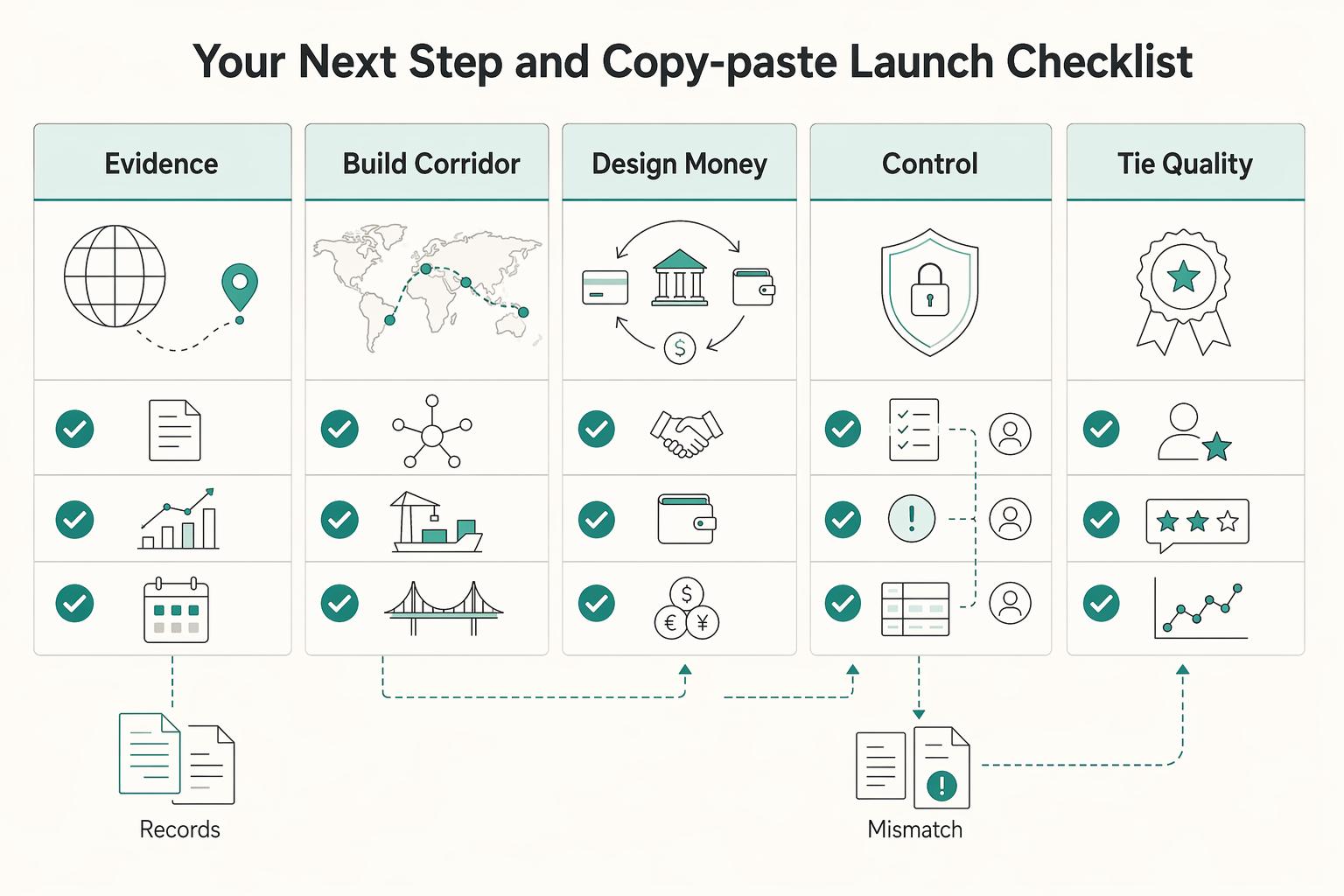
Use a structured rollout sequence before adding countries: choose the model, score corridors, design money movement, set compliance gates, run a pilot, then expand based on market and program constraints. That order helps you catch route gaps, reconciliation limits, and unclear release ownership before you scale.
- Choose the operating model and document tradeoffs.
Decide whether you are running a Contingent Workforce Management approach, a marketplace-led approach, or a service model. These models can assign different ownership for onboarding, compliance review, payout exception handling, and reviewer control. A marketplace claim like TranslatorsCafe being a large translation marketplace can support sourcing, but it does not define payout-exception ownership. A service claim like ATL offering subscription-based, ISO-certified translation and localization services can describe packaging, but ISO 17100:2015 covers translation-service process requirements, not payout compliance readiness.
- Build a corridor scorecard and reject vague coverage claims.
Score each target corridor on route availability, currency support, compliance path, and reconciliation evidence. Keep a dated vendor-confirmation field, since coverage maps can change and payment-method availability is not guaranteed. If a provider cites broad reach such as 200+ countries or territories or 150+ currencies, treat that as a starting point, not approval. Approve only after written confirmation for your exact corridor, method, and market.
- Design money movement before onboarding linguists.
Map the sequence end to end: payable approved, funds confirmed, FX decision, payout initiation, status tracking, then reconciliation close. Assign owners for held payouts, returned payouts, beneficiary-data corrections, and other unmatched items. Holds may be triggered by country requirements or beneficiary-data matching, and manual payouts leave reconciliation responsibility with your team. Confirm the exact finance artifact you will receive, since reconciliation reports and export formats can differ by payout setup.
- Set compliance and confidentiality gates with explicit controls.
Require joint sign-off for applicable AML/CFT and sanctions requirements, provider onboarding, confidentiality handling and funding controls. Assign bank CIP or covered-institution CDD obligations to the party actually subject to them. Collect only necessary data and limit access to the fields each role needs.
- Tie quality acceptance to payment release, then test the flow.
Release payouts only from a documented acceptance event, not informal approval. Keep reviewer comments, version history, and milestone terms attached to each job so release evidence is auditable. Test this flow in a safe environment before go-live. A valid outcome is a complete chain: acceptance record, payout status, provider reference, and reconciliation line.
- Run a narrow pilot and expand only with manageable exceptions.
Start with a small pilot cohort of countries and language pairs. Define pass criteria up front: payout success, exception volume your team can absorb, and reconciliation timeliness. Cross-border payments can be slow, costly, and opaque, so expansion should wait until failures are handled without manual breakdowns.
- Operating model selected and tradeoffs documented
- Country and corridor scorecard approved
- Payout sequence and failure ownership mapped
- Compliance and confidentiality gates signed off
- Quality acceptance tied to payment release
- Pilot passed with acceptable exception load
- Vendor claims verified for your exact markets and language pairs
If your team still has open corridor-level questions before go-live, run a focused ops review with Gruv via contact.
Frequently Asked Questions
How do you pay freelance translators in many countries without creating payout chaos?
Standardize payout operations before you scale countries. For each corridor, confirm the exact payout route, any country or currency limits, and the reconciliation artifact you will receive after payment. This matters because at least one platform states that payout methods depend on the freelancer's country of residence, and route feasibility should be confirmed directly rather than inferred from broad global-coverage claims.
What is the practical difference between a localization platform and a freelancer marketplace?
A localization platform can combine delivery workflow, sourcing and supplier payments; a marketplace can offer some of those functions too. A job board such as TranslatorsCafe primarily helps you find talent. Inspect the contract and payment flow to establish who owes the linguist and who handles failed-payment recovery instead of relying on the category label.
Which compliance checks should be completed before releasing cross-border linguist payouts?
Complete the verification and sanctions checks required by your operating model, local law and provider program. U.S. bank CIP and the FinCEN CDD rule apply to their covered institutions, not automatically to every localization company. For covered CDD institutions, the 2026 account-opening relief permits beneficial-owner verification at the first account, when prior information becomes unreliable and as risk-based ongoing diligence requires. Keep provider onboarding requirements and your own confidentiality controls distinct.
How should teams sequence country rollout for translator payments?
Sequence rollout by confirmed corridor, with a named route, agreed acceptance rules and traceable reconciliation evidence. Keep missing route or mandatory compliance approvals in sandbox/planning. A limited live pilot begins only once those gates clear, and tests settlement, exceptions and exports before wider release.
What should operators compare beyond translation quality when selecting a platform?
Compare who owes the linguist, who performs required verification, how acceptance changes the payable, and which statements finance can reconcile. Marketplace size is useful for sourcing; the decisive payment evidence is a workable contract, route and export for the exact program.
How do structured review and approval workflows reduce payment disputes?
Document the agreed submission, review and payment terms. Smartcat can use prepayment or post-payment models, so client acceptance is not a universal prerequisite for funding every job. Keep the job terms, delivered files, decisions and revisions linked to the payment authorization and payable so a dispute can be resolved without confusing pre-funded cash with completed work.
What details must be confirmed directly with vendors before go-live?
Confirm the exact country, currency, payout method, account eligibility and contractual fee schedule. Agree the handling of pending, returned and blocked items and obtain a sample reconciliation export. Match settlement estimates to the selected route and payment terms; do not apply one delivery estimate to every corridor.
Researched and edited by the Gruv editorial team. Gruv builds cross-border billing, payouts, and finance-operations software for global businesses.
Sources
- bis.org/cpmi/cross_border.htmtrusted
- bsaaml.ffiec.gov/manual/OfficeOfForeignAssetsControl/01_eptrusted
- bsaaml.ffiec.gov/manual/OfficeOfForeignAssetsControl/01trusted
- csrc.nist.gov/glossary/term/role_based_access_controltrusted
- csrc.nist.gov/glossary/term/least_privilegetrusted
- docs.stripe.com/connect/cross-border-payoutstrusted
- docs.wise.com/guides/product/send-money/quotestrusted
- documents1.worldbank.org/curated/en/099537106212238509/pdf/IDU06944bc...trusted
Educational content only. Not legal, tax, or financial advice.
Related Posts

The Freelance Payment Penalty: A Modeled Audit of Platform Fees, FX Spreads, and Payout Delays
The money rarely disappears through a single, easy-to-spot fee. The real loss is stacked. A marketplace takes its commission, a processor adds a charge for international cards, a bank or payment company converts the currency at a spread, a platform holds the funds before release, and a wire sheds a little to intermediaries on the way in. Each layer looks defensible on its own, but the worker feels the combined result as a smaller deposit and a later payday.

How to Respond to a Subpoena for Business Records
Move fast, but do not produce records on instinct. If you need to **respond to a subpoena for business records**, your immediate job is to control deadlines, preserve records, and make any later production defensible.

A US Expat's Guide to Investing in UCITS ETFs to Avoid PFIC Issues
The real problem is a two-system conflict. U.S. tax treatment can punish the wrong fund choice, while local product-access constraints can block the funds you want to buy in the first place. For **us expat ucits etfs**, the practical question is not "Which product is best?" It is "What can I access, report, and keep doing every year without guessing?" Use this four-part filter before any trade: