
Quick Answer
Identify the project jurisdiction and each claimant, choose progress or final and conditional or unconditional waiver correctly, and link the signed document to the approved payment and receipt evidence. Do not require an unpaid claimant to sign an unconditional waiver. Apply holds only where law or the contract permits them, while tracking payment deadlines and lower-tier obligations.
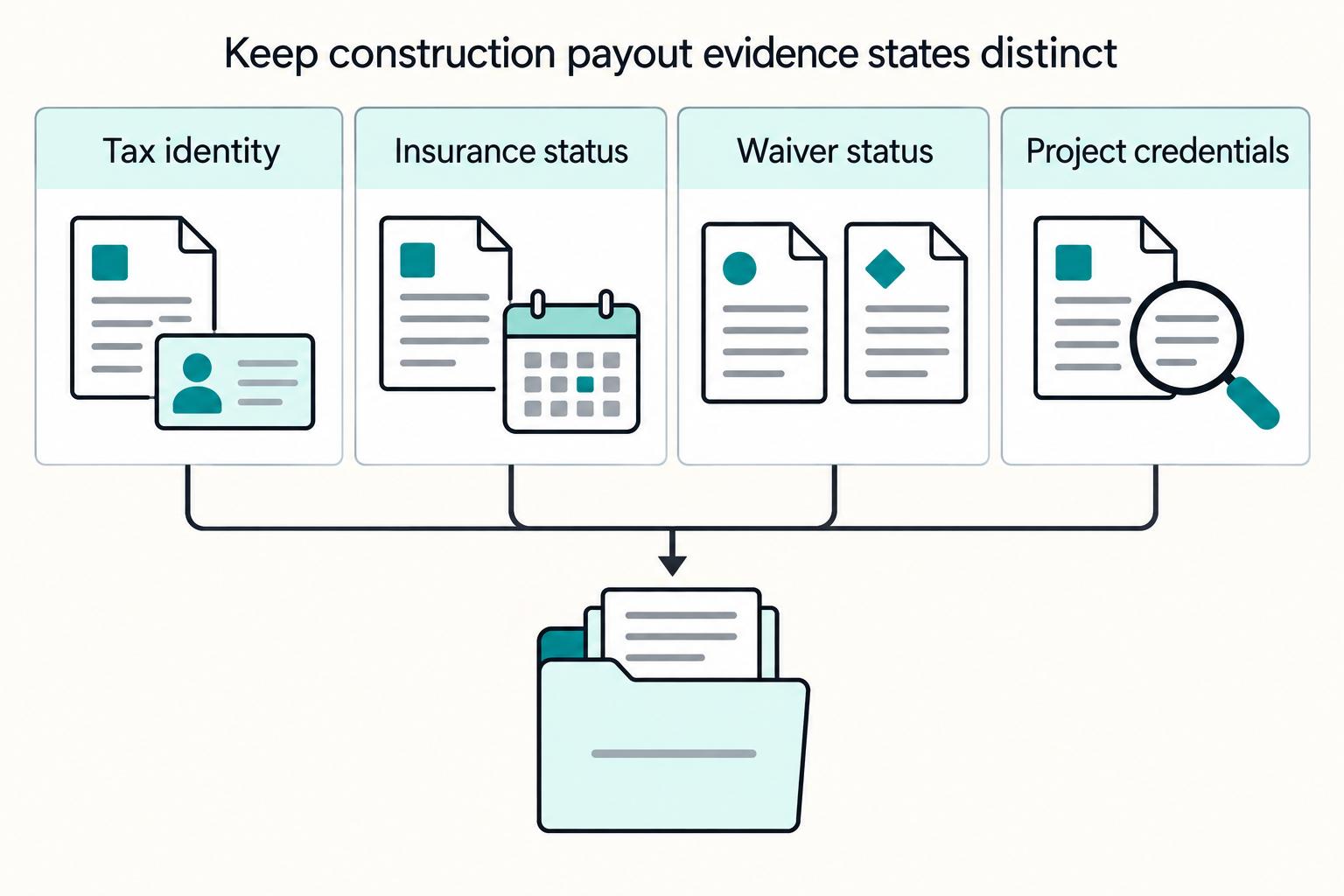
Keep the waiver decision separate from the payment status#
A construction payment can be approved without being sent, sent without being received, and received without every relevant claimant’s waiver being collected. A platform that labels all three “complete” hides the work project finance still needs to do.
Start with the project jurisdiction, contract, payment stage, and claimant. Establish the applicable waiver forms, payment deadlines, and lawful withholding conditions with project counsel. This guide uses California as a concrete example. Other jurisdictions and public works can have different rules; do not reuse a California form across every project.
Build a project-specific obligation and claimant record#
The approved pay application is the starting point for the amount due. Link it to the subcontract, project, legal payee, invoice or draw, approved changes, retainage, due date, and approval owner. Record the reason for any difference between requested and approved amounts.
Create a separate claimant record for each party whose release is required. A direct subcontractor’s payment or waiver does not show that its suppliers or lower-tier subcontractors were paid. The California CSLB guidance expressly warns against that assumption.
| Record | Fields to preserve |
|---|---|
| Payment obligation | Project, pay application, approved amount, currency, payee, due date, retainage, and change references |
| Claimant | Legal name, customer, project location, owner, tier, and relevant notice or contract reference |
| Waiver | Jurisdiction, approved form version, progress or final, conditional or unconditional, through date where applicable, exceptions, signature, and delivery |
| Transfer | Beneficiary version, submission reference, amount, status, return or failure evidence, and linked replacement if any |
| Review | Responsible person, applicable payment condition, findings, approval or lawful hold reason, and next action |
If lower-tier waivers are required for the project, include them in the first workflow. You can limit a pilot to a project with a simpler claimant structure, but you cannot postpone an existing legal or contractual requirement merely to simplify the product.
California example: four forms, not one signed state#
The CSLB links the current statutory forms associated with Civil Code sections 8132, 8134, 8136, and 8138. Choose both the payment stage and conditionality. Keep the statutory form and required notice intact rather than generating a generic release from a checkbox.
| Form | Appropriate timing | Control |
|---|---|---|
| Conditional progress — §8132 | A progress payment is expected and the claimant has not yet been paid | Keep the through date and exceptions; verify payment before relying on the release |
| Unconditional progress — §8134 | The claimant has actually received the progress payment | Verify receipt before requesting it; preserve the through date and exceptions |
| Conditional final — §8136 | Final payment is expected but not yet received | Review final scope and disputed-extra exceptions; verify payment before reliance |
| Unconditional final — §8138 | The claimant has actually received final payment | Verify final receipt and exceptions before requesting and reviewing the release |
Conditional progress does not erase every unpaid item#
The conditional progress form includes a through date and exceptions for retainage, unpaid extras, specified earlier unpaid progress payments, and identified contract rights. Store those exceptions as reviewable information. A broad through date is not proof that every item through that date has been paid or released.
The form describes receipt of payment on the specified check. If your project uses ACH or another rail, have counsel establish how the lawful form and payment evidence fit that rail. Do not silently replace statutory wording or assume a provider’s status label supplies the form’s payment condition.
Unconditional progress requires particular care#
The unconditional progress form says the claimant has received the identified payment and retains stated exceptions. Its notice warns that signing can make the release enforceable even if payment has not been received. Your workflow should request it after verified receipt, not as a prerequisite to releasing the same unpaid payment.
Final forms cover a different scope#
The conditional final form covers final payment and provides an exception for disputed extras. It needs payment evidence before reliance. It is not simply a progress form with a “final” label added by your system.
The unconditional final form states that the claimant has been paid in full and preserves its stated disputed-extra exception. Civil Code §8138 warns that the signed release can be enforceable even if unpaid. Do not ask a claimant to confirm full receipt based only on an approved pay application or a submitted transfer.
Worked example: a progress payment with retainage#
Assume a reviewed California subcontract permits 10% retainage for this payment. An approved progress application is USD 50,000, so USD 5,000 is retained and USD 45,000 is scheduled for payment. These figures illustrate the workflow; they do not establish a lawful retainage rate for every project.
Before payment, request the appropriate conditional progress waiver from the relevant claimant with accurate project information and through date. Review its exceptions, including retained and other unpaid amounts, against the payment record. Preserve a discrepancy for review rather than treating a signature as confirmation that the approved amount is correct.
After the USD 45,000 is actually received, record the receipt evidence and review whether the conditional release can be relied upon. If the project requires an unconditional progress release, obtain it at the appropriate time with its exceptions preserved. Do not mark the USD 5,000 retainage as paid or remove lower-tier requirements because the direct subcontractor received USD 45,000.
If the transfer is returned, record the failed payment and keep reliance on the conditional waiver unresolved. An earlier “sent” or “paid” provider label cannot establish current receipt on its own. If an unconditional waiver was signed before receipt, escalate its legal effect instead of assuming it automatically became conditional.
Apply holds only with authority and a deadline#
An internal checklist can identify a problem; it does not by itself authorise withholding an amount that is legally due. For each hold, identify the relevant statutory or contractual payment condition, the affected amount, notice requirement, payment deadline, and authorised decision-maker. Review prompt-payment and public-project rules for the actual project.
| Issue | Decision to make | Evidence and next action |
|---|---|---|
| Missing requested tax form | Determine the payer’s applicable reporting and withholding rules; do not assume total withholding is permitted | Tax owner records the applicable rule, required form, and lawful treatment |
| Expired insurance certificate | Check the contract, current coverage evidence, and permitted response | Insurance or legal reviewer identifies the defect, deadline, and any authorised remedy |
| Missing conditional waiver | Confirm that the form is a lawful required condition for this payment | Record request, form, claimant, affected obligation, and notice or escalation |
| Unconditional waiver requested before receipt | Correct the sequence; do not force a false receipt statement | Use the applicable conditional process and seek legal review where needed |
| Disputed pay application | Identify disputed and undisputed amounts and applicable payment obligations | Preserve calculation, contractual notice, reviewer, and due dates |
| Unknown transfer outcome | Trace the existing submission before any replacement | Retain provider reference, bank evidence, support case, and recovery decision |
W-9 supports relevant U.S. taxpayer identification and certification. Determine who needs it and the applicable consequences of missing information. Do not turn every missing form into a universal right to withhold the entire construction payment.
An authorised exception can address an internal process requirement within the approver’s authority. It cannot waive a statutory obligation or turn an unpaid claimant’s waiver into evidence of receipt. Keep the reason, legal or contractual basis, affected amount, approver, expiry, and follow-up owner.
Separate document states from transfer states#
Use document states such as requested, signed, reviewed, delivered, payment condition unresolved, and reviewed for reliance. Separately track the payment as approved, submitted, outcome unknown, confirmed received, failed, or returned. A document rejected for correction does not undo a transfer already submitted.
Immediately before submission, recheck the approved obligation and applicable conditions. A corrected waiver or pay application should create a new version with a review trail. If the amount, payee, beneficiary, or other material payment instruction changes, require the appropriate approval rather than editing a released record in place.
Persist one logical payment instruction before dispatch, with the obligation, amount, currency, approved beneficiary version, and duplicate-prevention reference. If submission times out, recover the existing provider result before changing provider or creating a new instruction. Local cancellation is not proof that the first transfer cannot complete.
For asynchronous updates, authenticate and durably save the receipt before acknowledging it. Apply validated state and accounting changes with the processed marker and any outbound intent in one local transaction. Dispatch outbound work after that transaction commits; a remote payment call cannot share the database transaction. Repeated or stale notifications must not create a second payment or erase a confirmed return.
Evaluate the workflow with realistic project exceptions#
Ask a vendor to demonstrate your jurisdiction and payment stage, a claimant with an exception, a required lower-tier release, and a transfer that later returns. Review the evidence it exports, not just the screen showing a signed form. Ask which form templates are maintained and who is responsible for approving their use.
- Can an operator identify the exact claimant, form version, through date, exceptions, and signature used?
- Can finance reconcile the approved obligation to actual debits, returns, and any replacement?
- Does the process preserve payment deadlines and distinguish lawful holds from internal warnings?
- Can a lower-tier requirement remain open after the direct subcontractor is paid?
- Can the platform keep a signed waiver’s legal review separate from a provider’s transfer status?
Use one project for the initial operating review, with all requirements for that project included. Expand only after the team can reconstruct a payment and its waiver decisions without relying on missing emails or undocumented overrides.
Frequently Asked Questions
Should an unpaid subcontractor sign an unconditional waiver?
Your workflow should not require that. In the California example, use the appropriate conditional form before payment and request an unconditional form after verified receipt where required. Unconditional forms warn that signing can waive rights even if unpaid.
Does a signed conditional waiver prove payment?
A signature alone does not establish the payment condition. Retain and review actual payment evidence before relying on a conditional release, using the applicable form and jurisdiction requirements.
Can we ignore lower-tier waivers in the first rollout?
Only if they are not required for the chosen project and arrangement. A direct subcontractor’s payment or release does not establish that lower-tier claimants were paid. Include every applicable requirement in the initial workflow.
Can internal policy hold a payment indefinitely for missing documents?
Internal policy alone does not authorise withholding a legally due amount. Identify the lawful payment condition, affected amount, notice, and deadline. Escalate unresolved requirements while observing applicable payment obligations.
Can California forms be used on projects nationwide?
Choose forms and rules for the actual project jurisdiction and contract. California’s four statutory forms are a worked example, not a nationwide waiver template.
If you are assessing payment approvals, references, and exception tracking for a construction workflow, review Gruv Payouts alongside the project’s approved waiver and legal process.
Researched and edited by the Gruv editorial team. Gruv builds cross-border billing, payouts, and finance-operations software for global businesses.
Sources
Educational content only. Not legal, tax, or financial advice.
Related Posts

The Freelance Payment Penalty: A Modeled Audit of Platform Fees, FX Spreads, and Payout Delays
The money rarely disappears through a single, easy-to-spot fee. The real loss is stacked. A marketplace takes its commission, a processor adds a charge for international cards, a bank or payment company converts the currency at a spread, a platform holds the funds before release, and a wire sheds a little to intermediaries on the way in. Each layer looks defensible on its own, but the worker feels the combined result as a smaller deposit and a later payday.

How to Respond to a Subpoena for Business Records
Move fast, but do not produce records on instinct. If you need to **respond to a subpoena for business records**, your immediate job is to control deadlines, preserve records, and make any later production defensible.

A US Expat's Guide to Investing in UCITS ETFs to Avoid PFIC Issues
The real problem is a two-system conflict. U.S. tax treatment can punish the wrong fund choice, while local product-access constraints can block the funds you want to buy in the first place. For **us expat ucits etfs**, the practical question is not "Which product is best?" It is "What can I access, report, and keep doing every year without guessing?" Use this four-part filter before any trade: