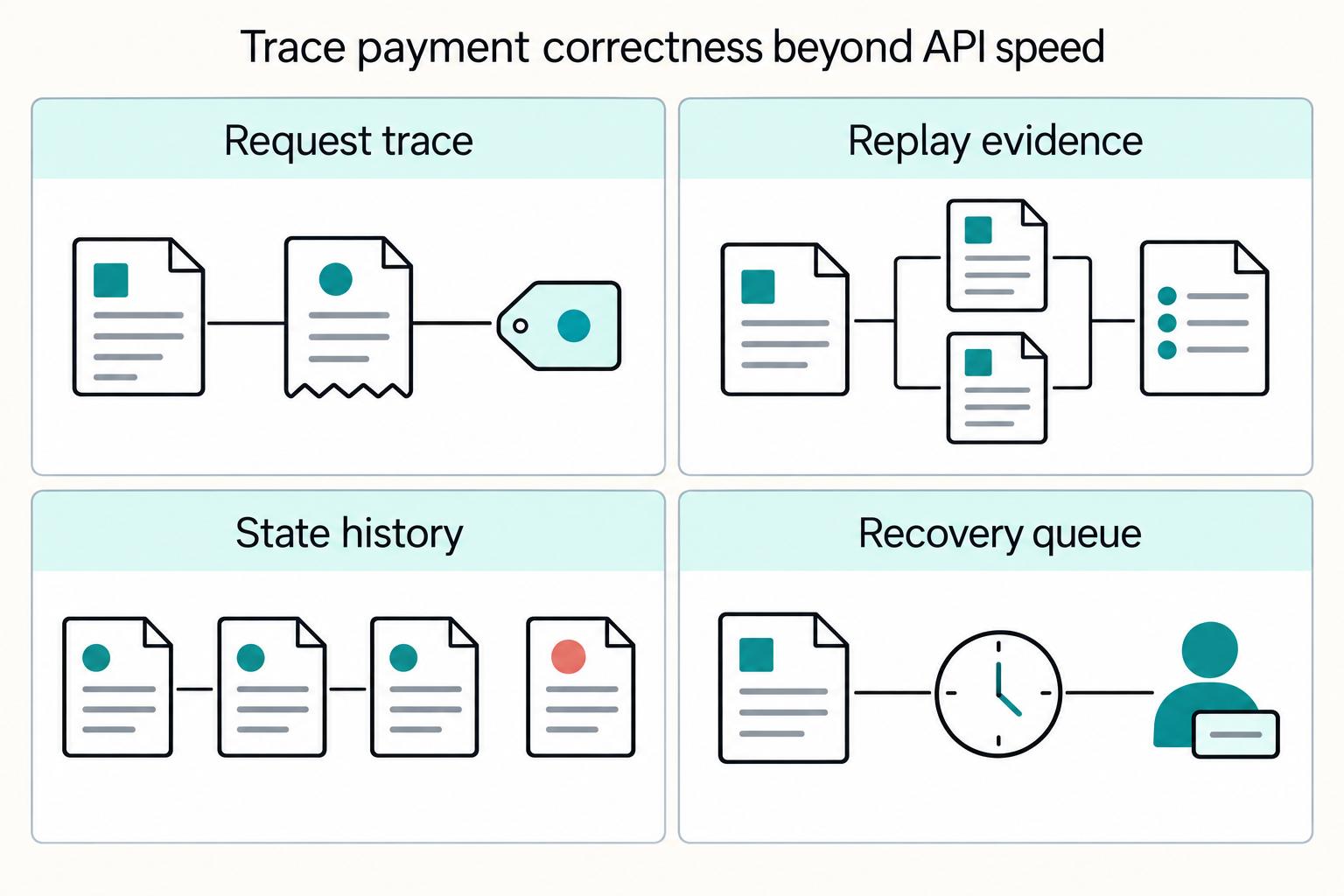
To safely support one million daily transactions, design for correctness before throughput. Define one authoritative record, lock replay and idempotency behavior, enforce a strict payment state machine, and make every transition traceable. Then harden async webhook handling with bounded retries, a dead-letter queue, reconciliation, and release gates that prove retries and failures do not create duplicate financial outcomes.
If you are aiming for million-transaction days, tighten correctness rules before you add more servers. In payments, strongly consistent processing matters because stale reads or conflicting writes can create duplicate charges or incorrect balances. Once timeouts or partial failures trigger retries, idempotency is what keeps those paths safe.
The hard part is not accepting traffic. It is deciding what a retry means, what counts as the same financial instruction, and how a payment can move through its lifecycle. That is why this guide starts with request identity, idempotency handling, and traceable state control.
That matters even more in service-heavy architectures, where one transaction can fan out into 10+ internal API calls.
A useful mental model is to treat payment processing as a multi-state journey, not a binary success or failure. One implementation example explicitly stores timestamped state_history and validates each transition before allowing a state change. Stripe's Ledger system is a concrete example of treating money movement as durable financial state rather than transient API output.
That gives you a concrete checkpoint. For any disputed or stuck payment, you should be able to inspect the current state, the prior state, when the change happened, and whether the transition was valid when accepted.
This is also where scale catches teams off guard. In one published surge scenario, volume jumped to 200,000 requests per minute, 4x normal load, while provider response times crept up and timeout risk increased. Once timeouts enter the picture, retries and partial downstream failures stop being edge cases. If your idempotency rules are loose, a traffic spike can turn into duplicate work and duplicate money-movement risk.
The practical promise of this guide is simple: lock down failure semantics, replay behavior, and traceability early, and you can scale without giving up auditability or operator control. That does not mean you need every advanced component on day one. It means you need foundations that keep later scale work from forcing a redesign of your API contract or state model.
A useful early checkpoint is whether your team can explain one failed payment end to end. That explanation should cover the original request, the idempotency control used on the mutation, the state transitions attempted, the downstream provider response or timeout, and the audit trail left behind. If you cannot do that for a single transaction, more traffic will only make diagnosis slower.
This matters even more in service-heavy environments. One team described the benefit of having one place to debug transaction flows that touched 27+ major services, and tied that visibility to much faster incident recovery. You do not need to copy their tooling choices. You do need a design where retries and state changes can be traced without guesswork. A high-volume payment-platform case study shows the same operational payoff from centralized flow visibility.
So the build order in the rest of this guide is deliberate. First define what must never happen, like duplicate charges and invalid state jumps. Then make state and failure behavior inspectable, choose where strong consistency is mandatory, and only after that shape endpoints, async handling, orchestration, and scale testing. That sequence helps growth avoid turning into platform debt.
Write the success contract first. If business and engineering are out of sync on failure handling and business goals, endpoint design will encode that misalignment.
Start with plain-English contract targets: how to reduce duplicate-charge risk, how payment states should be handled, and what investigation records operators need. Treat these as shared product and engineering requirements, not implementation details.
Make the contract visible across both teams. Define the purpose, target audience, and measurable business goals before route naming or payload debates start.
Use operator outcomes as the gate for this phase. "Done" should mean failure behavior is defined and status outcomes are explainable.
A failure walkthrough is a better checkpoint than a feature checklist. If the team cannot clearly describe what happened in one failed transaction and what evidence they would check, pause feature work and close that gap first.
Decide in writing how failure outcomes and status semantics should work. Then reflect that decision in API behavior so consumers know what is final and what may still be in progress.
Before implementation, require a short evidence pack: expected failure cases, status expectations, and required investigation records. Include at least one explicit unhappy-path API test, for example a curl check, before deployment. Keep this contract transparent, consistent, and easy to adopt so both teams can execute against the same plan.
For related finance operations context, see How to Build a Finance Tech Stack for a Payment Platform: Accounts Payable, Billing, Treasury, and Reporting.
Once the success contract is clear, build one shared evidence pack before implementation starts. Without it, teams fill gaps with assumptions and often miss security, compliance, and scalability planning.
Collect the inputs that shape payment behavior in one place: API capabilities, machine-readable product data, and the inventory and pricing signals your flow depends on. Keep this as a working reference, not something scattered across tickets and chat.
Make it answer-first for both engineering and operations. Clarify what changes transaction outcomes, what operators can see, and what may arrive later. If your platform supports both human-assisted and autonomous-agent flows, state that explicitly. Also confirm your payment architecture is API-first/headless and that your APIs expose the structured data those agent decisions need.
Teams should code against agreed integration artifacts early: core API contracts, shared data models, and payment-gateway integration points with CRM and ERP systems. Defining these after integrations begin usually creates inconsistent client behavior and manual handoffs.
Keep the artifacts concrete enough to remove guesswork. Define how teams detect and investigate failed transactions, and require identifiers that let teams trace activity across the original request, provider reference, and current payment state.
Plan security and compliance behavior early, and make the operator-visible outcome of reviews explicit. Labels like "under review" are not enough if operators cannot tell whether money movement is paused or delayed.
In the pack, state the visible effect of each compliance gate and who needs to act next. For deeper audit-trail design, see what an audit trail should capture.
Create one shared test pack for the workflow orchestration layer so teams validate the same assumptions. Include failure and recovery scenarios that reflect your architecture and expected load.
Focus on recovery proof, not only happy-path correctness. Each test should define expected outcomes and the evidence that confirms them. This is also where you catch manual swivel-chair gaps across payments, CRM, and ERP flows before scale amplifies them.
After the evidence pack is ready, decide your authority model first and your database pattern second. If your team cannot say which record is authoritative when systems disagree, recovery and audit become harder under load.
Write down which record settles the question "what happened?" when API responses, callbacks, and internal reports conflict. Choose one authoritative record and define how balances and reconciliation outputs relate to it.
Define this at the same level as your payment intent lifecycle, idempotency rules, and API contract so engineering and operations trace the same identifiers across the request, provider reference, and internal state.
The point here is tradeoff discipline, not finding a universal winner. The grounding excerpts do not establish a technical winner between CockroachDB, Amazon DynamoDB, or a hybrid model, so treat the matrix below as validation questions to run against your own failure and recovery path.
| Option | Write-path guarantee to validate | Multi-region behavior to validate | Migration/debugging risk to validate | Operational overhead to own |
|---|---|---|---|---|
CockroachDB + distributed SQL | Which critical writes must complete together before you return success? | How does failover affect write handling and operator response? | How will schema changes, backfills, and incident queries work on your model? | Database operations, tuning, and region strategy |
Amazon DynamoDB + event-driven patterns | Which writes are authoritative immediately versus eventually projected? | How will you handle replay, ordering, and duplicate events across regions? | How will on-call explain accepted requests when downstream views lag? | Consumer idempotency, replay tooling, and event observability |
| Hybrid | Which store is authoritative, and which stores are derived only? | How will you resolve temporary disagreement across stores or regions? | How will you avoid and diagnose dual-write drift? | Cross-store reconciliation and stricter ownership boundaries |
The grounding pack does not prove a universal recommendation to adopt or avoid manual sharding. State whether it is required now, deferred, or avoided for this phase. If you use it, document shard key logic, the rebalancing approach, cross-shard write expectations, and how operators can retrieve any transaction without special-case knowledge.
Consider storing reconciliation results as evidence linked to your authoritative record, not as reporting only. Keep transaction identifiers, provider references, reconciliation status, mismatch reason, and comparison timestamp so finance, support, and engineering can resolve disputes from one traceable record.
Related: How to Build a Partner API for Your Payment Platform: Enabling Third-Party Integrations.
After you choose the authoritative record, lock the client contract for money-changing operations. Keep replay behavior explicit, and avoid retry paths that can be interpreted in multiple ways.
This is more a contract-design problem than an endpoint-count problem. At scale, teams usually get better outcomes from clear, consistent contracts than from adding routes quickly.
Keep core payment and pricing definitions in one authoritative system. Your external contract should stay transparent, consistent, and easy to adopt, even if your internal flow spans multiple services.
If a client cannot tell how a retry maps to a prior action, tighten the contract language before traffic grows.
Define replay-related behavior clearly and enforce it consistently.
When behavior needs to change, publish a new version rather than changing existing semantics in place. Versioned definitions protect existing integrations and make replay outcomes easier to explain.
For duplicate submissions, late retries, and timeout recovery paths, aim for rules that are consistent enough for client teams to automate against. In payment flows, clarity beats "helpful" guesswork.
One useful test is whether another team could implement retry handling from your docs and SDK behavior without backchannel clarification.
Replay safety often fails when product and engineering interpret retries differently, not because the systems cannot handle load. Write the retry contract so both teams use the same definitions.
If your payment flow spans many services, centralized orchestration and debugging can make end-to-end transaction tracing easier.
Keep the policy short and explicit so teams can apply it consistently.
Related reading: Digital Nomad Payment Infrastructure for Platform Teams: How to Build Traceable Cross-Border Payouts.
Once retries have one fixed meaning, route every money-changing action through a strict payment state machine. Allow only named transitions, persist accepted transitions as append-only records, and surface rejected transitions as alerts.
Use explicit lifecycle states that reflect real business events in your system. Avoid collapsing them into broad buckets like paid or done, because different states can carry different operational and finance implications.
Keep the graph small and explicit. Internally, every edge should answer two questions: what is allowed next, and what is now forbidden? If a path depends on a prior condition in your domain, encode that as a guard instead of relying on operator memory.
Walk one payment through its normal path, then through one exception path. If accepted edges are unclear at any step, tighten the graph.
Store transitions as append-only records, not status overwrites. For each accepted edge, persist enough context to reconstruct what changed, including the triggering request or event reference.
That is what makes an audit trail operational instead of cosmetic. Stripe describes Ledger as immutable and auditable, used as a trustworthy financial system of record. The same principle applies here. Operators should be able to reconstruct what happened from durable records, not guess from transient logs.
Validation test: take a production-like payment and reconstruct the full lifecycle from persisted transition history alone, then confirm it matches your ledger and provider records.
Races show up when updates from different paths arrive close together or out of order. If multiple paths can write state without a guard, lifecycle integrity breaks.
Validate transitions against the current stored state, and perform that validation in the same durable write that records the new edge. Accept only valid edges. Reject everything else as an invalid transition attempt.
A useful test case is competing updates for the same payment, for example a repeated action plus a late callback. Your system should accept one valid sequence and reject conflicting edges without corrupting the final state.
Treat invalid transitions as real alerts because they can expose malformed inputs or partner-propagated errors.
At scale, explainability matters. Stripe reports Ledger processing five billion events per day and relying on early alerting to surface issues and proposed solutions. Their investigative tooling also monitors, categorizes, and triages 99.999% of activity, with the remaining long tail handled through manual analysis to keep imperfections manageable and bounded. You do not need that scale to apply the pattern. Alert early, categorize consistently, and attach evidence for triage.
For each rejected edge, keep the attempted transition, triggering request or event reference, and current stored state so operators can decide whether to reprocess, ignore, or escalate.
For a step-by-step walkthrough, see Revenue Leakage from Payment Failures: How Much Are Failed Transactions Really Costing Your Platform?.
Treat webhook events as an async boundary, not a place for full inline business processing. If provider callbacks run synchronous writes end to end, burst traffic and retry storms can exhaust your connection pool and turn an external incident into your outage.
Convert each inbound callback into one internal event envelope before business logic runs. Include provider event ID, event type, received timestamp, provider reference ID, and the dedup marker you will use downstream. Validate and normalize the payload before accepting it into processing.
Start receiver-side dedup at this boundary. Do not dedup on an internal entity ID alone. Use provider event ID plus internal routing keys so real retries collapse and distinct events remain distinct.
A quick check: from the envelope alone, can you answer which provider event this is, which internal record it affects, and which reference support teams will use later?
Design for at-least-once semantics from day one. Providers can redeliver and keep retrying failures for hours. Observed patterns include bursts of 10,000 webhook events and failed-delivery retries for 6 hours straight.
Use a worker tier with a bounded retry policy and final routing to a dead-letter queue (DLQ). Exponential backoff with jitter is a practical webhook retry pattern. The key decision is the boundary: retries stop, and exhausted events go to a visible lane for replay or investigation. For webhook retry design details, review this webhook system guide.
Track ingest rate, queue depth or age, and worker latency together. A view like 1,247 req/min · p50: 42ms · p99: 180ms can work as an operational checkpoint, not a universal target. If queue age climbs while workers look healthy, you may have a downstream bottleneck or a retry loop.
Replay is safest when checked against the same event identifier and current stored state. Use the same dedup/idempotency guard on replays that you use on first-pass processing, then validate that the transition is still allowed from stored state.
If the accepted outcome already exists, treat the replay as a duplicate and exit cleanly. If the event is stale or conflicts with stored state, route it for review. Avoid running side effects before guard checks, because that is where duplicate actions can slip through.
Keep the sequence explicit: ingest, validate, dedup, process, persist, emit status, reconcile. Each checkpoint should leave enough evidence to explain outcomes later, especially for DLQ cases. At minimum, keep the envelope ID, provider event ID, retry count, last error, and final disposition.
Run replay drills. Pull one DLQ event, replay it, and confirm you can trace it through every checkpoint without relying on transient logs. If any hop is opaque, fix that before scaling traffic further.
You might also find this useful: How to Build a Deterministic Ledger for a Payment Platform.
Set boundaries with a bias toward direct integrations for simple flows. Add a workflow orchestration layer when a payment flow spans multiple providers or systems and needs shared execution state and centralized visibility. If a path is simple and local, keeping it local usually means less integration and operational overhead.
Keep the flow local when one request can be completed through a single provider integration with limited downstream coordination.
Introduce orchestration when the flow is no longer linear. If completion depends on multiple providers or services, central coordination becomes easier to operate and trace across systems.
Check one failed payment. How many systems must you inspect to explain the outcome? If it is several disconnected services, orchestration is usually justified.
Use orchestration for multi-provider connectivity, execution state, routing, and centralized reporting. Avoid orchestration sprawl. Routing simple single-service actions through the layer can add complexity without adding operational value.
Use a responsibility matrix before implementation.
| Component | Owns | Must not own |
|---|---|---|
| Direct integration path | Straightforward single-provider payment interactions | Cross-provider routing and centralized monitoring responsibilities |
| Orchestration layer | Multi-provider coordination, execution state, routing, end-to-end visibility | Every simple payment path by default when direct integration is sufficient |
| Business services | Business handling around payment outcomes | Rebuilding provider-routing logic across multiple services |
Keep boundaries stable as requirements evolve. Orchestration should clarify responsibilities across layers, not blur them.
For orchestrated paths, require one traceable execution record per payment flow. You should be able to start from a payment ID or payment intent and reliably locate orchestration execution state and provider references.
Test this on a messy case, not a happy path. If you cannot quickly show who initiated the flow, what is waiting, and what failed, tighten boundaries before scaling further.
Sequence the rollout so you stabilize money truth before you optimize complexity or volume. A practical order is: core money write path, async lifecycle handling, reconciliation and cross-system proof, then scale drills.
| Phase | Primary focus | Checkpoint or gate |
|---|---|---|
| Launch the core money write path | Accept a payment and produce one authoritative final outcome | Consistent behavior under retries and timeouts; one financial result operators can trace end to end |
| Add lifecycle handling for async reality | Harden callback and event intake after the core write path is stable | Use messy callback tests, including delayed and conflicting events, before expanding providers or downstream fan-out |
| Productionize reconciliation and cross-system proof | Stand up batch reconciliation and cross-system consistency checks | Trace one complete payment across authorizations, settlements, chargebacks or refunds, and batch reconciliation status |
| Harden for scale with failure drills | Run traffic drills, inject dependency failures, and stress orchestration paths for multi-step flows | Use recovery quality as the exit criterion |
Start with a minimal flow that can accept a payment and produce one authoritative final outcome. Your first checkpoint is consistent behavior under retries and timeouts. The same request path should still resolve to one financial result that operators can trace end to end.
If your team cannot explain one transaction from request to final posting without guesswork, stop here and tighten this path before adding more moving parts.
Add lifecycle controls only after the core write path is stable, then harden callback and event intake. This is the point where delayed events and partial external failures become routine operational cases across sync and async workflows.
Use messy callback tests, including delayed and conflicting events, as a gate before you expand providers or downstream fan-out.
Stand up batch reconciliation and cross-system consistency checks only after Steps 1 and 2 are reliable. The goal in this phase is explainability across systems, not just successful API responses.
A strong checkpoint is whether one complete payment can be traced quickly across authorizations, settlements, chargebacks or refunds, and batch reconciliation status. In one reported high-volume platform, centralized debugging mattered because a single transaction flow could touch 27+ major services. Once many services and queues are involved, proof gaps become bottlenecks quickly.
Pressure-test the system you already trust by running traffic drills, injecting dependency failures, and stressing orchestration paths for multi-step flows. One reported team validated orchestration locally, then moved it to high-volume production and later reported 50M+ daily credit card transactions and peak throughput around 2,450 transactions per second. Treat those figures as a case-study data point, not a universal target.
Use recovery quality as the exit criterion. In the same case study, the team reported MTTR moving from 6.5 hours to under 3 minutes after orchestration changes. Before moving from phase 2 to phase 3, convert your reconciliation gates into explicit runbooks and API contracts in the Gruv docs.
After your core write path, async handling, and reconciliation flow are stable, instrument for explainability first, not vanity uptime. A healthy p99 can still hide duplicate attempts, invalid state transitions, or a DLQ that is aging toward an incident.
Track a small set tied to money correctness and recovery quality: duplicate attempt rate, idempotent replay rate, transition failure rate in the payment state machine, and DLQ aging. Together, these can show whether retries are expected, dedup is effective, lifecycle edges are failing, or async failures are sitting too long.
Do not force a universal threshold. Use trend plus change context. If duplicate attempts jump after a client release, or transition failures rise after webhook parsing changes, that can be operator signal. If DLQ aging rises while API latency stays flat, the issue may be recovery, not ingress.
Keep alerting narrow. Large rule sets can create false-positive noise that makes real risk harder to see. For high-volume flows, batch-only detection is a weak posture compared with event-driven monitoring that can react in real time.
Triage speed depends on whether one payment can be traced end to end without guesswork. In a microservices architecture, propagate and log transaction ID, idempotency key, and provider reference across sync requests, async events, retries, and reconciliation records. This trio is a practical baseline, not a universal guarantee for every architecture.
Use structured fields instead of free-text logs. If traces include transaction ID but webhook consumers only emit provider references, operators can still end up stitching evidence manually. As a release check, trace one successful and one failed payment from API request through ledger outcome, transition history, provider callback, and reconciliation status.
Your primary dashboard should answer "what happened?" before "how fast was it?" Include audit trail completeness, invalid transition counts, replay outcomes, DLQ depth and oldest age, and reconciliation pipeline health. That health view should cover unmatched records, stalled exports, and exception queue growth.
This also helps you avoid the legacy reconciliation loop of matching System A to System B, flagging exceptions, then manually investigating on a recurring cycle. The risk is fragmented evidence. One cited scenario described a $340,000 discrepancy spread across 47 Excel files and three processor dashboards, with close taking 18 days. If proof still requires spreadsheets, your operator view is incomplete.
Each release should confirm that observability and control still work under messy conditions, not only on the happy path. Consider checks like these before rollout, and treat failures as a prompt to tighten traceability and proof before wider deployment.
idempotency key after timeout and partial downstream success. Expected: one financial outcome, later attempts clearly marked as replay or duplicate.We covered this in detail in Build Plan Tiers and Add-Ons That Raise Revenue Per Platform User.
The costliest debt often starts as an architecture shortcut, then shows up when volume reaches roughly 10K-100K transactions/day. If reports diverge or settlements slip, investigate system design first.
Happy-path checks are not enough on their own. Test retry and async failure paths, and verify the API stays reliable (for example, 99%+ uptime for a week) before launch.
When reports do not match and settlements get delayed, reconciliation pain can grow with volume. A practical check is whether your team is spending significant time on manual reconciliation across systems.
Retries help only when failures can still be triaged and resolved predictably. Before launch, intentionally exceed rate limits and repeatedly test critical flows so failures are visible and practical instead of looping invisibly.
Batch processing plus tight coupling is a known failure mode behind delays, mismatches, and blind spots. As load grows, favor modular, event-driven architecture patterns that improve processing speed and accuracy.
If you want a deeper dive, read Platform-to-Platform Payments: How to Build B2B Settlement Between Two Marketplace Operators.
Use this sequence. Pause before scaling traffic if replay behavior, reconciliation, or end-to-end traceability are still unclear. The goal is to advance only when money truth and recovery behavior stay explainable.
Define the ledger as the source of truth, then set consistency boundaries for money-critical writes. Ground the ledger in double-entry bookkeeping so financial records stay balanced and auditable. For money correctness, decide explicitly where stronger consistency is required and where read models can tolerate looser consistency.
Lock the payment intent + idempotency key contract before adding advanced features. Prioritize upfront strategy and clear contract design over shipping more endpoints. Keep the contract transparent and consistent so teams align on what the instruction object is, how retries map to one business action, and which outcomes are final versus retryable.
Enforce a strict payment state machine with auditable transitions. Treat transitions as controlled events, not casual side effects across services. As volume rises, race conditions become more likely, so invalid transitions should be rejected and surfaced.
Harden async handling with a bounded retry policy and clear dead-letter queue (DLQ) ownership. Make replay behavior explicit, keep retries bounded, and assign who owns DLQ triage before incidents happen.
Stand up a reconciliation pipeline and operator dashboards before aggressive scaling. Operations should be able to connect transaction records, provider references, and ledger outcomes, then see unmatched or delayed items quickly. What Is an Audit Trail? How Payment Platforms Build Tamper-Proof Transaction Logs for Compliance is a useful companion if your evidence model is still weak.
Use phase gates and advance only when replay, reconciliation, and traceability pass together. Promote each milestone only after you can show retries do not create duplicate financial outcomes, reconciliation explains discrepancies, and one payment is traceable end to end.
Need the full breakdown? Read How to Build a Payment Reconciliation Dashboard for Your Subscription Platform.
If you want a pre-launch architecture check on payout flows, policy gates, and traceability for your target markets, talk to Gruv.
There is no universal minimum stack in the available evidence. Before scaling, map the regulatory architecture and dependencies across compliance, provider, and internal systems. Your team should be able to trace one transaction end to end and explain what happens if any connected API changes.
Do not size from one average-volume number alone. Validate burst behavior across connected systems, because fragmented subsystems are where reconciliation errors and maintenance debt tend to emerge.
The article supports fixed replay semantics, a single request identity, and checks against current stored state. Use the same dedup or idempotency guard on first-pass processing and on replays, then validate that the transition is still allowed. If the accepted outcome already exists, treat the replay as a duplicate and exit cleanly.
Keep the flow local when one request can be completed through a single provider integration with limited downstream coordination. Introduce orchestration when the flow spans multiple providers or services and needs shared execution state, routing, and centralized visibility. If explaining one failed payment requires checking several disconnected systems, orchestration is usually justified.
There is no universal first failure point. A common pattern is fragmented integrations, which lead to reconciliation errors and growing maintenance debt as volume rises. Retries, timeouts, and partial failures also become more dangerous when state and recovery behavior are unclear.
Lock in the blueprint before implementation: target segment, regulatory architecture, dependency map, and the expected effect of API changes across connected systems. Postponing those decisions raises wasted time and money later. If compliance scope is still unclear, close that gap before expanding implementation.
Ethan covers payment processing, merchant accounts, and dispute-proof workflows that protect revenue without creating compliance risk.
Includes 7 external sources outside the trusted-domain allowlist.
Educational content only. Not legal, tax, or financial advice.

**Start with the business decision, not the feature.** For a contractor platform, the real question is whether embedded insurance removes onboarding friction, proof-of-insurance chasing, and claims confusion, or simply adds more support, finance, and exception handling. Insurance is truly embedded only when quote, bind, document delivery, and servicing happen inside workflows your team already owns.
Treat Italy as a lane choice, not a generic freelancer signup market. If you cannot separate **Regime Forfettario** eligibility, VAT treatment, and payout controls, delay launch.

**Freelance contract templates are useful only when you treat them as a control, not a file you download and forget.** A template gives you reusable language. The real protection comes from how you use it: who approves it, what has to be defined before work starts, which clauses can change, and what record you keep when the Hiring Party and Freelance Worker sign.