
Quick Answer
Measure failed-payment exposure once per invoice or economic obligation, then follow it to recovery, an open receivable, or a Finance-approved loss classification. Keep the platform’s own revenue separate from gross payment value. Add handling and financing costs separately; a temporary delay or stale journal is not automatically lost revenue.
Why Payment Failures Quietly Drain Platform Margin#
Payment failures can be recoverable and still drain platform margin. Teams can track yesterday's declines and still miss the full cost when failures combine with under-billing, delayed recovery, reconciliation drag, and payout timing. The practical goal is simple: quantify the real cost, then map each failure point to a weekly checkpoint finance, ops, and product can actually run.
A failed payment is exposure, not automatically a final loss. Recovery delays can increase support work and financing cost; incorrect ledger timing can distort reported results. Measure those effects separately from an actual unrecovered receivable. A late receipt alone does not erase revenue already earned under the applicable accounting policy.
This scope is intentionally narrow. It is for ledger-backed platforms that need reconciliation, settlement operations, and payout execution to stay aligned at scale. It is not a generic billing primer. If your team owns authorization through settlement and downstream release logic, you need lifecycle visibility, not just decline-code visibility.
Leakage also starts before authorization. It can come from missed billing, contract errors, and revenue handling mistakes, not just payment rejection events. If reporting starts at processor events, teams can over-focus on retries and miss upstream leakage that never appears in failed-payment dashboards.
Use this operating rule: if cash collection, ledger status, settlement confirmation, and payout readiness are measured in different systems by different owners, assume leakage risk in the gaps. Start with these checkpoints:
- Failed payment volume vs. recovery rate
- Invoices issued vs. expected usage or contract value
- Payments authorized vs. payments settled
- Settled funds vs. ledger postings completed
- Unresolved exceptions still open past close or payout-release timing
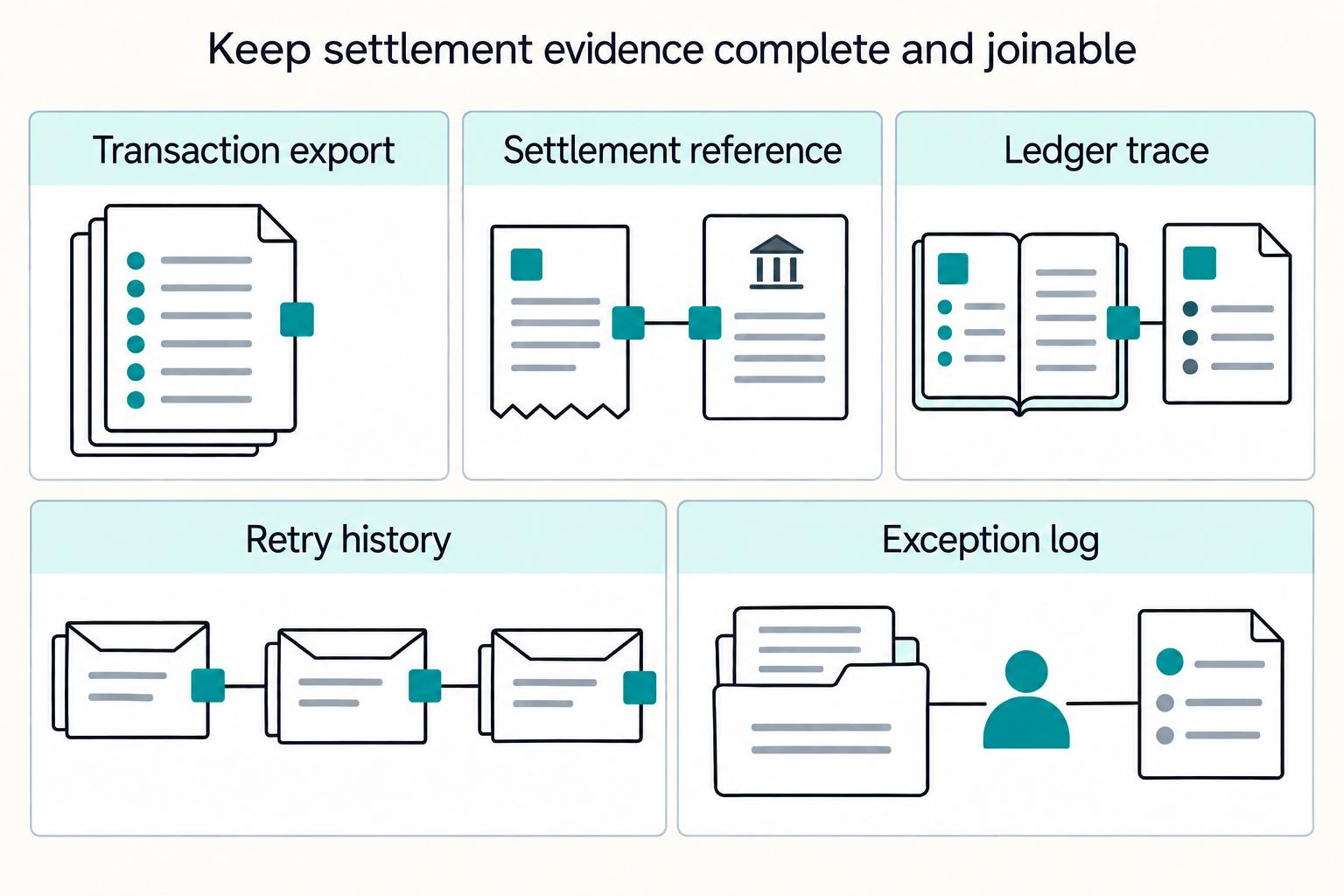
For any material exception, your team should be able to produce provider status, retry history, settlement reference, and a matching ledger journal trace. If any artifact is missing, the issue is bigger than a single failed transaction. You cannot prove where the loss, delay, or exposure sits.
External leakage benchmarks can help frame questions, but use your own invoice cohort to estimate cost. Count each invoice or economic obligation once, even if it generates several failed attempts. Then track what was recovered, what remains open, and what Finance has determined to be uncollectible.
First agree what counts as failed, at risk, recovered, and lost. For a marketplace, separate the total payment value from your own revenue or fee entitlement. A failed customer charge of $1,000 is not necessarily $1,000 of platform revenue.
Define The Terms Before You Start Measuring#
Define the terms first, or your metrics can conflict across teams. If finance treats a failed charge as lost while ops treats it as recoverable, reporting will be inconsistent. Use these terms the same way across finance, product, and operations:
| Term | Use it for | Do not use it for |
|---|---|---|
| Revenue leakage | Money that was earned but not collected | Temporary delay that is still in a normal recovery path |
| At-risk failed-payment revenue | Failed-payment value that may still be recovered through retry/recovery workflows | Revenue already confirmed as unrecoverable |
| Under-billing | Entitled charges that never made it onto an invoice | Processor declines after a correct bill was issued |
| Payment failure | A collection attempt that did not succeed | Revenue already classified as unrecoverable after recovery checks |
Keep failed-payment exposure split into recoverable and harder-loss classes. Retries can recover many failures, but not on the same conditions. Hard declines and cases with no available payment method should not sit in the same bucket as retry-eligible failures.
Treat under-billing as an upstream risk, not just a processor issue. Causes include usage-data gaps, pricing synchronization misses, and bill-calculation errors. One common failure mode is late usage import. When usage arrives after invoice posting, that usage is not billed on that posted invoice.
Use one maintained glossary with definitions and classification rules. If a team cannot show which bucket a failed transaction or missing charge belongs to, fix classification before you measure leakage.
Map The Money Lifecycle Where Leakage Actually Happens#
Leakage often shows up at handoffs, not inside one team. Map the money lifecycle as explicit stages with explicit owners so failed payments do not sit between billing, payments ops, and finance without clear follow-up.
Use this as a working operating map, not a claim that every rail or processor is identical. The stages are invoice or payment initiation, authorization or collection outcome, ledger posting, settlement confirmation, then payout release. Perfect labels matter less than clear transitions that are observable, traceable, and owned.
Start with the money events, not the org chart#
Begin at initiation, where a commercial event becomes a live collection event. In practice, initiation can start by sending an invoice for payment or by auto-charging a saved payment method. You should be able to verify both the commercial trigger and the payment trigger, such as an invoice moving from draft to open or a payment object being created.
For card flows, keep authorization, clearing, and settlement distinct in your operating view. Also keep payment-state tracking separate from cash availability. An authorization or collection outcome is not the same as usable payout cash, which depends on settlement and available balance.
| Stage | What you should verify | Common blind spot | Minimum owner |
|---|---|---|---|
| Invoice or payment initiation | Invoice status or payment creation event | Billing runs, but launch of collection is not confirmed | Billing ops |
| Authorization or collection outcome | Success, failure, or authentication-required status | Failure status can exist in payments tooling but not in finance reporting | Payments ops |
| Ledger posting | Internal ledger entry tied to payment or invoice | Payment status changes, but ledger posting is stale or late | Finance systems owner |
| Settlement confirmation | External settlement reference or settlement batch evidence | Teams treat approval as settled funds | Reconciliation owner |
| Payout release | Funds available for payout and linked to payout batch | Payout timing is treated as proof of earlier stages | Treasury or payout ops |
Mark the handoffs where teams stop sharing the same truth#
This is where quote-to-cash, contract-to-cash, and downstream reconciliation can fall out of sync. You do not need one universal boundary between those labels. You do need clear boundaries for your own system: where commercial records hand off to billing, and where billing handoffs enter finance reconciliation.
Use a simple trace test. If a payment fails in processor records, can your team trace it to the originating contract or invoice, then to the ledger entry, then to settlement or payout evidence without manual escalation? If a handoff depends on email follow-up or an ad hoc CSV exchange, treat that point as a leakage risk.
Manual updates are where status drift hides#
Manual status handling is a common place for reporting drift. If finance reporting depends on rekeying or file uploads, it can fall out of sync with actual payment outcomes. Manual-entry reconciliation errors can add noise, making failures and settled funds harder to classify quickly.
Set a minimum control rule for this part of the lifecycle: one clear owner per stage and one defined evidence artifact per handoff, with no unowned transitions.
Quantify Platform Cost With A Practical Leakage Model#
Use one invoice or receivable cohort with three views: initial failed-payment exposure, subsequent recoveries, and the remaining open or written-off amount. These are stages of the same exposure, not three amounts to add together. Count an economic obligation once; retry attempts are operational detail.
Use one reference table for every leakage review#
Use one table across finance, billing, and payments ops so everyone reviews the same event population and status definitions.
| Driver | Gross exposure | Recoverable share | Confirmed loss | Confidence |
|---|---|---|---|---|
| Failed transactions | Unique unpaid invoice or receivable value in the cohort; repeated failed attempts do not add exposure | Portion still collectible through retry, payment method update, or customer intervention before recovery is no longer reasonably expected | Amount written off when recovery is no longer reasonably expected | High if tied to payment event, invoice, retry history, and ledger trace |
| Under-billing | Earned contract or usage value that should have been billed but was omitted or short-billed | Portion you can still invoice and collect after usage, pricing, or contract correction | Amount you cannot bill because evidence is missing, timing passed, or the commercial obligation cannot be enforced | Medium unless usage, pricing, and contract records are complete |
| Invoicing errors | Invoice value delayed or blocked by mistakes that require correction or reissue | Portion likely collectible once corrected and reissued | Amount abandoned, credited, or practically unrecoverable after dispute or aging | Medium if invoice versions and correction logs exist |
| Delayed settlement | Funds expected from approved or collected payments but not yet available within the expected settlement cycle | Portion expected in the next cycle and matched to provider references | Shortfall Finance determines to be a loss after investigation and the applicable accounting assessment | High only when settlement files and internal ledger matches are complete |
Keep the columns distinct. Exposure is not loss, and expected recovery is not collected cash. Finance should apply its accounting policy to impairment and write-offs; an operating queue label does not replace that assessment. For example, in a hypothetical $100,000 failed-invoice cohort, $70,000 later collected, $20,000 still open, and $10,000 written off sum to the original exposure. Track handling cost separately. If those invoices include amounts owed to sellers, calculate the platform’s own revenue exposure separately from gross payment value.
Keep direct leakage separate from operating drag#
Direct leakage is unrecovered earned value. Indirect cost is the operating burden created around it.
Track indirect cost separately, including support effort, reconciliation delay, invoice correction or reissue work, and potential customer-retention impact from failed payments. Invoice mistakes and failed payments can drive both direct exposure and indirect workload, so combining everything into one loss line distorts close reporting.
Use a monthly evidence pack for each material exception class: invoice or contract reference, payment or retry history, ledger entry, settlement reference when relevant, and final disposition. If the only evidence is a dashboard screenshot or manual spreadsheet, treat the metric as non-decision-grade.
Time changes the classification#
Classify by recovery state at close, not by first failure event. Keep only the still-unpaid, recoverable balance at risk and move successful collections to recovered. Retry safety is a separate control: each retry must trace to one payment chain without duplicate financial operations.
If an item remains open across close, flag its age, recovery evidence, and required Finance assessment. Do not classify it as lost merely because the retry window or reporting period ended. Finance should assess collectibility and any allowance or write-off under the applicable policy.
Apply the same distinction to settlement. A timing difference remains an open reconciliation item until the cause and outcome are established. An unexplained shortfall needs investigation and an accounting assessment; its age alone is not proof of loss.
Add confidence flags before you compare periods#
Record whether each metric comes from your own transaction records, a tested estimate, or an external benchmark. Use that confidence flag when comparing periods or choosing a remediation. A vendor recovery percentage is not measured performance for your platform.
Use a simple rule: if you cannot trace a metric from source event to ledger to final disposition on a sample basis, downgrade confidence.
For a step-by-step walkthrough, see Calculate Platform Interchange Revenue From Card Transactions and What You Keep.
Fix The Highest-Impact Failure Points First#
Once you separate gross exposure, recoverable share, and confirmed loss, prioritize defects by measured impact, recurrence, and effort, not by backlog noise. Fix high-exposure, high-recurrence issues with clear implementation paths first, and leave edge-case cleanup for later.
Use a short decision matrix, not a backlog debate#
Use one decision rule across finance, billing, and product so teams rank the same issues the same way.
| Failure point | Prioritize first when | Verification checkpoint |
|---|---|---|
| Trial-to-paid conversion failures | Conversion records show new paid subscriptions are not activating or charging correctly, which can create immediate at-risk recurring revenue and potential involuntary churn | Review recent converted accounts: invoice created, payment attempted, ledger posted, and no manual rescue required |
| Pricing enforcement errors | Contracted or configured pricing is not applied, causing under-billing or unbilled upgrades | Compare contract or plan price to billed amount on affected invoices and trace variances to config or sync defects |
| Bill calculation errors and proration errors | Charge math breaks during amendments, credits, or mid-term changes, especially when baseline retry metrics are already within close tolerance | Recompute invoices with plan-change history and confirm billed amounts match expected partial-cycle charges or credits |
| More retry tuning | Failed-payment recovery is still weak, recovery lag extends past close, or retry behavior remains unreliable | Review failure rate, recovery rate, recovery lag, and duplicate-posting checks on the same payment chain |
Fix the upstream leak before polishing recovery#
Do not assume recovery work belongs first. If trial-to-paid conversion failures and pricing enforcement errors both exist, rank them by measured exposure and recurrence. Start with trial-to-paid when records show failed conversions are creating immediate recurring leakage, because retries cannot recover charges that were never initiated.
If pricing enforcement errors affect a larger billed population or create material contract mismatches, those can outrank conversion fixes. Use the same logic for retries versus billing defects. Retrying failed payments is a strong recovery control, but once baseline recovery metrics are stable, bill-calculation and proration defects can have higher marginal leakage impact.
Make every remediation ticket prove its value#
Each remediation ticket should carry its own proof burden: accountable owner, target checkpoint date, expected impact, and the exact evidence to review. Clear ownership and a dated checkpoint keep defects from stalling between finance, billing ops, and product.
Define checkpoints so they can fail. If a ticket closes with only a dashboard view or a lower failure count, but no invoice, payment, or ledger evidence, treat the result as unverified.
Related: our guide to payment platform expansion as a strategic driver.
Build A Control Matrix Teams Can Operate Weekly#
Now move from diagnosis to execution. Put your highest-impact defects into one control matrix that finance, billing, and product all run from. Each recurring failure should have a clear trigger, one system of record, one accountable owner, a documented SLA, and a defined evidence artifact so issues do not drift across teams.
This is not a dashboard clone. It is an operating document: what starts action, who responds first, what evidence closes the issue, and where escalation goes when work crosses sales, billing, and finance.
| Control area | Trigger | System of record | Owner | SLA | Evidence artifact |
|---|---|---|---|---|---|
| Usage data gaps | Expected usage is missing in-period, or invoice preview does not reflect known usage | Billing meter or usage store | Billing ops or product/data owner | Target correction before invoice finalization, or carry as a named exception | Usage export plus ingested meter-event audit log |
| Invoicing errors | Invoice amount differs from contract, plan, or amendment history | Billing platform | Billing ops | Same-cycle review and correction | Invoice version history, config audit log, webhook trace for invoice events |
| Payment failures | Charge attempt fails, payment status remains unresolved, or expected async outcome is missing | Payment processor event stream | Payments ops | Resolve under documented retry and disposition policy | Webhook trace, payment event log, retry history |
| Ledger reconciliation breaks | Payment, refund, or fee event does not match ledger posting | Internal ledger | Finance ops or accounting owner | Clear before close, or hold as named reconciliation exception | Reconciliation export and journal trace |
| Settlement operations exceptions | Payout received, or expected payout, cannot be tied to underlying transaction batches | Payout or settlement reporting | Treasury, finance ops, or settlements owner | Resolve per documented reconciliation policy before period close | Payout reconciliation report or settlement details report |
Make triggers specific enough to start action#
Write triggers so action is unambiguous. "Monitor usage" is vague. "Usage expected this billing period but missing from usage export" is practical. Billing correctness depends on usage being recorded through the billing period. Meter-event summaries or upcoming invoices can lag because processing is asynchronous, so validate completeness from usage exports and audit logs, not only invoice previews.
Apply the same standard to payment and payout controls. Trigger payment exceptions not only on hard declines, but also when an expected async status does not appear in webhook traces. For settlement controls, use payout lifecycle events such as payout.paid or payout.reconciliation_completed to retrieve reconciliation data asynchronously instead of waiting for month-end cleanup.
Define escalation before incidents#
Owner-only fields are not enough for cross-team exceptions. Add explicit escalation routing and keep it in the matrix:
- Primary owner acknowledges and starts triage.
- If acknowledgment does not happen within the documented SLA, route to the next responder, not a shared inbox.
- For multi-team incidents, assign one incident owner with authority over status, workaround, and closure evidence.
Clear authority helps reduce duplicate work and missed handoffs during active exceptions.
Add a strict replay rule for retries#
If a payment-side request has an ambiguous outcome, recover its status and retransmit only under the provider’s supported idempotency rules. Within the supported key lifetime, reuse the key for that same request. Once a decline is confirmed, follow the recovery policy for any legitimate new attempt; do not confuse it with retransmission of the old request.
Document two implementation details in the matrix notes. First, define a deterministic key format within provider limits. For example, Stripe supports keys up to 255 characters. Second, account for key lifetime, since Stripe notes keys may be pruned after at least 24 hours. For aged replays, require status lookup and, if needed, manual review before sending a new request.
Keep webhook health in the control matrix. Stripe’s subscription webhook guidance distinguishes invoice creation, finalization, and collection. A failed invoice.created acknowledgment can delay automatic finalization; this is different from a configured grace period for late usage. Monitor both causes before diagnosing a missing collection attempt.
Run this matrix on a regular cadence, weekly if that fits your operating rhythm, so reviews stay objective. Each exception should already have a trigger, owner, evidence pack, and escalation path.
If you need cleaner measurement across retries, recoveries, and write-offs, read How to Build a Deterministic Ledger for a Payment Platform.
If you want your weekly control matrix to be executable, with owners, SLAs, retry traces, and reconciliation artifacts, use this as an implementation checklist in Gruv Docs.
Run Recovery Without Creating Duplicate Damage#
Once ownership is clear, recovery should follow a clear order: detect the failure code, classify recoverable vs. non-recoverable, apply retry policy, route to customer or operator intervention, then record final disposition. Do not send a new attempt before classification, or you raise duplicate-processing risk and create avoidable cleanup work.
Classify before you retry#
The first branch is retryability. Hard declines and missing payment methods should not follow the same path as potentially recoverable failures, including missing asynchronous responses. Stripe is explicit that it does not retry when no payment method is available or when the issuer returns a hard decline code.
If your processor exposes equivalent states, map them directly to recovery logic and queue labels. For non-recoverable states, skip automated retries and move to customer outreach or payment-method collection. For recoverable states, apply the retry policy and keep a clear closure state for each item.
Stripe Smart Retries recommends eight tries within two weeks as its default setting. Configure the policy for your account and payment methods, and distinguish scheduled retries from actual charge execution. Each attempt should remain linked to the invoice being collected.
Make every replay provably safe#
Use the provider’s idempotency mechanism for retransmission of the same request. Keep a separate identifier for the invoice or collection obligation, and enforce journal uniqueness atomically with the posting. A legitimate new collection attempt after a known decline is different from retransmitting an ambiguous API request; it may need a new attempt identifier under the provider’s rules.
Record provider key scope and lifetime in recovery notes. Stripe can remove keys after they are at least 24 hours old. Adyen documents validity of 7 to 14 days at company-account scope and warns that separate regional endpoints do not share duplicate checks. Query the original outcome before an aged or cross-region replay.
For aged retries, require status lookup plus webhook evidence before sending a new request. Before closing a recovered item, confirm processor event history, internal payment records, and ledger posting all resolve to one business action.
Separate collection recovery from payout recovery#
Collection and payout failures both affect cash outcomes, but they should run on separate recovery paths by default. Collection issues begin at charge or invoice-payment failure. Payout issues begin after payout initiation, and a posted payout does not guarantee recipient receipt.
Use different evidence packs. For collection recovery, use the payment event log, retry history, idempotency key, and webhook trace. For payout recovery, use payout status history, provider reference, and return status.
For payout recovery, use the chosen rail’s return and failure semantics. Track recipient details, provider state, expected arrival, and any later return together. A paid or executed status must be interpreted according to that provider’s definition; it is not a universal proof that the recipient received usable funds.
Track recovery lag alongside recovery rate, and monitor the "in recovery" population separately. Current-period recovery rate can look temporarily lower while retry windows are still open.
Close Upstream Billing Leaks That Masquerade As Payment Problems#
If invoice inputs are wrong, retry tuning will not fix the loss. Treat suspected payment failures as a billing-integrity check first. Some "payment" misses start upstream in missing usage, pricing changes that are not reflected in invoices, weak discount control, or invoice construction errors that surface only at collection time.
NetSuite frames revenue leakage around faulty processes and bad data, and Salesforce's quote-to-cash scope runs from sales through billing and receivables. In practice, upstream errors can travel through the flow and look like processor problems later.
Audit billing inputs before blaming the processor#
Run a recurring audit cadence that fits your operation, and start with three buckets: usage data gaps, pricing enforcement drift, and invoicing errors. When defects repeat there, treat processor outcomes as downstream signals, not root cause.
For usage billing, compare period-end meter records with invoiced quantities for the same customer and period. Stripe’s invoice grace-period rules let qualifying metered subscription cycle invoices include late usage before finalization. Threshold and other invoices have different inclusion rules. Report usage early enough for the configured grace period and investigate what was left out.
Keep the original meter-event identifier and a documented correction path. A cancellation or adjustment has provider-specific eligibility and timing, and it may not revise an already finalized invoice. Trace the correction to the next bill, credit, or other approved invoice adjustment rather than assuming the usage record and invoice automatically change together.
Reconcile Salesforce and NetSuite with one source of truth#
Choose the authoritative record for contract terms, approved prices, invoices, and cash separately. If you use Salesforce with NetSuite, document the connector’s object and field ownership. A CRM amendment should reach the invoice-producing system through an approved change path; resolve conflicts using those rules.
Match approved quote or amendment records to the resulting invoice and the connector’s change log. Check effective dates, quantity, discounts, and sync timing. A successful sync is only useful if the invoice reflects the approved terms.
Common red flags include these cases:
- Salesforce shows updated renewal terms, but NetSuite invoicing still reflects prior pricing.
- Discount details are present, but policy control is unclear.
- Quantity or term changes are visible in CRM, but invoice rating does not reflect them.
Put tighter controls around proration and bill calculation#
For prepaid recurring charges, test the configured proration behavior during plan changes and cancellations. Stripe distinguishes prorated prepaid charges from usage-based billing, which is not prorated. Also test changes while an invoice is unpaid so a credit for unused time does not accidentally assume that unpaid time was collected.
For mid-cycle changes, credits, cancellations, and amendments, require a pre/post bill comparison before further collection automation. Validate effective date, prior and new price, quantity, discount treatment, credit handling, and expected invoice result.
If those upstream inputs are unreliable, consider pausing automation expansion until data-quality checks stabilize. Scaling retries or dunning on untrusted billing data can turn billing integrity defects into apparent collections failures.
For the prevention side, read How to Use Machine Learning to Reduce Payment Failures on Your Subscription Platform.
Reconcile Faster With A Standard Evidence Pack#
Once billing inputs are reliable, faster reconciliation comes from using the same evidence every time. Define one close-ready pack per payout or settlement batch so reviewers can validate outcomes without rebuilding context from exports, emails, and screenshots.
Define the pack before you need it#
Your pack should let any reviewer trace a single item from provider activity to ledger outcome without relying on analyst memory. Keep the same five artifacts even when nothing appears wrong.
| Artifact | What it should prove | Practical check |
|---|---|---|
| Transaction export | Which underlying payments, refunds, fees, or other balance transactions are in the batch | Totals and item counts tie to the provider batch or payout |
| Settlement reference | Provider payout ID, batch number, date, or unique identifier | The bank deposit or settlement line links back to this reference |
| Ledger journal trace | Which journal entries were created from provider records | Each external reference maps to a journal outcome with no orphan entries |
| Retry history | Whether a failed request was retried, when, and with which idempotency key | Repeated attempts did not create duplicate financial effects |
| Exception disposition log | Why an item did not match, who owns it, and what happens next | Unmatched items have status, owner, aging, and next action |
Use the provider artifact that gives the clearest batch-level proof. Stripe's Payout reconciliation report is built to match bank payouts to the payment batches behind them, and automatic payouts preserve transaction-to-payout association. For item-level support, Stripe's balance transaction endpoint can list transactions in a specific automatic payout. On Adyen, the Settlement details report provides transaction-level detail for payments that were settled and paid out.
Add two checkpoints for different risks#
If you control payout execution, consider a reconciliation checkpoint before release for material or sensitive batches so unresolved uncertainty is caught before funds move. Then run a second checkpoint at your recurring close cadence, such as daily, weekly, or monthly, to finalize classification for reporting.
This split separates release risk from reporting completeness risk. Stripe's balance reporting is explicitly positioned for recurring close cycles, which makes it useful for the second pass.
Keep unmatched items out of the main path#
Do not let every mismatch block normal flow. Handle unmatched items explicitly in a separate path. Oracle defines a reconciliation exception as a bank-statement line that auto-reconciliation cannot match to an application transaction, and presents exceptions in the context of that bank statement line.
In practice, a separate exception register or queue can track owner, amount, reason, aging, and next action for unmatched items. That keeps low-risk noise from stalling payout flow while preserving a clear disposition trail.
Name and retain artifacts so audits do not depend on memory#
Consistent naming and retention make reconciliation auditable without manual reconstruction. Adyen report names already use deterministic elements such as batch number, date, and unique identifier. Mirror that structure internally so request to provider reference to ledger outcome is easy to trace.
For retried create or update calls, keep the idempotency key in the retry log to confirm retries were safe rather than duplicate operations. Set retention based on your regulatory and audit scope. If you are in broker-dealer scope, SEC Rule 17a-4 includes 3-year or 6-year preservation requirements for records in scope. The first 2 years must be easily accessible, and SEC guidance describes retaining records in a way that allows recreation of originals if modified or deleted.
Choose Platform Capabilities That Reduce Leakage In Reality#
Choose the platform that makes failure handling auditable end to end, not the one with the best demo. In practice, weight four capabilities first: status visibility, retry safety, reconciliation exports, and clear exception ownership.
A practical test is whether the vendor can walk one failed item through the full trail. That trail should include the raw status change, retry attempt, idempotency key, ledger impact, and a reconciliation artifact showing final disposition. If that trail is weak, front-end recovery rates are not enough.
What to ask in diligence#
Quote-to-cash spans sales, fulfillment, billing, and receivables, so diligence has to cover QTC handoffs, not just checkout or collections. Ask directly about Salesforce and NetSuite behavior:
- Is Salesforce-to-NetSuite sync bi-directional, or limited to specific objects and fields?
- What is the sync cadence per object or event, and where is that configured?
- What happens when payment status changes after invoice, order, or fulfillment data has already synced?
- When CRM, billing, and ERP disagree, can you trace owner and resolution path?
Inspect directionality and cadence for each object and field. Test a delayed or rejected update and establish who corrects the resulting invoice. A connected-system label does not establish that all commercial changes reach billing in time.
Validate claims against your own evidence#
Validate vendor case studies against the same failed-invoice population you use internally. Compare measured recovery, final unrecovered value, and handling cost with their scope notes. Use a controlled test to estimate the effect of a change rather than importing a marketing leakage range into your forecast.
Also test depth, not just retry claims. Idempotent requests return the same result for the same key. Stripe can automatically resend undelivered webhook events for up to three days, but undelivered-event retrieval is limited to the last 30 days. If incident review often starts later, require exported logs and exception history you can retain. Finally, confirm reconciliation tooling by payout mode. Stripe's Payout reconciliation report is for automatic payouts, so do not assume identical batch proof in every setup.
Related reading: How to Handle Payment Disputes as a Platform Operator.
Adjust Controls For Country And Program Constraints#
A single global recovery design is risky. Country rules and provider program gates can make normal operations look like leakage if controls are not market-specific. Define controls by country, payout rail, and provider program before you lock payout execution, exception routing, or close timing.
| Provider / area | Constraint to confirm first | Why it changes your controls |
|---|---|---|
| Stripe cross-border payouts | Confirm destination, currency, account enablement, payout type, and the applicable fee quote | A recovery path can be valid in one country set and unavailable in another, so do not assume one cross-border release process will work everywhere |
| PayPal Payouts | Confirm account access and sending/receiving features for the actual destination | "Supported" is not enough. Some countries allow receive or withdraw but not send payouts, which changes cutover and fallback design |
| Adyen platforms | Confirm the verification and capability requirements for the selected account and transfer | Compliance is a hard gate. If verification issues are not resolved, capabilities can be disallowed, which can stall processing and payouts for reasons that look like payment failures |
Before promising a recovery SLA, confirm destination, rail, currency, account enablement, required verification, fees, and bank details for the actual payout path. Test a failure and return on that path so the recovery process has usable provider references and a named owner.
Use the settlement schedule configured for your account and payment method. Keep normal availability delays separate from missed expected settlement dates; otherwise your report can label routine timing as leakage.
Document local compliance dependencies early in contract-to-cash notes: verification status, payout rail availability, settlement assumptions, and required originator or beneficiary payment-message data. Flag any recovery step that needs manual override because required verification or payment data was not collected upstream.
The Next Step Is A Measurable Control System#
The next move is a measurable control system, not more tooling: one leakage definition, one cost model, and one control matrix with named owners across finance, billing, and payments ops.
Ownership is the control. Management is responsible for establishing and maintaining internal control over financial reporting, and that accountability does not disappear because a vendor or another team runs part of the flow. In practice, each matrix row needs a person, not just a queue.
Start with a common measurement spine#
Keep the first version simple and consistent across teams:
| Control area | What to measure in the 30-day baseline | Named owner | Evidence checkpoint |
|---|---|---|---|
| Payment failures | First-attempt failures divided by all eligible unique obligations first attempted; later recoveries divided by the initially failed cohort, measured at a stated observation date | Payments or billing ops lead | Retry history, webhook trace, final disposition log |
| Under-billing | Count and value of corrected under-billed invoices | Billing product owner or revenue ops | Usage records, invoice revision log, approval trail |
| Ledger reconciliation exceptions | Count, value, and age of unmatched or manually adjusted items | Finance ops or reconciliation lead | Reconciliation export, journal trace, settlement reference |
For subscription programs, keep KPI definitions stable. First-attempt failure rate is failed unique obligations divided by all eligible unique obligations first attempted. Recovery rate is the recovered count or amount divided by the initially failed count or amount from that same cohort, measured at a stated observation date. Use count weighting or value weighting consistently within each rate. Keep scope notes visible too. In Stripe's recovery analytics, data is limited to recurring subscription payments and excludes the first invoice payment after a trial, so period comparisons need like-for-like populations.
Run the 30-day baseline before changing tools#
Treat 30 days as a practical starting window, not a standard. It is often long enough to expose recovery timing, under-billing corrections, and reconciliation exceptions before broad workflow changes.
During that baseline, avoid changing retry logic, invoice logic, and reconciliation matching all at once. If everything changes together, you cannot attribute results. Use one validation rule: each classified exception should map the source record, cash outcome, and ledger outcome to the same economic event.
Do not mistake activity for control improvement. Higher retry counts, more alerts, or cleaner dashboards are not success if unrecovered value is flat. In usage-based billing, usage records are required to bill correct amounts, so missing or delayed usage belongs in the same control view as payment recovery.
Judge success by cash and close quality#
Judge the system on outcomes: lower leakage and better close quality. If those do not improve, the control set is not working yet.
Measure close quality as elapsed days from trial balance to completed consolidated financial statements. For external reporting context, Form 10-Q deadlines are 40 days after quarter-end for large accelerated and accelerated filers, and 45 days for other registrants. Form 10-K deadlines are 60, 75, or 90 days by filer category. If exceptions remain unresolved through close, the control result is still weak.
Use a short monthly review with these checks:
- Leakage reduced by category
- Recovery rate with scope notes
- Unresolved reconciliation exceptions by age
- Owner actions due before the next checkpoint
Use a strict decision rule: if a change does not reduce unrecovered value or improve exception resolution through close, do not call it success yet.
When your 30-day baseline is ready, you can pressure-test your leakage controls against real payout and reconciliation workflows with Gruv, where supported for your program.
Frequently Asked Questions
What is revenue leakage from payment failures in practical terms for a platform team?
It is money your platform earned but did not collect after a payment failure when recovery does not happen or does not succeed. In practice, it appears in failed collection and recovery metrics. Financially, it is the gap between contractually obligated revenue and what you actually collect.
How is at-risk revenue different from actual lost revenue?
At-risk value may still be recovered, so a failed transaction is not automatically a permanent loss. Track the recovery process and retain open balances separately. Finance determines any impairment or write-off under the accounting policy; exhausting retries alone is not an accounting conclusion.
How much can payment-failure leakage cost relative to ARR?
Calculate the percentage from your own confirmed platform-revenue loss and a comparable revenue denominator. For a hypothetical $50 million annual revenue business, $500,000 of confirmed loss would be 1%. That arithmetic is an illustration, not an industry leakage benchmark. Keep gross marketplace payment losses, temporary delays, and handling costs separate from the platform’s revenue loss.
Which failure points should we fix first when resources are limited?
Rank defects by measured exposure, recurrence, recovery opportunity, and effort. Retry-eligible declines can need quick attention, while hard declines require customer action or a new payment method. Larger usage or pricing defects can outrank retry tuning when the expected charges were never billed correctly.
How do we reduce payment failures without creating duplicate ledger postings?
Separate retransmitting a request from starting a legitimate new collection attempt. Use the provider’s request-idempotency rules, retain a stable invoice or obligation identifier, and commit journal deduplication with the accounting effect. Check provider outcome before retrying an ambiguous request after its key expires. Reconcile every attempt to the same obligation without duplicating its ledger effect.
Are payment failures mainly a processor issue or a billing and operations issue?
They are not mainly one or the other. Causes can include processor and card issues, insufficient funds, gateway behavior, fraud controls, and billing or operations defects such as missing usage, pricing drift, or invoicing errors. Ownership should therefore be shared across billing, payments, and operations.
What is the minimum control checklist to run weekly for finance and ops?
Measure first-attempt failures and recovery on the same unique invoice cohort. Keep actual execution records alongside scheduled retry metadata: Stripe’s attempt_count can increment for a scheduled hard-decline retry that does not execute a new charge. For ACH debit originations, apply Nacha’s defined return-code populations and denominators when monitoring unauthorized, administrative, and overall rates; they are not generic payout-failure percentages.
Researched and edited by the Gruv editorial team. Gruv builds cross-border billing, payouts, and finance-operations software for global businesses.
Sources
Includes 4 external sources outside the trusted-domain allowlist.
- docs.stripe.com/api/idempotent_requeststrusted
- docs.stripe.com/webhookstrusted
- ecfr.gov/current/title-17/chapter-II/part-240/subpart...trusted
- guides.gaoinnovations.gov/greenbook/2025/principle-3-establish-structu...trusted
- docs.adyen.com/development-resources/api-idempotencyexternal
- docs.adyen.com/reporting/settlement-reconciliation/transact...external
- nacha.org/system/files/2024-01/Calculate_Unauthorized_...external
- nacha.org/system/files/2024-01/Calculate_Admin_or_Over...external
Educational content only. Not legal, tax, or financial advice.
Related Posts

The Freelance Payment Penalty: A Modeled Audit of Platform Fees, FX Spreads, and Payout Delays
The money rarely disappears through a single, easy-to-spot fee. The real loss is stacked. A marketplace takes its commission, a processor adds a charge for international cards, a bank or payment company converts the currency at a spread, a platform holds the funds before release, and a wire sheds a little to intermediaries on the way in. Each layer looks defensible on its own, but the worker feels the combined result as a smaller deposit and a later payday.

How to Respond to a Subpoena for Business Records
Move fast, but do not produce records on instinct. If you need to **respond to a subpoena for business records**, your immediate job is to control deadlines, preserve records, and make any later production defensible.
A US Expat's Guide to Investing in UCITS ETFs to Avoid PFIC Issues
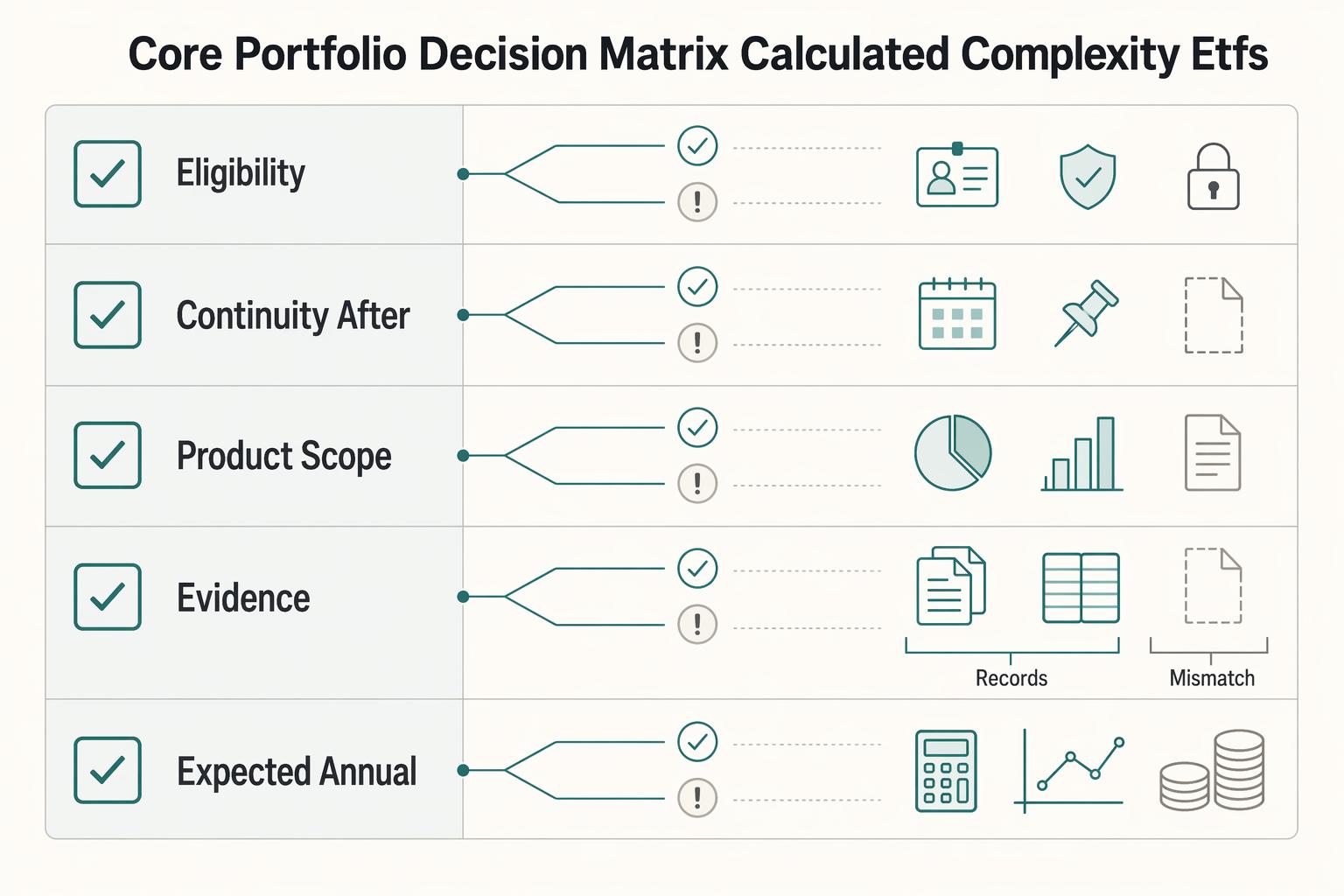
The real problem is a two-system conflict. U.S. tax treatment can punish the wrong fund choice, while local product-access constraints can block the funds you want to buy in the first place. For **us expat ucits etfs**, the practical question is not "Which product is best?" It is "What can I access, report, and keep doing every year without guessing?" Use this four-part filter before any trade: