
Quick Answer
Give each dispute one owner, its actual provider deadline, and a reason-specific evidence checklist. Decide whether to defend, accept, or escalate using evidence quality and expected recovery. An internal blocker does not stop the external deadline. Keep inquiry and chargeback responses distinct, and close the case only after provider outcomes and financial postings reconcile.
How to handle payment disputes as a platform operator using ownership, clocks, and ledger checks#
Payment disputes create operational and financial risk early, not just later as a finance line item. For a platform operator, the exposure is not only the disputed amount. It is also the labor to work the case and the drag from slower resolution when cases move across multiple parties and platforms.
A payment dispute is a formal claim from a cardholder or issuing bank about a payment. A chargeback is a dispute where a cardholder questions a payment with their issuer. Representment is the process of contesting a chargeback to recover funds. These distinctions matter because unclear terminology can blur ownership across Product, Support, Finance, and Payments Ops.
The cost goes well beyond fees. Disputes consume operational resources, and resolution often spans multiple platforms. In practice, the flow usually includes issuer, acquirer, and merchant handoffs, which can increase processing time and make deadline management harder.
Start by verifying liability in your own setup. In Stripe Connect marketplace configurations, the platform is in the end liable for chargebacks and related costs for both destination charges and separate charges and transfers. If your team still treats disputes as a merchant-only issue, fix that before you design queues, rules, or automation.
A costly failure mode is delay paired with weak evidence. Missing evidence deadlines can lead to an automatic chargeback loss. Contested disputes can also take two to three months, so aging backlog is an operational risk, not a cosmetic metric.
Verify the basics first#
Before you optimize anything, confirm three things in your environment:
| Check | What to confirm |
|---|---|
| Liability location | Whether your platform, your merchant, or both absorb chargeback losses and related costs |
| Deadline source | Where evidence deadlines appear, who sees them, and whether those deadlines are tracked in your own tools or only in a provider console |
| Case trail | That each dispute ties back to the original transaction and the records needed for representment when appropriate |
If these basics are unreliable, extra tooling usually helps you process confusion faster, not resolve it better.
This guide is for platform operators who need practical choices, not theory. The next sections move through the decisions in order: define ownership, set evidence standards, choose where automation helps, and keep human judgment where conceding, contesting, or escalating changes the outcome.
Related: What Is Dunning? A Platform Operator's Guide to Recovering Failed Recurring Payments.
Define the dispute terms and who owns each decision#
Lock down language and ownership first. Use one dispute vocabulary and one accountable owner for each decision so cases are routed and handled consistently.
- Standardize the terms in writing
Use scheme-grounded definitions for external dispute events, then label internal finance terms as internal. A payment dispute or chargeback starts when a cardholder questions a payment and the issuer initiates a formal dispute. Representment is contesting that chargeback to recover funds. Treat write-off and recovery as internal accounting labels, not universal scheme definitions. Verify this by aligning the terms across support macros, finance close notes, and dispute-tool field labels.
- Assign one accountable owner per decision
Split ownership across merchant support, issuer-facing ops, and acquirer-facing ops, since issuer and acquirer workflows both participate in formal filings and document exchange. In RACI, keep exactly one accountable owner for each task. A practical split is merchant support for seller notification and evidence intake, issuer-facing ops for dispute intake triage, acquirer-facing ops for filing and document submission, and one named approver for the final accept-or-defend decision. Each case record should show the current owner for intake, evidence approval, and final decision.
- Name one escalation owner for scheme-rule exceptions
Assign an escalation owner for changes to scheme rules, submission requirements, and monitoring programs. Keep the effective rule version with each case and update templates through the acquirer or provider. A merchant response deadline and an issuer filing window serve different purposes.
Need the full breakdown? Read How Platform Operators Should Plan PCI DSS Level and Cost.
Gather prerequisites before you touch the first queue#
Before you process live disputes, make sure every case has complete inputs, your evidence structure is reusable, access is tested, and internal SLA targets are set against known external clocks.
Build a minimum case file for every dispute#
Start every case with one baseline packet before deciding to concede or file representment:
- transaction timeline in chronological order
- customer communications
- fulfillment proof, delivery or access
- refund history
- provider transaction and dispute financial references from your merchant stack
Keep the timeline first in your internal view: authorization, capture, fulfillment or access, customer contact, refund attempt, dispute notice. If analysts have to reconstruct this across multiple tools, cases are harder to review consistently as volume rises.
Do not use one evidence standard for every reason code. Evidence needs vary by dispute reason, and fulfillment proof is central for service and subscription disputes. Include partial-refund history too, because the unrefunded portion can still be disputed. Review recent chargebacks and confirm each can be understood from the case file alone.
Standardize the evidence folder before the first submission#
Use one consistent top-level folder spine across dispute types, then add reason-specific checklists inside it.
Suggested top-level sections:
- receipts and order records
- customer communications
- policies and terms
- system logs
- fulfillment artifacts
- provider references
This gives you reuse and auditability without pretending every reason code needs the same documents. Keep the layout standard, but keep the requirements reason-specific.
Do not file early with an incomplete pack. Some flows allow one submission only, with no edits or supplemental evidence after filing.
Confirm access, permissions, and event visibility#
Test permissions before analysts touch the queue. Access to accepting disputes and submitting evidence is often role-gated.
Minimum access to validate:
- dispute console
- transaction and dispute financial records
- document upload paths
- webhook and event logs for async updates
Status updates arrive asynchronously and can be redelivered. Test authenticated event receipt, durable capture, retries, and recovery of missed events for each provider, then record which role owns failures.
Set internal SLA targets before volume forces bad habits#
Set internal SLA targets now, because external timelines differ by scheme and reason context. A single vague "respond quickly" target is not enough.
| Clock | Use |
|---|---|
| Provider response deadline | Latest time to submit the case response; record timezone and submission buffer |
| Internal work target | Earlier intake, retrieval and review checkpoints; blockers do not extend external time |
| Issuer filing window | Whether an issuer may initiate the dispute; distinct from your response time |
Set separate intake, evidence, approval, and submission targets backward from the actual provider deadline, with a buffer for retrieval and review. Issuer filing windows do not give your team extra response time.
Map the lifecycle from first alert to final ledger impact#
Turn your dispute process into explicit states with clear ownership, clocks, and ledger checkpoints. If cases sit in a vague "open" bucket, deadlines can slip and reconciliation work can pile up for Finance.
Define internal states and clocks#
Define your internal states even when providers use different labels. One practical internal operating model is intake, triage, evidence collection, review, submission, ruling, and post-resolution write-off or recovery. Treat this as your operating sequence, not a universal provider sequence.
For each state, store four fields in the case record:
- owner, one team or role
- entry trigger
- exit condition
- SLA clock rule
Clock rules need to reflect real provider deadlines. On Stripe, response deadlines are usually 7 to 21 days by network, and missing the deadline means you automatically lose the dispute.
Attach provider status signals to each state so analysts can act without guessing:
- Stripe: Dashboard, email, webhooks, and API notifications
- Finix: response states like
NEEDS_RESPONSEto indicate required action - Primer:
DISPUTE.STATUSwebhook on every status or type change
Sample five recent cases and confirm each has a clear alert source, current state, single owner, and active clock.
Set clock rules and blocker codes#
Store the provider’s deadline and timezone as soon as the notice arrives. An incomplete notice or broken intake record should trigger escalation immediately; it does not postpone the external clock. Set internal work targets separately and track blocked cases against the remaining response time.
Use internal blocker reasons, for example:
- missing transaction reference
- missing customer communication history
- missing fulfillment proof
- unclear liability owner
- webhook received but no internal case created
A blocker code and next check date can track internal work, but must never pause or extend the provider deadline. Alert before the case reaches its submission buffer even when evidence is still missing.
Separate operational close from financial close#
Close disputes in two stages: operational close at ruling, then financial close after ledger reconciliation. Provider case status alone is not enough.
On Stripe, disputed funds are typically withdrawn immediately and returned only if the case is resolved in your favor, and Stripe also debits the dispute amount plus a dispute fee at creation. That creates financial impact before the ruling.
Map each provider outcome to ledger events:
- Stripe: match dispute reference to initial debit, dispute fee, and any recovery
- Finix: confirm the funds pull appears as a
MERCHANT_DEBITtransfer where applicable
This matters because issuer decisions can take 60-75 days after evidence submission, and full dispute lifecycles can run 2 to 3 months. Reconcile yesterday's dispute creations and resolutions against ledger entries, and route unmatched items into post-resolution review.
Use a handoff matrix for cross-team exceptions#
Use an internal handoff matrix so Support, Finance, and Engineering route missing-data issues differently from fraud-risk decisions.
| Trigger | Primary owner | Secondary owner | Next action |
|---|---|---|---|
| Missing delivery or access proof | Support | Engineering | Support requests fulfillment artifacts; Engineering joins only if logs are missing or inaccessible |
| Provider alert received but no internal case or broken webhook trail | Engineering | Finance | Engineering restores event capture and backfills case creation; Finance holds manual posting until references are complete |
| Disputed funds or fee posted but no matching case | Finance | Support | Finance reconciles ledger impact; Support adds customer context and evidence links |
| High-confidence fraud pattern with weak customer legitimacy | Finance or Risk owner | Support | Concede or escalate under fraud policy instead of forcing weak representment |
If you use Stripe Connect, include one explicit ownership rule in the matrix: charge type plus negative-balance responsibility determines who responds to the dispute. Test one dispute per supported charge type and confirm the responder of record and debit responsibility match the matrix.
Set decision rules for fight, concede, or escalate#
Once each case has a state and a clock, make the response rule-based, not analyst-by-analyst. Fight only when the reason code, evidence quality, and time remaining support representment.
Build a default decision table by reason code#
Build a reason-code decision table and make it the queue default. Defend-versus-accept should follow the dispute reason code and evidence readiness, not whoever picked up the case.
| Case pattern | Default action | Why | Verification point |
|---|---|---|---|
| Reason code is defensible and compelling, relevant evidence is already available | Fight | Defend only when sufficient compelling evidence exists | Case record shows reason code, evidence checklist, and submission owner before review |
| Transaction value is low relative to handling effort | Concede fast | Some disputes are not worth the evidence effort | Record includes value, estimated handling effort, and concede reason |
| Evidence does not meet defense requirements, or key proof is still missing late in the clock | Concede unless manually approved | Late evidence can become un-submittable, and weak files consume effort without improving odds | Missing document is named explicitly, not hidden under "needs review" |
| Case needs nonstandard data collection, raises privacy or compliance concerns, or falls outside policy | Escalate | Evidence collection must stay within privacy and legal limits, and the issuer decides the final outcome | Escalation owner and decision deadline are attached to the case |
Keep the table short enough to apply in under a minute.
Review missing evidence before deadline pressure#
Choose a review checkpoint well before the actual response deadline. Use the provider’s case-specific clock rather than a generic merchant or issuer window when deciding how long evidence retrieval can continue.
At that checkpoint, assess the missing evidence, realistic retrieval time, expected recovery, and handling cost. Accept cases that cannot support a defense; keep viable retrieval work moving within the remaining deadline. An arbitrary midpoint alone should not decide the outcome.
Be explicit about what "incomplete" means. Require analysts to name the missing document and the last realistic retrieval date.
Score fightable cases to focus effort#
Use a confidence score to prioritize effort across fightable cases. The issuer decides the final ruling, so the score should guide resource allocation, not suggest control over the outcome.
Use one consistent score model tied to:
- reason-code fit
- payment method
- evidence availability and relevance
- cost relative to likely recovery
Use provider eligibility or prioritization signals as inputs to review, not guarantees of recovery. The evidence still needs to address the actual reason code and claim.
Create a narrow exception lane#
Separate policy exceptions from standard handling. Create a narrow, visible override path for relationship, precedent, or brand-risk cases so exceptions do not break queue discipline.
Use one exception label, one approver role, and one required note explaining why the case sits outside normal policy. Route legal or compliance review through this same exception lane when evidence-collection scope is sensitive.
Watch for false-economy behavior#
Track false-economy behavior weekly. Fighting weak cases can consume resources with little expected recovery, especially when evidence does not meet defense requirements.
Review weak-evidence cases that stayed open late and were still defended. If that pattern grows, investigate missing records, retrieval delays, and decision ownership. Move evidence review earlier so analysts can distinguish viable retrieval work from files that cannot support a defense before deadlines tighten.
For broader benchmarks, see State of Platform Payments: Benchmark Report for B2B Marketplace Operators.
Build evidence standards that survive issuer scrutiny#
Treat evidence quality as a gate, not a cleanup task. A defensible case is a reason-code and scheme-specific packet that is readable on first review and does not introduce PCI or privacy risk.
Create separate templates by reason and scheme#
Use separate evidence templates by dispute reason and scheme, not one generic packet. Reason codes determine what proof matters, and representment is the acquirer response to a first chargeback, so templates should match both the dispute category and the submission path.
Split each template into mandatory and optional fields. Keep mandatory fields focused on the transaction timeline, customer communications, and reason-code-specific proof such as active acceptance of terms at checkout. Use optional fields to add context without blocking submission when required files are complete.
Before marking a case ready, record its reason code, scheme, required documents, and each file’s source. For Visa Compelling Evidence 3.0, use a separate branch for eligible Visa10.4 card-absent-fraud cases and follow the current provider eligibility checks rather than hard-coding an incomplete historical rule.
Check proof quality before submission#
Run proof-quality checks before final submission. Issuer review is easier when evidence is chronological and readable without interpretation.
Verify these four items every time:
- timeline consistency across transaction and support records
- customer consent trail, such as checkout proof showing active acceptance of terms
- artifact quality, with readable text and clear images
- refund and resolution attempts, supported by processor logs and merchant account statements, not narrative alone
This is a common failure point. Mismatched dates, unreadable screenshots, or missing consent records can weaken the file, and some consumer dispute flows require documented prior resolution attempts with the business.
Store evidence with traceability and data controls#
Store evidence to protect data and preserve traceability. Use PCI DSS as the baseline control: minimize stored card data, mask or truncate printed card data, and do not retain card verification codes after authorization.
Create redacted sharing copies while retaining permitted originals under restricted access and a retention policy. Track file identity, uploader, timestamp, case reference, and redaction version. Do not include prohibited card verification data in either copy.
Turn failed submissions into structured feedback#
Convert failed submissions into structured feedback. Define standard reject reasons in internal QA before anything is sent to the acquirer.
Check the provider’s current file-size, page-count, and submission rules before filing. Stripe allows one final evidence submission, so correct draft files before that point. Record internal QA rejection reasons without treating every provider’s draft-editing workflow as identical.
Use one verification check: every rejected packet must produce one structured reason, one owner, and one template or training action. If the same reject reason repeats weekly, fix the template or the upstream data capture.
Related: How Platform Operators Control Employee Expenses with Automation.
Choose tooling with a buy-build decision table#
Choose tooling based on operational fit, not demos. Use PSP-native tools when most dispute volume sits with one PSP. Use specialist SaaS when you need faster rollout with prebuilt workflows. Build internally when control over logic and data handling is worth the engineering ownership.
Compare the three realistic tooling paths#
Map the three realistic paths before vendor calls, then compare them on the same criteria.
| Path | Integration depth | Evidence automation coverage | Rule flexibility | Analyst override and reporting | Commercial watch-outs |
|---|---|---|---|---|---|
| PSP-native tools | Deep in that PSP environment | Can automate key dispute tasks for eligible cases | Bounded by provider controls | Varies by provider workflow and fields | May include per-transaction fees and, for platform setups, connected-account fees |
| Specialist SaaS | Can be lighter initial integration, depending on connectors and enrichment inputs | Prebuilt workflows can reduce manual assembly work | Varies by product and plan | Override controls and reporting depth vary widely | Subscription or usage pricing, plus portability and lock-in risk |
| Internal tooling | Defined by what your team builds and maintains | Depends on your own data capture, mapping, and submission flows | Highest direct control | Highest control if properly staffed | Highest build and maintenance burden |
Stripe is a clear PSP-native example. Smart Disputes automates evidence collection, compilation, and submission for eligible card disputes, and can auto-submit before timeout if no one takes action. Stripe also states outcomes are not guaranteed because the issuer makes the final decision. For marketplace flows, Stripe states the platform is in the end liable for chargebacks and related costs for destination charges and separate charges and transfers.
Score tools on day-to-day operating impact#
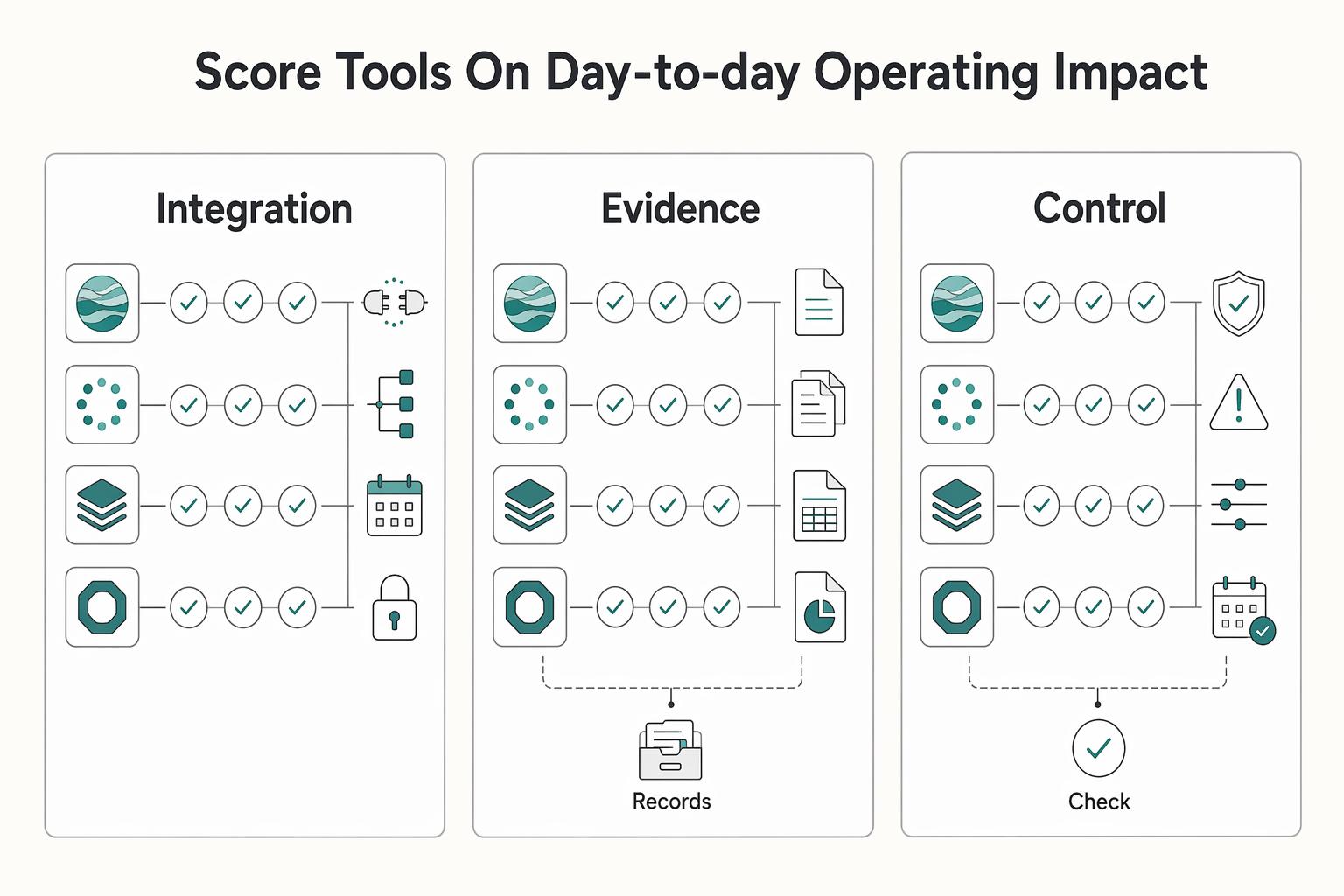
Score each option against day-to-day operating impact with five checks:
- Integration scope: confirm the tool handles merchant/acquirer dispute responses for your charge types, rather than issuer-side cardholder claims.
- Evidence coverage: use sample closed cases to see what is collected automatically and what an analyst supplies.
- Rule controls: separate preventive fraud rules from accept-or-defend and evidence-routing rules.
- Analyst override: confirm permission, cutoff timing, and audit records for changes to automated handling.
- Reporting: verify case deadlines, submission receipts, outcomes, and financial references can be exported.
Pressure-test commercials before commitment#
Get commercials in writing before you commit. Confirm:
- implementation effort, including API work, data mapping, and QA on evidence output
- expected analyst workload after go-live
- data export rights for case history, evidence files, and rule configuration
- cost and staffing impact if dispute volume doubles
Price fraud prevention and dispute response separately. Transaction screening, evidence automation, submission fees, and SaaS or internal staffing costs have different triggers. Compare the total costs for your expected case mix and confirm export rights before choosing tooling.
For a step-by-step walkthrough, see What Is Vendor Management? A Platform Operator's Guide to Supplier Lifecycle Control.
Wire events and retries so automation does not create accounting errors#
Treat dispute events as accounting inputs, not just queue updates. Duplicate deliveries and delayed callbacks are normal, so build idempotency and reconciliation into the core flow.
Enforce idempotency before any posting or case change#
Deduplicate deliveries using provider event IDs scoped to the correct account, and make each business update and posting idempotent. Claim processing work atomically; an event recorded as received is not necessarily processed. Retrieve current objects when needed so delayed events cannot reverse newer case state.
Test concurrent duplicates, a crash after persistence, out-of-order updates, and replay after partial processing. Confirm one intended business transition and no duplicate journal effect, while preserving the separate debit, fee, and recovery postings a dispute can legitimately create.
Accept fast, persist first, reconcile later#
Authenticate the webhook using the provider’s signature scheme, then durably store it or enqueue it before returning success. Perform slower processing asynchronously. If durable capture fails, return a retryable failure rather than acknowledging an event you may lose.
For Stripe dispute flows, events such as charge.dispute.created can arrive before your internal case has full context. Persist first, retrieve missing objects by API, then reconcile internal case state against ledger outcomes before closure. Your verification rule is simple: every resolved dispute has a matching internal status and matching accounting result, with no orphaned case and no orphaned journal entry.
Monitor stale states and retry storms#
Monitor provider-specific redelivery windows and your own catch-up process. Stripe can resend undelivered events for up to three days; other providers differ. Keep durable processing records and reconciliation checks so a retry window ending does not silently close an unresolved gap.
Monitor two signals:
- cases stuck waiting for provider updates beyond your expected window
- spikes in redeliveries for the same event type or endpoint
If retries bunch during an outage, slow your own retry pressure instead of increasing it and making recovery harder.
Related: What Is AP Automation? A Platform Operator's Guide to Eliminating Manual Payables.
Run a weekly governance rhythm with KPIs that drive action#
Weekly dispute governance should be decision-first, not reporting-first. Run one weekly review with a short KPI pack, and require each metric to trigger a clear action. Anything that does not drive staffing, rules, product, or evidence changes belongs in a monthly appendix.
Lock KPI definitions before reviewing trends#
Lock KPI definitions first so weekly trends stay trustworthy. Track new disputes, open backlog including SLA-breached cases, outcomes to dispute submissions, average closing time, and dispute write-offs, then add one exposure metric for leadership: dispute rate or dispute activity, labeled correctly.
Keep the distinction clean: dispute rate is disputes on successful payments by charge date, while dispute activity is by dispute date. Include a deadline lens in backlog reporting, because response windows are usually 7 to 21 days after notification and missing evidence deadlines can lead to automatic chargeback loss. Each week, reconcile new-case counts to provider intake and reconcile write-offs and dispute outcomes to the ledger.
Segment the metrics before diagnosing performance#
Segment before you diagnose performance. Review metrics at least by payment method and country. Where possible, add card brand and reason code.
This avoids false conclusions, because dispute exposure is not the same across payment methods. Reason codes vary by brand and can vary by region or network, so segmentation helps you isolate whether the issue is queue execution or a specific policy, onboarding, UX, or evidence gap.
Tie each KPI to a named decision#
Map every KPI to one named decision so the meeting ends with execution, not commentary.
| KPI | Decision it should trigger |
|---|---|
| Open backlog (including SLA-breached cases) | Temporary staffing change, queue reprioritization, or faster concede rules for weak cases nearing deadline |
| Outcomes to dispute submissions | Evidence template revision or tighter fight criteria by reason code |
| Average closing time | Tooling or handoff fix when cases stall |
| Dispute write-offs and related costs | Product, fraud, or merchant policy review when losses stay high |
| Dispute rate or dispute activity | Review the relevant provider or scheme measure against its current region/program thresholds |
Interpret outcome trends using resolved cohorts, since issuer decisions and new dispute arrivals can lag the original payment. Keep the actual reason-specific filing and response windows with the analysis rather than assuming one universal arrival cap.
Split dashboards for leaders and operators#
Use separate dashboards for leaders and operators. Keep the exec view narrow: new-dispute trend, dispute rate or activity, dispute write-offs and related costs, SLA-breached open cases, and the highest-activity segments.
Use the operator view for queue control: aging buckets, open urgent cases, average closing time, evidence-submission performance, and slices by payment method, region, card brand, and reason code. End each review with an owner and due date per decision, then confirm at the next review whether each KPI movement ties to a completed action, a deliberate hold, or a documented data issue.
Execute the first 90 days without overbuilding#
Treat the first 90 days as a stabilization sequence, not a tooling sprint. Automating messy intake before ownership, deadline tracking, and evidence quality are reliable is how control breaks down.
Days 0 to 30. Stabilize intake first#
In days 0-30, stabilize intake first because outcome feedback lags and deadlines do not. Disputes can take 30-90 days to resolve, while response windows can be much shorter, often 7-21 days depending on network and flow.
For each new case, require one owner, one due date, one current state, and one baseline evidence pack for your top dispute categories. A practical baseline often includes transaction timeline, customer communications, fulfillment proof, refund history, and provider reference so the first representment submission is usable.
By day 30, spot-check recent cases and confirm you can answer quickly:
- Who owns it?
- When is evidence due?
- What is still missing?
- Does internal case status match provider status?
If those answers are inconsistent, do not expand automation yet. Early submission quality matters because some flows allow only one submission and may not allow supplemental edits.
Days 31 to 60. Add fight and concede rules, then automate only clear data pulls#
In days 31-60, implement explicit fight and concede rules, then automate only the data pulls that remove obvious manual drag. After a chargeback, the branch is clear: accept it or defend it.
Do not defend everything. Booked chargebacks can carry fees, and weak cases consume analyst time without improving recovery. Start with reason categories where evidence quality is repeatable, keep exceptions narrow and named, and prevent one-off overrides from breaking queue discipline.
If volume is growing, move from console-only handling toward API- and webhook-driven intake. High-volume handling is better suited to API-based processing, and webhook events are a documented way to track status changes. Each intake event should create or update exactly one internal case, with provider reference or event code stored for auditability.
By day 60. Reconcile operations and finance together#
Before you add advanced routing, put reconciliation in place by day 60. Disputes affect both operations and finance: chargebacks can debit the payment amount plus a processing fee, and successful defenses can return funds.
By day 60, reconcile on a schedule:
- provider outcome
- internal case state
- ledger posting
If provider outcomes and ledger effects do not match, fix that gap before adding routing complexity.
Days 61 to 90. Optimize routing with measured outcomes#
In days 61-90, optimize routing and tool decisions using measured outcomes, not vendor claims. Prioritize by deadline risk, evidence completeness, and observed win/loss history by category.
If a segment keeps losing despite timely handling, tighten concede rules there and reallocate analyst time to cases where evidence changes outcomes. Make vendor or build decisions only when your baseline is stable across backlog aging, evidence-submission completeness, reconciliation accuracy, and analyst touch time per case.
Add a monthly stop-go gate alongside weekly governance. Visa evaluates dispute and fraud performance monthly, and entities above thresholds can be required to implement mitigation measures. Internally, if backlog aging worsens in any monthly check, pause new automation scope and fix data quality first. Monitoring programs do not depend on whether some disputes are eventually won, and your build sequence should not either.
Related reading: How to Build a Global Accounts Payable Strategy for a Multi-Country Platform.
Before expanding automation scope, map your dispute lifecycle to idempotent events and ledger reconciliation patterns in the Gruv docs.
Avoid the mistakes that make dispute programs fail#
Once your baseline is stable, many dispute programs break down in four places: weak prioritization, premature staffing cuts, thin KPIs, and unclear ownership. Fix those before adding more automation.
Do not prioritize all chargebacks the same way#
Do not treat all chargebacks as equal priority. Route by deadline risk and evidence readiness, because dispute categories require different evidence and response handling, and response windows are usually 7 to 21 days depending on the card network.
Use a fast queue check: in a sample of open cases, confirm each has one due date, one dispute category, and one evidence status. Missing the response deadline is a hard failure because you automatically lose the dispute and cannot recover the funds.
Do not cut analyst capacity too early#
Do not assume SaaS adoption immediately reduces analyst capacity. Tooling can help collect and submit evidence, but your team still decides whether to accept or challenge each case, and the issuer bank still decides the outcome.
Keep overlap staffing until manual exception work is consistently low. If analysts are still cleaning evidence, reassigning ownership, or resolving duplicate cases after go-live, you have shifted work, not removed it.
Do not run the program on win rate alone#
Track wins, losses, fees, and recoveries alongside dispute-rate exposure. A successful defense does not automatically remove the dispute from provider or scheme monitoring. Use the actual filing rules for each case rather than a universal post-payment cutoff.
Keep provider dispute activity, charge-date dispute rate, and scheme monitoring measures separate. Apply the current thresholds for the relevant network, region, and program rather than carrying one percentage across them.
Do not leave ownership ambiguous#
Do not leave ownership ambiguous between merchant support and finance ops. Assign one accountable owner for each lifecycle stage, especially for the accept-or-challenge decision.
Document ownership for intake, evidence approval, submission, and reconciliation, and confirm liability setup on connected accounts so it is clear whether the platform or the connected account responds. If current ownership is unclear, that case is already at risk.
Conclusion#
Your edge is disciplined operations, not a single tool. Clear ownership, explicit fight-or-concede rules, reliable evidence, and deadline control matter more. For each case in NEEDS_RESPONSE, your team should know immediately who decides, what evidence is required, and how the ledger changes if you lose, concede, or recover.
- Define dispute terms and owners across your core teams.
Use one shared dispute glossary and assign a named owner for each decision point. Validate this with recent cases: each one should show an intake owner, a fight-or-concede owner, and an escalation contact. If disputes sit in unrelated queues, decisions slow down and outcomes can degrade.
- Publish lifecycle states with response clocks, blockers, and escalation paths.
Map intake, triage, evidence, submission, ruling, and reconciliation to provider states. Keep the actual response deadline visible through blockers and inquiries. If an inquiry escalates to a formal dispute, confirm the new response requirements and submit again where required.
- Implement fight, concede, and escalate rules with evidence quality gates.
Write the rule down so analysts are not relying on instinct alone. Defended cases should include the evidence pack submitted; conceded cases should record why they were accepted. The operational goal is simple: strong files get worked on time, weak files do not consume deadline capacity.
- Choose tooling with a buy-build table, not vendor promises.
Evaluate tools on operational fit: deadline visibility, evidence collection support, analyst override controls, and outcome data for reconciliation. Automation can help execution, but your team still has to evaluate each dispute and choose the response. If a tool cannot show the full flow from alert to evidence submission to ledger outcome, treat it as unproven.
- Reconcile every dispute outcome to ledger impact and a regular KPI review.
A case is not done when a provider marks it closed. Confirm dispute debits and recoveries match settlement and internal loss reporting. Review a KPI set on a regular cadence, for example weekly: new disputes, backlog aging, response timeliness, evidence completeness, handling time, and net loss after recovery.
- If useful, reassess at day 30, 60, and 90 before scaling automation scope.
Use these checkpoints as operating reviews, not a universal standard. At day 30, verify ownership and state discipline; at day 60, test whether fight and concede rules reduce avoidable work; at day 90, decide whether more automation is justified. If aging or reconciliation worsens, pause expansion and fix data quality first.
If you want a platform-specific review of dispute operations, payout controls, and audit readiness, talk with Gruv.
Frequently Asked Questions
What should a platform operator do first when payment disputes spike?
Start with triage, not new tooling. Check every open case for dispute category, response deadline, and evidence status, then review the response guidance for that category before building a defense. Validate that staff alerts are firing for new disputes, because missing a deadline can automatically forfeit the case.
Should we fight every chargeback or concede some quickly?
No. Defend disputes where you have sufficient compelling evidence, and concede when required defense documents are missing or do not meet defense requirements. Prioritize strong cases so they do not age into deadline failures while analysts work weak files.
When is third-party dispute automation worth it for a growing platform?
Automation is usually most useful when evidence collection, alerting, and submission handling are slowing response execution. If ownership is unclear or data quality is weak, tooling is less likely to help on its own. For Stripe users, Smart Disputes is built in with no extra integration, and Stripe Apps provides third-party dispute-management options.
Who should own dispute decisions: support, risk, finance, or payments ops?
Team names matter less than clear accountability. Assign one owner for the concede-or-fight decision and one owner for post-resolution reconciliation, with support, risk, and finance feeding required inputs. Keep final ownership explicit in marketplace setups, because the platform can be in the end liable for chargebacks and related costs.
Which weekly metrics actually predict dispute loss risk?
Track deadline aging, evidence completeness by reason category, handling time, and reconciliation accuracy. Pair outcomes with the relevant provider and scheme monitoring measures: a successful defense does not automatically remove a dispute from exposure. Keep dispute activity, charge-date dispute rate, and VAMP measures separate, with current region and program thresholds.
How do we decide between Stripe-native dispute tooling, an external SaaS, and internal tooling?
Separate payment-risk prevention from dispute-response operations before choosing a path. For lower implementation effort inside Stripe, start with Stripe-native dispute tooling like Smart Disputes; for broader vendor coverage, evaluate third-party apps; for custom routing and evidence workflows, use the Disputes API plus webhooks. Choose internal tooling only if your team can reliably handle webhook events and ledger reconciliation.
Try a related tool
Researched and edited by the Gruv editorial team. Gruv builds cross-border billing, payouts, and finance-operations software for global businesses.
Sources
Includes 2 external sources outside the trusted-domain allowlist.
- consumerfinance.gov/ask-cfpb/how-can-i-get-a-refund-on-a-product...trusted
- docs.stripe.com/disputes/respondingtrusted
- docs.stripe.com/connect/marketplace/tasks/refunds-disputestrusted
- it.cornell.edu/it-service-management/raci-and-rasci-definit...trusted
- stripe.com/guides/introduction-to-payment-disputestrusted
- stripe.com/resources/more/representment-explainedtrusted
- checkout.com/docs/payments/process-disputes/dispute-reaso...external
- developer.visa.com/capabilities/visa-resolve-onlineexternal
Educational content only. Not legal, tax, or financial advice.
Related Posts
IRS Form 1042-S for Platform Operators: How to Report and Withhold on Foreign Contractor Payments
If you own compliance, legal, finance, or risk for a platform paying foreign contractors, sellers, or creators, you may need to make **Form 1042-S** operational. That means clear decisions, reliable checks, and escalation points your team can apply and defend.
What Is Dunning? A Platform Operator's Guide to Recovering Failed Recurring Payments
Dunning management is an accounts-receivable process for recovering overdue balances. In recurring billing, it also covers failed-transaction notices and overdue-payment reminders. For platform teams, that means dunning is not an ad hoc email task. It is an operating process with clear triggers, owners, and end states.

State of Platform Payments Benchmark Report for B2B Marketplace Expansion
This article translates broad payments narratives into expansion decisions: where a B2B marketplace operator should launch first, what to delay, and what to validate before committing product and GTM budget in 2026.