
Quick Answer
For a platform operator, dunning is the failed-payment recovery process for recurring billing. It covers customer notices, retries where supported, subscription-state decisions, and case closure after a renewal or invoice payment fails. The process should be event-driven, replay-safe, and tied to clear ownership, entitlement updates, and audit-ready records.
Why Dunning Matters for Platform Operators#
Dunning management is an accounts-receivable process for recovering overdue balances. In recurring billing, it also covers failed-transaction notices and overdue-payment reminders. For platform teams, that means dunning is not an ad hoc email task. It is an operating process with clear triggers, owners, and end states.
When renewals fail or invoices go overdue, the risk is not just missed collections. It is also avoidable churn and cash-flow pressure when recovery is inconsistent. When recovery spans multiple teams, gaps appear unless responsibilities are explicit.
You see this cross-functional complexity most clearly in marketplace and embedded-payment models. When payment functionality sits inside your product, recovery becomes part of the product experience, not only a back-office process. In cross-border setups, feature availability can also vary by region.
This guide defines dunning for platform recurring payments, then lays out how to choose automation depth, where human review should stay, and which audit-ready controls to set before you scale. The goal is a traceable process: what failed, which message went out, what happened next, and how the case resolved.
This is especially relevant if finance, operations, and support share payment operations on your platform, particularly in marketplace and embedded-payment workflows.
This is operational guidance, not legal or tax advice. Policy choices, program coverage, and feature availability vary by market and jurisdiction. Even baseline definitions can differ across jurisdictions. Use this guide to improve recovery operations, then confirm market-specific requirements with legal, tax, and payments partners before you finalize policy.
For a step-by-step walkthrough, see How to Embed Payments Into Your Gig Platform Without Rebuilding Your Stack.
Define dunning in platform terms#
For a platform operator, dunning management is a failed-payment recovery workflow, not a single reminder. You detect a failed renewal, notify the customer, retry collection where your setup supports it, decide account state, and close the case with a clear outcome.
In plain terms, dunning is communication to collect due or past-due payments. In recurring billing, platform dunning is broader. It includes notifications, retry behavior, and policy decisions for a past-due subscription. That is why a failed auto-collection attempt affects more than messaging. It can also affect subscription billing and entitlements.
A single card-decline email is not enough. When renewal collection fails, a subscription can move to past due, and you may need to provision or de-provision access based on status. If recovery succeeds, billing should return to active and paid. If recovery attempts are exhausted, configured policy may pause or cancel the subscription.
A useful way to run it is as a control loop:
- Detect failure from asynchronous webhook events.
- Notify the customer and schedule the next retry or notice.
- Apply the expected subscription and entitlement state.
- Record the outcome and resolve the case.
Keep the loop replay-safe. If event delivery is retried, non-idempotent handling can duplicate notices or state changes, so use idempotency keys for retryable API calls. Define done explicitly: payment recovered or status definitively resolved, entitlements aligned, and internal records updated.
You might also find this useful: Build a Platform Dunning Campaign With Timing You Can Defend.
Separate dunning from retries and collections#
You will make better policy decisions if you separate retries, dunning, and collections. Retries re-attempt payment. Dunning typically manages customer communication and, in some systems, subscription-state handling through non-payment. Collections is a later receivables path.
| Function | Goal | Trigger | Owner | Customer tone | Stop conditions |
|---|---|---|---|---|---|
| Payment retries | Recover a failed charge with another attempt | Renewal or invoice payment fails and is still retryable | Billing provider or billing layer | Minimal unless authentication or payment-method action is needed | Payment succeeds, retry schedule ends, or failure is not retryable |
| Dunning | Recover revenue while managing notices and service-state decisions | Failed renewal creates past-due or unpaid status | Platform finance, product, and engineering; provider emails may be enabled | Clear, corrective, action-oriented | Payment recovers, payment method is updated, subscription state is resolved (for example canceled), or the case moves to receivables handling |
| Collections | Recover unpaid debt after normal billing recovery fails | Balance remains unpaid after retries and dunning, including after cancellation in some flows | Internal finance or ops, or a third-party debt collector | Formal and bounded | Paid, settled, written off, or transferred |
Provider automation and platform policy sit on different boundaries. In Stripe Billing, retries can run automatically, including Smart Retries timing, and failed-payment emails can be provider-sent when enabled. Your platform still owns entitlement and account-state policy, plus how webhook lifecycle outcomes map to support and operations.
Vendor labels are not equivalent, so decode them before you configure anything:
| Vendor language | What it usually covers |
|---|---|
| Stripe: "dunning" | Communication to collect due or past-due payments |
| Maxio: "Retries & Dunning" | Retry scheduling plus dunning workflow configuration |
| Paddle: "payment recovery" / "dunning" | Failed-payment recovery for subscriptions that move to past due |
| Zoho Billing: "dunning management" | Automated recovery that includes configurable retries and intervals |
| Revolv3: "dunning management" | Public terminology for failed-payment recovery; scope is not automatically identical to other vendors |
Use these escalation rules so you do not make the wrong move:
- If failure is a soft decline or another retryable path, prioritize automated retries first.
- Do not assume every failure is retryable. Hard-decline paths and missing payment methods are documented retry exclusions in Stripe.
- If failures continue across the retry window, escalate dunning communications and make an explicit service-state decision.
- If retries are exhausted and the balance remains unpaid, move to cancellation or to a separate collections or receivables track.
Map where recurring payments fail#
Dunning gets more reliable when you map failure points before you tune messaging. Treat recurring-payment recovery as a sequence of state changes, not a single charge result. Do not post final ledger journals as confirmed cash while the rail is still pending.
Follow the money and state transitions#
Start with the invoice and track each state change through to completion. In Stripe's documented flow, creating a subscription creates an invoice with status open. Stripe immediately attempts collection. A failed initial payment can move the subscription to incomplete, and a successful payment moves the subscription and invoice to active and paid. Stripe also documents about 23 hours for the first payment to succeed before expiry behavior in that path.
Track at least this operator trace:
- invoice or renewal attempt created
- collection attempted
- provider outcome received
- customer and subscription state updated
- accounting entry posted, or marked pending for reconciliation
For each failed or recovered attempt, keep a joinable record: provider reference, internal attempt ID, invoice ID, subscription ID, and expected journal reference. Without that, support, finance, and engineering can each end up with different versions of the truth.
Failure points change by billing model#
The failure pattern depends on the billing model and payment rail, so map both before you automate escalation.
| Model | Where it commonly fails | What to watch |
|---|---|---|
| Subscription billing | Immediate collection fails at first invoice or renewal | Check current invoice and subscription state, then confirm whether retry handling is still active. |
| Usage-based billing | Invoice amount can be wrong or incomplete before collection | Usage must be recorded to bill correctly, and Stripe notes meter events are asynchronous, so invoice-visible totals can lag recently sent events. |
SEPA Direct Debit | Payment can fail after creation | SEPA Direct Debit is a reusable, delayed-notification method. Stripe documents failures up to 6 business days after creation, and GoCardless calls out refusal and insufficient funds as common failure causes. |
Handle asynchronous truth through webhooks#
Do not treat synchronous attempt responses as final system truth. Stripe documents webhooks for asynchronous outcomes, and PayPal describes webhooks as HTTPS posts sent when events occur. In this setup, two controls matter:
- Assume duplicate webhook delivery and deduplicate by logged event IDs before side effects.
- Make downstream actions replay-safe with idempotency keys, or an equivalent unique command key, so retried handlers are less likely to duplicate retries, notifications, or journal actions.
Posting to ledger journals improves auditability because the ledger is immutable, but reconciliation visibility can still lag source events.
Ops checkpoint#
For every failed recurring-payment case, confirm all five are true:
- failure detected
- customer notified
- retry queued
- state updated
- reconciliation visible
If you want a deeper dive, read SEPA Payments for Platforms: Direct Debit Instant Transfer and Recurring Billing.
Choose automation depth by platform model#
If you process recurring renewals at meaningful volume, manual, inbox-led dunning usually does not scale. Start with event-driven webhooks plus a state machine, then tune retries and message cadence around that foundation.
Once outcomes can arrive asynchronously, be redelivered for up to 3 days, or arrive out of order in some stacks, manual handling becomes a data-quality risk, not just a staffing problem.
Match automation to payment ownership and team maturity#
Choose automation depth based on who owns payment responsibility and how reliably your team handles asynchronous events. Marketplace payments and embedded payments often need deeper automation earlier. With a Merchant of Record (MoR), you may still need reliable internal state for entitlement, support, and finance actions.
| Model | Manual | Hybrid | Full automation | Practical recommendation |
|---|---|---|---|---|
Marketplace payments | Viable only at low volume or for a narrow pilot. | Useful if you ingest provider events but require approval before suspension or seller-impacting changes. | Most practical once renewals are frequent or multi-party effects matter. Use webhooks, idempotent handlers, and state-machine retries and notifications. | Move off inbox-led handling early. |
Embedded payments | Usually too slow once payments are part of core product UX. | Strong interim setup: automate retries and notices, route exceptions to ops. | Common target state with in-product recovery, automated retries, and reliable status sync. | Automate customer-facing recovery paths first. |
Merchant of Record (MoR) | Sometimes workable at low scale, but weak as volume grows. | Often practical: combine provider-managed recovery with internal exception review. | Valuable when you need consistent internal entitlement and support behavior tied to outcomes. | Do not assume MoR removes the need for internal automation. |
Keep humans on exceptions, not on inbox triage#
Human review should sit on exceptions, not routine failed-payment processing. Keep manual review for:
- high-value accounts where automated restriction could cause churn or escalation
- repeated risk flags, especially where tooling supports a
reviewpath - ambiguous status, such as missing webhooks, conflicting events, or delayed payment outcomes
This matters because undelivered webhook events can be resent for up to 3 days, and some stacks do not guarantee webhook order. Final warnings or access changes should wait until you have reconciled the latest state.
Balance recovery speed with customer friction#
More automation can speed recovery, but it can also create false positives and unnecessary pressure if your cadence ignores delayed outcomes and review holds.
Providers note that overaggressive controls and false declines can frustrate customers and drive abandonment. The same risk shows up in dunning. A single escalating sequence for every failure may recover some revenue while damaging trust in cases that only needed a retry window or a short delay.
A practical rule is to automate the routine actions and gate the high-impact ones. Early failure notices can be immediate and clear. Later actions, such as service restriction, seller-impacting changes, or cancellation, should require a confirmed latest-state check.
Define "full automation" as controlled automation#
Full automation does not mean setting retries and forgetting them. It means event-driven, replay-safe handling with explicit state transitions. At minimum, put these controls in place:
| Control | Purpose | Detail |
|---|---|---|
| Webhook ingestion | Capture outcomes and identifiers | Ingest outcomes through webhooks and persist the provider event ID plus internal billing or attempt identifiers. |
| Idempotency | Prevent duplicate effects on replays | Enforce idempotency so replays do not duplicate notifications, retries, or ledger actions. |
| State machine | Choose next action explicitly | Use a state machine to choose next actions: retry, notify, pause, review, or close. |
| Human review routing | Hold unclear or sensitive cases | Route commercially sensitive or unclear cases to human review. |
Vendor defaults are a starting point, not policy. Stripe documents a recommended Smart Retries default of 8 tries within 2 weeks, while Paddle describes a default 30-day dunning period. Use them as baselines, then tune by model, rail, and customer impact.
Related: Airline Delay Compensation Payments: How Aviation Platforms Disburse Refunds at Scale.
Design the retry and communication sequence#
A fixed, staged flow cuts down on ad hoc reminders. Failed-renewal recovery should move through explicit steps that your team can verify. Use this sequence template:
| Stage | Action | Detail |
|---|---|---|
| Trigger event | Start from the failed payment or invoice event in webhooks | Record the provider event ID, failure reason, and attempt_count if available, then apply state changes only after an ordering-safe check. |
| Immediate notice | Send a plain-language message right away | Tell the customer payment failed and that the next step is to update the payment method or complete payment. |
| Timed retries | Run automated retries on a defined schedule | Treat provider defaults as baselines rather than universal policy. |
| Escalation notice | Send a clearer impact notice if retries keep failing | State the exact action needed to avoid access changes. |
| Final state change | Move to the access or cancellation state defined by policy | Do this if the recovery window closes. |
| Recovery closeout | Restore normal subscription billing and close the recovery state | In Stripe flows, successful payment returns the subscription and invoice to active and paid. |
In practice, the sequence only works if you enforce a few rules. Start from webhook events, not inbox triage. Record the provider event ID, failure reason, and attempt_count if available. Apply state changes only after an ordering-safe check, for example using event occurred_at. If a retry succeeds, restore normal billing immediately. If failures continue, apply the access or cancellation state defined by your policy. If the decline is hard, stop retries until payment details are updated.
Keep ownership explicit, for example:
- Finance: policy, including retry window, unresolved criteria, and access-impact policy
- Product: customer UX, including message timing, content, update flow, and limited-access behavior
- Engineering: orchestration, including webhooks, idempotent writes, event persistence, and state transitions
Make every step verifiable:
- status transition logged
- retry reason captured
- provider reference, internal attempt ID, timestamp, and resulting state recorded
- evidence posted to your internal audit trail
This prevents a common failure mode: acting on stale or replayed events. Use ordering-safe webhook handling and idempotent write patterns so retries and replays do not create duplicate notices, duplicate restrictions, or duplicate closeouts.
Build audit-ready system behavior#
Treat failed-payment recovery as an evidence trail, not just a retry loop. Audit-ready behavior starts with provider events through webhooks, replay-safe mutating actions through idempotency keys, and committed outcomes posted to append-only ledger journals.
Document the contract, not just the code#
Your operating contract should define what enters the platform, how repeats are handled, and what becomes a permanent record. Webhooks are asynchronous HTTP callbacks, so the original charge API response is not enough to determine final payment or recovery state.
Build around two expected behaviors. First, duplicate webhook delivery happens, so persist processed event IDs and skip repeats. Second, acknowledge receipt before heavy logic where required. Adyen recommends acknowledgment first and marks delivery as failing if no response is returned within 10 seconds.
If you process before confirming receipt, replays can trigger duplicate downstream actions. Event-ID deduplication and idempotency keys are the controls that prevent this.
Make traceability reconstructable in one pass#
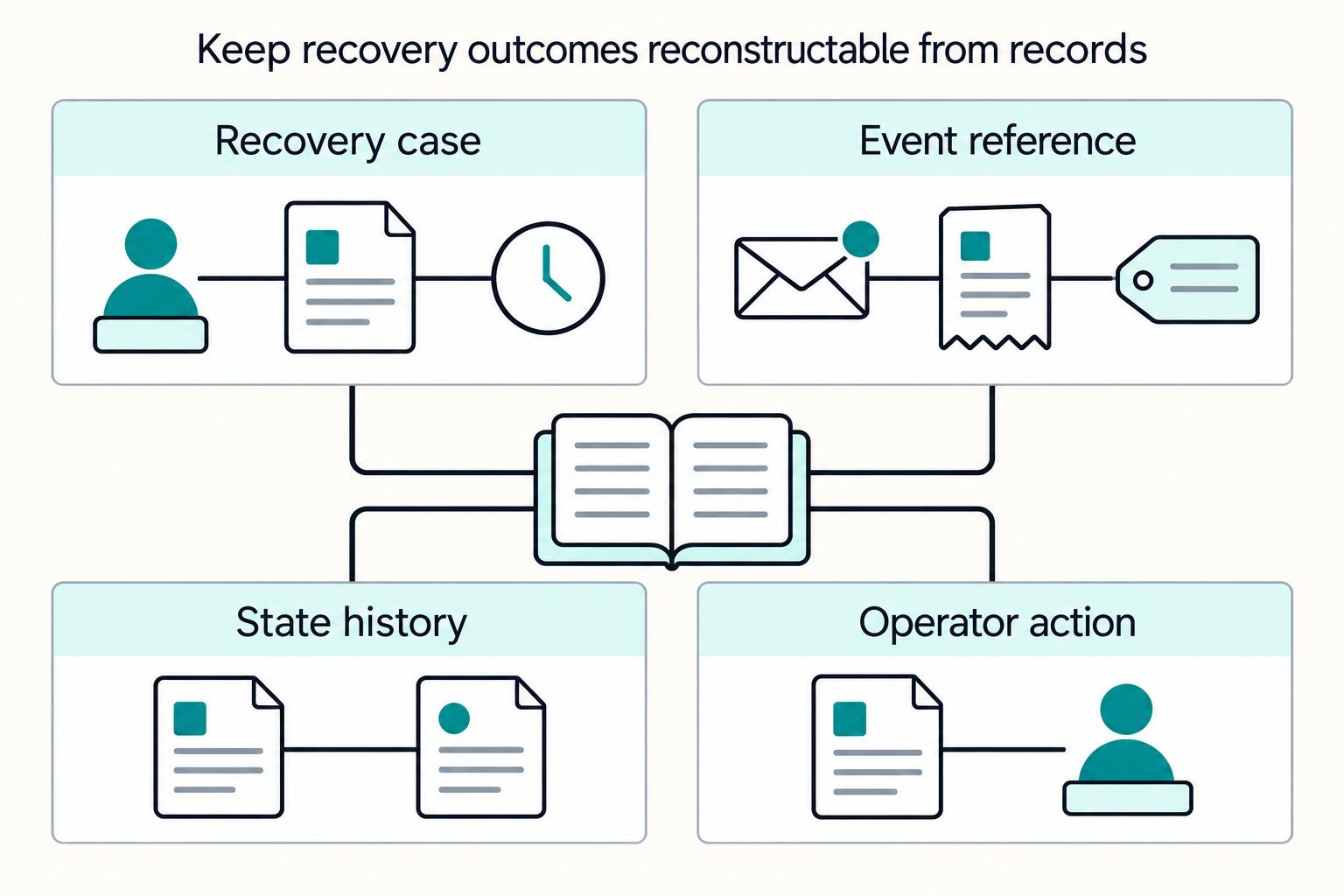
You should be able to trace one incoming event to one customer outcome without stitching guesses across systems. At minimum, store:
| Record element | Why it matters | Example source |
|---|---|---|
| Internal recovery ID | Groups your own recovery actions across retries and operator touchpoints | Platform-generated |
| Provider reference | Matches lifecycle events for reconciliation and audit | PSP reference |
| Event ID and request reference | Separates new events from replays and links cause to effect | Webhook payload, provider request field |
| State transition | Shows what changed and when | Failure recorded to recovery complete |
| Operator action log | Explains overrides, exceptions, and approvals | Internal audit log |
Use the provider reference precisely. Adyen uses a PSP reference as the transaction identifier, and Stripe event payloads can include a request identifier tied to the API request that caused the event. Stripe request logs also support operator and audit reconstruction.
Post the resulting financial state to ledger journals as append-only entries. Overwriting rows weakens your ability to prove what the platform knew at each step.
Tell finance where lag is expected#
Finance needs to know where lag is normal. With eventual consistency, recent writes may not appear immediately in read models, so wallet or balance screens can temporarily differ from source records.
Set the operating rule clearly: use source entries and journal postings to decide whether recovery is complete. Use derived balance views for monitoring, not as the sole trigger for suspension or reinstatement.
Set the minimum alerts before launch#
Define baseline alerts before go-live so intake failures do not look like customer non-payment:
- retries stuck in pending beyond your documented recovery window
- missing or failing webhook acknowledgments
- mismatches between payment state and journal state, such as a recovered status without the expected ledger closeout posting
Provider retry behavior makes these alerts necessary. Stripe can resend undelivered webhook events for up to three days, and Adyen retries three times immediately before queueing retries that can continue for up to 30 days.
Related reading: What Is Vendor Management? A Platform Operator's Guide to Supplier Lifecycle Control. Before rollout, map your webhook, idempotency, and reconciliation flow against the implementation patterns in the Gruv docs.
Set policy gates and compliance boundaries#
A recovered payment does not automatically clear regulated actions. Keep billing recovery and account eligibility as separate decisions, so success in dunning does not imply you can move funds, release payouts, or remove holds.
| Gate or control | What it covers | Boundary |
|---|---|---|
| KYC requirements | Can apply before connected accounts can accept payments and send payouts; requirements vary by business type, country, and requested capabilities | Recovered payment does not auto-release funds or re-enable payouts when verification is still pending |
| Beneficial-owner checks | Identify and verify beneficial owners of legal-entity customers | Do not auto-release recovered funds or re-enable payouts if verification is still pending |
| AML review | Risk-based due diligence and ongoing monitoring | Do not auto-release recovered funds or re-enable payouts if the account is under review |
| W-9 | Provides a taxpayer identification number for information returns | Not used for retry and service-state decisions |
| W-8BEN | Establishes foreign status when requested by a payer or withholding agent | Not used for retry and service-state decisions |
| FEIE / Form 2555 | FEIE is calculated on Form 2555 if the person qualifies | Not used for retry and service-state decisions |
| FBAR | Can apply when aggregate maximum foreign account values exceed $10,000 during the calendar year | Not used for retry and service-state decisions |
| Form 1099-K | Card and third-party network transactions are reportable under IRS rules | Not used for retry and service-state decisions |
| Required tax information | When enabled in certain programs, missing required tax information can disable payouts at 600 USD in charges if required data is not collected and verified | This is a tax-reporting gate, not a dunning rule |
| VIES / VAT validation | VIES is a search engine over national VAT databases, and procedures vary across EU countries | Use VAT checks for tax handling where supported, not as a proxy for whether failed payments should enter recovery |
Recovery can succeed while payouts stay blocked#
In platform and connected-account models, this separation is critical. KYC requirements can apply before connected accounts can accept payments and send payouts, and requirements vary by business type, country, and requested capabilities. Keep those caveats explicit in policy text: where supported, when enabled, and coverage varies by market or program.
Apply the same boundary to beneficial-owner checks and AML review. Beneficial-owner controls focus on identifying and verifying beneficial owners of legal-entity customers, while AML programs rely on risk-based due diligence and ongoing monitoring. Your dunning flow should not auto-release recovered funds or re-enable payouts if verification is still pending or the account is under review.
A common failure mode is a successful renewal paired with a still-blocked payout account. Billing may return to active while the seller or contractor remains blocked because verification data is missing. Put a verification checkpoint between payment recovered and any money-movement action, and avoid customer messaging that implies full restoration when policy gates still apply.
Tax and reporting controls are adjacent, not substitutes#
Tax and reporting controls are separate from dunning logic. VAT validation, W-8BEN, W-9, FEIE, FBAR, and Form 1099-K serve tax, withholding, or reporting purposes, not retry and service-state decisions.
Form W-9 provides a taxpayer identification number for information returns. Form W-8BEN establishes foreign status when requested by a payer or withholding agent. FEIE is calculated on Form 2555 if the person qualifies. For U.S. persons, FBAR can apply when aggregate maximum foreign account values exceed $10,000 during the calendar year. Card and third-party network transactions are reportable on Form 1099-K under IRS rules.
These controls do not decide whether to retry a failed renewal, send reminders, or suspend service. They can still block adjacent outcomes. For example, when enabled in certain programs, missing required tax information can disable payouts at 600 USD in charges if required data is not collected and verified. That is a tax-reporting gate, not a dunning rule.
VAT validation has the same boundary. VIES is a search engine over national VAT databases, not a universal source of truth, and procedures vary across EU countries. Use VAT checks for tax handling where supported, not as a proxy for whether failed payments should enter recovery.
What to confirm before launch#
Before launch, confirm these controls are explicit and owned:
- legal and policy sign-off on where recovery stops and where human review is required
- documented exceptions for regulated edge cases, including pending verification, beneficial-owner review, and tax-data holds
- a named escalation owner for accounts that are billing-recovered but still blocked from payouts or other regulated actions
- customer messaging that does not promise payout release unless verification and tax conditions are actually cleared
- operator checks that log the exact block reason, such as missing W-9, pending verification, or market-specific VAT limitations
Use one default tie-breaker: when payment recovery status and compliance status conflict, enforce the stricter gate and log the mismatch explicitly.
Track outcomes with an operator scorecard#
A useful scorecard should show more than whether revenue was recovered. It should also show how recovery happened and whether the result reconciles cleanly to ledger journals. If recovery improves while manual effort or reconciliation gaps grow, the operating model is getting weaker, not stronger.
Start with five metrics you can defend#
Track a compact set of metrics with stable definitions:
| Metric | Practical definition | What to validate before reporting |
|---|---|---|
| Recovery rate | Share of failed subscription payment volume recovered after initial failure | Do not treat current-month values as final while retries are still in flight. |
| Involuntary churn | Customer loss driven by non-intentional causes such as payment failures | Define this separately from voluntary cancellations. |
| Failed payments | Volume of subscription payments that failed on the first attempt | Keep this definition stable period to period before comparing trends. |
| Retry success by attempt | Success rate by attempt index, such as attempt 1, 2, 3, and so on | Use webhook attempt indexing such as attempt_count on invoice.payment_failed. |
| Manual-intervention rate | Share of recoveries driven by direct team action | Track staff-led recoveries separately from automated retries and customer self-update. |
Segment before you optimize#
Do not manage to a single blended number. Split reporting by:
- billing model: subscription billing vs usage-based billing
- payment rail: card, ACH Direct Debit, and other non-card or Direct Debit methods
- customer cohort: the segments you use for retry policy decisions
This matters because retry behavior differs by rail, and subscription recovery analytics do not automatically represent usage-based performance.
Use the scorecard to make operating calls#
Use the scorecard to make operating decisions against your own audited data and defined recovery windows:
- tighten retry windows when later attempts add limited recovery and do not materially improve failed-payment or involuntary-churn outcomes
- review communications strategy when recovery stays stable but involuntary churn worsens during the recovery window
- hand accounts to human review when automated retries are exhausted and resolution depends on direct team action
Before you publish results, run a reconciliation checkpoint: match billing outcomes to transaction-level payout reconciliation, then confirm alignment with ledger journals and your GL view. If billing shows a recovery but payout or ledger reconciliation does not support it, treat it as unresolved.
Avoid the failure modes competitors skip#
Many preventable dunning failures come from control gaps, not just retry logic. Common risk patterns are duplicate side effects, missed events, and unclear ownership during incidents.
Start with request and event safety. Retrying API calls without idempotency keys can create duplicate effects instead of returning the original result. Webhooks can also be delivered more than once or resent for up to three days if undelivered. Treat this as a launch gate: store each inbound event by unique ID, process it once, and return success for already-processed events so retries stop.
Missing webhook coverage is another common failure. If your endpoint is down or relevant event types are not handled, billing and status updates can miss your application state. Validate event subscriptions against your real state transitions, not just dashboard labels.
Trust is part of recovery#
Aggressive dunning copy can hurt retention and trust. Keep the language clear, respectful, and action-oriented so customers understand what happened and what to do next.
Keep tax data inside approved lanes#
If your dunning operations intersect with W-8 or W-9 workflows, treat that data path as sensitive by default. Form W-9 can include a TIN, including SSN for individuals. W-8BEN is provided to the withholding agent or payer and can contain foreign TIN and date-of-birth data. Keep this information out of support notes, shared inboxes, and ad hoc spreadsheets.
Pre-launch checks#
- Run sandbox tests for duplicate webhook delivery, endpoint downtime, and replay recovery.
- Prepare rollback before launch, including which automations to disable first.
- Keep a
known unknownslog for market constraints, since payment-method availability varies by country, currency, and product. - Assign named owners for policy, message approval, and event handling before launch.
Conclusion#
Dunning management works best as a coordinated operating process, not just a reminder sequence. Depending on your setup, that can mean defining payment states, making webhook and event handling replay-safe where webhooks are used, aligning policy gates, and iterating on retries and customer communication.
Make the system trustworthy before you optimize copy. If billing status, product access, and finance records can drift, recovery metrics can look better than the customer outcome actually is. Validate a full failed-payment path from start to finish before you treat recovery reporting as decision-grade.
You may not need full automation on day one. A phased approach can automate event intake, retry timing, and standard notices first, while keeping manual review for repeated failures, unclear statuses, or commercially sensitive accounts.
A practical next step is a limited pilot on one clearly defined cohort, followed by an internal review before you scale automation depth. Use that readout to decide what to automate next and what should stay policy-led review. For deeper implementation detail, see A Guide to Dunning Management for Failed Payments.
If you want a practical review of your dunning operating model and control points, talk to Gruv.
Frequently Asked Questions
What is dunning in recurring payments for a platform operator?
For a platform operator, dunning is the full failed-payment recovery process for recurring billing, not just reminder emails. It combines retries, customer notifications, and account-state decisions after a renewal or invoice payment fails. The workflow detects the failure, attempts recovery, tells the customer what to do next, and resolves subscription status.
When should a platform start dunning after a failed renewal?
Start once the failed payment is confirmed in your billing system. You can send a customer email immediately after a failed payment if that feature is enabled, but confirm the failure event was actually recorded before triggering messages or access changes.
How many retry attempts should we run before suspension or cancellation?
There is no universal retry count. Stripe documents a recommended default of 8 tries within 2 weeks, while Zoho Billing recommends at least three retries every three to five days. Your final rule should depend on payment-method behavior and decline type, including hard declines that need a new payment method before retries can continue.
What should be fully automated versus manually reviewed in dunning management?
Automate repetitive, time-sensitive work such as failure detection, retry timing, and standard failed-payment emails. Keep manual review for high-value overdue invoices, repeated failures, and unclear or commercially sensitive cases. If teams are handling routine failures manually at volume, automation is usually under-configured.
How is dunning different from gateway retries and third-party collections?
Dunning is broader than gateway retries because it also covers customer communication and account-state decisions when payment is not recovered. Gateway retries only re-attempt payment. Third-party collections are a separate legal context after normal billing recovery fails.
Which metrics prove that our dunning process is improving retention and cash flow?
Start with payment failure rate and recovered payments. Then track average time to collect payments, response rates to dunning messages, and overall cash-flow impact. Use those metrics alongside recovery rate, involuntary churn, retry success by attempt, and manual-intervention rate to see whether results are improving cleanly.
How should dunning change for marketplace or embedded-payments models?
Design dunning around the platform model, provider, and payment rail. Marketplace and embedded-payments setups usually need deeper automation earlier because recovery affects product experience, support, and finance actions. Stripe Connect supports recurring billing flows with routed payments or payouts, while Braintree states recurring billing is not compatible with Braintree Marketplace. Some direct-debit methods can also skip retries and move straight to a configured dunning end action.
Researched and edited by the Gruv editorial team. Gruv builds cross-border billing, payouts, and finance-operations software for global businesses.
Sources
- consumerfinance.gov/rules-policy/regulations/1006trusted
- docs.stripe.com/billing/revenue-recovery/smart-retriestrusted
- docs.stripe.com/api/idempotent_requeststrusted
- ecfr.gov/current/title-31/subtitle-B/chapter-X/part-1...trusted
- ecfr.gov/current/title-31/subtitle-B/chapter-X/part-1...trusted
- ftc.gov/legal-library/browse/statutes/fair-debt-coll...trusted
- irs.gov/forms-pubs/about-form-w-9trusted
- irs.gov/forms-pubs/about-form-w-8-bentrusted
Educational content only. Not legal, tax, or financial advice.
Related Posts

The Freelance Payment Penalty: A Modeled Audit of Platform Fees, FX Spreads, and Payout Delays
The money rarely disappears through a single, easy-to-spot fee. The real loss is stacked. A marketplace takes its commission, a processor adds a charge for international cards, a bank or payment company converts the currency at a spread, a platform holds the funds before release, and a wire sheds a little to intermediaries on the way in. Each layer looks defensible on its own, but the worker feels the combined result as a smaller deposit and a later payday.

How to Respond to a Subpoena for Business Records
Move fast, but do not produce records on instinct. If you need to **respond to a subpoena for business records**, your immediate job is to control deadlines, preserve records, and make any later production defensible.

A US Expat's Guide to Investing in UCITS ETFs to Avoid PFIC Issues
The real problem is a two-system conflict. U.S. tax treatment can punish the wrong fund choice, while local product-access constraints can block the funds you want to buy in the first place. For **us expat ucits etfs**, the practical question is not "Which product is best?" It is "What can I access, report, and keep doing every year without guessing?" Use this four-part filter before any trade: