
Quick Answer
Start AP-first when the pain sits in vendor invoice capture, approval routing and payment readiness. Map the workflow and evaluate capabilities alongside total implementation and operating cost. Use a controlled pilot to prove invoice validation, ERP posting, payment recovery and reconciliation; missing traceability is a live-release blocker to resolve with the chosen solution.
Why AP automation becomes urgent once your platform starts scaling payouts#
AP stops feeling like a back-office admin task once your platform is processing more supplier and vendor payables. At that point, ap automation for platform operators is about controlling operational risk as much as efficiency. Manual AP is slower, more error-prone, and more expensive, and those weaknesses surface fast as volume rises.
What usually breaks first is not the happy path. It is the growing stack of exceptions around it. One invoice arrives with missing data, another needs a different approver, a payment file has to be rerun, someone changes payment details late, and month-end reconciliation depends on three exports plus a spreadsheet only one person understands. Manual handling can absorb a small number of these issues. It does not scale when every new payable lane adds more variation.
Use your own workload baseline. Count invoices, manual touches, exception types and payment corrections over a consistent period. A rise in invoice volume alone does not explain effort: a small lane with frequent supplier changes or incomplete service evidence can consume more time than a larger predictable lane.
This guide helps you make the actual decision#
This guide helps you make a decision, not just understand the category. It focuses on choosing between Accounts Payable (AP) automation options and implementing with fewer surprises once you pick a direction.
The scope is intentionally practical. We are looking at the payable path from invoice intake through payment execution, then the controls and reconciliation needed to prove what happened after money moves. That can involve ownership across Finance Ops, Product, and Engineering when workflows are split across systems. In many platform setups, AP issues do not stay inside finance. If approvals live in one tool, payment execution in another, and reconciliation in a third, the real problem is usually the handoff.
A useful rule early on is to evaluate tools against the points where your team still has to intervene manually. If the biggest pain is reviewing invoice data, chasing approvals, and matching payment output back to accounting records, that should shape your shortlist more than a long feature page.
Why skepticism matters before you commit#
This category is full of marketing-led claims. Many vendors can describe invoice digitization, approvals, payments, and reporting in a clean sequence. Your risk usually sits in the exception paths and manual review points they do not lead with.
Go into evaluation with validation checkpoints, not just feature questions. Ask a vendor to show one document from intake to approval to payment release to reconciliation output, including the audit trail when something goes wrong. If they cannot show how exceptions are handled, what evidence Finance Ops keeps after a payment run, or where manual review still happens, treat that as a red flag. That is usually where implementation surprises start.
What AP automation means in a platform environment#
Accounts Payable (AP) automation connects invoice receipt, validation, approval, General Ledger (GL) coding, payment, reconciliation and archive. For a platform operator, distinguish company vendor liabilities from balances owed to marketplace sellers or other beneficiaries. Both may use payout infrastructure, but they need different source records, liability calculations and approval rules; an invoice workflow is not automatically a seller-earnings ledger.
The mechanics that matter#
The core components are straightforward:
- A digital mailroom captures invoices from email, uploads, and scanned paper.
- Optical Character Recognition (OCR) extracts invoice data so teams are not manually keying fields.
- Supplier master data management keeps payee records consistent.
- Approval logic routes invoices to the right reviewer based on your policy rules.
- Approved invoices move into ERP/accounting for payment, then records are archived with an action-level trail.
“Touchless” processing means an eligible invoice can pass predefined checks without a person touching every step. It does not mean ignoring exceptions or removing required approval. Track the share processed without intervention alongside incorrect releases and exception aging so a high touchless rate does not hide weaker controls.
Why the platform context is different#
In a platform environment, the standard is end-to-end traceability, not just faster intake. You need a clear chain from invoice capture to approval, ERP/accounting handoff, payment processing, and archived audit trail so Finance Ops can verify what happened without rebuilding it manually.
A practical checkpoint: trace one invoice from intake to archived record. You should be able to see extracted fields, approval history, final coding, payment status, and audit history in one system or clearly linked records. If that chain breaks, the risk is not only slower processing, but weaker auditability and less reliable visibility into open payables.
Related: Accounts Payable Automation for Dummies: A Plain-English Guide for Platform Operators New to AP Tech.
Map your payable system before you evaluate vendors#
Map your payable flow before demos. If identifiers or final posting records are missing, make those gaps explicit requirements for the pilot. A vendor may help repair that workflow; you do not need to build complete observability before evaluating software, but you must prove the missing links before live release.
Draw the current state#
Document the real path, not the policy version. For each invoice lane, capture where it enters, what supporting document is expected, who approves it, how it is paid, and where it is reconciled at month end. In most platform environments, that means mapping intake channels, purchase orders and delivery support where used, approval hops, payment rails, and ERP posting points.
This makes manual handoffs visible. When intake, approvals, and payments move across inboxes, spreadsheets, and one-off workarounds, delays grow and visibility drops. That is the risk to evaluate first, because a polished demo can hide the slowest steps.
Assign owners while you map:
- Finance owns policy and approval rules.
- Engineering owns ERP and payment-system integrations, plus status surfaces.
- Payments Ops owns post-approval exceptions, including returns and reconciliation breaks.
If a lane has no clear owner, fix that operating gap before tool selection.
Build the evidence pack#
Take a compact evidence pack into every demo so vendors respond to your real process, not a happy path. Include:
- top exception types you already see
- duplicate patterns and where they first appear
- manual touchpoints from intake to approval to payment to archive
- ERP posting delays, with timestamps or concrete examples
Use three traced examples: one standard invoice, one exception invoice, and one month-end problem invoice. Keep each packet together with the source document, approval history, final GL coding, payment status, and posted ERP record.
Use those examples to locate delay rather than assuming a peer benchmark. Separate time waiting for supplier information, approver action, ERP acceptance and payment outcome; each delay has a different owner and remedy.
Choose AP-first or full P2P based on operating complexity#
Start AP-first when your bottleneck begins at invoice intake, approval routing, and payment readiness. Move to a broader P2P approach when the control gap starts earlier in purchasing, receiving, and policy enforcement before an invoice arrives.
AP-first and P2P solve different problems. AP-first focuses on making manual AP work simpler for the people doing it. P2P is wider: it connects procurement, fulfillment, and payment-readiness data, so control starts before payment. If your core issues are PO history, receipt evidence, or upstream approval discipline, invoice-only cleanup may not close the real gap.
Use the breakpoint, not the feature list#
Use this decision rule:
| Decision point | AP-first | P2P |
|---|---|---|
| Where exceptions begin | Start when exceptions begin when invoices arrive | Evaluate sooner when exceptions begin earlier in purchasing and receiving |
| What it focuses on | Making manual AP work simpler for the people doing it | Connects procurement, fulfillment, and payment-readiness data so control starts before payment |
| Upstream document flow | Invoice-only cleanup may not need broader upstream scope first | Depends on purchase orders, order acknowledgements, shipment notices, and receipts moving cleanly before invoice or payment approval |
| Typical tradeoff | Often lighter to implement | Can improve end-to-end visibility and control, but requires stronger data discipline, clearer purchasing policy, and tighter cross-team operating habits |
- If exceptions begin when invoices arrive, start AP-first.
- If exceptions begin earlier in purchasing and receiving, evaluate P2P sooner.
A practical test is whether upstream documents already matter in your process. P2P depends on purchase orders, order acknowledgements, shipment notices, and receipts moving cleanly between suppliers and your ERP before invoice or payment approval. If those flows are weak today, broader scope can increase implementation load without fixing your immediate constraint.
The tradeoff is usually speed versus control depth. AP-first is often lighter to implement. Broader P2P can improve end-to-end visibility and control, but it requires stronger data discipline, clearer purchasing policy, and tighter cross-team operating habits.
At scale, do not assume automation keeps adding value by itself. Exception handling can grow faster than invoice volume, and manual intervention can return. Choose the model that matches where your exceptions actually start.
Two common platform scenarios#
A fast-scaling marketplace with lean procurement often starts AP-first: stabilize intake, approvals, coding, payment readiness, and archive first, then expand scope when upstream spend controls become urgent.
A mature multi-team operator often reaches P2P earlier: when spend governance, receiving evidence, and cross-team policy enforcement must happen before AP touches the invoice.
| Vendor | Scope-check question | AP-first signal | Broader P2P signal |
|---|---|---|---|
| Invoice-focused candidate | Can the workflow capture, approve, post and pay our actual invoices? | Existing purchasing controls stay outside this implementation. | Upstream controls require another system or a wider scope. |
| Procurement-capable candidate | Can it link approved purchases and receipts to invoices? | Use only the required invoice lane initially. | Demonstrate purchasing, receiving and invoice exception ownership. |
| ERP-native candidate | Which controls are native and which depend on connectors? | Existing coding and posting rules are reused. | Confirm cross-team approval and receipt evidence. |
| Integrated suite candidate | What implementation and operating work comes with broader scope? | Confirm a constrained AP rollout is supported. | Prove purchasing policy and receiving workflows before expansion. |
Use this table to qualify scope, not to rank vendors. The best fit is the one aligned to where your process breaks first.
Evaluate capabilities and total cost together#
Start with a written capability gate and a cost model. Evaluate subscription, implementation, connector maintenance and manual exception work alongside the workflow evidence so the chosen scope is both operable and affordable.
Ask every vendor to prove minimum requirements using representative documents in a controlled demonstration or sandbox. Discuss implementation and total cost alongside capability: a successful demo can still depend on costly custom mapping or ongoing manual work. Keep unresolved release controls as go-live blockers.
Set the minimum bar in writing#
Keep baseline requirements binary and testable. For this section's scope, that baseline includes OCR capture, duplicate controls, anomaly detection, configurable approvals, GL coding, and ERP connector quality.
| Checkpoint | Confirm | Evidence |
|---|---|---|
| Before approval | Extraction, supplier identity and matching result | Source document, exception reason and reviewer |
| At approval | Authority and any material edits | Approval version, actor and timestamp |
| After posting | ERP acceptance and separate payment outcome | ERP document, instruction, provider and reconciliation references |
Use one standard invoice and one exception invoice to test the three checkpoints above. Add a concrete matching case: a hypothetical PO orders 100 units at USD 10, receiving records show 80 units, and the invoice bills USD 1,000. A three-way match with no allowed overbilling variance should hold the 20-unit difference; it should not silently approve the invoice because the PO total matches.
- For a non-PO services invoice, retain the contract, agreed rate and evidence of acceptance instead of inventing a goods receipt.
- Investigate suspected duplicates using legal entity, supplier identity, normalized invoice number, amount and currency; account for duplicate supplier records.
- Release a matching hold only through the authorized correction or exception path, with the reason retained.
Validate payment operations depth before you treat a tool as viable#
Confirm support for the payment methods and countries in your actual lanes. Demonstrate instruction creation, provider acceptance, failure or return handling and reconciliation. A submitted file or accepted API call is not evidence that the vendor received money.
Ask the vendor to show a complete payment flow, including run-level status and links to source records when an issue occurs. Include any missing export or recovery capability in the risk and cost assessment; prove critical gaps closed before live release.
Treat compliance readiness and archive export as hard requirements#
Check global invoicing support, tax compliance workflows, and archive/audit export quality in the same pass/fail structure. Require a usable export of invoices, approvals, edits, and payment evidence, and log any vague answer as a real gap to close.
| Shortlisted tool | Baseline capabilities | Payment operations | Compliance and archive | Risk notes |
|---|---|---|---|---|
| Candidate A | Pass / Fail / Not tested | Pass / Fail / Not tested | Pass / Fail / Not tested | Evidence, gap, owner and ongoing cost |
| Candidate B | Pass / Fail / Not tested | Pass / Fail / Not tested | Pass / Fail / Not tested | Evidence, gap, owner and ongoing cost |
| Candidate C | Pass / Fail / Not tested | Pass / Fail / Not tested | Pass / Fail / Not tested | Evidence, gap, owner and ongoing cost |
Complete the scorecard with evidence, limitations, ongoing costs and an owner for each gap. A workaround is acceptable only if it is staffed, tested and preserves the required release controls. Unsupported vendor coverage should remain an open evaluation item.
For a related introduction, see Accounts Payable Automation for Dummies. Use sample invoices with realistic coding and exception conditions in the pilot rather than judging a system by document appearance.
Design integrations and controls so retries do not create financial risk#
Financial risk usually starts at the boundary, not the retry itself. If your AP system, ERP, bank or PSP, and internal status surfaces can each change payment state without a clear contract, retries can create conflicting records and expensive cleanup.
At scale, your ERP, finance, and data systems need reliable data exchange. When integrations fragment, teams see inconsistent cross-system data, repeated cross-app entry, and more manual correction work.
Draw the boundary before you automate release#
Assign one primary role to each system and document it. Keep AP focused on invoice capture, approvals, and release intent; ERP on accounting acceptance and posted state; bank or PSP on movement status; and internal Finance/Ops views on visibility.
Then pressure-test one invoice end to end. You should be able to follow the same core identifiers from approval to payment result to ERP record. If that trace breaks, you are already drifting into integration sprawl.
Make retries replay safely#
Persist the approved local instruction, stable operation ID, provider idempotency key where supported, amount, currency and beneficiary version before sending it. Attach the provider reference when it is returned. After a timeout, look up the original attempt using the supported client reference or reconcile the bank file before authorizing resubmission. A fresh key can create a second payment.
Deduplicate incoming status events separately from outgoing instructions. A failed payment with corrected beneficiary details is a controlled new attempt tied to the original liability, while a duplicate webhook is only another observation of an existing attempt. Reject changes to the amount or payee under an unchanged instruction ID. Keep invoice approval, ERP posting and payment status distinct.
Put control points and verification gates in the path#
Define control points before release and verification gates after release so "technically successful" does not bypass policy.
Before release, set clear checks for:
- Independently verify beneficiary changes using a previously known contact channel, not a number supplied in the change request; require a separate approval before release.
- Set matching tolerances and anomaly thresholds with named reviewers; OCR confidence alone does not prove the liability.
- Enforce approval authority and separation of supplier editing from payment release; reapprove material changes after approval.
After release, set clear checks for:
- event-to-instruction reconciliation
- unmatched transaction queue review
- audit-log completeness across capture, edit, approval, release, and posting
Roll out in phases with explicit go live checkpoints#
Do not switch every payable lane at once. Roll out in phases, and only move forward when each phase clears explicit entry criteria and go-live checks.
Start with limited, predictable invoice lanes so issues are easy to detect and correct before scale.
Use a simple phase order#
| Phase | Scope | Focus |
|---|---|---|
| Pilot limited invoice types | One entity or a constrained supplier set with repeatable approvals | Trace each invoice from intake to approval to ERP posting to payment result without manual detective work |
| Expand to higher-volume lanes | Lanes creating the most manual work and month-end pressure | Expand after the pilot is stable |
| Add advanced controls and broader coverage | More complex controls and broader entity coverage | Do not expand before exception handling is staffed |
- Pilot limited invoice types
Run one entity or a constrained supplier set with repeatable approvals. Confirm you can trace each invoice from intake to approval to ERP posting to payment result without manual detective work.
- Expand to higher-volume lanes
After the pilot is stable, expand into lanes creating the most manual work and month-end pressure.
- Add advanced controls and broader coverage
Then add more complex controls and broader entity coverage. Expanding before exception handling is staffed often turns "touchless" plans into ticket backlog.
Gate every phase before go live#
Require these four checks before each expansion:
- Clean master data: supplier and related records are current and usable.
- Tested ERP mapping: invoice, approval, and posting flows map correctly, including rejects or reversals.
- Approved approval matrix: Finance has signed off on approval authority and exception ownership.
- Staffed exception queue: named owners are actively handling mismatches, failed postings, and status disputes.
Before widening scope, export a pilot sample and verify invoice ID, supplier, amount, approver, ERP reference, and payment reference line up end to end.
Measure go live like an operator#
Measure approval cycle time, duplicate releases, exception aging and reconciliation lag over comparable periods. Also track close time and manual minutes per invoice. Define each clock’s start and end so a faster approval metric does not merely exclude waiting or rejected items.
If approval time improves but exception aging or reconciliation lag worsens, pause expansion. That usually means work is being moved, not removed.
Related reading: MoR vs. PayFac vs. Marketplace Model for Platform Teams.
Avoid common failure modes and challenge vendor claims early#
Challenge vendor claims before go-live, because the main AP automation failure mode is buying a smooth demo and inheriting messy exception work later.
Make them demo the ugly cases#
Do not rely on slides or a happy-path walkthrough. Require a live demo of:
- a failed match
- a supplier record change that affects routing or payment
- a reversal or correction after posting
Your decision point is whether unusual items are clearly flagged for human review and captured in a clean audit trail. Ask for the transaction evidence pack from the demo: timestamps, who touched it, what changed, approval history, ERP document reference, and whether GL coding changed during the exception.
Treat prebuilt ERP integration as a claim to test#
"Prebuilt ERP integration" only matters if ownership is explicit. Confirm who owns mapping, failure monitoring, change requests, and connector maintenance as ERP fields, approval rules, or tax requirements change. If ownership is unclear across AP, IT, and the vendor, expect slower recovery when something breaks.
Ask for operational proof, not product positioning#
Ask who reviews recurring exceptions, how the system behaves at your volume, and which tax or invoicing cases require manual intervention. Have the vendor demonstrate those cases and show their exported records. A broad accuracy claim cannot replace evidence about your invoice types.
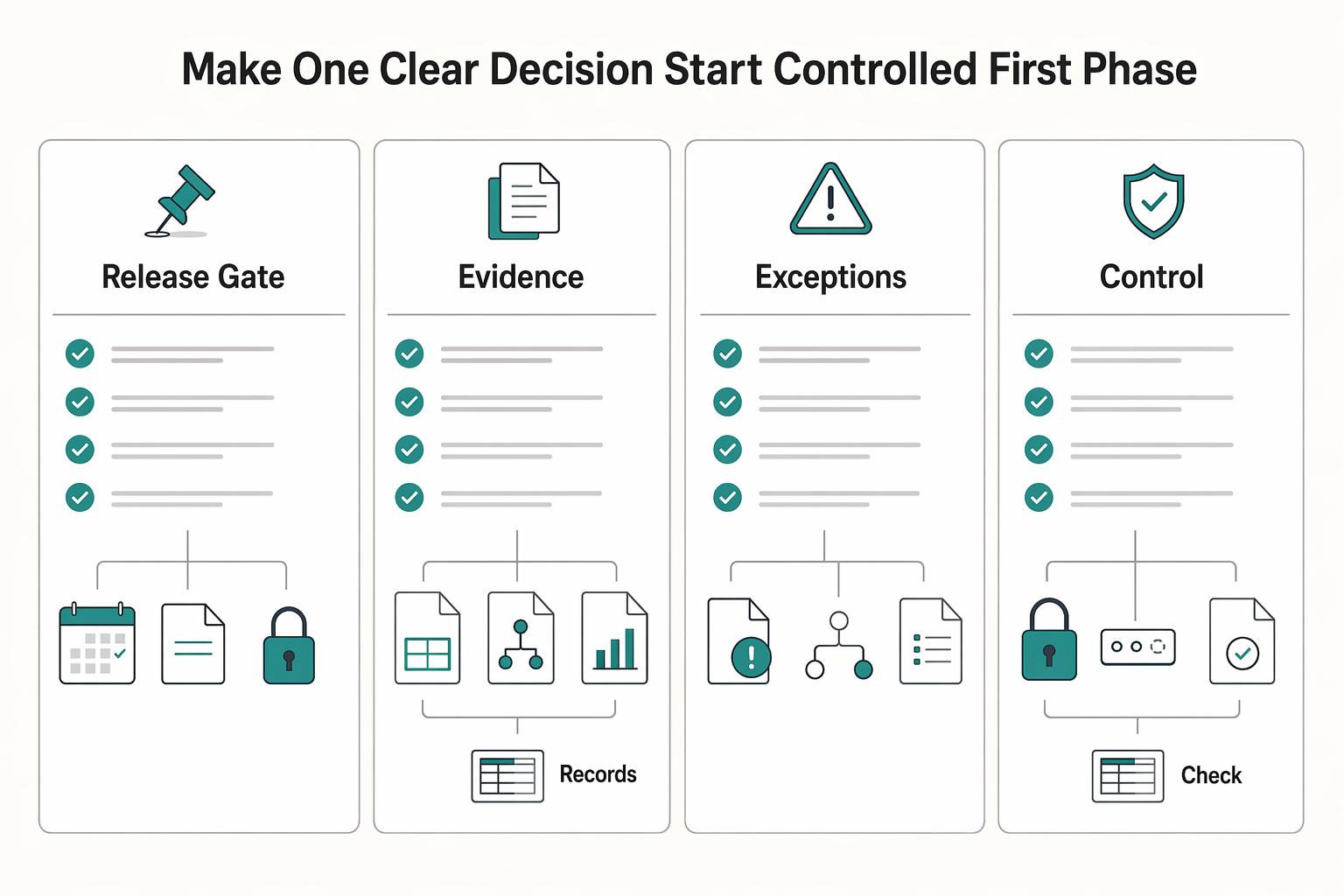
Make one clear decision and start with a controlled first phase#
Choose the architecture that fits your operating complexity, not the loudest category narrative. If your bottleneck is still invoice intake, approvals, payments, and reconciliation, start with AP automation before expanding to a broader P2P suite.
Next, run a structured shortlist using the capability scorecard and integration checkpoints you already defined. Hold every vendor to the same proof path: one real invoice, one real approval chain, one exception, one payment outcome, and the final reconciliation or ERP record.
The goal is not speed alone. A connected AP workflow should carry each invoice through to reconciliation, with approvals, exceptions, and payment records traceable in one place. If you still rely on inbox handoffs, spreadsheets, or one-off workarounds, fix that operating baseline as part of the pilot.
Keep phase one deliberately narrow: one invoice lane with enough volume to surface real issues, but enough simplicity to isolate root causes quickly. Before go-live, require:
- tested approval rules for the pilot lane
- a confirmed integration checkpoint with evidence of the final record
- a staffed exception queue with named owners
- clear control ownership across Finance, Engineering, and Payments Ops
Define pilot success using approval cycle time, exception aging, reconciliation lag and manual effort. For illustration, reducing 1,000 invoices from 8 to 3 manual minutes each saves about 83 hours per month before new exception work. Compare the value of that time with subscription, connector, implementation and operating costs; do not treat time saved as automatic headcount savings.
If you are actively buying, use sales conversations to confirm hard coverage questions first: supported markets, supported programs, audit export quality, and exception handling when the happy path fails. Then validate those claims in a constrained pilot. For most teams evaluating ap automation for platform operators, that is the fastest path to a defensible decision.
You might also find this useful: Finance Automation and Accounts Payable Growth: How Platforms Scale AP Without Scaling Headcount.
Frequently Asked Questions
What is AP automation for platform operators versus standard AP teams?
Platform AP connects vendor invoice validation, approvals, accounting and payments across systems. Map missing identifiers and records as evaluation requirements; a vendor may help repair them. Prove invoice-to-payment-to-posting traceability in the pilot before live release.
When should we pick AP-first software instead of a full Procure-to-Pay platform?
Pick AP-first when your real pain is invoice capture, approval routing, duplicate prevention, and payment execution. Consider broader Procure-to-Pay (P2P) only when procurement-side controls are already creating risk. If procurement is still light, a full suite can add implementation load before it solves your current bottleneck.
Which controls are truly non-negotiable before we automate payments?
Start with invoice verification, approval enforcement, duplicate checks, and complete traceability. Invoice verification is the pre-payment control that confirms an invoice is accurate, legitimate, and ready to pay, and that matters even more when payments fraud remains common. For physical purchases, test 3-way matching. For every payment lane, confirm controls prevent duplicate payments or incorrect payment amounts.
How do we evaluate ERP integration risk before contract signature?
Treat ERP integration as a cost, ownership, and change-management question, not a checkbox. Additional integration cost may apply depending on ERP complexity and customization, so ask who owns mapping, failure monitoring, change requests, and connector maintenance after go live. A strong checkpoint is a live pass through your real flow, including an exception, plus proof of the final ERP posting result.
What evidence should we request to validate vendor claims on implementation time and ROI?
Ask the vendor to run your real AP process from invoice receipt through payment execution, then export the evidence from that transaction. You want timestamps, approval history, exception handling, and proof of how the item lands in the ERP. Do not accept a fixed ROI claim. Ask for assumptions tied to your invoice volume, exception rate, and current manual steps.
How should we handle global invoicing and tax compliance when rules vary by market?
Do not assume one tool handles every market equally well. Validate market coverage directly, including how exceptions and errors are handled and how those workflows are maintained as requirements change. If a response is only "configuration," ask what operational ownership and change process that really means.
What is the fastest low-risk first rollout for a platform with growing payment volume?
Start with one invoice lane that is high volume but operationally simple, then expand only after the exception queue is stable. The first phase should have clean supplier data, tested approval rules, and validated payment method support for the rails you actually use, whether that is ACH, cards, or something else. Avoid a big-bang launch across every entity and market. It makes root-cause analysis much harder when errors appear.
Try a related tool
Researched and edited by the Gruv editorial team. Gruv builds cross-border billing, payouts, and finance-operations software for global businesses.
Sources
Includes 4 external sources outside the trusted-domain allowlist.
Educational content only. Not legal, tax, or financial advice.
Related Posts
Win-Back Campaigns That Reactivate Churned Subscribers Without Margin Loss
Assume from the start that a win-back flow can lift reactivations and still be a bad trade. If you do not measure what those returns cost in incentives and short-term re-churn, you can end up celebrating activity that does not help the business.
Accounts Payable Automation for Dummies for Platform Operators
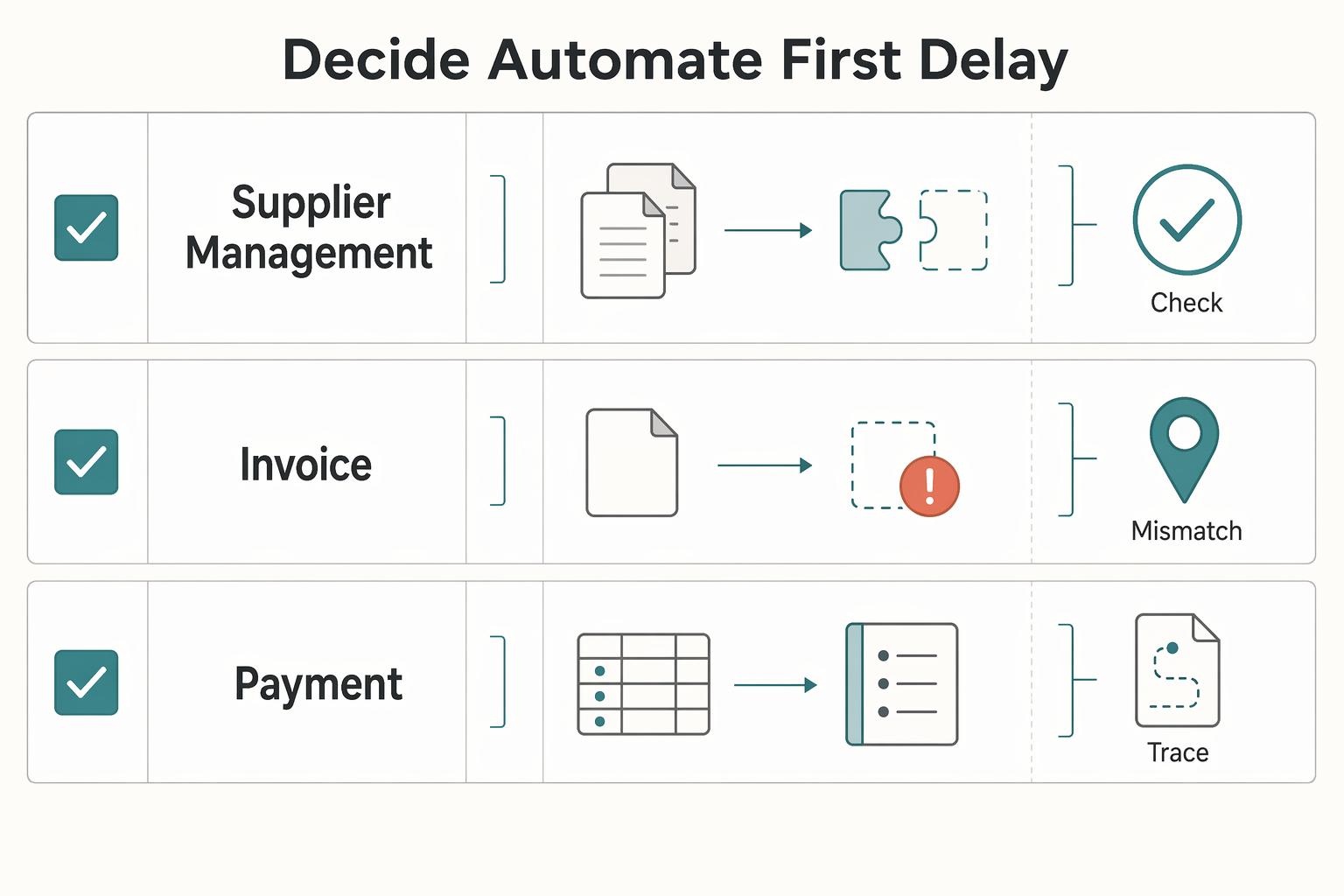
Treat accounts payable automation as a sequencing problem, not a software shopping trip. If you are new to AP technology, the useful question is not which tool has the most features. It is which steps you should automate first so invoices, approvals, payments, and reconciliation stay reliable as volume grows.

How Platform Teams Scale AP Volume Without Adding Headcount
Use this as a decision list for operators scaling Accounts Payable, not a generic AP automation explainer. In these case-study examples, invoice volume can grow faster than AP headcount when the platform fit is right, but vendor claims still need hard validation.