
Quick Answer
Start with CRM lifecycle states and only automate a win-back path after entry, exit, and suppression rules are explicit. Use email as the base path, then add push, SMS, or in-app only when cross-channel collisions are controlled. Match outreach to churn reason first, and treat discounts as gated exceptions with finance approval, not default copy. Judge success by retention durability and revenue quality, with checkpoints at Day 1, Day 7, and Day 30 rather than open rates.
Why most win-back automation underperforms for platform operators#
Assume from the start that a win-back flow can lift reactivations and still be a bad trade. If you do not measure what those returns cost in incentives and short-term re-churn, you can end up celebrating activity that does not help the business.
Step 1: Define success beyond the reactivation count. A win-back campaign targets users who have gone inactive or show signs of churn; it is not a generic blast. That distinction matters because a return only counts if the account comes back on terms you can actually support. Your first checkpoint is simple: for any recovered cohort, confirm you can tie reactivation to revenue quality, not just opens, clicks, or a temporary subscription restart.
A practical test before launch is this: can you separate full-price returns from discount-led returns, and can finance see the cost of the offer? If not, the automation is not ready. You are measuring activity, not recovery quality.
Step 2: Use vendor guidance as input, not as your operating logic. Braze, Stay AI, and ProsperStack all offer useful patterns, but examples are not economics. Braze points to inactivity windows such as 30, 60, or 90 days. ProsperStack describes win-back sequences as usually 3 to 5 messages, most often via email. Those are reasonable starting points, not defaults to copy unchanged.
Stay AI is especially clear about two common design flaws: using discounts as the default offer and treating all churned subscribers the same. Both choices feel efficient at setup time. Both can hide waste by pushing the same message and the same incentive to segments with very different intent.
Step 3: Focus on the decisions you actually control. For operators, the real work sits in four places:
- Segmentation: separate recent inactivity from confirmed churn and high-value lapses from low-probability returns.
- Behavioral triggers: decide which event starts the sequence, such as inactivity or other churn-related signals.
- Channel orchestration: choose when email carries the sequence and when other channels should support it instead of colliding with it.
- Finance checks: set rules for when an offer is allowed, capped, or blocked.
If any one of those is vague, the automation can look live while doing blunt-force outreach underneath.
Step 4: Protect against discount conditioning from day one. Frequent or predictable discounting can train customers to wait for the next sale. That pattern can quietly undermine win-back programs. Start with a simple test: prove value before you introduce an incentive. Remind the user what changed, what they are missing, or what problem you now solve better.
That is the thread for the rest of the article: define who is actually recoverable, map intent to message and channel, and only then decide where an offer belongs. Related: Customer Winback Economics: When Re-Acquiring Churned Subscribers Costs Less Than New Acquisition.
Define who is churned and who is still recoverable#
Treat this as a classification problem first: if "churned" is a catch-all CRM label, your automation will misfire. Keep separate states for inactive, at-risk, and churned users so each cohort gets different timing, message pressure, and cost exposure.
Step 1: Split lifecycle states before writing messages. Use churn signals plus segmentation filters to separate early inactivity from clear churn, and prioritize high-value, winnable subscribers instead of blasting every canceled account with the same flow. Before you scale outreach, confirm the entry event is visible and explainable for each state. If accounts marked "churned" still show recent activity or no clear cancel signal, fix cohort logic first.
Step 2: Define explicit entry, exit, and suppression rules across channels. Set named rules for when users enter, when they exit, and what suppresses duplicate outreach across email, push notifications, SMS, and in-app messaging. Exception events should remove users as soon as the relevant event happens, and suppression should prevent overlap across channels. Otherwise, you get collision: multiple teams and channels sending conflicting "come back" prompts to the same person.
Step 3: Use low-cost reactivation first when intent is unclear. If you cannot tell whether the issue is price, habit loss, or simple inactivity, start with reminder and value messaging before incentives. This will not recover every segment, but it reduces the risk of conditioning subscribers to wait for discounts.
If you want a deeper dive, read Winback Campaigns for Churned Subscribers: Timing Channels and Offers.
Prepare the data, owners, and proof requirements before launch#
Do not automate win-back until your data can show why someone left, whether you can contact them, and what reactivation success means.
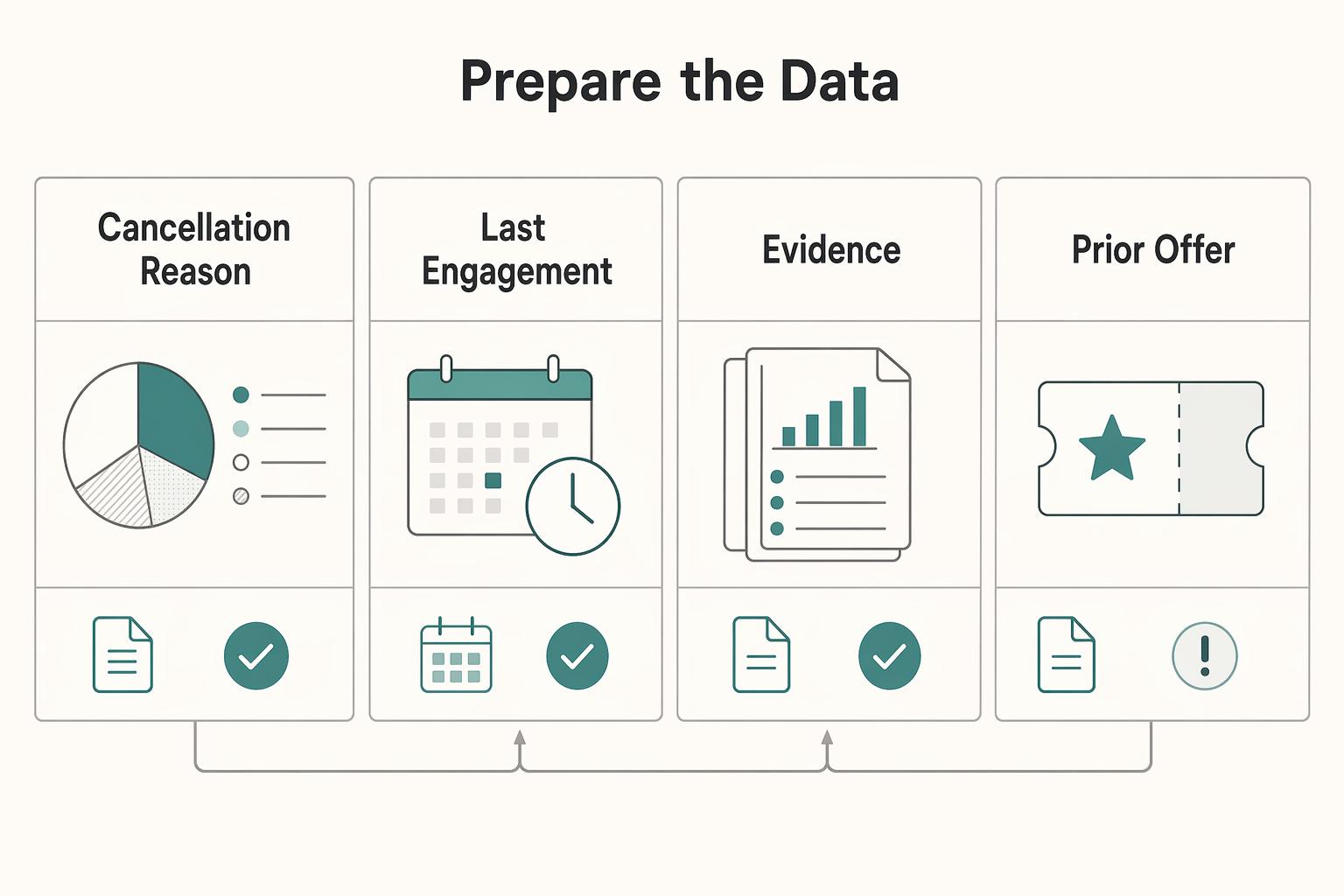
| CRM field | What to keep |
|---|---|
| Cancellation reason | Structured subscription cancellation details where available |
| Last engagement event | Recent product or campaign interaction fields used for segmentation |
| Channel consent status and consent record | For each outbound channel before first contact |
| Prior offer history | Avoid repeating discounts or save offers blindly |
Step 1: Build a minimum evidence pack in the CRM before anyone writes triggers. Keep it small and operational:
- Cancellation reason or structured subscription cancellation details where available.
- Last engagement event, including recent product or campaign interaction fields used for segmentation.
- Channel consent status and consent record for each outbound channel before first contact.
- Prior offer history so you can avoid repeating discounts or save offers blindly.
If these fields are missing or unclear for a segment, fix that first.
Step 2: Assign owners by decision type, not by tool access. Use a clear split for trigger quality, offer logic, and margin approval. A practical model is product owning behavioral triggers, revenue owning offer rules, and finance owning margin guardrails. This is not a universal standard, but it helps prevent launch gaps where messages go live before trigger quality or margin impact is validated.
Step 3: Define one measurable reactivation outcome for every segment before launch. Each segment needs a named success event you can measure after messaging within a defined window. If a segment cannot map to a measurable conversion event, pause it until it can.
Before launch, confirm every segment has a clear audience rule, a named owner, and one measurable reactivation outcome.
When you benchmark vendor claims, treat headline results as directional unless methodology is transparent. For example, if a vendor claims it can "reduce churn up to 39% at the point of cancellation," log the claim, source, and unknowns before using it as proof.
We covered this in detail in Build a Cancellation Flow That Saves the Right Subscribers.
Map churn reasons to offers without eroding margin#
Match each churn reason to the lightest credible return path, and require a margin check before activation. A single discount-first flow is rarely the right default across all churn reasons.
Build a decision table before writing offer logic#
Start with segmentation decisions, not message copy. One campaign should not be assumed to fit all churn reasons, and win-back relevance should come from behavior and preferences rather than one-size-fits-all promotions.
| Churn reason | Likely objection | First test | Preferred channel | No-go conditions |
|---|---|---|---|---|
| Value unclear or low feature adoption | "I never got enough value" | Clarify use case or expected outcome before discounting | Email or in-app return touchpoint | No recent engagement signal, or prior incentive already used |
| Explicit price objection | "Too expensive right now" | Controlled incentive test only after clear messaging | Email first, then SMS only with consent | Margin check not approved, or repeated discount history |
| Temporary pause/seasonality | "Not using it this period" | Pause, downgrade, or return reminder before cash incentive | Email or push for recent users | Billing or plan setup cannot support pause/downgrade |
| Operational friction | "Too hard to use / issue unresolved" | Service recovery or product-fix message, not discount | Support/success-led email | Root issue still unresolved |
Use a simple readiness check: sample records from each row and confirm you can explain the row assignment from CRM evidence. If assignment depends on guesswork or missing fields, do not automate that row yet.
Separate value confusion from price objections#
Do not treat every churn signal as a pricing problem. When records point to value confusion, lead with clarity and proof of use; when price objection is explicit, test controlled offers with defined downside.
This protects margin and improves learning quality. A discount can mask a value-understanding problem, while an explicit price objection may justify an offer only when expected reactivation value and downside are clear.
Adjust logic by business model, then validate with data#
B2B and OTT often need different win-back mechanics, so avoid copying one incentive pattern across both without testing. OTT can show short-cycle reactivation behavior: Antenna reports 22% of cancelers resubscribe within three months, which supports testing lighter-touch prompts before margin-spending offers. The same report shows average ad-free plan price paid rose 23% in two years to $13.88, so price sensitivity still matters in offer design.
For OTT teams, keep this deeper churn context nearby: why subscribers leave OTT services.
Gate predictive routing and offers with data + margin signoff#
Use predictive routing only after data-quality checks. Prediction quality depends on data validity, so weak labels and incomplete history can misroute reactivation paths and inflate cost.
Before activation, require both checks for each decision-table row:
- Data check: churn reason, consent status, and prior offer history are present and explainable.
- Margin check: expected ROI and margin impact are approved for that offer type.
Treat discounting as an investment decision, not a default. If expected margin impact is unclear, keep that offer out of the automated flow.
For broader monetization tradeoffs, see Choosing Creator Platform Monetization Models for Real-World Operations.
Build trigger logic and channel sequencing that matches intent#
After the offer table is set, run win-back automation in a fixed order: detect the churn signal, qualify the segment, assign the channel path, apply suppression, then send. That sequence prevents duplicate prompts, mistimed outreach, and noisy reactivation data.
Detect signals first, and do not route on weak events#
Use action-based entry, not only scheduled sends, so journeys can react to cancellations, return visits, failed renewals, or meaningful inactivity as they happen. But only route when the event record is decision-ready.
Treat event quality as a hard dependency. If naming, properties, consent fields, or subscriber identifiers are inconsistent, routing quality breaks before messaging quality does.
Before launch, spot-check recent trigger events and confirm:
- The timestamp is credible.
- The subscriber ID resolves to one person or account in CRM.
- The event includes the segmentation fields required by your decision table.
If those checks fail, fix tracking quality before you tune timing or copy.
Give each channel one job in the sequence#
Assign channels by role instead of firing everything at once. Email is your broad out-of-app coverage layer. Push should be tighter because it is interruptive, so reserve it for higher-urgency or recent-behavior moments. In-app works for return sessions because users only see it when active in the app.
| Channel | Use in sequence |
|---|---|
| Broad out-of-app coverage layer | |
| Push | Higher-urgency or recent-behavior moments |
| In-app | Return sessions |
| Other direct channels | Only after qualification and consent checks |
For other direct channels, route only after qualification and consent checks, not as a default first touch. The operating goal is one primary channel per path, not channel competition.
Apply suppression before every send#
Use dynamic suppression so users enter and exit automatically as they meet criteria. In lifecycle recovery flows, that is what stops channel collisions when someone engages, reactivates, or moves into another recovery path.
At minimum, suppress:
- Users who already engaged meaningfully in another channel during the same recovery window.
- Users who already reactivated or moved into a support-led path.
Looser suppression can increase touches, but it also increases mixed signals and duplicate incentives.
Add timeout, retry, and idempotency controls so failures stay contained#
Behavioral triggers need delivery controls, not just cadence rules. Define when a trigger is considered stuck, when it retries, and when it stops and alerts an operator.
Also make trigger handlers idempotent. At-least-once event processing can replay events, so the same cancellation or return signal should not create duplicate sends or duplicate offer records.
Watch for silent failure: events still flow and dashboards still move, but bad identifiers or duplicates route the wrong people. That is how automation can look active while underperforming on real reactivation.
Write message variants and launch with operational safeguards#
Once routing is stable, make message quality and send control the next gate: launch segment-specific variants only after caps, suppression, delivery monitoring, and duplicate-safe retries are in place.
Build variants from your segmentation table#
Build variants from churn reason and segment, not from a generic Braze or Stay AI starter template. If churn is price-driven, address price; if churn is low adoption or unclear value, address the missing value proof. Braze supports up to 8 variants in a multivariate setup, but use that range for structured testing, not filler.
Require every variant to do two jobs:
- State one concrete value claim.
- Give one clear action path to reactivation.
Before launch, check each variant against its segment and confirm you can explain in one sentence why that message fits that cohort and what action it requests.
Add contact-pressure rules before you turn on retention automation#
Set contact-pressure rules before activation. Use frequency caps and suppression lists so recently contacted or already-reactivated users are automatically excluded, and apply those controls across email and SMS to avoid channel collisions.
Define failed-send handling explicitly. Use status callbacks and message logs to track lifecycle states such as Delivered, Undelivered, or Failed, then route the next action by rule. If SMS fails, suppress repeated sends for that attempt and continue recovery through another valid channel.
Make every send and every incentive auditable#
Log campaign events in CRM and downstream systems so each send and incentive is traceable end to end. A collection layer like Twilio Segment can route customer events to CRM, messaging tools, and monitoring, which makes investigation faster when duplicates or unexpected offers appear.
At minimum, record subscriber ID, campaign ID, variant ID, churn segment, offer ID (if present), channel, send timestamp, delivery status, and reactivation outcome. Then verify this operationally by sampling attempts and tracing each path from trigger to offer creation to delivery result.
Use idempotency keys on side-effecting trigger actions so retries stay safe. Duplicate processing can occur in event-driven systems; if a churn event is replayed, you should still get one offer and one intended send record, not duplicate incentives.
Measure reactivation quality and economics, not vanity lift#
If you report only reactivation count, you can miss win-backs that look good briefly but hurt retention later. Use a cohort-based scorecard that tracks who reactivated, who stayed, and what happened to revenue quality by segment, offer type, and channel mix.
Track durable outcomes by cohort#
Start with cohort retention analysis, not blended campaign totals. Aggregate views can hide segment-level differences, so split results by churn reason, offer type, and user path across email, SMS, and in-app messaging.
Track, at minimum:
- reactivation rate
- later retention rate
- a revenue-quality metric such as net revenue retention (NRR)
Do not treat opens as a primary success metric. Open-rate reporting became less reliable after iOS 15, and performance judgment has shifted toward action metrics. A high open rate with weak reactivation durability is still a weak outcome.
Your checkpoint is operational: sample recent reactivations and confirm you can reconstruct the full path for each one, including segment, offer type, channel sequence, reactivation timing, and retention at your next checkpoint.
Compare profitable retention across offer and channel mixes#
Once cohort reporting is reliable, compare like-for-like groups. A discount-led email plus SMS path may reactivate more users than email alone, but that is not better if those users churn again quickly or return on lower-value terms.
Evaluate profitable retention, not lift in isolation. Test whether adding SMS or in-app actually improves durable outcomes beyond email. If multi-channel performance is similar but adds incentive cost or contact pressure, simplify.
Keep cohorts separated by channel mix and offer type so you can tell whether the gain came from sequencing, incentives, or neither.
Pause fast re-churn and treat vendor benchmarks as directional#
Use a clear rule: if a segment reactivates and then churns again quickly, pause it and rework offer-message fit before scaling. Fast re-churn often means you drove the click without resolving the underlying objection.
Apply the same standard to external benchmarks. ProsperStack publicly claims up to 39% churn reduction at cancellation, but that is a vendor claim, not proof for your lifecycle campaigns. Treat it as directional until your own cohorts validate retention and revenue outcomes.
Common failure modes and fast recovery actions#
Most win-back failures are operational, not volume problems. The fastest recovery usually comes from better segmentation, less discount dependency, stronger cross-channel suppression, and reporting tied to durable outcomes.
Weak segmentation in CRM -> rebuild cohorts from clear churn signals. If churned subscribers sit in one broad bucket, pause broad sends and rebuild cohorts using churn reason and recent behavioral triggers. Treating all churned subscribers the same is a known win-back flaw, and it makes offer and channel choices too blunt to diagnose or improve.
Discount dependency -> lead with value before incentives. Discount-first win-back design is a common failure mode. If reactivation rises but retention quality falls, shift first-touch messaging to value proof and hold incentives for non-responders instead of making discounts the default.
Channel collisions -> enforce suppression across channels. Subscribers can qualify for multiple journeys at the same time, which can create message bursts in short windows. Use frequency capping and smart-sending controls, but add orchestration-level suppression across push, in-app, and email because channel-level windows alone do not prevent cross-channel duplication.
Open-rate reporting -> move to reactivation quality and retention. Open-heavy reporting is a vanity pattern when open behavior is obscured by privacy protections, including iOS 15 Mail Privacy Protection. Put reactivation, post-reactivation retention, and cohort quality by offer and channel mix at the top of the dashboard.
The practical next step for operators#
Launch a narrow pilot first, and scale only when it shows durable reactivation with healthy margin.
Step 1. Pick one winnable cohort and set the economic guardrail. Start with one high-confidence segment, not every churned user. Use signals you trust, for example recent inactivity with prior engagement, and define the money line up front: keep this path live only if recovery cost compares favorably with new acquisition cost. If return depends on discounting that weakens margin or drives repeat discount behavior, treat that as a warning.
Step 2. Prove trigger and suppression logic before volume. Use explicit action-based or API-triggered delivery, not a loose batch guess. In your CRM, spot-check records so eligibility rules match reality: engagement event, consent status, prior offer exposure, and lifecycle status. Then verify suppression across channels so people do not get overlapping email, push, and SMS from competing flows.
Clean event data is a hard dependency here. If tracking is stale or incomplete, campaign reporting can look fine while decisions are wrong.
Step 3. Make retries safe, then check durability before scaling. Add idempotent handling so replayed events do not trigger duplicate offers or repeat sends. Then evaluate post-return behavior by cohort at Day 1, Day 7, and Day 30. If results spike early and fade by Day 30, refine message, offer, or timing before expanding.
Step 4. Expand one variable per cycle. After the pilot, change one lever at a time: segment, message, offer, or channel order. That keeps cause and effect clear and turns win-back automation into a repeatable operating advantage.
If you want help pressure-testing the setup, Talk to Gruv.
Frequently Asked Questions
What triggers should start a win-back campaign first?
Start with observable inactivity or churn signals, not a batch send to every lapsed user. A practical trigger is a user going quiet for 30, 60, or 90 days, adjusted to your purchase cycle and validated with testing. If your trigger cannot distinguish real inactivity from measurement noise, tighten the signal before automating.
How do we segment churned subscribers when cancellation reasons are incomplete?
Use behavior-led relevance instead of waiting for perfect labels. When cancellation reasons are incomplete, segment by verified behavior and tailor messaging to what those users did, not a one-size-fits-all send. Practical groups include users who stopped opening, stopped purchasing, or simply went inactive.
Which channel should we automate first: email, push notifications, SMS, or in-app messaging?
Email is a common first automation channel in win-back flows. Then add SMS or push as needed based on user behavior and preferences, rather than assuming one channel is best for every segment.
How long should we wait before sending reactivation messages?
Do not assume 90 days is correct just because it is common. The right delay depends on purchase latency, so test timing by segment instead of forcing one clock across the whole base.
When should we avoid incentives because the economics do not work?
Avoid leading with incentives by default; discount-first win-back can backfire. Start with non-discount value messaging, then test incentives only where segment data supports it.
What metrics matter beyond opens and clicks for lifecycle campaigns?
Opens should not be a primary success metric because Apple Mail Privacy Protection can preload pixels and make open metrics unreliable. Measure outcomes with stronger signals such as clicks, purchases, and reactivation, then check whether users keep returning over time. If your analytics reports return behavior in the first 42 days, use that to evaluate retention durability instead of a one-day spike.
Try a related tool
Researched and edited by the Gruv editorial team. Gruv builds cross-border billing, payouts, and finance-operations software for global businesses.
Sources
Includes 8 external sources outside the trusted-domain allowlist.
- blog.funnelfox.com/winback-campaign-subscription-appsexternal
- braze.com/docs/user_guide/message_building_by_channel/...external
- braze.com/docs/user_guide/message_building_by_channel/...external
- cdn.prod.website-files.com/6756b521db09e280168a4cf3/67f451bde7ec5469b61...external
- docs.cloud.google.com/architecture/guidelines-for-developing-high-...external
- forbes.com/councils/theyec/2020/07/17/will-discounting-...external
- help.activecampaign.com/hc/en-us/articles/10378696462236-Use-automat...external
- prosperstack.com/solutions/winback-campaignsexternal
Educational content only. Not legal, tax, or financial advice.
Related Posts
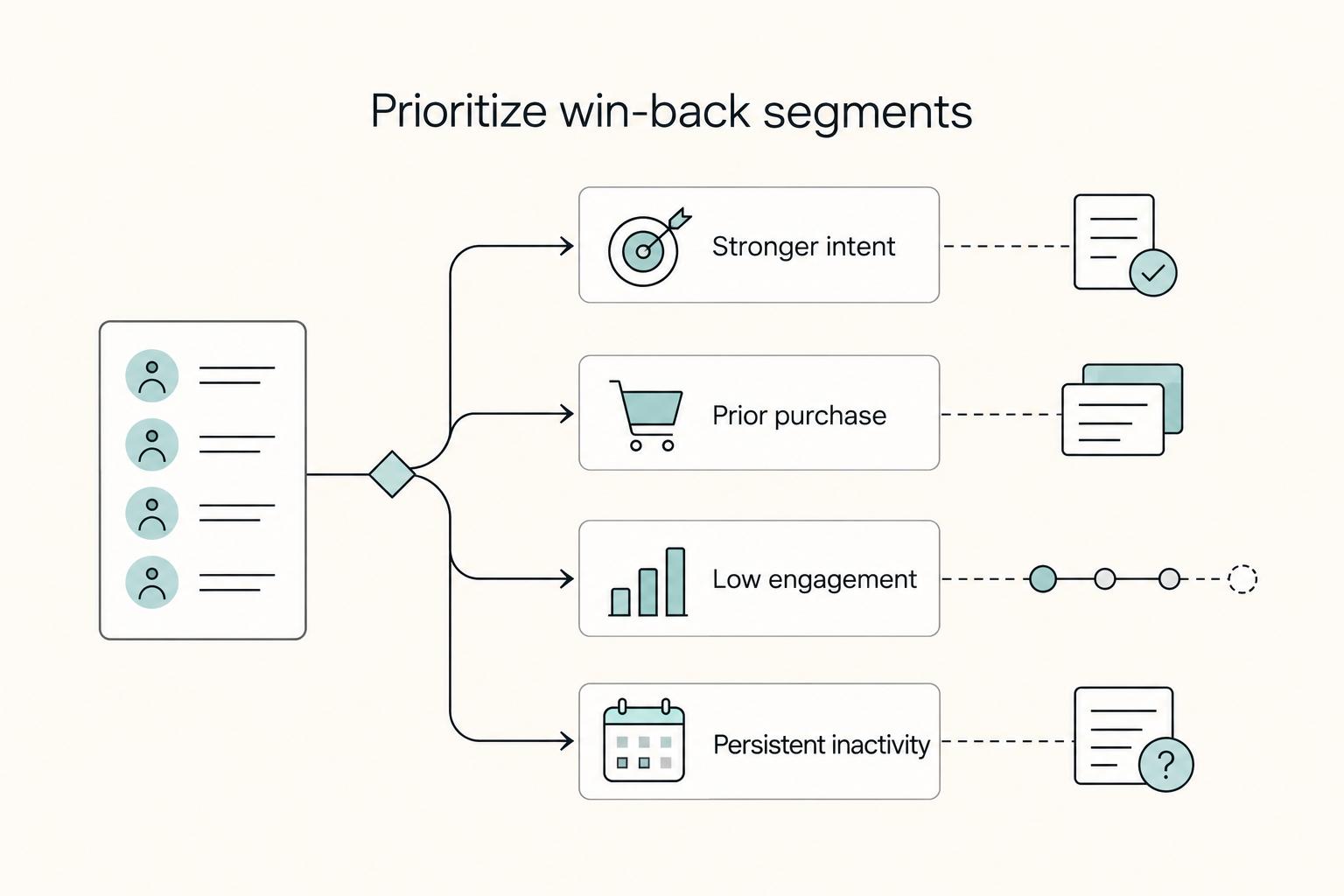
Subscriber Winback Campaign Decisions on Timing Channels and Offers
A subscriber winback campaign should optimize recovered value, not activity. Churn is not just a lifecycle problem. It is a unit economics decision: is a former subscriber worth recovering, or should that budget go to new acquisition or low-cost nurture instead? For subscription businesses, every cancellation means lost monthly recurring revenue and sunk acquisition spend, so your response determines whether that value is gone for good or still recoverable.
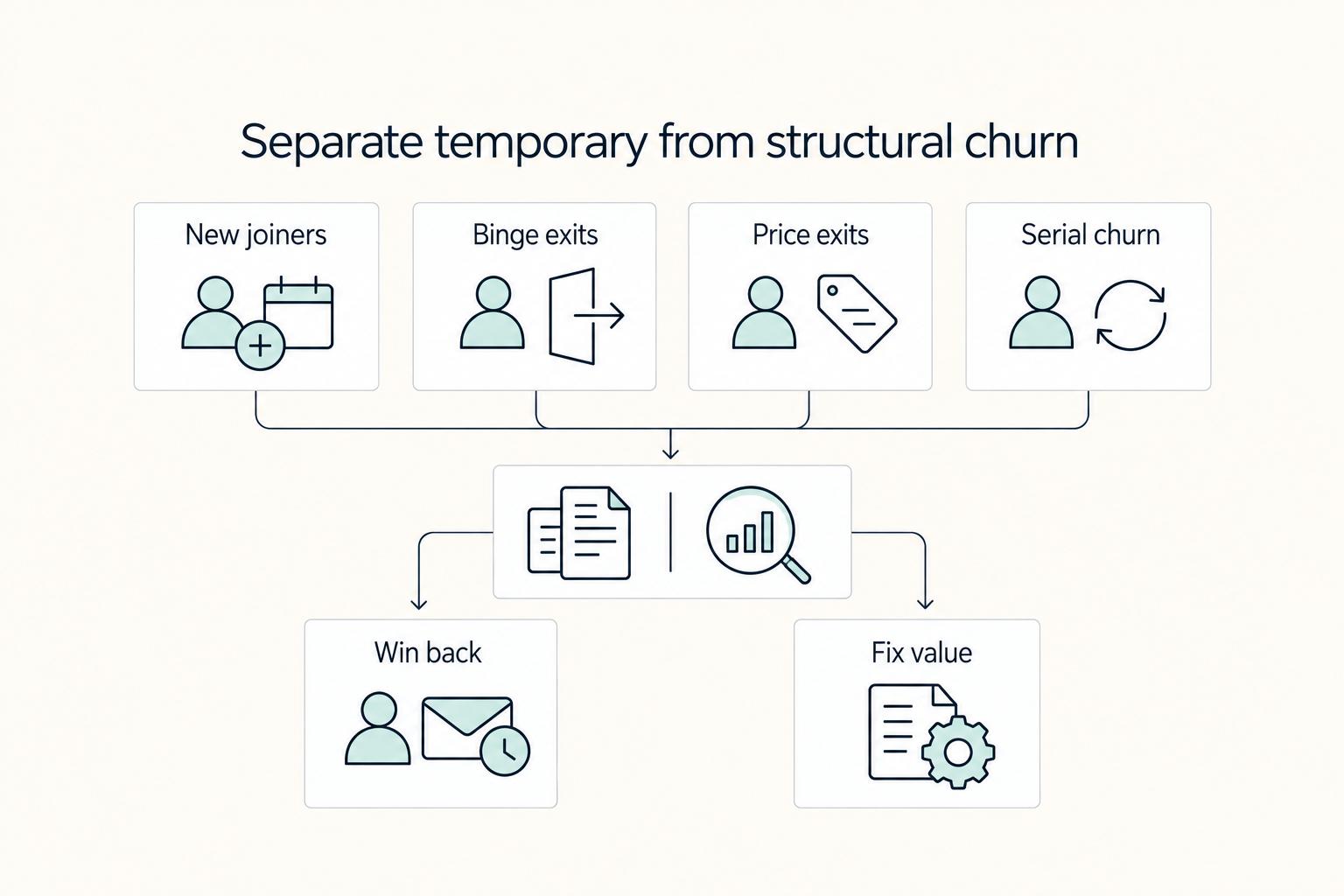
Streaming Platform Churn Analysis: Why Subscribers Leave OTT Services and How to Win Them Back
If you are doing **streaming platform churn analysis OTT**, your first move is not a discount or a copy of whatever a major platform just tried. First separate temporary churn from structural churn, then choose the retention lever that fits the exit pattern before you scale into another market.
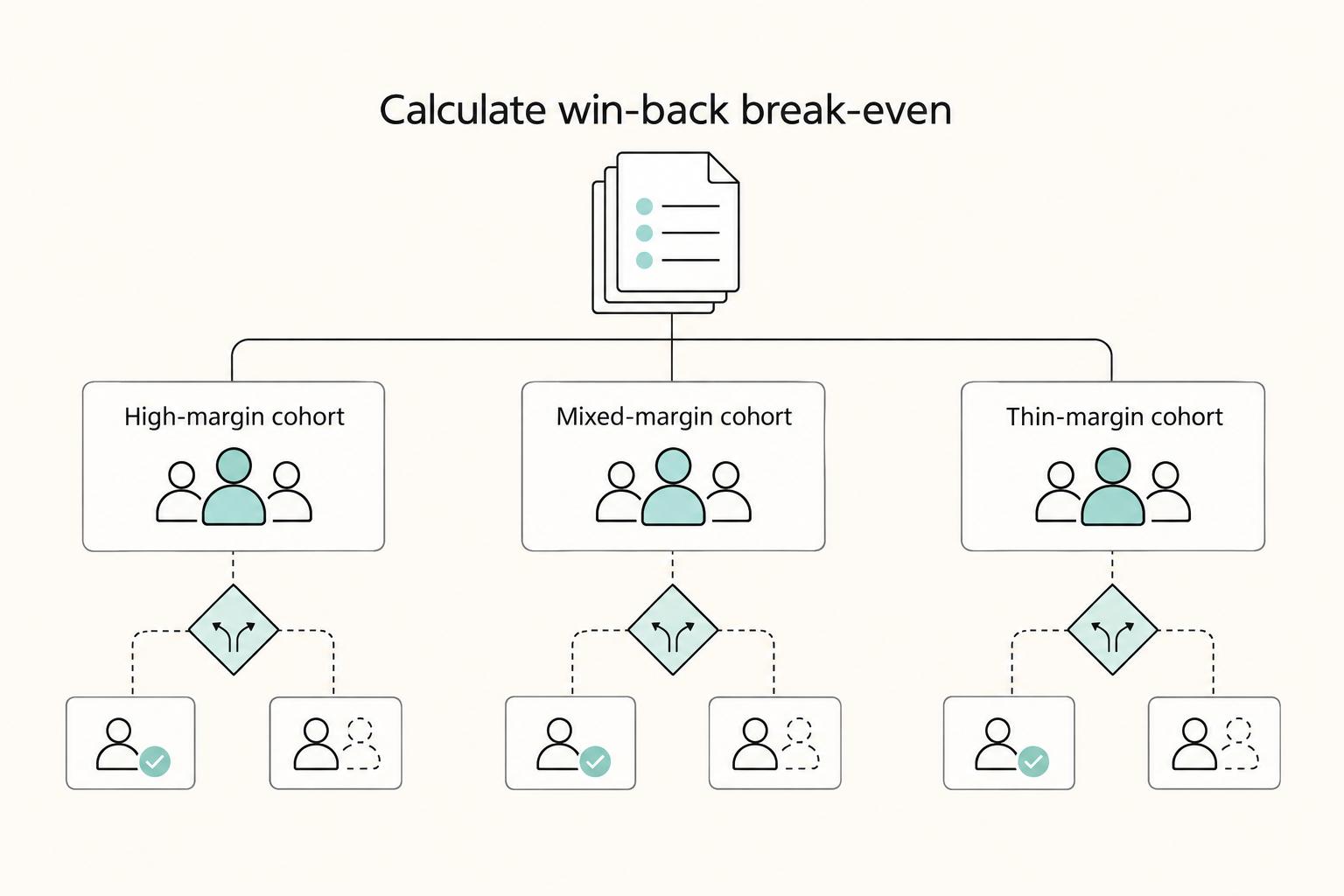
When Reacquiring Churned Subscribers Costs Less Than Net-New Growth
Reactivation volume is easy to celebrate. Recovered margin is the harder test, and it should decide whether you keep spending. A winback effort is only worth funding when the expected net contribution from a returned subscriber is better than what the same budget could earn through a comparable net-new path.