
Quick Answer
Yes, pursue winback only when expected recovered value beats your net-new alternative under the same payback assumptions. Start with cohort ranking and break-even modeling, then launch the lightest viable offer that still clears contribution requirements. Keep strict stop conditions for contact volume and incentive burn, and treat payment-to-ledger reconciliation as mandatory. If those checks fail, pause expansion even when reactivation counts look strong.
Reactivation volume is easy to celebrate#
Reactivation volume is easy to celebrate. Recovered margin is the harder test, and it should decide whether you keep spending. A winback effort is only worth funding when the expected net contribution from a returned subscriber is better than what the same budget could earn through a comparable net-new path.
That is the mistake this article aims to fix. Teams often report restarted subscriptions, opens, or clicks first, and finance is left to figure out whether the program added profitable revenue. A returned subscriber may be easier to reach because they already know the product and may still have billing details on file. That does not make the economics favorable by default, especially if the original churn reason is still unresolved.
For 2026, treat market benchmarks as context, not permission. Recurly reported subscription acquisition rates falling from 4.1% to 2.8% between 2021 and 2024, which is useful directional evidence that net-new growth can get harder. But that is a source-specific benchmark, not a universal rule. If you do not have current external data you trust for your category, use your own recent quarters of CAC, conversion, contribution margin, and payback performance as the baseline.
The practical sequence is straightforward: segment similar churned customers, analyze why those groups left, and rank segments by expected economic return before outreach. Then set clear checkpoints so you can verify whether reactivation improves contribution versus a comparable net-new path. If your recovery performance depends heavily on what happens before cancellation is final, fix that earlier point first with a stronger cancellation flow.
A simple checkpoint before launch is this: you should be able to tie each offer, message variant, or channel touch to a specific reactivation and compare recovered contribution against the net-new alternative on the same accounting basis. If that connection is unclear, tighten measurement before you scale.
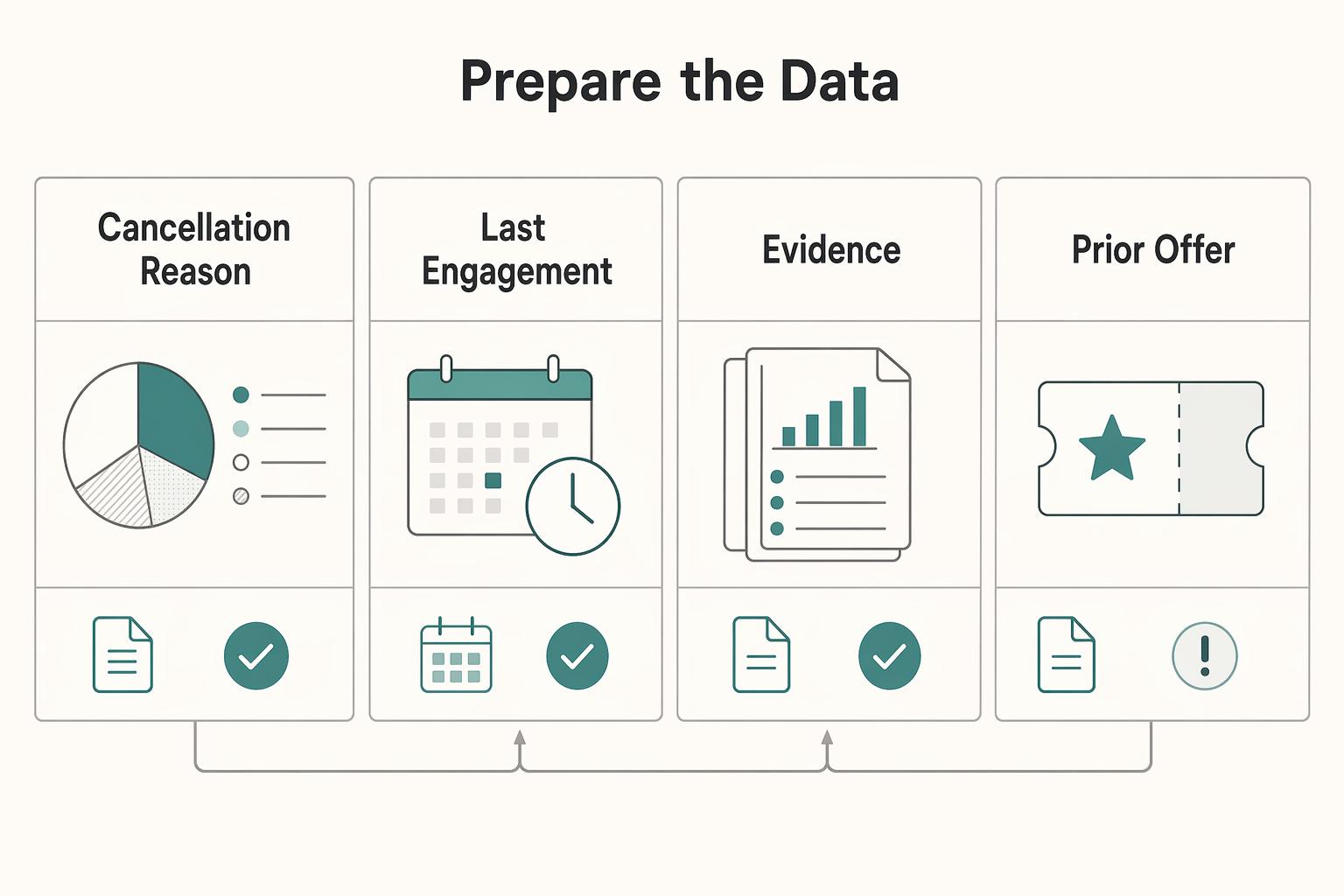
One common failure mode is mistaking reactivation counts for economic success, especially after deep discounts. Another is skipping churn analysis altogether. Before outreach, segment similar customers and review why those groups left using both behavioral and revenue data plus exit feedback, not just headline churn rate.
Related reading: Unit Economics for Payment Platforms: How to Calculate True Cost Per Payout.
Define the economic terms before choosing tactics#
Winback decisions are only reliable when your team defines success as recovered economic value, not activity volume. Before you choose channels, timing, or discounts, align on terms so growth, product, and finance are evaluating the same outcome.
| Term | Practical definition | Decision input it feeds |
|---|---|---|
| Customer winback | Recovering canceled subscribers into renewed revenue | What counts as a true return |
| Churn rate | The share of subscribers who leave in a defined period | Your baseline leakage, tracked over time |
| Churn analysis | Studying why people leave, when they leave, and what predicts it using engagement/revenue data plus cancellation feedback | Which segments are worth contacting |
| Contribution margin | Revenue left after variable costs | Whether returned subscribers can support spend |
| Incremental lift | Reactivations caused by the campaign beyond those who would have returned anyway | Whether the campaign created value or only captured natural returns |
Signal is not proof: opens, clicks, restarts, and raw reactivation counts are signals, while durable paying return on a contribution basis is proof. Re-engagement and monetization are not the same outcome, because some subscribers return briefly and churn again before routine usage.
Before launch, use this checklist:
- Required inputs: growth provides expected reach, conversion, and channel or incentive cost; product provides churn analysis from behavior, revenue, and exit feedback; finance confirms the contribution basis used for evaluation.
- Comparison rule: compare expected recovered value against the same contribution standard used for new acquisition, not topline subscription value.
- Success condition: treat winback as successful only when returned subscribers are verified as paying revenue under that same basis.
With definitions locked, it is much easier to judge timing and offer choices. For tactics, see winback campaigns for churned subscribers.
This also pairs with Subscriber Acquisition Benchmarks for Platform Operators on CAC, LTV Ratio, and Payback.
Rank churned subscribers by expected economic return#
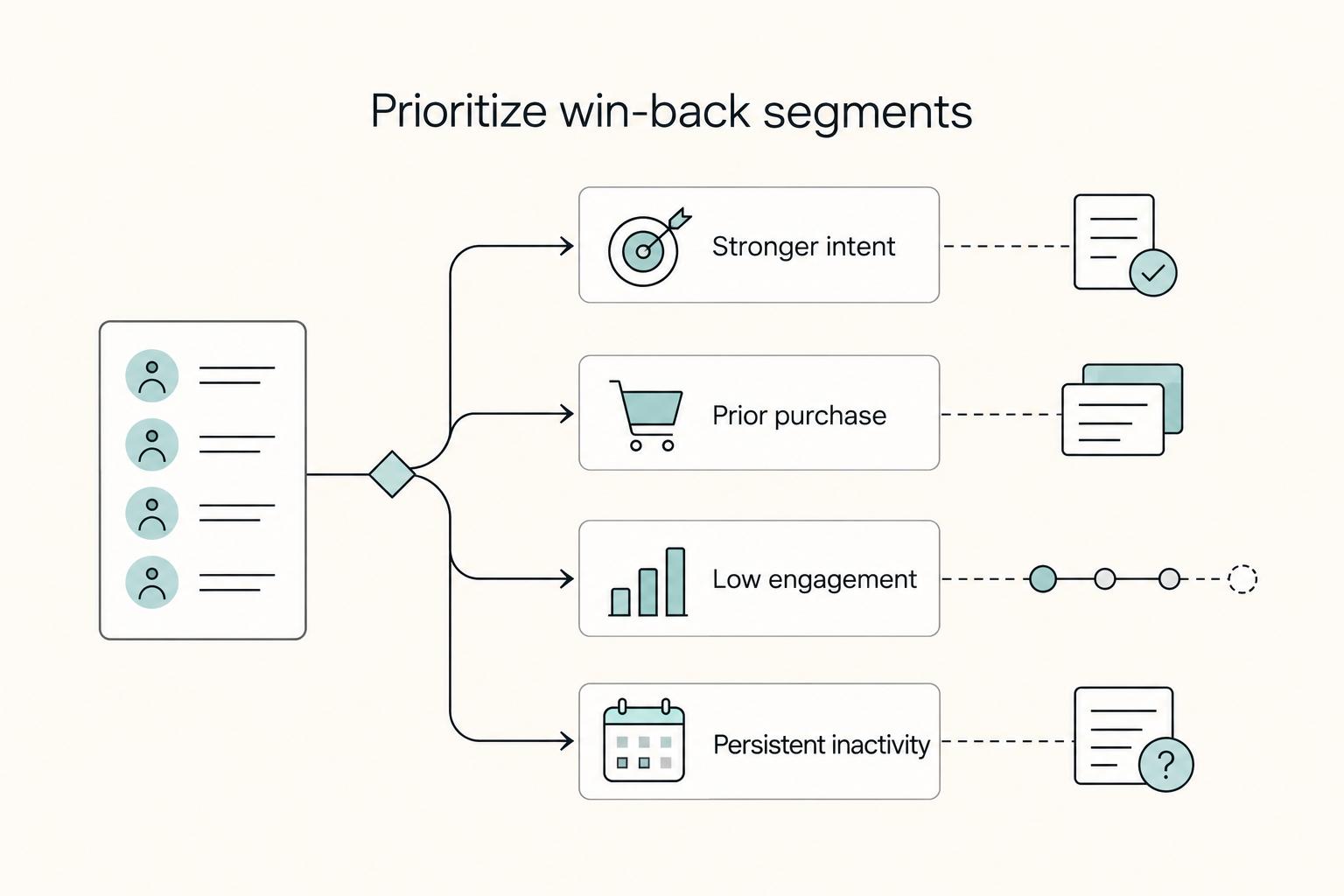
Prioritize canceled subscribers by expected net return, not by reactivation odds alone. Segmenting by churn signals helps you focus spend where losses are concentrated and recovery is more plausible.
Build the ranking from consistent, measurable inputs: Customer Lifetime Value, prior revenue per account, churn reason from the Cancellation flow, time since cancellation, and expected offer cost.
| Field | What it tells you | How to use it |
|---|---|---|
| Customer Lifetime Value | Relative long-term value potential | Prioritize higher-value accounts when fit signals are still reasonable |
| Prior revenue per account | Economic contribution before churn | Separate meaningful contributors from low-value returners |
| Churn reason | Why the customer left | Match message and offer type to the underlying attrition driver |
| Time since Cancellation flow completion | How recent the opportunity is | Score recency using your own churn patterns, not a universal cutoff |
| Offer cost | Credits, promo codes, and channel spend | Evaluate expected recovery net of cost before launch |
Use one decision rule across segments: if margin is weak and the churn reason points to poor fit, deprioritize the segment even when return probability looks high. Keep a simple winnable now vs later flag so timing stays tied to observed churn behavior instead of guesswork.
As a checkpoint, verify that churn reason is captured in a structured field and that time-since-cancel is measured from the same event timestamp for every segment. If those inputs are inconsistent, the ranking can look precise while still misallocating budget.
If you want a deeper tactical breakdown, read Winback Campaigns for Churned Subscribers: Timing Channels and Offers. You might also find this useful: How to Let One Customer Hold Multiple Plans on Your Platform.
Calculate the break-even point before you send offers#
Send offers only when expected net contribution is positive inside your payback window under shared finance assumptions. Opens, clicks, and reactivation rate are useful diagnostics, but they are not the send gate.
At the company level, break-even is when revenue equals total expenses. Use that same logic at the segment level: recovered contribution from reactivated accounts must cover outreach, incentive, and service costs within the payback window.
Build the break-even table from contribution, not revenue#
Use MRR for this send or no-send decision, and keep ARR for longer-horizon planning. Start from the subscription baseline:
Break-Even Point = Fixed Costs / (ARPA - Variable Costs Per User)
Then adapt to segment-level contribution math:
Contribution inside payback = M × CM × T
Net contribution per reactivated account = M × CM × T - I - S
Required conversion rate to break even = O / (M × CM × T - I - S)
Here, M is expected monthly recurring revenue recovered, CM is contribution margin ratio, and T is the target payback period in months. O is outreach cost per targeted churned account, S is expected service cost per reactivated account, and I is incentive redeemed on converted accounts.
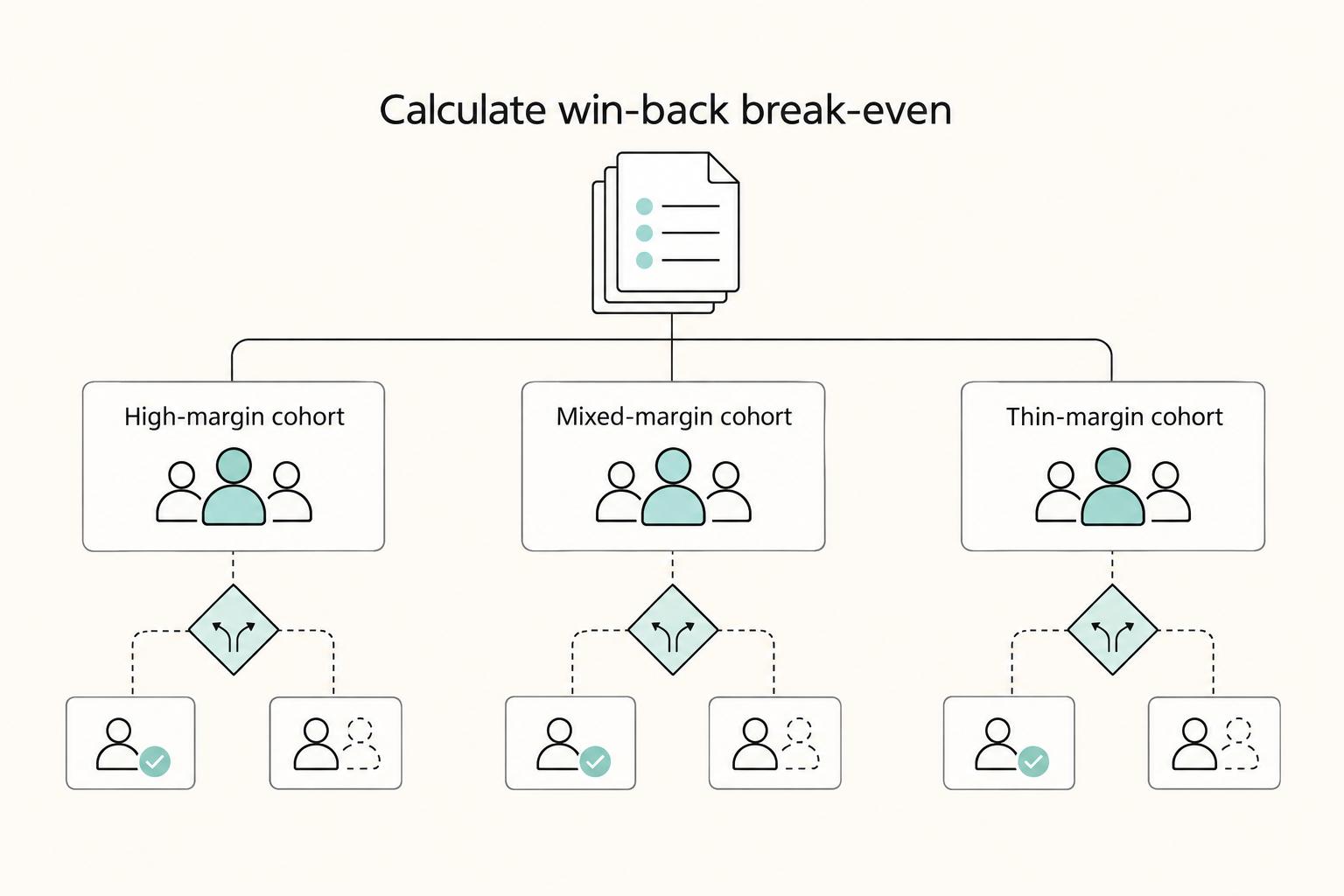
| Segment | Blended CAC benchmark | Required conversion with no incentive | Required conversion with light incentive | Required conversion with deep incentive |
|---|---|---|---|---|
| High ARPU, healthy margin | Current blended CAC | O / (M×CM×T - S) | O / (M×CM×T - I1 - S) | O / (M×CM×T - I2 - S) |
| Mid ARPU, mixed margin | Current blended CAC | O / (M×CM×T - S) | O / (M×CM×T - I1 - S) | O / (M×CM×T - I2 - S) |
| Low ARPU or thin margin | Current blended CAC | O / (M×CM×T - S) | O / (M×CM×T - I1 - S) | O / (M×CM×T - I2 - S) |
Hard stop: if M × CM × T - I - S is zero or negative, do not send for that segment.
Input-quality checks before you trust outputs:
- Expected plan mix: model the plan subscribers are likely to return to, not the highest historical plan.
- Variable cost treatment: confirm what is already inside CM versus modeled separately, so costs are not double-counted.
- Incentive redemption assumption: define whether I is issued value or expected redeemed value, and keep it consistent.
- Verified support-cost model: use a checked method for S, not a rough estimate.
Compare reacquisition and net-new on one basis#
Only compare reacquisition and net-new when both use the same contribution basis, the same horizon, and the same attribution logic. If one side is net contribution and the other is gross revenue, the result is not decision-grade.
Reacquisition can look cheaper on channel spend alone and still underperform once incentives, plan mix, support burden, and non-incremental returns are included. Put Blended CAC on that same footing, then compare against winback required conversion and expected contribution. If CAC assumptions are inconsistent, align them first with How to Calculate Customer Acquisition Cost (CAC).
Use the finance-approved payback rule only after it has been verified in source records. Until then, treat the target payback value as pending source-record verification.
Attach a preflight packet before send#
Treat this as a required approval packet, not a slide headline.
| Packet item | Include | Decision note |
|---|---|---|
| Segment assumptions | Audience definition; expected recovered MRR; expected plan mix; contribution margin ratio; outreach cost; incentive assumption; support-cost model version; CAC snapshot date | Use in the required approval packet |
| Downside case | Lower conversion; higher redeemed incentive cost; higher service cost | If downside turns net contribution negative, treat as stop unless risk is explicitly accepted by an approver |
| Approval owner | Decision owner for economics sign-off | Not only the campaign operator |
The packet should be complete enough that an approver can see the economics, the downside case, and the sign-off owner without hunting through slides.
Practical rule: if the forecast only works under optimistic conversion or understated service cost, pause and rework before send. Related: Platform Economics 101 for Commission Fees, Payout Costs, and Gross Margin.
Choose timing channels and offers that protect margin#
Protect margin by running winback in a fixed order: complete the grace-period check, route by churn reason, then choose the lowest-cost channel and lightest offer that can still clear your approved payback hurdle.
- Confirm the account is truly out of grace.
- Confirm churn reason quality is strong enough to route the account.
- Choose channel and message strategy before choosing incentive depth.
If you skip that order, you drift into blanket discounts and reactive save-desk behavior that can lift reactivations but weaken profitable retention. Hold any segment if grace status or churn-reason data is not reliable.
Set timing from observed cohort return latency, not a default delay. Keep the response-window rule marked as pending until finance, growth, and product verify it from analytics records. If a segment typically returns outside the approved payback window, do not escalate the offer.
| Segment | Starting channel and message strategy | Contribution protection logic |
|---|---|---|
| Resolved billing/service issue, high prior value | Start with a support-led owned message after resolution is confirmed; lead with what changed. | Restores trust first instead of paying discounts on unresolved friction. |
| Price-sensitive but still a fit | Start with low-cost owned channels (for example, email) and plan-fit or downgrade framing before stronger incentives. | Tests fit before discount depth increases margin pressure. |
| Value/relevance drift | Start with low-cost owned messaging focused on use case and product value; no first-touch incentive. | Avoids paying for returns that may churn again quickly. |
| High-value, no unresolved issue, still winnable | Start owned; add higher-cost touch only if updated projections still clear the same hurdle. | Expands spend only where expected contribution remains defensible. |
Keep the incentive ladder explicit: escalate only while projected net contribution and the same payback assumptions still clear the hurdle from your break-even model. Stop immediately when the next tier pushes expected contribution to zero, negative, or outside the approved window.
After each cohort, run a shared metrics review across growth, product, service, and finance to compare modeled versus actual returned-plan mix and early retention. For detailed channel and sequencing patterns, see Winback Campaigns for Churned Subscribers: Timing Channels and Offers. For the upstream prevention step, use How to Build a Cancellation Flow That Saves Subscribers: Pause Downgrade and Win-Back Tactics.
Set hard stop rules so winback spend does not drift#
Set stop rules before launch and enforce them in execution, or exceptions will turn into default spend. There is no universal churn benchmark, so define limits by segment and business context, then lock them in writing.
| Control | Rule | Action |
|---|---|---|
| Maximum touches | Lock a limit in writing for each segment | Enforce it as a real frequency cap |
| Maximum incentive spend | Lock a limit in writing for each segment | Require it in the campaign brief or approval workflow before launch |
| Minimum expected Contribution margin | Lock a limit in writing for each segment | Require it in the campaign brief or approval workflow before launch |
| Time-based stop | If a segment does not convert within its defined window | Remove it from active winback and move it to lower-cost nurture or suppression |
| Cohort analysis quality gate | If returned users in a segment churn again quickly | Pause that segment and reassess audience fit, offer, and messaging before spending more |
| Enterprise or strategic logo exception | Allow exceptions only when documented | Record approver, rationale, spend ceiling, expected margin case, and review date |
Start with the first three controls, because they set your economic floor: touch volume, incentive exposure, and minimum margin. Then apply the time-based stop so inactive segments do not keep consuming paid effort.
Use Cohort analysis as your quality gate after reactivation. If fast re-churn shows up, pause the segment and fix targeting, offer design, or messaging before you spend more.
For enterprise or strategic logos, keep exceptions explicit and reviewable so they do not become permanent overrides.
Related: Win-Back Campaigns for Platform Operators: How to Re-Engage Churned Subscribers Automatically.
If you want a deeper dive, read How to Build a Subscriber Win-Back Flow for Churned Users.
Assign ownership across product growth and finance#
Assign ownership before launch so winback is judged on value, not just reactivation volume. A workable split is: growth runs channel tests and sequencing, product owns the Cancellation flow and offer UX, and finance approves threshold logic and exceptions. The goal is to keep conversion pressure and economic guardrails in balance.
| Function | Primary responsibility | Named owner in brief |
|---|---|---|
| Growth | Runs channel tests and sequencing | Channel and sequencing owner |
| Product | Owns the Cancellation flow and offer UX | In-product offer experience owner |
| Finance | Approves threshold logic and exceptions | Finance approver for threshold logic and exceptions |
Before any segment launches or expands, name the decision owners in the brief:
- Channel and sequencing owner
- In-product offer experience owner
- Finance approver for threshold logic and exceptions
Run a recurring review on economics, not vanity metrics. At minimum, review segment performance, break-even assumptions, CLV impact, and variance to plan so growth, product, and finance evaluate the same outcomes.
If reactivation volume rises while value outcomes weaken, do not let volume targets override guardrails. Churn affects adopter growth, user growth, and monetary growth, so ownership decisions should be evaluated across all three.
Define an escalation trigger in advance and apply it consistently, for example, two consecutive review cycles below approved assumptions. When triggered, run a joint growth-product-finance review and choose one action: pause the segment, tighten eligibility, or redesign the offer and Cancellation flow before additional spend.
Implement measurement and verification in Gruv operations#
Do not scale a winback motion in Gruv until finance can trace one returned subscriber from offer event to ledger posting. If that chain is incomplete, you have activity, not trusted recovered revenue.
That standard matters even more when growth is tight. The Paddle report on the ProfitWell B2B SaaS Index (34,000+ companies) says December 2023 was the first recorded revenue decline, tied to weaker new sales and peak churn. In that context, inflated reactivation reporting can misallocate spend.
Use one pass/fail chain before scale#
Set one record per stage, one checkpoint per stage, and one finance acceptance rule for the full chain. Keep definitions shared across growth, product, and finance so the same return event is counted once.
When you change the funnel, measure the impact. Keep core checkpoints visible: sales page conversion, install-to-trial conversion, average time from install to trial, and trial-to-paid conversion. Also track the downside: more aggressive in-app communication can raise conversion while hurting retention.
| Area | Stage/check | What to document before scale | Pass/fail question |
|---|---|---|---|
| Verification chain | Offer exposure | Team-defined subscriber/event references and timestamp rules used in reporting | Can finance trace this exposure to one approved segment and one count? |
| Verification chain | Offer response | Team-defined response states and offer-version mapping | Does this response match approved offer logic for that subscriber? |
| Verification chain | Billing confirmation | Team-defined billing/transaction evidence for paid outcome | Did a real billed or paid event occur? |
| Verification chain | Ledger truth | Finance-approved ledger evidence used for close | Is this accepted as posted revenue/cost evidence? |
| Pre-scale checklist | Market eligibility | Current market eligibility decision for this motion | Is expansion limited to approved markets for this setup? |
| Pre-scale checklist | Payout-program compatibility | Current payout-program fit for the transaction path | Does payout handling support model assumptions? |
| Pre-scale checklist | Cross-border flow support | Current support check for collection and payout path | Could a successful return fail later due to unsupported flow? |
Treat webhook reliability controls as required#
Before scale, require documented controls for idempotency-key handling, duplicate-event suppression, and out-of-order event reconciliation. In Gruv terms, retries should replay safely rather than create duplicate business outcomes, and exceptions should stay reviewable.
If duplicated or out-of-order deliveries can change response, billing, or ledger counts, hold expansion until controls are verified. For implementation context, see Win-Back Campaigns for Platform Operators: How to Re-Engage Churned Subscribers Automatically.
Reconcile monthly with three views before expansion#
Use three views and require agreement before increasing volume:
- Cohort performance view (segment, offer version, responses, recovered MRR, incentive burn)
- Billing confirmation view (which returns actually billed or paid)
- Ledger truth view (what finance accepted as posted revenue and related costs)
If these views diverge, resolve exceptions first. Verify the reporting-lag window from analytics or source records before treating cohort reporting as final, and verify the payout-settlement window from finance records before judging cash realization. Keep one monthly evidence pack with cohort export, billing export, ledger report, exception log, and finance signoff.
For a step-by-step walkthrough, see How to Use AI to Personalize Subscriber Experiences at Scale on Your Platform.
Conclusion#
If you reduce the whole decision to one rule, make it this: compare reactivation spend and net-new spend on the same contribution basis, then fund the one that returns more inside your approved payback window. Use gross-margin logic, not top-line revenue, because a returned subscriber only matters economically if the account keeps paying long enough to cover the offer, channel cost, and service cost.
That framing matters because churn hits both user growth and monetary growth, and the money usually lags the first sign of return. A reopened account, a click, or even a restarted subscription is not the finish line. If the subscriber leaves again before recovering cost, the program can look active while still hurting profitability. Any market-context benchmark for acquisition cost or returner share should be verified from current source records before use.
Measurement is where good intent often turns into bad allocation. Treat reactivation results as real only when they are measured consistently and tied to the actual discount, channel spend, payment cost, and support cost attached to each segment. Before you scale, keep the controls simple and visible:
- Segment scoring table: rank churned accounts by expected value, likely response, churn reason, time since cancel, and expected offer cost. If a segment has weak gross-margin recovery or short expected lifespan, push it down the queue.
- Break-even table: show the minimum conversion rate needed for each offer level on the same contribution assumptions you use for net-new. A rough checkpoint is lifespan sensitivity using
1 ÷ churn rate; even small churn changes can compress value fast. - Pre-set stop rules: define maximum touches, maximum incentive exposure, and the minimum contribution margin required by segment before launch. If a segment misses that floor after real results come in, stop it.
If you need help with the practical execution details, pair this with Winback Campaigns for Churned Subscribers: Timing Channels and Offers and How to Build a Cancellation Flow That Saves Subscribers: Pause Downgrade and Win-Back Tactics.
For the full breakdown, read Subscriber Engagement Scoring: Predicting Churn Before It Happens Using Behavioral Data.
Frequently Asked Questions
When is reacquiring a churned subscriber actually cheaper than new acquisition?
Treat it as a case-by-case decision, not a universal rule. Reported figures indicate that replacing churned subscribers can be costly and that acquisition rates fell from 4.1% to 2.8% between 2021 and 2024, which makes careful winback evaluation more important. Use your own economics to confirm go/no-go.
What conversion rate does a segment need to break even?
There is no universal floor to apply here. Set a segment-level break-even threshold using your internal cost and revenue assumptions, and treat aggressive assumptions as a reason to pause rather than auto-approve spend.
Should we judge winback using customer churn or revenue churn?
Use both, but do not confuse them. Customer churn tracks how many subscribers left, while revenue churn tracks how much recurring revenue was lost, and those can point to different priorities.
How should discounts be capped so margin stays protected?
There is no fixed discount ceiling to apply here. Keep offer policy tied to your internal profitability guardrails and measured outcomes, and adjust or stop if results do not hold. For offer sequencing and response timing, the practical companion is Winback Campaigns for Churned Subscribers: Timing Channels and Offers.
When should we stop pursuing churned subscribers?
Define stop conditions before launch and make them part of the campaign plan. A concrete checkpoint from the grounding is explicitly deciding when pursuit should stop, then ending or downgrading efforts when results no longer meet your success criteria.
Which metrics prove profitability beyond reactivation volume?
Use explicit winback success measurement beyond raw reactivation counts. At minimum, review both return volume and recurring revenue impact, since customer-count outcomes and revenue outcomes can diverge.
What should we verify before calling a cohort successful?
Do not call success from activity alone. Verify against the success criteria you set upfront, including whether the cohort produced the intended revenue outcome rather than only return counts.
Who should own the go or no-go decision?
There is no single prescribed ownership model, so the key is one shared decision standard and clear stop conditions. One documented failure mode is ending a recovery interaction too early with a previously high-value customer, which can miss a real reactivation opportunity.
Try a related tool
Researched and edited by the Gruv editorial team. Gruv builds cross-border billing, payouts, and finance-operations software for global businesses.
Sources
- academia.edu/4308591/Customer_churn_analysis_usedtrusted
- dew.sc.gov/soc-code-descriptionstrusted
- erau.edu/hub-spoke/explore/impacttrusted
- fdic.gov/resources/supervision-and-examinations/exami...trusted
- ntrs.nasa.gov/api/citations/20100029469/downloads/20100029...trusted
- pmc.ncbi.nlm.nih.gov/articles/PMC11680688trusted
- pmc.ncbi.nlm.nih.gov/articles/PMC12929532trusted
- sec.gov/Archives/edgar/data/1676238/0001676238250000...trusted
Educational content only. Not legal, tax, or financial advice.
Related Posts
Subscriber Winback Campaign Decisions on Timing Channels and Offers
A subscriber winback campaign should optimize recovered value, not activity. Churn is not just a lifecycle problem. It is a unit economics decision: is a former subscriber worth recovering, or should that budget go to new acquisition or low-cost nurture instead? For subscription businesses, every cancellation means lost monthly recurring revenue and sunk acquisition spend, so your response determines whether that value is gone for good or still recoverable.
Win-Back Campaigns That Reactivate Churned Subscribers Without Margin Loss
Assume from the start that a win-back flow can lift reactivations and still be a bad trade. If you do not measure what those returns cost in incentives and short-term re-churn, you can end up celebrating activity that does not help the business.
Build a Cancellation Flow That Saves the Right Subscribers
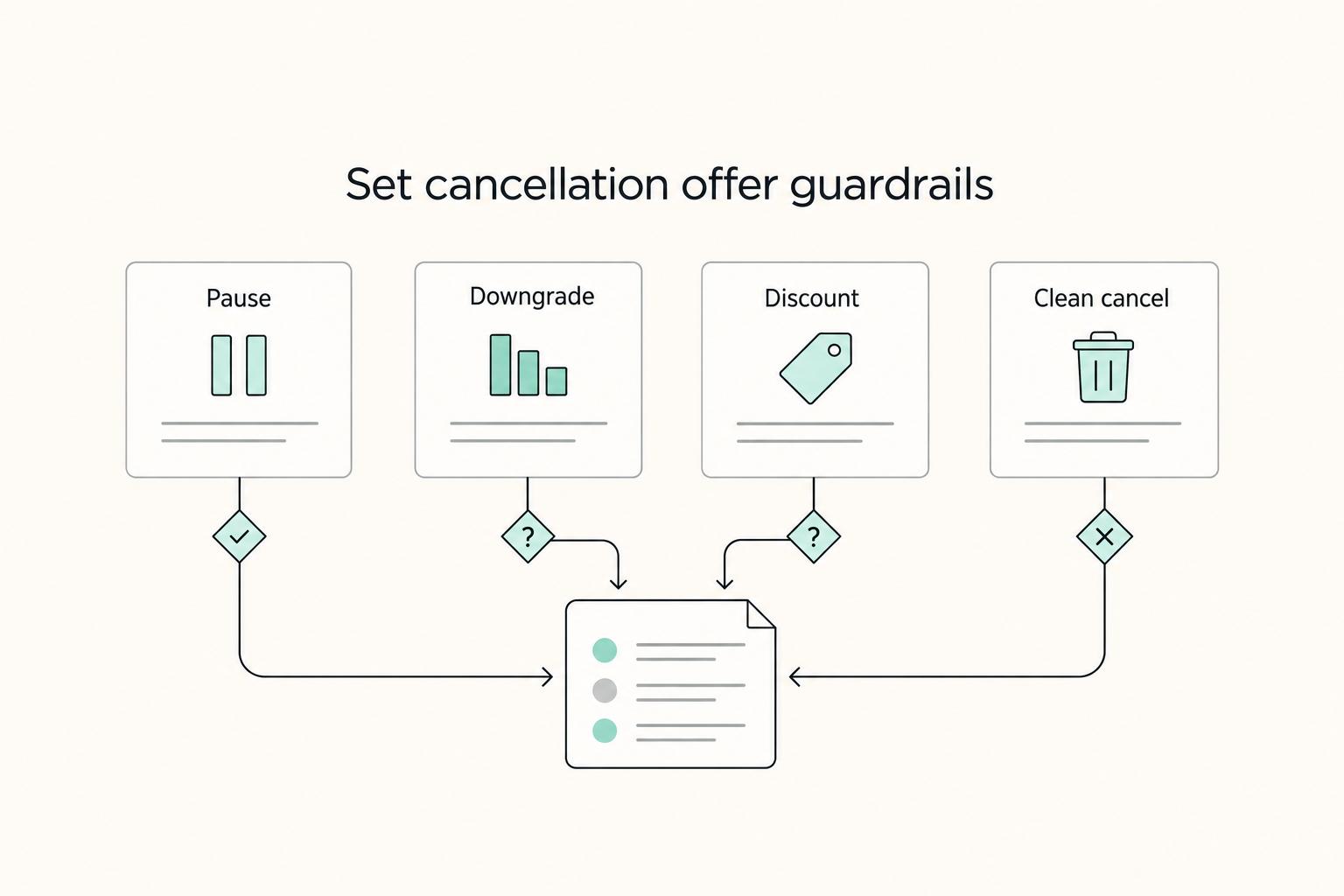
Treat the cancellation flow as a commercial control point, not a last click on the way out. When a subscriber leaves, the loss to recurring revenue does not stop at one invoice. It compounds month after month. Start with an operating question, not a UX question: should you save this customer now, offer a lower-commitment path, or let them go cleanly?