
Quick Answer
Start by treating a subscriber winback campaign as an economics decision, not a messaging project. Prioritize segments with recoverable value, define triggers across cancellation flow and grace period, and cap incentive spend before launch. Use channel roles deliberately, keep one primary CTA per touch, and enforce cooling-off after failed save attempts. The practical pass/fail test is whether recovered MRR clears your margin bar after discounts and delivery cost.
Make the Core Winback Decisions Up Front#
A subscriber winback campaign should optimize recovered value, not activity. Churn is not just a lifecycle problem. It is a unit economics decision: is a former subscriber worth recovering, or should that budget go to new acquisition or low-cost nurture instead? For subscription businesses, every cancellation means lost monthly recurring revenue and sunk acquisition spend, so your response determines whether that value is gone for good or still recoverable.
That matters more when acquisition gets harder. Recurly cites subscription acquisition rates falling from 4.1% to 2.8% between 2021 and 2024, and reports that 20% of new acquisitions come from returning subscribers. That does not mean every business should push harder on winback. It means former subscribers are still part of your revenue market, and they should be judged with the same commercial discipline you apply to paid acquisition or pricing.
So judge winback on recovered value, not surface activity. At its core, a winback email campaign is a series of messages meant to re-ignite engagement and bring past users back into an active segment. That can be useful, but it is not enough. Open rates, click rates, and even reactivation counts can look healthy while recovered value still misses your economics bar after incentives and message costs. A practical checkpoint is simple: before launch, define what a recovered subscriber is worth after incentives and message cost, then set a stop rule for segments that cannot clear that bar.
There is a second benefit worth keeping in view. Winback can also help you identify truly inactive subscribers and clean your list, which helps protect engagement quality over time. That is a real operational upside, but it should not become an excuse to keep mailing low-value accounts indefinitely. A failure mode is treating every former subscriber as equally recoverable and then reading inbox activity as proof of success. The better question is narrower: who is still likely to return to healthy recurring revenue, through which channel, and at what maximum cost?
This section covers concrete decision points for segmentation, timing windows, channel choice, strategic discounts, and verification. Just as important, you will get clear stop rules so the effort improves MRR instead of turning into a vanity exercise dressed up as re-engagement. Related reading: How to Read a Balance Sheet for Freelancers and Small Teams.
Define what a subscriber winback campaign is trying to optimize#
A subscriber winback campaign should optimize recovered value, not just activity. It is a targeted re-engagement effort for churned subscribers or inactive users, triggered by behavior rather than a bulk calendar send, with the goal of guiding the right users back into active engagement.
| Stage | When it applies | Primary job |
|---|---|---|
| Cancellation flow | Before the account fully exits | Prevent churn before the account fully exits |
| Grace period | After exit intent is signaled but recovery is still possible | Recover value after exit intent is signaled but recovery is still possible |
| Reactivation campaign | After a true lapse, often defined by inactivity windows such as 30, 60, or 90 days | Re-engage former subscribers after a true lapse |
Keep these jobs separate so targeting, offers, and measurement do not blur:
- Cancellation flow: prevent churn before the account fully exits.
- Grace period: recover value after exit intent is signaled but recovery is still possible.
- Reactivation campaign: re-engage former subscribers after a true lapse (often defined by inactivity windows such as 30, 60, or 90 days).
Use one primary score: recovered net contribution to MRR. Treat opens, clicks, and raw reactivation counts as diagnostics, not the outcome. Before launch, confirm your triggers can distinguish cancelers from inactive users and set a clear ceiling on message and incentive cost.
If your team cannot clearly name who should not be won back, the segment is not ready. Broad, discount-led winback can erode trust and train subscribers to wait for offers, turning recovery into a margin problem.
You might also find this useful: Customer Winback Economics: When Re-Acquiring Churned Subscribers Costs Less Than New Acquisition.
Prioritize who is worth winning back before you write a single email#
Decide who is worth trying to recover before you build copy or offers. If you skip triage, win-back turns into blanket outreach and weak unit economics.
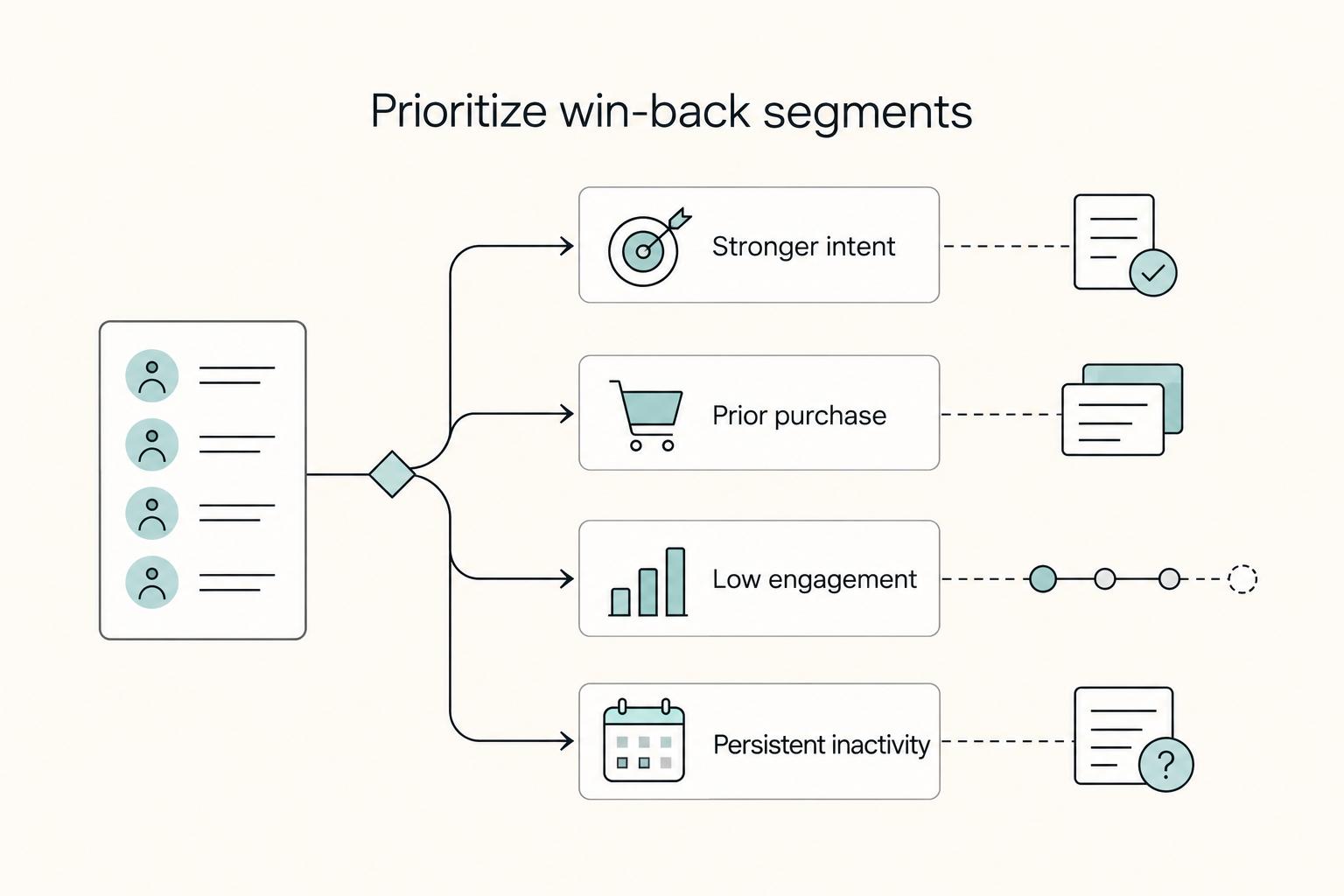
Start with a practical segmentation matrix so canceled users and inactive users are not treated as one audience. Build segments from signals you can verify in your own data, such as cancellation reason, tenure, prior expansion potential, and prior response to CTA. Win-back works better as a system of segmentation and trigger-based outreach than as one generic "we miss you" send.
Build the matrix#
Keep the framework simple and auditable. For each segment, define the likely cause, default channel, offer approach, and stop condition before launch.
| Segment | Likely cause | Recommended channel | Offer ceiling | Stop condition |
|---|---|---|---|---|
| Canceled users with stronger prior engagement signals | Plan mismatch, value gap, or price sensitivity | Triggered email sequence with reason-specific copy | Set a pre-approved maximum incentive | Stop when no meaningful response after the planned sequence |
| Inactive users with prior engagement history | Habit decay or lost relevance | Triggered email; add product touchpoints only if activity still exists | Start without discount; escalate only if justified | Stop incentive spend if re-entry signals do not appear |
| Low-engagement churned users | Weak fit or poor activation | Low-cost nurture only | Minimal or none | Suppress quickly if no action |
| Persistently inactive users | True dormancy | Final low-cost touch, then cleanup | None | Remove from active recovery flows |
Treat cancellation and inactivity differently. Cancellation is an explicit signal; inactivity is inferred, so it usually needs lower-cost testing before you spend incentive budget.
Set spend stops before launch#
Apply one rule across all segments: if expected recovery margin is worse than your reacquisition alternative, suppress discounts and move that segment to low-cost nurture. Reactivation can be cheaper than new acquisition in many cases, but that does not make every churned segment worth subsidizing.
A useful control is to approve three items per segment up front: the trigger, the maximum offer, and the stop condition. That keeps spend tied to recoverable segments and makes "no win-back" a valid outcome when the economics are weak.
If you want a deeper dive, read Win-Back Campaigns for Platform Operators: How to Re-Engage Churned Subscribers Automatically.
Set timing windows and behavioral triggers that match subscriber intent#
Set timing by intent state, then suppress overlap so one subscriber is not hit by conflicting winback messages. Behavior-led messaging works best when it responds while the signal is still relevant, so each trigger family needs a clear job.
| Trigger family | Intent signal | Message job | Control check |
|---|---|---|---|
| In-app risk signals | Friction or drop-off behavior before cancellation | Reinforce value or remove the likely objection while intent is still active | Confirm this is a real behavior signal, not a noisy proxy |
| Auto-renew cancellation | An explicit choice to stop | Address the stated reason and present the clearest next step | Confirm cancellation reason is captured in a usable field |
| Grace period expiry | Account is near or at access loss | Clarify account status and the path to recover access | Confirm state updates correctly if payment is resolved |
| Post-lapse inactivity | No meaningful return after lapse | Test for remaining demand before incentive spend | Use a consistent inactivity window (for example, 30, 60, or 90 days) |
Control urgency by tier, not by channel habit#
Define urgency tiers first, then map channels to those tiers. Use email as the anchor, and only add more touches when the response signal justifies it. The key safeguard is suppression logic: if intent changes, the newer trigger should pause or replace the older path.
Escalate by changing the angle before adding incentives#
When early touches do not get engagement, change the message angle first. Move from reminder to objection handling, or from broad value to a simpler CTA. This protects margin and gives you cleaner evidence about whether the blocker is relevance, price sensitivity, or low intent.
For repeat churn-return cycles, do not restart the same reactivation campaign from step one. Check what path was already used, suppress duplicate copy, and require a different angle or a cooling-off rule before re-entry.
For a step-by-step walkthrough, see How to Set Up Your First Google Ads Campaign.
Choose channels by recoverability not by team habit#
Choose the channel based on where a response is still most likely, not on team habit. In practice, that usually means in-app messaging for active but at-risk users, email for more considered decisions, and SMS for urgent grace-period recovery, with push used selectively.
Recovery is naturally cross-channel because people move between email, text, and apps. Treat orchestration as role clarity: each channel should do a different job. If multiple channels deliver the same message at the same time, you are duplicating effort instead of improving recoverability.
Match the channel to the remaining intent#
| Channel | Use when | Notes |
|---|---|---|
| In-app messaging | Product intent is still live and the user is active in the app | Use for active but at-risk users |
| Decisions are more deliberate and need fuller context | Use for more considered decisions | |
| SMS | The reminder is time-sensitive and needs one clear action | Use for urgent grace-period recovery |
| Push notifications | Timely reminders in mobile-centric programs | Use carefully when brevity could strip needed context |
- In-app messaging: Use when product intent is still live and the user is active in the app.
- Email: Use when decisions are more deliberate and need fuller context.
- SMS: Use for time-sensitive grace-period reminders with one clear action.
- Push notifications: Use carefully for timely reminders in mobile-centric programs, especially when brevity could strip needed context.
Add one checkpoint before assigning a channel#
For each segment, ask: Where does this user still show intent? Then verify the signal is current and the channel is reachable before entry into that path. If reachability is weak, move the segment to a lower-cost recovery lane instead of forcing the same sequence.
Make channel conflict rules explicit#
Set suppression rules so channels do not undermine each other. If email is carrying the longer value case, suppress generic push on the same trigger until email has time to work. Also confirm channel availability and consent coverage by market or program before launch, since coverage can vary.
Build an offer ladder that protects margin and brand#
Use a value-first offer ladder, and treat discounts as a later step, not your opening move. Broad promotions can lift short-term response but also train subscribers to wait for the next coupon instead of returning for product value.
Start with a value reminder and clear relevance before any strategic discount. For many churned users, the first recovery message should focus on why the product is still useful to them and match the reason they went inactive, rather than assuming price is the blocker. Reactivation can be cheaper than new acquisition, but that does not make every paid save offer worth it.
Start with a three-step ladder#
Escalate only when the prior step fails, and only where unit economics support it:
- Step 1: No-incentive recovery
Lead with value, relevance, and one clear next action. Tailor the message to the lapse reason so low-usage and billing-friction users are not handled the same way.
- Step 2: Low-cost incentive
If value-first does not convert, move to a narrow perk or targeted code instead of a blanket price cut. Personalized promo codes can protect margin by limiting discounts to users who appear to need one to convert.
- Step 3: High-cost save offer
Reserve richer offers for a small, explicitly eligible segment. If eligibility is loose, exceptions expand until the exception becomes policy.
Put the guardrails in writing#
Offer ladders fail when exceptions are improvised. Write the rules down and enforce them:
- maximum discount depth
- maximum touches in one reactivation cycle
- mandatory cooling-off after a failed reactivation path
Cooling-off is especially important. If someone ignores or declines the high-cost step, immediate re-entry into the same discounted lane reinforces delay behavior and weakens price integrity.
Before any discounted path opens, verify the user still fits the intended segment. A practical check is lapse window, prior response history, and recent incentive exposure. If your targeting uses a 60-120 day lapse window, confirm the user is actually in that window before issuing an offer.
Match offer richness to value#
| Scenario | Offer bias | Stop rule |
|---|---|---|
| High-LTV annual churn | Use a richer save path only after value-first recovery fails | Stop after the high-cost step fails, then apply cooling-off |
| Low-LTV monthly churn | Keep incentives tight and suppress faster | If no response after the low-cost step, end the discount path quickly |
| Repeat promo-responsive users | Prioritize perks, feature clarity, or no-incentive recovery | Do not escalate discount depth just because past coupons converted |
If you use one operating rule, use this: make the richest offer the hardest to qualify for. That protects margin and reduces coupon-conditioning over time.
Related: How to Build a Cancellation Flow That Saves Subscribers: Pause Downgrade and Win-Back Tactics.
Write the sequence and CTA logic so each touch has one job#
Once your offer ladder is set, execution is message discipline: each touch should do one job. In a sequence, that usually means one argument and one primary CTA per message so you can see what moved the subscriber and what did not.
A practical flow is to assign roles by step: reminder, objection handling, value proof, then a selective offer. Early messages do not need to close immediately. Use the first touch to re-establish relevance, then handle likely objections, then show what changed or what the subscriber missed; escalate to the richer save path only for the segment that qualifies.
Make the CTA path progressive, not repetitive#
Your CTA path should move forward with intent:
- Resume plan for subscribers ready to return now
- Change plan when fit, commitment, or price is the barrier
- Confirm cancellation when recovery is unlikely and you need a clean exit
Keep channel roles clear in a hybrid flow: SMS can do visibility work, while email carries the fuller narrative. Repeating the same generic CTA across every touch makes intent harder to read.
Turn cancellation reasons into copy blocks#
Personalization should change the argument and the destination, not just the greeting. Build a simple map for each reason you capture: reason, message angle, proof point, CTA, and landing page.
| Reason | Lead with | Copy note |
|---|---|---|
| Price-sensitive | Change plan | Before discount language |
| Low-usage | Value proof | Before offer depth |
| Billing-friction | The account-action path | Not broad marketing copy |
- Price-sensitive: lead with
change planbefore discount language - Low-usage: lead with value proof before offer depth
- Billing-friction: lead with the account-action path, not broad marketing copy
If you use a 90-day engaged email segment, plan for lapsed subscribers who may miss much of a month-long sequence and rely more on SMS visibility.
QA the failure points before launch#
Before launch, check the failure modes that usually break execution:
- Every CTA link resolves to the intended destination for that segment
- No template still contains expired offer language or old dates
- If your product uses a grace period, copy matches the account state users will actually see
- Each cancellation-reason value maps to the right copy block, with a fallback for blank or unknown values
Set ownership, instrumentation, and verification checkpoints#
Set ownership and validation checkpoints before you scale a subscriber winback campaign; otherwise performance signals get harder to trust.
Assign clear owners across lifecycle, product, and finance for each stage, including who can approve strategic discounts. Cross-functional collaboration improves adaptability, but only when responsibilities and decisions are explicit.
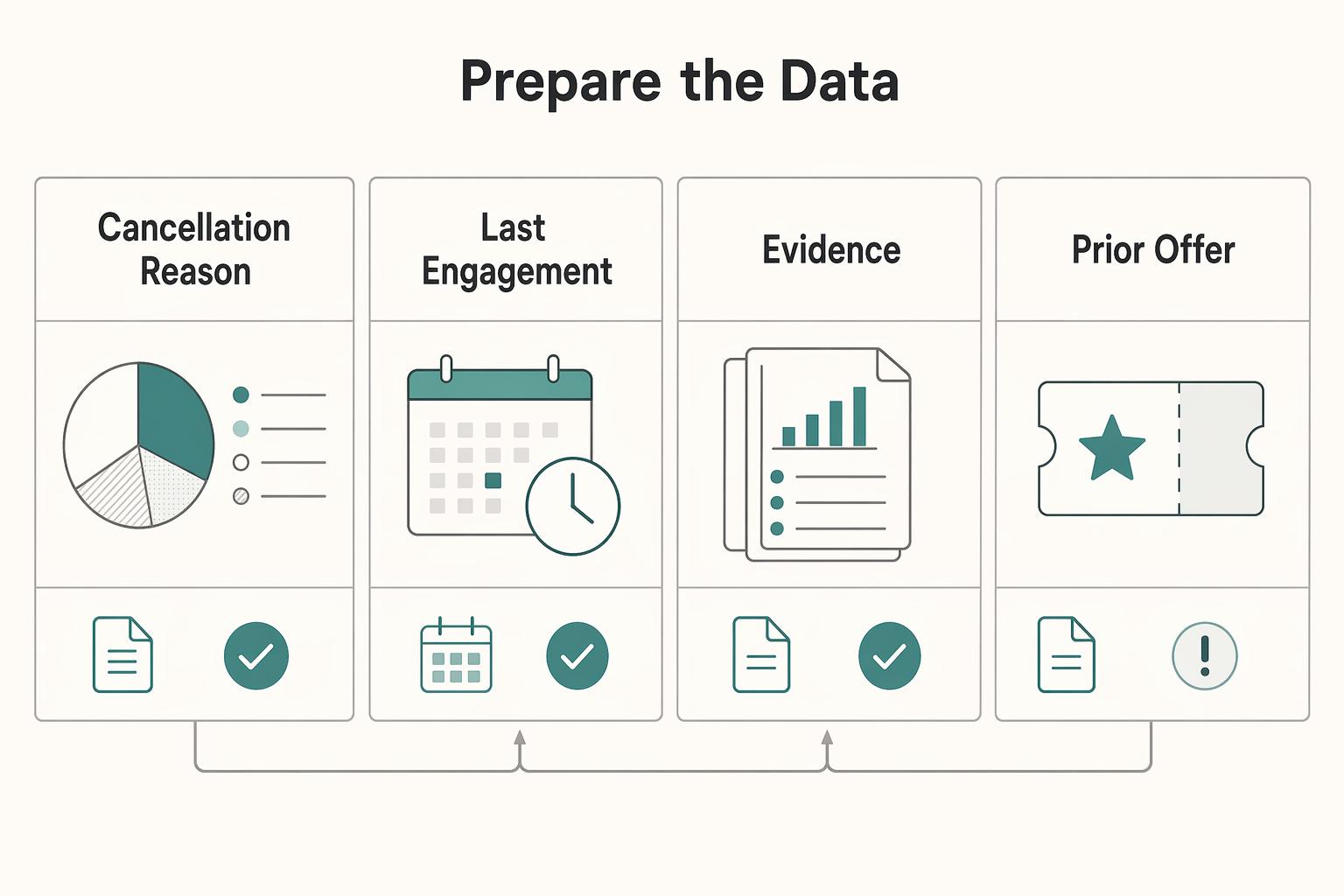
Keep one versioned evidence pack so changes are traceable:
- segment definition version
- trigger logic
- offer rules
MRRrecovery review cadence and outputs
Before scaling, verify execution mechanics first:
- behavioral triggers fire on the intended events
- channel deliverability is healthy for the target segments
- holdout comparisons are reviewed by segment, not only in aggregate
For global programs, document where market or program rules differ, then confirm rollout with legal and compliance before broad release. Validation will not guarantee outcomes, but it improves your odds of scaling what actually works.
Conclusion#
The core decision is simple: treat revenue recovery as the primary test of a win-back campaign, not just clicks, replies, or brief reactivation. Churn is inevitable, and Shopify's warning is blunt: unless you do something, some lapsed customers may never buy from you again. That does not mean every lost customer should get the same recovery sequence.
The practical way to make winback work is to make it boring in the best sense. Set segment priority first, then lock trigger timing, channel logic, and offer guardrails before anyone writes copy. A win-back campaign is a sequence of emails, texts, or notifications designed to reengage a previous customer. It becomes dependable when those messages sit inside clear business constraints instead of team instinct.
One detail matters: keep behavioral messaging separate from offer decisioning. Adobe treats those as different jobs for a reason. Behavioral signals can tell you what content, product, or benefit to surface across web, in-app, or email, while offer decisioning should stay bounded by eligibility rules and business constraints. If you blur the two, you can misapply incentives based on engagement signals instead of eligibility rules.
Your next move should be operational, not creative:
- Build the segment decision table first. At minimum, include segment, lapse definition, preferred channel, incentive ceiling, and stop rule.
- Build the trigger map second. Specify which event starts outreach, which channel fires first, and what condition moves a customer to the next step.
- Launch one controlled cohort before broad rollout. That gives you a clean checkpoint to verify that the trigger actually fired on the intended lapse event and that your eligibility rules matched the audience you meant to target.
A grounded example helps here. Shopify gives a six-month inactivity window as one possible trigger for reactivation outreach. Treat that as a reference point, not a universal rule. If your annual subscribers naturally buy less often, six months may be early. If your monthly plan has a tight renewal cycle, it may be far too late.
A common failure mode is ad hoc execution: overlapping channels, no proof of who qualified for an offer, and no stop condition when recovery stops making economic sense. If you cannot point to the document that defines the lapse trigger, the eligible audience, and the incentive rules, you are not ready to scale.
So keep the final test plain. If the sequence brings inactive customers back to regular purchases and supports revenue goals, expand it. If it only inflates reactivation counts while eroding price integrity, fix the table, the triggers, or the offer rules before you send another round.
Frequently Asked Questions
When should a subscriber winback campaign start after cancellation?
There is no single right delay for every business. For inactivity-based audiences, Braze describes common windows like 30, 60, or 90 days, while Attentive triggers winback journeys only after at least 45 days with no purchase, and that minimum is not editable. The practical rule is to align timing to the lapse definition for that segment rather than assuming one universal delay.
Should we use discounts immediately or wait?
Not always immediately. There is no one-size-fits-all playbook, so start with the approach that fits the segment and test whether a non-discount message works before adding an incentive.
Which channel should we start with first: email, SMS, push, or in-app?
Do not hard-code one universal first channel. Klaviyo's guidance is straightforward: the best channel depends on your audience and message, and SMS can be immediate but more expensive because you send to all engaged SMS subscribers. A good checkpoint is simple: start where that segment is most likely to respond, then test.
How many win-back messages are too many?
If you keep adding touches without a new angle, you are usually creating noise, not recovery. Attentive's default structure is a restrained example: two messages separated by a 15-day wait step, and it also caps daily journey entry at 1% of total subscribers. If you are exceeding that kind of pacing, have a reason tied to segment performance, not team habit.
How do we decide which churned subscribers are worth pursuing?
Start with people who have actually purchased before. Attentive excludes never-purchased subscribers from its winback journey logic, which is a useful guardrail if your team is mixing prospect re-engagement with true reactivation. Then rank by prior value and engagement, since subscribers with few, infrequent, low-value transactions are often treated as at risk but may not justify costly offers.
What should we measure besides open and click rates?
Track actual recovery outcomes, such as reactivation or purchase, by segment. Also verify that results are being read against the intended lapse definition (for example, 30/60/90-day inactivity windows or an at-least-45-day no-purchase trigger in Attentive). A rising open rate with flat recovery is a signal to revisit the approach.
When should we stop trying to win back a subscriber?
Stop after the planned sequence fails, when the subscriber no longer has a usable channel, or when expected recovery no longer justifies additional outreach. Put a cooling-off period in place after a failed reactivation attempt so repeat churn-return users do not get the same sequence over and over. If you cannot name the stop rule before launch, the campaign will tend to drift into unprofitable follow-up.
Try a related tool
Researched and edited by the Gruv editorial team. Gruv builds cross-border billing, payouts, and finance-operations software for global businesses.
Sources
Includes 6 external sources outside the trusted-domain allowlist.
- academia.edu/44881681/Internship_Report_on_Customer_Life_...trusted
- govinfo.gov/content/pkg/CHRG-114shrg23397/html/CHRG-114s...trusted
- 3l3c.ai/blog/ai-in-retail-e-commerce/online-discount...external
- attentive.com/blog/triggered-email-marketing-strategyexternal
- braze.com/resources/articles/what-is-a-win-back-campai...external
- braze.com/resources/articles/cross-channel-engagement-...external
- cartboss.io/blog/customer-reactivation-strategiesexternal
- experienceleague.adobe.com/en/docs/blueprints-learn/architecture/use-ca...external
Educational content only. Not legal, tax, or financial advice.
Related Posts
Win-Back Campaigns That Reactivate Churned Subscribers Without Margin Loss
Assume from the start that a win-back flow can lift reactivations and still be a bad trade. If you do not measure what those returns cost in incentives and short-term re-churn, you can end up celebrating activity that does not help the business.
Build a Cancellation Flow That Saves the Right Subscribers
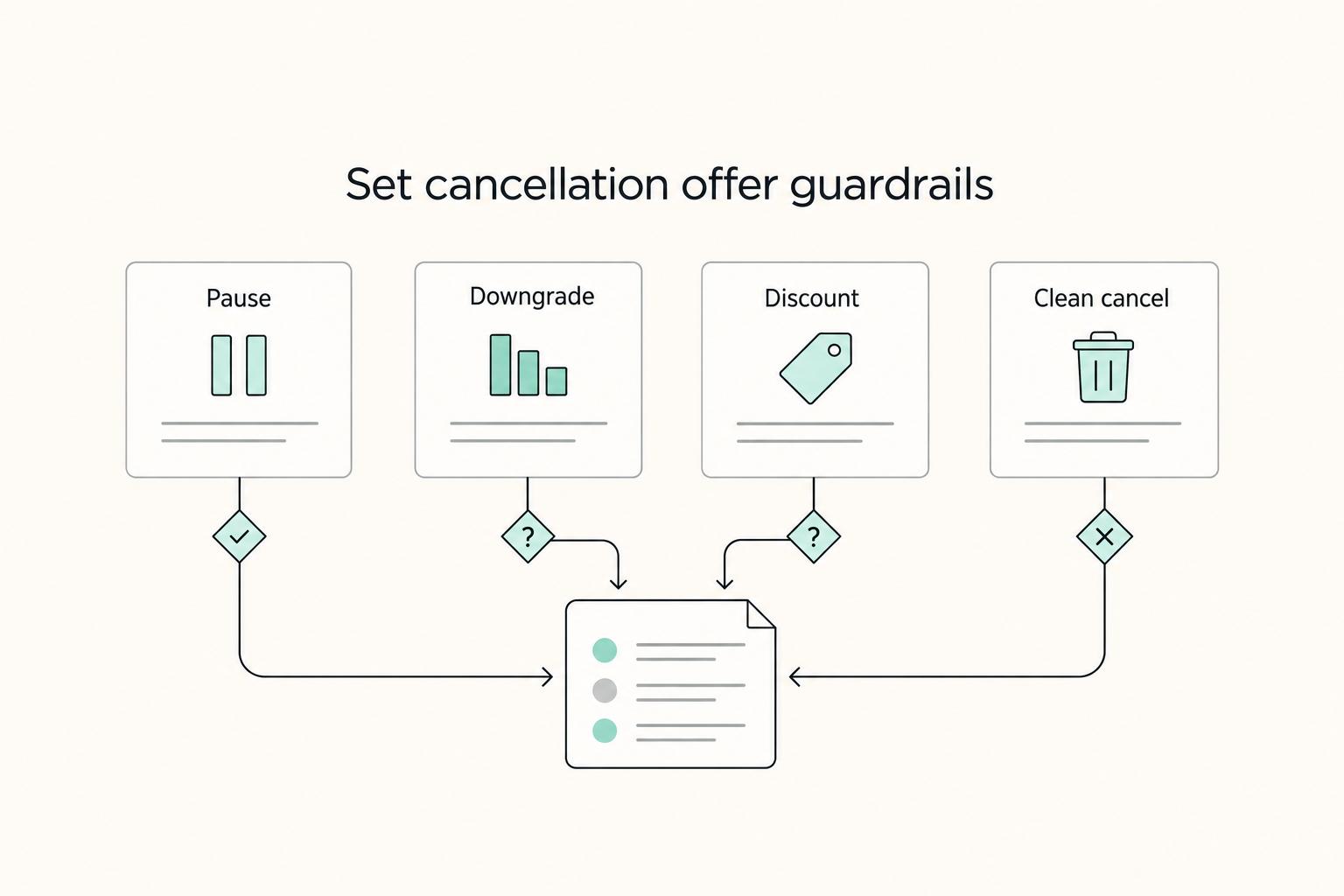
Treat the cancellation flow as a commercial control point, not a last click on the way out. When a subscriber leaves, the loss to recurring revenue does not stop at one invoice. It compounds month after month. Start with an operating question, not a UX question: should you save this customer now, offer a lower-commitment path, or let them go cleanly?
When Reacquiring Churned Subscribers Costs Less Than Net-New Growth
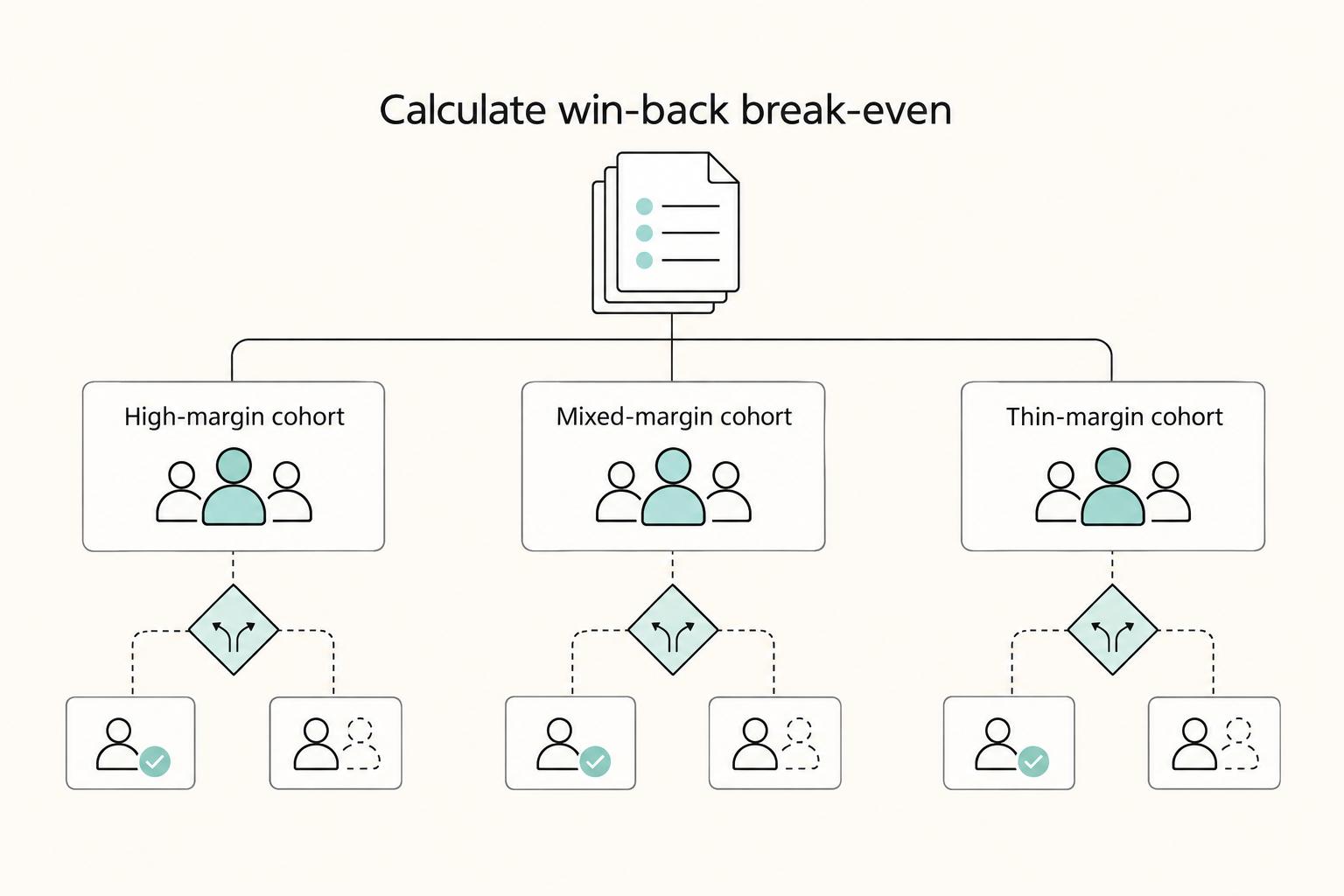
Reactivation volume is easy to celebrate. Recovered margin is the harder test, and it should decide whether you keep spending. A winback effort is only worth funding when the expected net contribution from a returned subscriber is better than what the same budget could earn through a comparable net-new path.