
Quick Answer
Keep cancellation visible, surveys skippable and offers optional. Confirm whether the request cancels now or at a future date, including billing and access effects. Compare matured subscription outcomes with a randomized clear-cancel control to see whether offers create profitable paid retention.
What the Cancellation Flow Should Optimize For#
Step 1 Reframe cancellation as a revenue decision#
When a subscriber asks to cancel, provide a direct path to submit that request. A relevant pause or lower plan can be useful, but accepting an alternative is the customer’s choice. The commercial decision is which optional offer to show, never who is permitted to leave.
Define who is eligible for each offer while keeping a clear cancellation action available to everyone. Surveys and offers must be skippable. A reason can improve the recommendation, but a missing reason cannot prevent the request.
Step 2 Separate selective saves from forced saves#
Some customers will prefer an alternative; others want to leave. Respect either choice and measure whether an accepted offer produces durable paid retention rather than another cancellation next month.
Separate offer eligibility from cancellation eligibility. The first depends on your plan and commercial rules; the second must not depend on answering a survey, viewing an offer or being judged worth retaining.
Store request acceptance separately from the effective cancellation date, billing stop and access end. For period-end cancellation, access may continue until the paid-through date even though the request is already confirmed. Any attempt to reverse it requires the customer’s explicit choice.
Step 3 Anchor the work in measurable outcomes#
Measure this work with a small set of outcomes that finance, product, and lifecycle teams can all recognize: Save rate, Monthly Recurring Revenue (MRR), true cancel completion, and what happens after cancellation. If you cannot verify which path a subscriber took and what happened next, you cannot tell whether the flow improved retention quality or just delayed churn.
One early failure mode is poor off-boarding. Companies that underinvest in reactivation and create a bad exit experience can lose customers permanently. The standard is not "add more prompts." It is "make each branch deliberate, measurable, and respectful." Once that standard is in place, lock the inputs before you change the flow.
What to prepare before you change the cancellation flow#
Lock your measurement and policy inputs before you touch the flow, or you will not trust what changed.
Step 1 Pull one baseline everyone uses#
Pull one shared baseline for the cancellation metrics you plan to manage, for example: Voluntary churn, Save rate, Pause uptake, Downgrade conversion, and Winback recovery rate. Use the same segments and definitions across teams. Store the query logic with the extract so product, billing, and lifecycle are reading the same outcomes.
Run a simple trace test on one recent account from cancel intent to final billing outcome. If you cannot tell the branch path and reactivation outcome, fix instrumentation first.
Step 2 Confirm Billing and Cancellation Policies#
Document when cancellation takes effect, what happens to access and renewal, how existing usage or invoices are handled, and any applicable refund entitlement. Check the relevant jurisdiction and contract requirements before launch. Apply the correct tax treatment to credits, refunds and plan changes in the billing workflow.
Step 3 Clean reason data and assign one owner#
Export top reasons from your exit and post-cancellation surveys, then map them into routing buckets your flow can act on, such as temporary no-need, price mismatch, and missing capability. Free-text-only reasons create inconsistent decisions and weak save logic.
Assign one owner for instrumentation across product, billing, and lifecycle messaging before launch. Once event names and outcome codes are stable, you can set economic rules with less guesswork. If you want a deeper dive, read Cancellation Flow Design for Subscription Platforms.
Set economic guardrails before you offer pause or discounts#
Judge an offer by incremental contribution over a fixed horizon after discounts, refunds, servicing and outreach costs. Keep cancellation directly available regardless of the result. A high immediate acceptance rate can conceal low-margin renewals or delayed churn.
Step 1 Tie save attempts to retained value#
Historical acquisition cost is already spent; it does not justify a new retention discount. MRR is a revenue measure, not retained profit. Compare expected future contribution with and without the offer using comparable account populations and the same horizon.
For an illustrative 90-day offer test, treatment yields $1,200 of contribution after discounts, service and refunds, versus $1,000 for an equally sized randomized control. If extra offer and outreach costs are $150 and were not already included, incremental contribution is $50. Do not count the $1,200 as all caused by the offer or subtract those costs twice.
Trace one recent cancellation through the billing schedule and contribution calculation. Deferred revenue is normal for prepaid service; its presence alone says nothing about whether an offer works. Investigate inconsistent recognition or cash assumptions, underestimated refunds, and incremental contribution below the agreed target.
Step 2 Write explicit eligibility rules for each offer#
Set offer rules from plan, billing cycle and existing discount status. Use a voluntarily supplied reason when available. If the customer skips the survey or declines the recommendation, proceed with cancellation.
| Offer path | Use when |
|---|---|
| Pause subscription | Temporary no-need or short-term budget pressure |
| Plan downgrade | Sustained price-value mismatch or clear overbuy |
| Discount | The customer still fits and is not already deeply discounted |
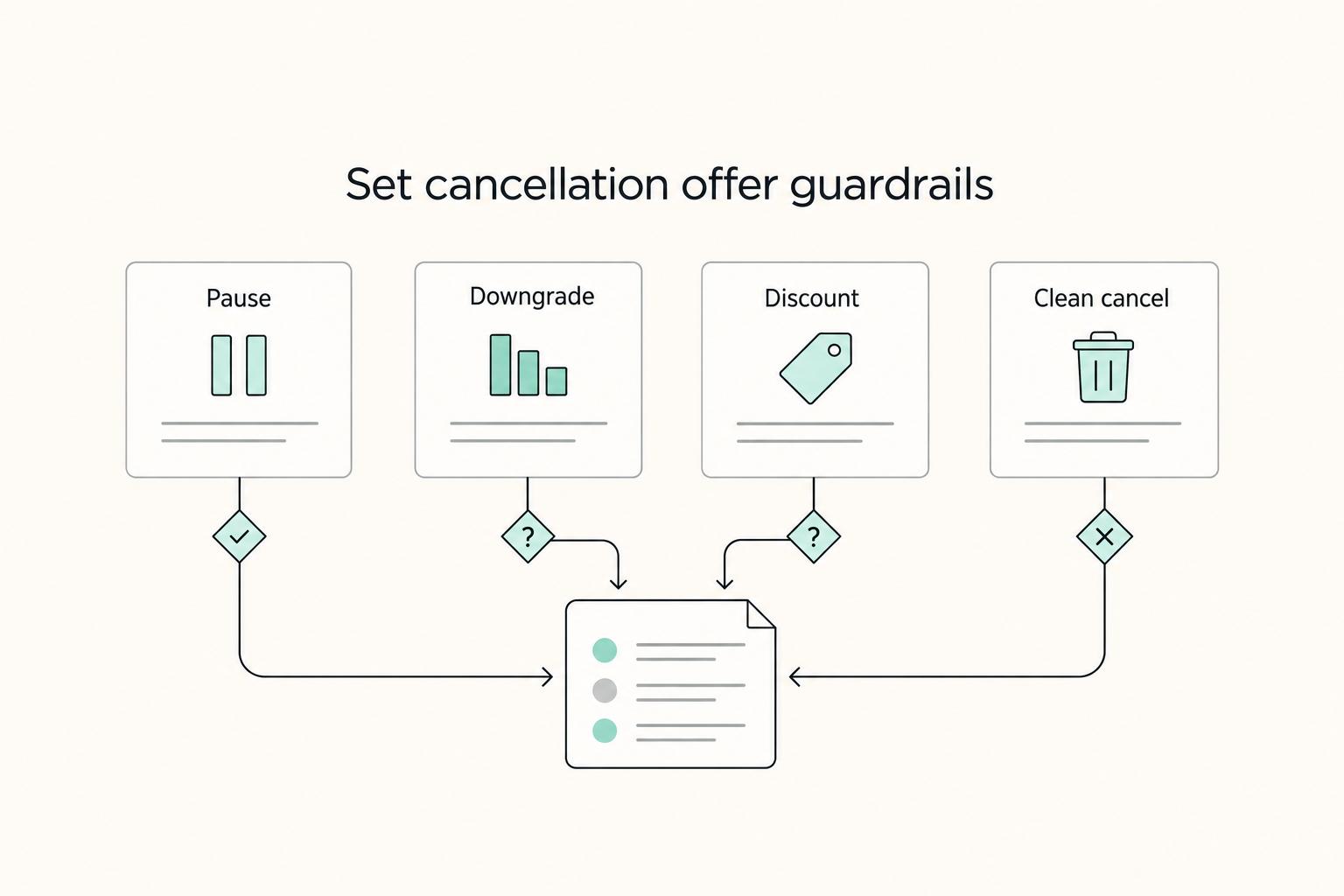
| Clean cancel | Available at every branch; no offer or survey acceptance required |
Choose stacking limits from measured economics and fulfillment rules. An existing discount need not automatically force a pause; show only an eligible, useful alternative and let the customer cancel.
Step 3 Get finance sign-off on timing changes#
Use a lightweight finance review for pause or downgrade paths that change recognition timing, refund exposure, or reactivation assumptions. The goal is alignment across commercial logic, billing treatment, and reporting before launch.
Keep the sign-off to one page: offer design, billing effect, refund handling, and expected reporting outcome. Validate one test account across billing, support guidance, and dashboard metrics; if those disagree, your "retention gain" is not decision-ready.
Build the minimum cancellation architecture in the right order#
Capture cancel intent, then provide direct request submission alongside any optional reason question and relevant alternative. Confirm the chosen action with its effective date and billing/access consequences. Any post-cancellation survey and later winback contact are optional follow-up.
| Flow step | What to do |
|---|---|
| Cancel intent | Record the start without blocking direct cancellation |
| Optional reason | Accept reason_skipped and continue |
| Optional alternative | One eligible offer with plain terms and a direct cancel action |
| Confirmation | Confirm request acceptance, effective date, billing/access consequences |
| Follow-up | Optional survey and appropriately suppressed lifecycle handoff |
Step 1 Capture intent and reason before any save offer#
Ask for a reason once and make skipping explicit. Temporary non-use may suggest a pause; a price mismatch may suggest a lower plan. Keep the cancellation action available regardless of the answer.
Log either the supplied reason or reason_skipped. A skipped reason is a valid outcome, not an error that delays cancellation.
Step 2 Show one relevant alternative, then keep cancellation clear#
Show at most one relevant alternative with clear price, duration, access and restart terms. The customer can decline it and submit cancellation immediately. A failed or timed-out offer must not silently remove an already accepted cancellation request.
Keep friction low, avoid hidden paths, and make outcomes legible on screen. Where EU Consumer Rights Rules may apply, route live UX and copy through legal or compliance review; use one clear internal reference path such as How to Build a Compliant Cancellation Flow Under EU Consumer Rights Rules.
Step 3 Log each step as auditable events with outcome codes#
Record cancel intent, optional survey response or skip, offer decision, request acceptance, scheduled effective date, provider confirmation, billing stop and access end as separate events. A button click or local confirmation is not proof that the billing system scheduled the requested change.
Retain the durable cancellation request and reconcile it with the provider state. On a timeout, query the original operation before retrying; deduplicate local effects and preserve the customer’s request during recovery. Confirm completion only when the intended change is authoritative, and give unresolved cases an owner without continuing renewal by default.
Step 4 Define lifecycle handoff and suppression conditions#
Send lifecycle the confirmed outcome and dates: pause scheduled or active, downgrade scheduled or effective, cancellation scheduled or effective. Do not collapse those into a single final state. Suppress winback while cancellation or an offer operation remains unresolved.
Define suppressions up front. If pause or downgrade is accepted, suppress immediate winback; if refund, trust, or unresolved support issues are open, suppress promotional outreach until resolved.
Choose pause, downgrade, or cancel with explicit decision rules#
Use the stated reason to recommend an optional action. A temporary need gap can suit pause, sustained price mismatch a downgrade, and trust-related exits no save attempt. Direct cancellation remains available in every branch.
Step 1 Define the decision scope before you map offers#
This logic is for voluntary churn: the customer intentionally chooses to cancel. If a subscription ends because of failed payment or billing error, treat it as involuntary churn and handle it in a different flow.
Capture one optional structured reason and optional detail. Use reason_skipped when the customer declines to answer, then complete the requested action.
Checkpoint: each cancel attempt should log one clear reason state, including a catch-all like reason_other when no mapped offer fits.
Step 2 Map each Churn intent to one default action#
Recommend one best-fit action based on the stated reason, and keep cancellation obvious.
| Churn intent from Exit survey | Default action | Retention and margin tradeoff |
|---|---|---|
| Temporary inactivity or "not using it right now" | Pause subscription | Can retain the customer without resetting them to a lower price point, but may only defer churn if terms are unclear. |
| Sustained price-value mismatch or clear overbuy | Plan downgrade | Better aligns plan-to-usage than a blanket discount, but retained revenue is lower. |
| Trust broken, unresolved service issue, refund conflict, or strong frustration | Cancel now | Protects trust; forcing a save attempt can make recovery harder. |
| No mapped offer fits | Direct cancel; optional later survey | Lower immediate saves, but often better trust protection and better recovery input. |
Step 3 Add implementation guardrails and a clean fallback#
Define guardrails by billing setup and product constraints before launch, then test each path with real accounts. Do not show a Pause subscription option until your current configuration supports it end to end.
Test the actual provider and account state against the promised dates. If an offer fails, keep the prior cancellation request or complete the customer’s cancellation choice rather than labeling the account saved.
Design retention offers that protect margin and trust#
Design each retention offer to solve one clear problem while protecting margin and execution reliability. In practice, the best offer is the one that fits the stated pain, preserves contribution margin, and works cleanly in your recurring-billing setup.
Match each Personalized retention offer to one dominant pain. Use a tight mapping: budget pressure to a lower-priced option, low near-term usage to Pause subscription, and feature mismatch to Plan downgrade only when the lower plan fits actual usage. Avoid a blanket discount across all reasons; it can subsidize organic demand and erode margin when control performance is close.
Define discount, credit, refund and reactivation interactions before launch. Commercial stacking limits cannot remove an applicable refund right or obstruct cancellation.
- Can this offer combine with existing discounts or credits?
- What happens if a refund is requested after acceptance?
- On reactivation, which plan and pricing apply?
- How does a failed offer preserve or complete the cancellation request?
Use copy that says exactly what will happen. Use plain labels: "Pause subscription," "Move to lower plan," or "Cancel now." Under each option, state the immediate consequence in one sentence and restart terms in another, including access, billing change timing, and reactivation behavior.
Remove vague promise language. If pause ends access now but billing resumes later, say so. If downgrade changes features at renewal, say that directly.
Validate fulfillment with billing and support before launch. Do not ship a save path your stack cannot execute consistently. Billing, compliance, and integration constraints can break offers at scale, so verify state transitions with billing and confirm support macros plus exception handling before rollout.
Instrument the KPI stack and prove causality#
Instrument measurement before rollout. If you cannot separate a true save from a delayed cancel, flow performance will look better than it is.
The objective is decision quality, not dashboard volume. Use a compact KPI stack that shows what changed, for which segment, and with what downstream account state.
Count distinct subscriptions in a defined cohort, rather than event clicks. The following 90-day horizon is illustrative; choose and freeze one that captures renewals for your product. Separate immediate option uptake from durable paid outcomes and report cohorts that have not yet matured.
| Metric | Cohort and denominator | Qualified outcome |
|---|---|---|
| 90-day paid retention | Distinct eligible subscriptions assigned at cancel intent | Paid and active at day90, with no pending cancellation; report treatment versus control |
| Pause uptake | Subscriptions shown an eligible pause offer | Provider-confirmed pause scheduled or active; report separately from later paid resumption |
| Downgrade conversion | Subscriptions shown an eligible downgrade offer | Lower plan actually effective by the specified date |
| Request completion | Distinct subscriptions submitting cancellation | Confirmed immediate cancellation or scheduled effective cancellation with renewal stopped as promised |
| Winback recovery | Effectively cancelled subscriptions eligible for the declared campaign cohort | Qualifying paid reactivation within90days of effective cancellation; contacted rate reported separately |
For each metric, retain the cohort date, denominator, observation horizon and source query. Use one cancellation episode per subscription within the declared window, and report missing outcomes rather than silently dropping them.
Break KPIs by segment, plan type, and offer path. Do not rely on one aggregate save number. Split performance by segment, plan type, and path shown so you can distinguish real retention from temporary deferral.
Break results out by randomized assignment as well as offer shown and accepted. Branch-only comparisons can confuse customer intent with the effect of the offer.
For winback, freeze a cohort of effectively cancelled subscriptions and measure a qualifying paid return within the declared horizon from that date. Report contacted and all-eligible denominators separately; a return without evidence of exposure is not automatically attributable to a message.
Randomly assign comparable eligible subscriptions at cancel intent to the offer flow or a clear-cancel control. Preserve that assignment in analysis whether or not the customer accepts the offer. Compare matured paid retention and incremental contribution over the same horizon, with cancellation completion, refunds, complaints and support effort as guardrails.
Common mistakes and how to recover fast#
If your Exit survey labels are broad, treat intent as uncertain and rework the buckets so distinct reasons are not merged. Use a small manual sample to align survey selection, notes, and final account action before you update flow logic.
Under margin pressure, put Pause subscription or Plan downgrade ahead of extra price cuts as a deliberate policy choice, then review results by path. Keep the decision tied to retained-margin quality, not headline saves alone.
Review the applicable cancellation rights and the promised effective date, billing stop and access end together. Keep surveys and retention offers optional, and test that skipping them still submits the request.
Define the Post-cancellation survey fields your team needs, map responses to Winback strategy triggers, and confirm those handoffs fire correctly in CRM. Validate account-level consistency so cancel state, reason, suppression, and message eligibility do not conflict.
Frequently Asked Questions
What is the minimum viable Cancellation flow for a subscription product?
Provide a direct cancellation action, optional reason capture and at most one relevant alternative. Confirm request acceptance and the effective date, then reconcile billing and access outcomes. The customer must be able to skip surveys and decline offers.
When should we offer Pause subscription instead of Plan downgrade?
Recommend pause for a temporary need gap and downgrade for a sustained price mismatch when the lower plan fits. Both are optional. Explain billing, access and restart terms, and keep direct cancellation available to everyone.
What should we ask in an Exit survey versus a Post-cancellation survey?
Use a skippable exit survey for the immediate reason and an optional later survey for what would need to change for a return. Contact eligibility and preferences must be respected; answering either survey is not required to cancel.
How do we tie cancellation decisions to Monthly Recurring Revenue (MRR) and Customer Acquisition Cost (CAC)?
MRR tracks recurring revenue; it does not measure profit, and historical CAC is sunk for this decision. Assess incremental future contribution after offer, service, refund and outreach costs against a comparable control over the same horizon.
Which metrics matter most: Save rate, Pause uptake, Downgrade conversion, or Winback recovery rate?
Report immediate pause and downgrade uptake separately from matured paid retention. Define the subscription cohort, denominator and horizon for each metric. A scheduled cancellation is a successfully accepted request, while effective cancellation and paid winback are later account outcomes.
How do we avoid dark patterns while still reducing Voluntary churn?
Keep a direct cancellation action available throughout, make surveys and offers optional, and confirm the timing and consequences plainly. An offer failure must preserve or complete the cancellation request rather than leave renewal enabled without the customer’s choice.
How should teams handle Billing cycle, Refund policy, and Reactivation terms edge cases?
Define request acceptance, effective cancellation, renewal stop, access end and any final usage or refund separately. Confirm scheduled provider changes and reconcile them when they take effect; do not describe a requested pause or downgrade as fulfilled before the relevant state is verified.
Try a related tool
Researched and edited by the Gruv editorial team. Gruv builds cross-border billing, payouts, and finance-operations software for global businesses.
Sources
Educational content only. Not legal, tax, or financial advice.
Related Posts
How to Build a Compliant Cancellation Flow Under EU Consumer Rights Rules
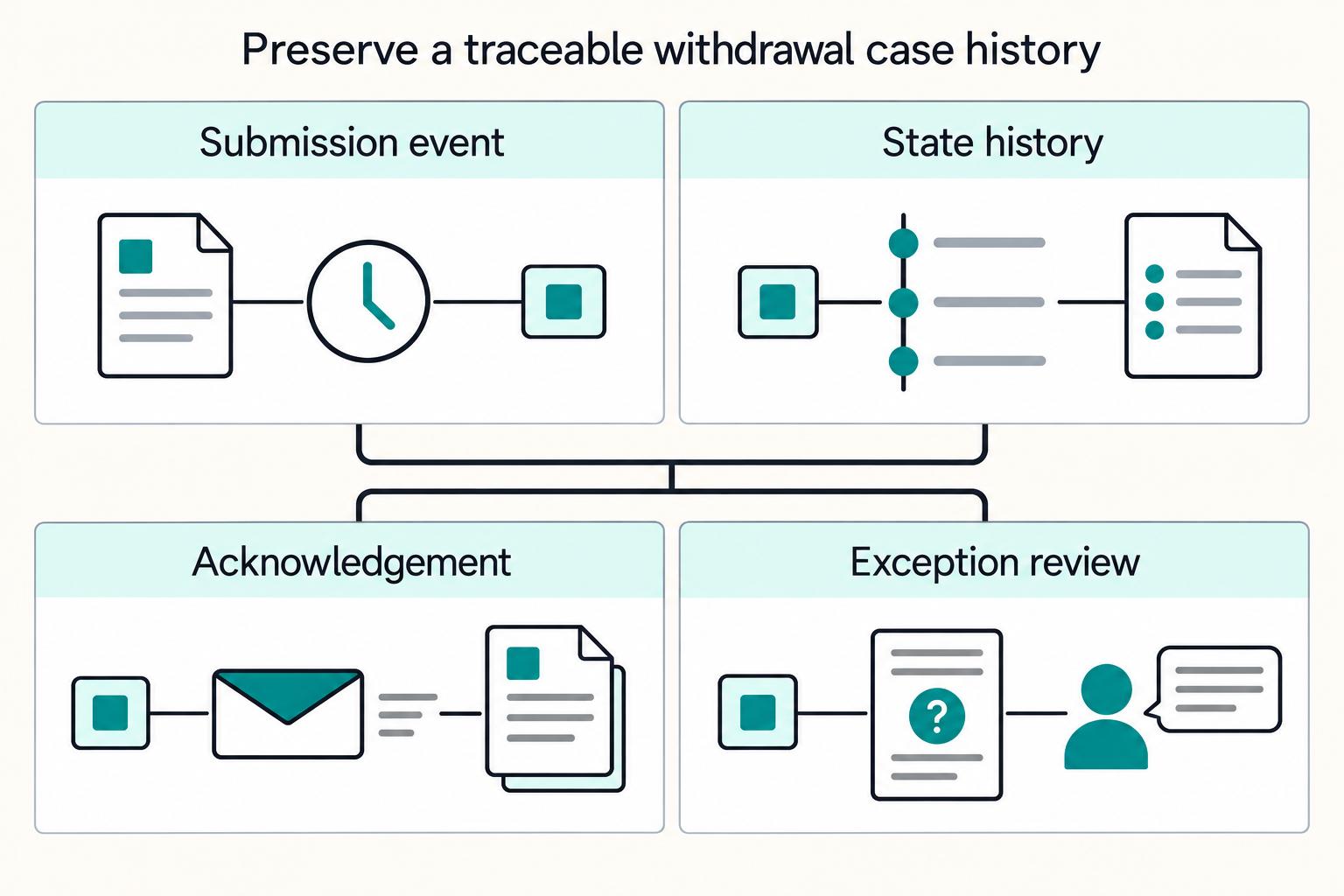
The application date for Directive (EU) 2023/2673 was 19 June 2026. For an EU-facing platform, the task now is to operate the applicable national rules: identify covered contracts, provide the withdrawal function, acknowledge submissions and connect them to the correct reimbursement process.
When Reacquiring Churned Subscribers Costs Less Than Net-New Growth
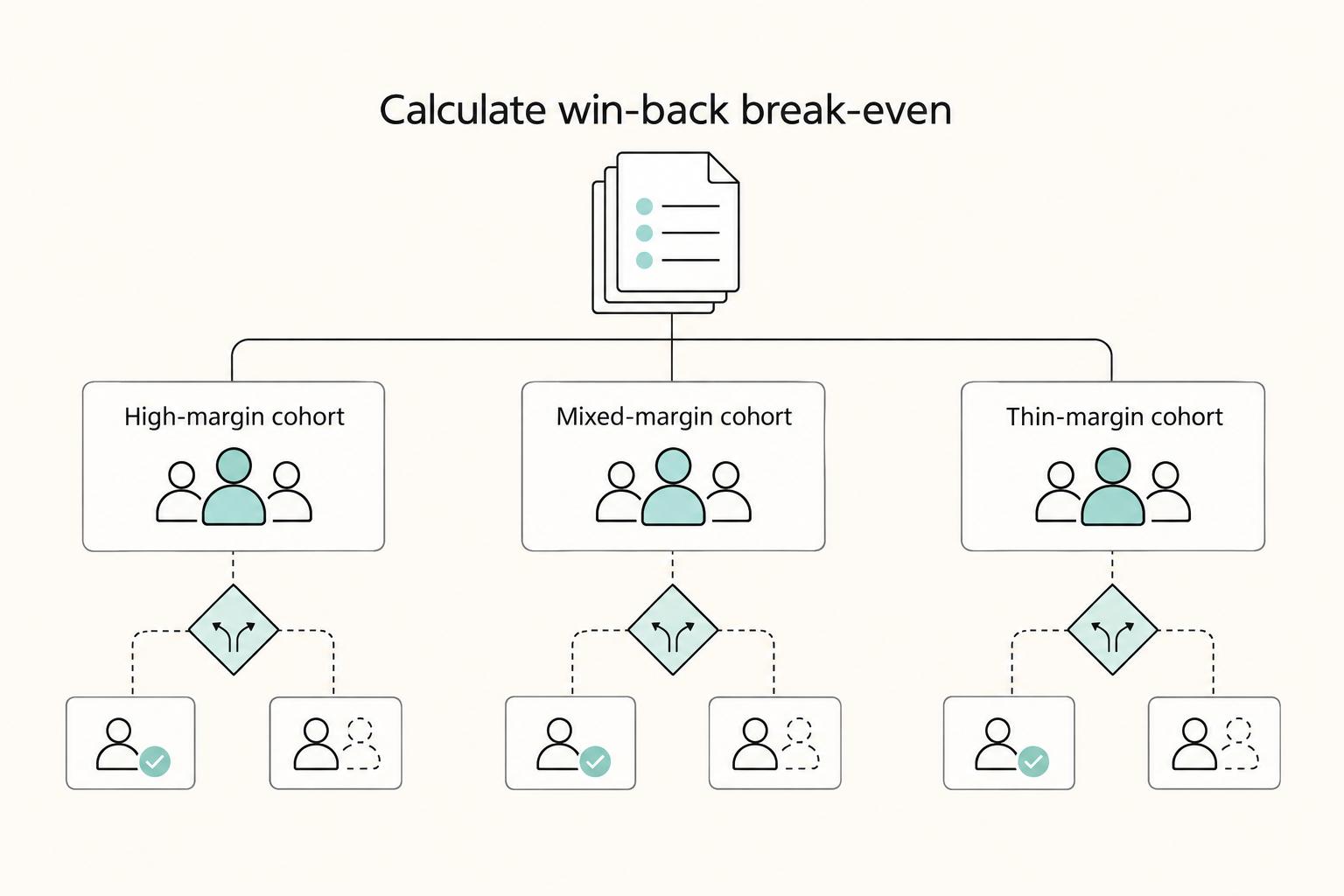
Reactivation volume is easy to celebrate. Recovered margin is the harder test, and it should decide whether you keep spending. A winback effort is only worth funding when the expected net contribution from a returned subscriber is better than what the same budget could earn through a comparable net-new path.
Cancellation Flow Design for Subscription Platforms
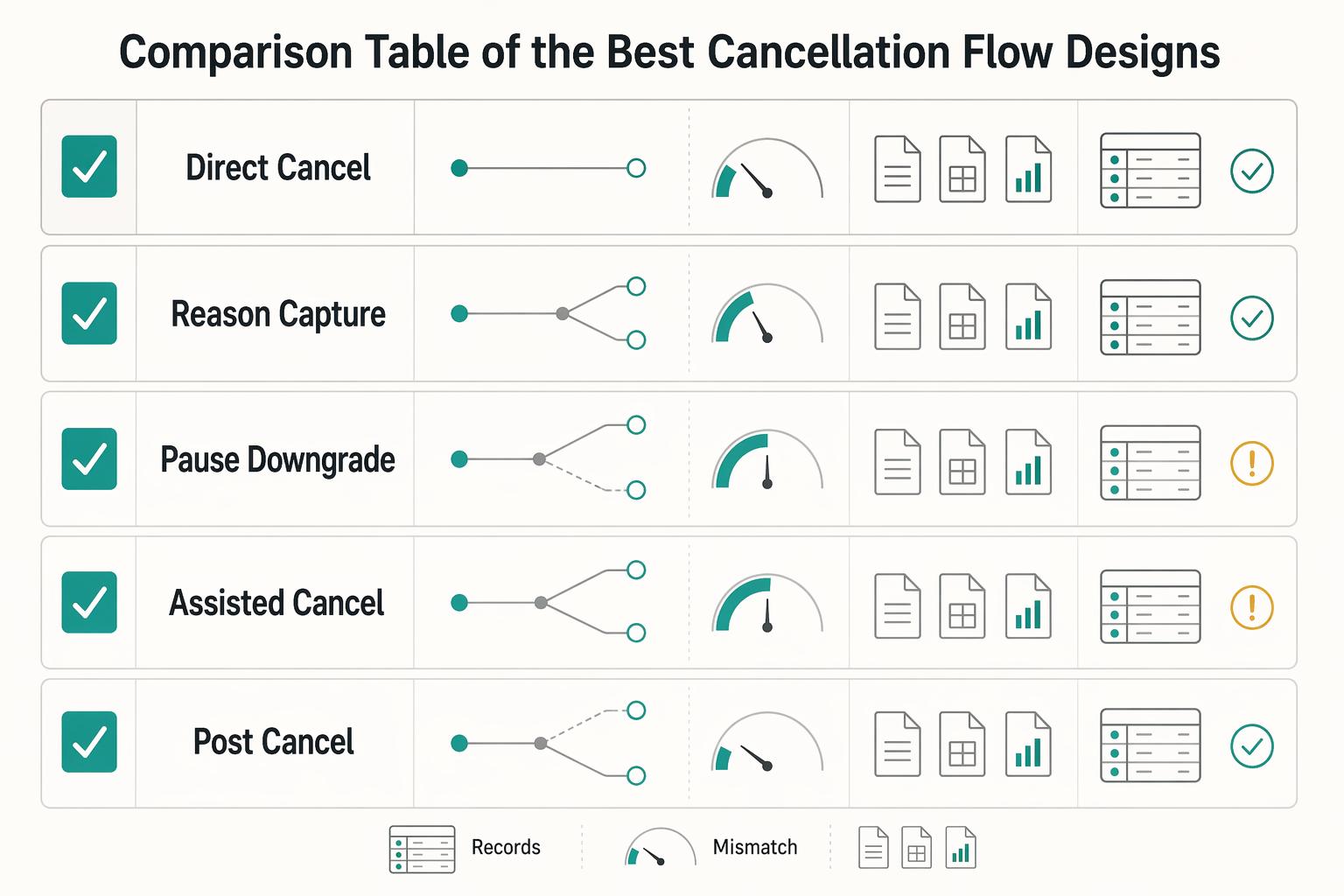
Subscription cancellation flow design is both a revenue and UX decision. A cancellation flow is the set of steps a customer goes through to end a product or subscription, and in SaaS that path may happen on-site or in-app. If you treat it as a simple exit screen, you miss the real tradeoff. Every added step can affect revenue, retention, and how much trust is left when the customer leaves.