
Quick Answer
Keep direct cancel available, make feedback and retention offers optional, and confirm the billing provider’s resulting state. State when renewal stops and access ends. Treat pauses, downgrades, refunds, account deletion and unresolved requests separately, then measure paid retained revenue at consistent cohort ages.
Why Cancellation Flow Design Matters#
Subscription cancellation flow design is both a revenue and UX decision. A cancellation flow is the set of steps a customer goes through to end a product or subscription, and in SaaS that path may happen on-site or in-app. If you treat it as a simple exit screen, you miss the real tradeoff. Every added step can affect revenue, retention, and how much trust is left when the customer leaves.
A cancellation request can end in several different states: renewal stopped, access ended now, a pause, a cheaper plan, or an unresolved request. Those states affect revenue differently. Measure what the customer authorized and what the billing system actually applied, rather than treating departure from the screen as retention. This guide is for:
- founders trying to protect revenue without turning cancellation into a brand problem
- revenue leaders balancing save offers against margin quality
- product teams deciding how much friction belongs in the exit path
- finance and billing operators who need the offboarding process to be explainable, measurable, and consistent
The practical point is simple. A good cancellation experience is not just a survey. It can include alternatives during offboarding, but those options only work when they match the user's intent and your business reality.
Before you change anything, verify the basics you already control. Check where the cancellation journey starts and whether it finishes in-app or on-site.
The biggest failure mode is not cancellation itself. It is designing around business goals so heavily that people feel trapped, confused, or delayed. The goal of this article is more practical than "save every account." It is to help you choose a flow that gives people a clean exit when needed while still protecting unit economics in a subscription business with real margin pressure.
If your cancellation flow needs to account for plan changes, add-ons, coupons, or dunning, see Subscription Billing Platforms for Plans, Add-Ons, Coupons, and Dunning.
Who this list is for and how to choose a design#
Use this list if you own cancellation outcomes across product, finance, and support. If you only need copy polish on one cancellation screen, this is a broader operating decision than you need.
- Confirm multi-team ownership before design changes.
Name owners for the customer journey, provider subscription state, entitlements, final invoices and refunds. Distinguish stopping a renewal from closing an account or deleting its data. Finance handles tax adjustments for invoices or refunds separately; a customer ending one subscription does not itself mean the seller leaves a VAT scheme.
- Score each option on four dimensions.
Compare voluntary churn, retained recurring revenue, implementation complexity and applicable consumer/platform rules. Keep legal requirements as a pass/fail condition before scoring commercial benefits. Distinguish consumer subscriptions from negotiated B2B contracts and identify who actually bills the customer.
- Apply a trust-first decision rule and name clear accountability.
Direct cancel is the baseline across trust levels. When reason data and offer eligibility are reliable, present one optional alternative alongside that route. Name owners for pricing exceptions, support escalation and final messages; none of those internal approvals should make a valid cancellation request disappear or require the customer to start again.
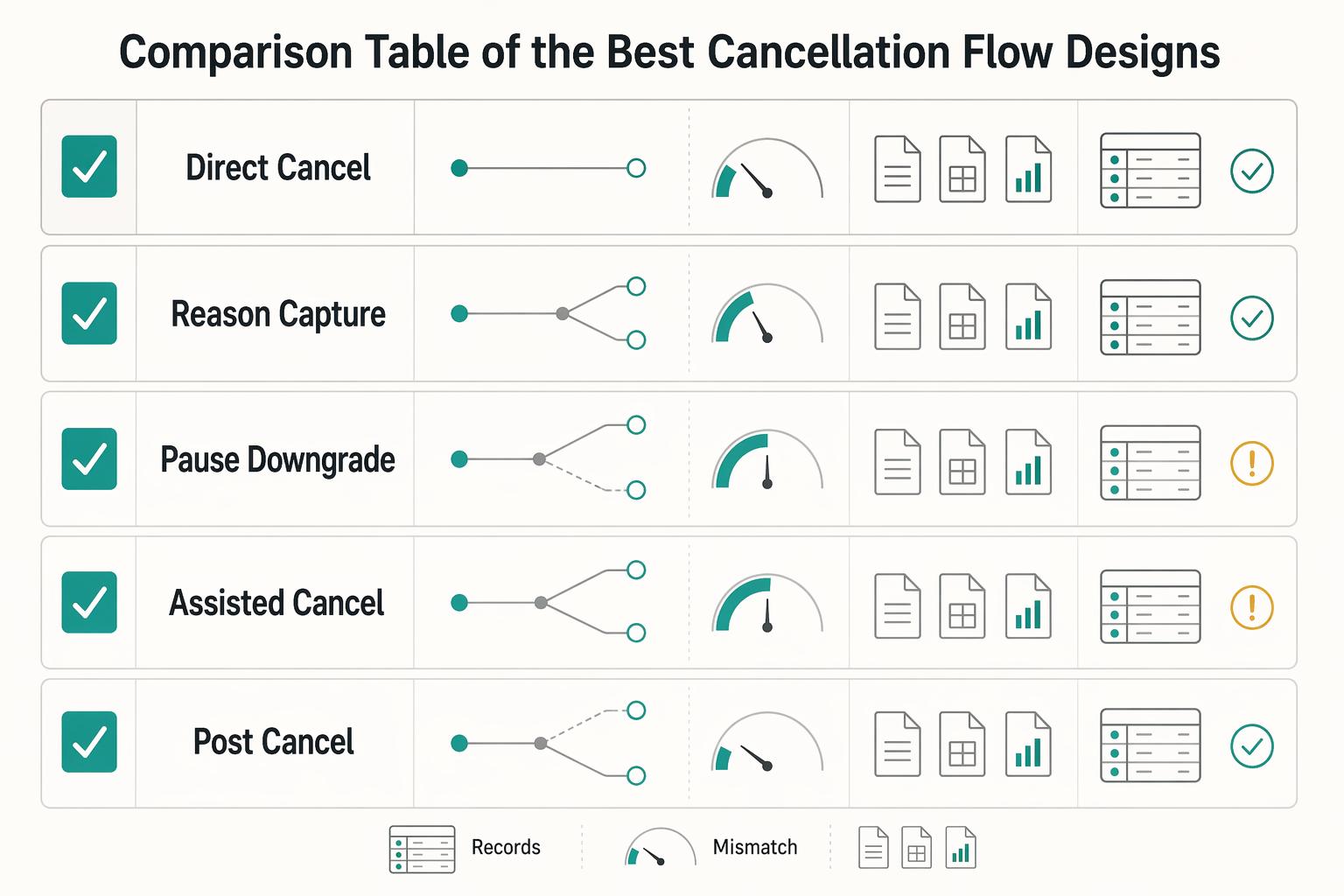
Comparison table of the best cancellation flow designs#
Keep direct cancel available while comparing the five optional operating patterns below. The qualitative ratings describe design tradeoffs, not measured retention forecasts. Follow each request from cancel_intent to the authoritative subscription and billing outcome.
| Design | Best for | Retention hypothesis to test | Discount or service-cost risk | Implementation effort in SaaS | Compliance exposure | Evidence before full rollout |
|---|---|---|---|---|---|---|
| Direct cancel | Teams prioritizing trust and a clean exit | Lower in-session upside, with clearer customer intent | Low | Low | Lower because the path is simpler | Track cancel_intent, cancel_page_view, cancel_confirmed; QA proof the cancel path is clear; RACI owner named; cohort review cadence set |
| Reason capture plus save offer | Teams with reliable churn-intent capture and controlled offer rules | Targeted upside when offer and reason match | Medium to high when saves depend on discounts | Medium to high | Medium to high due to extra branching and messaging decisions | Track reason_selected, offer_shown, offer_accepted, offer_declined; QA each branch; cross-functional RACI sign-off; cohort review cadence set |
| Pause or downgrade | Temporary budget or timing friction where customers may stay on a lighter path | Potential upside for temporary churn intent | Low to medium for pause; medium for downgrade | Medium | Medium because billing and entitlement paths branch | Track pause_selected, downgrade_selected, cancel_after_offer; QA billing and entitlement outcomes; RACI sign-off; cohort review cadence set |
| Assisted cancel | Optional support or genuine contractual/account-closure exceptions; preserve any required self-serve exit | Limited in-flow upside, but can support cleaner exits and selective saves | Low discount risk, with higher service effort | High | Medium to high due to manual process variance | Keep ticket/CRM linkage and closure records; QA handoff steps; RACI for exceptions and final messaging; cohort review cadence set |
| Post-cancel win-back strategy | Teams that want low-friction cancellation with later recovery attempts | Delayed upside after cancellation | Medium when recovery relies on discounting | Low to medium | Low to medium in-product; outbound messaging needs review | Track cancel_completed, winback_sent, reopen_clicked, reactivated; QA audience and suppression rules; RACI owner for cadence and stop rules |
| Do not ship dark-pattern choices | Hidden exits, forced channel switching, App Store dead-ends, fake confirmation loops | False upside from abandonment, not true retention | High long-term risk from distrust and noisy data | Often low effort, which makes them tempting | High | Fail QA if cancel intent cannot reach a clean completion path; require design and policy sign-off before rollout |
A retained MRR figure measures recurring revenue, not margin. Discounts reduce that figure; support costs, payment fees and service delivery costs affect contribution margin separately. Read the table as a test plan, then measure both recurring revenue and cost before scaling.
If reason capture is weak, default to direct cancel or post-cancel win-back and avoid complex save logic until churn-intent signals are usable. Personalized offers can work, but only when they map to the actual reason for cancellation.
Dark-pattern rows are also a measurement warning: if users cannot complete cancellation cleanly, your retention reporting can look better while trust and support load get worse. For more on compliant design, see How to Build a Compliant Cancellation Flow Under EU Consumer Rights Rules.
Direct cancel with graceful goodbye#
Direct cancel is the right default when you run a low-ARPU, self-serve motion and trust loss costs more than a missed in-session save. In that setup, extra friction can create support load and sentiment risk without changing clear churn intent.
What you gain: a clean, reachable exit that lowers the odds the cancellation experience turns negative because users cannot find a way out. What you give up: fewer immediate save-offer conversions, so short-term retention can look weaker than in a heavier intervention flow.
For subscriptions billed by Apple, provide Apple’s management route rather than pretending a local web button can stop its billing. A subscription bought directly from your company needs your own billing route even if the customer uses an iPhone. Show the billing owner and confirm the provider’s resulting renewal and expiration state.
Use these guardrails:
- Keep cancellation visibly reachable. A user who has expressed cancel intent should be able to finish without dead-ends, forced support, or platform mismatch.
- Keep feedback optional. Collect reasons if useful, but do not block completion.
- Log completion events. Track intent expressed, cancel path reached, and cancellation confirmed so you can separate true saves from abandoned exits.
Identify the billing owner from the subscription record, not just the device or app where the customer clicked. For Apple-billed subscriptions, link to https://apps.apple.com/account/subscriptions; Apple’s support instructions also show the Settings → Subscriptions route. Keep a help path for customers who cannot locate the relevant Apple Account or receipt.
Pair this path with measured post-cancel win-back instead of stuffing the cancel screen with last-minute offers. A respectful exit now and restrained follow-up later is usually the safer operating model, especially since overly clingy post-cancel messaging can backfire.
Reason capture with intent-based save offer#
Use this path only when your team can trust reason capture and enforce offer eligibility across product and finance. If churn intent is noisy or eligibility controls are weak, this flow usually adds complexity without reliable savings.
Reason capture helps match an optional offer to the stated problem and exposes recurring product issues. Keep the survey skippable. Choosing a reason or declining an offer must not become another authorization to renew or a requirement to contact support.
Match the first intervention to the reason#
Start with the smallest intervention that directly addresses the stated problem.
| Reason bucket | First intervention | Why this fit works |
|---|---|---|
| Price pressure | Downgrade or plan change before any discount | Tests plan fit first instead of jumping to a price cut |
| Missing value or low adoption | Onboarding help, setup guidance, or feature education | Addresses activation gaps before changing price |
| Hard exit or poor fit | Direct cancel with graceful goodbye | Preserves trust when save likelihood is low |
For price pressure, offer a cheaper plan if its limits fit the customer’s needs. Show the new price, features, effective date and any proration before acceptance. A discount can be tested separately when contribution margin supports it; neither option replaces the direct-cancel button.
If the reason is missing value, route to help before cutting price. A user who has not reached value usually needs activation support, not a cheaper plan.
Where teams usually get this wrong#
The main failure mode is over-discounting. When discounts become the default response, you risk weaker revenue quality and train users to use cancellation as a negotiation step.
The second failure mode is polluted reason data. If options are vague, overlapping, or visibly tied to different perks, users will often pick the option that unlocks the best offer, not the truest reason.
Treat this as a product-and-finance decision tree, not just a UX pattern. Define which reasons map to downgrade, which map to help, and which go straight to cancel, then QA that routing against plan and billing state.
Instrument it like a finance decision#
Only run this flow if you can measure outcomes by reason bucket. At minimum, log selected reason, offer shown, offer accepted or declined, MRR at risk at intent, and 30-day and 60-day retention by reason bucket.
Keep request ID, account and subscription IDs, billing provider, selected reason if supplied, offer terms shown, explicit acceptance or decline, request timestamp and authoritative final state. Deduplicate repeated clicks and events so one customer request is one funnel entry. Review cohorts with product and finance before expanding the flow; simplify unstable reason buckets.
Pause and downgrade before cancel#
When a customer still has some fit but needs flexibility, offer pause and downgrade as alternatives before full cancellation, while keeping direct cancel visible in the same flow.
| Option | When to use it | Why it helps |
|---|---|---|
| Pause | Intent looks temporary | Preserves account continuity instead of forcing an all-or-nothing decision. |
| Downgrade | Pressure is budget, not total lack of value | Keeps the customer on a plan they can justify. |
| Direct cancel | Intent is a hard exit or poor fit | Protects trust with a clear, immediate path out. |
These are optional alternatives: pause for temporary need, downgrade for budget pressure, and direct cancel for a firm exit. Explain each option’s access and billing consequences before acceptance. A user should be able to skip the alternatives without answering a survey.
Define what pause means in your product. In Stripe, pausing payment collection leaves the subscription active and continues invoice generation; it is different from pausing the subscription itself. Set invoice behavior and any resumption date explicitly, then map your access policy. Show the customer whether service continues, what will be charged later and how to stop renewal. Report paused accounts separately from paid retained accounts.
Avoid stacking multiple save offers in one session. If a user declines one path, then accepts another, then still gets an extra discount, save rate can rise while unit economics weaken. Cancellation is a strategic moment, but that does not require an endless sequence of incentives.
Log the path clearly: cancel initiated, intent selected, pause offered and outcome, downgrade offered and outcome, and final cancellation state. Then review retained MRR and reactivation by path, because monthly churn compounds over time. If pause mostly delays exit, simplify the flow.
If pricing structure is part of the churn conversation, see Choosing Between Subscription and Transaction Fees for Your Revenue Model.
Assisted cancel for high-value and regulated accounts#
Offer assistance for negotiated contract questions, requester-authority checks or complex final billing. A high account value or a tax adjustment alone does not justify forcing a consumer into support to cancel. Capture a valid request and its timestamp before handling back-office closure work, and preserve the applicable self-serve cancellation route.
| Assisted-cancel case | Brief description | Key differentiator |
|---|---|---|
| Negotiated enterprise contract | Annual, multi-seat or custom billing may have agreed notice periods, authorized administrators and final credits. | Confirm the governing terms, requester and effective end date; explain any remaining commitment. |
| Final invoice or refund | Cancellation can leave accrued usage, unpaid invoices, a credit or a separate refund to resolve. | Stop the applicable renewal while billing staff resolve the identified balance; send its status separately. |
| Workspace and data closure | Several subscriptions, exports or retention obligations may outlive one subscription. | List affected subscriptions and access cutoffs; offer export instructions and handle deletion as a separate request. |
Assistance is useful when it records the requested outcome and resolves a genuine exception. Its cost is operator time and delay. Record when the request was received, when renewal stops, when access ends and which financial documents remain, so a ticket backlog cannot silently add another billing cycle.
Keep subscription cancellation, refund processing, account closure and tax registration as separate states. A refund may need a linked credit note and tax adjustment, while invoice records may need retention after access ends. Do not require an individual subscriber to resolve the seller’s OSS registration or cross-border SME eligibility before renewal can stop.
Confirm the requester’s authority, legal billing entity, affected subscription IDs, received timestamp, requested and agreed effective dates, access cutoff, final invoice or credit status, refund status and customer receipt. Verify the provider’s state before declaring completion. Preserve a cancellation received before renewal even if an internal case remains open.
Assign RACI before launch:
- Responsible: support or billing ops verifies the requester, records the request and reconciles provider state.
- Accountable: the cancellation service owner ensures the request reaches its required outcome; finance owns final invoice and refund reconciliation.
- Consulted: legal or compliance resolves genuine contract or consumer-rights exceptions.
- Informed: the account owner sends a receipt and any later financial updates. Internal sign-off does not postpone a valid cancellation.
If you cannot name these owners and closure criteria on one page, keep assisted cancel limited to true exceptions instead of routing every exit into a ticket queue. For a step-by-step walkthrough, see Retainer Subscription Billing for Talent Platforms That Protects ARR Margin.
Post-cancel recovery with a clear stop rule#
Complete cancellation first. If the customer is eligible for later marketing, use a separate win-back campaign with documented audience and suppression rules. For covered US commercial email, CAN-SPAM requires an opt-out and honoring it within ten business days; other markets may require consent before sending. Do not treat an offer email as permission to reopen billing.
Record the canceled subscription, campaign, offer terms and explicit new purchase or reactivation. Exclude suppressed contacts and customers whose complaint or unresolved refund makes the campaign inappropriate. Test one message against a comparable holdout, and review paid return after 30 and 60 days, discount cost and complaints. Stop the campaign for an opt-out or the documented frequency limit.
For a cancellation arriving near renewal, review the provider subscription and any already-created invoice or payment separately. Stripe can leave pending invoice items or usage to handle; cancellation pauses automatic collection on the subscription’s open and draft invoices. Inspect final charges and credits explicitly. A stored customer credit is different from a cash refund, and cancellation itself is not proof a refund was paid. Show any pending financial resolution separately from the confirmed renewal stop.
Measurement, governance, and red flags to catch early#
After you decide who gets self-serve versus assisted cancel, treat measurement and governance as release gates, not reporting cleanup. Keep one scorecard, validate instrumentation before testing, and do not launch if ownership or save-offer logic is unclear.
- Use one source-of-truth scorecard
Define cancellation completion as requests reaching the promised provider state divided by eligible cancellation requests, within a stated time window. Count offer acceptance only among customers shown that offer. Keep scheduled cancellations, ended subscriptions, pauses, downgrades and unresolved requests distinct. Retained MRR uses actual recurring prices after discounts; contribution margin deducts the defined service and support costs.
For example, 100 distinct cancel intents each have $100 monthly revenue at risk. Sixty cancel, ten pause, ten abandon without a confirmed outcome, and twenty explicitly keep service: ten at $100 and ten at $70. Confirmed retained MRR is $1,700, not $2,000 or $4,000; pause and abandonment are separate states. If thirty customers saw an offer, twenty acceptances mean 66.7% offer acceptance, but only 20% of all intents explicitly retained. At day 60, eight full-price and six discounted accounts still paying yield $1,220 retained MRR and fourteen paid retained accounts. These are cohort observations; a randomized comparison is needed to attribute improvement to the offer.
- Instrument, validate, then run one controlled test
Keep the order strict: instrument flow events, validate data quality, run one controlled test, then review outcomes with product and finance together.
Validate requested, scheduled and effective end timestamps separately. With Stripe, cancel_at_period_end=true schedules the end; customer.subscription.updated can report that change, while customer.subscription.deleted reports actual cancellation. A scheduled cancellation can be reversed before it takes effect; an already canceled subscription needs a new subscription to resume billing. Confirm refund, usage and invoice outcomes separately.
- Catch red flags before launch
Hidden exits are a blocker. If users must hunt for cancellation, switch channels without warning, or face unclear exit copy, trust drops quickly.
A button click is an attempted action, not proof that renewal stopped. On timeout, retain the request and retrieve the provider subscription state before another mutation. Process duplicate events once and verify current state when events arrive late. If the provider did not apply the change, use a controlled retry or operator case tied to the original request; show pending status and preserve its received time. Once confirmed, send the effective date, access cutoff and any separate invoice or refund status.
Watch post-cancel messaging volume. In categories already affected by SaaS fatigue and license bloat, over-messaging after exit can damage trust.
- Make governance a hard go/no-go rule
No launch if RACI ownership is unclear or if teams cannot explain why a specific save offer appears for a specific segment. Product should know the trigger, finance should know the revenue tradeoff, and support should know how to explain the path.
As of October 2026, do not treat the FTC’s 2024 click-to-cancel amendment as an operative federal rule: it was vacated in July 2025, and the FTC opened a new rulemaking inquiry in March 2026. Existing protections still apply, including ROSCA’s simple mechanism to stop recurring charges for covered online negative-option transactions, plus applicable state rules. In the EU, distinguish ordinary termination from statutory withdrawal. Directive (EU) 2023/2673 requires an online withdrawal function for covered online distance contracts during the withdrawal period, with national measures applying from 19 June 2026; check the relevant national implementation and exceptions. A renewal-cancellation button does not by itself implement that separate right.
For save tactics inside the cancellation path, see How to Build a Cancellation Flow That Saves Subscribers: Pause Downgrade and Win-Back Tactics.
Conclusion#
The strongest subscription cancellation flow design is usually the one users can complete without a fight, and the one your team can learn from. Cancellations will happen no matter what you do, so the job is not to block them. It is to protect trust first, use retention tactics only when they fit real churn intent, and prove that the extra complexity is earning its keep.
- Trust first
A cancellation flow is the set of steps a customer goes through after initiating cancellation, so the tone of those steps matters as much as the final button. If your path depends on hidden buttons, illegible text, or a forced phone call, you are adding friction that can annoy customers with no real upside. The practical check is simple: run a test account through the full path, confirm direct cancel stays visible, and make sure the final state is obvious in billing and in the goodbye message.
- Let churn intent decide the intervention
Use optional feedback to decide whether one offer addresses the customer’s actual need. Keep the direct exit visible. Show all price and timing terms before acceptance, then test one change at a time with a comparable cohort so you can distinguish offer effects from customers who would have stayed anyway.
- Simplify when measurement is weak
If accepted versus declined offers cannot be traced to provider state and paid retention, simplify the flow. Keep feedback optional and preserve the exit path. Fix identities, event definitions and reconciliation before adding new branches.
Before expanding a design, check that every cancellation request has a known owner and outcome, every accepted alternative has explicit terms, and cohort reporting separates pauses and unresolved requests. Review billing complaints and contribution margin alongside the paid-retention trend.
Frequently Asked Questions
What is subscription cancellation flow design, and where does the flow begin and end?
The flow begins with an identifiable cancellation request and ends when the promised provider state is confirmed and explained to the customer. Stopping renewal at period end differs from ending access immediately. A pause, downgrade, unresolved request or abandoned screen is a separate outcome, not a completed cancellation.
What are the minimum elements every credible cancellation UX must include?
Include a visible cancellation route, an explanation of the affected subscription, effective date and access consequences, explicit confirmation of the chosen action, and a receipt after provider verification. Feedback and save offers are optional. Account deletion, refunds and final invoices can be separate tasks; do not make them hidden prerequisites to stopping renewal.
How do we avoid dark patterns while still using a save offer?
Keep reasons optional and offer at most one relevant alternative that can be skipped. Give cancel a clear label and comparable visibility. Display the exact price, duration and renewal terms of any accepted offer, including the price after a discount expires. Check whether customers can finish without loops, forced channel switching or ambiguous success messages. Measure abandoned exits separately from explicit retention.
Which metrics matter most for product and finance decisions?
Keep product and finance aligned on a shared set of metrics such as completion rate, save-offer acceptance, retained revenue, retention by cohort, and reactivation. Your checkpoint should confirm you can trace the user through the path, reason step, any offer, final decision, and resulting billing state. If finance cannot map those events to invoiced outcomes, your "save" story may be overstated.
When should we use pause, downgrade, discount, or direct cancel?
A common approach is to use pause when churn appears temporary, downgrade when budget pressure is real, discount only when margin can support it and plan fit is still strong, and direct cancel when trust is weak or the user is clearly done. Keep direct cancel available in the same flow. Stacking pause, downgrade, and discount can inflate saves while making forecasting and cohort analysis harder.
Who should own cancellation decisions across product, revenue, finance, and support?
Ownership can be split clearly: product owns the user flow, finance owns retained-revenue and margin checks, revenue or pricing approves offer logic, and support owns explanation quality and exception handling. A useful release gate is a named RACI plus evidence: event definitions, QA proof from test accounts, and finance mapping for retained revenue. If those pieces are missing, the flow is likely not ready.
How often should we review and iterate the user flow?
Many teams review weekly after launch until patterns stabilize, then move to a regular cohort cadence (often including 30-day and 60-day retention/reactivation checks). Change one major variable at a time so results are interpretable. If you see vague churn reasons, hidden exits, or double counting paused accounts, review immediately rather than waiting for the next cycle.
Try a related tool
Researched and edited by the Gruv editorial team. Gruv builds cross-border billing, payouts, and finance-operations software for global businesses.
Sources
Includes 2 external sources outside the trusted-domain allowlist.
- docs.stripe.com/billing/subscriptions/canceltrusted
- docs.stripe.com/billing/subscriptions/pause-paymenttrusted
- eur-lex.europa.eu/eli/dir/2023/2673/ojtrusted
- ftc.gov/news-events/news/press-releases/2026/03/ftc-...trusted
- ftc.gov/business-guidance/blog/2018/07/time-rosca-re...trusted
- developer.apple.com/documentation/storekit/handling-subscription...external
- support.apple.com/en-us/118428external
Educational content only. Not legal, tax, or financial advice.
Related Posts
How to Build a Compliant Cancellation Flow Under EU Consumer Rights Rules
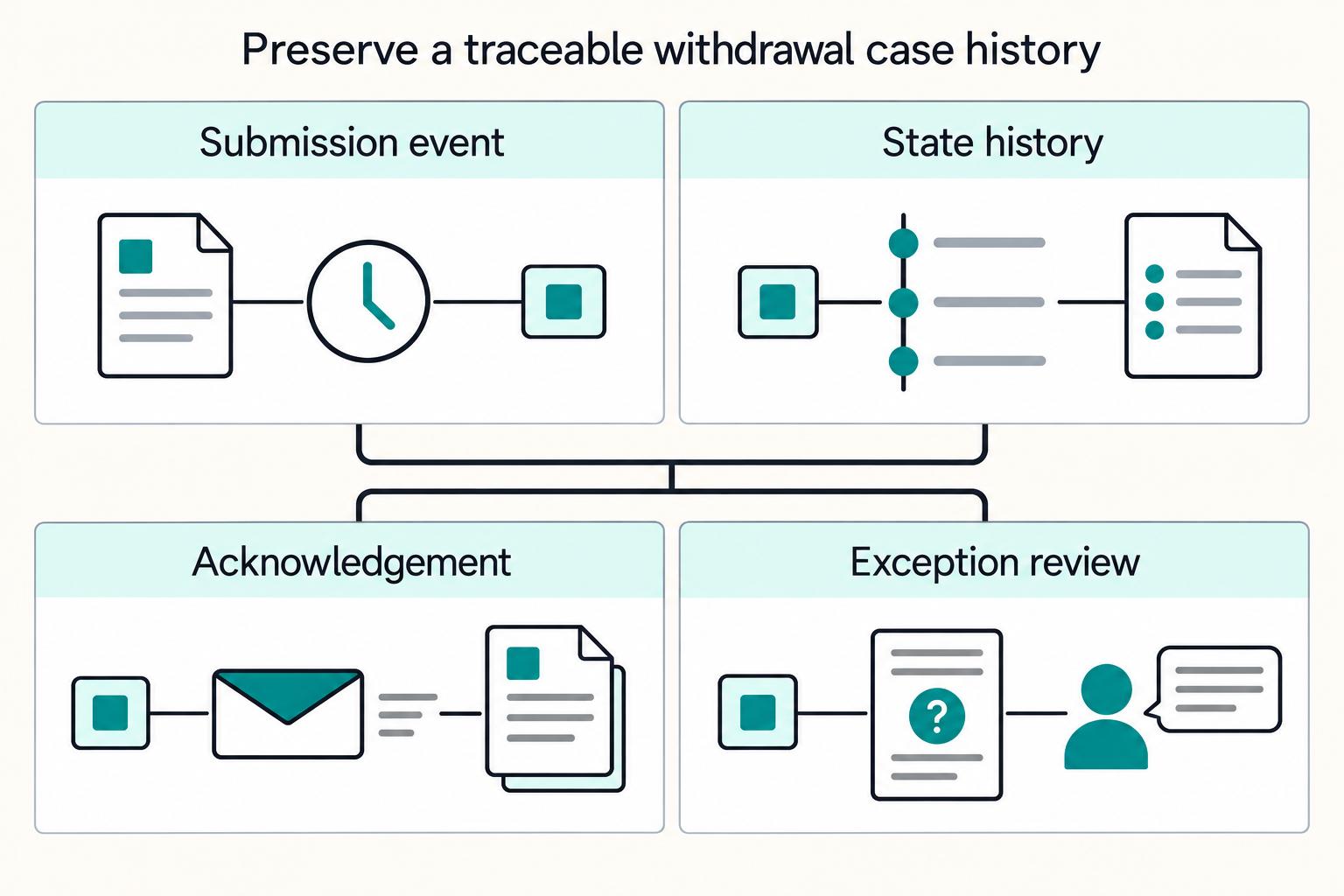
The application date for Directive (EU) 2023/2673 was 19 June 2026. For an EU-facing platform, the task now is to operate the applicable national rules: identify covered contracts, provide the withdrawal function, acknowledge submissions and connect them to the correct reimbursement process.
Build a Cancellation Flow That Saves the Right Subscribers
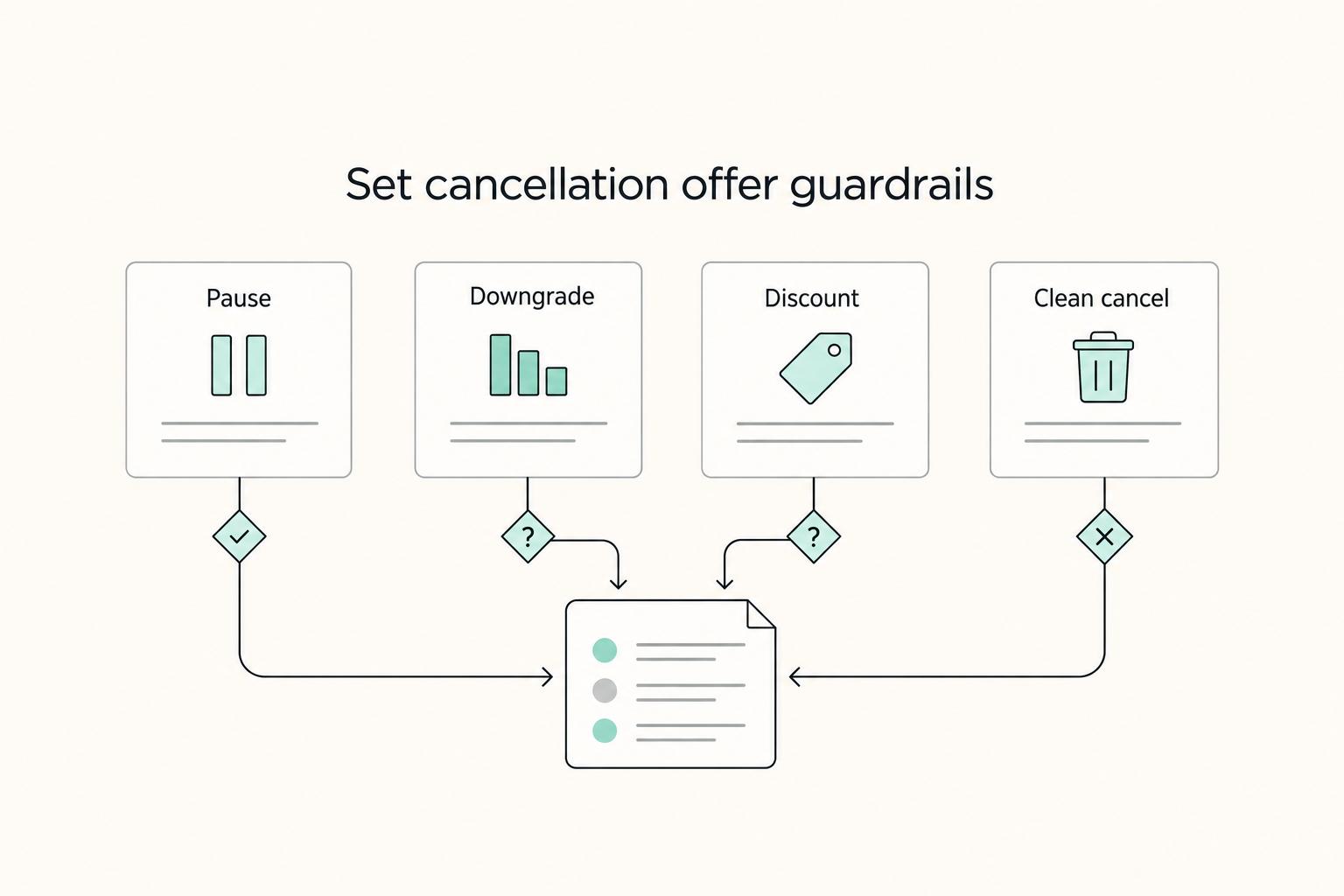
When a subscriber asks to cancel, provide a direct path to submit that request. A relevant pause or lower plan can be useful, but accepting an alternative is the customer’s choice. The commercial decision is which optional offer to show, never who is permitted to leave.

The Freelance Payment Penalty: A Modeled Audit of Platform Fees, FX Spreads, and Payout Delays
The money rarely disappears through a single, easy-to-spot fee. The real loss is stacked. A marketplace takes its commission, a processor adds a charge for international cards, a bank or payment company converts the currency at a spread, a platform holds the funds before release, and a wire sheds a little to intermediaries on the way in. Each layer looks defensible on its own, but the worker feels the combined result as a smaller deposit and a later payday.