
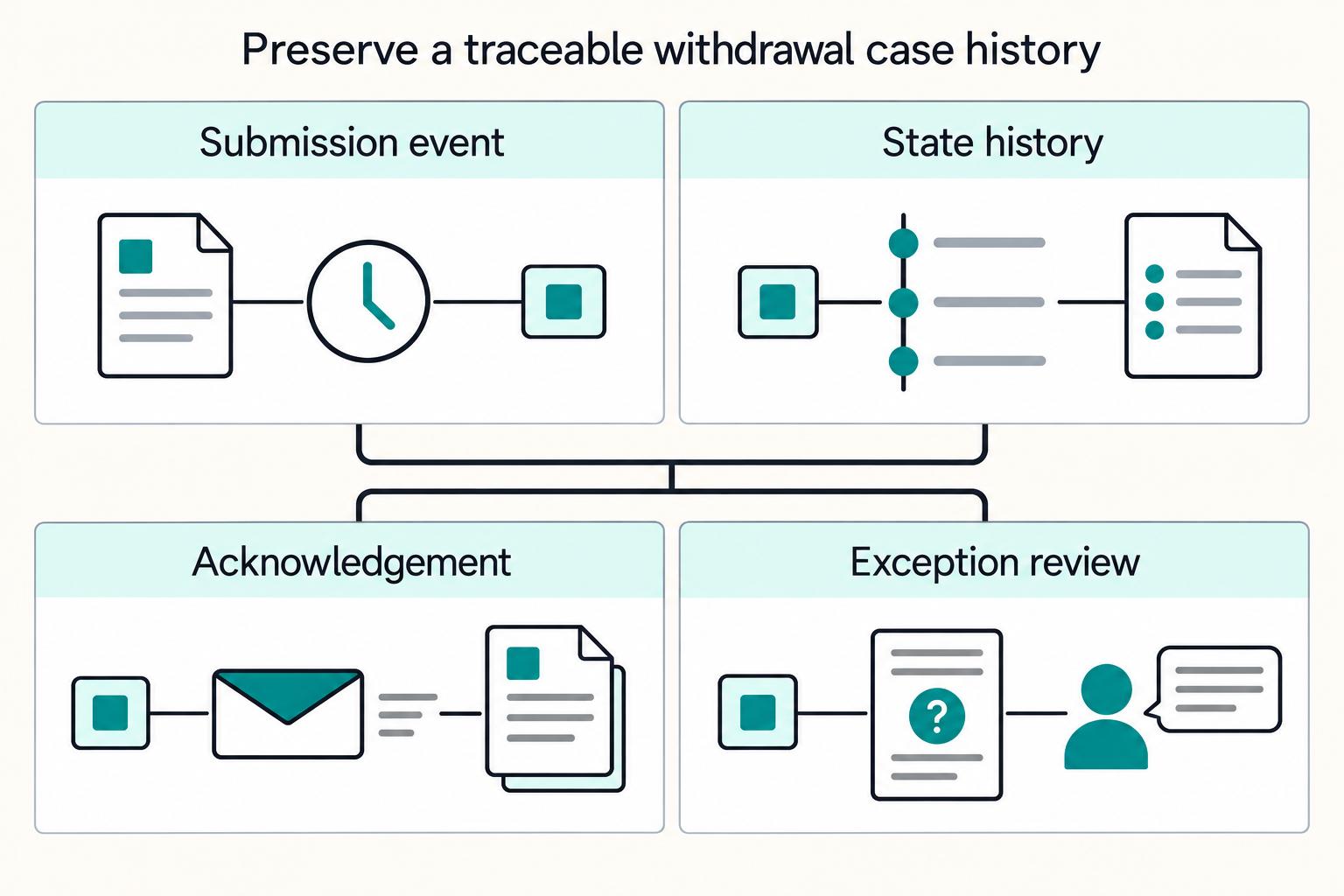
Quick Answer
For covered distance contracts concluded online, keep the withdrawal function accessible throughout the applicable period, collect or confirm the required statement details, provide a distinct confirmation action and send a durable-medium acknowledgement without undue delay. Use the applicable national and product rules for returns and reimbursement; ordinary termination and financial services need distinct routing.
Build a withdrawal flow from contract scope to reimbursement#
The application date for Directive (EU) 2023/2673 was 19 June 2026. For an EU-facing platform, the task now is to operate the applicable national rules: identify covered contracts, provide the withdrawal function, acknowledge submissions and connect them to the correct reimbursement process.
- Anchor decisions to legal scope, not interface patterns
The Directive applies to contracts between a consumer and a trader. Directive (EU) 2023/2673 (22 November 2023) amends Directive 2011/83/EU as regards distance financial-services contracts and inserts Article 11a on exercising withdrawal rights via an online interface. Do not assume every cancellation journey on your platform is covered in the same way.
Before writing tickets, confirm the exact contract variant, confirm consumer and trader status, and confirm that the contract is concluded at a distance through an online interface.
- Run one shared operating model across legal, compliance, finance, and product
Use one contract taxonomy, one scope decision per variant, and one owner per approval. Without that, teams can ship a UI control with partial backend handling and weak auditability.
If you operate multiple contract types, separate them early instead of copying one cancellation pattern across markets just because the interface looks similar.
- Set boundaries so implementation is not mistaken for legal certainty
This is an implementation guide based on the available materials around the EU Consumer Rights Directive, Directive (EU) 2023/2673, and Article 11a. It is not legal advice and should not be treated as proof that one implementation is automatically valid across all EU Member States.
Member States were to transpose the amendment by 19 December 2025 and apply the measures from 19 June 2026. Retain dated national-rule checks for each live market rather than presenting June 2026 as a future build deadline.
- Leave with five concrete outputs
Use this article to produce scope triage rules, implementation steps, evidence-pack requirements, escalation triggers, and a copy-paste launch checklist. For in-scope distance contracts concluded through an online interface, treat the withdrawal control as necessary but not sufficient. Article 11a requires the function to be prominently displayed, easily accessible, and labelled "withdraw from contract here" or an unambiguous equivalent. A compliant-looking control without clear logs, status handling, and ownership is still hard to defend.
Related: Cancellation Flow Design for Subscription Platforms.
Legal baseline you must design around#
Design to the legal trigger, not to a generic account-settings pattern. If a distance contract is concluded through an online interface and carries a right of withdrawal, Article 11a requires a withdrawal function.
| Focus | Requirement | Key detail |
|---|---|---|
| Scope trigger | Confirm the contract is a distance contract and that a withdrawal right exists before treating the control as required | Design to the legal trigger, not to a generic account-settings pattern |
| Interface requirement | The function exists, is prominently placed and easily accessible, and is labelled "withdraw from contract here" or an unambiguous equivalent | Treat Article 11a as a product control |
| Current operational readiness | Apply national measures from 19 June 2026 | Period start, exceptions and reimbursement rules depend on contract type |
1. Map the trigger to the contract, not the screen. Start with the legal chain. The EU Consumer Rights Directive (Directive 2011/83/EU) sets the baseline for consumer-trader contracts. Directive (EU) 2023/2673, adopted on 22 November 2023, amends that baseline and adds Article 11a. For distance contracts concluded by an online interface, the trader must make sure the consumer can withdraw using a withdrawal function.
Your first check is scope, not UI copy. Confirm the contract is a distance contract under the Directive and that a withdrawal right exists for that contract type before treating the control as required.
2. Translate Article 11a into product requirements. Treat Article 11a as a product control. Your acceptance criteria should reflect three points: the function exists, it is prominently placed and easily accessible, and it is labelled "withdraw from contract here" or an unambiguous equivalent.
This is not optional UX polish. It is the interface mechanism for exercising a statutory right.
3. Connect the function to the whole withdrawal process. Keep the control available during the applicable withdrawal period, record the confirmed submission, acknowledge it and start the correct return/reimbursement workflow. The button is not proof that the consumer was reimbursed.
For ordinary goods and non-financial services, the usual withdrawal period is 14 days, with different start events and statutory exceptions. Financial services need their own sector and Chapter IIIa analysis; do not apply one universal fourteen-day clock to every product.
Scope triage before you write a single ticket#
Scope triage comes first. If scope is wrong, you either overbuild or ship a cancellation flow you cannot defend. Before design or engineering starts, classify each contract variant and treat unresolved scope as a rollout blocker for that variant.
1. Start with the contract, not the UI. For each variant, confirm whether it is a consumer-trader contract, a distance contract, and whether an online interface is used at conclusion.
| Contract variant | Consumer-trader contract | Distance contract | Online interface involved | Current scope status |
|---|---|---|---|---|
| Retail consumer purchase completed online | Yes | Likely yes | Yes | Candidate for withdrawal-function review |
| B2B seller onboarding agreement | No or mixed | Possible | Yes | Out of scope for CRD consumer analysis unless legal says otherwise |
| Contract signed in person and later managed online | Possibly yes | No at conclusion | Yes for management only | Usually outside the withdrawal-function lane without legal confirmation |
| Financial services contract at a distance | Yes | Yes | Yes | Escalate and validate against final market transposition |
For each row, keep one evidence item behind the decision, for example contract terms, conclusion channel, or a legal classification note. If you cannot point to that evidence, the row is not implementation-ready.
2. Separate what is EU-baseline clear from what still needs market confirmation. At EU level, the baseline is that CRD covers consumer-trader contracts and aims at common consumer rights across the EU. It also generally does not allow stricter or looser national divergence unless the Directive itself allows it.
Article 11a is not confined to financial services merely because the amending directive’s title mentions them. It governs covered distance contracts concluded through an online interface where a withdrawal right exists. Verify national implementation and applicable sector rules, but do not turn the clear general function requirement into a blanket scope unknown.
3. Set the escalation rule before tickets are written. If legal cannot confirm scope for a variant, block rollout for that variant. This is an internal control choice, not a directive command, and it reduces the risk of inconsistent rights handling across products and markets.
4. Maintain one explicit out-of-scope lane. Use it for variants that are not consumer contracts, are not concluded at a distance, or are governed by other sector-specific obligations.
Assign an owner and a short reason code, for example B2B only, offline conclusion, or sector-specific review pending. If a one-sentence reason is not possible, the variant is not fully triaged yet.
After statutory withdrawal is complete, separate retention work may use subscriber win-back guidance. Do not make an offer, survey or save flow a condition of submitting withdrawal.
Minimum viable compliant flow in product and API#
Once a variant is confirmed in scope, the minimum defensible build is straightforward: a real withdrawal function, a valid submission path, an acknowledgement on a durable medium, and traceable handling as an operational control.
1. Make the withdrawal entry point explicit and continuously available. The withdrawal entry point should be prominently displayed, easily accessible, available throughout the withdrawal period, and labelled "withdraw from contract here" or an unambiguous corresponding formulation in an easily legible way.
Do not replace this with vague copy like "manage plan" or "contact us." If legal approves a local-language equivalent, lock and version that string as controlled compliance text. Treat this as a functional requirement across relevant online interfaces, not just a copy requirement. Verification checkpoint: legal text approved, UX copy approved, placement tested on relevant interfaces, compliance sign-off captured.
2. Collect the statement and provide a distinct confirmation action. Let the consumer easily provide or confirm their name, identifying contract details and the electronic means for sending confirmation. Then provide a clearly labelled confirmation function, using “confirm withdrawal” or an unambiguous corresponding formulation. Record activation as the submission event; do not make it conditional on a survey, save offer or later manual approval.
Use clear internal states you can evidence later, for example entry_point_viewed, withdrawal_submitted, acknowledgement_issued, and final_status_recorded. These labels are implementation choices, but the evidence is what matters. At minimum, persist statement content and exact submission date and time; add contract and user/session references for internal traceability.
Handle retries idempotently as an engineering control. Article 11a does not prescribe idempotency design, but your API should prevent duplicate withdrawal outcomes on repeated requests. Verification checkpoint: state transitions tested, duplicate-submit behavior tested, submission payload stored with timestamp, compliance sign-off captured.
| User action | Legal basis (EU Consumer Rights Directive / Article 11a) | System event | Case evidence (including internal control choices) | Owner |
|---|---|---|---|---|
| Open withdrawal entry point | EU Consumer Rights Directive / Article 11a | entry_point_viewed | UI version ID, copy version, timestamp, interface identifier | Product |
| Submit online withdrawal statement | EU Consumer Rights Directive / Article 11a | withdrawal_submitted | Consumer name, contract details, electronic confirmation means, statement content and confirmed submission date/time | Engineering |
| Receive acknowledgement | EU Consumer Rights Directive / Article 11a | acknowledgement_issued | Acknowledgement ID, content sent, delivery timestamp, durable-medium record | Operations / Engineering |
| Check handling state | Product control for defensibility; not expressly evidenced as an Article 11a duty | status_viewed or internal lookup | Current internal state, last update timestamp, support reference if applicable | Product / Support |
3. Issue acknowledgement without undue delay and preserve exactly what was sent. The acknowledgement must be on a durable medium and include withdrawal content plus submission date and time.
Generate the durable-medium acknowledgement from the confirmed statement, including its content and submission date/time, and send it without undue delay. An email containing a stable copy can support this; a mutable status page alone should not be assumed sufficient. Retain the sent content and delivery attempt, with a recovery owner for bounces.
4. Add status visibility as an operational control, not as a legal substitute. The evidenced baseline is the withdrawal function plus acknowledgement. Customer-facing status pages are not expressly mandated in the sources.
Keep statuses simple and truthful, for example "received," "acknowledged," and "completed." Make sure the UI and backend stay aligned so customer-facing status always matches the authoritative internal record. Verification checkpoint: visible status matches backend state, support tooling uses the same reference, compliance sign-off captured before release.
For ordinary subscription termination, see cancellation, pause and downgrade options. That retention flow is separate from the statutory withdrawal function described here.
Assign ownership so compliance does not become everyone and no one#
Assign one named owner to each control before launch. If legal interpretation, withdrawal-function behavior, acknowledgement handling, and dispute operations stay shared, approvals and complaint handling can stall.
1. Define ownership at control level. EU law sets obligations for the online interface and withdrawal handling, so you still need clear accountability for each control.
| Control | Accountable | Responsible | Consulted | Approval gate | Required output |
|---|---|---|---|---|---|
| Scope interpretation for covered distance contracts under Directive (EU) 2023/2673 and the EU Consumer Rights Directive | Legal | Compliance | Product, Engineering, Payments Ops | Legal approval recorded before build | Written scope memo with in-scope and blocked variants |
| Withdrawal function wording, placement, and availability on the online interface | Product | Engineering | Legal, Compliance | Product and legal approval before launch | Approved UX spec, copy version, test results |
| Acknowledgement on a durable medium including content plus date and time of submission | Operations | Engineering | Legal, Compliance | Ops approval of handling path | Template, delivery record, evidence export sample |
| Customer dispute and exception handling | Compliance | Payments Ops / Support | Legal, Product | Compliance approval before market launch | Dispute procedure, escalation contacts, case log standard |
If any row has two accountable teams, you likely have no accountable team.
2. Make approval gates explicit where legal interpretation becomes product behavior. Directive (EU) 2023/2673 was adopted on 22 November 2023, had to be transposed by 19 December 2025, with measures applicable from 19 June 2026. Unresolved interpretation points should not remain open at release.
As an internal control pattern, keep three gates mandatory:
- Legal scope gate confirming consumer/trader status, online-distance conclusion, the applicable withdrawal right, period and any sector-specific rule.
- Product gate confirming the withdrawal function uses approved wording, is prominently displayed, easily accessible, and continuously available during the withdrawal period.
- Operations gate confirming customer handling matches built states, acknowledgement timing, and support procedures.
Verification checkpoint: each gate should leave an exportable artifact, such as a signed scope memo, an approved UI screenshot with version ID, and a tested acknowledgement sample showing stored withdrawal content plus submission timestamp.
3. Escalate unresolved interpretation conflicts to counsel before market launch. The framework is harmonised, but where harmonised provisions do not exist, Member States may maintain or introduce national provisions.
Use a simple rule: if legal and compliance cannot align on scope, wording, or handling for a market, hold launch for that market and escalate. Apply the same rule when a local team requests a flow departure without a written legal basis.
4. Tie ownership to operational outputs, not meeting attendance. Legal should own the policy memo and market assumptions. Product and engineering should own withdrawal-function behavior, submission, and state test evidence. Operations should own monitoring and the incident response playbook for cancellation disputes, including exception review and manual-handling logs.
A launch packet with policy text but no test or dispute artifacts is a control gap. If withdrawal is challenged later, you need both the rule you relied on and evidence that the online flow and durable-medium acknowledgement worked.
Connect withdrawal to returns and reimbursement#
For ordinary non-financial Article 13 cases, refund payments without undue delay and no later than 14 days after notice. Include the cost of the least expensive standard delivery offered; additional cost from a more expensive delivery choice need not be reimbursed. Use the original payment means unless the consumer expressly agrees otherwise, without a refund fee. For goods, the trader may withhold reimbursement until receiving the goods or evidence of dispatch, whichever is earlier, unless the trader offered to collect them.
Suppose a consumer paid EUR 100 for goods, EUR 8 standard delivery and EUR 12 extra for express delivery. With a valid withdrawal, no diminished-value issue and no other adjustment, the refundable amount is EUR 108, not EUR 100 or EUR 120. If notice arrives on 10 October and evidence of dispatch arrives on 13 October, release the refund without undue delay; the ordinary fourteen-day notice deadline is 24 October. Keep the dispatch evidence, calculation, original payment ID and actual refund result together. This is a hypothetical operational example, not a universal ruling on delivery or retention.
For services begun during the period, determine whether the consumer expressly requested early performance and received the required information before charging a proportionate amount for work supplied. Full performance or starting a digital download does not automatically erase withdrawal rights: the relevant consent, acknowledgement and other statutory conditions matter. Missing withdrawal information can extend the period. Financial services follow applicable sector rules and Chapter IIIa where relevant, rather than inheriting the ordinary goods-refund calculation.
- Record timely confirmed notice and send acknowledgement; do not wait for goods, approval or fraud review to capture it.
- Determine the applicable period, exception, return condition and lawful refund amount.
- Link the refund to the original payment, prevent duplicate refund instructions and investigate ambiguous provider status before retry.
- Monitor unresolved refunds against their actual legal deadline, record completion or failure and notify the responsible owner.
Build the evidence pack regulators and auditors will ask for#
Lock your evidence model before launch so you can reconstruct each case from submission to outcome. If you cannot show who submitted what, when, for which contract, and what acknowledgement was sent, the flow is hard to defend.
1. Record each withdrawal action with tamper-evident history. Use tamper-evident, append-style records as a control choice, even though the directives do not prescribe one logging architecture. For each withdrawal-function action, capture enough to prove sequence and identity: timestamp, user or session reference, contract reference, event source, state transition, and confirmation status.
For withdrawal flows in scope, the acknowledgement on a durable medium should include the withdrawal content plus submission date and time, and be sent without undue delay.
| Artifact | Suggested fields | Why it matters |
|---|---|---|
| Withdrawal submission event | Submission timestamp, user or session reference, contract reference, channel, submission content or pointer | Shows what was submitted and when |
| State transition record | Case ID, prior state, new state, timestamp, actor or service | Reconstructs handling from request to outcome |
| Durable medium acknowledgement | Acknowledgement ID, submission content, submission date/time, send timestamp, delivery status | Supports proof that acknowledgement was issued without delay |
| Exception review record (control choice) | Case ID, reason code, manual override marker, reviewer identity, decision note | Documents why a case departed from the default path |
2. Link customer events to internal records end to end. Carry one join key from submission through acknowledgement, back-office handling, and final disposition. Without that link, you get disconnected artifacts instead of a defensible case history.
This matters because proof burdens are split. The trader carries proof for compliance with Chapter information duties, while the consumer carries proof of exercising withdrawal. Operationally, preserve both sides of the trail: the submitted request and the acknowledgement sent on a durable medium.
3. Define retention and export rules, and mark legal gaps clearly. Set retention and export rules before disputes arise. For each record class, define owner, retention status, and envisaged erasure time limit where possible.
Do not present one fixed EU-wide retention period for cancellation-event records. Use explicit statuses such as approved, market-specific, and unknown pending legal advice, especially where transposition scope is unclear. Keep that uncertainty visible in your evidence register.
Export a readable case chronology, the stored statement and the exact acknowledgement, plus the return and refund records finance needs. Restrict access and apply a documented retention schedule appropriate to the market and record purpose; avoid copying unnecessary personal data into general-purpose event logs.
4. Add dispute artifacts for exceptional handling. Reason codes, manual-override logs, and reviewer identity are not expressly mandated in the directives, but they are practical controls for defending exceptional outcomes. Use them to document why a case did not follow the default withdrawal path.
Keep the taxonomy usable, require named reviewer attribution for overrides, and store the decision basis with the case record. In practice, this can be the difference between a complete audit trail and an unresolved dispute.
Set decision rules for friction controls without undermining rights#
Treat any control that makes cancellation materially harder than sign-up as high legal risk and require senior review. That keeps product decisions aligned with the current enforcement direction against manipulative design and with the expectation that unsubscribing should be as easy as subscribing.
1. Start from parity, not retention. For in-scope flows where the right of withdrawal applies, the withdrawal function must stay prominently displayed, easily accessible, continuously available during the withdrawal period, and clearly labelled, for example "withdraw from contract here" or an unambiguous equivalent.
Run a direct step comparison on the same interface: sign-up path versus withdrawal path. If sign-up is short and obvious but withdrawal adds account hunting, repeated prompts, or channel switching, mark it red. During the withdrawal period (commonly 14 days for distance and off-premises contracts), any design that hides or dilutes the withdrawal function is especially hard to defend.
2. Define allowed versus prohibited friction in concrete terms. That way teams are not guessing.
| Control | Usually defensible | Usually high risk | Tradeoff to record |
|---|---|---|---|
| Confirmation step | One final confirmation after the user chooses withdrawal, with clear effect and plain copy | Multiple confirmation pages, loops back to settings, or wording that obscures the legal action | Stronger defensibility if it prevents accidental submission without adding material burden |
| Reason capture | Optional feedback after submission, or optional free text that does not block progress | Mandatory survey or required reason codes before submission | Risk-control benefit may be limited; trust impact can turn negative if users feel trapped |
| Retention offers | Neutral save offer that is easy to dismiss and does not replace submit | Pause, downgrade, or chat presented as the only visible path before cancellation | Legal and trust risk rises quickly if the offer becomes a gate |
Tie these examples to your subscription cancellation rules. "Allowed" means easier to justify, not universally safe in every market. Freeze approved copy and screenshots in the same evidence pack as legal sign-off to prevent later drift.
3. Keep the withdrawal path available even when fraud or abuse signals trigger review. Capture the withdrawal request first, send the durable-medium acknowledgement without undue delay, then route to review.
Do not let fraud review become a hidden blocker to submitting a withdrawal request. If review changes downstream processing, require counsel review for the contract type and market. Log the trigger signal, case ID, reviewer, whether person or system, and the reason processing changed.
4. Require a four-line tradeoff statement for every friction control before release. Cover legal defensibility, abuse-risk reduction, engineering complexity, and customer-trust impact. If the team cannot justify a control on those terms, it likely does not belong.
At verification, keep approved copy, screenshots, and step count versus sign-up, plus legal, product, and operations sign-off for each control. The goal is not zero friction. It is a flow that remains easy to find and use, with any extra control narrow, documented, and subordinate to withdrawal rights.
Roll out across EU markets without false certainty#
Do not launch all EU markets at once from one base flow. Roll out by country cohort with written legal assumptions per market, because EU directives set the goal and each Member State implements it through national law.
1. Start with a priority cohort, not the full EU map. Use the Consumer Rights Directive baseline for consumer-trader contracts and Directive (EU) 2023/2673 as a shared planning target. Do not treat the timeline dates as proof that every market is ready.
Use 19 December 2025 as a transposition checkpoint and 19 June 2026 as an application date in planning. For each country in the cohort, create a dated legal assumptions note before build or launch approval:
- In-scope contract types
- Whether your online interface is the relevant contracting or management surface
- Local transposition status confirmed by counsel or internal legal
- Required user-facing copy or terminology in that market
- Open issues and the named escalation owner
If a market has no dated assumptions note and named reviewer, treat it as not launch-ready.
2. Separate German contract termination from withdrawal. Section 312k BGB governs a cancellation-button process for specified paid continuing consumer contracts that can be concluded through a website, with exclusions including financial services. It addresses ordinary or extraordinary termination, not the cooling-off right in Article 11a. A German termination flow can coexist with the statutory withdrawal function; routing and records should keep the actions distinct.
Confirm the actual German rules for each product and the applicable withdrawal implementation. Do not substitute a termination request, delayed end-of-term cancellation or subscription pause for a timely withdrawal statement.
Do not assume a base English flow plus translation is enough. Do not allow local email, chat, or ticket detours without legal review. Both can create divergence from the reviewed flow.
3. Keep one shared country-readiness table for product, legal, and operations. Use it to make launch decisions, and store it with screenshots, legal notes, and sign-off records. Any blank field is a blocker, not a to-do.
| Country | Legal status | Copy requirements | Escalation owner | Launch decision |
|---|---|---|---|---|
| Germany | Separate Section 312k termination duties from applicable statutory withdrawal duties | Local copy approved and screenshots stored | DACH counsel or legal lead | Launch only after local confirmation |
| Member State A | EU baseline mapped; national implementation pending confirmation | Translation drafted, not yet legally cleared | Regional legal owner | Hold |
| Member State B | Scope confirmed, but one local requirement unresolved | Base copy approved; exception note open | Product compliance lead plus counsel | No launch until closed |
4. Set one hard policy: if local requirements are unclear, hold and escalate. Do not allow ad hoc workarounds, support-only cancellation paths, or copy changes outside the reviewed flow.
If your team cannot confirm how a market implemented the EU baseline for your in-scope flow, do not launch that market yet. False certainty spreads quietly and weakens the defensibility of the broader rollout.
Execute in order with go live checkpoints#
Use a fixed execution order and block the next step until the previous checkpoint is evidenced. This sequence is an internal control choice, not a claim that EU law mandates your build order.
| Stage | Evidence | Blocker |
|---|---|---|
| Lock legal interpretation | Dated scope matrix with named legal review, plus Member State transposition checks for each launch market | If any touchpoint can bypass the reviewed withdrawal path, hold release for that variant |
| Build UX, copy, backend states, and logging | Screenshots and raw event records showing submission content and submission date and time sent without undue delay | Do not treat the flow as ready unless the withdrawal function is clearly labelled, prominently displayed, easily accessible, and continuously available throughout the withdrawal period |
| Run QA as a dry run | Coverage for first-day withdrawal, withdrawal near day 14 where applicable, retries after slow response, web and app submission paths, and support follow-up after submission | If the flow duplicates requests, drops timestamps, or misses the acknowledgement, stop release |
| Compliance sign-off and limited launch | Release gates on every reviewed consumer-contract path and online-interface entry point, plus local transposition status, post-launch monitoring ownership, internal incident thresholds, and a named rollout pause owner | No unapproved route goes live |
1. Lock legal interpretation before product work. Confirm which consumer-trader contract variants are in scope, which are distance contracts, and which online interface surfaces are used to conclude or manage them. The checkpoint is a dated scope matrix with named legal review, plus Member State transposition checks for each launch market.
Do not review checkout alone. Include account settings, renewal screens, and app surfaces that can manage the contract. If any touchpoint can bypass the reviewed withdrawal path, hold release for that variant.
2. Build UX, copy, backend states, and logging as one chain. For in-scope online-interface distance contracts where the withdrawal right applies, the withdrawal function should be clearly labelled, for example "withdraw from contract here" or an unambiguous equivalent. It should also be prominently displayed, easily accessible, and continuously available throughout the withdrawal period.
Your backend checkpoint is one request state, one confirmation event, and one acknowledgement on a durable medium. Verify with screenshots and raw event records showing submission content and submission date and time sent without undue delay.
3. Run QA as a dry run with realistic distance-contract scenarios, not only component tests. Cover first-day withdrawal, withdrawal near day 14 where applicable, retries after slow response, web and app submission paths, and support follow-up after submission. If the flow duplicates requests, drops timestamps, or misses the acknowledgement, stop release.
4. Require compliance sign-off and a limited launch before broad enablement. Add release gates to every reviewed consumer-contract path and online-interface entry point so no unapproved route goes live.
Before enabling more markets, confirm local transposition status, assign post-launch monitoring ownership, define internal incident thresholds, and name who can pause rollout if confirmation failures, missing logs, or complaint spikes appear after 19 June 2026.
Before full rollout, align your engineering runbook to webhook events, idempotent retries, and status surfaces in the Gruv docs. This keeps recovery auditable and consistent while interpretation remains open.
Recover quickly from the mistakes most teams make#
If you find a gap after launch, recover in a fixed order: restore traceability, re-check scope, make evidence exportable, then pause affected rollout where interpretation is still open.
| Mistake | Recovery move | Checkpoint before further rollout |
|---|---|---|
| Shipping flow changes without backend traceability | Backfill event mapping so each withdrawal action maps to one internal state and one retrievable record. Block unresolved or duplicate end states. | A test case from every live entry point can be traced from action to recorded outcome. |
| Treating all contract variants the same | Re-run scope triage variant by variant using your contract taxonomy, instead of inheriting one product-wide answer. | Updated scope table shows in-scope, out-of-scope, and blocked rows with evidence behind each decision. |
| Relying on policy memos without evidence logs | Implement date-bounded audit exports for withdrawal submissions, acknowledgements, internal outcome, and exception handling. | Legal, ops, and engineering can run the same export and get the same case chronology. |
| Delaying escalation when scope or local interpretation is unclear | Pause affected rollout paths, assign escalation ownership, and document interim controls until interpretation is resolved. | The affected market or path is on hold with a recorded owner and a documented temporary handling path. |
Final checklist to launch with fewer regulatory surprises#
Do not launch until legal scope, interface behavior, and evidence records align for each in-scope flow.
| Check | What to verify | Action |
|---|---|---|
| Legal mapping | For each in-scope journey, record the legal basis under the Consumer Rights Directive, Directive (EU) 2023/2673, and the Article 11a withdrawal-function requirement being applied | If legal scope is unresolved for a contract variant, block that variant and escalate |
| Interface behavior | On website and app, confirm the withdrawal function is prominently displayed, easily accessible, continuously available during the withdrawal period, and clearly labelled "withdraw from contract here" or an unambiguous equivalent; confirm the final action is labelled "confirm withdrawal" | Do not launch until legal scope, interface behavior, and evidence records align for each in-scope flow |
| Evidence records | Retrieve the withdrawal submission content, submission date and time, and proof that acknowledgement was issued without undue delay | If records cannot be exported together, treat the flow as not launch-ready |
| Country approval | Approve launch country by country across EU Member States | If local interpretation is unresolved, hold and escalate before go-live |
| First-week monitoring | Track failed submissions, broken confirmations, findability complaints, and support-led exceptions | Use findings to tighten logging, copy, and placement while keeping the withdrawal path clear and easy to use |
| Reimbursement | Correct refund amount, payment means, return/dispatch evidence where relevant and completion by the applicable deadline | Escalate stuck refunds before the deadline; keep receipt evidence rather than only a submitted instruction |
1. Confirm legal mapping at the flow level, not just the product level. For each in-scope journey, record the legal basis under the Consumer Rights Directive, Directive (EU) 2023/2673, and the Article 11a withdrawal-function requirement you are applying. If legal scope is unresolved for a contract variant, block that variant and escalate.
Keep timeline controls visible. Member States were to adopt and publish transposition measures by 19 December 2025, and the directive applies from 19 June 2026.
2. Verify the electronic cancellation path end to end on every relevant online interface, including website and app. For in-scope flows, confirm the withdrawal function is prominently displayed, easily accessible, continuously available during the withdrawal period, and clearly labelled with "withdraw from contract here" or an unambiguous equivalent. Confirm the final action is labelled "confirm withdrawal."
Then validate system behavior after submission. Capture the submission content plus date and time, and confirm acknowledgement is issued without undue delay.
3. Validate evidence completeness before go-live. At minimum, make sure you can retrieve the withdrawal submission content, submission date and time, and proof that acknowledgement was issued without undue delay. As an internal control, your export or reporting should let teams pull request details, contract reference, confirmation evidence, and final status together.
If you use overrides or exceptions, keep traceability for who changed what and why. If records cannot be exported together, treat the flow as not launch-ready.
4. Approve launch country by country across EU Member States. The directive sets a harmonized baseline, but local variation can exist where the directive allows it, so do not assume identical implementation details in every market. Use a strict decision rule: unresolved local interpretation means hold and escalate before go-live.
5. Run first-week monitoring as an internal control to catch defects early without weakening the right of withdrawal. Track failed submissions, broken confirmations, findability complaints, and support-led exceptions.
Use the findings to tighten logging, copy, and placement while keeping the withdrawal path clear and easy to use.
For separate retention analysis after the required exit has been completed, see easy cancellation and platform retention. Retention goals must not obstruct a consumer’s statutory withdrawal.
If you need a market-by-market readiness review for payment operations and controls, contact Gruv.
Frequently Asked Questions
What must an EU-compliant withdrawal flow include now?
For covered online-interface distance contracts where a withdrawal right exists, provide the accessible withdrawal function throughout the applicable period, an online statement and separate confirmation action, then a durable-medium acknowledgement without undue delay. Connect that confirmed notice to the applicable return and reimbursement rules. The application date was 19 June 2026; verify the national rules for live markets.
Is an electronic cancellation button required for every online distance contract?
No. The core scope is consumer-trader contracts, and the withdrawal right applies to distance or off-premises contracts, subject to Article 16 exceptions. Treat "every online contract" as a warning sign and verify scope plus exceptions before marking the function as required.
How should the withdrawal action be worded in the interface?
Article 11a specifies “withdraw from contract here” or an unambiguous corresponding formulation for the entry function, and “confirm withdrawal” or an unambiguous corresponding formulation for confirmation. Use legible, approved local-language wording that distinguishes the statutory action from ordinary subscription termination.
How is a cancellation request different from the statutory right of withdrawal?
A statutory withdrawal request is the consumer informing the trader of a decision to withdraw, using the model form or any other unequivocal statement. A generic cancellation request may include non-statutory termination paths. If your interface combines both, your records should still distinguish withdrawal from other cancellation routes.
What records should we keep to prove compliance during an audit?
Keep the confirmed statement, submission date/time, acknowledgement, applicable deadline and refund evidence. For ordinary non-financial Article 13 cases, reimbursement is due without undue delay and within 14 days of notice, subject to the goods-return withholding rule. Distance financial-service treatment can differ, including a 30-calendar-day return deadline under Article 16c where applicable; use the product’s actual rule.
Who should own cancellation-flow controls across legal, product, and ops teams?
The law does not set one mandatory ownership model. Use a named accountable owner with explicit handoffs across legal, product and engineering, and ops and finance. If scope is disputed for a specific market, pause launch in that market until legal interpretation is resolved.
Researched and edited by the Gruv editorial team. Gruv builds cross-border billing, payouts, and finance-operations software for global businesses.
Sources
Includes 1 external source outside the trusted-domain allowlist.
- commission.europa.eu/law/law-topic/consumer-protection-law/consum...trusted
- eur-lex.europa.eu/legal-content/EN/TXT/PDFtrusted
- eur-lex.europa.eu/legal-content/EN/NIMtrusted
- europa.eu/youreurope/business/selling-in-eu/selling-go...trusted
- europa.eu/youreurope/citizens/consumers/shopping/retur...trusted
- gesetze-im-internet.de/bgb/__312k.htmlexternal
Educational content only. Not legal, tax, or financial advice.
Related Posts

The Freelance Payment Penalty: A Modeled Audit of Platform Fees, FX Spreads, and Payout Delays
The money rarely disappears through a single, easy-to-spot fee. The real loss is stacked. A marketplace takes its commission, a processor adds a charge for international cards, a bank or payment company converts the currency at a spread, a platform holds the funds before release, and a wire sheds a little to intermediaries on the way in. Each layer looks defensible on its own, but the worker feels the combined result as a smaller deposit and a later payday.

How to Respond to a Subpoena for Business Records
Move fast, but do not produce records on instinct. If you need to **respond to a subpoena for business records**, your immediate job is to control deadlines, preserve records, and make any later production defensible.

A US Expat's Guide to Investing in UCITS ETFs to Avoid PFIC Issues
The real problem is a two-system conflict. U.S. tax treatment can punish the wrong fund choice, while local product-access constraints can block the funds you want to buy in the first place. For **us expat ucits etfs**, the practical question is not "Which product is best?" It is "What can I access, report, and keep doing every year without guessing?" Use this four-part filter before any trade: