
Quick Answer
Start by segmenting churned users with three required fields: cancellation reason, purchase history, and account value tier. Then set one inactivity trigger per segment based on your buying cycle, not a blanket 90-day wait. Use an offer ladder that begins with low-cash value and escalates only when projected payback still protects margin. Keep each email specific with one clear CTA and a visible unsubscribe path, and stop segments that need deep discounts to reactivate.
What a Subscriber Win-Back Flow Should Do#
Some win-back advice overweights opens, clicks, and send volume. This guide takes a stricter view. Judge recovery by unit economics and margin first, then use engagement metrics to explain what happened. A reactivated subscriber who only returns on an overgenerous discount is not always a win.
That shift matters because a win-back campaign is not just another promotional blast. It sits inside retention and lifecycle marketing, and a win-back flow is a series of emails sent to customers who were previously engaged but have gone inactive. If you treat every churned user the same, you repeat a common design mistake in this category. The better question is not "when do we send the email?" but "which customer is worth recovering, on what terms, and why now?"
The core decision is to match three things to the customer in front of you: timing, reactivation offer, and message tone. Those choices should change with cancellation reason and account tier, not a fixed calendar rule. Someone who left because of temporary saturation should not get the same first touch as a former power user who hit a product issue after months of strong usage. A low-usage account with thin historical value should not receive the same offer ladder as a high-value account with a credible path back to profitable retention.
Timing is where teams often default to habit instead of evidence. A 90-day wait is common, but that does not make it right for your product or purchase pattern. Purchase latency, the time between customer purchases, is a better starting point because it anchors outreach to real behavior instead of a generic delay. Your first checkpoint is simple: before you automate anything, confirm you can explain the trigger in plain English using last meaningful activity, prior purchase history, and the stated or inferred reason for churn.
There is a real tradeoff here. Retention can be cheaper than acquisition, with acquisition often cited as costing five to 25 times more, but that does not make every recovery attempt financially sound. The failure mode is easy to miss. Broad discounts and generic copy can produce short-term reactivations that look healthy in the channel report while quietly compressing margin. If offer cost, support load, or a likely downgrade path makes payback unattractive, the right call may be to hold the incentive or skip the segment entirely.
By the end, you should have a concrete outline your product, revenue, and finance teams can execute and audit. It should show who enters the flow, when they get contacted, what offer they see, what message they receive, and what evidence justifies each choice. That is the standard for the rest of this guide.
Gather the inputs before you touch automation#
Before you automate, only include records you can justify with behavior, value, and economics. Everything else should wait.
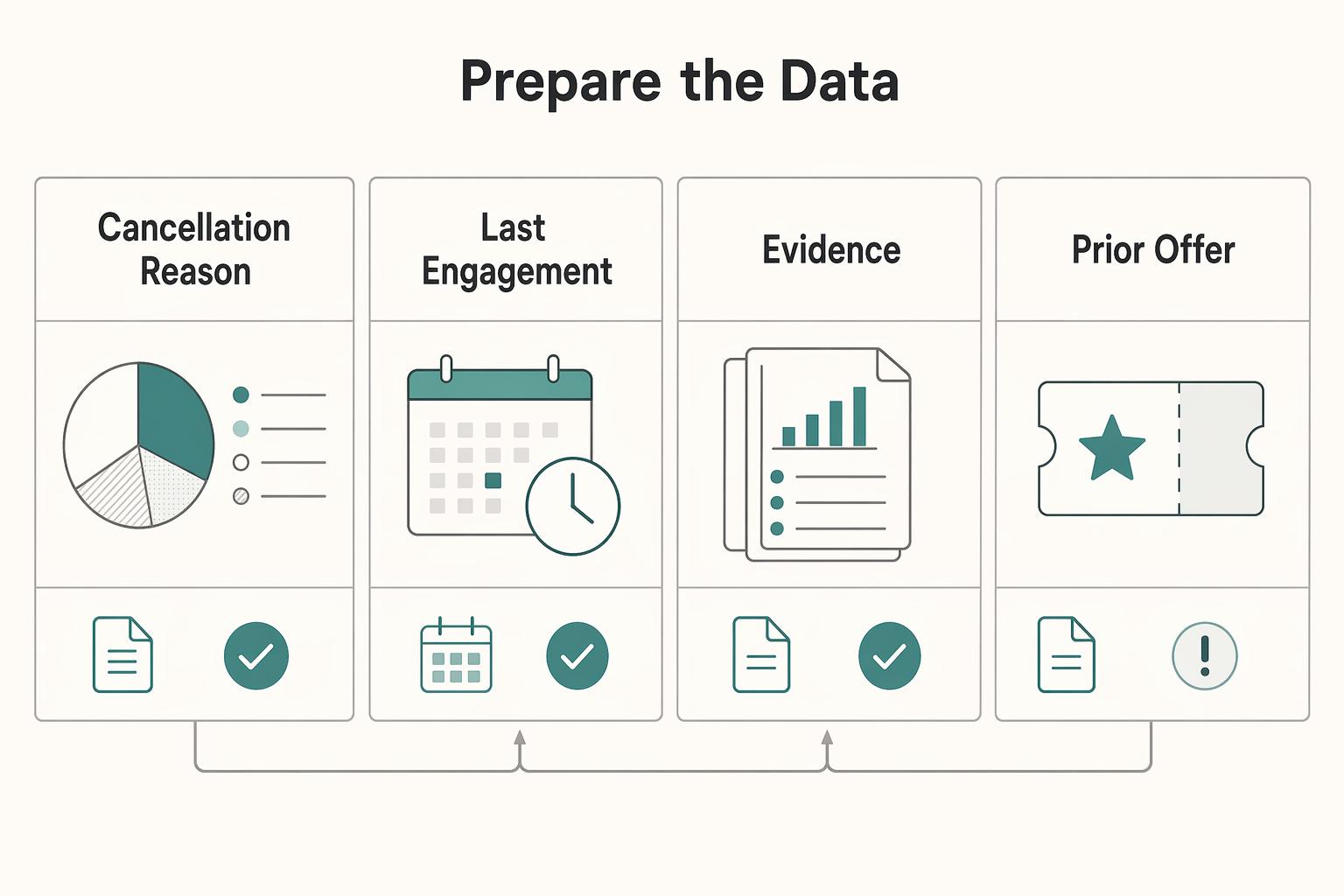
Step 1. Consolidate one source of truth. Pull one shared list of churned users and dormant subscribers, then tag each record with last meaningful activity and any available cancellation reason. Use behavior that signals risk, such as no logins, no purchases, reduced spend, or falling engagement.
Step 2. Build the minimum evidence pack. Attach prior purchase history, current plan value, and a practical tier (high-value accounts, power users, low-usage users). If cancellation reason is missing, keep those users in a separate segment instead of forcing precise targeting.
Step 3. Set financial guardrails before creative starts. Define the maximum discount by segment, your acceptable payback window, and a stop when projected margin turns negative. In SaaS, fewer than 12 months is a common CAC payback rule of thumb, but finance should set your actual recovery window.
Step 4. Confirm ownership and approvals. Lock ownership of creative, approvals, and send operations before you build the sequence so each branch can run reliably at volume.
If you want a deeper dive, read Winback Campaigns for Churned Subscribers: Timing Channels and Offers.
Segment users by recovery potential, not just churn status#
Segment by recoverability, not churn label alone. Sending the same win-back message to every churned user hides the signals that show who is worth pursuing and who is not.
Step 1. Combine cancellation reason, value, and behavior#
Use three fields per record: cancellation reason, account value tier, and last meaningful behavior. This is the minimum view you need to build targeted, personalized win-back segments instead of a generic blast.
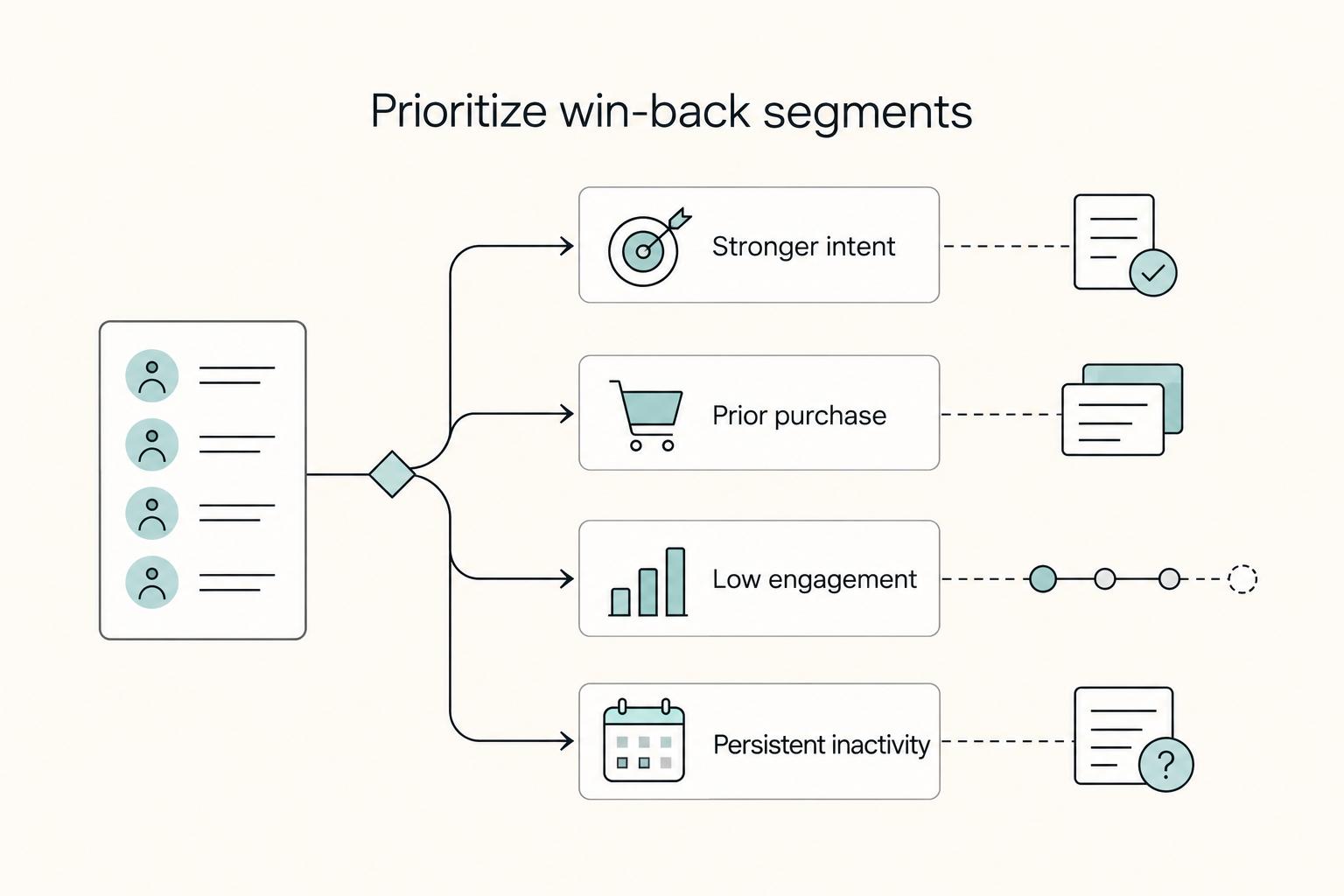
Former power users and low-usage users should not sit in the same lane, even when they canceled around the same time. Recent value behavior plus stronger prior engagement can support faster outreach. Weak history with an unclear reason usually belongs in a slower lane.
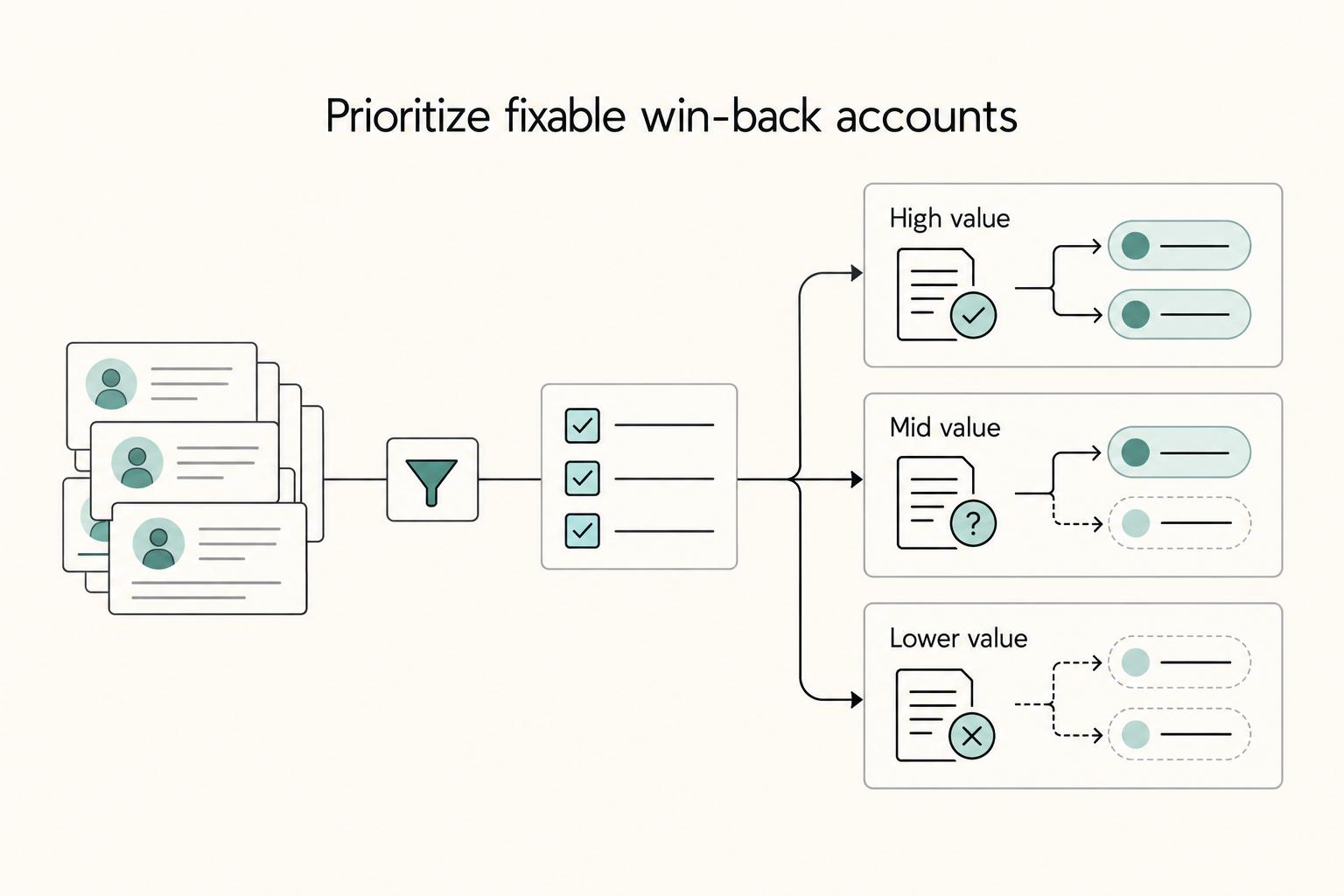
Step 2. Prioritize high-value accounts with fixable reasons#
Start with high-value accounts where the churn reason appears addressable. Not all churned users are worth pursuing, and some are more recoverable than others.
| Value tier | Reason / engagement | Action |
|---|---|---|
| High value | Fixable reason + prior engagement | Recover now |
| Mid value | Unclear reason or uneven engagement | Observe longer |
| Lower value | Limited signs of realized value | Lower priority |
Use a simple decision order:
- High value + fixable reason + prior engagement -> recover now
- Mid value + unclear reason or uneven engagement -> observe longer
- Lower value + limited signs of realized value -> lower priority
Step 3. Add a binary action to each segment#
Give each segment one operational status: recover now or observe longer. Base that status on inactivity trigger plus last value event, not churn date alone.
Run a quick quality check on a small sample from each segment. If a reviewer cannot explain why a record is in recover now, tighten the rules before launch.
Step 4. Create a do-not-pursue list before offers go live#
Define a do-not-pursue list for records where expected recovery value is unlikely to justify the effort, or where the churn reason is not meaningfully addressable. This keeps send volume from crowding out higher-potential recoveries.
Focusing on high-value, winnable accounts is economically meaningful because large buyers can represent an outsized share of revenue.
Set timing rules by segment instead of one universal delay#
Set timing by segment, not by one fixed delay. First-send timing is a core win-back design choice, and a universal wait like 90 days can be too early or too late depending on your average buying cycle and why the subscriber churned.
Step 1. Build a timing matrix from cancellation reason and buying cycle#
Start with your own inactivity baseline. Win-back flows should target people who have been inactive longer than your average buying cycle. In some businesses, that window is 30, 60, or 90 days; in others, it can be 3-6 months.
Then map each cancellation-reason segment to first contact timing, follow-up cadence, and stop conditions.
| Cancellation reason segment | First contact timing | Follow-up cadence | Stop condition |
|---|---|---|---|
| Temporary saturation or "too much right now" | Delay first touch until clearly past the normal buying cycle | Light, spaced follow-up | Stop if usage resumes or offer economics no longer work |
| Unresolved pain, with high prior engagement | Test earlier outreach once inactivity crosses the segment threshold | Tighter early cadence | Stop if no recovery signal appears after planned waves |
| Low usage or unclear reason with weak history | Wait longer, or suppress from active recovery | Minimal follow-up, often one check-in | Stop quickly if no value signal appears or unit economics do not justify more sends |
Practical rule: if the exit reason suggests temporary saturation, wait. If it suggests fixable friction and prior value was strong, test earlier. Segment logic should decide whether time helps or hurts.
Step 2. Gate every send with an inactivity checkpoint#
Do not advance the sequence on elapsed time alone. At each inactivity trigger, check for a recovery signal first, and use behavioral triggers so records move only when status still matches the next step.
Before each send, confirm:
- Any recovery signal since the last wave, such as a purchase, renewed usage, or login?
- Is the record still in the same timing segment and still eligible for this path?
- Does the next touch still meet segment-level cost and margin guardrails?
If recovery appears, suppress or reroute. If eligibility changed, update the path first. If economics fail, stop the sequence instead of forcing another touch. Use post-send actions to automatically unsubscribe or move non-responders after the series.
Step 3. Verify segment economics before you scale volume#
After each wave, compare reactivation lift versus offer cost by segment before you expand volume. Join segment inputs (cancellation reason, purchase history, plan value, last meaningful activity) to send outcomes and verify recovered value still clears your economic bar.
This is the key tradeoff: earlier timing can improve recovery in high-value, fixable segments, while delayed timing can protect margin in lower-intent segments. Expand first where lift is real without needing heavier incentives, and hold volume where recovery depends on escalating discounts. Timing should earn scale by producing recoveries that still make financial sense.
Design an offer ladder that protects margin#
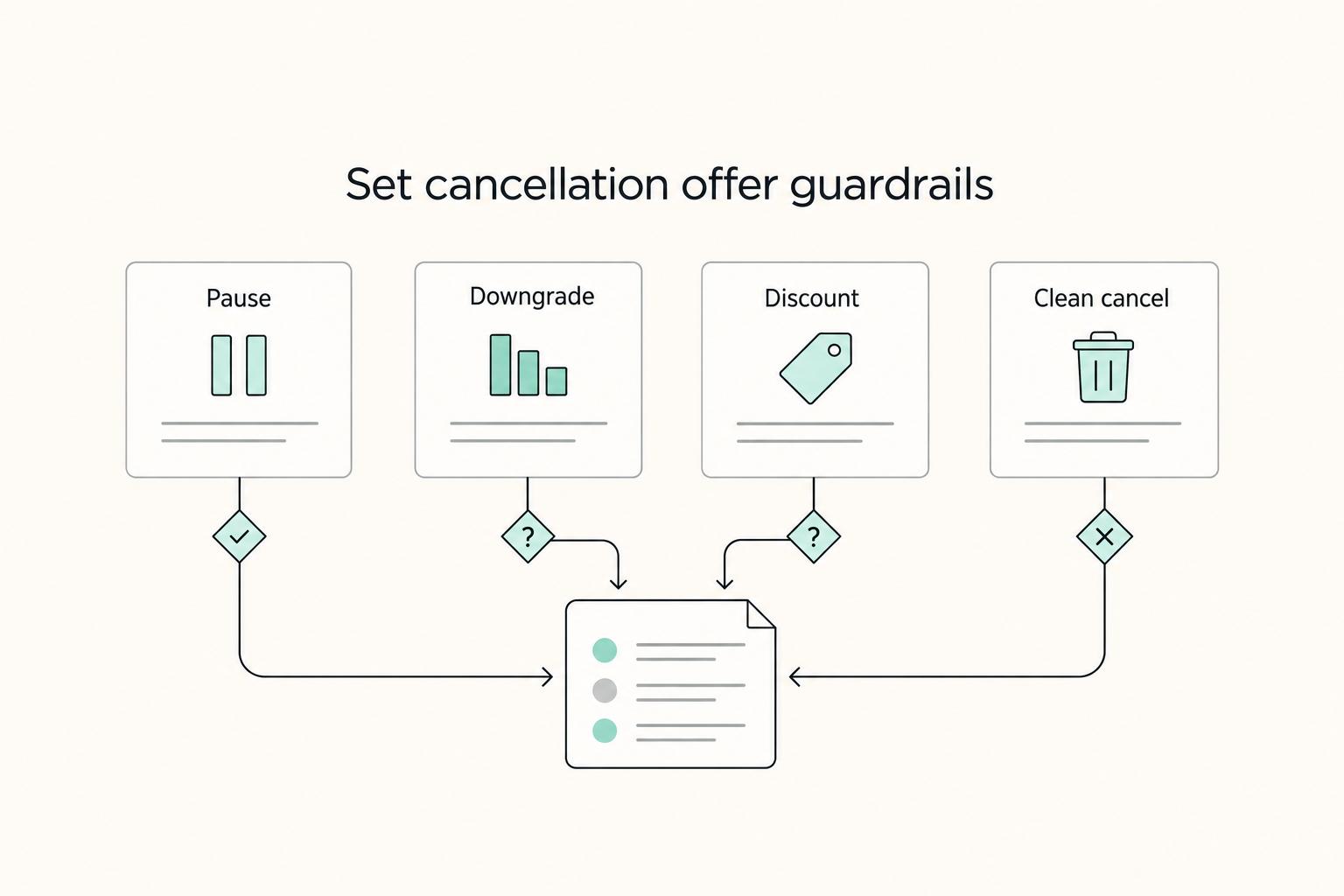
Build the ladder to escalate value over time, not to start with your most expensive concession. Lead with low-cash options, reserve deeper offers for segments likely to repay them, and require approval where margin risk increases.
Step 1. Start with low-cash value before money off#
Do not open with a discount just because someone churned. A practical win-back pattern is a 3-part sequence that escalates value across sends, so early touches can stay non-cash or low-cash. Use options like an exclusive access offer, a product update tied to why they left, or another low-cash incentive such as a complementary product or free gift based on purchase history.
Match that first offer to cancellation context. If someone left due to overload, a clear value reminder may be more credible than a coupon. If someone was price-sensitive but previously engaged, keep the discount in reserve instead of training discount waiting behavior.
Before launch, sample records and confirm each segment starts at the lowest-cost viable offer unless there is a documented exception.
Step 2. Tie offer strength to segment value and recoverability#
Offer strength should follow account value and recoverability, not churn status alone. Former power users and high-value accounts can justify stronger reactivation terms than low-usage or low-value users. If purchase history, plan value, and recent meaningful activity indicate recoverable value, escalation can be justified. If not, keep treatment light or use no incentive.
| Segment / condition | Offer stance | Evidence / rule |
|---|---|---|
| Former power users and high-value accounts | Stronger reactivation terms can be justified | Use purchase history, plan value, and recent meaningful activity |
| Low-usage or low-value users | Keep treatment light or use no incentive | Offer strength should follow account value and recoverability |
| Price-sensitive but previously engaged | Keep the discount in reserve | Avoid training discount waiting behavior |
| Expected recovery value does not cover incentive cost | Hold the offer | Use a message-only check-in, test non-cash value, or suppress the segment |
Use your existing evidence pack: cancellation reason, purchase history, plan value, and recent engagement. Then enforce a hard rule: if expected recovery value does not cover incentive cost, hold the offer. Use a message-only check-in, test non-cash value, or suppress the segment.
Avoid blanket discounting. Broad concessions can hurt margins and weaken perceived value.
Step 3. Put finance signoff on the expensive rungs#
Document the ladder in a shared approval artifact, not just campaign copy. For each segment and touch, list offer type, expected incentive cost, expected recovery value, and projected margin so unit economics are explicit before scale.
Set a written approval threshold for deeper discounts with a named approver. One documented governance pattern uses executive approval above 40% discount depth; you do not need that exact cutoff, but you do need a clear threshold and owner.
After each wave, compare recovered value versus incentive cost by segment. If a segment only converts at concession levels that break margin, stop escalation there.
For a step-by-step walkthrough, see How Creative Professionals Protect Flow State With a Compliance, Operations, and Client Firewall.
Write messaging that matches churn reason and intent#
Once the offer ladder is set, your copy should make the next step feel specific to why the person left. If the message reads generic, the offer will too.
Step 1. Build every win-back email around four required elements#
Keep each email anchored to four elements: a clear subject line, a personalized reference from purchase history, an explicit lapse acknowledgment, and one focused call to action (CTA). This gives context fast and keeps the next step unambiguous.
Make personalization concrete. If you have prior purchase data, reference the product, category, or plan they actually used instead of generic brand language. Also name the lapse directly so the message feels contextual, not random. Before launch, QA a live sample to confirm each email has one primary CTA and the right purchase-history field for that segment.
Step 2. Match tone to cancellation reason instead of sending one generic message#
Write to the churn reason, not a single house-style template. If a segment left for a specific objection, use practical "what changed" language that addresses that objection directly. If a segment went inactive, lead with a value reminder tied to what they previously used.
Keep the framing tied to the recorded reason or inactivity pattern for that segment. Some users respond to frequent touchpoints while others prefer a lighter nudge, so one uniform message pattern is usually the wrong default.
Step 3. Keep trust and compliance visible in every touch#
Every email needs a clear, conspicuous unsubscribe path. That is a compliance requirement for commercial email, and CAN-SPAM violations can reach up to $53,088 per email, so make opt-out easy to find.
Use urgency carefully. A direct subject line can help, but pressure language should match the segment and the situation. If urgency is not credible for that cohort, it can reduce trust instead of improving response.
You might also find this useful: How to Build a Cancellation Flow That Saves Subscribers: Pause Downgrade and Win-Back Tactics.
Implement the sequence with checkpoints and handoffs#
Once the copy is ready, make each inactivity-trigger path advance only when the user still belongs in that path, with a checkpoint after every send.
Step 1. Map each inactivity trigger into six stages#
For each inactivity trigger, use the same ordered flow: trigger, send, observe, branch, suppress, and close-out. This keeps timing and offer logic explicit instead of letting a linear drip run by default.
Use a real hold step between sends. A Wait Until step can pause a person until they meet a condition or enter a segment, and a max wait prevents people from sitting there indefinitely. After that, use a Decision Split yes/no branch based on behavior or attributes: re-engaged users move to follow-up, while others move to the next touch, suppression, or close-out.
Verify structure before launch: every path should show timeout, branch condition, and a clear end state.
Step 2. Add a checkpoint after each send#
Before moving a contact forward, confirm:
- List hygiene: remove unengaged, unsubscribed, invalid, and duplicate contacts from the sendable audience.
- Suppression logic: keep flagged profiles in-system but blocked from marketing sends.
- Economics: confirm the segment still clears your margin floor before the next reactivation offer.
If the segment no longer supports the offer cost, branch to suppression or close-out rather than escalating incentives automatically.
Step 3. Define handoffs and rollback rules#
When a user re-engages but does not convert after the first reactivation offer, hand the case across product, lifecycle, and finance instead of leaving the next move to one team. Keep the handoff packet short: segment, cancellation reason or inactivity pattern, purchase history, offer shown, re-engagement signal, and current value estimate.
Document rollback rules before launch so a segment can be paused quickly if unsubscribe or complaint patterns spike. If you send 5,000+ messages per day to Gmail accounts, use Google's spam-rate guardrails as practical triggers: stay below 0.1% and avoid reaching 0.3% user-reported spam.
Fix the mistakes that sink most win-back programs#
Most win-back programs fail when they use one message for everyone, default to discounts, track opens instead of payback, and keep emailing dormant subscribers without firm stop rules.
| Rule | Threshold / requirement | Context |
|---|---|---|
| Unsubscribe path | Clear, conspicuous in every email | Commercial email requirement |
| Opt-out requests | Honor within 10 business days | Audit suppression regularly |
| Gmail user-reported spam | Stay below 0.1% | For senders at 5,000/day to Gmail accounts |
| Gmail user-reported spam | Avoid 0.3% | Pause affected segments quickly if signals rise |
| CAN-SPAM violations | Up to $53,088 per email | Per violating email |
Step 1. Segment before you message. Treating all churned users the same is a known mistake. Split by cancellation reason and prior purchase history first, and do not send a generic campaign when those fields are missing. Every sendable segment should show both fields, not just churn status.
Step 2. Do not default to a discount offer. Using discounts as the default offer is a common flow flaw. Use your finance thresholds to gate when a stronger reactivation offer is allowed instead of escalating automatically after weak response. If redemptions increase but recovered margin does not, the offer strategy is likely mis-set.
Step 3. Judge each cycle on economics, not opens. Open rate shows attention, not profitability. Review unit economics and margin by segment after each cycle, then adjust or stop segments that are not paying back.
Step 4. Enforce hard stop rules for dormant subscribers. Keep the unsubscribe option clear in every message and ensure opt-out requests are honored within 10 business days. Audit suppression regularly: a suppressed profile should not receive marketing messages, even with prior consent. If spam or complaint signals rise, pause affected segments quickly; for senders at 5,000/day to Gmail accounts, keep user-reported spam below 0.1% and prevent it from reaching 0.3%.
Related: Win-Back Campaigns for Platform Operators: How to Re-Engage Churned Subscribers Automatically.
Build your first margin-safe win-back cycle this month#
Build one auditable win-back cycle first, then scale only what proves out. This month, focus on matching segment, timing, offer, and message to likely recovery paths so finance can validate outcomes before volume increases.
-
Map segments by cancellation reason and value. Start with high-value accounts, power users, low-usage users, and competitor switchers, then split further only when cancellation-reason data is reliable. Validate each segment with a record sample (reason tag, last meaningful activity, prior purchase history). If data is weak, hold that segment back instead of sending a generic flow.
-
Set one inactivity trigger per segment based on your buying cycle. Trigger only after inactivity is longer than your average buying cycle, not on a blanket timer. Define stop rules up front: stop on re-engagement, conversion, unsubscribe, or end-of-sequence. Before launch, confirm each user can enter one path and has one suppression path.
-
Approve an offer ladder before copy is written. Do not default every segment to discount-led reactivation. Use non-cash value (like exclusive access or a "what changed" message) where appropriate, and reserve stronger incentives for segments where expected recovery value can support them. Document segment, allowed offer type, max incentive, approver, and fallback.
-
Ship segment-specific messaging with fixed standards. Every email needs an accurate subject line, one clear CTA, and a visible unsubscribe path. Address the likely churn reason directly in each segment's message. QA operationally: send tests, verify the opt-out flow end to end, and confirm the final subject still matches the body. CAN-SPAM exposure can reach up to $53,088 per violating email.
-
Verify economics before scaling. Review reactivation rate, cost per recovery, conversion rate, and unit economics after offer cost. If a segment reactivates users but fails margin expectations, pause it and adjust timing or incentive strength before expanding. A successful first cycle tells you which segments to scale and which to suppress.
If you want the full breakdown, read How US Expats Can Catch Up on Back Taxes With Streamlined Filing.
Frequently Asked Questions
When should you send a win-back email to churned subscribers?
Send it only after the user has been inactive for longer than your actual buying cycle, not after a generic delay copied from another brand. A common 90-day default can miss the mark if your purchase cadence is shorter or much longer. Verify that the trigger uses real inactivity data and excludes people still inside their normal repurchase window.
How many touches should a subscriber win-back flow include before you stop?
There is no universal best number of touches, so do not hard-code an “always three emails” rule. Decide the count together with incentive timing, and treat incentives cautiously, often as a later or last-resort step. Stop when the person stays inactive through your planned sequence, opts out, or your stop rules indicate over-messaging risk.
What should every win-back email contain to be credible and compliant?
At minimum, use a subject line that accurately reflects the message and include a clear, conspicuous explanation of how the recipient can unsubscribe from future marketing email. CAN-SPAM exposure can reach up to $53,088 per violating email.
Who should receive the strongest reactivation offer first?
Not one fixed segment every time. Prioritize based on your own segment behavior and economics, then validate the approach with testing before you scale.
Should we lead with a discount offer or test exclusive access offer first?
Do not assume discount-first. Discount-led win-back is not universally effective across churned users. Test offer order by segment, and if you use discounts, consider introducing them later in the sequence rather than immediately.
What data is still unknown before scaling this flow across all segments?
The biggest unknown is usually timing by segment, which is why timing assumptions should be validated experimentally before expanding volume. Run A/B tests on win-back timing, and confirm your stop rules prevent over-messaging as you scale.
Try a related tool
Researched and edited by the Gruv editorial team. Gruv builds cross-border billing, payouts, and finance-operations software for global businesses.
Sources
Includes 5 external sources outside the trusted-domain allowlist.
- consumer.ftc.gov/consumer-alerts/2023/08/ftc-lawsuit-reminds-...trusted
- ftc.gov/business-guidance/resources/can-spam-act-com...trusted
- hbs.edu/faculty/Pages/item.aspxtrusted
- braze.com/resources/articles/what-is-a-win-back-campai...external
- braze.com/docs/user_guide/engagement_tools/canvas/canv...external
- clevertap.com/blog/win-back-campaignexternal
- content-and-marketing.com/blog/customer-win-back-timing-segmentation-g...external
- hbr.org/2014/10/the-value-of-keeping-the-right-custo...external
Educational content only. Not legal, tax, or financial advice.
Related Posts
Subscriber Winback Campaign Decisions on Timing Channels and Offers
A subscriber winback campaign should optimize recovered value, not activity. Churn is not just a lifecycle problem. It is a unit economics decision: is a former subscriber worth recovering, or should that budget go to new acquisition or low-cost nurture instead? For subscription businesses, every cancellation means lost monthly recurring revenue and sunk acquisition spend, so your response determines whether that value is gone for good or still recoverable.
Win-Back Campaigns That Reactivate Churned Subscribers Without Margin Loss
Assume from the start that a win-back flow can lift reactivations and still be a bad trade. If you do not measure what those returns cost in incentives and short-term re-churn, you can end up celebrating activity that does not help the business.
Build a Cancellation Flow That Saves the Right Subscribers
Treat the cancellation flow as a commercial control point, not a last click on the way out. When a subscriber leaves, the loss to recurring revenue does not stop at one invoice. It compounds month after month. Start with an operating question, not a UX question: should you save this customer now, offer a lower-commitment path, or let them go cleanly?