
Quick Answer
Creative professionals achieve flow by removing the background worry and business friction that keep the brain in threat-scanning mode. The article recommends a compliance dashboard with automated alerts and a weekly review, a single source of truth for invoicing and cash flow, and a client boundary that protects uninterrupted deep work.
Why Your Brain Can't Flow When It's Worried About Compliance#
It's a frustrating paradox for any professional: you've engineered the perfect work environment, silenced every notification, and blocked out your calendar for deep work, yet the state of deep focus you need - the flow state - remains elusive. The reason isn't a lack of discipline. your brain is neurologically incapable of reaching that state of immersive creativity when it's simultaneously functioning as your company's full-time risk-assessment officer.
To achieve flow, your brain must enter a state of transient hypofrontality - a temporary deactivation of the prefrontal cortex. This is the part of your brain that acts as your internal CEO, handling planning, self-monitoring, and complex decision-making. When this "inner critic" goes quiet, more radical, associative, and creative thinking can emerge.
Chronic business anxiety does the literal opposite. Stress from worrying about compliance, client disputes, or unpredictable cash flow floods your brain with cortisol. This chemical response puts your prefrontal cortex on high alert, forcing it to constantly scan for threats. Instead of relaxing its grip to allow for innovation, your brain's CEO becomes a hyper-vigilant micromanager. In this neurological state, creative flow isn't just difficult; it's biologically inhibited.
This creates a massive and invisible cognitive load, a term for the total mental effort being used in your working memory. Think of your working memory as a computer's RAM. When it's overloaded by dozens of open "anxiety tabs" - Is this invoice VAT-compliant? How many days do I have left in this jurisdiction? - there are simply fewer resources available for the complex problem-solving your core work demands.
We must reframe these administrative burdens not as annoying chores, but as a direct tax on your peak performance. A business run on a patchwork of spreadsheets and a chaotic inbox forces you into a perpetual state of shallow work, making sustained deep work impossible.
The solution is to build a Flow State Firewall - a systematic, three-part defense that eliminates anxiety and protects your focus.
Part 1: Turn Compliance Worries Into Tracked Thresholds and Alerts#
To reclaim the mental energy your chaotic back office steals, you must systematically dismantle the sources of low-grade, corrosive anxiety. This isn't about ignoring risks; it's about confronting them with a clear methodology, transforming abstract fear into concrete control.
Map Your "Nightmare Scenarios"#
Anxiety thrives in ambiguity. The first step to neutralizing it is to drag your specific compliance worries into the light. Identify your top two or three scenarios and define their exact thresholds.
- For the U.S. Expat: Your primary fear might be the Foreign Earned Income Exclusion's (FEIE) physical presence test. The specific threat is failing to be physically present in a foreign country for at least 330 full days during a 12-month period.
- For the U.K.-Centric Professional: Your concern is likely the Statutory Residence Test (SRT). The risk is accidentally spending too many days in the U.K. and triggering an unexpected tax residency.
- For Anyone with Global Assets: A common anxiety is the FBAR (Report of Foreign Bank and Financial Accounts) reporting threshold. You must file if the aggregate value of your foreign financial accounts exceeds $10,000 at any point during the year.
Naming these threats stops the cycle of vague worry and allows you to build a targeted defense.
Build a "Compliance Dashboard," Not a Spreadsheet#
A spreadsheet is a reactive log; a dashboard is a early command center. You must shift from a digital shoebox where you record past events to a hub that shows your current status in real-time. This transforms your primary anxieties into simple, manageable data points.
| From This (Reactive Spreadsheet) | To This (Early Dashboard) |
|---|---|
| Manually logging past travel dates | Live Counter: Days in U.K. this tax year |
| Guessing current foreign bank balances | Live Metric: Aggregate Foreign Bank Balance (USD) |
| Anxiously recounting calendar days | Live Counter: Days Remaining to Meet FEIE Requirement |
Automate Your Triggers and Alerts#
Your system must serve you, not the other way around. Offload the burden of constant mental monitoring by setting up automated alerts that trigger when you approach a critical threshold. An automatic notification - "You have 30 days remaining before you hit your 90-day U.K. limit" - does the work of weeks of background worry, freeing up immense cognitive resources.
Run a 15-Minute "Sunday Compliance Review"#
Finally, create a simple, non-negotiable ritual. Dedicate just 15 minutes every Sunday to review your compliance dashboard. This small, consistent habit prevents the slow accumulation of anxiety. You'll check your day counts, confirm your balances, and see that your alerts are set. This weekly check-in ensures you are always operating from a position of knowledge, not fear, clearing the way for a week of immersive work.
Part 2: The Operational Engine - Reducing Cognitive Friction#
The Sunday ritual clears the background hum of compliance dread, but your focus is still under assault from a more immediate threat: the cognitive friction of a disorganized business. The constant switching between apps to create an invoice, log a payment, and categorize an expense isn't just annoying; it's a direct tax on your creative output.
Calculate the True Cost of Your "App Juggling"#
Context switching is the enemy of immersive work. Every time you toggle from your invoicing software to your bank's portal, then to your payment processor, you fracture your attention. According to the International Data Corporation, the average knowledge worker spends over a quarter of their day just looking for and consolidating information across different systems.
Let's put a price on that friction. Use this simple calculation:
| Variable | Your Estimate |
|---|---|
| A. Minutes lost per switch (avg. 5 mins) | __________ |
| B. Switches per day (e.g., invoicing, checking payments) | __________ |
| C. Your effective hourly rate ($) | __________ |
Formula: (A * B * 20 workdays) / 60 mins * C = Monthly Cost of Friction
When you see the real dollar amount, the motivation to build a better system becomes undeniable.
Design Your "Single Source of Truth"#
The solution is to create an operational hub - a "Single Source of Truth" (SSoT) where the entire lifecycle of a financial transaction exists in one unified flow. This moves you from a "digital shoebox" model to an integrated system where an invoice, its payment, and its tax categorization are all smoothly connected. As productivity expert Tiago Forte argues, we create cognitive overload by asking our minds to do too much remembering. By offloading this burden to a well-designed external system, you liberate your mind to do what it does best: think, create, and solve complex problems.
Systematize Your Cash Flow#
Financial uncertainty is a massive flow blocker. The anxiety of the "feast or famine" cycle can cripple creativity. Systematizing your cash flow transforms this unpredictability into a reliable process.
- Standardize Your Terms: Define a clear, professional standard (e.g., 50% deposit, Net-15 on final invoice) and build it into your master services agreement. This removes ambiguity and establishes a predictable financial rhythm.
- Automate Your Reminders: Chasing late payments is emotionally draining. Use a system that automatically sends polite, professional reminders when an invoice is due or overdue. This depersonalizes the process and ensures you get paid without the mental effort.
- Create a Simple Forecast: A true SSoT doesn't just show you past earnings; it helps you project future income. By having all your issued invoices and their due dates in one dashboard, you can instantly see your expected cash flow for the next 30, 60, and 90 days. This predictability is the ultimate antidote to financial anxiety.
Part 3: The Client Boundary - Defending Your Time and Focus#
With your finances systematized, the final wall of your firewall protects your most finite asset: your attention. Clients, even with the best intentions, are the single greatest source of focus-shattering interruptions. Unclear expectations and scope creep don't just add more work; they pull you out of the deep work required to deliver high-value results. You must early build a professional framework that makes interruptions the rare exception, not the daily rule.
Architect Your Onboarding as a Client "User Manual"#
The best way to prevent client-induced chaos is to architect a system that makes it nearly impossible. Your onboarding process is your first and best opportunity to provide a clear, professional "user manual" for working with you.
- Sign a Professional Services Agreement: This is non-negotiable. Before any work begins, a signed contract sets the legal terms and scope, serving as the ultimate source of truth for the engagement.
- Issue a Welcome Packet: Go beyond the contract. A welcome packet outlines mutual expectations in plain language. Use it to define:
- Communication Channels: Specify how you communicate (e.g., "All project feedback will be managed through our shared portal: no feedback via text message or social media DMs, please.").
- Office Hours: State your working hours and expected response times clearly (e.g., "My core office hours are 9:00 AM to 5:00 PM CET, and I respond to all non-urgent messages within 24 hours.").
- The Definition of "Done": Explicitly state what is included in the project scope, such as the number of revisions, to prevent ambiguity.
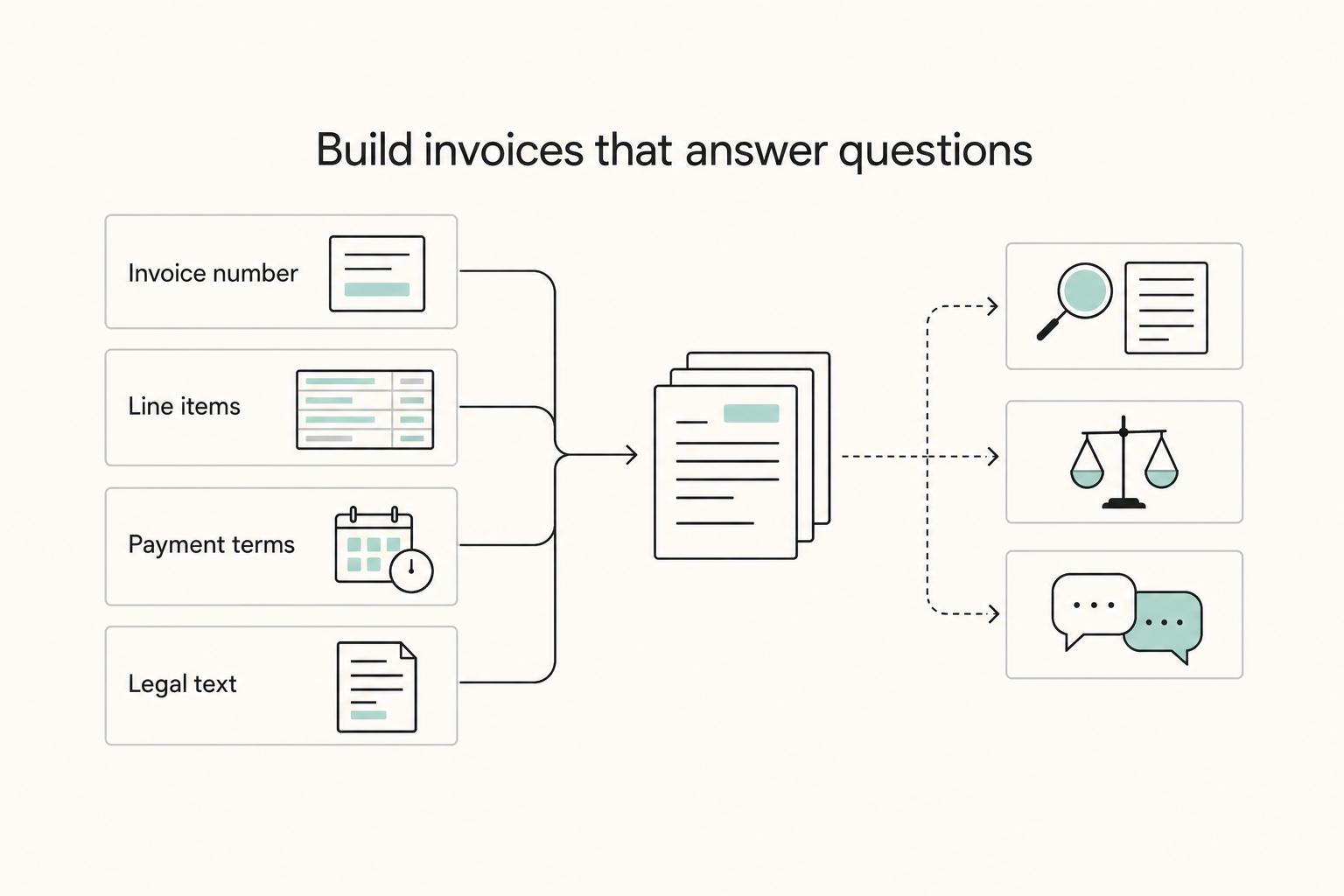
Engineer Invoices That Answer Questions Before They Are Asked#
An invoice is more than a request for payment; it's a critical communication tool that eliminates the back-and-forth that breaks your focus. Engineer your invoices to be so clear they answer every potential question before it's asked.
| Element | Purpose | Example |
|---|---|---|
| Unique Invoice Number | Professional tracking and reference. | INV-2025-087 |
| Detailed Line Items | Justifies the cost and clarifies the work completed. | Instead of "Consulting," use "Phase 1: Market Research & Competitive Analysis." |
| Clear Payment Terms | Removes ambiguity about when you expect to be paid. | Payment Due: Net 15 (November 6, 2025) |
| Required Legal Text | Ensures compliance and prevents delays. | For B2B services in the EU, a "Reverse-Charge" clause shifts VAT responsibility to the client. |
Use Scope Creep "Circuit Breakers"#
Scope creep - the slow expansion of deliverables beyond the original agreement - is a notorious flow killer. Have a pre-planned, professional process for handling these requests; it turns a potentially awkward confrontation into a simple business transaction. When a client asks for "one more thing," trigger your process with calm, professional phrases:
- "That's a great idea. It falls outside our current scope, but I'd be happy to scope it out as a Phase 2 add-on. I can send over a separate proposal for that this week."
- "I'm happy to accommodate that change. Per our change-request process, I'll assess the impact on the timeline and budget and send over a formal change order for your approval before proceeding."
This reframes the request from a casual favor to a formal business decision, protecting your boundaries and your bottom line.
Batch Your Communication#
Finally, you must treat your focus as your most valuable resource. The constant hum of notifications is the death of deep work. The solution is to batch all client communication into specific, scheduled blocks of time.
- Schedule Two Daily Windows: Dedicate two 30-minute slots per day - for example, at 11:00 AM and 4:00 PM - solely for client communications.
- Turn Off All Notifications: Outside of these windows, turn off all email and messaging notifications. No exceptions.
- Train Clients with an Autoresponder: Use a simple, professional autoresponder to manage expectations.
Example Autoresponder: "Thank you for your message. I'm currently in a deep work session to focus on client projects. I review and respond to all emails at 11:00 AM and 4:00 PM CET. If your matter is urgent, please text [Your Number]. Otherwise, I look forward to connecting during my next communication window."
Conclusion: Reclaim Your Focus by Treating Your Business Like a Professional#
Achieving a sustainable flow state is not a matter of luck or sheer force of will; it is the natural result of strategic business design. The myth that peak creativity comes from a chaotic, unstructured life is a deep disservice to the professional. The opposite is true: the discipline you bring to your business operations is precisely what liberates your mind to do brilliant work.
This is the purpose of the Flow State Firewall. It is a deliberate, systematic shield built from three core components:
- The Compliance Shield: Transforms your deepest anxieties about regulations and taxes into clear, manageable data, neutralizing the background stress that poisons deep work.
- The Operational Engine: Consolidates your financial life into a single source of truth, eliminating the context-switching and cognitive friction that drain your mental resources.
- The Client Boundary: Establishes firm, professional protocols that defend your time and attention from interruptions, creating the uninterrupted blocks of time essential for true immersion.
By implementing this framework, you are fundamentally re-architecting your business to serve its one true purpose: to create the optimal conditions for you to produce exceptional work. The endless "work of work" - the invoicing, the compliance checks, the back-and-forth emails - is the single biggest drain on your creative potential.
Stop allowing the administrative side of your business to be a constant source of friction. That approach forces you to work in your business, constantly reacting to its demands. Building a firewall allows you to work on your business, and more importantly, on the creative output that defines your professional identity. Take control of your operations, systematize your processes, and reclaim the mental space you need to perform at your peak.
Operational Guardrails Table for Protected Focus Blocks#
Use one written workflow to protect deep-work windows and reduce compliance drift. This checklist pairs your calendar blocks with controls from self-employed IRS guidance, NYC freelancer protections, and APA multitasking research.
| Control Area | Minimum Standard | Weekly KPI | Escalation Trigger |
|---|---|---|---|
| Focus blocks | 2 x 90-minute blocks on client-delivery days | 4 protected blocks/week | Less than 3 protected blocks in a week |
| Invoice cadence | Send invoices within 24 hours of milestone completion | Invoice lag under 1 day | Any invoice older than 3 days |
| Scope control | Written change-order for all add-on requests | $0 unapproved scope work | More than $200 in undocumented extra work |
| Compliance review | Weekly 15-minute tax and contract check | 100% weekly completion | Two missed weekly reviews in a month |
How many focus blocks should a freelancer schedule each week?#
Most solo operators get reliable output with four to six protected 90-minute blocks per week. Track the count every Friday and reset scope before the next week if you miss the floor.
What is a reasonable threshold for invoice and cash-flow control?#
A practical threshold is same-day invoicing after milestones and a hard alert if any invoice remains outstanding beyond 30 days. Put that rule in your operating checklist and review it weekly.
How do you keep compliance work from taking over creative time?#
Batch compliance into a fixed 15-minute weekly slot and automate reminders. Avoid ad-hoc admin interrupts inside production blocks unless there is a legal or payment deadline risk.
What internal playbooks should be linked into this workflow?#
Pair this system with your file-ops SOP in digital file organization, your offer design in platform strategy, and your hiring/legal template controls in offer letter workflow.
For 2026 planning, define numeric boundaries in writing: cap emergency context switches to 5 per week, keep admin overhead under 20%, and hold a weekly process budget of $300 for tooling and compliance tasks.
Frequently Asked Questions
Why do traditional productivity hacks like the Pomodoro Technique fail to solve this problem?
Traditional productivity hacks manage your time, but they don't manage your cognitive load. Techniques like time-blocking are effective for surface-level distractions, but they are powerless against the deep, background anxiety that comes from an unmanaged business. You can't focus for a 25-minute sprint if your mind is subconsciously worried about a tax deadline or an overdue invoice. The Flow State Firewall addresses the root cause, not just the symptoms.
My business is complex. Isn't building these systems just more administrative work?
It's a one-time investment of strategic work to eliminate thousands of future administrative micro-decisions and worries. Think of it as the difference between building a bridge and choosing to swim across the river every single day. The upfront effort to systematize your compliance, operations, and client boundaries pays a massive, long-term dividend in reclaimed mental energy and focus.
Is it possible to achieve a flow state when working on administrative tasks?
Absolutely. A flow state can be achieved in any activity where there is a clear goal and a balance between the challenge and your skill level. When you transform chaotic administrative chores into a streamlined, repeatable system, you remove the friction and uncertainty that cause frustration. With a clear process, you can execute these tasks with a high degree of focus and efficiency, often entering a productive flow state even during non-creative work.
What is the difference between "deep work" and "flow state"?
Think of the relationship as strategy versus outcome. Deep work, a concept from Cal Newport, is the practice of intentionally scheduling distraction-free blocks of time to concentrate on a cognitively demanding task. It's the disciplined framework you create. A flow state is the specific, immersive psychological experience that can happen during a session of deep work. Deep work is the act of building the firewall; flow is the feeling of effortless productivity and creativity you experience behind it.
How many focus blocks should a freelancer schedule each week?
Use a weekly floor of four to six 90-minute protected blocks and intervene if you miss it for two consecutive weeks.
What is a reasonable threshold for invoice and cash-flow control?
Same-day invoicing after milestones and a hard risk trigger when invoices age beyond 30 days keeps cash risk visible.
How do you keep compliance work from taking over creative time?
Batch compliance into one scheduled review block each week and keep operational changes documented in one checklist.
What internal playbooks should be linked into this workflow?
Link file management, offer design, and offer-letter controls so decisions stay consistent across delivery, sales, and legal operations.
Researched and edited by the Gruv editorial team. Gruv builds cross-border billing, payouts, and finance-operations software for global businesses.
Sources
- acquisition.gov/far/subpart-43.2trusted
- csrc.nist.gov/glossary/term/Risk_Registertrusted
- dol.ny.gov/freelance-isnt-free-acttrusted
- irs.gov/businesses/small-businesses-self-employed/se...trusted
- irs.gov/forms-pubs/about-publication-583trusted
- nyc.gov/site/dca/businesses/freelance-isnt-free-act....trusted
- nyc.gov/assets/dca/downloads/pdf/workers/Protecting-...trusted
- sec.gov/files/cash-flow-statement-bblocks.pdftrusted
Educational content only. Not legal, tax, or financial advice.
Related Posts

GDPR Compliance Checklist for Freelancers Working With EU Clients
Start by separating the decisions you are actually making. For a workable **GDPR setup**, run three distinct tracks and record each one in writing before the first invoice goes out: VAT treatment, GDPR scope and role, and daily privacy operations.
How to Manage Your Time Effectively as a Freelancer
Most freelancers struggle not because they work too few hours, but because they misallocate the hours they have—treating time as an infinite resource rather than a finite business asset with a real cost per unit. The solution is a three-layer operating system: a Time Budget Framework that commits hours to four categories before any client work is booked, a Weekly Operating Template that assigns those categories to specific calendar windows, and a monthly Admin Audit Checklist that reconciles invoicing, bookkeeping, and compliance records. Multi-client orchestration requires a WIP limit, dedicated client windows, and a capacity decision rule run before accepting new engagements. Together, these systems replace reactive decision-making with a repeatable structure that keeps delivery quality consistent, records audit-ready, and the freelance practice operationally durable.
Deep Work for Freelancers Who Run a Business of One
If you run a business of one, deep work is not a lifestyle preference or a generic productivity trick. It is part of how you protect quality and judgment in client work. Context switching quickly becomes an operational risk when you are doing delivery, sales, finance, and admin from the same chair.