
Quick Answer
Yes. A customer can hold separate subscriptions under one account when the billing system supports it. Give each subscription its own identifier, renewal and cancellation rules, and entitlement mapping. Keep Recurly checkout pricing single-currency and verify the final server-confirmed charge. Multiple plans do not require one renewal date or one invoice.
Multi-subscription support fails on operations not features#
Step 1. Set the bar at operational integrity, not feature availability. Multi-plan billing can break after the product demo. The real test is whether one customer can hold multiple plans without bad totals at checkout, unclear posting into the ledger, or support cases that bounce between teams because nobody sees the same billing state.
That standard carries through the rest of this guide. The question is not just whether your billing stack can attach more than one subscription to a customer. It is whether the result remains auditable and supportable once discounts, tax, one-time charges, retries, and plan changes start happening in production. If you cannot explain the posting path from checkout to ledger entry and then to reconciliation ownership, the feature is not ready.
Verification point: before you build further, write down who owns checkout pricing truth, who owns ledger truth, and who owns payout reconciliation against transaction history. If any of those answers are shared or vague, exceptions are more likely.
Step 2. Anchor scope to what the public product material actually supports. The strongest concrete evidence is in checkout pricing mechanics and connected support experience. Recurly explicitly positions its multi-subscription support as a hybrid billing model that can include many subscriptions alongside one-time charges. For pricing calculation, Recurly.js provides recurly.Pricing.Checkout, designed to make actual checkout costs easier to determine in complex checkouts.
That matters because checkout accuracy is a control, not just a UX detail. A practical checkpoint is to verify totals after each mutation. Add a plan, remove an add-on, apply a coupon, then confirm the final amount lock before payment submit. One common failure mode is mixing API mutations with DOM-bound pricing elements and assuming the UI will stay current. The documentation warns that those values will not auto-update unless you use API-only mode or re-render the values yourself.
The public material gets much thinner once money leaves checkout. You can find transaction-level settlement reporting in providers like Adyen, and Stripe states plainly that you are responsible for reconciling payouts against transaction history. What vendor-facing pages often do not cover is your internal control design: who matches settlement detail to posted journals, what exceptions get held, and when finance stops new plan combinations until variances are resolved.
Step 3. Define success in operator terms before you touch implementation. Success here is specific. Checkout totals must be accurate and repeatable. Posting paths must be traceable from customer action to financial record. Exception handling must be predictable enough that support does not improvise credits or retries. And omnichannel customer support has to mean one connected customer story across chat, email, and any other channel, not three partial histories.
A good evidence pack for this stage is simple. Include one sample cart with multiple plans and a one-time charge, the expected total from recurly.Pricing.Checkout, the intended ledger posting path, and the support view that should appear when payment succeeds or fails. If those four artifacts do not line up, fix operations first and feature breadth second.
If you want a deeper dive, read Mass Payment Importance of Supporting Multiple Payment Methods: Why One Rail Isn't Enough.
Define the account model and decision boundaries first#
Define decision boundaries before you wire checkout. Most failures come from allowing plan combinations that your pricing and finance workflows cannot support consistently.
Step 1. Decide what can coexist on one customer account. Write down whether a customer can hold concurrent base plans, add-ons, or both. Recurly can support a broad catalog and multi-item purchases (subscriptions plus one-time charges), so the practical limit is usually your operating model, not plan count. Use a quick test: list a few allowed carts and a few blocked carts. If teams still debate edge cases, your model is not clear enough.
Step 2. Bind every allowed cart to one currency code. Treat this as a hard rule: one recurly.Pricing.Checkout instance cannot mix currencies. If a customer needs mixed currencies, split checkout paths instead of forcing one pricing object. Set currency before adding items, and only use currencies already enabled on the site for plan or coupon pricing.
Step 3. Define state ownership and financial record ownership separately. Document which system owns checkout/subscription state transitions and which system is authoritative for financial posting. Clear ownership keeps product-side changes from creating finance-side ambiguity.
Step 4. Publish a one-page decision sheet. Keep it operational: allowed combinations, currency rule, approval path for upgrades/downgrades, and add-on handling. Include one verification line: plans, add-ons, coupons, gift cards, and taxes used in checkout must exist and be active on the same site.
For example, suppose customer C1 holds a $20 monthly analytics subscription S1 renewing on the first and a $50 monthly support subscription S2 renewing on the fifteenth. Keep two subscription IDs and two entitlement records. Cancelling S2 at its paid-through date should remove support access then while S1 keeps renewing. Decide separately whether supported billing configuration aligns their cycles, prorates a mid-cycle change, or combines invoices; a shared customer ID alone does none of those things.
This pairs well with ARR vs MRR for Your Platform's Fundraising Story.
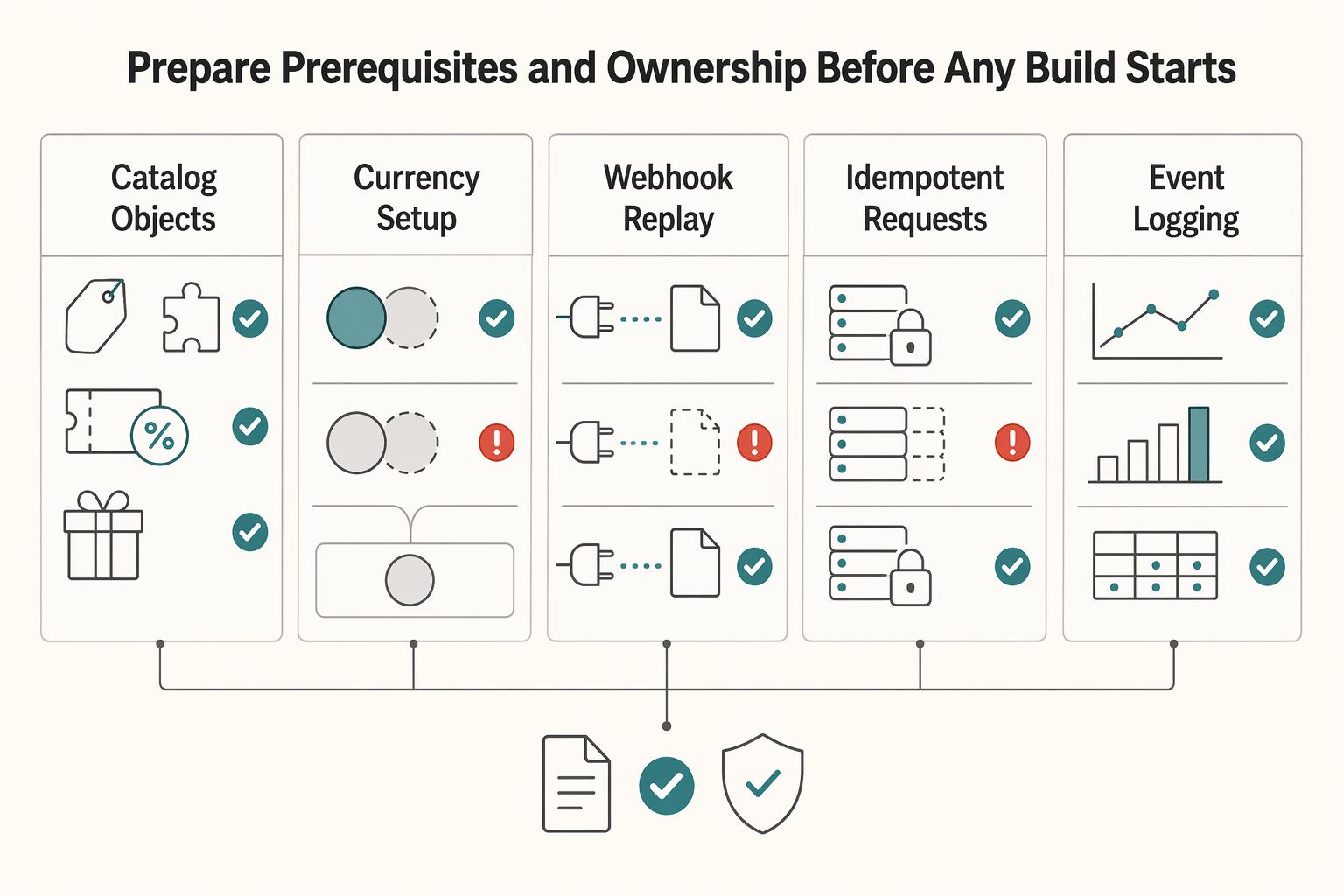
Prepare prerequisites and ownership before any build starts#
Treat readiness as a pre-build gate, not a launch-week cleanup task. If catalog status, event handling, and finance evidence are not testable up front, multi-plan checkout failures show up in production.
| Prerequisite | Requirement | Note |
|---|---|---|
| Catalog objects | Plans, add-ons, coupon, gift card, and tax setting exist and are active on the target site | Verify before build work starts |
| Currency setup | All items for one checkout share one currency code | One checkout pricing instance cannot mix currencies |
webhook handling | Set up the endpoint early and test failure paths | Required before feature work is called done |
| Idempotent requests | Use provider-supported idempotency for mutating financial commands | Retries should not duplicate effects |
| Event logging | Keep your own event logging as part of the audit trail | Webhook history in the Recurly console is retained for 15 days |
Step 1. Build a readiness checklist for every referenced catalog object. Before build work starts, verify that every referenced plan, add-on, coupon, gift card, and tax setting exists and is active on the target site. Also confirm that all items intended for a single checkout share one currency code, since one checkout pricing instance cannot mix currencies.
A common miss is validating a plan while a discount or tax object is inactive, then finding the mismatch late in testing.
Step 2. Assign one owner and one approval gate for each control area. Named ownership matters even if you skip a formal RACI. Assign owners for pricing configuration, API integration, finance controls, and CRM support routing, and give each owner one launch-approval question.
Keep the gates practical: pricing confirms active catalog objects, engineering confirms webhook endpoint and retry behavior, finance confirms posting ties to the ledger, and support confirms billing cases route correctly.
Step 3. Require integration prerequisites before feature work is called done. Set up the webhook endpoint early and test failure paths before launch. Recurly retries failed webhook deliveries but stops after ten failed attempts, so you need working retry handling before launch.
Persist each charge command before sending it, using provider-supported idempotency for retries of that command. Keep internal event logs independently of the provider console.
Step 4. Collect launch evidence, not just screenshots. Your sign-off pack should include a config export or direct API verification for live catalog objects, plus Test Gateway transactions and reconciliation proof tied to the ledger. For discounts, coupon lookup output is stronger evidence than a UI image. For reconciliation, keep a payout-level breakdown, or equivalent transaction list, that shows settled activity and posted mapping.
Related: Gateway Routing for Platforms: How to Use Multiple Payment Gateways to Maximize Approval Rates.
Implement multi-plan checkout with deterministic pricing behavior#
Deterministic multi-plan checkout depends on three controls: one pricing authority, one interaction pattern per surface, and explicit checks before submit.
| Interaction style | Update behavior | Note |
|---|---|---|
Attached DOM mode | Bound values recalculate automatically when inputs change | Choose one interaction style per surface |
API-only mode | Render amounts from pricing state and change events | Use when the app owns state with custom components or async orchestration |
| Mixed attached mode plus direct API calls | Bound inputs and outputs do not auto-refresh | You must re-render manually |
Step 1. Use one client pricing object per cart. Recurly.js supplies the checkout display calculation. The server must independently validate allowed catalog items, quantities, discounts and the amount before committing a purchase; client-calculated totals are not authorization to charge.
Keep one hard guardrail from the start: all items in a single CheckoutPricing instance must share the same currency code. If customers can hold plans in different currencies, split the checkout path before items are added. As a checkpoint, log the cart payload before pricing initialization and confirm every plan, add-on, coupon, and gift-card action stays in the same currency context.
Step 2. Choose one interaction style per surface: attached DOM mode or API-only mode. In attached mode, bound values recalculate automatically when inputs change. If you mix attached mode with direct API calls on the same instance, bound inputs and outputs do not auto-refresh, so you must re-render manually.
If your app owns state with custom components or async orchestration, use API-only mode and render amounts from pricing state and change events. Validate one full mutation path in-browser: add a plan, edit quantity, remove an add-on, and confirm subtotal, discount, tax, and total all come from the same source.
Step 3. Put explicit controls around coupons, gift cards, and async cart mutations. Do not assume coupon behavior. Multiple eligible coupons can be applied when that feature is enabled, but the number of discount applications still depends on coupon configuration. If the business expects repeat use on one account, confirm the coupon is configured as Multi-Use.
Apply the same control pattern to gift cards. Gift card purchases and redemption as product credit are supported, but your UI and service layer should still block duplicate apply attempts and reject stale async responses. A common failure is an older response repainting totals after a newer cart change.
Step 4. Add verification checkpoints for each mutation and lock the final amount before submit. CheckoutPricing emits change events on every mutation, so use those events as checkpoint boundaries. After each add/remove, quantity edit, coupon action, or gift-card action, verify computed amounts changed as expected and the UI reflects the latest pricing state.
Before submit, match the display to the latest cart version. Validate the submitted cart and final payable amount on the server. If repricing changes the amount, show it and obtain confirmation before charging.
Related reading: How to Choose a Multi-State Payroll Service for a Business of One.
Design ledger posting and reconciliation controls before scale#
After checkout, the control point is posting, not display: write financial truth from confirmed server-side payment facts to your ledger, and treat balances as derived views that can lag as funds move from pending to available.
Step 1. Define one posting order and keep derived balances secondary. Start from payment confirmation, not browser events or projected balances. webhook notifications should not be the only control for critical functions, so pair them with API responses or server-side fetches: confirm outcome, write the journal, then refresh balance projections and operational views.
Settlement timing is separate from payment confirmation, so a balance view can lag a journaled event without being wrong. Verify this with a timestamp check on one successful multi-plan purchase: payment confirmation, ledger journal, and balance projection should all be present and ordered.
Step 2. Map event handling by trigger source before expanding plan combinations. Use one shared event matrix so finance, product, and engineering apply the same control logic.
| Event type | Trigger source | Expected journal action | Reconciliation owner | Settlement dependency |
|---|---|---|---|---|
| Checkout price change | JavaScript API / recurly.Pricing.Checkout | None in ledger; pricing only | Product or engineering | No |
| Payment success confirmation | Server API response or provider fetch | Create payment-confirmed journal record | Finance ops | Not yet settled |
| Webhook redelivery or delayed provider event | webhook | Atomically deduplicate and apply the first valid transition; repeated copies add no effect | Finance ops plus engineering | Maybe |
| Settlement status change | Server event or provider balance data | Record settlement movement and any required accounting entry, linked to the original transaction | Treasury or finance ops | Yes |
| Subscription state mismatch review | Internal control job | Exception record, not new financial posting | Billing ops | Depends |
Do not assume client and server events arrive in order. Use server-confirmed facts for financial posting, and treat client-side events as advisory until matched.
Step 3. Authenticate and durably capture webhook receipts. Verify the incoming request with the mechanism documented for its provider and format. Recurly JSON notifications include a recurly-signature header; XML integrations require their own supported authentication path. Persist a verified receipt or durable queued work before acknowledging success, so a process crash does not lose the event. Then scope receipt identity by provider and account, and commit its processing marker in the same database transaction as journal changes. A received-but-unprocessed event is not complete. Protect each business transition too, because distinct events can describe the same transition.
Stripe automatically retries live webhook deliveries for up to three days; manual resend windows differ. Follow each provider’s current retry and retention limits and keep durable internal receipts so recovery does not depend on console history.
Step 4. Run daily controls and define a stop-the-line trigger. Review these exception classes every day:
- unreconciled journals
- orphaned subscription states with no matching financial record
- settlement mismatches between journal status and pending or available balance state
- missing
audit traillinks between provider event, internal action, and ledger record
If reconciliation variance persists past one review cycle, pause new plan combinations until root cause is resolved. That is an internal control choice, not a universal standard, and it limits compounding errors while posting logic is uncertain.
You might also find this useful: Customer Lifetime Value Optimization for Subscription Platforms: 7 Operational Levers.
Unify support and billing signals so customers are not bounced between teams#
Route support by billing truth first, then by channel. When support, finance, and product each work from different account state, customers get bounced and teams make conflicting fixes.
Step 1. Connect CRM history to billing state in one agent view. Omnichannel support only works when channel activity and customer context are consolidated under a single source of truth. In practice, your CRM view should show active plans, latest payment status, dispute flag, entitlement status, and recent contact history across chat, email, and other channels. Stripe Billing supports integration with CRM systems, which helps when billing and support data live in different tools.
Checkpoint: open two cases from the same customer on different channels and confirm the second agent can see both prior interaction and current billing state without asking the customer to repeat details. This is the core continuity requirement, and it aligns with reported expectations for consistent cross-team interactions and lower repetition. A common failure mode is syncing plan labels but not payment or dispute state, so accounts appear healthy while finance is already handling an exception.
Step 2. Route by financial state first, channel second. Queue ownership should be driven by financial state such as failed payment, pending settlement, disputed charge, or entitlement mismatch. Channel still matters for response handling, but it should not decide case ownership on its own.
If your stack supports unified agent status, use it so one availability state drives routing across channels. Validate with a small sample: review recent billing-related cases and confirm ownership matched financial state rather than arrival channel. Without this, customers can receive contradictory updates from different teams on the same issue.
Step 3. Use AI for triage with controlled financial escalation. Automation can classify or summarize a billing case. Require authorized approval for refunds, credits, write-offs and manual plan changes, and record the final action and approver.
Keep refunds, credits, write-offs, and manual plan corrections behind human approval. This matches customer expectations for human validation of AI output. Verification is simple: each financial adjustment should show a named human approver, plus the AI summary and final decision in the case record.
Step 4. Define when payment collection in support is allowed. For collection during support interactions, separate simple link-based collection from embedded collection paths. Stripe Billing supports no-code subscription payment links for controlled collection workflows. Use embedded payments only in approved, authenticated support surfaces and only where your policy allows it.
In both paths, payment completion should update billing and CRM history from a server-confirmed event. Do not treat an agent note as payment proof. The key red flag is a customer who pays during support but still appears failed or suspended because systems never reconciled.
For a step-by-step walkthrough, see Subscription Billing Platforms for Plans, Add-Ons, Coupons, and Dunning.
Plan failure recovery paths before the first incident#
Treat failure recovery as launch scope, not postmortem cleanup. Define the known failure modes now, assign a default operator action for each, and make retries safe so one incident does not create duplicate financial effects or inconsistent customer messaging.
Step 1. Lock in the four failure modes and the default response.
| Failure mode | Why it fails | Default operator action |
|---|---|---|
| Inactive catalog object | Referenced plans, add-ons, coupons, gift cards, and taxes must exist and be active | Block publication or remove the offer from checkout until active |
Mixed currency code in one cart | One CheckoutPricing instance supports only one currency code | Split checkout paths immediately |
DOM + API state drift | Bound pricing elements do not auto-refresh after direct API mutations | Stop payment submission until you re-render or move to API-only mode |
Delayed webhook events | Delivery can be late, repeated or out of order | Fetch authoritative provider state and process the missing transition; do not assume silence means payment failure |
Step 2. Make the runbook executable in under a minute. Operators should not be interpreting logs during live incidents. For each failure mode, document trigger, owner, immediate action, and stop-condition in plain language so on-call can execute the next step quickly and consistently.
Step 3. Recover ambiguous external commands before replay. Persist the charge command, its provider-supported key and outcome. A timeout can hide a successful charge: query or reconcile the original attempt rather than creating a new one. Provider keys expire; absence of a local journal is not proof that an external charge failed. Retry only within the provider’s safe rules or after confirming no prior effect.
Step 4. Preload customer fallback language in the CRM. Use one approved, status-based message set so chat, email, and phone teams give the same explanation across channels. Keep wording factual and temporary, for example:
- "We can see your request and your account is under review while billing events finish syncing. We will confirm final status once that completes."
- "Your selected plans require separate checkout paths because they use different currencies. We can help you complete each purchase cleanly."
- "We are preventing a duplicate financial action while we verify the original attempt."
Consistent language supports connected omnichannel interactions, and the CRM is where that shared customer context should live. Avoid any macro that promises success, refund, or activation before billing records and ledger state confirm it.
We covered this in detail in The Best Customer Support Software for SaaS Businesses.
Apply compliance and tax gates without breaking conversion#
Treat compliance and tax gates as action-level controls, not a generic account status. Map each check to the exact subscription action it governs, and only block the actions that cannot proceed.
| Document or check | Workflow use |
|---|---|
Form W-9 | Collect when you need a correct TIN for IRS information-return reporting |
Form W-8 BEN | Collect when requested for a foreign beneficial owner in withholding flows |
Form 1099 | Mark as a reporting dependency where your program creates reportable income |
VAT validation (VIES) | Run where EU cross-border VAT registration status matters |
Step 1. Map checks to lifecycle actions and block rules. Place KYC/KYB checks where users or businesses enter regulated financial activity, and run AML with a risk-based approach across the lifecycle. For each trigger point, define the action outcome (start plan, change plan, renew plan, set up payouts). When verification is pending, keep related functionality disabled until verification is complete.
Step 2. Tie each tax document to the workflow that creates the obligation.
Form W-9: collect when you need a correct TIN for IRS information-return reporting.Form W-8 BEN: collect when requested for a foreign beneficial owner in withholding flows.Form 1099: mark as a reporting dependency where your program creates reportable income.VAT validation (VIES): run where EU cross-border VAT registration status matters.
Step 3. Make gate outcomes explicit. Record which action is blocked and the obligation behind the block. Required legal checks cannot be bypassed by an operator override; exceptions need a lawful basis and an authorized decision.
Step 4. Keep every compliance decision auditable. Record what was checked, when, for which entity, what document or validation result was used, and who approved any exception. Your checkpoint is simple: finance should be able to reconstruct a pending verification decision or failed VAT validation decision directly from the audit trail.
For the full breakdown, read Building Subscription Revenue on a Marketplace Without Billing Gaps.
Close with the operator checklist you can run this week#
Do not launch new plan combinations until every checkpoint below is green. If one control fails, hold rollout, fix the gap, and rerun checks on the exact checkout path you plan to ship.
- Confirm prerequisites before payment submit.
Verify catalog and checkout dependencies first: plans, add-ons, coupons, gift cards, and tax configuration must exist and be active on the same billing site/public key pairing. Then confirm your integration pattern is intentional: DOM-bound updates or API-only mode. If you mutate a DOM-bound flow through API calls without re-rendering, displayed totals can drift because those elements do not auto-update. Pass only if every cart item resolves, final on-screen totals match submitted totals, and each CheckoutPricing instance stays single-currency.
- Validate financial controls with retry and reconciliation tests.
Verify one original charge and safe recovery of its retry, plus a delayed event, a duplicate receipt, and two distinct events describing the same transition. A failed local transaction must remain processable. Trace each payment and settlement to stable transaction IDs and accounting entries; retain internal logs independently of provider console windows.
- Verify support readiness in
CRMand routing.
Agents need a shared customer view with billing state, active plans, and conversation history in one place. Route by billing condition, for example failed payment, pending settlement, or entitlement mismatch, not just by channel. Where available, use automatic routing so financial exceptions land in the right queue without manual triage. Test escalation paths for refunds, reactivation, and invoice or settlement questions; if ownership is unclear in any path, stop launch.
- Confirm compliance gates and audit trail completeness.
Check that KYC/AML controls behave as documented for the customer types you support. Where legal entities are in scope, confirm beneficial ownership procedures are in place where required. For tax certification workflows, verify you are using the current document path that applies, such as Form W-9 (Rev. March 2024) when relevant. Final pass requires an audit trail that connects checkout actions, webhook events, charge attempts, ledger postings, support interventions, and compliance decisions through exported records and stable IDs. If any decision cannot be reconstructed, hold launch. For country- or program-specific support, Talk to Gruv.
Frequently Asked Questions
Can one customer hold multiple active plans on one platform account?
Yes, if your billing platform supports multiple subscriptions for the same subscriber or account. When that capability exists, the real question is not whether it is possible but whether your account model, ledger posting, and support rules treat those plans as separate financial objects. A good checkpoint is to confirm that each active plan has its own stable subscription identifier and that support can see all of them in one customer record.
What breaks multi-subscription checkout most often in production?
A common failure pattern is state drift. Cart totals, discounts, taxes, or entitlements stop matching because different parts of the flow update at different times. You are especially exposed when pricing state changes asynchronously and operators cannot tell which total was actually locked at payment submit. Check add or remove actions, quantity edits, and discount application against the final charged amount before launch, because that is where silent mismatches often surface.
When should we split checkouts by `currency code` instead of combining plans?
In single-invoice flows that require same-currency charges and credits, split checkout as soon as plans do not share the same currency code. In those flows, the platform does not perform currency conversions, so forcing mixed-currency plans into one invoice creates avoidable failure. If a customer needs USD and EUR subscriptions, send them through separate checkout paths and reconcile them as separate payment events.
How do we prevent duplicate charges when `webhook` delivery is delayed or retried?
Webhooks can repeat or arrive out of order. Commit the processing marker with local journal changes, and protect each business transition from duplicate effects. Charge commands need separate durable identity and provider-supported idempotency. After an ambiguous timeout, recover the original provider outcome before another charge; an expired key or missing journal is not proof of failure.
What is the minimum evidence pack needed for reconciliation sign-off?
There is no universal regulator-set minimum. You should not sign off without a payout reconciliation report, or equivalent payout-to-transaction linkage, plus stable transaction identifiers and the internal ledger entries tied to those identifiers. If your processor provides a unique transfer or payout identifier, keep it with the charge records so finance can trace bank movement back to underlying transactions. The red flag is any sign-off that depends on screenshots or support notes instead of exported reports and IDs.
How do we keep `omnichannel customer support` from creating conflicting billing actions?
Give agents a shared customer view with conversation history and current billing state, then route cases by financial condition rather than by channel alone. A failed payment case, pending settlement case, and entitlement mismatch should not land in the same queue with the same permissions. Also require one approval path for financial adjustments, because omnichannel customer support helps with context, but routing rules and action limits are what stop two teams from refunding, reissuing, or reactivating the same account differently.
Try a related tool
Researched and edited by the Gruv editorial team. Gruv builds cross-border billing, payouts, and finance-operations software for global businesses.
Sources
Includes 2 external sources outside the trusted-domain allowlist.
- docs.stripe.com/api/idempotent_requeststrusted
- docs.stripe.com/webhooks/process-undelivered-eventstrusted
- ecfr.gov/current/title-31/subtitle-B/chapter-X/part-1...trusted
- europa.eu/youreurope/business/taxation/vat/check-vat-n...trusted
- irs.gov/forms-pubs/about-form-w-9trusted
- irs.gov/forms-pubs/about-form-w-8-bentrusted
- docs.recurly.com/recurly-subscriptions/docs/pricingexternal
- docs.recurly.com/recurly-subscriptions/docs/webhooksexternal
Educational content only. Not legal, tax, or financial advice.
Related Posts
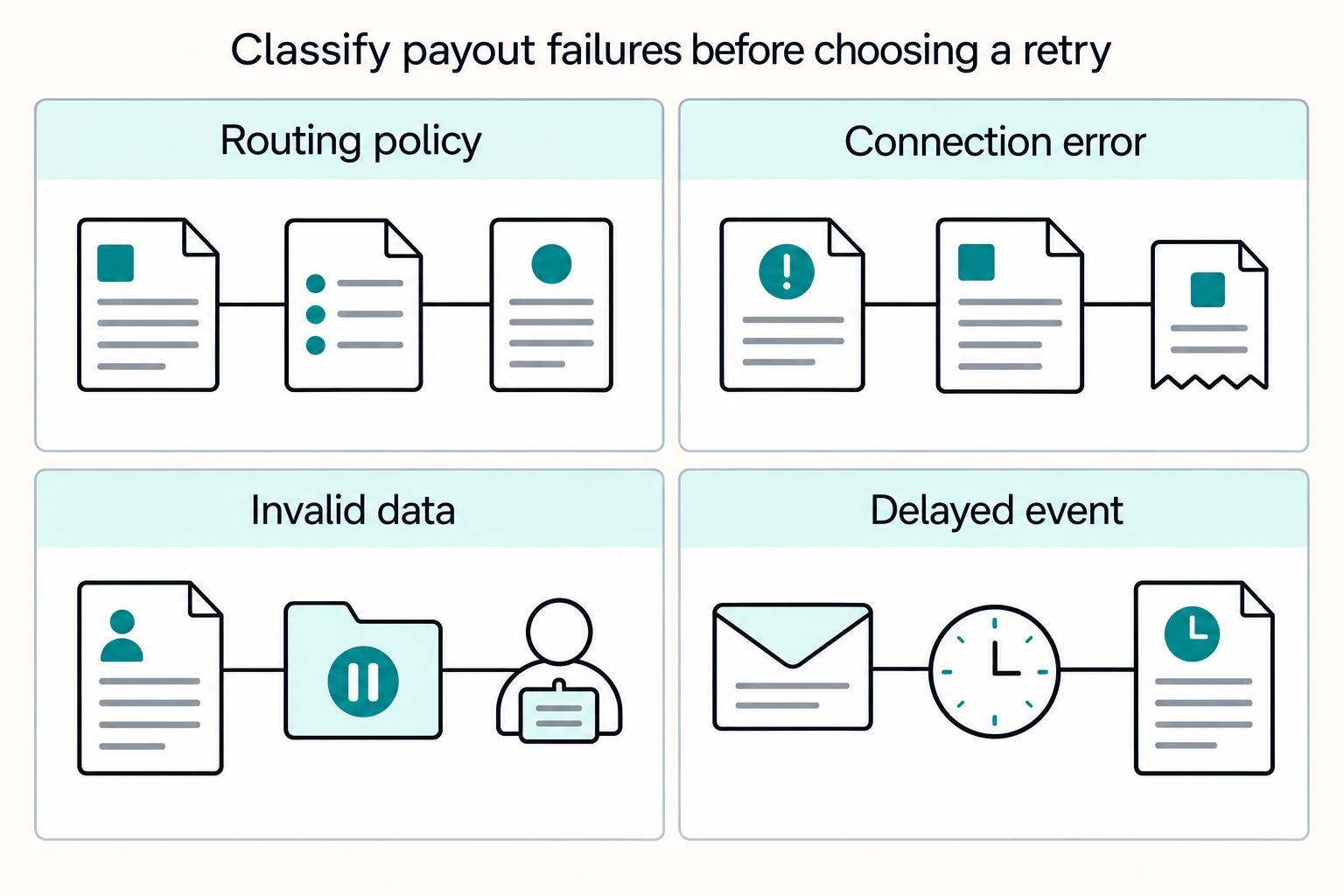
Why One Payout Rail Fails in Mass Payment Platforms
Once your platform is paying large recipient groups, payouts often stop being just a finance workflow. They become a product, operations, and engineering decision.
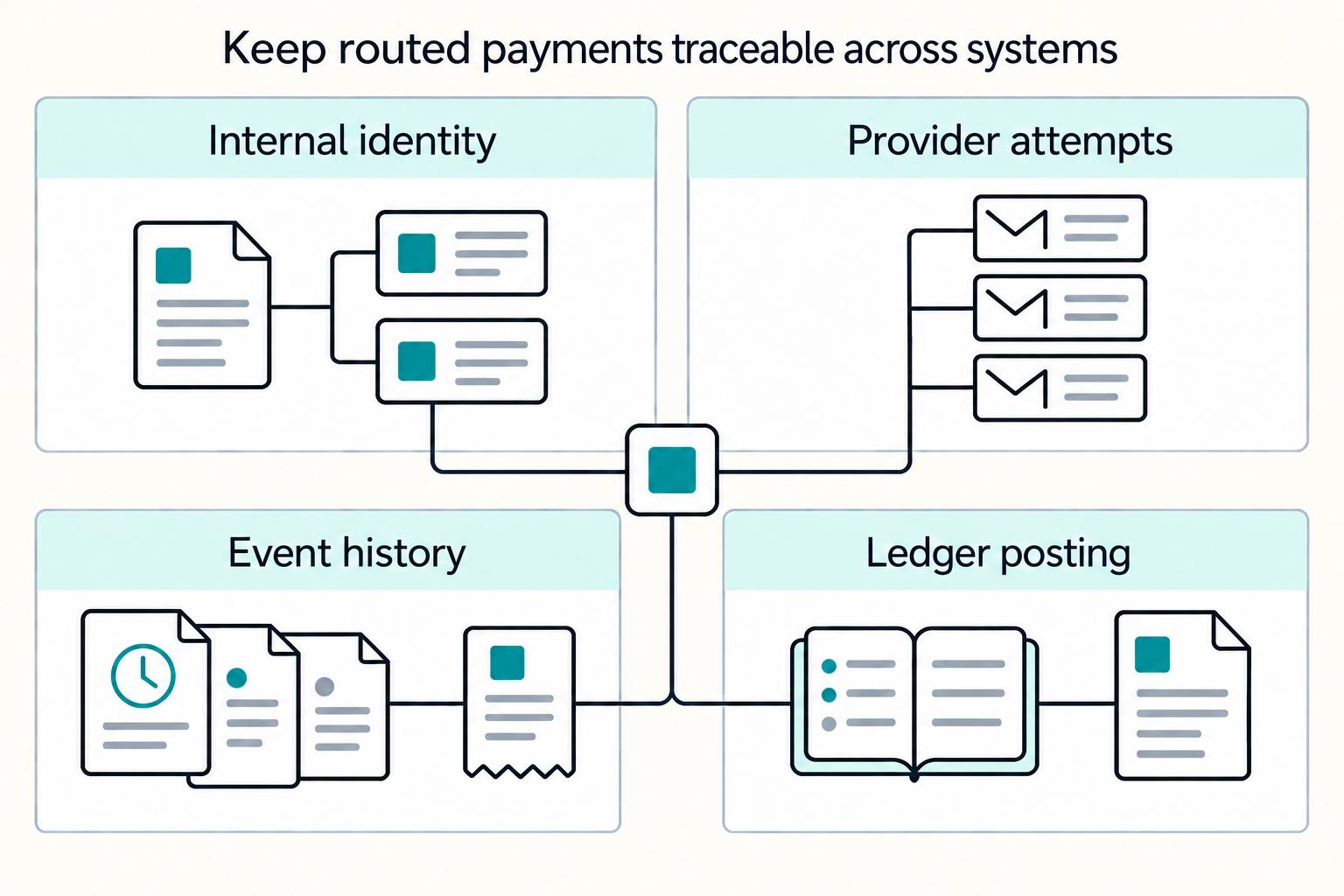
Gateway Routing for Platforms: How to Use Multiple Payment Gateways to Maximize Approval Rates
Adding a second payment gateway is not the win. The win is routing each payment on purpose, then proving approvals improved without creating new latency, cost, or reconciliation problems.
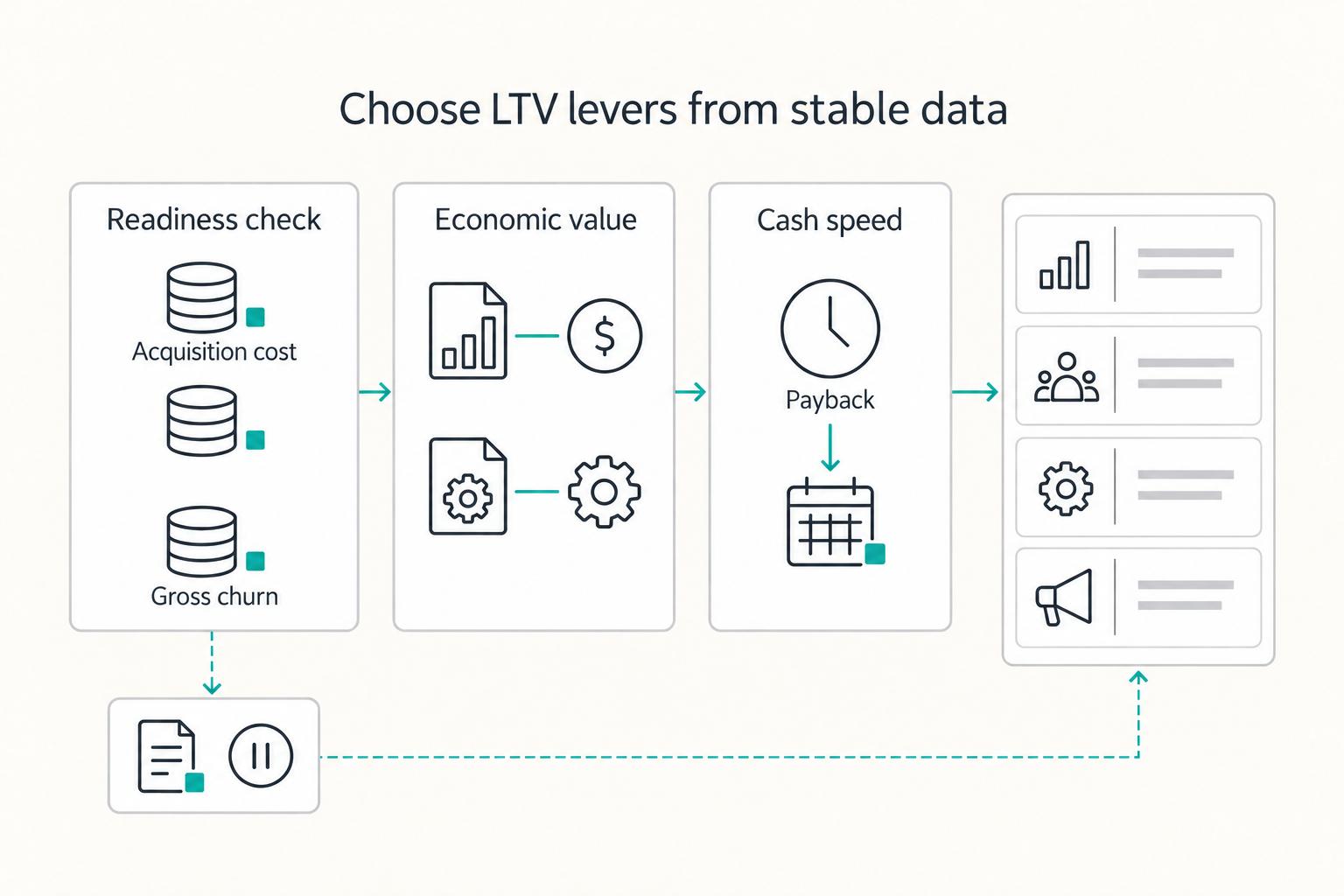
Customer Lifetime Value Optimization for Subscription Platforms Using 7 Operational Levers
For a subscription platform, Customer Lifetime Value is first a unit economics question. It rises or falls based on how reliably you turn acquired demand into recurring revenue over time. It also depends on how much of that revenue you retain and the margins behind it.