
Quick Answer
Use two rails from day one in your highest-volume corridor: one primary path and one approved fallback. Build routing on country, currency, method eligibility, and compliance status, then test timeout, provider reject, and delayed webhook cases before launch. Keep retries idempotent and require row-level evidence linking internal request ID, provider reference, and final settlement status. Expand only after that evidence is reliable.
Why a Single Payout Rail Becomes a Failure Point#
Once your platform is paying large recipient groups, payouts often stop being just a finance workflow. They become a product, operations, and engineering decision.
A mass payment is a batch payout model. You send many recipient payments in one cycle instead of initiating them one by one. That model is common in high-volume environments, especially for marketplace-style businesses with many sellers or payees.
The case for multiple payment methods is mostly about fit, not feature count. Method fit depends on user location, transaction context, and channel. So the practical question is not "what is the best method?" It is "which mix is reliable for this recipient and this corridor?"
That is where a lot of vendor messaging falls short. Benefits lists explain why mass payments are attractive, but they do not tell you how to choose coverage, handle tradeoffs, or set operating checkpoints before you expand rails. This article focuses on that harder part.
There is useful directional evidence for offering choice. Stripe reports that showing at least one additional relevant method at checkout was associated with average uplifts of 12% revenue and 7.4% conversion. Those are checkout metrics, not mass-payout performance metrics. At a market level, ECB reporting also reinforces payment-option diversity, with cash still used in 52% of point-of-sale transactions in 2024, down from 59% in 2022. The broader point is that mixed-method behavior is normal, not an edge case.
By the end of this piece, you should be able to choose a payout method mix with a clear operating model, clear ownership, and practical verification points. Product, finance, and engineering should be able to execute without guesswork.
Define the terms before choosing tools#
Define the terms first. Otherwise, you can over-index on method counts and country coverage while missing the controls that matter in production.
What counts as a mass payment#
A mass payment is a batch payout model: many recipient payments are sent in one cycle, not initiated one by one. BILL describes mass payments as batch-based and gives a concrete example of up to 200 bills in a single batch. Operationally, that matters because you need to know what happened to every row in the batch, not just whether one payment succeeded.
What multiple payment methods actually means#
In payout operations, multiple payment methods means supporting more than one recipient rail in the same program. That can include bank transfer plus eWallet, and in some programs, crypto where platform and market limits allow it. Payoneer frames this around recipient-preferred methods, and i-payout explicitly markets bank transfers and eWallets in one platform. The practical check is not the homepage claim. It is whether the method is actually available for the country and program you care about.
Crypto shows why that distinction matters. Support exists in platform tooling, but scope can be narrow. Stripe documents Connect stablecoin payouts as a US-only private preview.
What makes a mass payout platform real#
A mass payout platform should combine payout execution with compliance controls, auditability, and reconciliation support. Tipalti explicitly ties its offering to tax compliance, fraud prevention, real-time reporting, reconciliation, and audit trails. Payoneer describes its platform as regulated and tightly audited.
Use control depth as the first filter. Vendors such as BILL, Payoneer, Tipalti, Tremendous, and i-payout market scale, method breadth, or both. Your shortlist should start with whether the platform supports compliance and finance reconciliation, not just how many methods it advertises.
For a step-by-step walkthrough, see Understanding Payment Platform Float Between Collection and Payout.
Why one payout rail breaks as you scale#
If payout reliability matters to the business, one rail is a scaling risk, not a strategy you can rely on for long. It concentrates outage exposure, corridor constraints, and exception handling into a single dependency. One incident can stall a large share of your payout flow.
Concentration risk shows up fast in real operations#
Rail outages are not theoretical. Payment-market guidance treats them as plausible events and recommends fallback channels for critical payments. On 27 February 2025, a TARGET Services incident left T2 unavailable for about 10 hours and T2S for about 8 hours. In a single-rail setup, a window like that can turn into payout delays, support pressure, and finance escalation at the same time.
| Failure mode | Article signal | Handling note |
|---|---|---|
| Major provider or rail outage | A TARGET Services incident left T2 unavailable for about 10 hours and T2S for about 8 hours | Test separately and do not send all failures down the same retry path |
| Corridor-level method unavailability | Availability can be tied to country or currency | Separate rows that can retry on the same rail from rows that need an alternate route |
| Policy-constrained service availability | Some services can be constrained for specific counterparties or geographies | Triage early so exceptions do not pile up |
In high-volume batch payouts, the problem is not only lateness. You need to separate rows that can retry on the same rail from rows that need an alternate route. If that triage drags, exceptions pile up.
Before volume ramps, test at least these failure modes separately, and do not send them all down the same retry path:
- major provider or rail outage
- corridor-level method unavailability tied to country or currency
- policy-constrained service availability for specific counterparties or geographies
Recipient fit is corridor-specific, not a global default#
A single-method launch can be operationally simple, but method fit is not uniform across markets. Availability depends on transaction context, including country and currency, and APAC shows more variability in locally preferred methods than Europe or the Americas.
That does not mean replacing existing methods everywhere. It means avoiding a single global default. Digital wallets represented $13.9 trillion in global transaction value in 2023, which reinforces that method diversity is already material in many markets.
There is also a policy layer. Some payment services can be restricted for specific counterparties or geographies. If your only rail is constrained, you may have no approved alternative. Validate corridor by corridor: country, currency, recipient profile, and program restrictions.
Finance absorbs the hidden cost#
Single-rail designs can look efficient until your AP team inherits the exception load. As payment volume and complexity rise, manual handling grows, reconciliation slows, and close timelines can get harder to hit.
To stay in control, make sure each batch row is traceable with clear references, method data, and final status. Without that, teams struggle to tell pending items from failed-and-rerouted ones.
That is why fallback capacity should be designed early, starting with your highest-volume corridors. The goal is not more methods for their own sake. It is payout continuity when outages, availability limits, or policy constraints hit.
Choose your first three methods with a corridor-first matrix#
Pick your next payout methods by corridor and recipient segment, not by what is easiest to demo. Start with country, currency, recipient type, and timing constraints, because support is bounded by country, currency, product, and API fit.
Use your payout map, not broad regional labels. Europe and APAC are useful planning buckets, but method fit is decided at corridor-plus-segment level, such as a specific country, currency, and recipient type. That is where you can validate availability, speed, cost, and policy constraints before engineering starts.
Build the matrix around corridor and segment#
Build the first matrix around the corridors that drive the most payout volume, value, or support pain. If one corridor concentrates failures or urgent recipient complaints, add redundancy there before you expand methods elsewhere.
Include at least:
- country and currency
- recipient segment, for example contractor or creator payouts
- expected payout speed for that program
- primary method available now
- secondary method candidate
- support checks needed, including country, currency, product, and API fit
- compliance or licensing concern
- decision status: now, later, or not now
Do the support checks before you choose the integration path. Method availability is scenario-dependent, and cross-border coverage is not universal. Where you manage customer funds, include licensing review in the decision.
Score methods on production realities#
Score each method against four operator questions: recipient adoption in that corridor, operational burden, compliance and control requirements, and failure recovery.
| Method | Adoption fit to score | Ops and compliance check | Failure recovery tradeoff |
|---|---|---|---|
| Bank transfer | Baseline option where local-currency payout is supported and recipients expect account-based payout | Validate country and currency support and expected timing; cross-border timing can vary by country, often 1-7 days | Can be a strong primary rail in many corridors, but slower paths can miss tight payout expectations; keep an approved fallback where delay risk is high |
| eWallet | Score from your recipient data plus provider country feature support | Verify country-level feature availability, product fit, and API support before build | Can work well in specific corridors, but coverage can vary by provider and market; limit rollout to proven corridors first |
| Cryptocurrency payouts where enabled | Treat as opt-in and narrow unless program and recipient eligibility are clear | Validate exact eligibility and country constraints, for example some stablecoin programs are limited by platform location and recipient type | Restriction risk is high; do not treat as a universal fallback rail |
Score speed and cost together, because they vary by method. Do not assume first-cycle timing will match steady-state performance, because initial live payouts can be slower.
Prioritize redundancy where concentration is highest#
Put fallback depth where business exposure is highest. If one corridor carries most of the volume, support pressure, or timing sensitivity, resilience there can be worth more than broad global expansion.
Use a simple rule: if a corridor is business-critical and already shows timing or failure concentration, prioritize an approved fallback there first. Expand globally only after that coverage is stable.
Make "not now" explicit#
Write down "not now" to reduce partial integrations and avoidable support overhead. For each deferred method, record the reason and the review trigger, such as unsupported country coverage, weak recipient demand, unresolved compliance questions, or poor recovery options.
The output should be a short internal method-priority matrix owned by Payments Ops and Finance, with a clear owner and version history. Keep evidence per row: provider support checks, corridor concentration data, and compliance notes.
Related: How to Expand Your Subscription Platform to Europe: Payment Methods Tax and Compliance.
Set ownership across product finance ops and engineering#
Once you choose methods by corridor, clear ownership is what keeps a multi-rail program reliable in production. Assign it by decision and evidence, not by informal handoff.
A simple RACI can work if each cross-functional decision has one accountable owner. The split below is a practical starting point, not a universal model.
| Function | Primary ownership | Key decisions | Verification checkpoint |
|---|---|---|---|
| Product | Method availability and recipient experience | Which method is exposed by corridor, when rollout starts, and what recipients see during issues | Method-priority matrix matches live availability and support messaging |
| Engineering | Idempotent execution and status surfaces | How payout requests are submitted, retried, paused, and surfaced internally | A payout item is traceable from internal request to provider status without manual log hunting |
| Finance | Reconciliation workflow and close criteria | What data is required to close books and when a payout is finance-complete | Sample payouts tie to provider reference, internal transaction record, and settlement or deposit evidence |
| Payments Ops | Exception handling and provider escalations | Which failed batch items are worked manually, when to escalate, and queue aging targets | Ops can retrieve request identifier and provider reference quickly for failed items |
Give each team one hard boundary#
Clear boundaries matter more than broad ownership language. Product owns corridor-level availability and recipient-facing messaging when a rail is delayed or disabled. Engineering owns idempotent submission, webhook status ingestion where supported, and the internal status surfaces other teams depend on.
Define where request identifiers and idempotency keys are generated and stored. Some APIs allow idempotency keys up to 255 characters, so set a stable format early. Finance owns close criteria and required reconciliation evidence, including links between payouts and bank deposits.
Put incident authority in writing before the first outage#
Write decision rights for rollout, rollback, and rail disablement before you go live. Incident response models often use an Incident Commander during major incidents, while higher-impact shutdown actions may require leadership approval. Spell out both boundaries. A practical rule set:
| Action | Decision authority | When used |
|---|---|---|
| Rollout | Product accountable, with Engineering, Finance, and Payments Ops readiness sign-off | Before go-live |
| Rollback | Product and Engineering jointly | When recipient impact or execution risk appears |
| Rail disablement during incident | Incident Commander within pre-agreed limits; broader shutdowns follow leadership escalation policy | During an incident |
Keep a shared operating document with exact identifiers#
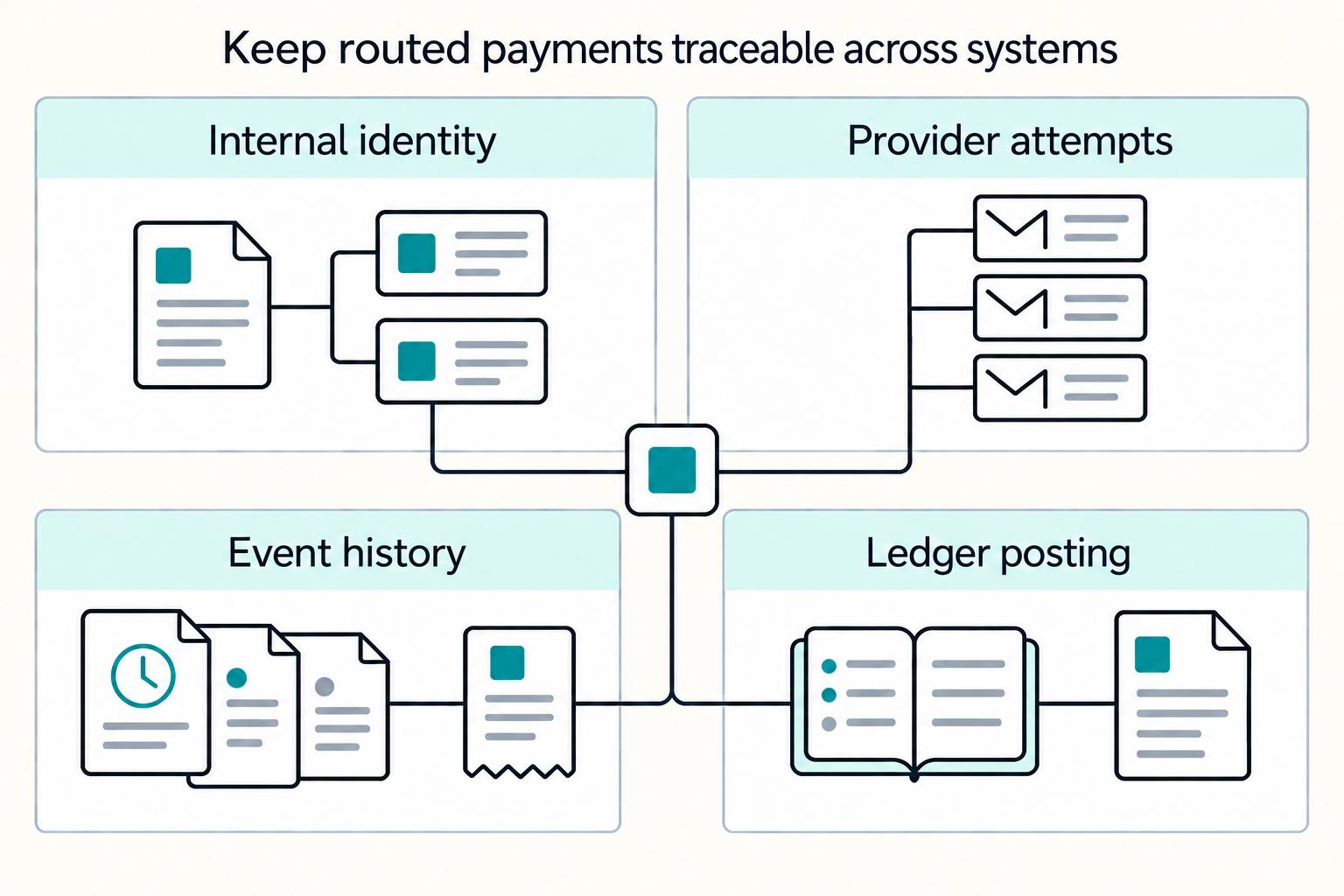
Keep a shared operating document, or equivalent operating record, that maps identifiers end to end across the payout rail, admin tools, and audit trail. Include: internal payout batch ID, payout row ID, request identifier, provider reference, webhook status or event record, ledger or transaction ID, and operator action taken.
That record supports both provider escalation and finance close. If a failed payout cannot be traced from request identifier to provider reference to audit record in that record, the operating model is still too fragile.
Design routing fallback and retries before launch#
Set routing policy before go-live: route by corridor and error class, not by whichever method was integrated first. If fallback and retry rules are undefined, happy-path tests can pass while real failures still break payout execution.
Start with deterministic routing rules#
Define routing per rail using at least four inputs: recipient country, payout currency, method eligibility, and compliance controls. Method enablement is constrained by country or region, currency, and integration setup, so a method that works in one corridor may be unavailable in another.
Treat corridor limits as a hard design constraint. For example, one provider documents Standard Payouts in 96 countries and 24 currencies while also noting that some countries have limited or restricted payout features. Your routing table should state, for each corridor, the primary method, approved backup methods, and when payouts should be blocked or sent to review because of eligibility or compliance limits. If country, currency, or eligibility is unknown at execution time, send the payout to manual review instead of guessing.
Branch retries by error type#
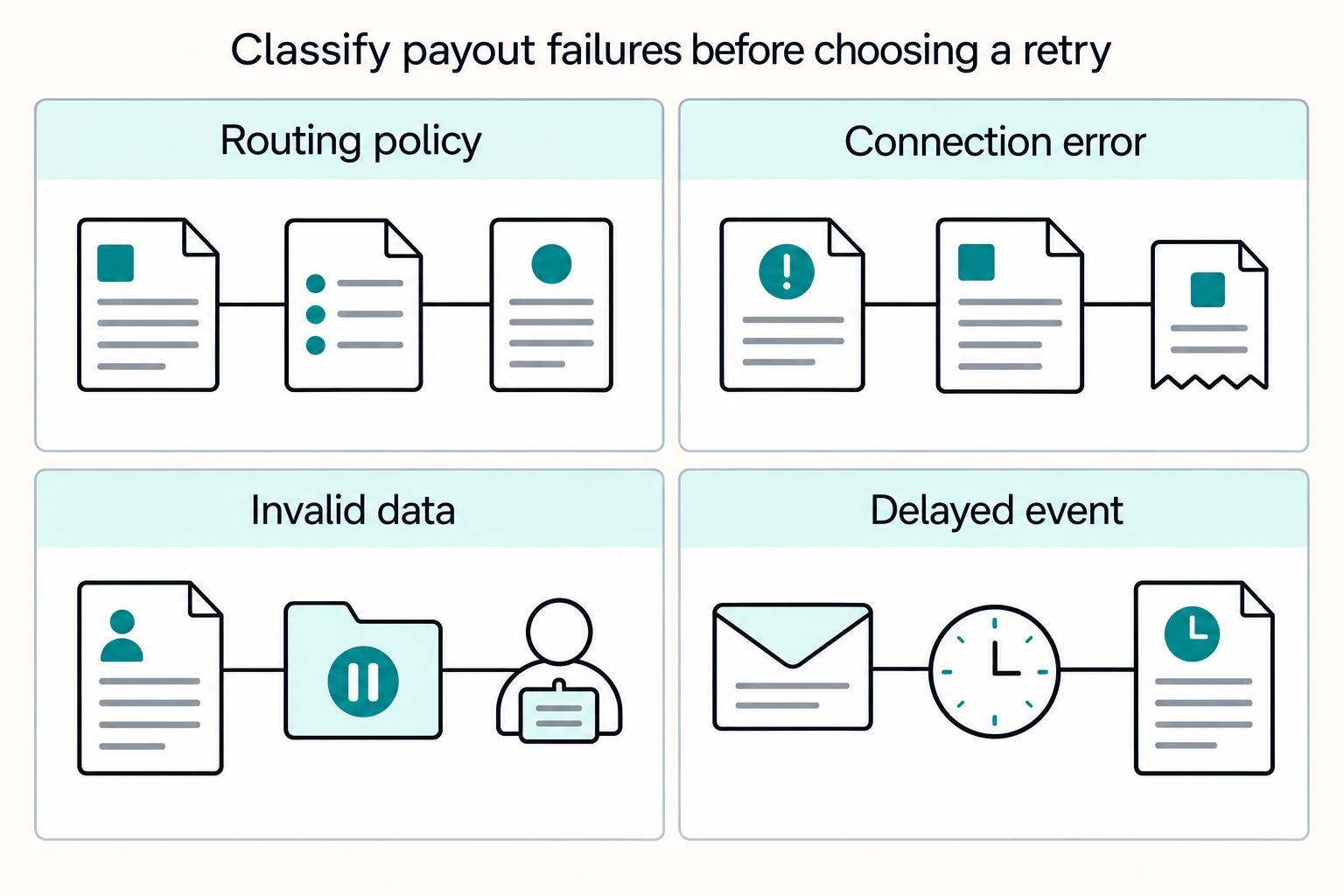
Retry logic should follow failure class. Timeout and connectivity errors are retry-relevant. Invalid data, unsupported recipient details, and decline or fraud outcomes usually need correction or review before another attempt.
| Failure mode | Typical action | Why |
|---|---|---|
| Timeout or connection error | Retry with the same idempotency key; optionally reroute to an approved secondary rail if policy allows | Request outcome may be unclear; idempotent retry reduces duplicate risk |
| Provider reject for invalid or unsupported recipient data | Pause automatic retries and send to manual review | Replaying unchanged data usually does not fix the underlying data or eligibility issue |
| Webhook delay or missing async confirmation | Keep state pending; do not blindly resubmit | Webhook delivery can be delayed, and duplicate submissions can create duplicate payouts |
If you allow a one-time reroute to a secondary rail, treat it as a launch guardrail, not a universal rule.
Make idempotency non-negotiable#
Any create or update call that can move funds should use an idempotency key, and retries after connection errors should reuse that same key. That is what prevents replayed batches from creating duplicate payout objects when an earlier response was lost.
In practice, each payout row should be traceable by internal request identifier, idempotency key, and provider reference.
Test the failures you expect in production#
Before live traffic, run failure-mode tests for timeout, provider reject, and webhook delay. Use provider testing tools to simulate transactions and verify webhook behavior. Focus on two checkpoints:
- Webhook timing: acknowledge quickly. One provider marks delivery as failing if no response is received within 10 seconds, and another documents retries in live mode for up to 3 days with exponential backoff.
- Outcome routing: confirm each case lands in success, pending, or manual review exactly as policy defines. A delayed webhook should not trigger a second payout attempt.
Before you ship fallback logic, map your runbook to compliance-gated batch execution and status tracking in Payouts.
Put compliance and security controls inside the payout path#
Put policy gates inside the release decision itself. Run KYC, AML, sanctions, and recipient verification before funds are sent, not after payout initiation. If a control only fires after the provider accepts the payout, the critical decision may already have passed.
Adyen states users must be verified before you can process payments and pay out funds, and Stripe states connected accounts must meet KYC requirements before they can accept payments and send payouts. In practice, verification status, sanctions and AML screening outcomes, and recipient-detail validation should be evaluated in the same decision that selects the payout rail.
Parameterize policy by country and capability#
Do not run one global compliance checklist. Verification requirements vary by business type, country, and required payment capabilities, so policy needs to be parameterized by corridor inputs like country, business profile, and enabled payout capability.
Before launch, confirm that each payout row can show why release was allowed or blocked. At minimum, capture verification status, market context, requested method, and decision timestamp. Recipient verification belongs in-path too. If details fail validation, stop before send instead of letting the payout fail downstream.
Treat method availability as a compliance input#
Method support is market- and program-dependent, so availability needs to be a hard gate. PayPal's crypto transacting example is explicitly scoped to the U.S. and U.S. Territories, and on March 17, 2026 PayPal announced PYUSD availability in 70 markets with remaining markets to follow.
Design for that reality. Never assume crypto or similar payout rails are globally available just because the provider brand is global. Store eligibility by market and program, and fail closed to review when a method is not enabled for that payout context.
This is also why post-send controls can be weak for sanctions risk. UN sanctions language includes freezing funds "without delay" and preventing funds from being made available to designated parties. The cited measures are in scope through 31 July 2026.
Minimize PII in logs without breaking investigations#
Keep audit trails complete, but minimize personal data exposure. The UK GDPR data minimisation principle requires personal data to be limited to what is necessary, and OWASP advises that sensitive data should usually be removed, masked, sanitized, hashed, or encrypted in logs.
Use separate logs by purpose, such as security events, transactions, and audit trail. Keep investigation records rich in references rather than PII: internal request ID, batch ID, provider reference, policy decision code, case or reviewer ID, and masked recipient identifiers. Avoid logging full account details or identity documents in application events and webhook archives.
Make reconciliation and auditability non-negotiable#
Make immutable ledger records and durable transaction references your baseline for reconciliation and audit work. Stripe describes balance transactions as a ledger-style record of money movement, and each balance transaction row does not change after it is created. That gives Finance Ops a stable trail for close and investigations.
Tie every payout batch row to durable identifiers#
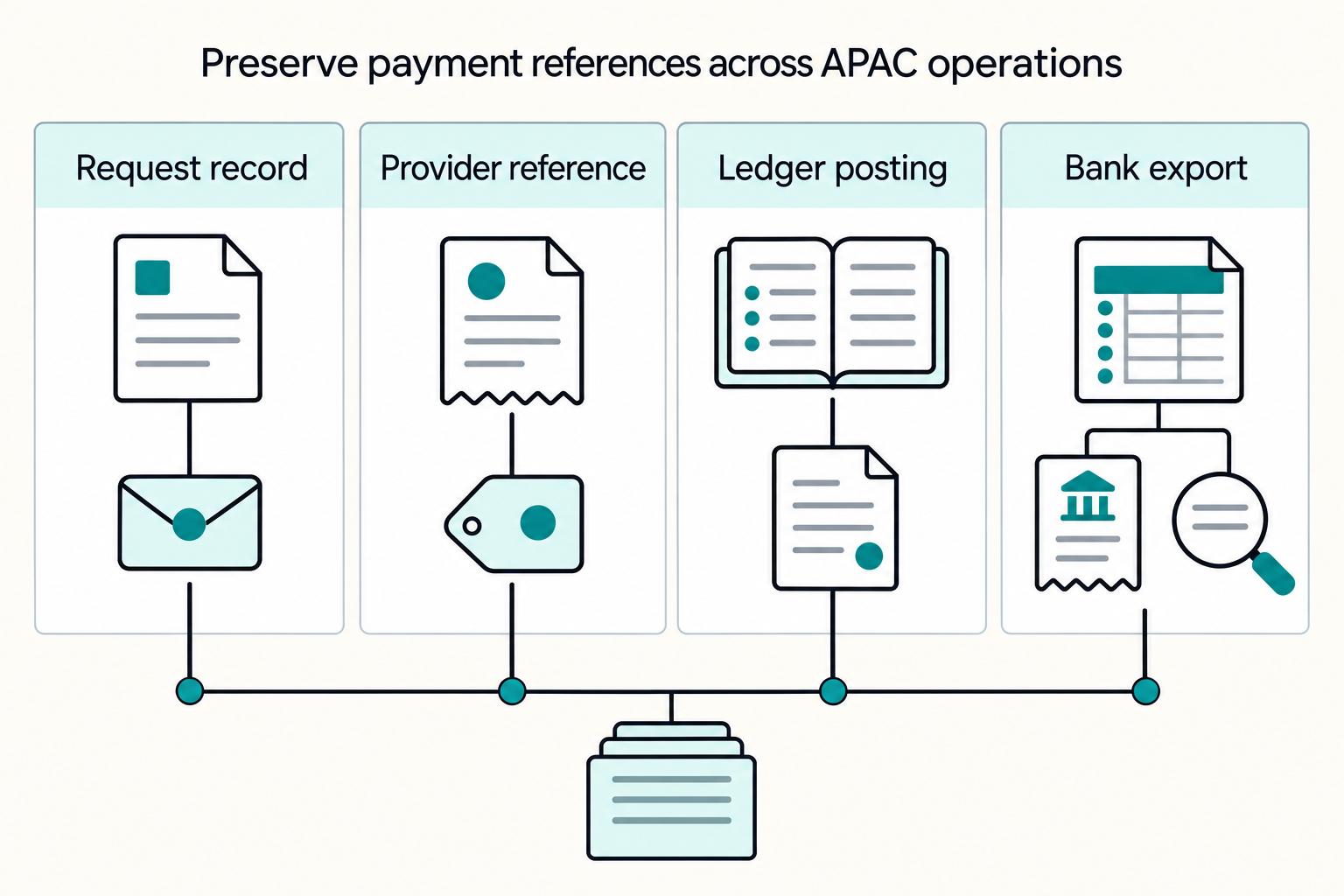
A payout batch is easier to reconcile when each row can be matched across systems. In practice, each row should carry your internal identifier, the provider reference, and reconciliation status where available. Adyen's transaction-level reports are structured as entries and use PSP Reference, the provider-assigned identifier, plus Merchant Reference, your identifier, to track and reconcile records across reports and systems.
A practical pre-launch check is to export a real payout batch and confirm that you can trace one row from internal record to provider report and reconciliation status.
Build close-ready evidence packs, not just ops dashboards#
Accounts payable and Finance Ops need exportable records for close workflows. Stripe provides payout reconciliation reporting for settlement batches, bank reconciliation reporting to track payouts against bank deposits, and CSV exports for accounting workflows. It frames this data as part of closing books accurately.
Your close pack should include:
- payout batch linkage plus transaction identifiers, including internal identifier and provider reference
- payout date, bank-deposit linkage where relevant, and reconciliation status for matched or unmatched rows
- monthly close artifacts used by the provider, for example Adyen's monthly invoice, which Adyen marks as required for full financial reconciliation
Cheap rails get expensive when references are weak#
When two methods look similar on fees, reference quality and export quality can materially change reconciliation effort.
Stripe also recommends automatic payouts because they preserve transaction-to-payout association. If you are choosing between similar options, favor the one that keeps payout-to-transaction linkage clear.
Roll out in 30 60 90 days with hard checkpoints#
Use a 30 60 90 rollout to limit risk while you add payout methods. Do not advance phases until three controls are proven: duplicate-safe retries, reviewed incident response, and transaction-level reconciliation.
| Phase | Scope | Evidence |
|---|---|---|
| Days 0 to 30 | Baseline the current flow and build a method-priority matrix by country, currency, and recipient segment | Export sample successful and failed payout batch rows and confirm each row can be traced by payout ID, linked transactions, payout method, and final status |
| Days 31 to 60 | Launch one additional method in one corridor | Prove replay behavior end to end and keep fallback narrow to cases where country, currency, and compliance eligibility allow it |
| Days 61 to 90 | Expand to a second corridor and automate finance-ready outputs | Confirm that compliance controls, exception handling, and close-cycle reporting still hold under higher volume and more variation |
Days 0 to 30 baseline the current flow before you add anything#
Baseline first, then expand. Measure your current mass payments flow with a defined lookback window so you capture real patterns. A practical anchor is the preceding 60 days or two calendar months.
Build a method-priority matrix by country, currency, and recipient segment, and assign clear ownership across Product, Engineering, Payments Ops, and Finance. Method availability and accepted presentment currencies vary by geography, so an unsupported country-currency-method combination is not a fallback path.
Require evidence, not dashboards alone. Export sample successful and failed payout batch rows, and confirm that each row can be traced by payout ID and linked transactions, along with payout method and final status.
Days 31 to 60 launch one additional method in one corridor#
To keep the blast radius controlled, launch one additional method in one corridor while you validate routing, settlement timing, and exception handling.
Duplicate protection needs to be in place before live traffic. Test retry safety in sandbox, enforce request-level idempotency, and use stable batch identifiers where supported. For example, PayPal sender_batch_id duplicate reuse is rejected within a 30-day window.
Before you enable fallback routing in production, prove replay behavior end to end: logs, provider response, and internal ledger should all show one intended batch outcome. Keep fallback narrow. Attempt rerouting only when recipient country, currency, and compliance eligibility allow it. Otherwise, route to manual review.
Days 61 to 90 expand to a second corridor and automate finance outputs#
By this phase, the main risk is operational drift. Expand to a second corridor only after you confirm that compliance controls, exception handling, and close-cycle reporting still hold under higher volume and more variation.
Tighten controls inside the payout path. Keep investigation trails, and require a current, formally approved incident response plan with checklist-based execution.
Automate finance-ready outputs. Reconciliation should support transaction-to-payout linkage at batch level, not just top-line totals. Finance should be able to match payouts and included transactions without ad hoc engineering pulls.
Hard gates for every phase#
Advance only when all gates pass:
- Idempotency and duplicate controls passed: retries are safe, replay behavior works as designed, and results are documented.
- Incident readiness reviewed: the incident plan is current, owners are named, and payout-specific checklists have been exercised.
- Close-cycle audit trail complete: each payout row ties to a payout ID and linked transactions, with method and status captured in finance exports.
If any gate fails, pause expansion.
Related reading: How to Build a Payment Sandbox for Testing Before Going Live.
Avoid the mistakes that keep teams in manual mode#
Multiple payout methods only reduce manual work when routing is explicit. If country, currency, and method eligibility are not mapped to a primary path, fallback path, or manual review path, decisions slide into case-by-case handling.
Route before you add choice#
Do not add methods until routing is deterministic. Build rules from recipient country, payout currency, and method eligibility, then validate them on sample payout batch rows before launch. For any failed row, you should be able to show why it went to method A, why it did or did not reroute to method B. You should also be able to point to the internal transaction ID and provider reference that confirm the outcome.
Price the back office, not just the rail#
Headline fees are not enough. Reconciliation quality is a core finance requirement, so method comparisons should include reference quality, status detail, and export usability alongside cost. Stripe frames payout reconciliation around settlement-batch transaction matching, and both PayPal and Adyen position reconciliation reports as part of accurate accounting and end-to-end reconciliation.
Regions are not one coverage block#
Coverage needs to be corridor-specific, not region-wide by label. Payment-method mix varies by geography, and payout currency availability is country- or region-specific. PayPal guidance explicitly calls for country and currency eligibility checks plus country restriction review to avoid payout failures.
Guardrails matter more once volume rises#
Retry and replay controls are operating requirements, not optional hardening. Use idempotency so retries do not duplicate operations, and have webhook handlers return a fast 2xx before heavy downstream logic. Because Stripe can resend undelivered webhook events for up to three days, your ledger and status handling need to stay replay-safe beyond the initial failure window.
We covered this in detail in How to Build a Deterministic Ledger for a Payment Platform.
Compare vendors with operator-grade criteria#
Treat vendor pages as inputs, not verdicts. Build a scorecard around production reality: the corridor coverage you actually need, webhook and status behavior you can verify, controls your auditors will accept, and the integration effort your team has to carry.
Start with claims you can test#
For a mass payout platform, score more than feature yes or no. Prioritize four areas: method coverage in your real corridors, continuity or redundancy signals vendors publish, webhook behavior, and integration fit. A neutral accounting source supports that baseline: evaluate compliance capabilities, security features, and integration options, not just payout reach.
| Vendor | Useful public signal | What to validate yourself |
|---|---|---|
| BILL | Lists ACH, virtual card, check, and international wire. Webhooks provide real-time notifications, and BILL says webhooks should not be your only source of truth. | Whether your integration re-reads API state before final ledger or status updates, and whether those methods cover your target corridors |
| Payoneer | Claims mass payouts in 190+ countries and territories and 70 currencies, plus preferred payment methods. API calls route through a security gateway with bearer validation. | Exact corridor and currency support for your recipient mix, and how tenant-specific incidents are communicated since some affected-client incidents may not appear on the public status page |
| Tipalti | Claims 200+ countries, 120 currencies, and 50+ payment methods. States controls including tax validation, sanctions screening, audit trails, and regulatory reporting. | Whether those controls apply to the products or entities you will use, and whether progressive payment statuses map cleanly to your internal payout states |
| Tremendous | Claims 2000+ payout methods. Supports HTTPS webhooks and shows a 90-day API uptime figure (99.96% in the referenced view). | Whether one webhook endpoint per organization fits your architecture or requires your own fan-out and tenant routing layer |
| i-payout | Claims backup options to keep payments flowing, encrypted API connections, and ISO 27001/ISO 9001 accreditation. | Exact country coverage, since public pages show both 180+ countries and 200+ countries and territories, and what "backup options" means in your corridors |
Score controls and evidence, not just reach#
Give controls their own scorecard section, because implementation details can diverge. BILL describes a timestamped, unalterable audit trail that includes bills, notes, approvals, payments, and remittance details. Tipalti calls out tax validation, sanctions screening, audit trails, and regulatory reporting. Tremendous states SOC 2 Type II compliance and regular third-party penetration testing. i-payout cites encrypted connections plus ISO 27001 and ISO 9001 accreditation.
Use one operator test: can the vendor produce an evidence pack for a failed payout batch row within minutes? Ask for sample exports and event history showing internal transaction ID, provider reference, status changes, timestamps, and remittance detail.
Test failure handling under batch stress#
Do not accept generic reliability language. Run a controlled batch with mixed recipients, unsupported corridors, one invalid destination detail, and one retryable failure. Then inspect API reads, webhooks, dashboard statuses, and exports. Tipalti's progressive payment statuses are a good example of the behavior you need to verify end to end.
Include support and incident handling in the same scorecard. BILL lists live-agent hours, Mon-Fri 5 am-6 pm PDT and Sat-Sun 6 am-3 pm PDT, plus advance in-product maintenance notices. Tipalti states phone and email support from 6:30 AM-6:30 PM Pacific and average first response under 2 hours. i-payout claims 24/7/365 support in 20+ languages, and Payoneer cites customer care in 22 languages. Treat these as inputs, then validate escalation behavior during a live exception spike.
Use one decision rule: trust corridor proof over headline scale. Claims from BILL, Payoneer, Tipalti, Tremendous, and i-payout are starting points. Your final score should come from your recipient data, failure tests, and reconciliation requirements.
Conclusion#
The goal is not to add more payout methods. It is to choose the right mix by corridor, route it deliberately, control it in-flow, and reconcile it without guesswork.
That standard matters because the tradeoff is real. Enterprises often add providers for global coverage and reliability, but managing multiple providers is also complex and resource-intensive. Use a strict decision rule: add a rail only when it improves recipient fit, recovery options, or coverage in a named corridor, and only when you can back that up with operating evidence.
That evidence should include reliability under failure, measured against clear availability and recovery objectives, not assumed from roadmap intent. Even mature payment infrastructure can miss recovery expectations, so scaling decisions should follow tested checkpoints.
Compliance controls also need to live inside the payout path. If you are in scope as a U.S. money services business, the AML program must be in writing and include internal controls. FATF's Recommendation 16 update, announced 18 June 2025, also raises cross-border transparency expectations, including standardized information for certain peer-to-peer cross-border payments above USD/EUR 1,000. Whether or not that exact threshold applies to your product, the practical takeaway is the same: only launch rails that can carry and retain the data needed for screening, investigation, and audit.
Finance readiness is the other scale gate. A practical readiness check is whether each payout can be traced end to end through final settlement status. Where applicable, 31 CFR 1010.410 requires core traceability fields such as transmittor name and address, amount, and execution date.
So the next step is controlled expansion, not broad rollout:
- Build a corridor-first method matrix and assign clear owners across Product, Engineering, Finance, and Payments Ops.
- Launch one corridor expansion with predefined checkpoints for payout completion, exception handling, recovery behavior, and duplicate prevention.
- Require Finance sign-off on reconciliation and audit evidence before adding the next rail or corridor.
That is the practical answer: not every option, but a payout method mix you can prove under real traffic, real controls, and real close-cycle scrutiny. When your corridor matrix is finalized, convert it into API-level workflows with the implementation guides in Gruv Docs.
Frequently Asked Questions
What is the difference between mass payments and one-by-one payouts in practice?
Mass payments let you send many payouts in one batch instead of handling each transfer individually. One-by-one payouts process each payment separately. In practice, the batch model changes how teams operate at scale because execution is grouped rather than handled transfer by transfer.
Why are multiple payment methods essential for a platform instead of optional?
Teams often add methods or providers for two reasons: broader coverage and better reliability. Method fit is local, so limiting recipients to one rail can reduce completion when that rail does not match local expectations or constraints. Relying on one rail also increases outage impact, because failures can delay payouts until service recovers or traffic is rerouted.
Which payment methods should we launch first for contractor payouts and creator payouts?
There is no single first method that is right for every platform. Start with the method that best fits your highest-volume corridor and recipient expectations, then add a fallback path that improves reliability for that same corridor. Use your real recipient mix and verified coverage details for the specific product/version to decide the order, not a generic global template.
What are the biggest risks of relying on one payout rail?
The main risk is concentration: if the primary path fails, affected payouts can stall until service recovers or traffic is rerouted. Payment failover exists to reduce that risk by moving traffic to a backup path. A second risk is retry mistakes, so retries should be idempotent to avoid duplicate operations.
How many payout methods are enough before complexity outweighs benefits?
There is no universal number. Add methods only when they clearly improve corridor coverage, recipient fit, or reliability recovery. Stop when added methods create more engineering and operational overhead than measurable payout benefit.
How should we phase rollout across Europe and APAC without disrupting operations?
Roll out by corridor, not by broad region, because local expectations and policy decisions differ across markets. Europe already shows a mixed non-cash profile, with H2 2024 at cards 57%, credit transfers 21%, direct debits 15%, and e-money 6%, which supports multi-method planning instead of a single-rail approach. Apply the same market-level approach in APAC rather than copying a Europe setup, and verify product-specific coverage claims before roadmap commitments when provider sources conflict.
Try a related tool
Where Gruv fits
Researched and edited by the Gruv editorial team. Gruv builds cross-border billing, payouts, and finance-operations software for global businesses.
Sources
- bis.org/press/p210721.htmtrusted
- cisa.gov/news-events/news/cisa-releases-incident-and-...trusted
- cisa.gov/sites/default/files/publications/Incident-Re...trusted
- csrc.nist.gov/pubs/sp/800/122/finaltrusted
- csrc.nist.gov/projects/incident-responsetrusted
- ecb.europa.eu/press/stats/paysec/html/ecb.pis2024h2~5ada00...trusted
- ecb.europa.eu/press/stats/paysec/html/ecb.pis2024h1~526305...trusted
- ecfr.gov/current/title-31/subtitle-B/chapter-X/part-1022trusted
Educational content only. Not legal, tax, or financial advice.
Related Posts
Gateway Routing for Platforms: How to Use Multiple Payment Gateways to Maximize Approval Rates
Adding a second payment gateway is not the win. The win is routing each payment on purpose, then proving approvals improved without creating new latency, cost, or reconciliation problems.

How to Expand Your Subscription Platform to Europe for Payment and VAT Readiness
Treat a European launch as an operations sequencing decision first. Lock VAT, payments, and compliance ownership before you scale localization or acquisition.
How to Expand Your Subscription Platform to APAC: Payment Methods Currency and Regulatory Landscape
Asia-Pacific (APAC) expansion requires country-by-country launches, not one regional motion. This guide helps you decide with payment, currency, and regulatory evidence so you do not mistake a strong regional headline for real launch readiness in your subscription platform.