
Quick Answer
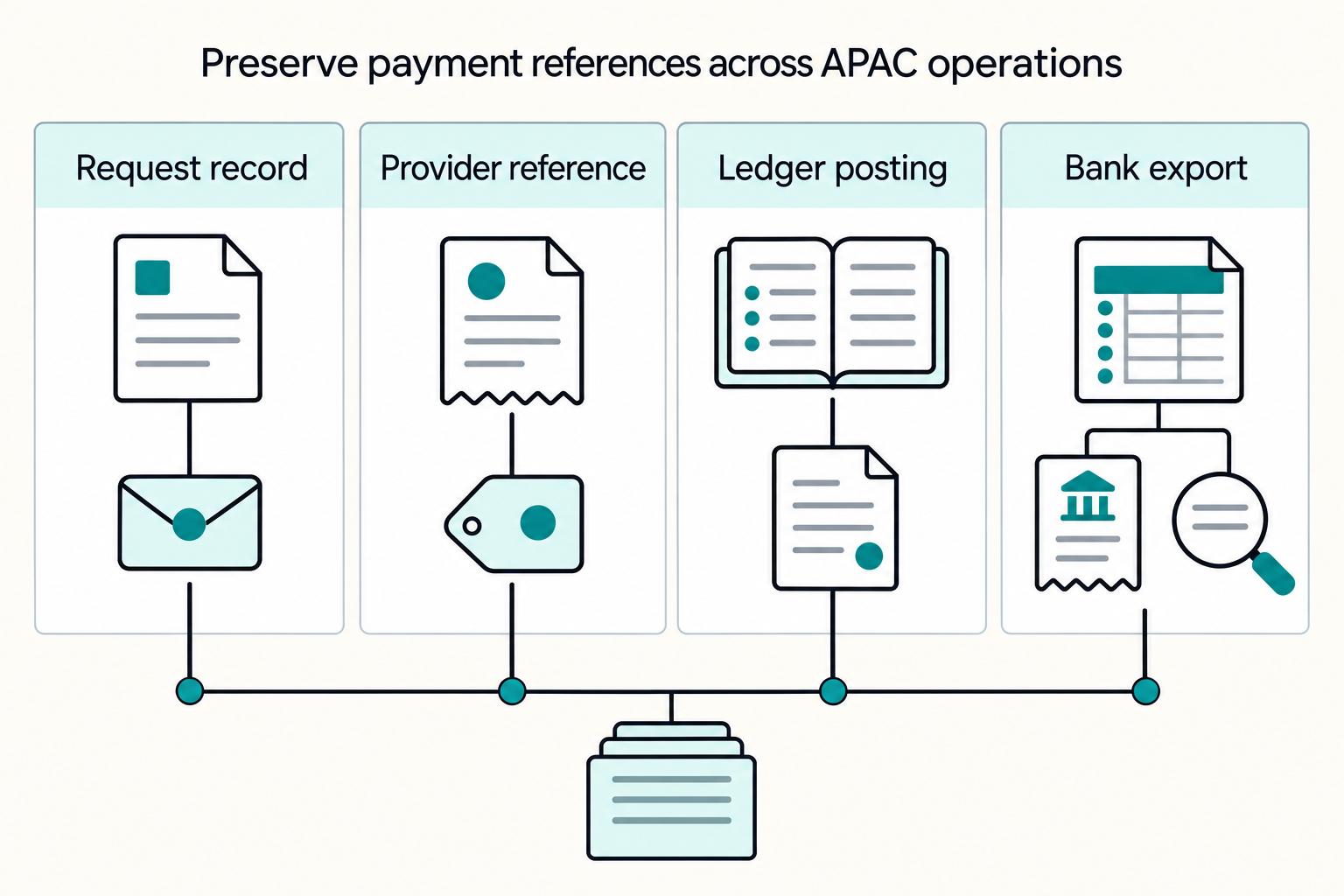
Plan APAC subscriptions by customer market, legal seller, merchant-account eligibility, recurring collection mode, currency and tax treatment. Australian BECS can support mandate debits; Stripe PayNow and Konbini use customer-paid invoices, while FPX is non-recurring. India renewals need the applicable mandate, notification and authentication flow. Resolve processing payments, capture events durably and reconcile one obligation per service period.
Expand subscription collections one market at a time#
To expand a subscription platform into APAC, match each customer market to a supported merchant setup, renewal method, billing currency and tax treatment. Then verify the whole renewal, failure and refund process. A method that completes the first checkout may still require customers to act on every renewal; broad card-network reach does not establish unattended subscription collection.
This plan focuses on selling subscriptions in Australia, Singapore, Japan, India and Malaysia. It uses Stripe as a documented payment-method example, not a universal provider recommendation. Provider and official regulatory guidance was checked on 3 October 2026. Card issuing, creator payouts and stablecoin treasury movement are separate projects with different requirements.
Define the seller and customer before choosing methods#
| Decision | Required record |
|---|---|
| Legal seller | Entity that contracts with the subscriber and sells the service |
| Customer segment | Consumer or business, with relevant location and tax-status evidence |
| Merchant account | Provider contracting entity, account country and approved business activity |
| Renewal model | Automatic collection under valid consent or customer-paid recurring invoices |
| Currency | Price currency, payment currency and available settlement currency |
| Service policy | Activation, grace period, cancellation, refunds and customer notices |
A foreign software company selling its own subscription is not automatically a payment-system operator because it accepts cards. If the platform collects for other merchants, holds customer funds or provides regulated payment services, the activity analysis changes. Establish the actual funds flow before declaring that every seller needs its own payment-services licence.
Use a five-market recurring-method matrix#
| Customer market | Method/currency example | Renewal behavior in documented Stripe offering | Merchant setup boundary |
|---|---|---|---|
| Australia | BECS Direct Debit in AUD | Reusable, business-initiated debits under a mandate; delayed outcomes | Australian Stripe account and Australian customer bank account |
| Singapore | PayNow in SGD | Customer scans/pays each invoice; send_invoice, not automatic debit | Singapore Stripe account |
| Japan | Konbini in JPY | Customer pays at a convenience store; send_invoice, not automatic collection | Japan Stripe account |
| India | India-issued cards or supported UPI recurring flow | Mandate, notification and applicable authentication requirements | Confirm exact merchant account, instrument and integration eligibility |
| Malaysia | FPX in MYR | Customer-authenticated one-off collection; recurring payments not supported | Malaysia Stripe account |
Cards can be a separate renewal candidate where the merchant account, customer card, currency and stored-payment consent are supported. Do not interpret this table as saying that the local method is the only possible method in that market. Compare automatic renewals and invoice-payment alternatives against your customer segment and operating capacity.
Australia: model mandates and delayed debit outcomes#
Stripe’s BECS documentation supports Australian accounts collecting AUD from Australian bank accounts. It requires a Direct Debit Request mandate and describes BECS as reusable with delayed notification: success or failure can take up to three business days after initiation. A submitted debit is therefore not immediate evidence of collected cash.
Capture the mandate under the provider’s supported process and keep its link to the customer and subscription. Set a policy for access while the debit is processing. Do not issue another collection solely because the first result is delayed; reconcile it before changing payment methods. Returns and disputes also need a documented handling path.
Singapore: PayNow requires customer action each cycle#
Stripe PayNow is SGD collection for Singapore Stripe accounts. Billing support means subscriptions and invoices can use send_invoice; automatically charging them is not supported. Checkout subscription/setup mode is also excluded for this method. A reusable subscription schedule is not the same thing as a reusable debit authority.
Choose PayNow when the customer-paid invoice experience fits your service. Send the invoice and payment instructions each period, communicate the due date and follow unpaid invoices under your policy. If uninterrupted unattended renewal is a requirement, evaluate a supported automatic method instead of assuming the QR payment can be repeated by the merchant.
Japan: separate Konbini invoices from automatic renewals#
Stripe Konbini lets customers in Japan pay JPY through convenience stores using Japan Stripe accounts. Its subscription/invoice support also requires send_invoice because collection is in person. A created payment instruction is not a settled payment; retain the reference and expiration/outcome so an unpaid instruction does not activate a paid entitlement.
For customers who prefer automated renewals, confirm the supported card or other recurring service separately. Decide whether the same plan can support both modes without generating duplicate invoices. Customer communications should distinguish a renewal invoice from a debit scheduled under an existing mandate.
India: implement the current mandate and authentication branch#
The RBI Digital Payments E-mandate Framework, 2026, issued on 21 April 2026, applies to covered recurring transactions using cards, PPIs and UPI, domestic or cross-border. Its general subsequent-transaction limit without additional factor authentication is ₹15,000 per transaction. The ₹1,00,000 exception covers insurance premiums, mutual-fund subscriptions and credit-card bill payments; ordinary software subscriptions should not borrow that category exception.
The framework includes mandate registration/first-transaction authentication and generally at least 24 hours’ pre-transaction notice. Do not use the old ₹5,000 general threshold. Preserve mandate status and amount limits, and route transactions that require customer authentication to the supported approval flow rather than repeatedly attempting them unattended.
Stripe’s India recurring-payment documentation describes its own implementation: card collection waits 26 hours after the payment request, with the PaymentIntent processing during the notice period. Amounts above ₹15,000 or the mandate maximum require additional authentication in the described card flow. Its UPI flow has its own supported amount limits and timing. The regulatory permission and the processor’s implemented capability are separate checks.
A higher annual plan, a tax-inclusive total or an upgrade can cross the relevant limit even if the base monthly price does not. Evaluate the amount actually charged and the mandate cap. Confirm currency and merchant-account eligibility with the provider; changing to a foreign billing currency is not a general exemption from the India-card rules.
Malaysia: do not treat FPX as a stored recurring debit#
Stripe FPX supports MYR collections for Malaysian Stripe accounts and explicitly lists recurring payments as unsupported. It also excludes Checkout subscription/setup mode. Use it for an eligible customer-initiated invoice or one-off payment flow, not an unattended debit based on a previous bank redirect.
If offering a manually renewed subscription, create and track the period’s obligation, collect payment through the supported flow and apply the resulting credit to that obligation. Keep a different automatic-renewal option where available. Explain which choice needs the customer to return so checkout convenience is not misrepresented as automatic renewal.
Set country tax treatment independently of payment-method support#
| Market | Official issue to evaluate | Launch record |
|---|---|---|
| Australia | Overseas GST turnover and sales connected with Australia | Supply/customer classification, registration decision and invoice treatment |
| Singapore | Overseas vendor registration for qualifying remote services and low-value goods | Global/local turnover tests, customer GST status and liable supplier/platform |
| Japan | Cross-border electronic services and specified-platform taxation | Service classification and who is responsible for tax on each channel |
| India | OIDAR supplier/recipient rules where applicable | Classification, registration/reporting responsibility and invoice treatment |
| Malaysia | Service tax on digital services under the foreign-provider regime | Taxability, registration, invoicing and current rate determination |
Australian government guidance describes the A$75,000 GST-turnover registration threshold for an overseas business’s sales connected with Australia. That is not a blanket threshold for every worldwide sale. Assess customer and supply facts, the applicable turnover tests and any platform responsibility before setting tax behavior.
IRAS overseas-business guidance describes Singapore OVR registration where annual global turnover exceeds S$1 million and qualifying B2C remote-service/low-value-goods supplies to Singapore exceed S$100,000 annually. Consumer status includes non-GST-registered customers in that regime. Do not assume that an email containing a company name proves a GST-registered business exemption; retain the relevant status and location evidence.
Japan’s National Tax Agency describes specified-platform taxation from 1 April 2025 for covered foreign B2C electronic services where proceeds are collected through a designated platform. It is not a rule that every payment processor assumes your consumption-tax duties. Direct sales and other service/customer classifications need their own assessment.
For India, the GST portal’s OIDAR return guidance identifies relevant overseas-service reporting categories. Malaysia provides the MySToDS foreign digital-service portal. Have the tax owner confirm the actual service, recipient class and reporting path instead of copying another market’s rate or registration threshold.
Choose currency and refund behavior together#
Price in a currency the payment method and approved merchant configuration support. Separately determine which currencies the provider can settle to your bank. Local prices do not guarantee local-currency settlement or eliminate FX. Keep invoice currency, charged amount, fee currency, converted net amount and bank receipt together.
Stripe’s currency documentation uses minor-unit API amounts, with JPY treated as zero-decimal: JPY1,000 is represented as 1000, while SGD10.00 uses 1000 in a two-decimal currency. Store amount and currency as a pair and apply the correct currency precision. Otherwise an apparently small implementation error can materially change a charge.
In a hypothetical transaction with no tax, a SGD100 charge less a SGD3 fee leaves SGD97. At a hypothetical settlement rate of USD0.74 per SGD, the net is USD71.78. A later full SGD100 refund at USD0.73 per SGD costs USD73 before any refund fees. Compare like amounts: the gross original charge’s USD equivalent was USD74, while the original net receipt was USD71.78. Record the fee, refund and exchange differences separately rather than treating all differences as lost revenue.
Confirm whether original fees are returned, how refund FX is determined and what happens when a method’s refund window has closed. A customer-paid invoice may need an alternate verified refund path, but an unresolved original refund should be resolved before issuing another refund through that route.
Keep renewal state separate from payment-attempt state#
| State | Meaning | Permitted next action |
|---|---|---|
| Invoice open | An amount is due for a stated service period | Choose an authorized collection path |
| Awaiting customer action | Payment or authentication needs the customer | Send the relevant invoice/approval instructions |
| Processing | A submitted payment has no final outcome yet | Await or query the provider; prevent competing collection |
| Paid | Confirmed eligible payment settles the obligation | Grant the corresponding entitlement once |
| Failed or expired | The provider confirms that attempt did not collect | Recover with permitted retry or customer action |
| Refunded/adjusted | A documented correction changes cash or obligation | Reconcile original and correcting records |
Use one obligation for each subscription period, with multiple attempts only where justified. A late PayNow or Konbini success must not combine with a fallback card charge to collect twice. Before changing routes, resolve outstanding attempts and reconcile any partially paid invoice. Service access and grace periods should follow the documented policy, not the most recently received notification.
Capture webhook work durably before acknowledging it#
Stripe webhook guidance calls for fast successful responses and warns that events can be duplicated or arrive out of order. A practical design is to verify the signature, persist the event in durable storage or a durable queue, and then acknowledge. If that capture fails, return a failure so delivery can be retried; acknowledging before durable capture can lose the only event your application saw.
Process captured events with replay-safe workers. Deduplicate event deliveries and also prevent repeated business effects against the invoice/payment, because distinct events can refer to the same obligation. Apply state changes and ledger effects transactionally, or use a recoverable outbox where another service is involved. Query current provider objects when event order is ambiguous.
Release a country with evidence from a complete cycle#
- Confirm the seller, merchant account and product/method approval for the proposed country.
- Review local supply/customer tax treatment and the actual regulated activity, if any.
- Exercise initial collection, ordinary renewal, customer-action renewal and failed/expired payment handling.
- Check upgrade amounts, mandate caps, notifications, cancellation and refund behavior.
- Verify duplicate/delayed events and unresolved transfers cannot produce a second collection or entitlement.
- Reconcile gross charges, fees, refunds, FX, provider balances and bank settlement with named exception owners.
Measure customers/invoices and attempts separately. If 100 renewal invoices produce 120 attempts and 90 paid invoices, the invoice collection rate is 90%; it is not 120% or the same as an attempt authorization rate. Report open/pending balances and recovery outcomes by country and method so an aggregate dashboard does not hide customer-action failures.
Frequently Asked Questions
Can PayNow automatically renew a Stripe subscription?
No. In the documented Stripe offering, PayNow invoices and subscriptions require send_invoice and customer action. It is not an automatic debit method, and Checkout subscription/setup mode is unsupported for PayNow.
Does Konbini subscription support mean unattended collection?
No. Customers pay in person, so the documented Stripe subscription/invoice configuration uses send_invoice. Track each invoice, payment instruction and confirmed outcome separately.
What is India’s general recurring-payment AFA threshold?
The RBI’s April 2026 e-mandate framework sets a general subsequent-transaction limit of ₹15,000 without additional factor authentication. The ₹1,00,000 exception applies to specified insurance, mutual-fund and credit-card-bill categories, not ordinary software subscriptions. Mandate and provider limits still apply.
Can a foreign merchant enable every APAC local method?
No. The documented Stripe examples have merchant-account country restrictions: BECS needs AU, PayNow SG, Konbini JP and FPX MY. Verify the provider’s actual account/product eligibility before advertising method coverage.
Does local-currency billing remove FX exposure?
Only if the full collection and settlement configuration avoids conversion. Otherwise retain gross amounts, fees, conversion and refund FX separately; local customer pricing alone does not determine the currency received by your business.
Researched and edited by the Gruv editorial team. Gruv builds cross-border billing, payouts, and finance-operations software for global businesses.
Sources
Includes 2 external sources outside the trusted-domain allowlist.
- business.gov.au/finance/tax/international-taxtrusted
- docs.stripe.com/payments/au-becs-debittrusted
- docs.stripe.com/payments/paynowtrusted
- iras.gov.sg/taxes/goods-services-tax-(gst)/gst-and-digit...trusted
- mystods.customs.gov.mytrusted
- tutorial.gst.gov.in/userguide/returns/GSTR-5A_faq.htmtrusted
- nta.go.jp/english/taxes/consumption_tax/05.htmexternal
- rbi.org.in/Scripts/NotificationUser.aspxexternal
Educational content only. Not legal, tax, or financial advice.
Related Posts

The Freelance Payment Penalty: A Modeled Audit of Platform Fees, FX Spreads, and Payout Delays
The money rarely disappears through a single, easy-to-spot fee. The real loss is stacked. A marketplace takes its commission, a processor adds a charge for international cards, a bank or payment company converts the currency at a spread, a platform holds the funds before release, and a wire sheds a little to intermediaries on the way in. Each layer looks defensible on its own, but the worker feels the combined result as a smaller deposit and a later payday.

How to Respond to a Subpoena for Business Records
Move fast, but do not produce records on instinct. If you need to **respond to a subpoena for business records**, your immediate job is to control deadlines, preserve records, and make any later production defensible.
A US Expat's Guide to Investing in UCITS ETFs to Avoid PFIC Issues
The real problem is a two-system conflict. U.S. tax treatment can punish the wrong fund choice, while local product-access constraints can block the funds you want to buy in the first place. For **us expat ucits etfs**, the practical question is not "Which product is best?" It is "What can I access, report, and keep doing every year without guessing?" Use this four-part filter before any trade: