
Quick Answer
OTT churn analysis works best when you diagnose whether cancellations are temporary or structural before funding any fix. Start with shared churn, resubscriber, and net churn definitions, validate cancel, return, and viewing data on one subscriber timeline, then segment cohorts such as binge-completion, price-sensitive, and serial churners. Use that diagnosis to choose plan shifts, bundles, content timing, or win-back tests.
Separate churn causes before copying retention tactics#
If you are doing streaming platform churn analysis OTT, your first move is not a discount or a copy of whatever a major platform just tried. First separate temporary churn from structural churn, then choose the retention lever that fits the exit pattern before you scale into another market.
Before you start#
Set expectations where the public evidence is strongest. The clearest visible patterns are in the U.S. streaming market, where industry coverage has shifted from pure subscriber growth to retention management. Europe is harder to compare cleanly across countries. Public views are often published as selected-country snapshots, and UK reporting such as Ofcom's Online Nation is country-level, not a harmonized EMEA baseline. If leadership asks for one benchmark for "EMEA churn," treat that as a red flag and label it as an assumption in your evidence pack.
The reason to diagnose churn type first is simple. Not every cancel is a true loss. In Antenna's cited 2023 premium SVOD view, 30% of gross additions were resubscribers. The same source reports that 23% of cancels were won back by Month 3 and 41% by Month 12. That does not create a universal threshold for every OTT service, but it does show that a meaningful share of exits are temporary. If you manage all churn as permanent, you can easily overspend.
Three practices keep the rest of the analysis honest. Use them from the start:
-
Start with the churn question, not the tactic. Ask whether recent losses look recoverable or persistent. A good first checkpoint is cancellation volume versus resubscription or reactivation behavior over a defined lookback window. If you cannot see who canceled and later returned, you are not ready to judge whether the issue is pricing, content completion, weak product value, or normal subscriber cycling.
-
Scope the market before you compare results. Use U.S. benchmarks and commentary as directional context only for U.S. decisions. If you are planning expansion into EMEA, verify country-level support before you port any pricing or win-back logic. A common failure mode is treating selected-country Europe snapshots as if they were a region-wide operating baseline.
-
Follow a simple sequence. In the sections that follow, you will build a churn baseline, validate the data behind it, split temporary and structural cohorts, choose retention options that fit the market, and test win-back logic with clear checkpoints. You will also get a copy-paste execution checklist so your team can document assumptions, evidence, and next decisions instead of debating definitions midstream.
If you keep one rule in mind, make it this: diagnose the type of churn before you fund the fix. That is what turns churn analysis into an operating decision instead of another reporting exercise.
For a step-by-step walkthrough, see How to Calculate and Manage Churn for a Subscription Business.
Set the churn baseline before you choose tactics#
Start with one shared churn dictionary, then segment by plan type before you choose any retention tactic.
Step 1 Define and approve core metrics in writing#
Define and approve core metrics in writing across Product, Finance, and Growth before anyone proposes a fix. At minimum, lock these three terms:
- Churn rate: the percentage of customers who cancel in a defined time period.
- Resubscribers: users who return to the same previously canceled service within 12 months.
- Net churn: a churn view that adjusts cancellations for resubscriptions.
Run a simple check: ask each team to calculate last month's churn independently. If the results differ, your baseline is not decision-ready. Gross and net views can diverge enough to change budget calls, as Antenna's September 2024 premium SVOD example shows: 5.3% gross churn vs 3.1% net churn. For serial churners, set an internal repeat cancel-and-return definition, but do not treat any single threshold as universal across markets or plan mixes.
Step 2 Anchor your internal trend to market context#
Anchor your internal trend to market context so normal category behavior does not get misread as a company-specific failure. Use trackers such as Fabric directionally, then pair that with public context on Netflix, Prime Video, and Disney+. Ofcom reports that two-thirds of UK households subscribe to at least one of Netflix, Amazon Prime Video or Disney+, and UK SVoD penetration was 68% in Q1 2025, the same level as 2021. That context helps you separate service issues from mature-market patterns.
Step 3 Split reporting into ad-supported and ad-free plans#
Split reporting from day one into ad-supported and ad-free plans, because blended averages can hide cancellation drivers. Deloitte reports 54% of surveyed SVOD subscribers say at least one paid service they use is ad-supported, so plan mix is already operationally material. If churn rises, test tier-level causes before defaulting to price; ad load, content completion, or value perception may be hitting one plan harder than the other.
Record known unknowns in leadership reporting. U.S. evidence is stronger because major trackers and dashboards are explicitly U.S.-consumer based, including Deloitte's dashboard updated March 25, 2026. For EMEA rollout decisions, label cross-market assumptions as unvalidated until country-level support is in place.
You might also find this useful: Choosing Creator Platform Monetization Models for Real-World Operations.
Build the data foundation for reliable churn diagnosis#
Do not train a churn model until cancel, return, and viewing signals sit on one subscriber timeline. Apparent churn swings are often data-quality issues first: missing events, delayed records, or broken joins.
Step 1 Define a minimum event set that explains cancellations#
Define a practical minimum event set that explains a cancellation, not just counts it. In most teams, that means aligning billing and status signals with product behavior and playback events in the same analysis layer so one subscriber journey is readable over time.
Structured capture is the baseline. Snowplow describes each event as a JSON object, and Adobe's core playback guidance highlights load, start, pause, and complete as core lifecycle events. If your data cannot reconstruct that sequence, your diagnosis is weak before modeling starts.
Before you move on, run a manual reconstruction check on a small sample of recent cancellations. Rebuild each subscriber's recent timeline and confirm analysts can do it without one-off logic or missing timestamps.
Step 2 Keep the order strict before you train and score#
Keep the order strict: audit instrumentation first, clean schema second, stitch identity third, then train and score. Defects become harder to detect once they are absorbed into features and campaign logic.
Snowplow defines identity stitching as combining multiple identifiers into a single user identity. Streaming systems also need explicit late-arrival handling: Databricks notes out-of-order and late data as a core complexity, and watermarks set how long stateful updates remain eligible. The 10 minute watermark in Databricks docs is an example, not a default.
Use explicit quality checkpoints and treat movement as a release signal, not as noise:
| Checkpoint | What it catches | What to do if it moves |
|---|---|---|
| Missing-event rate | Instrumentation gaps after app, SDK, or player changes | Pause retraining and inspect release-specific drops |
| Late-event rate | Delayed or out-of-order delivery that distorts recent behavior | Review watermark tolerance and backfill handling |
| Join failure rate | Broken subscriber timelines during identity or subscription joins | Inspect identifier coverage before using model outputs |
Netflix case-study material is clear on the consequence: missing events, delayed records, and schema mismatches can drive flawed decisions. Treat sudden churn spikes as untrusted until these checks pass.
Step 3 Assign named owners from detection through campaign execution#
Assign named owners from signal detection through campaign execution. Without explicit ownership, diagnosis quality breaks at the handoffs.
A workable split is:
- Data Engineering: event delivery, schema enforcement, lateness handling, identity-join reliability.
- Analytics: metric definitions, quality thresholds, feature logic, model validation.
- Lifecycle: trigger rules, suppression logic, campaign launch, response tracking.
Make handoffs auditable. For each model output or alert, include a short evidence pack: source tables, checkpoint status, identity-match coverage, and the exact trigger sent to Lifecycle. That is how you prevent pipeline issues from being mistaken for subscriber behavior.
If you want a deeper dive, read Contractor Churn Analysis: Why Freelancers Leave Platforms and How to Fix It.
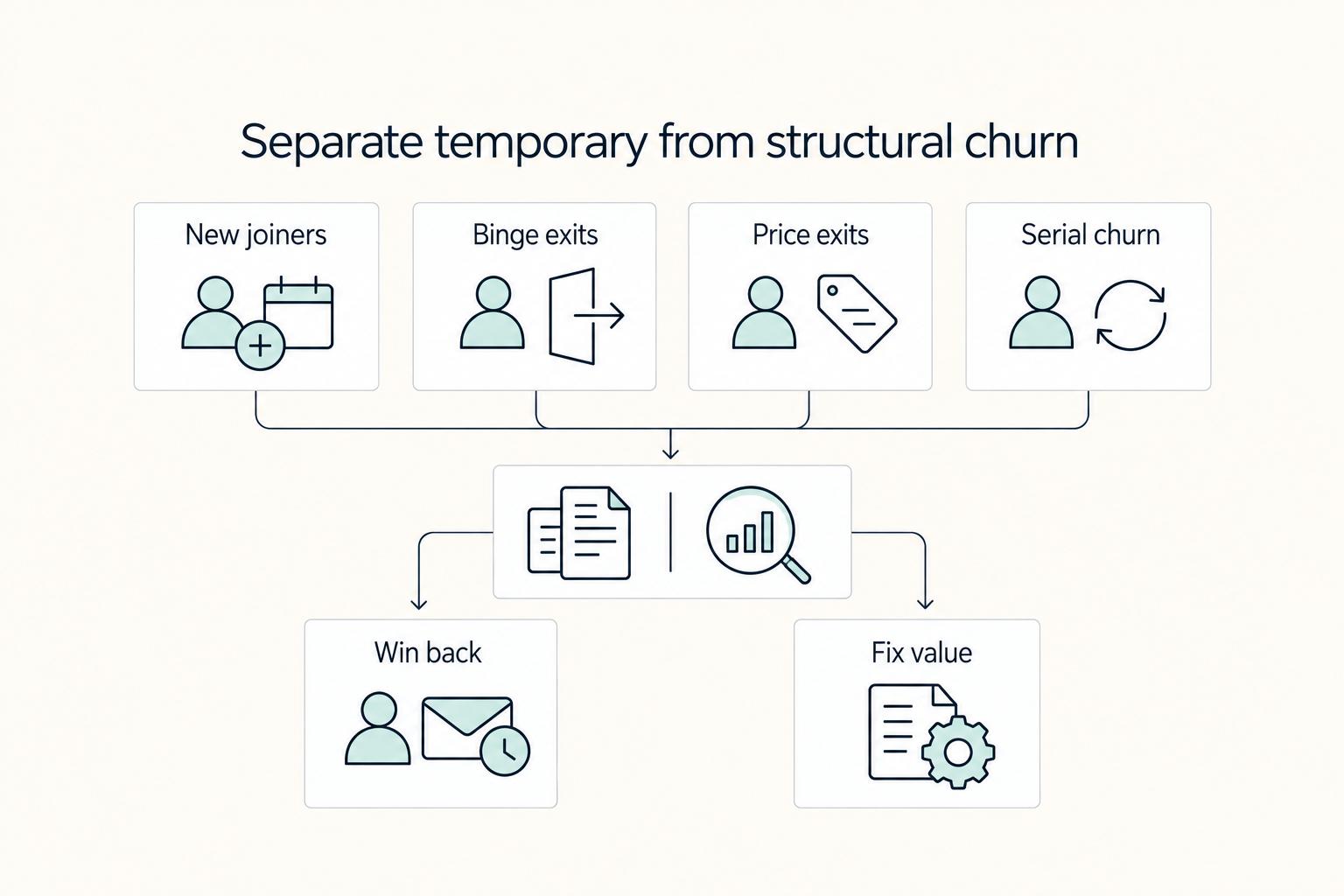
Separate temporary churn from structural churn cohorts#
Once the subscriber timeline is trustworthy, stop treating churn as one pool. If a cohort commonly returns, treat it as temporary churn and prioritize win-back. If repeated exits persist across offers or pricing changes, treat it as structural and fix the value issue underneath.
| Cohort | Needed evidence |
|---|---|
| New joiners | Tenure and first-renewal timing |
| Binge-completion exits | Completion and cancel timing |
| Price-sensitive exits | Renewal date, plan price, and recent fee-change or offer-expiry context |
| Serial churners | Prior cancel-and-return history, not a single cancellation flag |
Step 1. Cut cohorts by behavior, not demographics alone. Use four behavior-led groups: new joiners, binge-completion exits, price-sensitive exits, and serial churners. These cuts map to why cancellations happen, so they usually explain more than age or channel alone.
Make each cohort auditable from the event record. New joiners need tenure and first-renewal timing. Binge-completion exits need completion and cancel timing. Price-sensitive exits need renewal date, plan price, and recent fee-change or offer-expiry context. Serial churners need prior cancel-and-return history, not a single cancellation flag.
Step 2. Measure reactivation before labeling churn as structural. Gross churn can overstate loss when return behavior is strong. Antenna's September 2024 premium SVOD weighted average was 5.3% gross churn versus 3.1% net churn, which factors in resubscriptions, and Antenna defines resubscribers as users who rejoin within 12 months.
Use a practical rule: if return behavior is historically high, put win-back first. If repeat exits continue after offers, reminders, or plan options, treat that as structural churn and focus on product value, content cadence, or price-value fit.
Use platform comparisons as pattern prompts, not thresholds. Antenna reported September 2024 estimates of Netflix at 1.8% gross and 1.0% net, versus Peacock at 7.4% gross and 4.0% net.
Step 3. Isolate promotion-driven noise before calling a cohort unhealthy. Seasonal promotion windows can look like long-term decline if you do not separate them. Antenna estimated 8.3 million premium SVOD sign-ups on Black Friday 2024, up 31.7% from 2023, and those cohorts retained differently: 36% of Black Friday 2023 promo sign-ups were still subscribed at 12 months versus 31% for non-Black-Friday promotion cohorts.
Treat Prime Day as a confounder flag, not a causal conclusion. Amazon promoted streaming deals during July 8-11, 2025, so that window can shift acquisition and renewal behavior. Tag acquisition source, promo window, and offer type at signup, then read those cohorts separately before making long-term churn calls.
Apply the same lens to price-sensitive exits. Deloitte-reported research found 61% of respondents said they would cancel their favorite service after a $5 monthly increase, so cancellations clustered around renewal notices or price changes should be segmented before structural conclusions.
Step 4. Write a cohort evidence pack before moving budget. Document the same evidence for each cohort each month so decisions stay reproducible:
- cohort definition and lookback window (including a 12-month resubscriber rule if used)
- gross churn, net churn, reactivation rate, and repeat-exit rate after offers
- confounders such as Black Friday or Prime Day acquisition windows
- action taken and rationale: win-back, pricing test, content-timing change, or no spend
Choose retention levers by market reality not by trend#
Do not default to discounts once you separate price exits from binge-completion exits. Choose the lever that fits your plan economics, audience fit, and distribution options in the specific market you serve.
Step 1 Choose the lever that fits the exit pattern#
Start with the exit signal, then pick the intervention. For price-sensitive cohorts, test plan migration before changing headline price.
Fabric reports average U.S. pricing at USD 19.46 for ad-free versus USD 16.81 for ad-supported (a 14% gap). Antenna also reports that, among services offering both options, 46% of subscriptions are ad-supported and 71% of net additions over the last 9 quarters came from ad plans. That makes ad-supported migration a credible retention lever when cancellations cluster near renewal or fee changes.
Ad-free still matters when ad tolerance is low and margin room is tight. The tradeoff is practical: keep a higher-priced plan to protect plan revenue, or use ad-supported migration to reduce price pressure and keep more subscribers active.
| Lever | Best fit | What to verify first | Main tradeoff |
|---|---|---|---|
| Pricing change | Broad price objection across cohorts | Cancel timing vs renewal and fee-change dates | Can train users to wait for cheaper offers |
| Ad-supported migration | Price-sensitive users still showing content demand | Plan-level churn, take rate, and margin tolerance | Lower subscription price point; audience fit matters |
| Telecom or channel bundle | Reach or retention depends on distribution convenience | Partner availability, offer economics, and subscriber event visibility | Less direct control over the customer relationship |
| Content-window tactic | Binge-completion exits tied to flagship-title timing | Completion events and cancel timing around major releases | Usually helps temporary churn more than structural value issues |
Quick check: if users keep watching but resist price, test plan shift or bundle first. If usage drops after title completion, content-window timing is usually the more credible first lever.
Step 2 Screen market readiness before you copy a U.S. tactic#
Do not copy U.S. retention playbooks into EMEA without local checks. Fabric notes EMEA ad-free pricing averages USD 16.66 and is 17% cheaper, so pricing context is already different. Stripe also notes that Europe includes more than 40 countries, each with local payment methods.
If your retention path depends on downgrade or plan migration, verify country-level payment support, renewal flow behavior, and partner settlement before rollout. Your evidence pack should name the country, supported payment methods, planned partners, and the exact plan path you expect a subscriber to follow.
Step 3 Use partner strategy as a retention choice, not just a distribution choice#
Partner distribution can be a retention lever, not only an acquisition lever. AMC+ is available directly and through Prime Video Channels, Apple TV Channels, and The Roku Channel; Discovery+ can be added through Prime Video Channels; STARZ offers an Amazon Channel subscription; and MGM+ is positioned as a Prime Video add-on.
That does not mean channel availability or bundle value is uniform across distributors or countries. It means your retention decision should include a direct question: are subscribers more likely to stay in your standalone flow, or inside a partner's billing and discovery surface? Fabric reports that in the U.S., 43% of platforms maintain commercial partnerships, and 55% of those partnerships are with telecom operators. If standalone retention is weak and partner reach is credible, test bundle routes early; if direct-plan control is central, keep standalone first and use partners selectively.
Design win-back campaigns with clear trigger logic#
Design win-back as a trigger system, not a fixed "come back" calendar. Start from subscription status updates, then branch by churn reason, timing window, and prior churn history.
| Signal or cohort | First move | Note |
|---|---|---|
| Recurring payment fails | Route to payment recovery first | Many failed subscription and invoice payments are recoverable |
| Price exits | Lead with plan-shift or bundle options where viable | Match the offer to the churn reason |
| Content-completion exits | Time reactivation to a credible content moment | Match the offer to the churn reason |
| Serial churners | Use lower-cost first touches, then escalate incentive spend only after engagement intent is clear | Treat as a separate spend-governance cohort |
- Tie triggers to real exit signals before sending offers.
Use billing and behavior status as your first trigger groups. If recurring payment fails, route to payment recovery first, since many failed subscription and invoice payments are recoverable. Then use behavior signals for likely content-completion exits and trigger outreach only when cancel timing matches that pattern.
- Match the offer to the churn reason.
Price exits and content-completion exits should get different win-back prompts. For price pressure, lead with plan-shift or bundle options where viable. For completion-driven exits, time reactivation to a credible content moment. Return drivers can differ, including new-season demand and discounted offers, so reason-to-offer mapping matters.
- Treat serial churners as a separate spend-governance cohort.
Antenna defines Serial Churners as people who canceled three or more Premium SVOD services in the past two years, and nearly one in four U.S. streaming consumers fit that profile at the end of 2023. Use lower-cost first touches, then escalate incentive spend only after engagement intent is clear.
- Measure incrementality and post-return quality, not just reactivation volume.
Use holdout design so you can compare treated users against users held back from exposure and estimate true lift. Track results at explicit checkpoints such as Month 3 and Month 12. Then validate return quality with early payment and engagement outcomes so short-term wins do not hide repeat-cancel loops. For billing-side context, keep this companion guide on OTT subscription billing and churn nearby.
Avoid the common analysis mistakes that waste budget#
Retention analysis fails when the benchmark scope is mismatched or the churn signal is not fully traceable. Most wasted spend comes from copying headline numbers, skipping normalization, and reacting to pipeline noise as if it were behavior.
- Normalize scope before comparing yourself to Netflix, Prime Video, or Disney+.
A scope-normalized benchmark matters more than a brand-name comparator. Antenna's Premium SVOD view is US-only and excludes Free Tiers, MVPD + Telco Distribution, and select Bundles, so a blended OTT churn number is not comparable unless your exclusions match. Also account for maturity: Premium SVOD churn is lower partly because of large bases of long-term subscribers, especially Netflix users.
- Keep U.S. snapshots in the U.S. lane when planning EMEA.
A figure like 339 million U.S. streaming video subscriptions by end of Q2'25 is context, not an EMEA rollout baseline. Payment behavior varies by country, and the shift away from cash is not happening at the same pace everywhere. For country planning, separate what is locally validated from what is imported from U.S. data.
- Separate temporary churn from structural churn before assigning spend.
Treating all cancels as permanent loss distorts retention decisions. Antenna reports 25% of cancelers resubscribe within three months, so short-cycle reactivators should not be managed the same way as repeat price exits or other persistent churn patterns. A blended plan often over-discounts likely returners while under-fixing durable churn drivers.
- Verify data lineage before launching tactics.
Confirm an end-to-end audit trail from clickstream JSON through transformed tables to subscription logs and campaign audiences. For a sampled subscriber path, reconcile event timestamp, identity stitch, cancellation record, and segment assignment. If joins are failing, events are delayed, or billing/support signals are missing, treat the spike as unverified until lineage is clean.
Execute a 30-60-90 day operator sequence#
Use a phased 30-60-90 rhythm to scale only what shows cohort-level lift, reliable measurement, and acceptable economics.
| Window | Focus | Key actions |
|---|---|---|
| First 30 days | Lock the baseline | Align definitions, segment users by join cohort, and validate data lineage on sampled subscribers |
| Days 31-60 | Run controlled tests | Use holdout control groups for ad-supported plan shifts, telecom bundle experiments, and win-back campaigns; measure return quality |
| Days 61-90 | Promote only what holds up | Compare outcomes by cohort, keep interventions that beat holdout and stay within unit-economics tolerance, and retire low-signal tactics quickly |
| Monthly | Ship an evidence pack and add an expansion gate | Package assumptions, tested levers, tradeoffs, unresolved unknowns, and the next decision gate; run payment-readiness and partner-feasibility checks before scaling |
- First 30 days: lock the baseline.
Align definitions before launching offers: churn, reactivation, serial churners, plan type, and cancellation pathway. Segment users by join cohort, then identify where they churn in the lifecycle. Validate data lineage on sampled subscribers so plan ID, cancellation timestamp, and pathway reconcile across subscription logs, clickstream JSON, and status updates. If plan mapping or cancellation reasons are unstable, pause testing.
- Days 31-60: run controlled tests.
Use holdout control groups for each offer so you measure lift against a withheld audience, not raw response. Apply this to ad-supported plan shifts, telecom bundle experiments, and win-back campaigns. Keep ad-tier decisions cohort-specific: Antenna measured 11.2M ad-supported sign-ups in November 2023 (51% of Premium SVOD sign-ups), but ad-free demand remains meaningful. For win-back, measure return quality, not just return volume, especially since 25% of cancelers resubscribe within three months.
- Days 61-90: promote only what holds up.
Compare outcomes by cohort, not a blended average. Keep interventions that beat holdout and stay within your unit-economics tolerance. Retire low-signal tactics quickly, including offers that pull users back without durable retention.
- Monthly: ship an evidence pack and add an expansion gate.
Package assumptions, tested levers, observed tradeoffs, unresolved unknowns, and the next decision gate. Before scaling into a new country, run a payment-readiness and partner-feasibility check. Payment behavior varies by market; even within Europe, adoption differs (for example, the Netherlands reports 78% non-cash point-of-sale payments). If local payment constraints and partner feasibility are not clear, do not port the same retention design unchanged.
Conclusion and copy paste checklist#
The decision is simpler than the tooling makes it look: diagnose the churn type first, then choose the lever. Do not default to blanket discounts before diagnosis. First prove whether the exits are temporary, structural, or just a data-quality artifact, then test the smallest intervention that matches the cohort.
- Step 1: Define the shared glossary.
Put churn, serial churners, reactivation, gross churn, and net churn in one document that Product, Finance, and Lifecycle all use. For subscription products, decide whether churn means immediate cancellation or a time-based state after subscription end, because some subscription guidance uses time-based churn definitions. Verify: every dashboard uses the same denominator, lookback window, and reactivation rule.
- Step 2: Validate the source data before you diagnose behavior.
Reconcile subscription logs, event-log activity data, and subscription status updates into one subscriber timeline. If subscription history is missing explicit lifecycle fields such as Subscription ID or Transaction Date, fix that first instead of explaining a churn spike with marketing or content theory. Verify: missing-event rate, late-event rate, and join failure rate are reviewed before each churn readout. A grounded minimum for prediction work is at least 1,000 customer profiles in the prediction window, with preferably two to three years of subscription data.
- Step 3: Segment temporary and structural churn separately.
Keep binge-completion exits, price-sensitive exits, and serial churners in different cohorts even if their cancel date lands in the same month. Assign one primary intervention per cohort so you can tell whether a plan shift, bundle, or win-back message changed the outcome. Red flag: if first-time cancelers and repeat cancel-return users sit in the same audience, incentive spend can get wasted.
- Step 4: Test pricing, bundle, and win-back options with holdouts.
Measure exposed users against a non-exposed control group, not just before-and-after movement. That treatment-versus-control split is what tells you whether the offer created incremental retention or simply captured people who were already likely to return. Failure mode: a campaign can look strong on reactivations and still be weak if those users cancel again in the next billing cycle.
- Step 5: Separate U.S. streaming market assumptions from EMEA decisions.
Some commonly cited tracking is explicitly scoped to the U.S. and Canada, and one survey base often referenced is 8,000 internet households. That is useful context, but it is not a transfer rule for EMEA. If X, do Y: if the tactic depends on local payment behavior or partner distribution, validate those country by country before rollout.
- Step 6: Ship one monthly evidence pack.
Include the definitions used, cohorts reviewed, tests launched, treatment versus control results, tradeoffs accepted, unresolved unknowns, and the next checkpoint. Keep it short, but make it audit-ready. Expected outcome: decisions can stop drifting into opinion, and your retention work becomes more repeatable instead of reactive.
This pairs well with our guide on How to Use a Community to Reduce Churn and Increase LTV.
Or,
Frequently Asked Questions
What is OTT churn analysis and how is it different from basic subscriber reporting?
OTT churn analysis explains why subscribers leave, when they leave, and which cohorts return. It goes beyond opening subs, cancels, and ending subs by tracking resubscribers, net churn, plan pathway, and behavior patterns.
Why can churn rise even when total subscribers on platforms like Netflix or Disney+ still grow?
Because new subscriber adds can still exceed cancellations for a period. Gross churn and net churn can also diverge when returning subscribers are counted, so total subscriber growth can hide rising retention pressure.
Which signal should operators trust first when churn rises fast: pricing stress, content completion, or engagement decline?
Do not assume pricing, content completion, or engagement is the first cause. First reconcile subscription records and activity data so a data-quality problem is not mistaken for behavior, then test those signals against the cleaned baseline.
How should teams treat serial churners differently from first-time cancelers?
Treat serial churners as a separate spend-governance cohort because repeated cancel-return loops can weaken economics. Start with lower-cost first touches and escalate incentive spend only after engagement intent is clear, while first-time cancelers should be diagnosed by reason and lifecycle stage.
When should a team prioritize win-back campaigns instead of changing core pricing?
Prioritize win-back when cohort history shows temporary exits and meaningful resubscription rather than persistent rejection of product value. Net churn is the key checkpoint, and if returners cancel again quickly, reassess pricing, content timing, or plan fit.
Are U.S. streaming market churn patterns reliable for planning in EMEA?
Not directly. Use U.S. churn data as directional context, then validate country-level payment behavior, partner options, and local-market evidence before applying the same tactic in EMEA.
What minimum data is required before deploying real-time churn prediction models?
Start with at least 1,000 customer profiles within the prediction window and at least two activity records for 50% of customers. Before training, confirm those profiles and activity records are consistently linked on one subscriber timeline so the model learns behavior rather than data gaps.
Try a related tool
Researched and edited by the Gruv editorial team. Gruv builds cross-border billing, payouts, and finance-operations software for global businesses.
Sources
Includes 7 external sources outside the trusted-domain allowlist.
- data.europa.eu/en/publications/datastories/shift-digital-pa...trusted
- antenna.live/insights/antennas-2024-top-subscription-insi...external
- antenna.live/insights/resubscription-is-on-the-riseexternal
- arxiv.org/html/2309.14390external
- broadbandtvnews.com/2025/08/20/us-streaming-platforms-shift-focu...external
- cdn.prod.website-files.com/6756b521db09e280168a4cf3/67bdc1527f0c1577a2f...external
- churnkey.co/blog/churn-rates-for-streaming-servicesexternal
- deloitte.com/us/en/insights/industry/technology/digital-m...external
Educational content only. Not legal, tax, or financial advice.
Related Posts
How OTT Platforms Handle Billing Trials and Churn in Streaming Subscriptions
Start with the monetization model. Choose your monetization path before a product demo starts steering the decision. For a streaming offer, the real question is not which vendor can show subscriptions on a checkout page. It is whether your business is built around recurring access, ad-supported reach, one-off transactions, or a direct-to-consumer mix that may vary by market.
Why Freelancers Leave Platforms and How to Fix Contractor Churn
Contractor churn is not just another retention metric. On a freelancer platform, it is a business model decision because every dropout can affect activity volume, support cost, and the quality of the growth you keep.
What Is Know Your Artist (KYA)? How Music Platforms Stop Streaming Fraud Before It Starts
So this piece stays practical. You will see where basic identity checks end, where KYA adds real value, and where enhanced review is worth the extra operational load. You will also see a failure mode many teams miss: collecting signals without a clear action path. A flag that does not route to a defined approve, hold, or reject decision is not much of a control.